OPTOM MUHAMMED FASAL
Value literally means something that has a price, something
precious, dear and worthwhile.
It is defined as a belief upon which man acts by preference.
By a close examination of different sources of the meaning of
values, we may say
i) Values are general standards and higher order norms.
ii) Value is a belief that something is good and worthwhile.
iii) Value is a measure of goodness or desirability.
iv) Values are socially defined and accepted desires and
goods that are internalized through the process of learning,
socialization and conditioning
 i) Good values are the spontaneous manifestation
of a sound character and values form the central
pole around which our actions, desires and
ambitions are organized.
 ii) Values guide our behaviour and give meaning to
our existence.
 iii) Values assist us to take right decisions and
make choices.
 iv) Values give direction and firmness to life and
help us to be morally sound.
 v) Values set goals for achievements and they
motivate, define and colour all our activities in
cognitive, affective and conative domains.
 i) Choosing from alternatives.
 ii) Choosing after thoughtful consideration
of consequences.
 iii) Choosing freely.
 iv) Prizing and cherishing.
 v) Publicly affirming and appropriate
sharing.
 vi) Acting upon and
 vii) Acting upon with some consistent
pattern and repetition.
 The goal of the value clarification approach
(Simon1972) is to help people use these seven
processes of valuing in their own lives by applying these
valuing sub-processes to already formed beliefs and
behaviour patterns and to those still emerging.
 Religion, education, social and national traditions and
structure are pillars of certain values.
 The human conscience is also a source of value
awareness. When true values are inculcated among our
students they help them to take a voyage in the stormy
sea of life.
i) Constitutional and National values
ii) Social Values
iii) Professional Values
iv) Religious and Moral Values
v) Aesthetic Values
Vi)Environmental ethical values
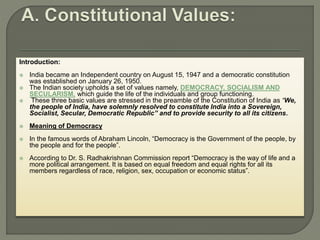
Introduction:
 India became an Independent country on August 15, 1947 and a democratic constitution
was established on January 26, 1950.
 The Indian society upholds a set of values namely, DEMOCRACY, SOCIALISM AND
SECULARISM, which guide the life of the individuals and group functioning.
 These three basic values are stressed in the preamble of the Constitution of India as “We,
the people of India, have solemnly resolved to constitute India into a Sovereign,
Socialist, Secular, Democratic Republic” and to provide security to all its citizens.
 Meaning of Democracy
 In the famous words of Abraham Lincoln, “Democracy is the Government of the people, by
the people and for the people”.
 According to Dr. S. Radhakrishnan Commission report “Democracy is the way of life and a
more political arrangement. It is based on equal freedom and equal rights for all its
members regardless of race, religion, sex, occupation or economic status”.
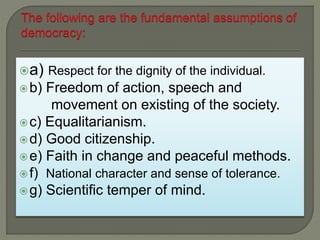
a) Respect for the dignity of the individual.
b) Freedom of action, speech and
movement on existing of the society.
c) Equalitarianism.
d) Good citizenship.
e) Faith in change and peaceful methods.
f) National character and sense of tolerance.
g) Scientific temper of mind.
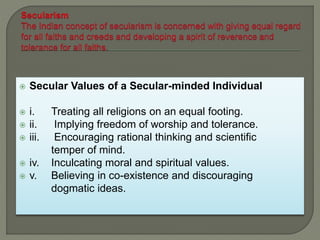
 Secular Values of a Secular-minded Individual
 i. Treating all religions on an equal footing.
 ii. Implying freedom of worship and tolerance.
 iii. Encouraging rational thinking and scientific
temper of mind.
 iv. Inculcating moral and spiritual values.
 v. Believing in co-existence and discouraging
dogmatic ideas.
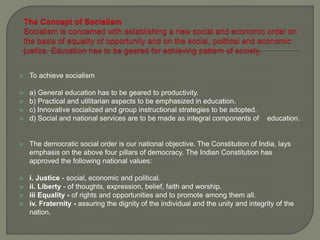
 To achieve socialism
 a) General education has to be geared to productivity.
 b) Practical and utilitarian aspects to be emphasized in education.
 c) Innovative socialized and group instructional strategies to be adopted.
 d) Social and national services are to be made as integral components of education.
 The democratic social order is our national objective. The Constitution of India, lays
emphasis on the above four pillars of democracy. The Indian Constitution has
approved the following national values:
 i. Justice - social, economic and political.
 ii. Liberty - of thoughts, expression, belief, faith and worship.
 iii Equality - of rights and opportunities and to promote among them all.
 iv. Fraternity - assuring the dignity of the individual and the unity and integrity of the
nation.
 i. Justice:
 The justice is built upon affirmative and collective relations and dependent on collective
interests of individual groups and society. It includes social justice, economic justice and
political justice.
 ii. Liberty:
 Each citizen has the right to freedom of speech. But it should not harm and ignore the
national, social and even the personal interest of others. It should not jeopardize the
national unity and social amity. Liberty is essential for individual progress and progress of
society.
 iii. Equality:
 It is necessary to achieve the ends in liberty. It is one of the important social objectives of
democracy.
 iv. Fraternity:
 For the glory of the individual and society, both the unity of the nation and the dignity of the
individual is of vital importance. The feeling of compassion, love among human beings and
the feeling of friendship are necessary for fraternity with a national feeling.
 National Integration:
 In India we have multi-cultural, multi-lingual, and multi-traditional groups. Our
constitution emphasizes the concept of unity in diversity and expects every citizen of
India to honour the feeling of national and emotional integration.
 Respect for all religions:
 India is a country of plural religions. The feeling of hatred towards religion may
hamper the unity of democratic India. Each Individual is free to follow his own faith
and principles of religion. Each individual has to respect other religions.
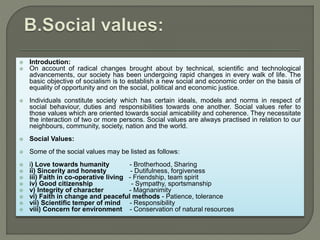
 Introduction:
 On account of radical changes brought about by technical, scientific and technological
advancements, our society has been undergoing rapid changes in every walk of life. The
basic objective of socialism is to establish a new social and economic order on the basis of
equality of opportunity and on the social, political and economic justice.
 Individuals constitute society which has certain ideals, models and norms in respect of
social behaviour, duties and responsibilities towards one another. Social values refer to
those values which are oriented towards social amicability and coherence. They necessitate
the interaction of two or more persons. Social values are always practised in relation to our
neighbours, community, society, nation and the world.
 Social Values:
 Some of the social values may be listed as follows:
 i) Love towards humanity - Brotherhood, Sharing
 ii) Sincerity and honesty - Dutifulness, forgiveness
 iii) Faith in co-operative living - Friendship, team spirit
 iv) Good citizenship - Sympathy, sportsmanship
 v) Integrity of character - Magnanimity
 vi) Faith in change and peaceful methods - Patience, tolerance
 vii) Scientific temper of mind - Responsibility
 viii) Concern for environment - Conservation of natural resources
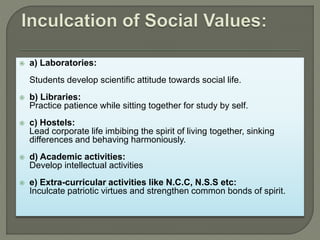
 a) Laboratories:
Students develop scientific attitude towards social life.
 b) Libraries:
Practice patience while sitting together for study by self.
 c) Hostels:
Lead corporate life imbibing the spirit of living together, sinking
differences and behaving harmoniously.
 d) Academic activities:
Develop intellectual activities
 e) Extra-curricular activities like N.C.C, N.S.S etc:
Inculcate patriotic virtues and strengthen common bonds of spirit.
Many professions are in existence and each profession has
got its own independent values. Irrespective of the specific
nature of profession, the following are the common values of
all the professions:
1. • Knowledge thrust
2. • Commitment
3. • Sincerity and honesty
4. • Resourcefulness
5. • Competence
6. • Responsibility
7. • Self-discipline
8. • Regularity and Punctuality
9. • Integrity
10. • Spirit of enquiry
11. • Confidentiality
12. • Self-study
13. • Sense of social responsibility
14. • Accountability
15. • Dutifulness
16. • Service
A few of the professional values may be explained as follows.
 Accountability : is related to responsibility. It is an indicator for measuring
the depth of one’s responsibility. Accountability is concerned with
discharging an assigned duty carefully, sincerely and diligently.
 Dutifulness : is concerned with the fulfillment of obligations and tasks. It is
a commitment to complete one’s work for the society, obeying rules and
regulations.
 Regularity and punctuality : win the respect of others. We become
dishonest and unreliable when we fail to practice regularity and punctuality
in our life.
 Honesty means truthfulness It is concerned with accepting one’s
potentialities and limitations and admitting the truth on all occasions.
Honesty demands upright thinking and brings respectability.
 Rabindranath Tagore observes, “A teacher can never truly teach, unless he
is still learning himself. A lamp can never right another lamp unless it
continues to burn its own flame”. Hence to be competent in any profesion
one has to develop knowledge thirst to keep in pace with the emerging
trends, specifically in his field of specialization.
 Introduction:
 Religion is based on certain moral principles. The core of all religions is the welfare of
human beings. It is a way of life and binds human beings. Due to difference in land,
climate, culture and language, many ways of worship came into existence. All
religions emphasize a sense of brotherhood, sisterhood and love.
 Religious Values:
The following common values of life are recommended by all the religions of the
world.
• Tolerance
• Broad mindedness
• Simplicity
• Welfare of mankind
• Pursuit of truth
• Holy life
• Simple living
• Purity
• Honesty
• Prayer
Respecting the place of worship and tolerance for other religions are to be treated as supreme
values of human beings. Participating enthusiastically in the celebrations of other religious
festivals, and respecting literature of other religions have to be developed
Introduction:
Moral Values are the standards of good or evil or principles of right or wrong or
desirable or undesirable which govern an individual’s behaviour or choices.
Moral Values:
Moral values are acquired as a part of cultural evolution. Individual’s morals are
derived from society and government. In due course the moral values may change as
laws. When society moves into the modern era the earlier system of laws may vanish.
Faith, loyalty, nonviolence, obedience, purity, truthfulness are examples of moral
values.
Inculcation of Moral Values:
i) Parenting
ii) Peer guidance
iii) Conscience
iv) Disapproval
v) Shunning
vi) Enforcing laws
Another source of moral values is the religion. Each religion has an in-built list of do’s
and don’ts. They prescribe a set of codes and principles which have a great impact on
the behaviour of followers.
Introduction:
Aesthetic values are values concerned with beauty or
the appreciation of beauty. They provide pleasure and
happy to the individual and are composed of feelings
of heart and mind.
Enjoying or appreciation of music, literature, painting,
drawing, sculpture, natural scenes, paper work,
modeling, etc. belong to this category of values.
Particularly, children possess aesthetic impulses and
express their impulses through paintings, music,
modeling, etc. from their infancy.
One can enjoy beauty in science as well as in poetry,
sculpture and painting. Aesthetic value is concerned
with questions of beauty and artistic taste.
i) By providing opportunities for extra-
curricular activities and histrionic talents
like music, drama, dance, recitation and
other cultural activities.
ii) Exposing students to the work of artistic
beauty.
iii) Role of mass media.
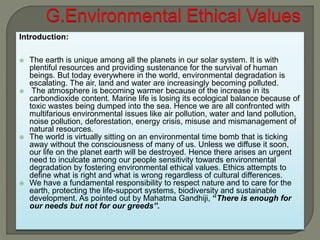
Introduction:
 The earth is unique among all the planets in our solar system. It is with
plentiful resources and providing sustenance for the survival of human
beings. But today everywhere in the world, environmental degradation is
escalating. The air, land and water are increasingly becoming polluted.
 The atmosphere is becoming warmer because of the increase in its
carbondioxide content. Marine life is losing its ecological balance because of
toxic wastes being dumped into the sea. Hence we are all confronted with
multifarious environmental issues like air pollution, water and land pollution,
noise pollution, deforestation, energy crisis, misuse and mismanagement of
natural resources.
 The world is virtually sitting on an environmental time bomb that is ticking
away without the consciousness of many of us. Unless we diffuse it soon,
our life on the planet earth will be destroyed. Hence there arises an urgent
need to inculcate among our people sensitivity towards environmental
degradation by fostering environmental ethical values. Ethics attempts to
define what is right and what is wrong regardless of cultural differences.
 We have a fundamental responsibility to respect nature and to care for the
earth, protecting the life-support systems, biodiversity and sustainable
development. As pointed out by Mahatma Gandhiji, “There is enough for
our needs but not for our greeds”.
The following are a set of environmental ethical
values to be inculcated.
• Environmental consciousness.
• Humility and reverence.
• Responsibility and commitment.
• Respect for all life and landscape.
• Global environmental citizenship.
• Self-reliance.
• Adoption of eco-friendly culture.
• Preservation of diversity on the planet.
• Sharing common environment.
 “Try not to be a man of success but rather try
to be a man of value”. - Albert Einstein.
• Using recycled paper for notes and circulars.
• Diverting waste from the kitchen to the garden.
• Switching off unnecessary lights.
• Using bicycles or walking.
• Using public transport systems.
• Collecting rain water.
• Avoiding using fresh water for gardening.
• Using cloth towels instead of paper towels.
• Avoiding unnecessary outdoors lighting.
• Organizing tree-plantation campaigns.
• Reducing volume of Radio/TV to reasonable levels.
• Listening to radio programmes on environment and its allied problems.
• Organizing eco-clubs.
• Placing trashcans and dustbins around the college premises.
• Observing Environment Day on 5th June and Earth Day on 22nd April.
• Planting trees in and around the campus.
• Encouraging healthy life styles through balanced nutrition, exercise and Yoga.
• Helping to enforce protection laws.
• Staging short plays on environmental crisis to create environmental awareness.
• Conserving energy resources by avoiding unnecessary wastage of energy.
• Collecting and displaying pictures and newspaper cuttings depicting the environmental crisis.
Thank you

Introduction values

  • 1.
  • 2.
    Value literally meanssomething that has a price, something precious, dear and worthwhile. It is defined as a belief upon which man acts by preference. By a close examination of different sources of the meaning of values, we may say i) Values are general standards and higher order norms. ii) Value is a belief that something is good and worthwhile. iii) Value is a measure of goodness or desirability. iv) Values are socially defined and accepted desires and goods that are internalized through the process of learning, socialization and conditioning
  • 3.
     i) Goodvalues are the spontaneous manifestation of a sound character and values form the central pole around which our actions, desires and ambitions are organized.  ii) Values guide our behaviour and give meaning to our existence.  iii) Values assist us to take right decisions and make choices.  iv) Values give direction and firmness to life and help us to be morally sound.  v) Values set goals for achievements and they motivate, define and colour all our activities in cognitive, affective and conative domains.
  • 4.
     i) Choosingfrom alternatives.  ii) Choosing after thoughtful consideration of consequences.  iii) Choosing freely.  iv) Prizing and cherishing.  v) Publicly affirming and appropriate sharing.  vi) Acting upon and  vii) Acting upon with some consistent pattern and repetition.
  • 5.
     The goalof the value clarification approach (Simon1972) is to help people use these seven processes of valuing in their own lives by applying these valuing sub-processes to already formed beliefs and behaviour patterns and to those still emerging.  Religion, education, social and national traditions and structure are pillars of certain values.  The human conscience is also a source of value awareness. When true values are inculcated among our students they help them to take a voyage in the stormy sea of life.
  • 6.
    i) Constitutional andNational values ii) Social Values iii) Professional Values iv) Religious and Moral Values v) Aesthetic Values Vi)Environmental ethical values
  • 7.
    Introduction:  India becamean Independent country on August 15, 1947 and a democratic constitution was established on January 26, 1950.  The Indian society upholds a set of values namely, DEMOCRACY, SOCIALISM AND SECULARISM, which guide the life of the individuals and group functioning.  These three basic values are stressed in the preamble of the Constitution of India as “We, the people of India, have solemnly resolved to constitute India into a Sovereign, Socialist, Secular, Democratic Republic” and to provide security to all its citizens.  Meaning of Democracy  In the famous words of Abraham Lincoln, “Democracy is the Government of the people, by the people and for the people”.  According to Dr. S. Radhakrishnan Commission report “Democracy is the way of life and a more political arrangement. It is based on equal freedom and equal rights for all its members regardless of race, religion, sex, occupation or economic status”.
  • 8.
    a) Respect forthe dignity of the individual. b) Freedom of action, speech and movement on existing of the society. c) Equalitarianism. d) Good citizenship. e) Faith in change and peaceful methods. f) National character and sense of tolerance. g) Scientific temper of mind.
  • 9.
     Secular Valuesof a Secular-minded Individual  i. Treating all religions on an equal footing.  ii. Implying freedom of worship and tolerance.  iii. Encouraging rational thinking and scientific temper of mind.  iv. Inculcating moral and spiritual values.  v. Believing in co-existence and discouraging dogmatic ideas.
  • 10.
     To achievesocialism  a) General education has to be geared to productivity.  b) Practical and utilitarian aspects to be emphasized in education.  c) Innovative socialized and group instructional strategies to be adopted.  d) Social and national services are to be made as integral components of education.  The democratic social order is our national objective. The Constitution of India, lays emphasis on the above four pillars of democracy. The Indian Constitution has approved the following national values:  i. Justice - social, economic and political.  ii. Liberty - of thoughts, expression, belief, faith and worship.  iii Equality - of rights and opportunities and to promote among them all.  iv. Fraternity - assuring the dignity of the individual and the unity and integrity of the nation.
  • 11.
     i. Justice: The justice is built upon affirmative and collective relations and dependent on collective interests of individual groups and society. It includes social justice, economic justice and political justice.  ii. Liberty:  Each citizen has the right to freedom of speech. But it should not harm and ignore the national, social and even the personal interest of others. It should not jeopardize the national unity and social amity. Liberty is essential for individual progress and progress of society.  iii. Equality:  It is necessary to achieve the ends in liberty. It is one of the important social objectives of democracy.  iv. Fraternity:  For the glory of the individual and society, both the unity of the nation and the dignity of the individual is of vital importance. The feeling of compassion, love among human beings and the feeling of friendship are necessary for fraternity with a national feeling.  National Integration:  In India we have multi-cultural, multi-lingual, and multi-traditional groups. Our constitution emphasizes the concept of unity in diversity and expects every citizen of India to honour the feeling of national and emotional integration.  Respect for all religions:  India is a country of plural religions. The feeling of hatred towards religion may hamper the unity of democratic India. Each Individual is free to follow his own faith and principles of religion. Each individual has to respect other religions.
  • 12.
     Introduction:  Onaccount of radical changes brought about by technical, scientific and technological advancements, our society has been undergoing rapid changes in every walk of life. The basic objective of socialism is to establish a new social and economic order on the basis of equality of opportunity and on the social, political and economic justice.  Individuals constitute society which has certain ideals, models and norms in respect of social behaviour, duties and responsibilities towards one another. Social values refer to those values which are oriented towards social amicability and coherence. They necessitate the interaction of two or more persons. Social values are always practised in relation to our neighbours, community, society, nation and the world.  Social Values:  Some of the social values may be listed as follows:  i) Love towards humanity - Brotherhood, Sharing  ii) Sincerity and honesty - Dutifulness, forgiveness  iii) Faith in co-operative living - Friendship, team spirit  iv) Good citizenship - Sympathy, sportsmanship  v) Integrity of character - Magnanimity  vi) Faith in change and peaceful methods - Patience, tolerance  vii) Scientific temper of mind - Responsibility  viii) Concern for environment - Conservation of natural resources
  • 13.
     a) Laboratories: Studentsdevelop scientific attitude towards social life.  b) Libraries: Practice patience while sitting together for study by self.  c) Hostels: Lead corporate life imbibing the spirit of living together, sinking differences and behaving harmoniously.  d) Academic activities: Develop intellectual activities  e) Extra-curricular activities like N.C.C, N.S.S etc: Inculcate patriotic virtues and strengthen common bonds of spirit.
  • 14.
    Many professions arein existence and each profession has got its own independent values. Irrespective of the specific nature of profession, the following are the common values of all the professions: 1. • Knowledge thrust 2. • Commitment 3. • Sincerity and honesty 4. • Resourcefulness 5. • Competence 6. • Responsibility 7. • Self-discipline 8. • Regularity and Punctuality 9. • Integrity 10. • Spirit of enquiry 11. • Confidentiality 12. • Self-study 13. • Sense of social responsibility 14. • Accountability 15. • Dutifulness 16. • Service
  • 15.
    A few ofthe professional values may be explained as follows.  Accountability : is related to responsibility. It is an indicator for measuring the depth of one’s responsibility. Accountability is concerned with discharging an assigned duty carefully, sincerely and diligently.  Dutifulness : is concerned with the fulfillment of obligations and tasks. It is a commitment to complete one’s work for the society, obeying rules and regulations.  Regularity and punctuality : win the respect of others. We become dishonest and unreliable when we fail to practice regularity and punctuality in our life.  Honesty means truthfulness It is concerned with accepting one’s potentialities and limitations and admitting the truth on all occasions. Honesty demands upright thinking and brings respectability.  Rabindranath Tagore observes, “A teacher can never truly teach, unless he is still learning himself. A lamp can never right another lamp unless it continues to burn its own flame”. Hence to be competent in any profesion one has to develop knowledge thirst to keep in pace with the emerging trends, specifically in his field of specialization.
  • 16.
     Introduction:  Religionis based on certain moral principles. The core of all religions is the welfare of human beings. It is a way of life and binds human beings. Due to difference in land, climate, culture and language, many ways of worship came into existence. All religions emphasize a sense of brotherhood, sisterhood and love.  Religious Values: The following common values of life are recommended by all the religions of the world. • Tolerance • Broad mindedness • Simplicity • Welfare of mankind • Pursuit of truth • Holy life • Simple living • Purity • Honesty • Prayer Respecting the place of worship and tolerance for other religions are to be treated as supreme values of human beings. Participating enthusiastically in the celebrations of other religious festivals, and respecting literature of other religions have to be developed
  • 17.
    Introduction: Moral Values arethe standards of good or evil or principles of right or wrong or desirable or undesirable which govern an individual’s behaviour or choices. Moral Values: Moral values are acquired as a part of cultural evolution. Individual’s morals are derived from society and government. In due course the moral values may change as laws. When society moves into the modern era the earlier system of laws may vanish. Faith, loyalty, nonviolence, obedience, purity, truthfulness are examples of moral values. Inculcation of Moral Values: i) Parenting ii) Peer guidance iii) Conscience iv) Disapproval v) Shunning vi) Enforcing laws Another source of moral values is the religion. Each religion has an in-built list of do’s and don’ts. They prescribe a set of codes and principles which have a great impact on the behaviour of followers.
  • 18.
    Introduction: Aesthetic values arevalues concerned with beauty or the appreciation of beauty. They provide pleasure and happy to the individual and are composed of feelings of heart and mind. Enjoying or appreciation of music, literature, painting, drawing, sculpture, natural scenes, paper work, modeling, etc. belong to this category of values. Particularly, children possess aesthetic impulses and express their impulses through paintings, music, modeling, etc. from their infancy. One can enjoy beauty in science as well as in poetry, sculpture and painting. Aesthetic value is concerned with questions of beauty and artistic taste.
  • 19.
    i) By providingopportunities for extra- curricular activities and histrionic talents like music, drama, dance, recitation and other cultural activities. ii) Exposing students to the work of artistic beauty. iii) Role of mass media.
  • 20.
    Introduction:  The earthis unique among all the planets in our solar system. It is with plentiful resources and providing sustenance for the survival of human beings. But today everywhere in the world, environmental degradation is escalating. The air, land and water are increasingly becoming polluted.  The atmosphere is becoming warmer because of the increase in its carbondioxide content. Marine life is losing its ecological balance because of toxic wastes being dumped into the sea. Hence we are all confronted with multifarious environmental issues like air pollution, water and land pollution, noise pollution, deforestation, energy crisis, misuse and mismanagement of natural resources.  The world is virtually sitting on an environmental time bomb that is ticking away without the consciousness of many of us. Unless we diffuse it soon, our life on the planet earth will be destroyed. Hence there arises an urgent need to inculcate among our people sensitivity towards environmental degradation by fostering environmental ethical values. Ethics attempts to define what is right and what is wrong regardless of cultural differences.  We have a fundamental responsibility to respect nature and to care for the earth, protecting the life-support systems, biodiversity and sustainable development. As pointed out by Mahatma Gandhiji, “There is enough for our needs but not for our greeds”.
  • 21.
    The following area set of environmental ethical values to be inculcated. • Environmental consciousness. • Humility and reverence. • Responsibility and commitment. • Respect for all life and landscape. • Global environmental citizenship. • Self-reliance. • Adoption of eco-friendly culture. • Preservation of diversity on the planet. • Sharing common environment.  “Try not to be a man of success but rather try to be a man of value”. - Albert Einstein.
  • 22.
    • Using recycledpaper for notes and circulars. • Diverting waste from the kitchen to the garden. • Switching off unnecessary lights. • Using bicycles or walking. • Using public transport systems. • Collecting rain water. • Avoiding using fresh water for gardening. • Using cloth towels instead of paper towels. • Avoiding unnecessary outdoors lighting. • Organizing tree-plantation campaigns. • Reducing volume of Radio/TV to reasonable levels. • Listening to radio programmes on environment and its allied problems. • Organizing eco-clubs. • Placing trashcans and dustbins around the college premises. • Observing Environment Day on 5th June and Earth Day on 22nd April. • Planting trees in and around the campus. • Encouraging healthy life styles through balanced nutrition, exercise and Yoga. • Helping to enforce protection laws. • Staging short plays on environmental crisis to create environmental awareness. • Conserving energy resources by avoiding unnecessary wastage of energy. • Collecting and displaying pictures and newspaper cuttings depicting the environmental crisis.
  • 23.