
Disrtibuted
Leadership
Hello!
I am
SEFAT UL ALOM,
Undergraduate student,
Institute of Education and Research,
University of Rajshahi.
Let’s start with leadership
“
“Academic analysis has given us more than 850
definitions of leadership”
Warren Bennis in “Leaders”
“Leadership is translating vision into reality”
Leadership is speaking up, stepping up, and standing up to make a difference
in something that matters to you and makes a difference for others.
Type’s of Leadership
1. The Great Man Theory
2. Situational Leadership Theory
3. Change Formula
4. Behavioral Leadership
5. Transformational Leadership
6. Disruptive Innovation
7. Management by Objectives
8. Hierarchy of Needs Theory
9. Leadership Pipeline
10.Change Phases
11.Servant Leadership
12.Five Competitive Forces
13.Three Levels of Culture
14.Stages of Team Development
15.Authentic Leadership Model
16.Autocratic Leadership Model
17.Laissez-Faire Leadership
18.Shared Leadership Model
19.Fiedler’s Contingency Theory
20.Path-Goal Leadership Theory
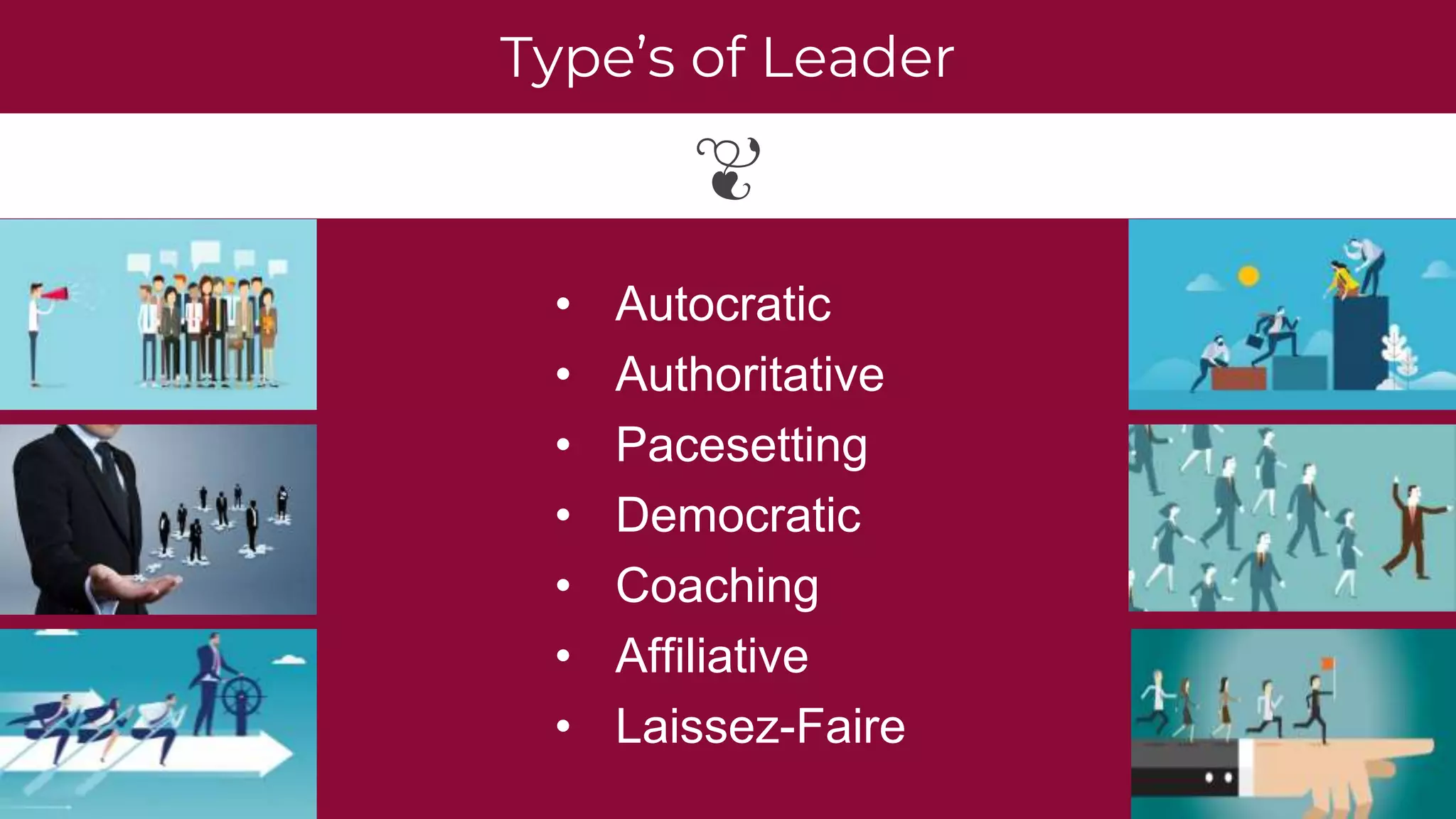
Type’s of Leader
• Autocratic
• Authoritative
• Pacesetting
• Democratic
• Coaching
• Affiliative
• Laissez-Faire
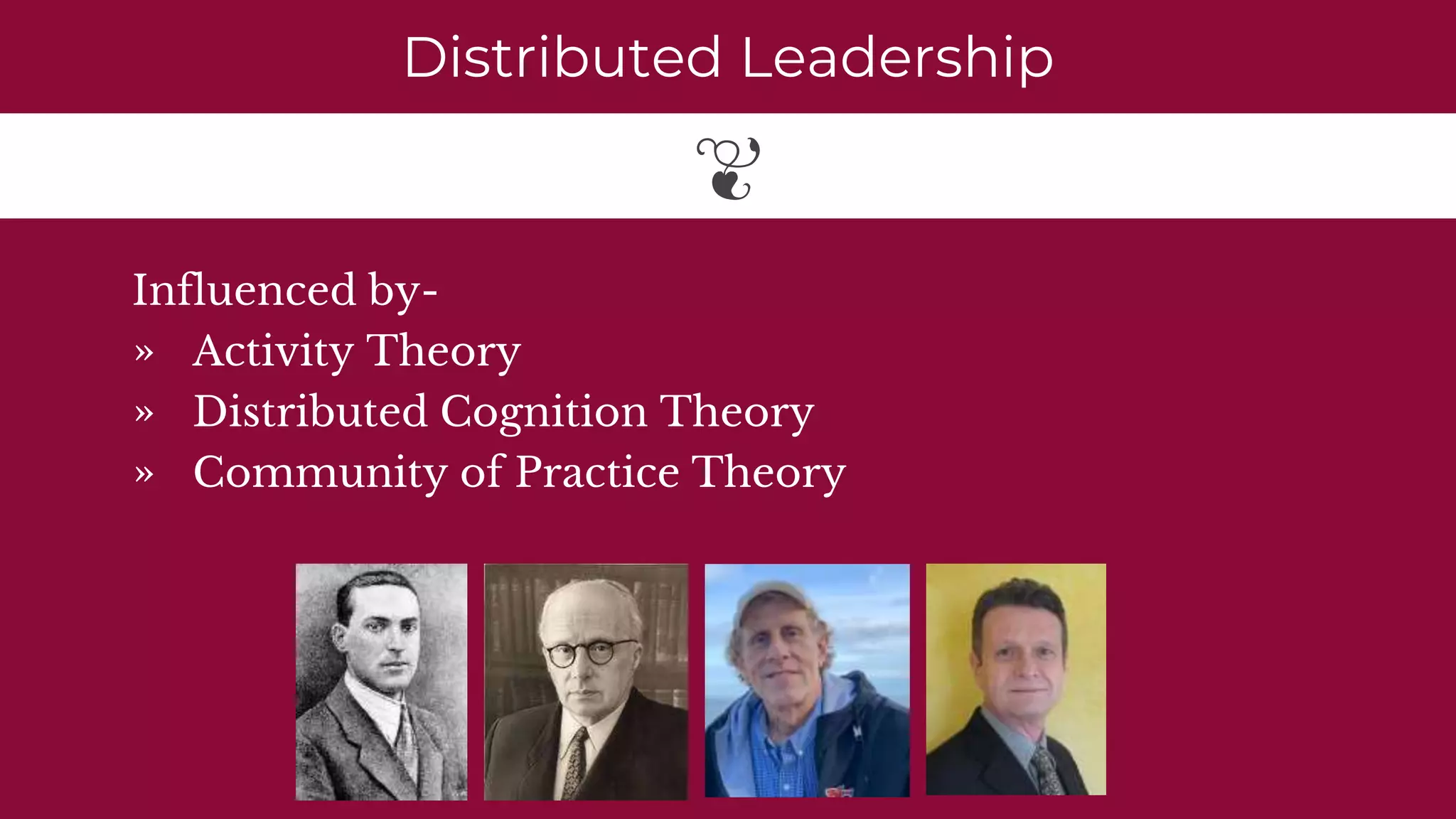
Distributed Leadership
Influenced by-
» Activity Theory
» Distributed Cognition Theory
» Community of Practice Theory
Distributed Leadership
Distributed leadership is a conceptual and
analytical approach to understanding how the
work of leadership takes place among the
people and in context of a complex
organization. Though developed and primarily
used in education research, it has since been
applied to other domains, including business
and even tourism.
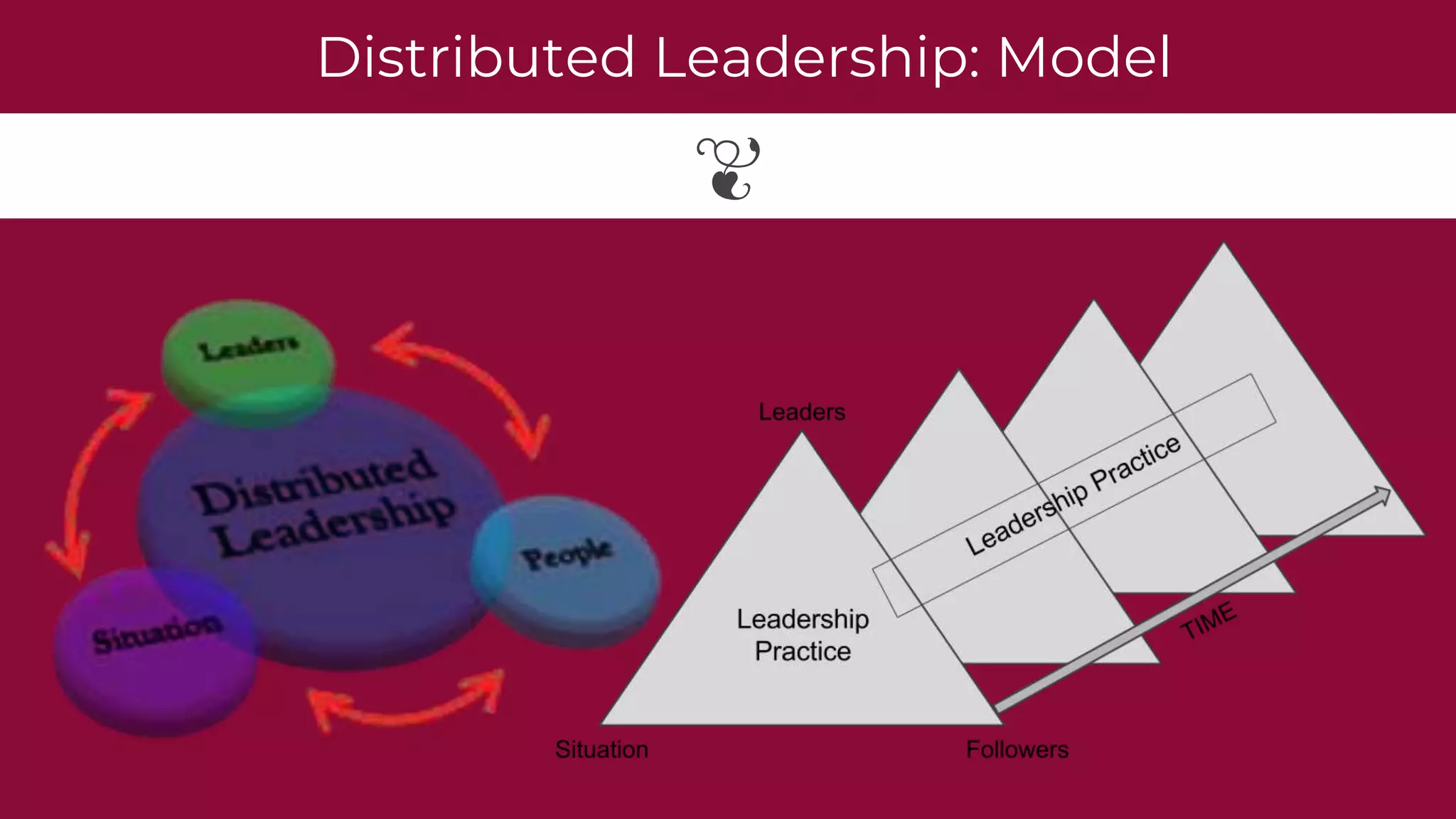
Distributed Leadership: Model
Distributed Leadership
The purpose of distributed leadership is to increase the leadership
capacity within a school so that the school can improve and grow
in an authentic manner, with no tricks, stunts or game-playing. It
allows a school to genuinely become a more effective educational
institution as a result of leaders within it collectively pulling in the
same direction, guided by the same vision and values towards a
common set of goals.
Ultimately, distributed leadership is about giving leaders in schools
ownership by empowering them to lead their teams and drive forward
their strategies that contribute towards the whole-school priorities.
Distributed Leadership: Key Principles
Autonomy
Capacity
Accountability
Autonomy is earned autonomy
Autonomy is earned by proving responsibility
Accountability dependents on capacity
Areas of responsibilities determine capability
Capability is amount of work one can do
Capacity is quality that require to be capable
Distributed Leadership: Advantage
 It gives the company more options.
 It retains elements of the traditional chain-of-command.
 It shares the bigger picture with everyone.
 It allows people to take ownership over their work.
 It provides upward movement opportunities.
 It creates the potential for a substantive change in the organization.
 It gives everyone a chance to serve.
 It emphasizes honesty.
 It provides opportunities for mutual learning.
Distributed Leadership: Disadvantage
 It can be a struggle to maintain accountability.
 It slows down the decision-making process.
 It creates an expectation of importance.
 It generates a certain level of uncertainty.
 It requires leaders to have specified experience.
 It requires a leader with instant reflex
 It can foster arguments.
“
Examples-
Orpheus Orchestra
Class Representative
Indigenous Tribes from Africa
The Navaratna Sabha of Emperor Vikramaditya
The Baro Bhuyan (Rebel landlords of Assam & Bengal)
Thank You

Distributive Leadership- basic discussion

  • 1.
  • 2.
    Hello! I am SEFAT ULALOM, Undergraduate student, Institute of Education and Research, University of Rajshahi.
  • 3.
  • 4.
    “ “Academic analysis hasgiven us more than 850 definitions of leadership” Warren Bennis in “Leaders” “Leadership is translating vision into reality” Leadership is speaking up, stepping up, and standing up to make a difference in something that matters to you and makes a difference for others.
  • 5.
    Type’s of Leadership 1.The Great Man Theory 2. Situational Leadership Theory 3. Change Formula 4. Behavioral Leadership 5. Transformational Leadership 6. Disruptive Innovation 7. Management by Objectives 8. Hierarchy of Needs Theory 9. Leadership Pipeline 10.Change Phases 11.Servant Leadership 12.Five Competitive Forces 13.Three Levels of Culture 14.Stages of Team Development 15.Authentic Leadership Model 16.Autocratic Leadership Model 17.Laissez-Faire Leadership 18.Shared Leadership Model 19.Fiedler’s Contingency Theory 20.Path-Goal Leadership Theory
  • 6.
    Type’s of Leader •Autocratic • Authoritative • Pacesetting • Democratic • Coaching • Affiliative • Laissez-Faire
  • 7.
    Distributed Leadership Influenced by- »Activity Theory » Distributed Cognition Theory » Community of Practice Theory
  • 8.
    Distributed Leadership Distributed leadershipis a conceptual and analytical approach to understanding how the work of leadership takes place among the people and in context of a complex organization. Though developed and primarily used in education research, it has since been applied to other domains, including business and even tourism.
  • 9.
  • 10.
    Distributed Leadership The purposeof distributed leadership is to increase the leadership capacity within a school so that the school can improve and grow in an authentic manner, with no tricks, stunts or game-playing. It allows a school to genuinely become a more effective educational institution as a result of leaders within it collectively pulling in the same direction, guided by the same vision and values towards a common set of goals. Ultimately, distributed leadership is about giving leaders in schools ownership by empowering them to lead their teams and drive forward their strategies that contribute towards the whole-school priorities.
  • 11.
    Distributed Leadership: KeyPrinciples Autonomy Capacity Accountability Autonomy is earned autonomy Autonomy is earned by proving responsibility Accountability dependents on capacity Areas of responsibilities determine capability Capability is amount of work one can do Capacity is quality that require to be capable
  • 12.
    Distributed Leadership: Advantage It gives the company more options.  It retains elements of the traditional chain-of-command.  It shares the bigger picture with everyone.  It allows people to take ownership over their work.  It provides upward movement opportunities.  It creates the potential for a substantive change in the organization.  It gives everyone a chance to serve.  It emphasizes honesty.  It provides opportunities for mutual learning.
  • 13.
    Distributed Leadership: Disadvantage It can be a struggle to maintain accountability.  It slows down the decision-making process.  It creates an expectation of importance.  It generates a certain level of uncertainty.  It requires leaders to have specified experience.  It requires a leader with instant reflex  It can foster arguments.
  • 14.
    “ Examples- Orpheus Orchestra Class Representative IndigenousTribes from Africa The Navaratna Sabha of Emperor Vikramaditya The Baro Bhuyan (Rebel landlords of Assam & Bengal)
  • 15.