

The Pedagogical Adventure

 The whole art of teaching is only the art of
awakening the natural curiosity of young minds for
the purpose of satisfying it afterwards (France in
Barell, 2003)
Introduction

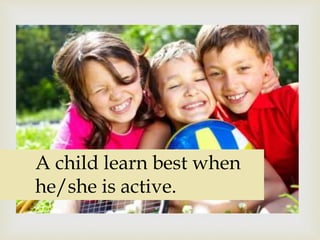
A child learn best when
he/she is active.

 Child-centered education stresses the need for taking
care of the child, his/her growth and development.
 It requires “individualization” of approach.
 The child is an agent in his/her own learning. It
means that curriculum must be thought in terms of
activities and experiences which appeal most to the
child.
Introduction

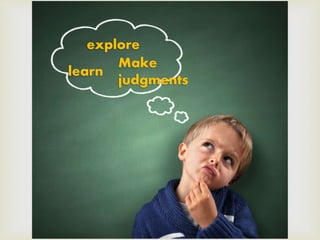
A learner needs
Exposure to
various
experiences

explore
Make
judgments
learn

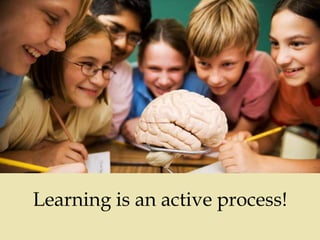
Learning is an active process!

New Knowledge

Problem-Based Learning (PBL)

 Zulueta (2009) stressed that with some changes of
emphasis on educational goals and objectives,
 The focus on the child as the important variable in
the educational process,
 The concept of teaching method has been diversified
and broadened and new approaches/strategies and
other instructional practices came about purportedly
premised to enhance the teaching-learning process.
Discussion:

 Both teaching method and an approach to the
curriculum.
The Problem-Based Learning

It consists of:
The Problem-Based Learning
 Carefully-designed problems that challenge students to use
problem solving techniques.
 Self-directed learning strategies
 Team participation skills, and
 Disciplinary knowledge (Center for Research on Learning and
Teaching, 2011).

The Problem-Based Learning
 It is always active and usually (but not necessarily) a
collaborative or a cooperative process.
 Blumenfeld et al. (in Good and Brophy, 2003) – a
comprehensive approach to classroom teaching and
learning that incorporates most of these principles for
capitalizing on students’ intrinsic motivation.

The Problem-Based Learning
 Within this framework, students pursue solutions to
authentic problems by asking and refining questions,
 Debating ideas,
 Making predictions,
 Designing plans or experiments,

The Problem-Based Learning
 Collecting and analyzing data,
 Drawing conclusions,
 Communicating their ideas and findings to others,
 Asking new questions,
 And creating products

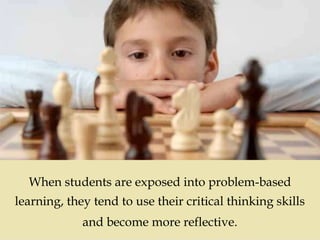
When students are exposed into problem-based
learning, they tend to use their critical thinking skills
and become more reflective.

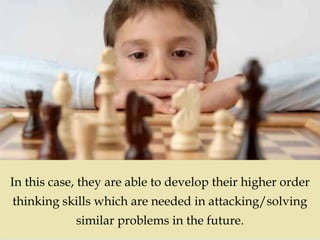
In this case, they are able to develop their higher order
thinking skills which are needed in attacking/solving
similar problems in the future.

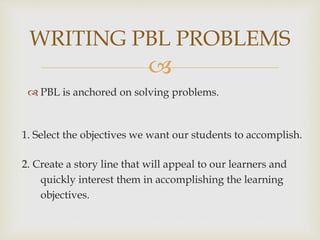
 PBL is anchored on solving problems.
WRITING PBL PROBLEMS
1. Select the objectives we want our students to accomplish.
2. Create a story line that will appeal to our learners and
quickly interest them in accomplishing the learning
objectives.

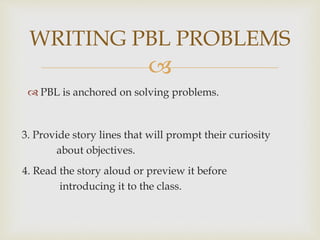
 PBL is anchored on solving problems.
WRITING PBL PROBLEMS
3. Provide story lines that will prompt their curiosity
about objectives.
4. Read the story aloud or preview it before
introducing it to the class.

The problem-based-learning

  • 1.
  • 2.
      The wholeart of teaching is only the art of awakening the natural curiosity of young minds for the purpose of satisfying it afterwards (France in Barell, 2003) Introduction
  • 3.
     A child learnbest when he/she is active.
  • 4.
      Child-centered educationstresses the need for taking care of the child, his/her growth and development.  It requires “individualization” of approach.  The child is an agent in his/her own learning. It means that curriculum must be thought in terms of activities and experiences which appeal most to the child. Introduction
  • 5.
     A learner needs Exposureto various experiences
  • 6.
  • 7.
     Learning is anactive process!
  • 8.
  • 9.
  • 10.
      Zulueta (2009)stressed that with some changes of emphasis on educational goals and objectives,  The focus on the child as the important variable in the educational process,  The concept of teaching method has been diversified and broadened and new approaches/strategies and other instructional practices came about purportedly premised to enhance the teaching-learning process. Discussion:
  • 11.
      Both teachingmethod and an approach to the curriculum. The Problem-Based Learning
  • 12.
     It consists of: TheProblem-Based Learning  Carefully-designed problems that challenge students to use problem solving techniques.  Self-directed learning strategies  Team participation skills, and  Disciplinary knowledge (Center for Research on Learning and Teaching, 2011).
  • 13.
     The Problem-Based Learning It is always active and usually (but not necessarily) a collaborative or a cooperative process.  Blumenfeld et al. (in Good and Brophy, 2003) – a comprehensive approach to classroom teaching and learning that incorporates most of these principles for capitalizing on students’ intrinsic motivation.
  • 14.
     The Problem-Based Learning Within this framework, students pursue solutions to authentic problems by asking and refining questions,  Debating ideas,  Making predictions,  Designing plans or experiments,
  • 15.
     The Problem-Based Learning Collecting and analyzing data,  Drawing conclusions,  Communicating their ideas and findings to others,  Asking new questions,  And creating products
  • 16.
     When students areexposed into problem-based learning, they tend to use their critical thinking skills and become more reflective.
  • 17.
     In this case,they are able to develop their higher order thinking skills which are needed in attacking/solving similar problems in the future.
  • 18.
      PBL isanchored on solving problems. WRITING PBL PROBLEMS 1. Select the objectives we want our students to accomplish. 2. Create a story line that will appeal to our learners and quickly interest them in accomplishing the learning objectives.
  • 19.
      PBL isanchored on solving problems. WRITING PBL PROBLEMS 3. Provide story lines that will prompt their curiosity about objectives. 4. Read the story aloud or preview it before introducing it to the class.