PLANNING AND
POLICY MAKING
PROCESS
Tariqul Islam
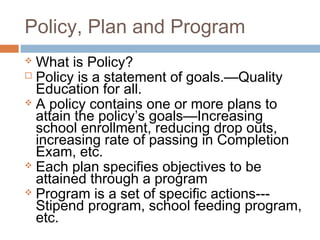
Policy, Plan and Program
 What is Policy?
 Policy is a statement of goals.—Quality
Education for all.
 A policy contains one or more plans to
attain the policy’s goals—Increasing
school enrollment, reducing drop outs,
increasing rate of passing in Completion
Exam, etc.
 Each plan specifies objectives to be
attained through a program
 Program is a set of specific actions---
Stipend program, school feeding program,
etc.
Education Policy making
process
 Background
 Committee formulation
 Setting Goal
 Specify rational and objectives
 Review of education commission and policy
 Draft policy and feedback
 Policy finalization
Education Policy, 2010
Background
 It has not been possible to construct and
establish any Education policy in the last four
decades
 Vision 2021: to bring change in the quality of
life
 Promise of establishing a digital Bangladesh
Education Policy, 2010
Committee formulation
 An 18 member Education Policy formulation
committee
 National Professor Kabir Chowdhury as the
chair
 Dr. Qazi Kholiquzzaman Ahmad as the co-
chair
Education Policy, 2010
Setting Goal
 Goal of The National Education Policy
embodies the nation’s verdict and aspirations,
the spirit of liberation warand independence;
it reflects people’s goals and values
and thereby follows the basic Constitutional
guideline.
Education Policy, 2010
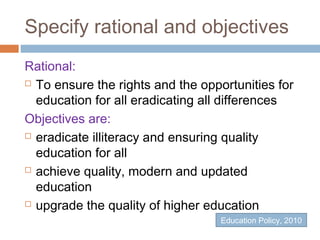
Specify rational and objectives
Rational:
 To ensure the rights and the opportunities for
education for all eradicating all differences
Objectives are:
 eradicate illiteracy and ensuring quality
education for all
 achieve quality, modern and updated
education
 upgrade the quality of higher education
Education Policy, 2010
Review of education commissions
and Policy
 Dr. Qudrat-e-Khuda Commission, 1972
 Education Policy, 2000 (draft)
Education Policy, 2010
Draft policy and feedback
Within four months, a draft National Education
Policy was developed and
 it was put to website and other media for
sharing widely with the people of all walks of
life for their feedback.
 Different seminars and meetings were held on
the draft policy and comments were recorded.
Education Policy, 2010
Policy finalization
The draft policy has been finalized with
 Further additions and amendments with the
incorporation of relevant views,
recommendations and suggestions
received from educationists, teachers, students,
parents, politicians, ale m s (Muslim theological
experts), businessmen, investors,
professionals and people from all strata of life.
Education Policy, 2010
Planning
 Is reasoning about how an organization will
get where it wants to go (policy).
 Is to see opportunities and threats in the future
and to exploit or combat them by making
decision in the present
Models of different Planning
Framework
 Rational planning model
 Logical incremental planning
 Contingency planning
 Crisis management planning
Rational planning model
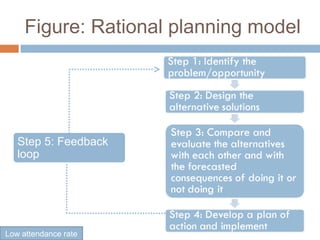
 Rational planning model provides a
systematic and well-established model to
understand the planning process
Figure: Rational planning model
Step 5: Feedback
loop
Low attendance rate
Logical incremental planning
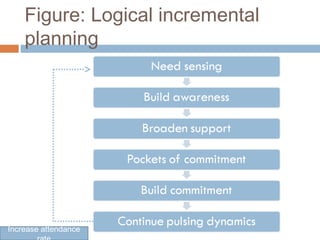
 Logical incremental model recommends
that the policymakers meet challenges
slowly by taking small—incremental—
steps.
 Do a pilot project, if it works, expand,
improve, if it doesn’t work at all, start
again new.
Figure: Logical incremental
planning
Increase attendance
Contingency planning
 If there is a flood—how will the schools
have classes?
 If there is a too many absent teachers–
how will the school conduct classes?
 If-Then scenario planning.
 The plans should be made ahead
 Scenarios have to be projected and plans
how to deal with them must be done
beforehand.
Crisis management planning
 Forms of crisis/accidents:
 Natural—fire, floods, cyclones, etc.
 Normal—physical illness, industrial
accidents, supply breakdowns, power
failures, books and supplies breakdown,
economic crises, recessions, etc,
 Abnormal—criminal crisis, terrorist
attacks, kidnapping, information crises,
cyber attacks, tampering with official
records, etc.
Stages of Crisis Management
 If there is a probability of infectious disease
outbreak like chicken pox—what steps will
schools follow?
Stages of Crisis Management
 There are three essential steps:
 Prevention:
- building relationship with key stakeholder
 Preparation:
- detail planning to handle
- designate a spokesperson
 Containment (response and follow-up
concerns)
- speak with one voice to minimize the
number of conflicting stories
- strive to give people a sense of security and
Crisis Management Plan (CMP)
 This should be a detailed written plan that
specifies what steps should be taken by
whom in a crisis.
 The plan should list names of contact
persons with phone numbers, etc.
 There should be plans of backup and
recovery if and when it calls for.

Education policy making process

  • 1.
  • 2.
    Policy, Plan andProgram  What is Policy?  Policy is a statement of goals.—Quality Education for all.  A policy contains one or more plans to attain the policy’s goals—Increasing school enrollment, reducing drop outs, increasing rate of passing in Completion Exam, etc.  Each plan specifies objectives to be attained through a program  Program is a set of specific actions--- Stipend program, school feeding program, etc.
  • 3.
    Education Policy making process Background  Committee formulation  Setting Goal  Specify rational and objectives  Review of education commission and policy  Draft policy and feedback  Policy finalization Education Policy, 2010
  • 4.
    Background  It hasnot been possible to construct and establish any Education policy in the last four decades  Vision 2021: to bring change in the quality of life  Promise of establishing a digital Bangladesh Education Policy, 2010
  • 5.
    Committee formulation  An18 member Education Policy formulation committee  National Professor Kabir Chowdhury as the chair  Dr. Qazi Kholiquzzaman Ahmad as the co- chair Education Policy, 2010
  • 6.
    Setting Goal  Goalof The National Education Policy embodies the nation’s verdict and aspirations, the spirit of liberation warand independence; it reflects people’s goals and values and thereby follows the basic Constitutional guideline. Education Policy, 2010
  • 7.
    Specify rational andobjectives Rational:  To ensure the rights and the opportunities for education for all eradicating all differences Objectives are:  eradicate illiteracy and ensuring quality education for all  achieve quality, modern and updated education  upgrade the quality of higher education Education Policy, 2010
  • 8.
    Review of educationcommissions and Policy  Dr. Qudrat-e-Khuda Commission, 1972  Education Policy, 2000 (draft) Education Policy, 2010
  • 9.
    Draft policy andfeedback Within four months, a draft National Education Policy was developed and  it was put to website and other media for sharing widely with the people of all walks of life for their feedback.  Different seminars and meetings were held on the draft policy and comments were recorded. Education Policy, 2010
  • 10.
    Policy finalization The draftpolicy has been finalized with  Further additions and amendments with the incorporation of relevant views, recommendations and suggestions received from educationists, teachers, students, parents, politicians, ale m s (Muslim theological experts), businessmen, investors, professionals and people from all strata of life. Education Policy, 2010
  • 11.
    Planning  Is reasoningabout how an organization will get where it wants to go (policy).  Is to see opportunities and threats in the future and to exploit or combat them by making decision in the present
  • 12.
    Models of differentPlanning Framework  Rational planning model  Logical incremental planning  Contingency planning  Crisis management planning
  • 13.
    Rational planning model Rational planning model provides a systematic and well-established model to understand the planning process
  • 14.
    Figure: Rational planningmodel Step 5: Feedback loop Low attendance rate
  • 15.
    Logical incremental planning Logical incremental model recommends that the policymakers meet challenges slowly by taking small—incremental— steps.  Do a pilot project, if it works, expand, improve, if it doesn’t work at all, start again new.
  • 16.
  • 17.
    Contingency planning  Ifthere is a flood—how will the schools have classes?  If there is a too many absent teachers– how will the school conduct classes?  If-Then scenario planning.  The plans should be made ahead  Scenarios have to be projected and plans how to deal with them must be done beforehand.
  • 18.
    Crisis management planning Forms of crisis/accidents:  Natural—fire, floods, cyclones, etc.  Normal—physical illness, industrial accidents, supply breakdowns, power failures, books and supplies breakdown, economic crises, recessions, etc,  Abnormal—criminal crisis, terrorist attacks, kidnapping, information crises, cyber attacks, tampering with official records, etc.
  • 19.
    Stages of CrisisManagement  If there is a probability of infectious disease outbreak like chicken pox—what steps will schools follow?
  • 20.
    Stages of CrisisManagement  There are three essential steps:  Prevention: - building relationship with key stakeholder  Preparation: - detail planning to handle - designate a spokesperson  Containment (response and follow-up concerns) - speak with one voice to minimize the number of conflicting stories - strive to give people a sense of security and
  • 21.
    Crisis Management Plan(CMP)  This should be a detailed written plan that specifies what steps should be taken by whom in a crisis.  The plan should list names of contact persons with phone numbers, etc.  There should be plans of backup and recovery if and when it calls for.