WHAT IS PLANNING?
Planning involves defining the organizations goals
establishing strategies for achieving those goals , and
developing plans to integrate and coordinate work activities.
WHAT IS EDUCATIONAL PLANNING?
Educational planning can be define as the process of
setting advance strategies , policies , procedures ,
programs and standards through which an educational
objective ( or set of objectives)can be achieved.
TYPES OF EDUCATIONAL PLANNING
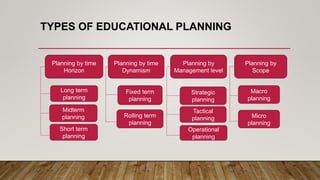
Planning by time
Horizon
Planning by time
Dynamism
Planning by
Management level
Planning by
Scope
Long term
planning
Midterm
planning
Short term
planning
Fixed term
planning
Rolling term
planning
Strategic
planning
Tactical
planning
Operational
planning
Macro
planning
Micro
planning
PLANNING BY TIME HORIZON
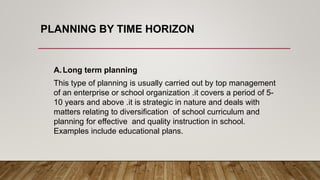
A.Long term planning
This type of planning is usually carried out by top management
of an enterprise or school organization .it covers a period of 5-
10 years and above .it is strategic in nature and deals with
matters relating to diversification of school curriculum and
planning for effective and quality instruction in school.
Examples include educational plans.
b). Mid-term planning
This type of planning defines the future goals and objectives of education with
greater clarity and provides clear–cut strategies and procedures are action plans for
achievement of future targets it covers a period of two – four years.
c). Short term planning
This is a type of planning designee to achieve immediate future goals it covers a time
frame of one year or less than one year it helps the organization two progress
gradually to achievement of long term goals.
2. PLANNING BY TIME DYNAMISM
a) Fixed term planning
This has a specific duration of year such as three year or five years and it has fixed
targets and objectives to b accomplished with in a fix period of time. Fix term
planning provides for relative stability within the educational system with regards to
policy designees and implementation.
b) Rolling term planning
This involves standing the time frame of a plan for one year of a time based on the
extent of the success of the plan implementation. This means a plan that is not
accomplished during the specified time frame is rolled over into another period or
year. In other words rolling plan teds to eliminate the need for short term planning.
3). PLANNING BY MANAGEMENT LEVEL
a) Strategic planning.
It is involved setting up a future educational goals and objectives by top
management or executive level ( e.g. ministerial level ).Strategic planning
provides a set of decision that gives direction for task performance ,
activities and programs at the lower level of management.
b) Tactical planning.
Tactical planning is done by middle level managers such as deans of
faculties, heads of department or units and directors of institute in a
university. Tactical planning is used to explain and interpret the goals of
strategic plan to operational personal. Tactical plans are narrow in scope
then the strategic plans but their objectives must align with objectives of
strategic plan.
• c) Operational planning
Operational planning involve planning activities that facilitate the
accomplishment of everyday activities of first-level or low level
managers in an institution or enterprise. Planning here involves work
scheduling, preventive maintenance scheduling and design of work
methods. Operational planning includes vice principals, teachers,
school prefects, games masters, guidance counselors etc. they are
the real implementers of strategic plan.
4). PLANNING BY SCOPE
a) Macro planning
This is planning at the national and state level .it is aimed at achieving
national success and high productivity in education. The component of
macro level planning include policy formulation, financing of education,
integration of education into the national development plan, educational
reform, teacher education and administrative strategies for implementation
of a plan.
b) Micro planning
This type of planning focuses on the input and process of educational
practice it deals with educational problems at the institutional level,
acquisition and maintenance of teaching facilities and equipment, attitude of
parents, pupils and teachers to education.
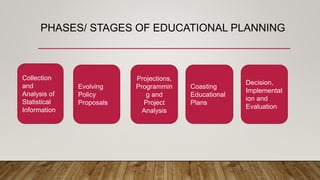
PHASES/ STAGES OF EDUCATIONAL PLANNING
Collection
and
Analysis of
Statistical
Information
Evolving
Policy
Proposals
Projections,
Programmin
g and
Project
Analysis
Coasting
Educational
Plans
Decision,
Implementat
ion and
Evaluation
1)COLLECTION AND ANALYSIS OF STATISTICAL
INFORMATION
• At this stage, relevant information about the system of
education and concerned socio-economic factors is
collected so as to provide the quantitative basis for
projections aimed at the future development of the
educational system.
2)EVOLVING POLICY PROPOSALS
• The statistical information collected helps in identifying the
gaps, weaknesses and shortcoming and provides the
planners with a clear idea of the existing conditions.
3) PROJECTIONS, PROGRAMMING AND PROJECT
ANALYSIS
• An effective plans necessitates projections of all the
inputs of the educational system students, teachers,
administrators, school buildings classrooms, equipment
and financial requirements.
4)COSTING EDUCATIONAL
• Education is an activity where in the institution and the
society bear part of the cost and the learner bears part of
the cost. In order to improve the formulation and
implementation of educational plans. It is necessary to
understand the methods of costing education and the
problems associated with it.
5) DECISION, IMPLEMENTATION AND EVALUATION
• A five year plans need to be broken up into annual plans,
each annual plan is scrutinized, discussed and criticized
in relation to a review of previous year’s strengths.
Weaknesses and achievements. At this stage, the
necessary conditions for effective implementation of
programme need to be created. Thereafter, the actual
operations take place.
PRESENTATION of planning school learning

PRESENTATION of planning school learning

  • 1.
    WHAT IS PLANNING? Planninginvolves defining the organizations goals establishing strategies for achieving those goals , and developing plans to integrate and coordinate work activities.
  • 2.
    WHAT IS EDUCATIONALPLANNING? Educational planning can be define as the process of setting advance strategies , policies , procedures , programs and standards through which an educational objective ( or set of objectives)can be achieved.
  • 3.
    TYPES OF EDUCATIONALPLANNING Planning by time Horizon Planning by time Dynamism Planning by Management level Planning by Scope Long term planning Midterm planning Short term planning Fixed term planning Rolling term planning Strategic planning Tactical planning Operational planning Macro planning Micro planning
  • 4.
    PLANNING BY TIMEHORIZON A.Long term planning This type of planning is usually carried out by top management of an enterprise or school organization .it covers a period of 5- 10 years and above .it is strategic in nature and deals with matters relating to diversification of school curriculum and planning for effective and quality instruction in school. Examples include educational plans.
  • 5.
    b). Mid-term planning Thistype of planning defines the future goals and objectives of education with greater clarity and provides clear–cut strategies and procedures are action plans for achievement of future targets it covers a period of two – four years. c). Short term planning This is a type of planning designee to achieve immediate future goals it covers a time frame of one year or less than one year it helps the organization two progress gradually to achievement of long term goals.
  • 6.
    2. PLANNING BYTIME DYNAMISM a) Fixed term planning This has a specific duration of year such as three year or five years and it has fixed targets and objectives to b accomplished with in a fix period of time. Fix term planning provides for relative stability within the educational system with regards to policy designees and implementation. b) Rolling term planning This involves standing the time frame of a plan for one year of a time based on the extent of the success of the plan implementation. This means a plan that is not accomplished during the specified time frame is rolled over into another period or year. In other words rolling plan teds to eliminate the need for short term planning.
  • 7.
    3). PLANNING BYMANAGEMENT LEVEL a) Strategic planning. It is involved setting up a future educational goals and objectives by top management or executive level ( e.g. ministerial level ).Strategic planning provides a set of decision that gives direction for task performance , activities and programs at the lower level of management. b) Tactical planning. Tactical planning is done by middle level managers such as deans of faculties, heads of department or units and directors of institute in a university. Tactical planning is used to explain and interpret the goals of strategic plan to operational personal. Tactical plans are narrow in scope then the strategic plans but their objectives must align with objectives of strategic plan.
  • 8.
    • c) Operationalplanning Operational planning involve planning activities that facilitate the accomplishment of everyday activities of first-level or low level managers in an institution or enterprise. Planning here involves work scheduling, preventive maintenance scheduling and design of work methods. Operational planning includes vice principals, teachers, school prefects, games masters, guidance counselors etc. they are the real implementers of strategic plan.
  • 9.
    4). PLANNING BYSCOPE a) Macro planning This is planning at the national and state level .it is aimed at achieving national success and high productivity in education. The component of macro level planning include policy formulation, financing of education, integration of education into the national development plan, educational reform, teacher education and administrative strategies for implementation of a plan. b) Micro planning This type of planning focuses on the input and process of educational practice it deals with educational problems at the institutional level, acquisition and maintenance of teaching facilities and equipment, attitude of parents, pupils and teachers to education.
  • 10.
    PHASES/ STAGES OFEDUCATIONAL PLANNING Collection and Analysis of Statistical Information Evolving Policy Proposals Projections, Programmin g and Project Analysis Coasting Educational Plans Decision, Implementat ion and Evaluation
  • 11.
    1)COLLECTION AND ANALYSISOF STATISTICAL INFORMATION • At this stage, relevant information about the system of education and concerned socio-economic factors is collected so as to provide the quantitative basis for projections aimed at the future development of the educational system.
  • 12.
    2)EVOLVING POLICY PROPOSALS •The statistical information collected helps in identifying the gaps, weaknesses and shortcoming and provides the planners with a clear idea of the existing conditions.
  • 13.
    3) PROJECTIONS, PROGRAMMINGAND PROJECT ANALYSIS • An effective plans necessitates projections of all the inputs of the educational system students, teachers, administrators, school buildings classrooms, equipment and financial requirements.
  • 14.
    4)COSTING EDUCATIONAL • Educationis an activity where in the institution and the society bear part of the cost and the learner bears part of the cost. In order to improve the formulation and implementation of educational plans. It is necessary to understand the methods of costing education and the problems associated with it.
  • 15.
    5) DECISION, IMPLEMENTATIONAND EVALUATION • A five year plans need to be broken up into annual plans, each annual plan is scrutinized, discussed and criticized in relation to a review of previous year’s strengths. Weaknesses and achievements. At this stage, the necessary conditions for effective implementation of programme need to be created. Thereafter, the actual operations take place.