EDUC 208
Educational Planning
and Control
Educ 208
Lyzel C. Copioso
MAED Administration & Supervision
DBPMCF
Planning
01
“Is to design some action to be
done before hand.”
-Oxford English Dictionary
Planning
02
"Planning is regarded as the
process of setting out in advance a
pattern of action to bring about
overall national policies by the
closest possible articulation of
means and ends."
-Philips
03
• a systematic design of action for
realization of educational aims and
objectives for individual and social
development through maximum utilization
of available resources.
• a process utilized by an administrator
while performing the role of a leader,
decision- maker, change agent and so on.
Educational Planning
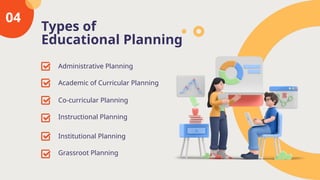
Types of
Educational Planning
04
Administrative Planning
Academic of Curricular Planning
Co-curricular Planning
Instructional Planning
Institutional Planning
Grassroot Planning
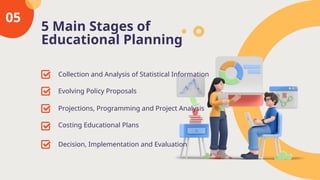
5 Main Stages of
Educational Planning
05
Collection and Analysis of Statistical Information
Evolving Policy Proposals
Projections, Programming and Project Analysis
Costing Educational Plans
Decision, Implementation and Evaluation
M I T
E
T I M
E
S P I C E L O
I
P O L I C I E
S
D U N F
S
F U N D
S
A T A
D
D A T
A
Factors Affecting
Educational Planning
Educ 208
Lyzel C. Copioso
MAED Administration & Supervision
DBPMCF
02
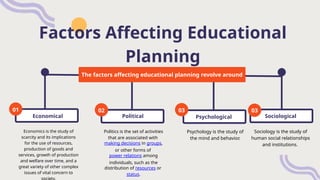
The factors affecting educational planning revolve around
Factors Affecting Educational
Planning
Psychological
Political
03
Economical
01
Economics is the study of
scarcity and its implications
for the use of resources,
production of goods and
services, growth of production
and welfare over time, and a
great variety of other complex
issues of vital concern to
society.
Politics is the set of activities
that are associated with
making decisions in groups,
or other forms of
power relations among
individuals, such as the
distribution of resources or
status.
Psychology is the study of
the mind and behavior.
Sociological
03
Sociology is the study of
human social relationships
and institutions.
• There are such things as educational laws that protect
both students and educators. As such, legal protection is
also an expenditure to think about.
• Laws also dictate work hours, hourly wages, licensing
and workman's compensation among many other
things.
Existing educational policies and laws
• This includes all the money allotted toward salary,
infrastructure, purchases, benefits, maintenance, and
every other expenditure for a specific period of time.
This period of time is called a fiscal year.
• By definition, a fiscal year is the length of time that a
budget is supposed to last for an educational year.
Funding and Budgeting
Outsourcing and in-sourcing workers means finding
enough people to man the different needs-based
services that either provide the education, protect the
premises, or maintain the grounds.
Human Factor
With an absence of funds leads to minimize development
because other facilities and resources cannot be acquired.
Shortage of physical facilities/resources
Producing people with skills requires time. This means
that as people undergo training work will not be done. As
graduate trainees undergo training the number of
enrollment increases, hence surpassing the number of
graduate being trained.
Time element
The community must be taken into consideration as far as
the services it will need, the type of infrastructure it can
support, the resources that can be found, and the
demographics of the clients. A high-risk community cannot
support or be educated by an institution that cannot meet
its immediate needs.
The Community
• Political authority to create an enabling environment for educational planner and
adapt their recommendations
• Educational planner to have a clear idea as to what their responsibilities are
• Serious attention should be directed towards the development of clear educational
policies and priorities so that educational planners have a better notion of what
they are planning
• Policy makers must refrain from creating the development alternatives and
political decisions rather than a technical matter.
• Educational administrators must actively support changes in educational planning.
• Generally, there should be mutual coordination of all those concerned with the
development of education as a whole
• Reduce corruption
• Public sensitization to give accurate data
• Involve all stakeholders when planning for education, e.g. Involving employers
Possible solutions
Thank You

Educ 208, Educational Planning and Control.pptx

  • 1.
    EDUC 208 Educational Planning andControl Educ 208 Lyzel C. Copioso MAED Administration & Supervision DBPMCF
  • 2.
    Planning 01 “Is to designsome action to be done before hand.” -Oxford English Dictionary
  • 3.
    Planning 02 "Planning is regardedas the process of setting out in advance a pattern of action to bring about overall national policies by the closest possible articulation of means and ends." -Philips
  • 4.
    03 • a systematicdesign of action for realization of educational aims and objectives for individual and social development through maximum utilization of available resources. • a process utilized by an administrator while performing the role of a leader, decision- maker, change agent and so on. Educational Planning
  • 5.
    Types of Educational Planning 04 AdministrativePlanning Academic of Curricular Planning Co-curricular Planning Instructional Planning Institutional Planning Grassroot Planning
  • 6.
    5 Main Stagesof Educational Planning 05 Collection and Analysis of Statistical Information Evolving Policy Proposals Projections, Programming and Project Analysis Costing Educational Plans Decision, Implementation and Evaluation
  • 7.
  • 8.
  • 9.
    S P IC E L O I
  • 10.
    P O LI C I E S
  • 11.
    D U NF S
  • 12.
    F U ND S
  • 13.
  • 14.
  • 16.
    Factors Affecting Educational Planning Educ208 Lyzel C. Copioso MAED Administration & Supervision DBPMCF
  • 17.
    02 The factors affectingeducational planning revolve around Factors Affecting Educational Planning Psychological Political 03 Economical 01 Economics is the study of scarcity and its implications for the use of resources, production of goods and services, growth of production and welfare over time, and a great variety of other complex issues of vital concern to society. Politics is the set of activities that are associated with making decisions in groups, or other forms of power relations among individuals, such as the distribution of resources or status. Psychology is the study of the mind and behavior. Sociological 03 Sociology is the study of human social relationships and institutions.
  • 18.
    • There aresuch things as educational laws that protect both students and educators. As such, legal protection is also an expenditure to think about. • Laws also dictate work hours, hourly wages, licensing and workman's compensation among many other things. Existing educational policies and laws
  • 19.
    • This includesall the money allotted toward salary, infrastructure, purchases, benefits, maintenance, and every other expenditure for a specific period of time. This period of time is called a fiscal year. • By definition, a fiscal year is the length of time that a budget is supposed to last for an educational year. Funding and Budgeting
  • 20.
    Outsourcing and in-sourcingworkers means finding enough people to man the different needs-based services that either provide the education, protect the premises, or maintain the grounds. Human Factor
  • 21.
    With an absenceof funds leads to minimize development because other facilities and resources cannot be acquired. Shortage of physical facilities/resources
  • 22.
    Producing people withskills requires time. This means that as people undergo training work will not be done. As graduate trainees undergo training the number of enrollment increases, hence surpassing the number of graduate being trained. Time element
  • 23.
    The community mustbe taken into consideration as far as the services it will need, the type of infrastructure it can support, the resources that can be found, and the demographics of the clients. A high-risk community cannot support or be educated by an institution that cannot meet its immediate needs. The Community
  • 24.
    • Political authorityto create an enabling environment for educational planner and adapt their recommendations • Educational planner to have a clear idea as to what their responsibilities are • Serious attention should be directed towards the development of clear educational policies and priorities so that educational planners have a better notion of what they are planning • Policy makers must refrain from creating the development alternatives and political decisions rather than a technical matter. • Educational administrators must actively support changes in educational planning. • Generally, there should be mutual coordination of all those concerned with the development of education as a whole • Reduce corruption • Public sensitization to give accurate data • Involve all stakeholders when planning for education, e.g. Involving employers Possible solutions
  • 25.