Using cost-benefit analysis in
policy making
18 November 2013
Tera Allas
Director General, Strategic Advice
Department for Business, Innovation and Skills
2

Using cost-benefit analysis in policy
making: outline of today’s discussion
• Overall policy making process and role of cost-benefit
analysis in it
• The objective function(s) and decision making criteria in
government policy making
• Using cost-benefit analysis as a framework and
quantitative tool to inform policy making and decisions
• Key concepts in cost-benefit analysis without which
conclusions are suspect
• Challenges in applying cost-benefit analysis and the role
of judgement
3

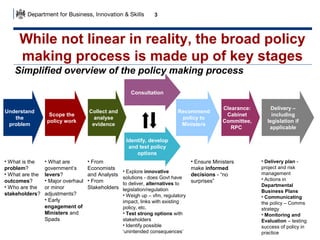
While not linear in reality, the broad policy
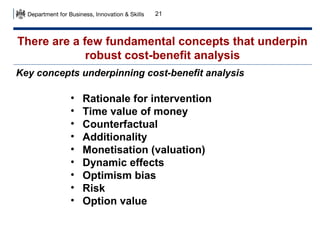
making process is made up of key stages
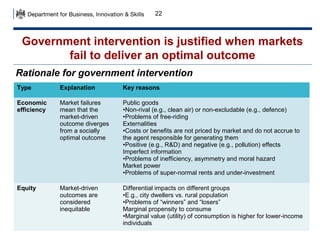
Simplified overview of the policy making process
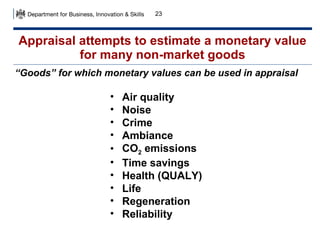
Consultation
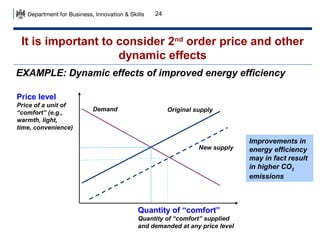
Understand
the
problem

Scope the
policy work

Collect and
analyse
evidence

Recommend
policy to
Ministers

Clearance:
Cabinet
Committee,
RPC

Delivery –
including
legislation if
applicable

Identify, develop
and test policy
options
• What is the
problem?
• What are the
outcomes?
• Who are the
stakeholders?

• What are
government’s
levers?
• Major overhaul
or minor
adjustments?
• Early
engagement of
Ministers and
Spads

• From
Economists
and Analysts
• From
Stakeholders

• Explore innovative
solutions - does Govt have
to deliver, alternatives to
legislation/regulation
• Weigh up – vfm, regulatory
impact, links with existing
policy, etc.
• Test strong options with
stakeholders
• Identify possible
‘unintended consequences’

• Ensure Ministers
make informed
decisions - “no
surprises”

• Delivery plan project and risk
management
• Actions in
Departmental
Business Plans
• Communicating
the policy – Comms
strategy
• Monitoring and
Evaluation – testing
success of policy in
practice
4

Making a difference to outcomes

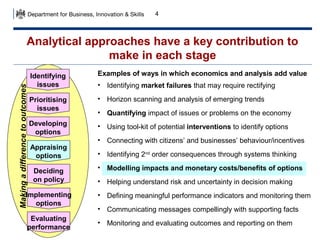
Analytical approaches have a key contribution to
make in each stage
Identifying
issues

Examples of ways in which economics and analysis add value

Prioritising
issues

• Horizon scanning and analysis of emerging trends

Developing
options

• Using tool-kit of potential interventions to identify options

Appraising
options
Deciding
on policy

Implementing
options
Evaluating
performance

• Identifying market failures that may require rectifying

• Quantifying impact of issues or problems on the economy

• Connecting with citizens’ and businesses’ behaviour/incentives
• Identifying 2nd order consequences through systems thinking
• Modelling impacts and monetary costs/benefits of options
• Helping understand risk and uncertainty in decision making
• Defining meaningful performance indicators and monitoring them
• Communicating messages compellingly with supporting facts
• Monitoring and evaluating outcomes and reporting on them
5

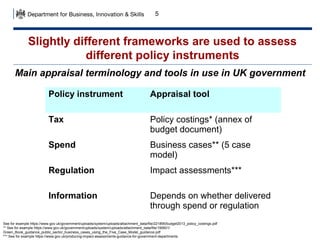
Slightly different frameworks are used to assess
different policy instruments
Main appraisal terminology and tools in use in UK government
Policy instrument

Appraisal tool

Tax

Policy costings* (annex of
budget document)

Spend

Business cases** (5 case
model)

Regulation

Impact assessments***

Information

Depends on whether delivered
through spend or regulation

See for example https://www.gov.uk/government/uploads/system/uploads/attachment_data/file/221895/budget2013_policy_costings.pdf
** See for example https://www.gov.uk/government/uploads/system/uploads/attachment_data/file/190601/
Green_Book_guidance_public_sector_business_cases_using_the_Five_Case_Model_guidance.pdf
*** See for example https://www.gov.uk/producing-impact-assessments-guidance-for-government-departments
6

Using cost-benefit analysis in policy
making: outline of today’s discussion
• Overall policy making process and role of cost-benefit
analysis in it
• The objective function(s) and decision making criteria in
government policy making
• Using cost-benefit analysis as a framework and
quantitative tool to inform policy making and decisions
• Key concepts in cost-benefit analysis without which
conclusions are suspect
• Challenges in applying cost-benefit analysis and the role
of judgement
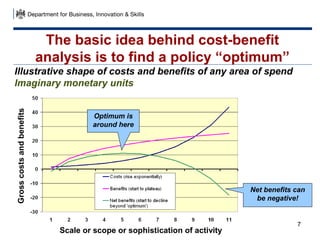
The basic idea behind cost-benefit
analysis is to find a policy “optimum”

Gross costs and benefits

Illustrative shape of costs and benefits of any area of spend
Imaginary monetary units
Optimum is
around here

Net benefits can
be negative!

Scale or scope or sophistication of activity

7
8

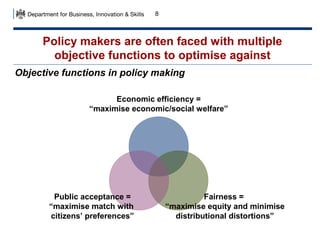
Policy makers are often faced with multiple
objective functions to optimise against
Objective functions in policy making
Economic efficiency =
“maximise economic/social welfare”

Public acceptance =
“maximise match with
citizens’ preferences”

Fairness =
“maximise equity and minimise
distributional distortions”
9

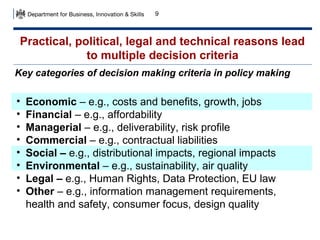
Practical, political, legal and technical reasons lead
to multiple decision criteria
Key categories of decision making criteria in policy making

•
•
•
•
•
•
•
•

Economic – e.g., costs and benefits, growth, jobs
Financial – e.g., affordability
Managerial – e.g., deliverability, risk profile
Commercial – e.g., contractual liabilities
Social – e.g., distributional impacts, regional impacts
Environmental – e.g., sustainability, air quality
Legal – e.g., Human Rights, Data Protection, EU law
Other – e.g., information management requirements,
health and safety, consumer focus, design quality
10

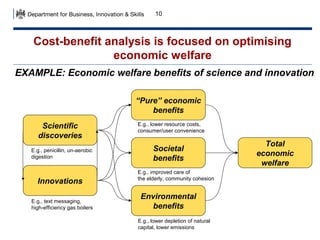
Cost-benefit analysis is focused on optimising
economic welfare
EXAMPLE: Economic welfare benefits of science and innovation
“Pure” economic
benefits
Scientific
discoveries
E.g., penicillin, un-aerobic
digestion

Innovations
E.g., text messaging,
high-efficiency gas boilers

E.g., lower resource costs,
consumer/user convenience

Societal
benefits
E.g., improved care of
the elderly, community cohesion

Environmental
benefits
E.g., lower depletion of natural
capital, lower emissions

Total
economic
welfare
11

Economic welfare is not exactly the same as GDP or
growth – but is related
Very roughly (!) Economic welfare = GDP + consumer surplus +/- externalities
Price level

Aggregate
demand

Prices of labour,
goods and services

Aggregate
supply

Consumer
surplus
GDP [at prevailing prices,
taxes and subsidies]

Output
Quantity of goods and
services bought and sold

* Nominal growth – where nominal GDP grows because prices of labour, goods and services increase (inflation) – does not increase employment, living
standards or the Government’s fiscal position (and therefore ability to offer public services); real growth (which strips out inflation) is the appropriate policy goal
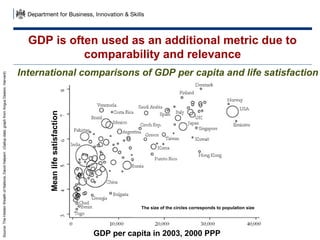
International comparisons of GDP per capita and life satisfaction

Mean life satisfaction

Source: The Hidden Wealth of Nations, David Halpern (Gallup data; graph from Angus Deaton, Harvard)

GDP is often used as an additional metric due to
comparability and relevance

The size of the circles corresponds to population size

GDP per capita in 2003, 2000 PPP
13

Using cost-benefit analysis in policy
making: outline of today’s discussion
• Overall policy making process and role of cost-benefit
analysis in it
• The objective function(s) and decision making criteria in
government policy making
• Using cost-benefit analysis as a framework and
quantitative tool to inform policy making and decisions
• Key concepts in and elements of cost-benefit analysis
without which conclusions are suspect
• Challenges in applying cost-benefit analysis and the role
of judgement
14

As mentioned, economic welfare is one of
several considerations in decision making
EXAMPLE: Department for Transport decision framework [1/3]
15

As mentioned, economic welfare is one of
several considerations in decision making
EXAMPLE: Department for Transport decision framework [2/3]
16

As mentioned, economic welfare is one of
several considerations in decision making
EXAMPLE: Department for Transport decision framework [3/3]
17

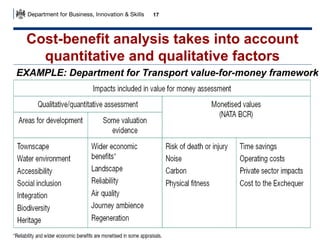
Cost-benefit analysis takes into account
quantitative and qualitative factors
EXAMPLE: Department for Transport value-for-money framework
18

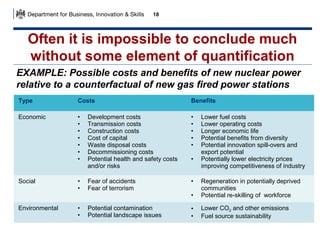
Often it is impossible to conclude much
without some element of quantification
EXAMPLE: Possible costs and benefits of new nuclear power
relative to a counterfactual of new gas fired power stations
Type

Costs

Benefits

Economic

•
•
•
•
•
•
•

Development costs
Transmission costs
Construction costs
Cost of capital
Waste disposal costs
Decommissioning costs
Potential health and safety costs
and/or risks

•
•
•
•
•

•
•

Fear of accidents
Fear of terrorism

•

Social

•

Lower fuel costs
Lower operating costs
Longer economic life
Potential benefits from diversity
Potential innovation spill-overs and
export potential
Potentially lower electricity prices
improving competitiveness of industry

•
Environmental

•
•

Potential contamination
Potential landscape issues

Regeneration in potentially deprived
communities
Potential re-skilling of workforce

•
•

Lower CO2 and other emissions
Fuel source sustainability
19

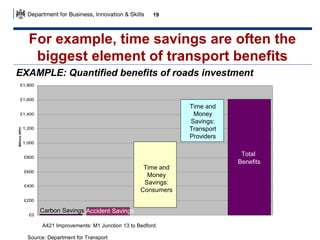
For example, time savings are often the
biggest element of transport benefits
EXAMPLE: Quantified benefits of roads investment
£1,800
£1,600

Time and
Money
Savings:
Transport
Providers

£1,400

Millions
Millions (NPV)

£1,200
£1,000
£800

Time and
Money
Savings:
Consumers

£600
£400
£200
£0

Carbon Savings Accident Savings
A421 Improvements: M1 Junction 13 to Bedford.

Source: Department for Transport

Total
Benefits
20

Using cost-benefit analysis in policy
making: outline of today’s discussion
• Overall policy making process and role of cost-benefit
analysis in it
• The objective function(s) and decision making criteria in
government policy making
• Using cost-benefit analysis as a framework and
quantitative tool to inform policy making and decisions
• Key concepts in and elements of cost-benefit analysis
without which conclusions are suspect
• Challenges in applying cost-benefit analysis and the role
of judgement
21

There are a few fundamental concepts that underpin
robust cost-benefit analysis
Key concepts underpinning cost-benefit analysis

•
•
•
•
•
•
•
•
•

Rationale for intervention
Time value of money
Counterfactual
Additionality
Monetisation (valuation)
Dynamic effects
Optimism bias
Risk
Option value
22

Government intervention is justified when markets
fail to deliver an optimal outcome
Rationale for government intervention
Type

Explanation

Key reasons

Economic
efficiency

Market failures
mean that the
market-driven
outcome diverges
from a socially
optimal outcome

Public goods
•Non-rival (e.g., clean air) or non-excludable (e.g., defence)
•Problems of free-riding
Externalities
•Costs or benefits are not priced by market and do not accrue to
the agent responsible for generating them
•Positive (e.g., R&D) and negative (e.g., pollution) effects
Imperfect information
•Problems of inefficiency, asymmetry and moral hazard
Market power
•Problems of super-normal rents and under-investment

Equity

Market-driven
outcomes are
considered
inequitable

Differential impacts on different groups
•E.g., city dwellers vs. rural population
•Problems of “winners” and “losers”
Marginal propensity to consume
•Marginal value (utility) of consumption is higher for lower-income
individuals
23

Appraisal attempts to estimate a monetary value
for many non-market goods
“Goods” for which monetary values can be used in appraisal

•
•
•
•
•
•
•
•
•
•

Air quality
Noise
Crime
Ambiance
CO2 emissions
Time savings
Health (QUALY)
Life
Regeneration
Reliability
24

It is important to consider 2nd order price and other
dynamic effects
EXAMPLE: Dynamic effects of improved energy efficiency
Price level
Price of a unit of
“comfort” (e.g.,
warmth, light,
time, convenience)

Demand

Original supply

New supply

Quantity of “comfort”
Quantity of “comfort” supplied
and demanded at any price level

Improvements in
energy efficiency
may in fact result
in higher CO2
emissions
25

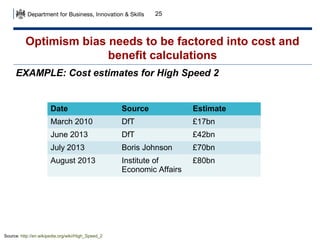
Optimism bias needs to be factored into cost and
benefit calculations
EXAMPLE: Cost estimates for High Speed 2

Date

Source

Estimate

March 2010

DfT

£17bn

June 2013

DfT

£42bn

July 2013

Boris Johnson

£70bn

August 2013

Institute of
Economic Affairs

£80bn

Source: http://en.wikipedia.org/wiki/High_Speed_2
26

Using cost-benefit analysis in policy
making: outline of today’s discussion
• Overall policy making process and role of cost-benefit
analysis in it
• The objective function(s) and decision making criteria in
government policy making
• Using cost-benefit analysis as a framework and
quantitative tool to inform policy making and decisions
• Key concepts in and elements of cost-benefit analysis
without which conclusions are suspect
• Challenges in applying cost-benefit analysis and the role
of judgement
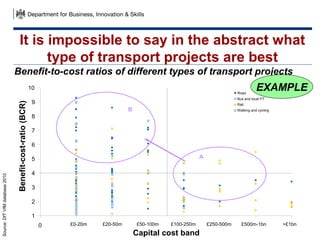
It is impossible to say in the abstract what
type of transport projects are best
Benefit-to-cost ratios of different typesvs. BCR
All approved schemes, capital cost of transport projects
10
BCR
Benefit-cost-ratio (BCR)

Source: DfT VfM database 2010

Road

EXAMPLE

Bus and local PT

9

Rail

B

Walking and cycling

8
7
6
A

5
4
3
2
1
0

£0-20m
1

£20-50m
2

£50-100m
3

£100-250m
4

Capital cost band
Capital cost band

£250-500m
5

£500m-1bn
6

>£1bn
7 27
28

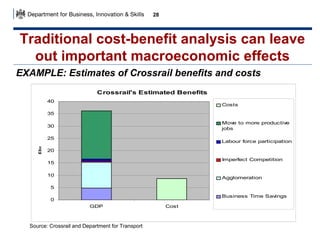
Traditional cost-benefit analysis can leave
out important macroeconomic effects
EXAMPLE: Estimates of Crossrail benefits and costs
Crossrail's Estimated Benefits
40

Costs

35
Move to more productive
jobs

30

£bn

25

Labour force participation

20
Imperfect Competition

15
10

Agglomeration

5
Business Time Savings

0
GDP

Source: Crossrail and Department for Transport

Cost
29

The results are often highly sensitive to
uncertain underlying assumptions
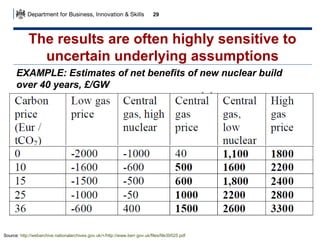
EXAMPLE: Estimates of net benefits of new nuclear build
over 40 years, £/GW

Source: http://webarchive.nationalarchives.gov.uk/+/http://www.berr.gov.uk/files/file39525.pdf
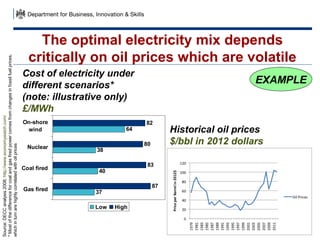
Source: DECC analysis 2008; http://www.economywatch.com/
* Most of the difference for coal and gas fired power comes from changes in fossil fuel prices,
which in turn are highly correlated with oil prices

The optimal electricity mix depends
critically on oil prices which are volatile
Cost of electricity under
different scenarios*
(note: illustrative only)
£/MWh
On-shore
wind
Nuclear

Coal fired

Gas fired

64

82

80

38

Historical oil prices
$/bbl in 2012 dollars

83

40

87

37
Low

EXAMPLE

High

30
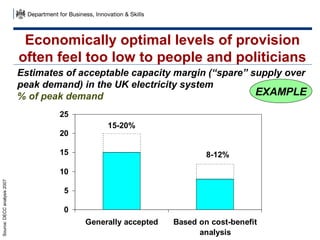
Economically optimal levels of provision
often feel too low to people and politicians
Estimates of acceptable capacity margin (“spare” supply over
peak demand) in the UK electricity system
EXAMPLE
% of peak demand
25
20

15-20%

15

8-12%

Source: DECC analysis 2007

10
5
0
Generally accepted

Based on cost-benefit
analysis
32

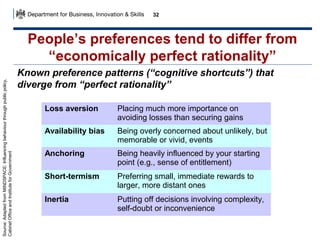
Source: Adapted from MINDSPACE: Influencing behaviour through public policy,
Cabinet Office and Institute for Government

People’s preferences tend to differ from
“economically perfect rationality”
Known preference patterns (“cognitive shortcuts”) that
diverge from “perfect rationality”
Loss aversion

Placing much more importance on
avoiding losses than securing gains

Availability bias

Being overly concerned about unlikely, but
memorable or vivid, events

Anchoring

Being heavily influenced by your starting
point (e.g., sense of entitlement)

Short-termism

Preferring small, immediate rewards to
larger, more distant ones

Inertia

Putting off decisions involving complexity,
self-doubt or inconvenience
33

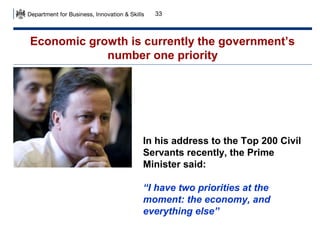
Economic growth is currently the government’s
number one priority

In his address to the Top 200 Civil
Servants recently, the Prime
Minister said:
“I have two priorities at the
moment: the economy, and
everything else”
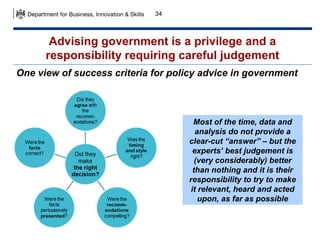
34

Advising government is a privilege and a
responsibility requiring careful judgement
One view of success criteria for policy advice in government

Most of the time, data and
analysis do not provide a
clear-cut “answer” – but the
experts’ best judgement is
(very considerably) better
than nothing and it is their
responsibility to try to make
it relevant, heard and acted
upon, as far as possible
Using cost-benefit analysis in
policy making
18 November 2013
Tera Allas
Director General, Strategic Advice
Department for Business, Innovation and Skills
36

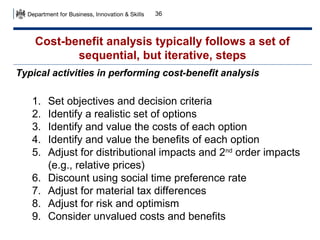
Cost-benefit analysis typically follows a set of
sequential, but iterative, steps
Typical activities in performing cost-benefit analysis

1.
2.
3.
4.
5.
6.
7.
8.
9.

Set objectives and decision criteria
Identify a realistic set of options
Identify and value the costs of each option
Identify and value the benefits of each option
Adjust for distributional impacts and 2nd order impacts
(e.g., relative prices)
Discount using social time preference rate
Adjust for material tax differences
Adjust for risk and optimism
Consider unvalued costs and benefits
37

Meeting the PM’s challenge requires policy makers
to understand what drives growth
Labour
participation
Hours worked
per capita
GDP per capita
£ ‘000
GDP
£ billion

x
Population
m

x
Labour
productivity
£ GVA* per
hour worked

First-order drivers**
include:
•
•
•
•
•
•
•
•
•
•

Aggregate demand
Incentives to work
Cost of labour
Labour market
efficiency
Skills
Competition
Trade
Enterprise
Innovation
Investment

* GVA=Gross Value Added; value of outputs (price times quantity) minus value of inputs; when aggregated up across sectors and adjusted for taxes and
subsidies, adds up to total GDP [GDP = GVA + taxes on products/services – subsidies on products/services]
** Many of the drivers are interconnected (e.g., enterprise drives innovation; trade drives competition) and are themselves driven by other factors (e.g.,
investment is driven by business environment, including interest rates, taxes, regulataory environment, planning system, etc.)
38

Policy makers should also know key economic
concepts relevant to their work
Example list of key economic concepts everyone should know

•
•
•
•
•
•
•
•
•

Marginal costs and benefits
Opportunity cost
Counterfactual
Net present value (NPV)
Market failure
Externalities
Incentives (rational choice)
Supply and demand dynamics
Creative destruction (competition)

Cost benefit analysis in policy making ta 181113

  • 1.
    Using cost-benefit analysisin policy making 18 November 2013 Tera Allas Director General, Strategic Advice Department for Business, Innovation and Skills
  • 2.
    2 Using cost-benefit analysisin policy making: outline of today’s discussion • Overall policy making process and role of cost-benefit analysis in it • The objective function(s) and decision making criteria in government policy making • Using cost-benefit analysis as a framework and quantitative tool to inform policy making and decisions • Key concepts in cost-benefit analysis without which conclusions are suspect • Challenges in applying cost-benefit analysis and the role of judgement
  • 3.
    3 While not linearin reality, the broad policy making process is made up of key stages Simplified overview of the policy making process Consultation Understand the problem Scope the policy work Collect and analyse evidence Recommend policy to Ministers Clearance: Cabinet Committee, RPC Delivery – including legislation if applicable Identify, develop and test policy options • What is the problem? • What are the outcomes? • Who are the stakeholders? • What are government’s levers? • Major overhaul or minor adjustments? • Early engagement of Ministers and Spads • From Economists and Analysts • From Stakeholders • Explore innovative solutions - does Govt have to deliver, alternatives to legislation/regulation • Weigh up – vfm, regulatory impact, links with existing policy, etc. • Test strong options with stakeholders • Identify possible ‘unintended consequences’ • Ensure Ministers make informed decisions - “no surprises” • Delivery plan project and risk management • Actions in Departmental Business Plans • Communicating the policy – Comms strategy • Monitoring and Evaluation – testing success of policy in practice
  • 4.
    4 Making a differenceto outcomes Analytical approaches have a key contribution to make in each stage Identifying issues Examples of ways in which economics and analysis add value Prioritising issues • Horizon scanning and analysis of emerging trends Developing options • Using tool-kit of potential interventions to identify options Appraising options Deciding on policy Implementing options Evaluating performance • Identifying market failures that may require rectifying • Quantifying impact of issues or problems on the economy • Connecting with citizens’ and businesses’ behaviour/incentives • Identifying 2nd order consequences through systems thinking • Modelling impacts and monetary costs/benefits of options • Helping understand risk and uncertainty in decision making • Defining meaningful performance indicators and monitoring them • Communicating messages compellingly with supporting facts • Monitoring and evaluating outcomes and reporting on them
  • 5.
    5 Slightly different frameworksare used to assess different policy instruments Main appraisal terminology and tools in use in UK government Policy instrument Appraisal tool Tax Policy costings* (annex of budget document) Spend Business cases** (5 case model) Regulation Impact assessments*** Information Depends on whether delivered through spend or regulation See for example https://www.gov.uk/government/uploads/system/uploads/attachment_data/file/221895/budget2013_policy_costings.pdf ** See for example https://www.gov.uk/government/uploads/system/uploads/attachment_data/file/190601/ Green_Book_guidance_public_sector_business_cases_using_the_Five_Case_Model_guidance.pdf *** See for example https://www.gov.uk/producing-impact-assessments-guidance-for-government-departments
  • 6.
    6 Using cost-benefit analysisin policy making: outline of today’s discussion • Overall policy making process and role of cost-benefit analysis in it • The objective function(s) and decision making criteria in government policy making • Using cost-benefit analysis as a framework and quantitative tool to inform policy making and decisions • Key concepts in cost-benefit analysis without which conclusions are suspect • Challenges in applying cost-benefit analysis and the role of judgement
  • 7.
    The basic ideabehind cost-benefit analysis is to find a policy “optimum” Gross costs and benefits Illustrative shape of costs and benefits of any area of spend Imaginary monetary units Optimum is around here Net benefits can be negative! Scale or scope or sophistication of activity 7
  • 8.
    8 Policy makers areoften faced with multiple objective functions to optimise against Objective functions in policy making Economic efficiency = “maximise economic/social welfare” Public acceptance = “maximise match with citizens’ preferences” Fairness = “maximise equity and minimise distributional distortions”
  • 9.
    9 Practical, political, legaland technical reasons lead to multiple decision criteria Key categories of decision making criteria in policy making • • • • • • • • Economic – e.g., costs and benefits, growth, jobs Financial – e.g., affordability Managerial – e.g., deliverability, risk profile Commercial – e.g., contractual liabilities Social – e.g., distributional impacts, regional impacts Environmental – e.g., sustainability, air quality Legal – e.g., Human Rights, Data Protection, EU law Other – e.g., information management requirements, health and safety, consumer focus, design quality
  • 10.
    10 Cost-benefit analysis isfocused on optimising economic welfare EXAMPLE: Economic welfare benefits of science and innovation “Pure” economic benefits Scientific discoveries E.g., penicillin, un-aerobic digestion Innovations E.g., text messaging, high-efficiency gas boilers E.g., lower resource costs, consumer/user convenience Societal benefits E.g., improved care of the elderly, community cohesion Environmental benefits E.g., lower depletion of natural capital, lower emissions Total economic welfare
  • 11.
    11 Economic welfare isnot exactly the same as GDP or growth – but is related Very roughly (!) Economic welfare = GDP + consumer surplus +/- externalities Price level Aggregate demand Prices of labour, goods and services Aggregate supply Consumer surplus GDP [at prevailing prices, taxes and subsidies] Output Quantity of goods and services bought and sold * Nominal growth – where nominal GDP grows because prices of labour, goods and services increase (inflation) – does not increase employment, living standards or the Government’s fiscal position (and therefore ability to offer public services); real growth (which strips out inflation) is the appropriate policy goal
  • 12.
    International comparisons ofGDP per capita and life satisfaction Mean life satisfaction Source: The Hidden Wealth of Nations, David Halpern (Gallup data; graph from Angus Deaton, Harvard) GDP is often used as an additional metric due to comparability and relevance The size of the circles corresponds to population size GDP per capita in 2003, 2000 PPP
  • 13.
    13 Using cost-benefit analysisin policy making: outline of today’s discussion • Overall policy making process and role of cost-benefit analysis in it • The objective function(s) and decision making criteria in government policy making • Using cost-benefit analysis as a framework and quantitative tool to inform policy making and decisions • Key concepts in and elements of cost-benefit analysis without which conclusions are suspect • Challenges in applying cost-benefit analysis and the role of judgement
  • 14.
    14 As mentioned, economicwelfare is one of several considerations in decision making EXAMPLE: Department for Transport decision framework [1/3]
  • 15.
    15 As mentioned, economicwelfare is one of several considerations in decision making EXAMPLE: Department for Transport decision framework [2/3]
  • 16.
    16 As mentioned, economicwelfare is one of several considerations in decision making EXAMPLE: Department for Transport decision framework [3/3]
  • 17.
    17 Cost-benefit analysis takesinto account quantitative and qualitative factors EXAMPLE: Department for Transport value-for-money framework
  • 18.
    18 Often it isimpossible to conclude much without some element of quantification EXAMPLE: Possible costs and benefits of new nuclear power relative to a counterfactual of new gas fired power stations Type Costs Benefits Economic • • • • • • • Development costs Transmission costs Construction costs Cost of capital Waste disposal costs Decommissioning costs Potential health and safety costs and/or risks • • • • • • • Fear of accidents Fear of terrorism • Social • Lower fuel costs Lower operating costs Longer economic life Potential benefits from diversity Potential innovation spill-overs and export potential Potentially lower electricity prices improving competitiveness of industry • Environmental • • Potential contamination Potential landscape issues Regeneration in potentially deprived communities Potential re-skilling of workforce • • Lower CO2 and other emissions Fuel source sustainability
  • 19.
    19 For example, timesavings are often the biggest element of transport benefits EXAMPLE: Quantified benefits of roads investment £1,800 £1,600 Time and Money Savings: Transport Providers £1,400 Millions Millions (NPV) £1,200 £1,000 £800 Time and Money Savings: Consumers £600 £400 £200 £0 Carbon Savings Accident Savings A421 Improvements: M1 Junction 13 to Bedford. Source: Department for Transport Total Benefits
  • 20.
    20 Using cost-benefit analysisin policy making: outline of today’s discussion • Overall policy making process and role of cost-benefit analysis in it • The objective function(s) and decision making criteria in government policy making • Using cost-benefit analysis as a framework and quantitative tool to inform policy making and decisions • Key concepts in and elements of cost-benefit analysis without which conclusions are suspect • Challenges in applying cost-benefit analysis and the role of judgement
  • 21.
    21 There are afew fundamental concepts that underpin robust cost-benefit analysis Key concepts underpinning cost-benefit analysis • • • • • • • • • Rationale for intervention Time value of money Counterfactual Additionality Monetisation (valuation) Dynamic effects Optimism bias Risk Option value
  • 22.
    22 Government intervention isjustified when markets fail to deliver an optimal outcome Rationale for government intervention Type Explanation Key reasons Economic efficiency Market failures mean that the market-driven outcome diverges from a socially optimal outcome Public goods •Non-rival (e.g., clean air) or non-excludable (e.g., defence) •Problems of free-riding Externalities •Costs or benefits are not priced by market and do not accrue to the agent responsible for generating them •Positive (e.g., R&D) and negative (e.g., pollution) effects Imperfect information •Problems of inefficiency, asymmetry and moral hazard Market power •Problems of super-normal rents and under-investment Equity Market-driven outcomes are considered inequitable Differential impacts on different groups •E.g., city dwellers vs. rural population •Problems of “winners” and “losers” Marginal propensity to consume •Marginal value (utility) of consumption is higher for lower-income individuals
  • 23.
    23 Appraisal attempts toestimate a monetary value for many non-market goods “Goods” for which monetary values can be used in appraisal • • • • • • • • • • Air quality Noise Crime Ambiance CO2 emissions Time savings Health (QUALY) Life Regeneration Reliability
  • 24.
    24 It is importantto consider 2nd order price and other dynamic effects EXAMPLE: Dynamic effects of improved energy efficiency Price level Price of a unit of “comfort” (e.g., warmth, light, time, convenience) Demand Original supply New supply Quantity of “comfort” Quantity of “comfort” supplied and demanded at any price level Improvements in energy efficiency may in fact result in higher CO2 emissions
  • 25.
    25 Optimism bias needsto be factored into cost and benefit calculations EXAMPLE: Cost estimates for High Speed 2 Date Source Estimate March 2010 DfT £17bn June 2013 DfT £42bn July 2013 Boris Johnson £70bn August 2013 Institute of Economic Affairs £80bn Source: http://en.wikipedia.org/wiki/High_Speed_2
  • 26.
    26 Using cost-benefit analysisin policy making: outline of today’s discussion • Overall policy making process and role of cost-benefit analysis in it • The objective function(s) and decision making criteria in government policy making • Using cost-benefit analysis as a framework and quantitative tool to inform policy making and decisions • Key concepts in and elements of cost-benefit analysis without which conclusions are suspect • Challenges in applying cost-benefit analysis and the role of judgement
  • 27.
    It is impossibleto say in the abstract what type of transport projects are best Benefit-to-cost ratios of different typesvs. BCR All approved schemes, capital cost of transport projects 10 BCR Benefit-cost-ratio (BCR) Source: DfT VfM database 2010 Road EXAMPLE Bus and local PT 9 Rail B Walking and cycling 8 7 6 A 5 4 3 2 1 0 £0-20m 1 £20-50m 2 £50-100m 3 £100-250m 4 Capital cost band Capital cost band £250-500m 5 £500m-1bn 6 >£1bn 7 27
  • 28.
    28 Traditional cost-benefit analysiscan leave out important macroeconomic effects EXAMPLE: Estimates of Crossrail benefits and costs Crossrail's Estimated Benefits 40 Costs 35 Move to more productive jobs 30 £bn 25 Labour force participation 20 Imperfect Competition 15 10 Agglomeration 5 Business Time Savings 0 GDP Source: Crossrail and Department for Transport Cost
  • 29.
    29 The results areoften highly sensitive to uncertain underlying assumptions EXAMPLE: Estimates of net benefits of new nuclear build over 40 years, £/GW Source: http://webarchive.nationalarchives.gov.uk/+/http://www.berr.gov.uk/files/file39525.pdf
  • 30.
    Source: DECC analysis2008; http://www.economywatch.com/ * Most of the difference for coal and gas fired power comes from changes in fossil fuel prices, which in turn are highly correlated with oil prices The optimal electricity mix depends critically on oil prices which are volatile Cost of electricity under different scenarios* (note: illustrative only) £/MWh On-shore wind Nuclear Coal fired Gas fired 64 82 80 38 Historical oil prices $/bbl in 2012 dollars 83 40 87 37 Low EXAMPLE High 30
  • 31.
    Economically optimal levelsof provision often feel too low to people and politicians Estimates of acceptable capacity margin (“spare” supply over peak demand) in the UK electricity system EXAMPLE % of peak demand 25 20 15-20% 15 8-12% Source: DECC analysis 2007 10 5 0 Generally accepted Based on cost-benefit analysis
  • 32.
    32 Source: Adapted fromMINDSPACE: Influencing behaviour through public policy, Cabinet Office and Institute for Government People’s preferences tend to differ from “economically perfect rationality” Known preference patterns (“cognitive shortcuts”) that diverge from “perfect rationality” Loss aversion Placing much more importance on avoiding losses than securing gains Availability bias Being overly concerned about unlikely, but memorable or vivid, events Anchoring Being heavily influenced by your starting point (e.g., sense of entitlement) Short-termism Preferring small, immediate rewards to larger, more distant ones Inertia Putting off decisions involving complexity, self-doubt or inconvenience
  • 33.
    33 Economic growth iscurrently the government’s number one priority In his address to the Top 200 Civil Servants recently, the Prime Minister said: “I have two priorities at the moment: the economy, and everything else”
  • 34.
    34 Advising government isa privilege and a responsibility requiring careful judgement One view of success criteria for policy advice in government Most of the time, data and analysis do not provide a clear-cut “answer” – but the experts’ best judgement is (very considerably) better than nothing and it is their responsibility to try to make it relevant, heard and acted upon, as far as possible
  • 35.
    Using cost-benefit analysisin policy making 18 November 2013 Tera Allas Director General, Strategic Advice Department for Business, Innovation and Skills
  • 36.
    36 Cost-benefit analysis typicallyfollows a set of sequential, but iterative, steps Typical activities in performing cost-benefit analysis 1. 2. 3. 4. 5. 6. 7. 8. 9. Set objectives and decision criteria Identify a realistic set of options Identify and value the costs of each option Identify and value the benefits of each option Adjust for distributional impacts and 2nd order impacts (e.g., relative prices) Discount using social time preference rate Adjust for material tax differences Adjust for risk and optimism Consider unvalued costs and benefits
  • 37.
    37 Meeting the PM’schallenge requires policy makers to understand what drives growth Labour participation Hours worked per capita GDP per capita £ ‘000 GDP £ billion x Population m x Labour productivity £ GVA* per hour worked First-order drivers** include: • • • • • • • • • • Aggregate demand Incentives to work Cost of labour Labour market efficiency Skills Competition Trade Enterprise Innovation Investment * GVA=Gross Value Added; value of outputs (price times quantity) minus value of inputs; when aggregated up across sectors and adjusted for taxes and subsidies, adds up to total GDP [GDP = GVA + taxes on products/services – subsidies on products/services] ** Many of the drivers are interconnected (e.g., enterprise drives innovation; trade drives competition) and are themselves driven by other factors (e.g., investment is driven by business environment, including interest rates, taxes, regulataory environment, planning system, etc.)
  • 38.
    38 Policy makers shouldalso know key economic concepts relevant to their work Example list of key economic concepts everyone should know • • • • • • • • • Marginal costs and benefits Opportunity cost Counterfactual Net present value (NPV) Market failure Externalities Incentives (rational choice) Supply and demand dynamics Creative destruction (competition)

Editor's Notes

  • #13 But economic growth is not just about closing the structural deficit and being able to finance public sector expenditure going forward. Economic growth also underpins citizens’ well-being and quality of life. International studies demonstrate that – on average – countries with higher levels of prosperity also display higher levels of life satisfaction.