WHAT IS AN ECOLOGY
The branch of biology
that deals with the
relations of organisms
to one another and to
their physical
surroundings.
WHAT IS AN ECOSYSTEM
An ecosystem is the unit
composed of all the living
things in a single place at
a given time, in addition
to, the important non-
living components of the
system.
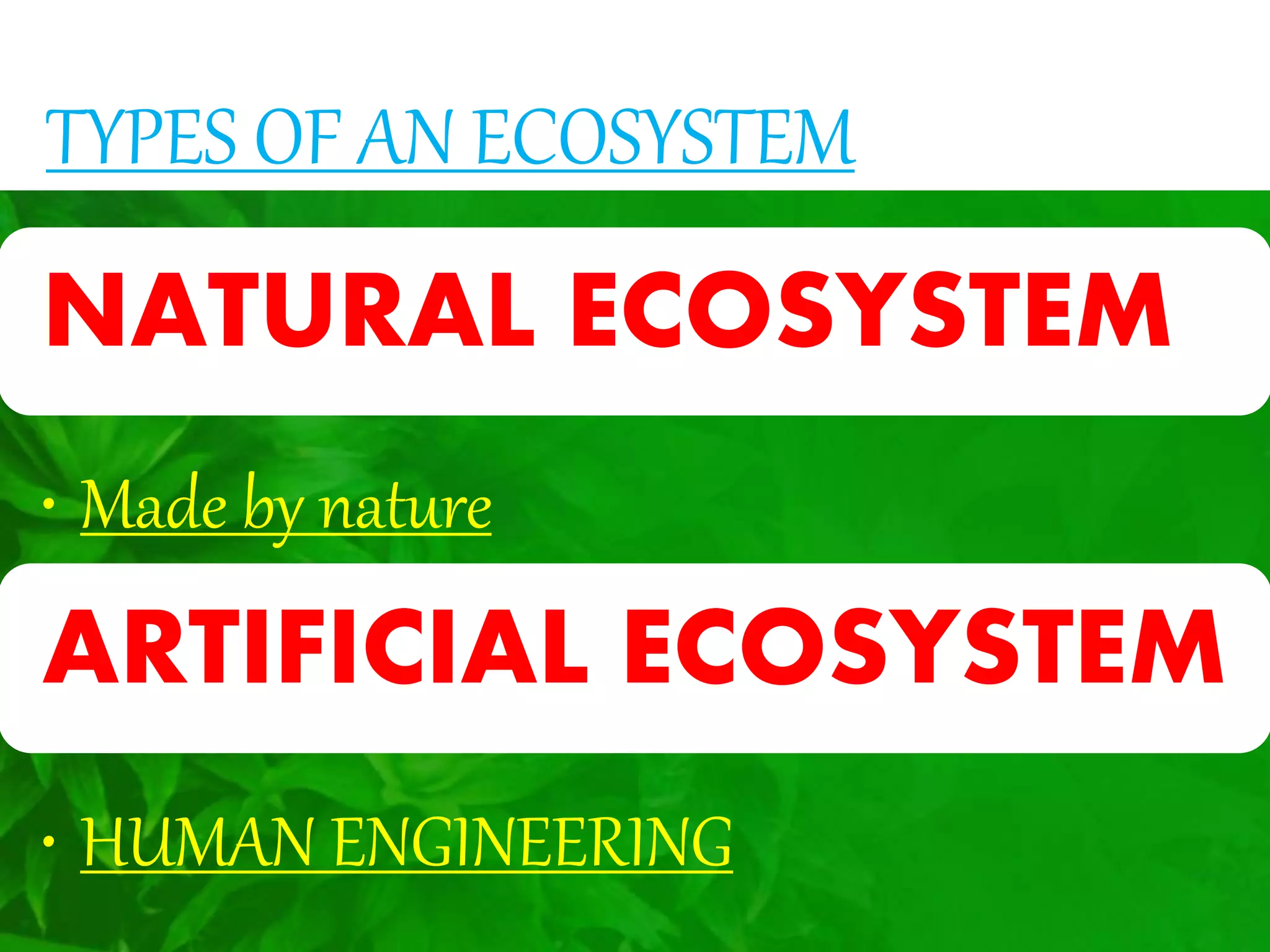
TYPES OF AN ECOSYSTEM
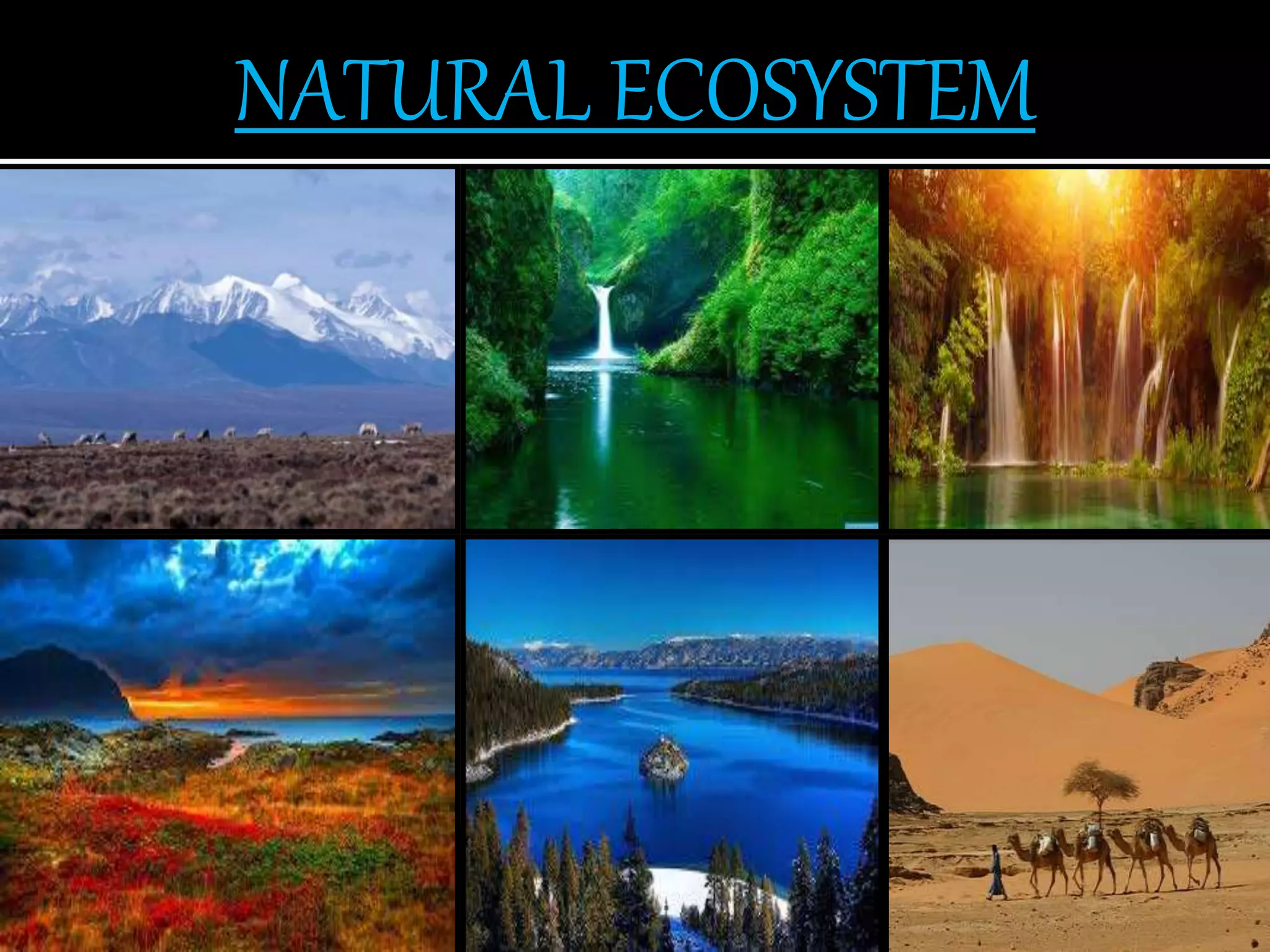
NATURAL ECOSYSTEM
• Made by nature
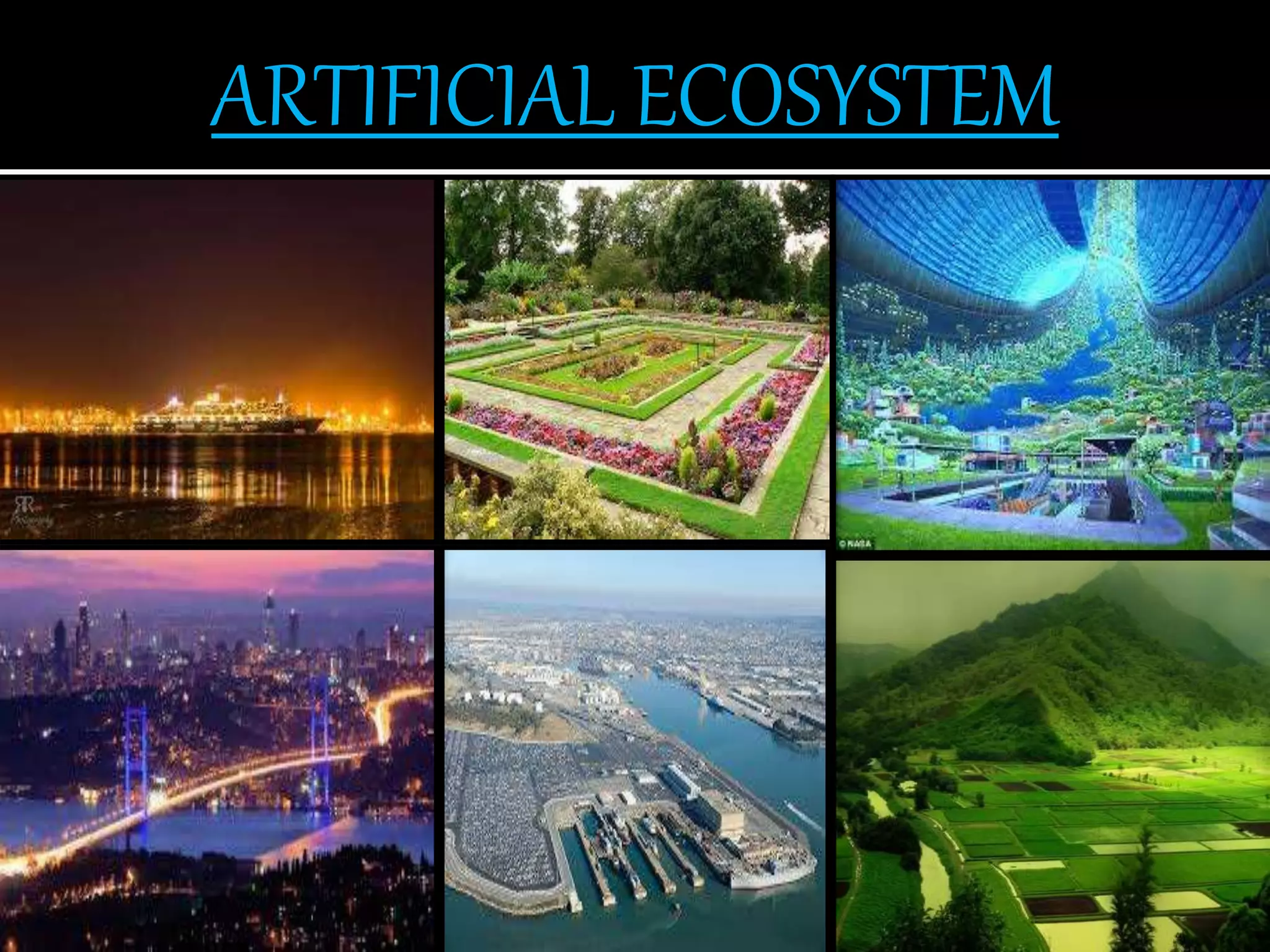
ARTIFICIAL ECOSYSTEM
• HUMAN ENGINEERING
NATURAL ECOSYSTEM
ARTIFICIAL ECOSYSTEM
STRUCTURE OF AN ECOSYSTEM
BIOTIC COMPONENTS
• LIVING THINGS
ABIOTIC COMPONENTS
• NON LIVING THINGS
BIOTIC COMPONENTS
DECOMPOSERS
DETRITIVORES MICRO-ORGANISMS
CONSUMERS
HETEROTROPHS ANIMALS
PRODUCERS
AUTOTROPHS SELF FEEDERS
CONSUMERS CLASSIFICATION
•HERBIVOREPRIMARY
•CARNIVORESECONDARY
•OMNIVORETERTIARY
BIOTIC COMPONENTS
ABIOTIC COMPONENTS
ECOSYSTEM SERVICES
FUNCTIONS OF AN ECOSYSTEM
FOOD CHAIN
FOOD WEB
ENERGY FLOW CHART
FOOD CHAIN
FOOD WEB
ENERGY FLOW CHART
EFFECT OF HUMAN
ACTIVITIES ON ECOSYTEM
A person cuts down a tree to let more sunlight shine on a
small garden. Now think about some of the consequences of
this action. For instance, before the tree was cut down, birds
and insects used it for food, shelter, and nesting. Now the tree
can no longer provide the birds and insects with these
resources. As well, the insects, worms, and other organisms
that lived in and among the tree’s living roots can no longer
get the resources they need to sustain them.
Human activities always cause changes to ecosystems. For
example, in the situation in the first paragraph, many
organisms have lost their living space and their source of
food. As well, the area around the garden is now fully
exposed to sunlight instead of being shaded from it. This will
change the way that the soil holds rainwater. Plants that
grew well in shaded conditions will also die.
The changes caused by human activities always
have consequences for the biotic and abiotic parts of
ecosystems.
HUMAN ACTIVITIES ABIOTIC AND BIOTIC
CONSEQUENCES
• Surface soil is removed,
killing soil organisms and
plants that were rooted in the
soil.
• Farmland that is taken over
to build roads and buildings
can no longer be used to
grow crops and livestock.
•Soil and plant life are
removed to make space
to build factories and
landfill sites for the solid
wastes that the factories
produce.
CONSTRUCTION OF ROADS
AND BUILDINGS
MANUFACTURING AND
CONSUMPTION STORE
Ecosystem and Ecology

Ecosystem and Ecology

  • 2.
    WHAT IS ANECOLOGY The branch of biology that deals with the relations of organisms to one another and to their physical surroundings.
  • 3.
    WHAT IS ANECOSYSTEM An ecosystem is the unit composed of all the living things in a single place at a given time, in addition to, the important non- living components of the system.
  • 4.
    TYPES OF ANECOSYSTEM NATURAL ECOSYSTEM • Made by nature ARTIFICIAL ECOSYSTEM • HUMAN ENGINEERING
  • 5.
  • 6.
  • 7.
    STRUCTURE OF ANECOSYSTEM BIOTIC COMPONENTS • LIVING THINGS ABIOTIC COMPONENTS • NON LIVING THINGS
  • 8.
  • 9.
  • 10.
  • 11.
  • 12.
  • 13.
    FUNCTIONS OF ANECOSYSTEM FOOD CHAIN FOOD WEB ENERGY FLOW CHART
  • 14.
  • 15.
  • 16.
  • 17.
  • 18.
    A person cutsdown a tree to let more sunlight shine on a small garden. Now think about some of the consequences of this action. For instance, before the tree was cut down, birds and insects used it for food, shelter, and nesting. Now the tree can no longer provide the birds and insects with these resources. As well, the insects, worms, and other organisms that lived in and among the tree’s living roots can no longer get the resources they need to sustain them. Human activities always cause changes to ecosystems. For example, in the situation in the first paragraph, many organisms have lost their living space and their source of food. As well, the area around the garden is now fully exposed to sunlight instead of being shaded from it. This will change the way that the soil holds rainwater. Plants that grew well in shaded conditions will also die. The changes caused by human activities always have consequences for the biotic and abiotic parts of ecosystems.
  • 19.
    HUMAN ACTIVITIES ABIOTICAND BIOTIC CONSEQUENCES • Surface soil is removed, killing soil organisms and plants that were rooted in the soil. • Farmland that is taken over to build roads and buildings can no longer be used to grow crops and livestock. •Soil and plant life are removed to make space to build factories and landfill sites for the solid wastes that the factories produce. CONSTRUCTION OF ROADS AND BUILDINGS MANUFACTURING AND CONSUMPTION STORE