A Complex Web of Life
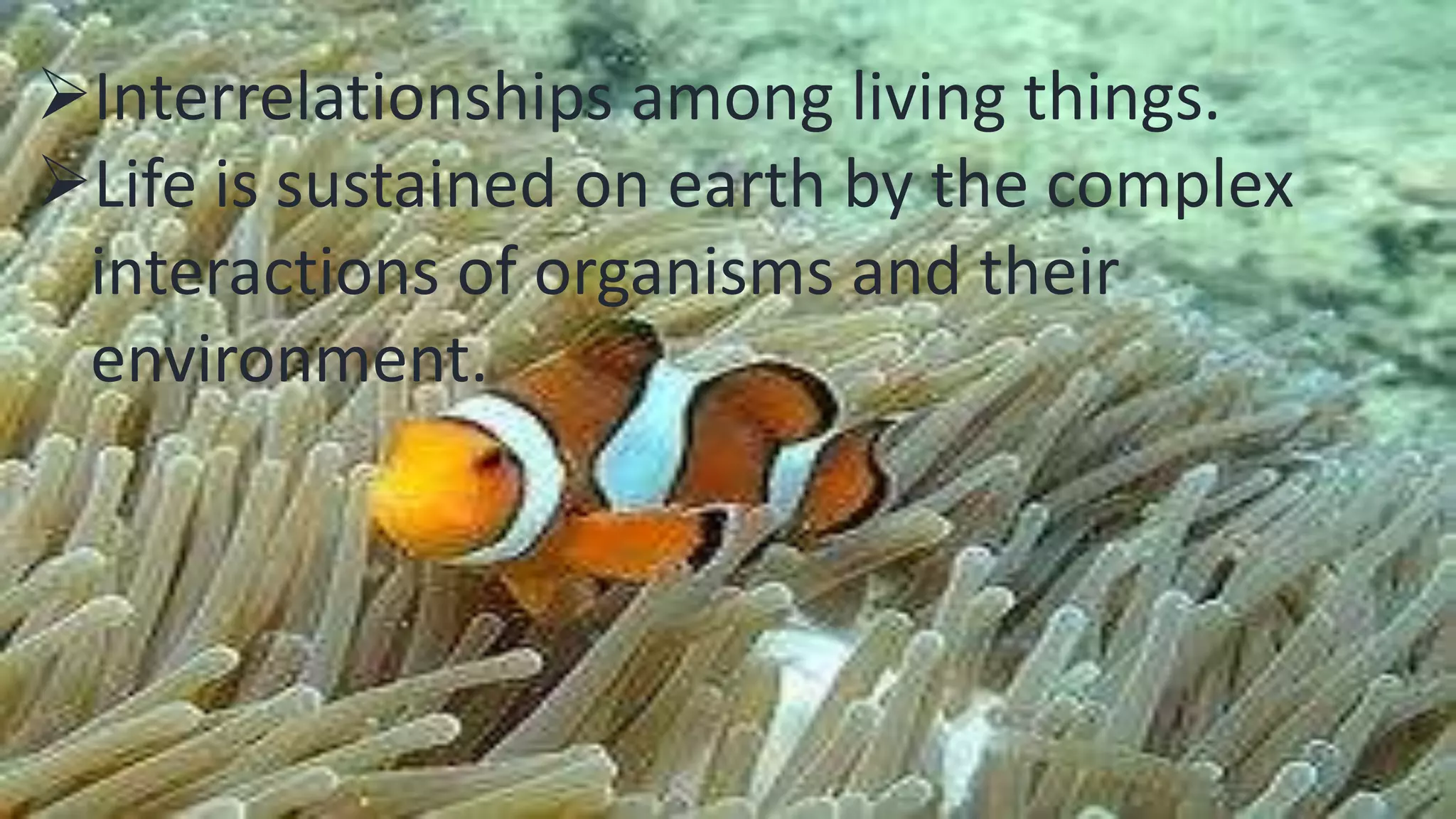
Interrelationships among living things.
Life is sustained on earth by the complex
interactions of organisms and their
environment.
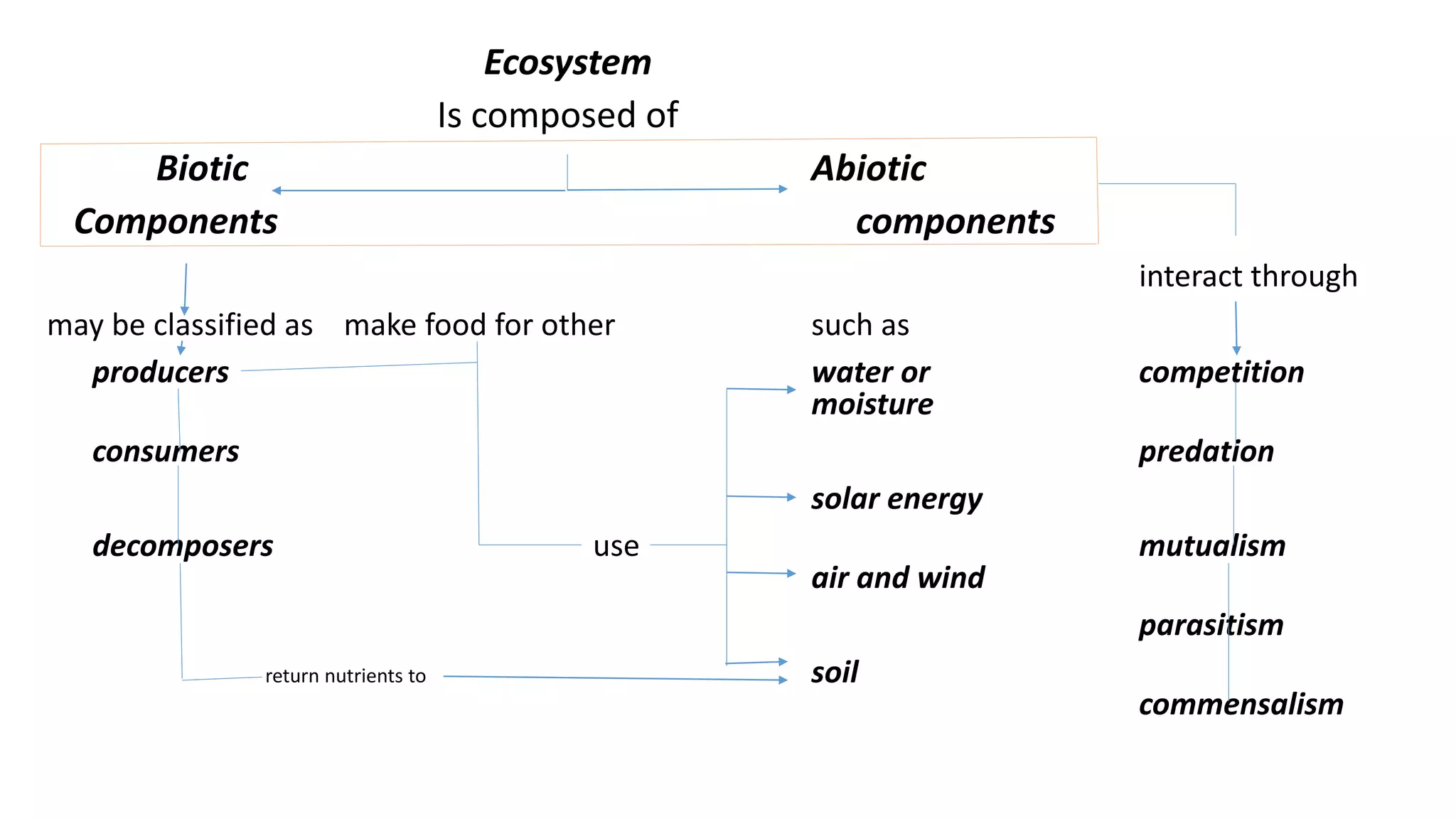
Ecosystem
Is composed of
Biotic Abiotic
Components components
interact through
may be classified as make food for other such as
producers water or competition
moisture
consumers predation
solar energy
decomposers use mutualism
air and wind
parasitism
return nutrients to soil
commensalism
Ecological Way
of Life
Basic Units of Ecology
Organisms interact with their environment at several ecological
levels.
Life on earth is a complex web of life. Organisms continually
interact with one another and with their environment.
Ecology is the science which tries to understand how and why
these kinds of interaction happen. In simple terms, ecology is the
study of the relationships and interactions of living things with one
another and with their external environment. Ecology comes from
the Greek word oikos which means “house,” and logos which means
“to study.”
Scientists who study these interactions are called ecologists. They
ask questions like:
• What animals and plants live in this lake or forest?
• How do they interact with each other and with their physical
environment?
• What changes will this lake or forest undergo over time?
Ecologists therefor study both the nonliving or physical
environment, and the living environment. Ecology involves learning
about ways living things and non livings and nonliving world interact
to support life.
To make sense of the complexity of our world, ecologists
often speak of various layers of ecological organization
described as the following:
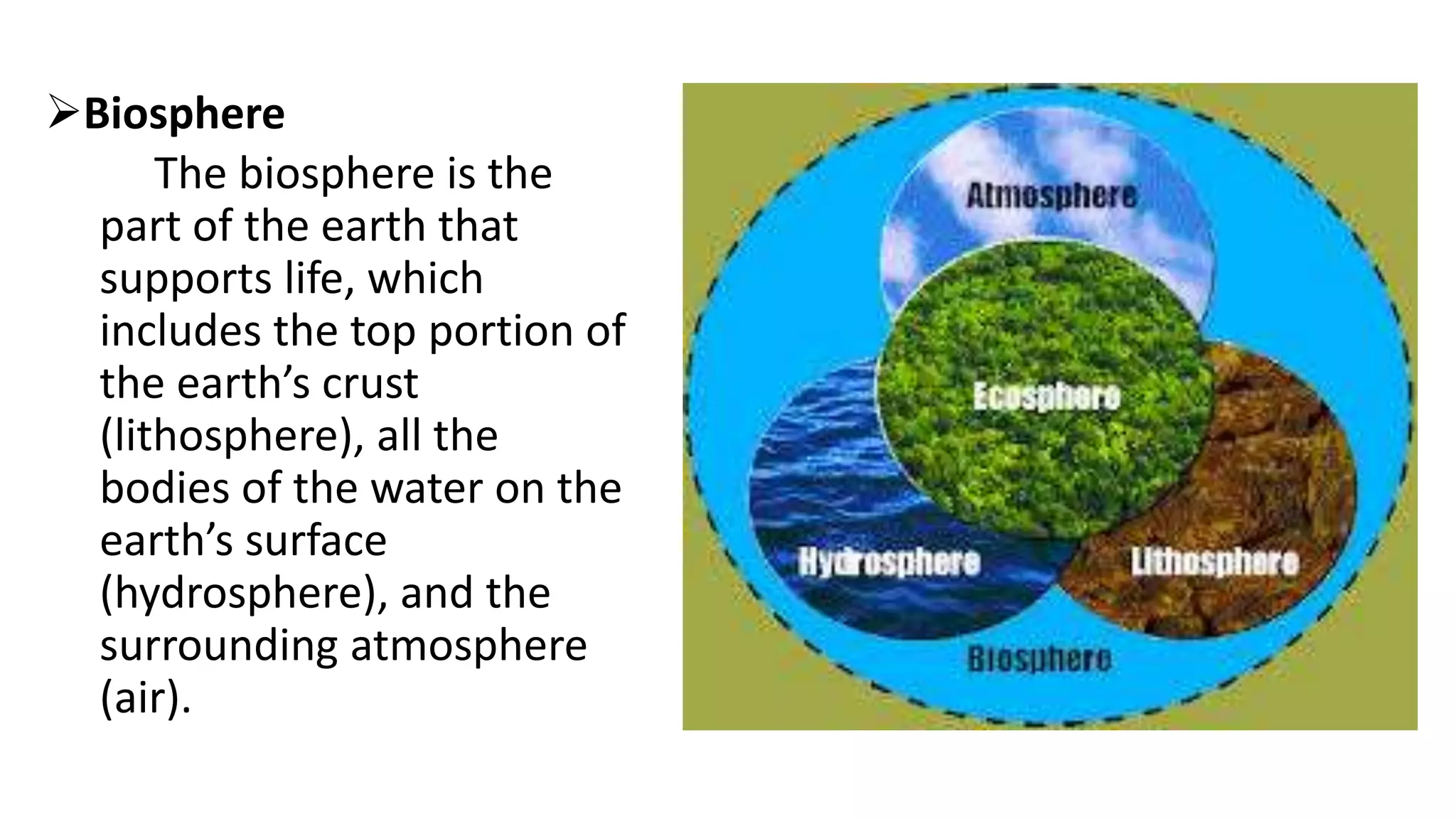
Biosphere
The biosphere is the
part of the earth that
supports life, which
includes the top portion of
the earth’s crust
(lithosphere), all the
bodies of the water on the
earth’s surface
(hydrosphere), and the
surrounding atmosphere
(air).
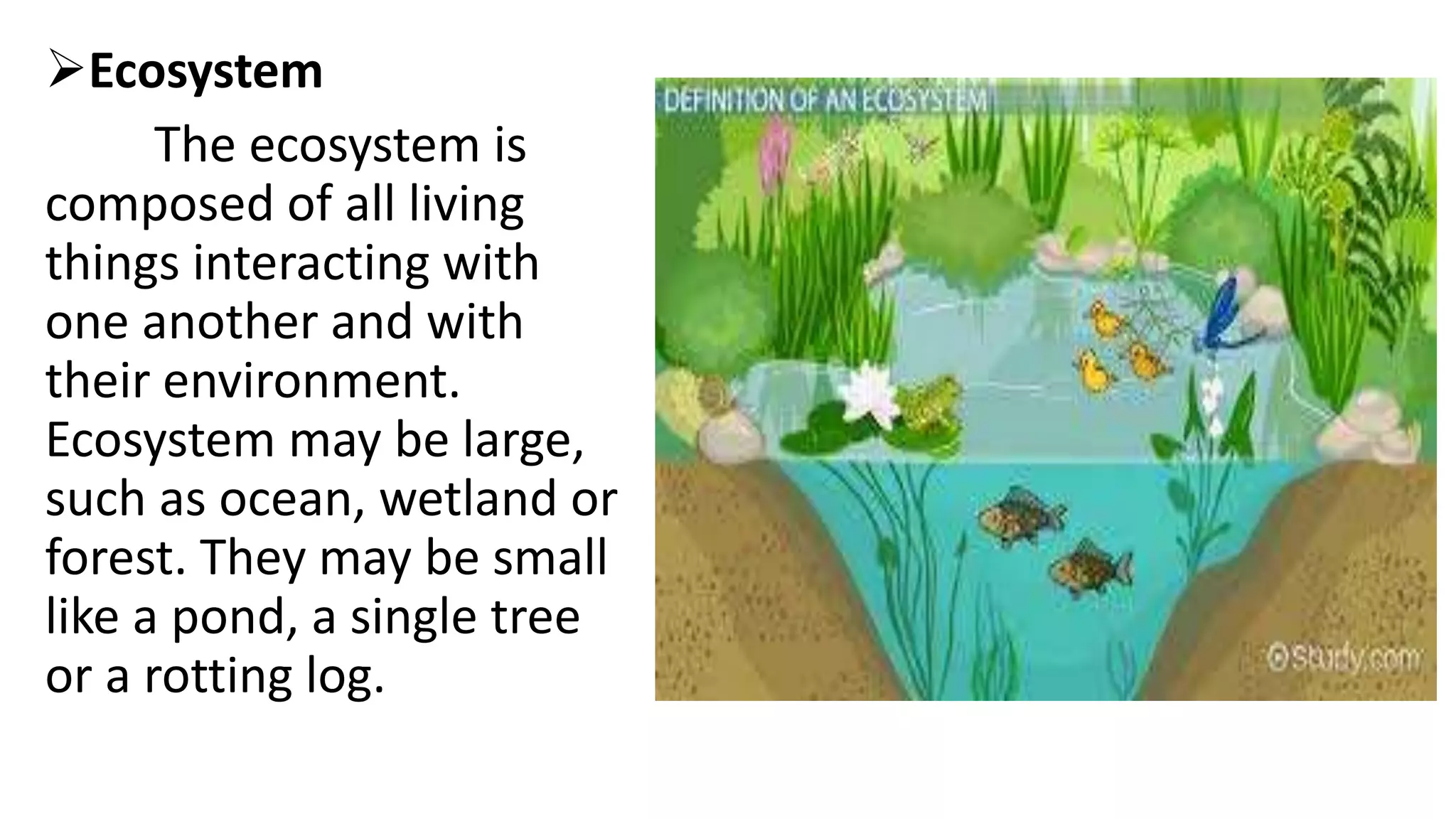
Ecosystem
The ecosystem is
composed of all living
things interacting with
one another and with
their environment.
Ecosystem may be large,
such as ocean, wetland or
forest. They may be small
like a pond, a single tree
or a rotting log.
Community
A community consists of
different species of organisms
that interact with each other in a
given area. A species is a group
of organisms that share general
physical characteristics and are
able to interbreed and produce
offspring. A community is made
up of all populations in a given
habitat. The variety of life forms
is collectively known as
biological diversity or
biodiversity.
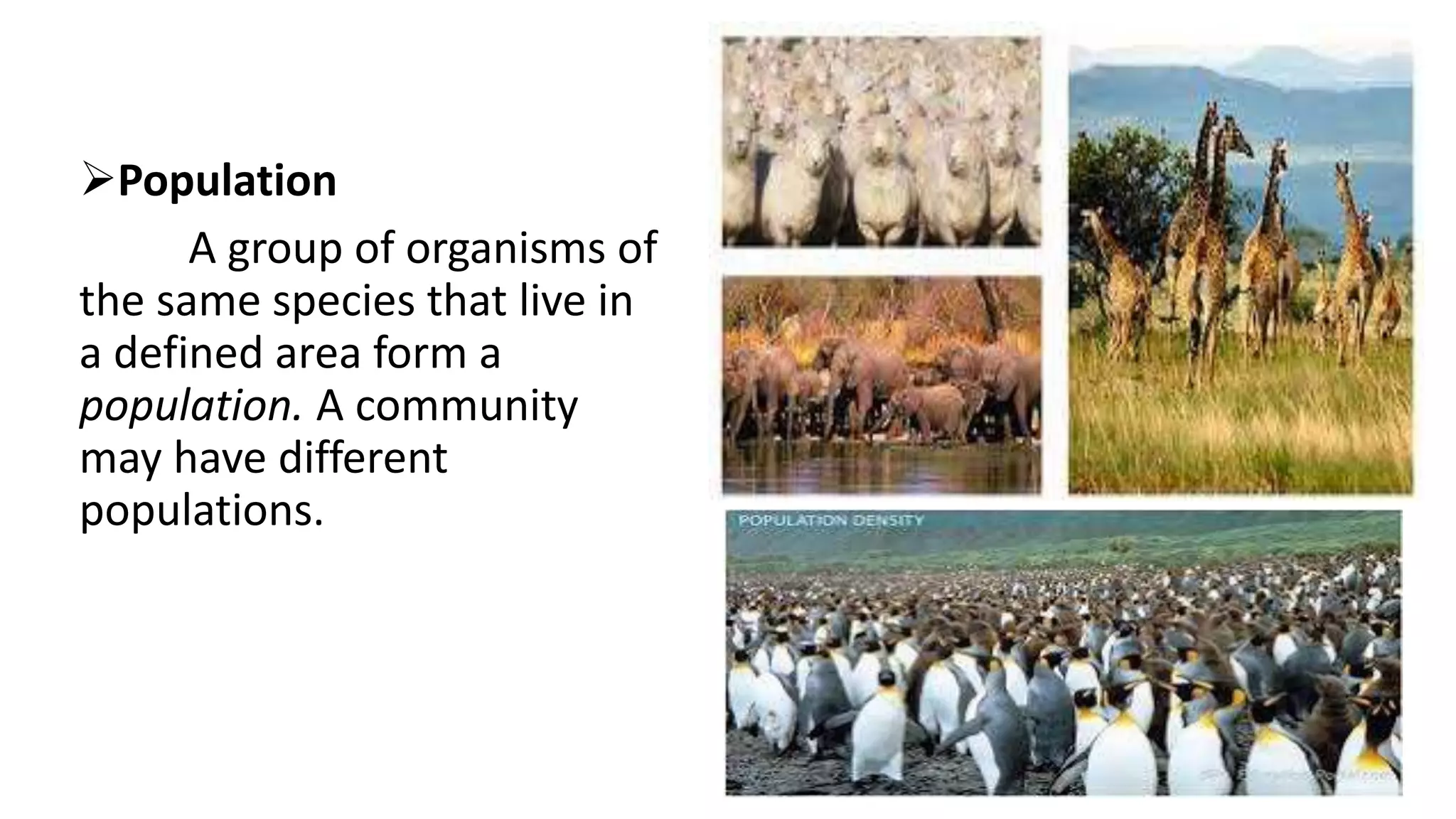
Population
A group of organisms of
the same species that live in
a defined area form a
population. A community
may have different
populations.
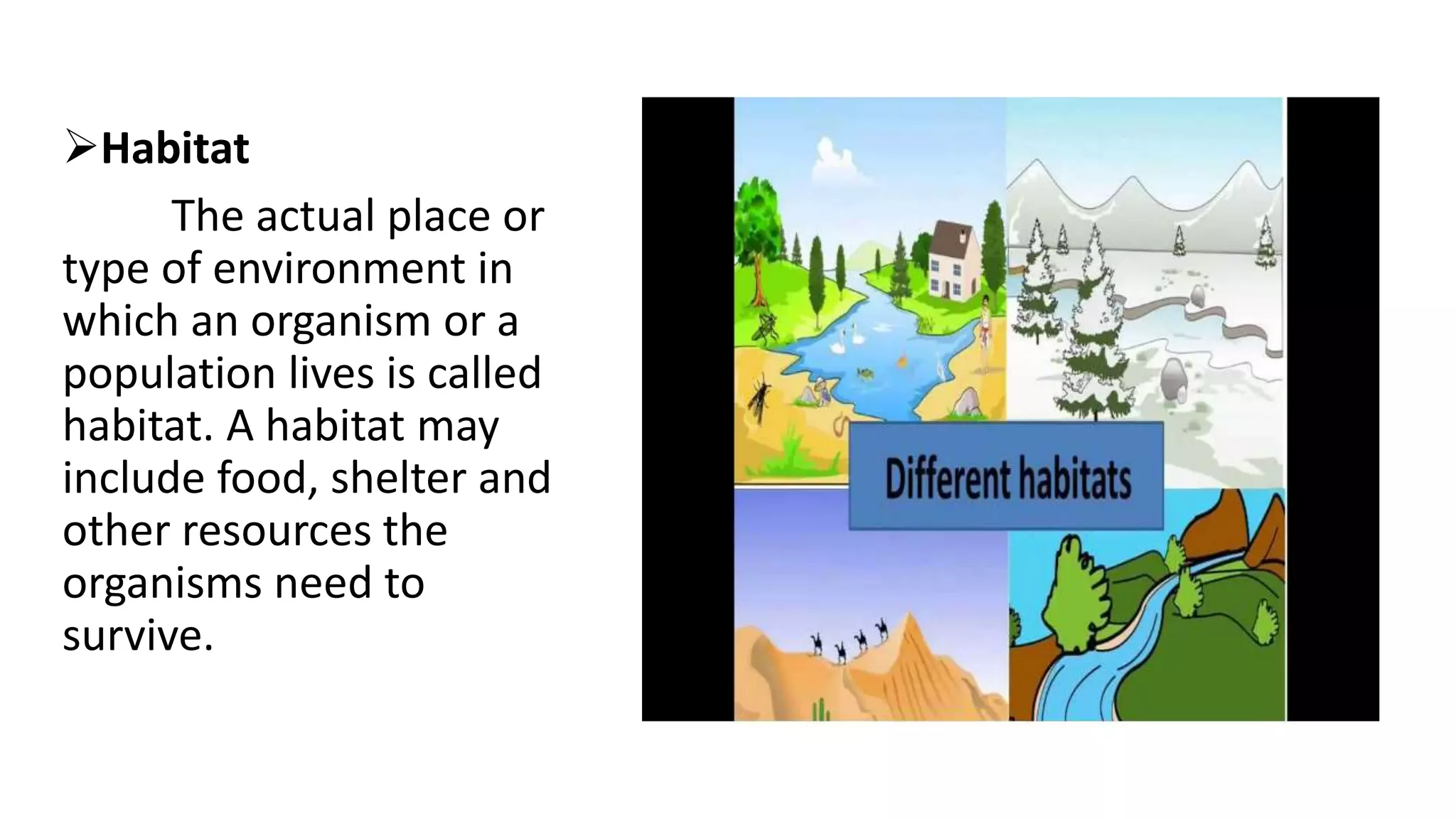
Habitat
The actual place or
type of environment in
which an organism or a
population lives is called
habitat. A habitat may
include food, shelter and
other resources the
organisms need to
survive.
And it’s
Components
The number and variety of organisms on earth are affected by
the living and nonliving components of the environment.
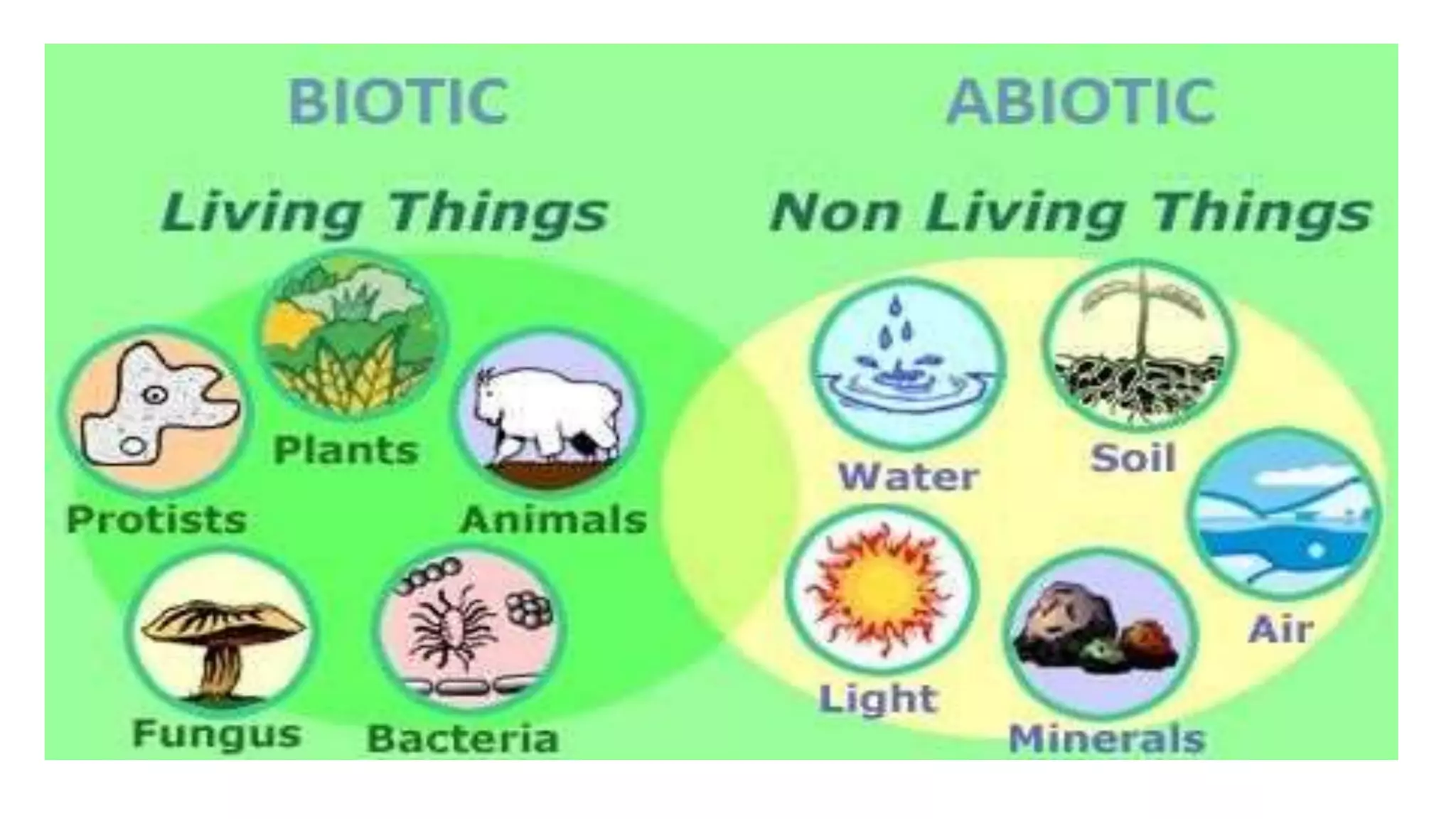
An ecosystem is a community of plants, animals and
microorganisms that interact with their physical environment and
depend on each other for survival. The term “ecosystem” was coined
by the British plant ecologist Sir Arthur George Tansley to show that a
habitat is a system in which its biotic (living) and abiotic (non-living)
components constantly interact.
The biotic component of an ecosystem is made up of two groups
of organisms: those that can produce their own food, called producers
or autotrophs such as plants, and those that consume or eat other
organisms called consumers or heterotrophs such as animals. A special
type of consumers that feed on dead plants and animals are known as
decomposers, which include bacteria.
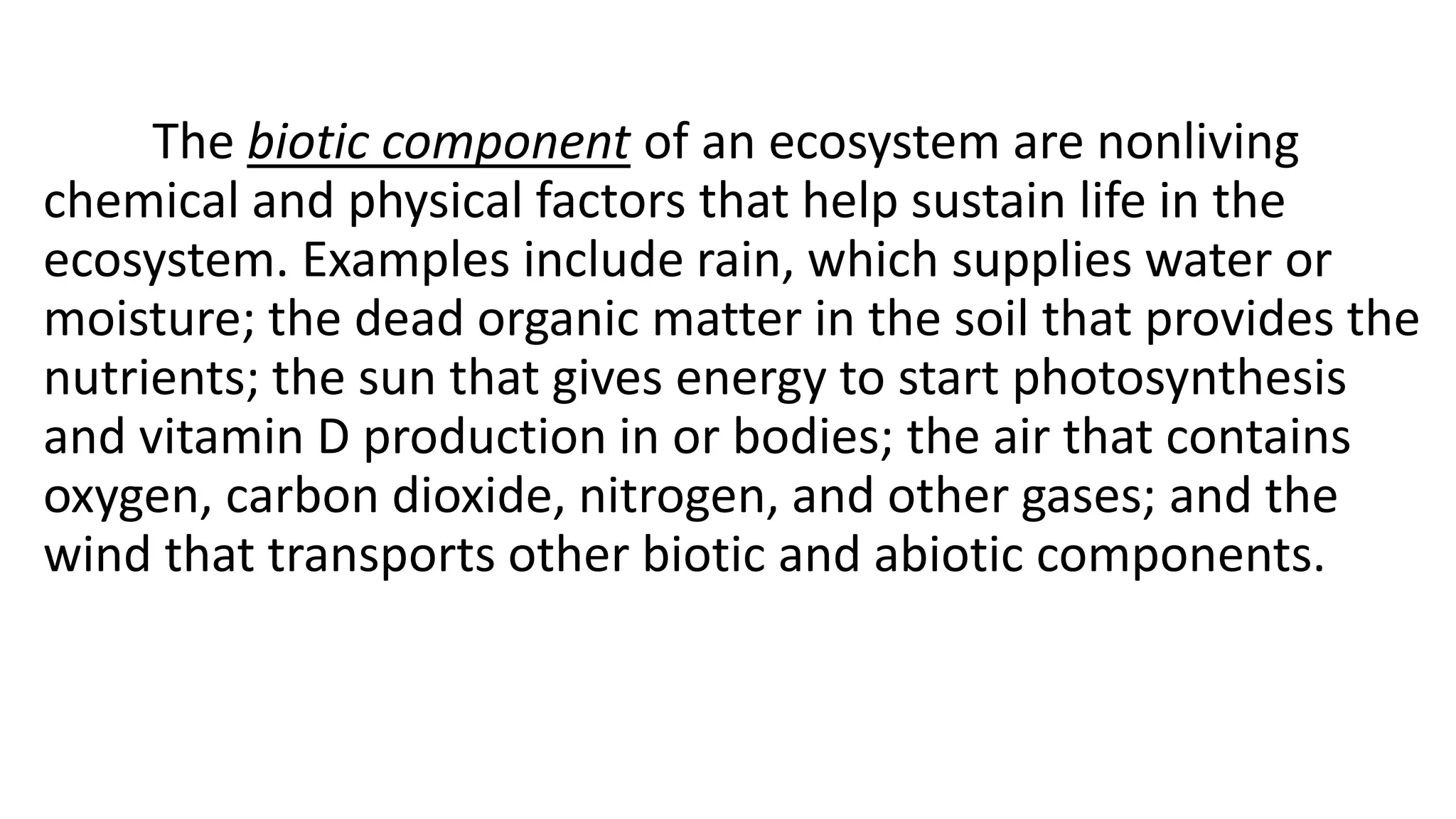
The biotic component of an ecosystem are nonliving
chemical and physical factors that help sustain life in the
ecosystem. Examples include rain, which supplies water or
moisture; the dead organic matter in the soil that provides the
nutrients; the sun that gives energy to start photosynthesis
and vitamin D production in or bodies; the air that contains
oxygen, carbon dioxide, nitrogen, and other gases; and the
wind that transports other biotic and abiotic components.
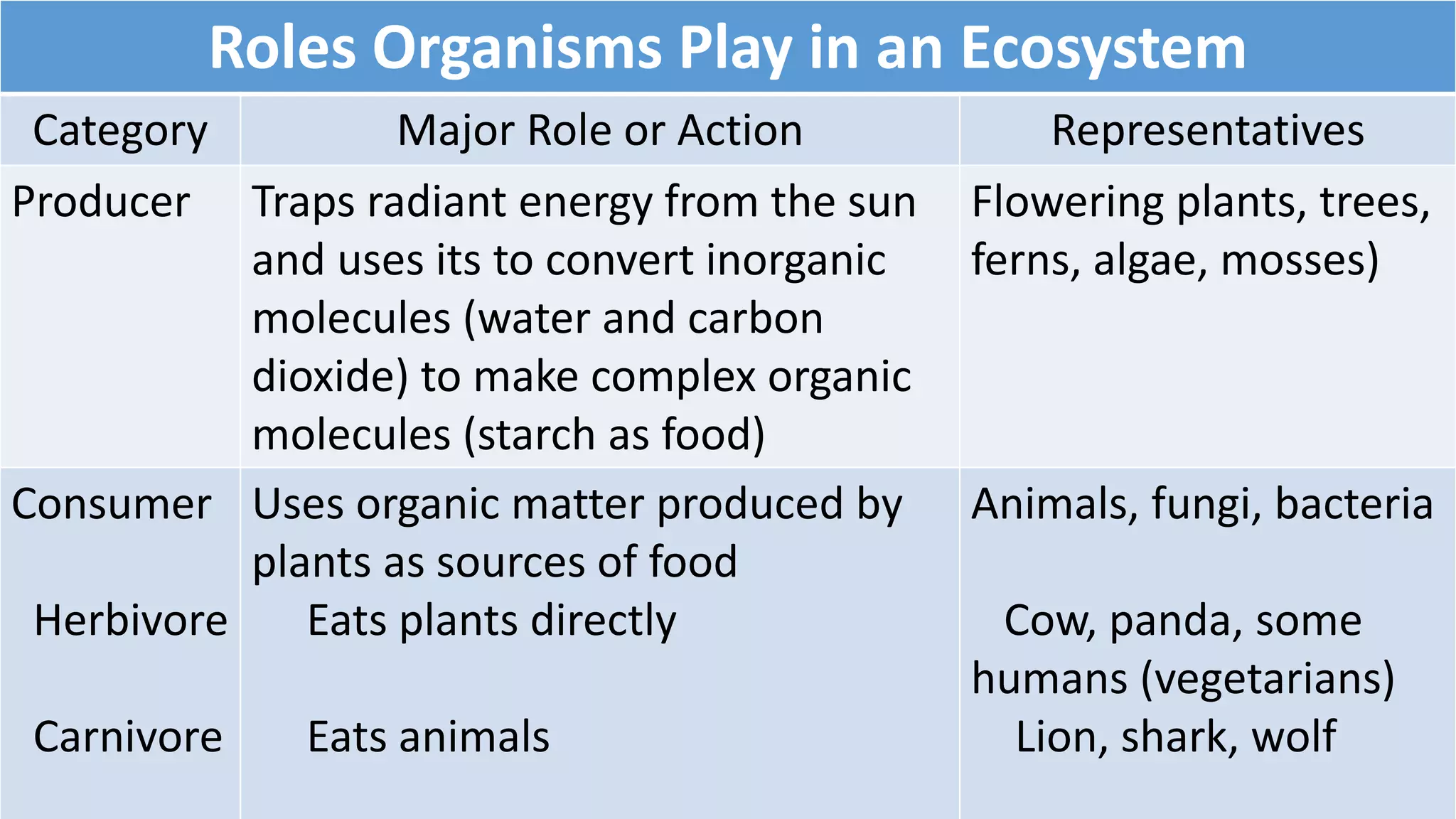
Roles Organisms Play in an Ecosystem
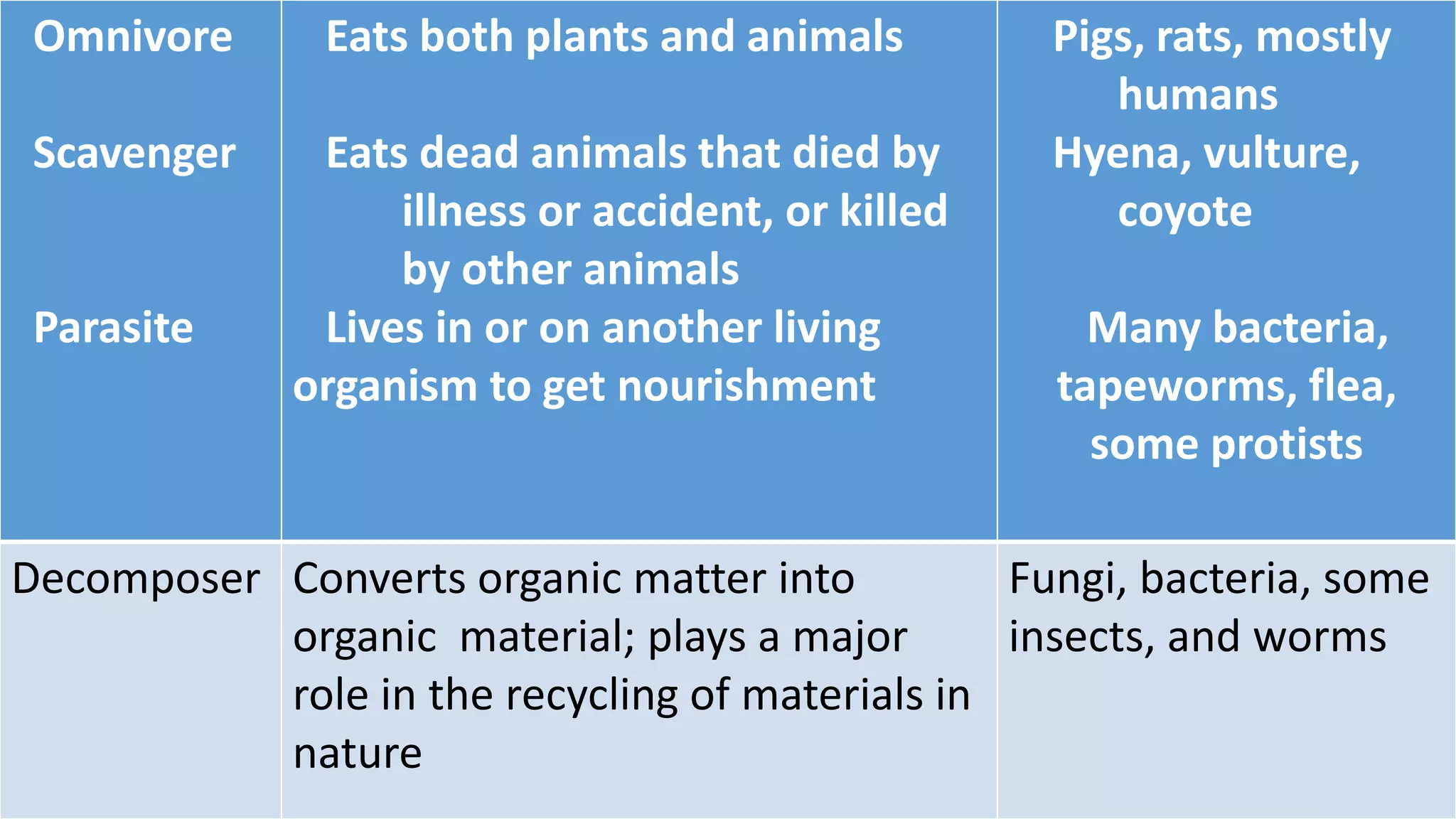
Category Major Role or Action Representatives
Producer Traps radiant energy from the sun
and uses its to convert inorganic
molecules (water and carbon
dioxide) to make complex organic
molecules (starch as food)
Flowering plants, trees,
ferns, algae, mosses)
Consumer
Herbivore
Carnivore
Uses organic matter produced by
plants as sources of food
Eats plants directly
Eats animals
Animals, fungi, bacteria
Cow, panda, some
humans (vegetarians)
Lion, shark, wolf
Omnivore
Scavenger
Parasite
Eats both plants and animals
Eats dead animals that died by
illness or accident, or killed
by other animals
Lives in or on another living
organism to get nourishment
Pigs, rats, mostly
humans
Hyena, vulture,
coyote
Many bacteria,
tapeworms, flea,
some protists
Decomposer Converts organic matter into
organic material; plays a major
role in the recycling of materials in
nature
Fungi, bacteria, some
insects, and worms
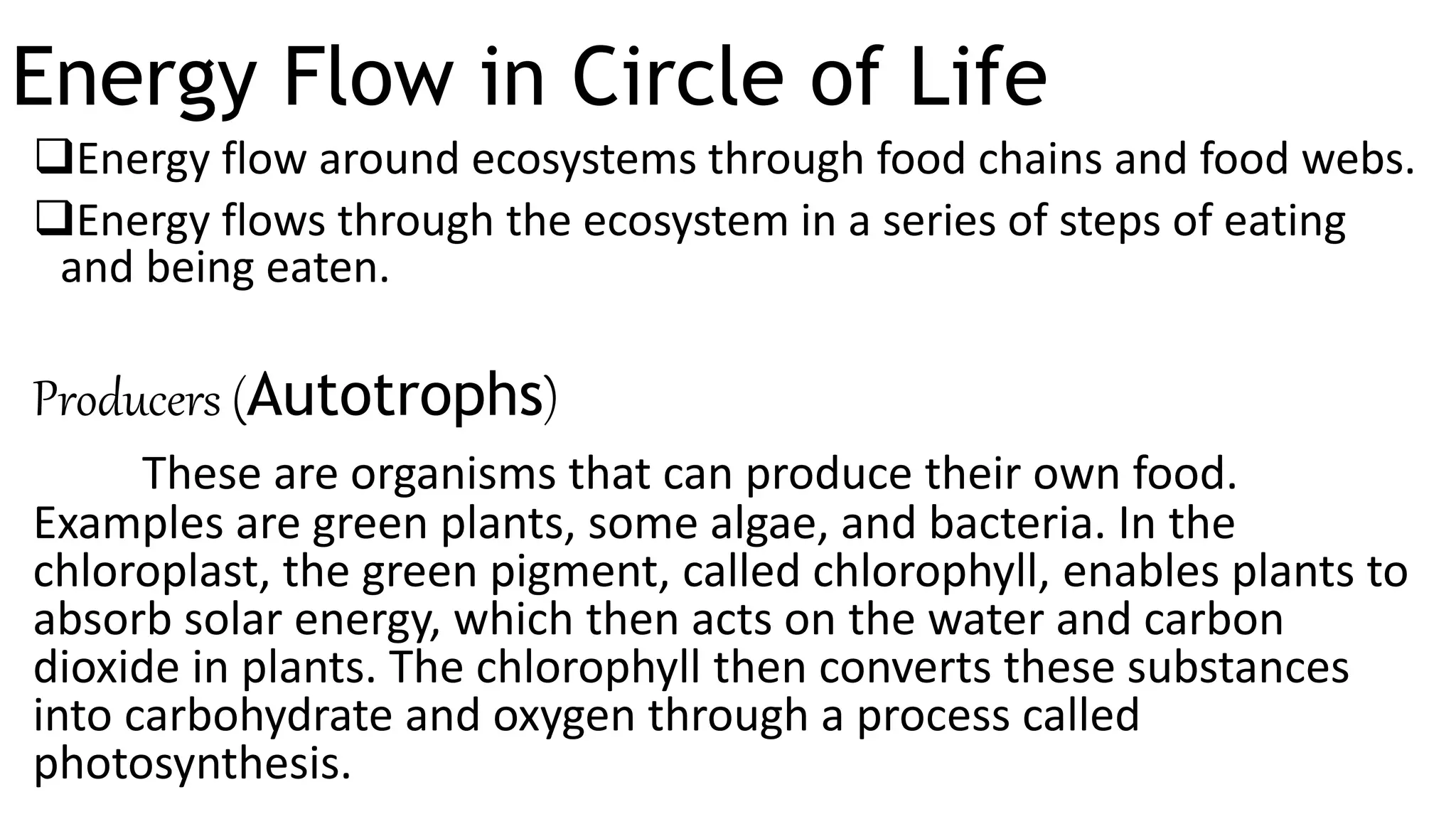
Energy Flow in Circle of Life
Energy flow around ecosystems through food chains and food webs.
Energy flows through the ecosystem in a series of steps of eating
and being eaten.
Producers (Autotrophs)
These are organisms that can produce their own food.
Examples are green plants, some algae, and bacteria. In the
chloroplast, the green pigment, called chlorophyll, enables plants to
absorb solar energy, which then acts on the water and carbon
dioxide in plants. The chlorophyll then converts these substances
into carbohydrate and oxygen through a process called
photosynthesis.
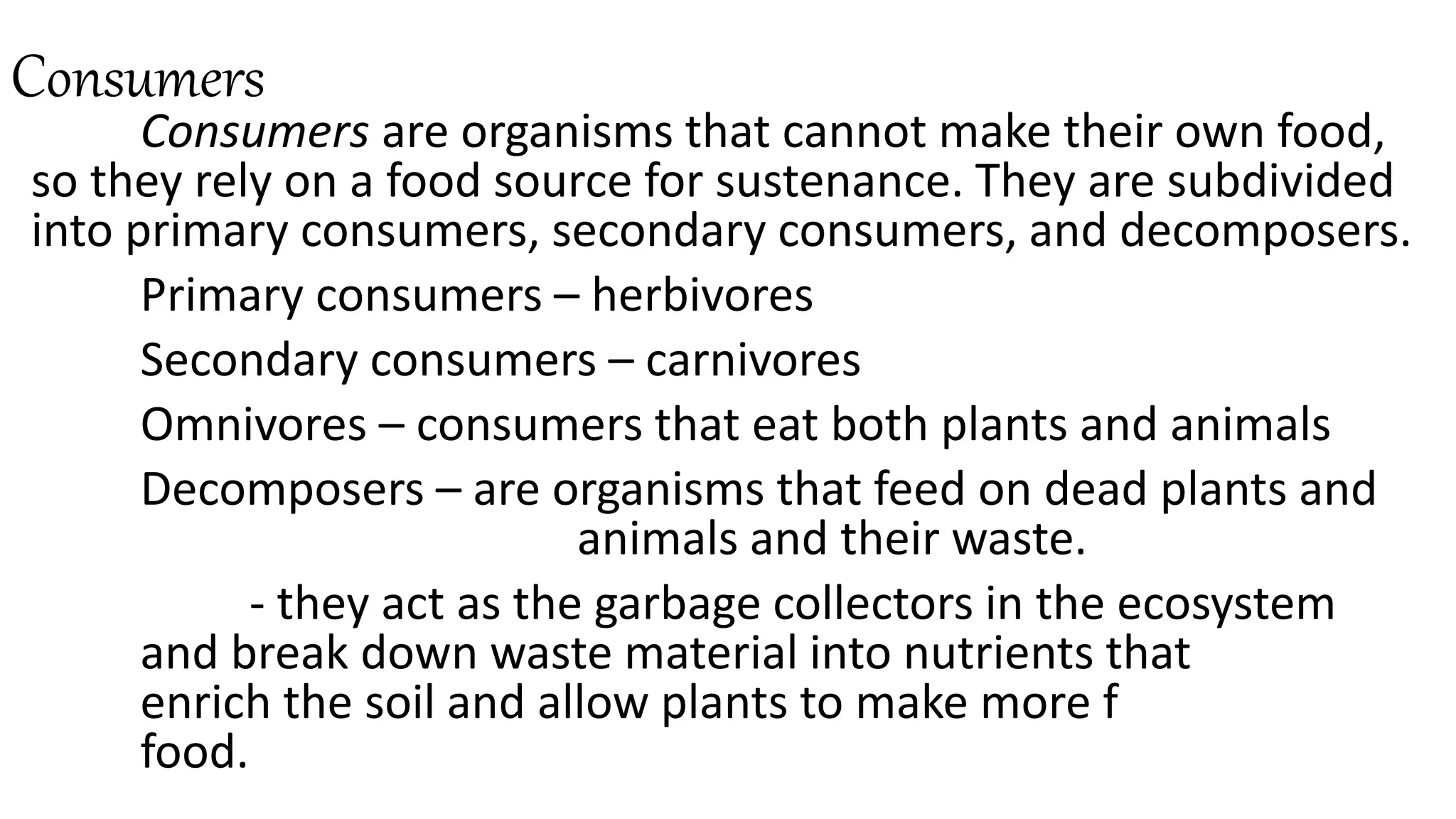
Consumers
Consumers are organisms that cannot make their own food,
so they rely on a food source for sustenance. They are subdivided
into primary consumers, secondary consumers, and decomposers.
Primary consumers – herbivores
Secondary consumers – carnivores
Omnivores – consumers that eat both plants and animals
Decomposers – are organisms that feed on dead plants and
animals and their waste.
- they act as the garbage collectors in the ecosystem
and break down waste material into nutrients that
enrich the soil and allow plants to make more f
food.
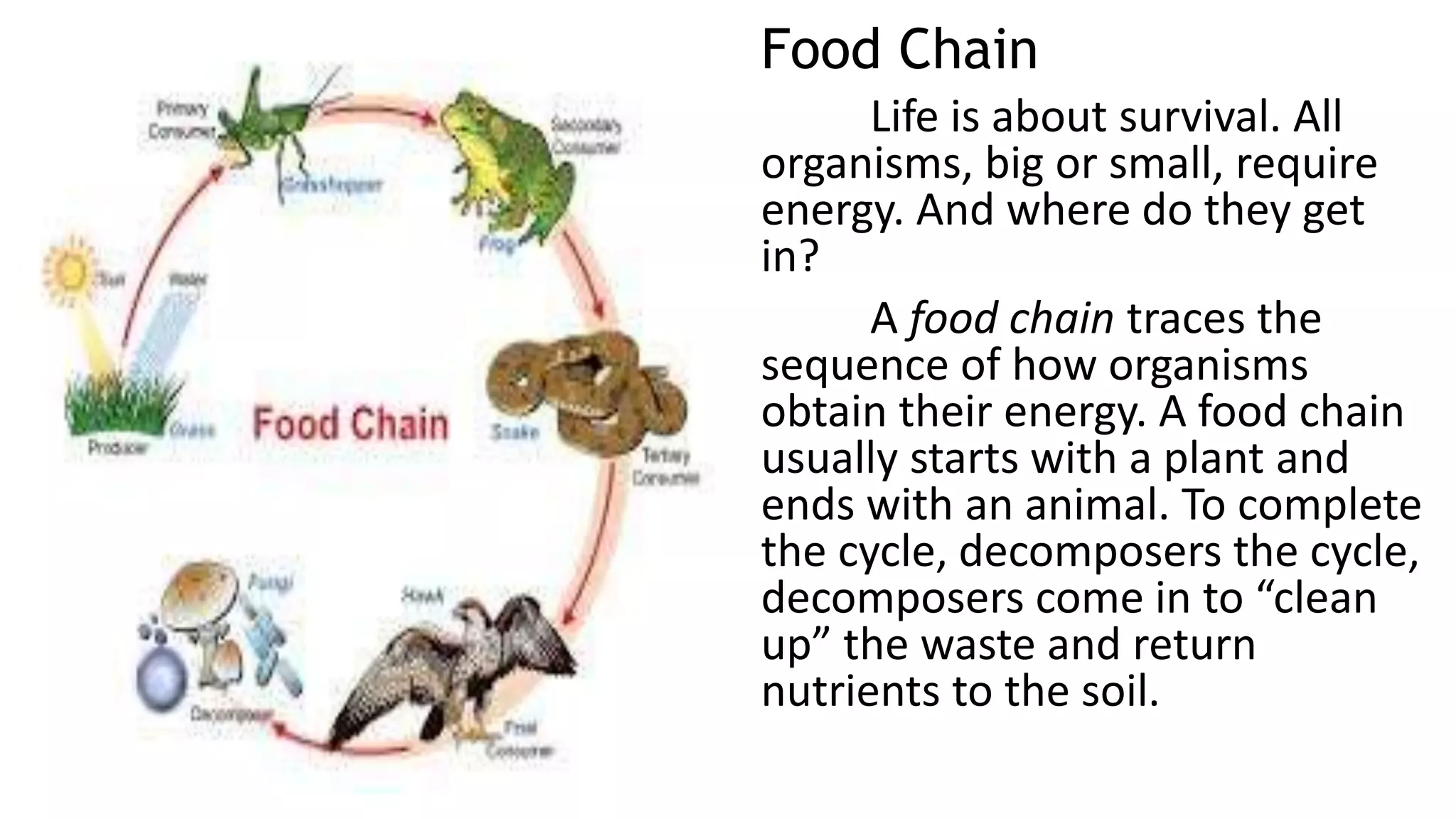
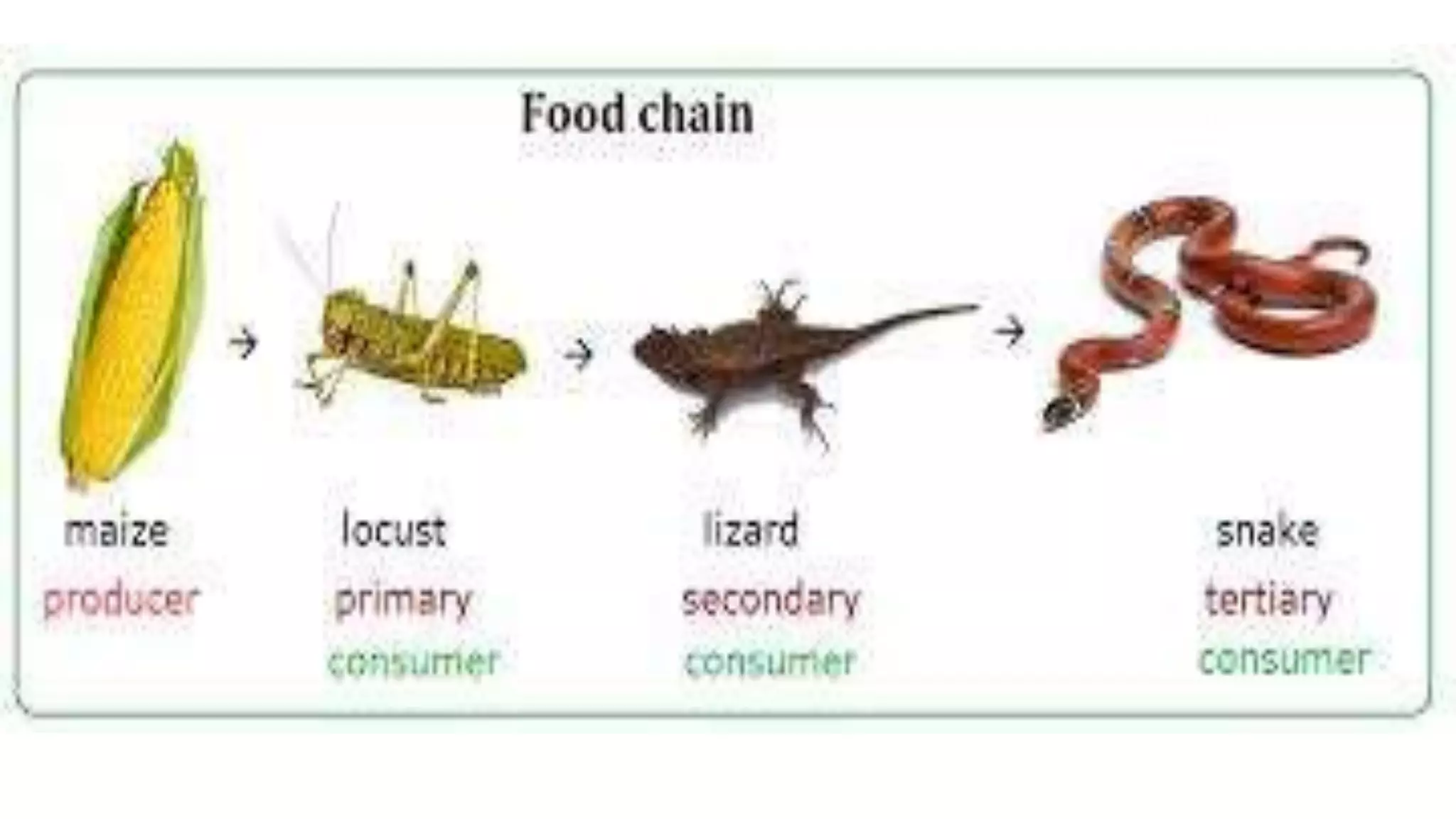
Food Chain
Life is about survival. All
organisms, big or small, require
energy. And where do they get
in?
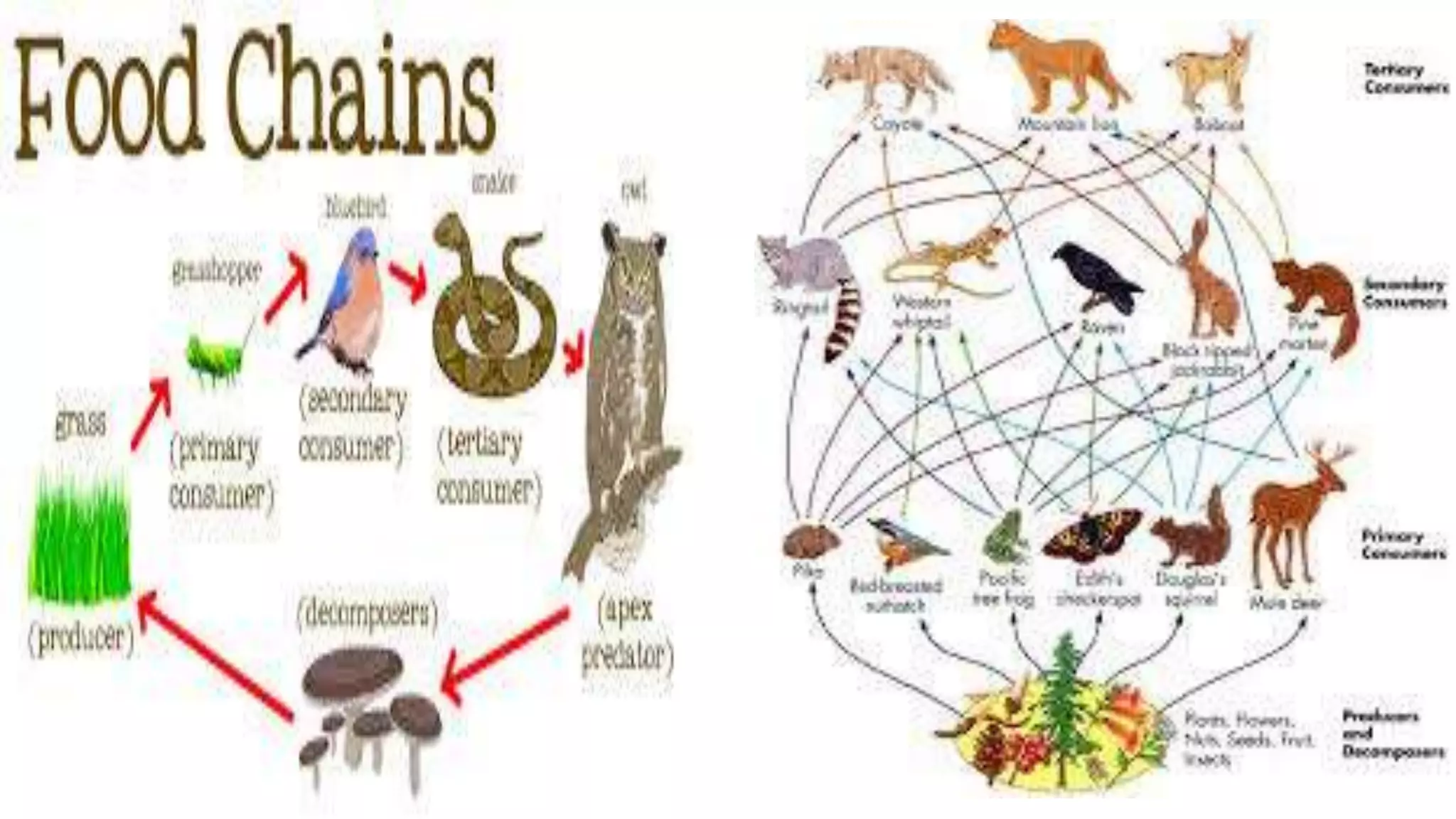
A food chain traces the
sequence of how organisms
obtain their energy. A food chain
usually starts with a plant and
ends with an animal. To complete
the cycle, decomposers the cycle,
decomposers come in to “clean
up” the waste and return
nutrients to the soil.
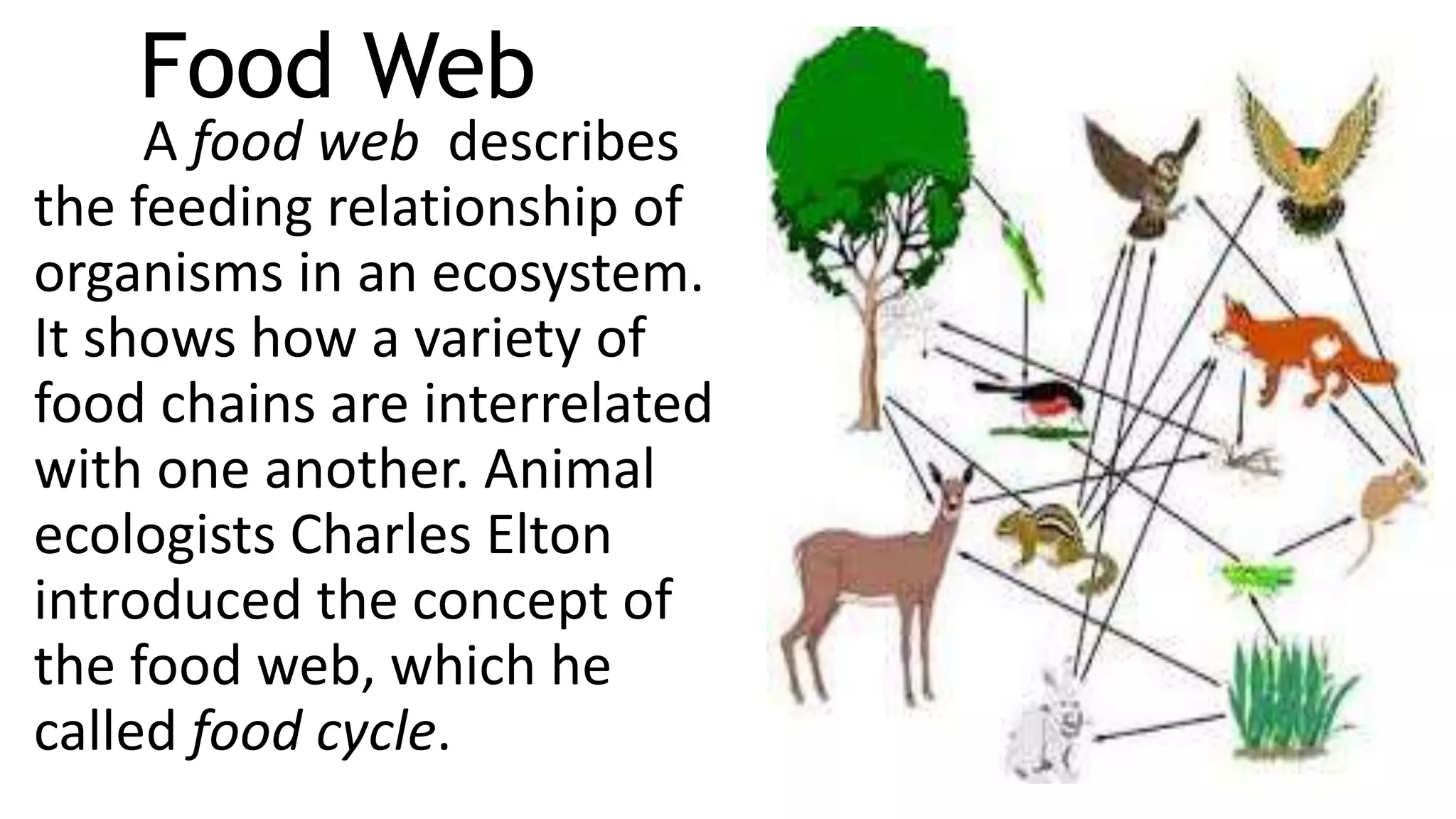
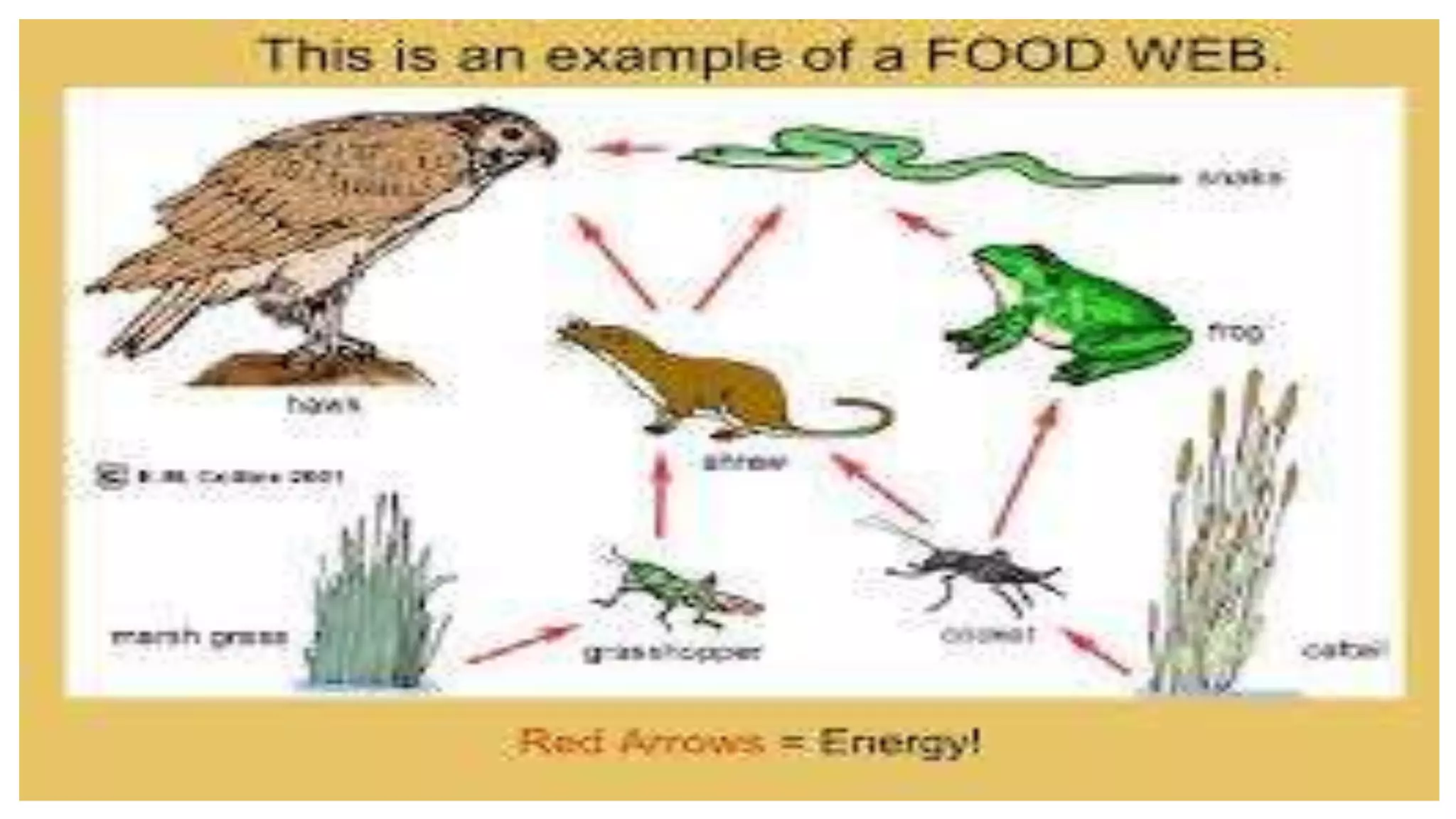
Food Web
A food web describes
the feeding relationship of
organisms in an ecosystem.
It shows how a variety of
food chains are interrelated
with one another. Animal
ecologists Charles Elton
introduced the concept of
the food web, which he
called food cycle.
ecosystem and its components.pptx

ecosystem and its components.pptx

  • 1.
  • 2.
    Interrelationships among livingthings. Life is sustained on earth by the complex interactions of organisms and their environment.
  • 3.
    Ecosystem Is composed of BioticAbiotic Components components interact through may be classified as make food for other such as producers water or competition moisture consumers predation solar energy decomposers use mutualism air and wind parasitism return nutrients to soil commensalism
  • 4.
  • 5.
    Basic Units ofEcology Organisms interact with their environment at several ecological levels. Life on earth is a complex web of life. Organisms continually interact with one another and with their environment. Ecology is the science which tries to understand how and why these kinds of interaction happen. In simple terms, ecology is the study of the relationships and interactions of living things with one another and with their external environment. Ecology comes from the Greek word oikos which means “house,” and logos which means “to study.”
  • 6.
    Scientists who studythese interactions are called ecologists. They ask questions like: • What animals and plants live in this lake or forest? • How do they interact with each other and with their physical environment? • What changes will this lake or forest undergo over time? Ecologists therefor study both the nonliving or physical environment, and the living environment. Ecology involves learning about ways living things and non livings and nonliving world interact to support life. To make sense of the complexity of our world, ecologists often speak of various layers of ecological organization described as the following:
  • 7.
    Biosphere The biosphere isthe part of the earth that supports life, which includes the top portion of the earth’s crust (lithosphere), all the bodies of the water on the earth’s surface (hydrosphere), and the surrounding atmosphere (air).
  • 8.
    Ecosystem The ecosystem is composedof all living things interacting with one another and with their environment. Ecosystem may be large, such as ocean, wetland or forest. They may be small like a pond, a single tree or a rotting log.
  • 9.
    Community A community consistsof different species of organisms that interact with each other in a given area. A species is a group of organisms that share general physical characteristics and are able to interbreed and produce offspring. A community is made up of all populations in a given habitat. The variety of life forms is collectively known as biological diversity or biodiversity.
  • 10.
    Population A group oforganisms of the same species that live in a defined area form a population. A community may have different populations.
  • 11.
    Habitat The actual placeor type of environment in which an organism or a population lives is called habitat. A habitat may include food, shelter and other resources the organisms need to survive.
  • 12.
  • 13.
    The number andvariety of organisms on earth are affected by the living and nonliving components of the environment. An ecosystem is a community of plants, animals and microorganisms that interact with their physical environment and depend on each other for survival. The term “ecosystem” was coined by the British plant ecologist Sir Arthur George Tansley to show that a habitat is a system in which its biotic (living) and abiotic (non-living) components constantly interact. The biotic component of an ecosystem is made up of two groups of organisms: those that can produce their own food, called producers or autotrophs such as plants, and those that consume or eat other organisms called consumers or heterotrophs such as animals. A special type of consumers that feed on dead plants and animals are known as decomposers, which include bacteria.
  • 14.
    The biotic componentof an ecosystem are nonliving chemical and physical factors that help sustain life in the ecosystem. Examples include rain, which supplies water or moisture; the dead organic matter in the soil that provides the nutrients; the sun that gives energy to start photosynthesis and vitamin D production in or bodies; the air that contains oxygen, carbon dioxide, nitrogen, and other gases; and the wind that transports other biotic and abiotic components.
  • 16.
    Roles Organisms Playin an Ecosystem Category Major Role or Action Representatives Producer Traps radiant energy from the sun and uses its to convert inorganic molecules (water and carbon dioxide) to make complex organic molecules (starch as food) Flowering plants, trees, ferns, algae, mosses) Consumer Herbivore Carnivore Uses organic matter produced by plants as sources of food Eats plants directly Eats animals Animals, fungi, bacteria Cow, panda, some humans (vegetarians) Lion, shark, wolf
  • 17.
    Omnivore Scavenger Parasite Eats both plantsand animals Eats dead animals that died by illness or accident, or killed by other animals Lives in or on another living organism to get nourishment Pigs, rats, mostly humans Hyena, vulture, coyote Many bacteria, tapeworms, flea, some protists Decomposer Converts organic matter into organic material; plays a major role in the recycling of materials in nature Fungi, bacteria, some insects, and worms
  • 18.
    Energy Flow inCircle of Life Energy flow around ecosystems through food chains and food webs. Energy flows through the ecosystem in a series of steps of eating and being eaten. Producers (Autotrophs) These are organisms that can produce their own food. Examples are green plants, some algae, and bacteria. In the chloroplast, the green pigment, called chlorophyll, enables plants to absorb solar energy, which then acts on the water and carbon dioxide in plants. The chlorophyll then converts these substances into carbohydrate and oxygen through a process called photosynthesis.
  • 19.
    Consumers Consumers are organismsthat cannot make their own food, so they rely on a food source for sustenance. They are subdivided into primary consumers, secondary consumers, and decomposers. Primary consumers – herbivores Secondary consumers – carnivores Omnivores – consumers that eat both plants and animals Decomposers – are organisms that feed on dead plants and animals and their waste. - they act as the garbage collectors in the ecosystem and break down waste material into nutrients that enrich the soil and allow plants to make more f food.
  • 20.
    Food Chain Life isabout survival. All organisms, big or small, require energy. And where do they get in? A food chain traces the sequence of how organisms obtain their energy. A food chain usually starts with a plant and ends with an animal. To complete the cycle, decomposers the cycle, decomposers come in to “clean up” the waste and return nutrients to the soil.
  • 22.
    Food Web A foodweb describes the feeding relationship of organisms in an ecosystem. It shows how a variety of food chains are interrelated with one another. Animal ecologists Charles Elton introduced the concept of the food web, which he called food cycle.