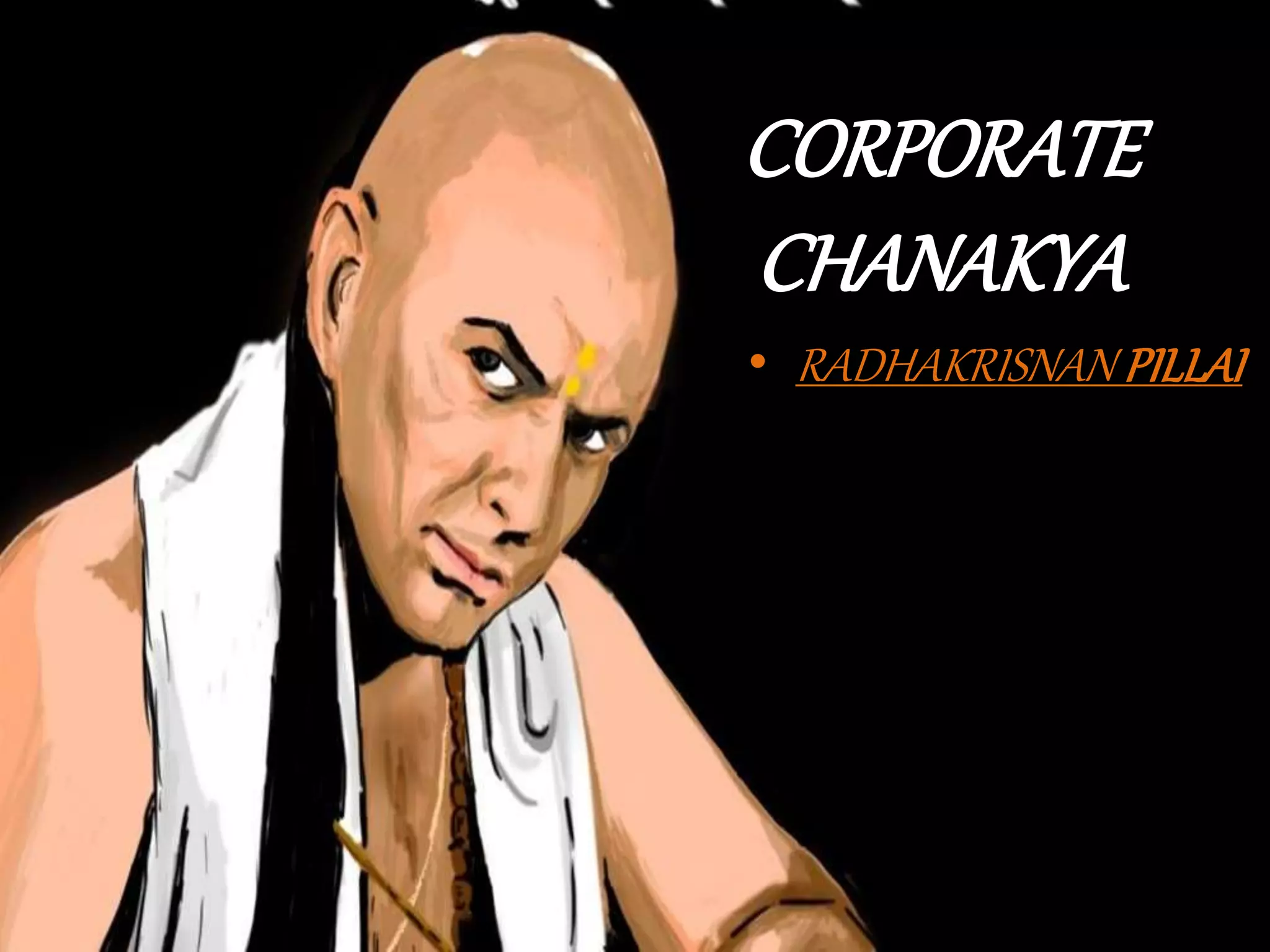
CORPORATE
CHANAKYA
• RADHAKRISNAN PILLAI
ABOUT THE BOOK
• A pioneer of economics and political science in India, Chanakya was one of the
most brilliant, tactful and shrewd economists and strategists of the Mauryan Era.
Building the entire Mauryan Empire can be attributed to Chanakya's witty
principles and out of the box strategies. The modern day world is a witness to
innumerable business empires which need effective management to remain at par
with growing competition. The author makes use of the aphorisms or sutras
proposed in Chanakya's book called Arthasastra (Economics), in the management
and functioning of modern day businesses.
• Corporate Chanakya is divided into three major sections - Leadership, Management
and Training. The author chooses the most apt sutras to provide tricks to achieve
success in all these fields. in the leadership section he explains the importance of a
leader's foresight, vision, enthusiasm and positive approach to handling situations.
The author also gives you tips on making effective decisions, time management and
creating a lasting impact to generate business.
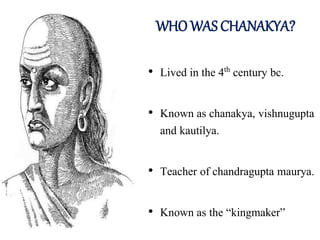
WHO WAS CHANAKYA?
• Lived in the 4th century bc.
• Known as chanakya, vishnugupta
and kautilya.
• Teacher of chandragupta maurya.
• Known as the “kingmaker”
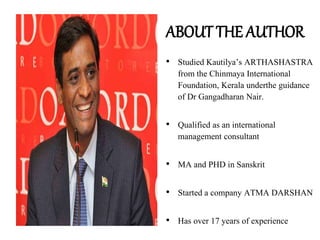
ABOUT THE AUTHOR
• Studied Kautilya’s ARTHASHASTRA
from the Chinmaya International
Foundation, Kerala underthe guidance
of Dr Gangadharan Nair.
• Qualified as an international
management consultant
• MA and PHD in Sanskrit
• Started a company ATMA DARSHAN
• Has over 17 years of experience
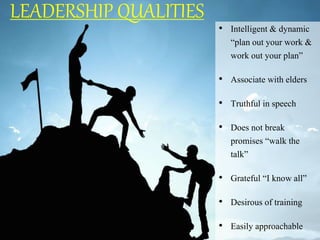
LEADERSHIP QUALITIES
• Intelligent & dynamic
“plan out your work &
work out your plan”
• Associate with elders
• Truthful in speech
• Does not break
promises “walk the
talk”
• Grateful “I know all”
• Desirous of training
• Easily approachable
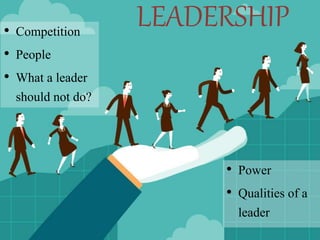
LEADERSHIP• Competition
• People
• What a leader
should not do?
• Power
• Qualities of a
leader
MANAGEMENT
EMPLOYEES
• Safety and security
• Selecting the right Person
• Command promotion
• Safety in Deal-making
• Quality control
• Don’t beat around the bush
• Reward productive people
• Take the Initiative
• Want to be a good boss?
FINANCE
• Making Timely payments
• Dirty money
• Money for wealth creation
• Money for more money
• Net profit counts!
• Take care of the Treasury in
Difficult times.
• Budgeting
• Advance money
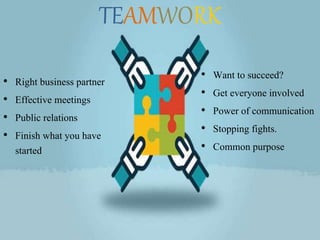
TEAMWORK
• Right business partner
• Effective meetings
• Public relations
• Finish what you have
started
• Want to succeed?
• Get everyone involved
• Power of communication
• Stopping fights.
• Common purpose
STRATEGY
• Principles of
management
• Keep an open mind
• Politics and
politicians
• Constantly educate
yourself
• Disaster
management
• CSR
• Working in new
Regions
• Ensuring growth
TRAINING
• Trainees
• Boss
• Organisation
• Training children
• Do not corrupt
• Degrees alone are not enough
• Mixing up the old and new
• The right attitude
• Learning something new
• Advice to modern trainees
TRAINEES
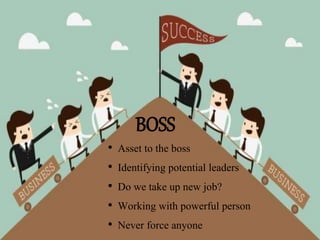
BOSS
• Asset to the boss
• Identifying potential leaders
• Do we take up new job?
• Working with powerful person
• Never force anyone
ORGANIZATION
• Self discipline
• Cleanliness at work
• Setting up systems
• Decision making
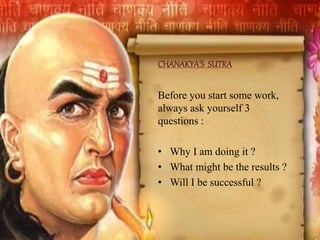
CHANAKYA’S SUTRA
Before you start some work,
always ask yourself 3
questions :
• Why I am doing it ?
• What might be the results ?
• Will I be successful ?
Knowledge is
power.
Be an asset in life
Proper Execution
Corporate Chanakya

Corporate Chanakya

  • 1.
  • 2.
    ABOUT THE BOOK •A pioneer of economics and political science in India, Chanakya was one of the most brilliant, tactful and shrewd economists and strategists of the Mauryan Era. Building the entire Mauryan Empire can be attributed to Chanakya's witty principles and out of the box strategies. The modern day world is a witness to innumerable business empires which need effective management to remain at par with growing competition. The author makes use of the aphorisms or sutras proposed in Chanakya's book called Arthasastra (Economics), in the management and functioning of modern day businesses. • Corporate Chanakya is divided into three major sections - Leadership, Management and Training. The author chooses the most apt sutras to provide tricks to achieve success in all these fields. in the leadership section he explains the importance of a leader's foresight, vision, enthusiasm and positive approach to handling situations. The author also gives you tips on making effective decisions, time management and creating a lasting impact to generate business.
  • 3.
    WHO WAS CHANAKYA? •Lived in the 4th century bc. • Known as chanakya, vishnugupta and kautilya. • Teacher of chandragupta maurya. • Known as the “kingmaker”
  • 4.
    ABOUT THE AUTHOR •Studied Kautilya’s ARTHASHASTRA from the Chinmaya International Foundation, Kerala underthe guidance of Dr Gangadharan Nair. • Qualified as an international management consultant • MA and PHD in Sanskrit • Started a company ATMA DARSHAN • Has over 17 years of experience
  • 5.
    LEADERSHIP QUALITIES • Intelligent& dynamic “plan out your work & work out your plan” • Associate with elders • Truthful in speech • Does not break promises “walk the talk” • Grateful “I know all” • Desirous of training • Easily approachable
  • 6.
    LEADERSHIP• Competition • People •What a leader should not do? • Power • Qualities of a leader
  • 7.
  • 8.
    EMPLOYEES • Safety andsecurity • Selecting the right Person • Command promotion • Safety in Deal-making • Quality control • Don’t beat around the bush • Reward productive people • Take the Initiative • Want to be a good boss?
  • 9.
    FINANCE • Making Timelypayments • Dirty money • Money for wealth creation • Money for more money • Net profit counts! • Take care of the Treasury in Difficult times. • Budgeting • Advance money
  • 10.
    TEAMWORK • Right businesspartner • Effective meetings • Public relations • Finish what you have started • Want to succeed? • Get everyone involved • Power of communication • Stopping fights. • Common purpose
  • 11.
    STRATEGY • Principles of management •Keep an open mind • Politics and politicians • Constantly educate yourself • Disaster management • CSR • Working in new Regions • Ensuring growth
  • 12.
  • 13.
    • Training children •Do not corrupt • Degrees alone are not enough • Mixing up the old and new • The right attitude • Learning something new • Advice to modern trainees TRAINEES
  • 14.
    BOSS • Asset tothe boss • Identifying potential leaders • Do we take up new job? • Working with powerful person • Never force anyone
  • 15.
    ORGANIZATION • Self discipline •Cleanliness at work • Setting up systems • Decision making
  • 17.
    CHANAKYA’S SUTRA Before youstart some work, always ask yourself 3 questions : • Why I am doing it ? • What might be the results ? • Will I be successful ?
  • 18.
    Knowledge is power. Be anasset in life Proper Execution