Introduction to environment
            Think Globally
            Act locally
            Save environment….
Definition:

“The aggregate of all the circumstances, people, things,
 and events around us that influence our life.”


“The circumstances, or conditions by which one is
 surrounded.”
                                          -Webster dictionary

                  Source: Environmental studies(F.Y.B.Com)
                                                     -Rashmi Desai (Vipul Prakashan)
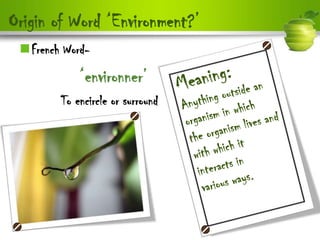
Origin of Word „Environment?‟
 French Word-
            „environner‟
        To encircle or surround
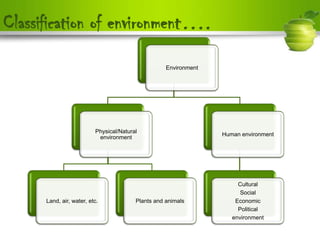
Classification of environment….
                                                    Environment


                          Physical/Natural
                                                                  Human environment
                           environment


                                                                       Cultural
                                                                        Social
      Land, air, water, etc.             Plants and animals           Economic
                                                                       Political
                                                                     environment
Components of environment…..
                  Abiotic components:
 All those physical and chemical aspects of environment that
 exert an influence on living organism.
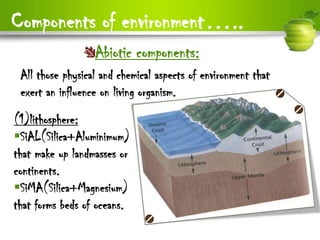
(1)lithosphere:
SiAL(Silica+Aluminimum)
that make up landmasses or
continents.
SiMA(Silica+Magnesium)
that forms beds of oceans.
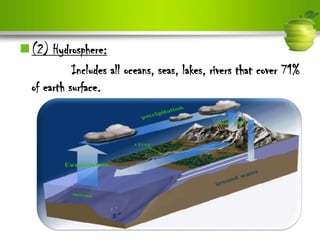
(2) Hydrosphere:
           Includes all oceans, seas, lakes, rivers that cover 71%
 of earth surface.
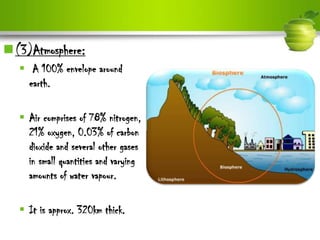
(3)Atmosphere:
   A 100% envelope around
    earth.

   Air comprises of 78% nitrogen,
    21% oxygen, 0.03% of carbon
    dioxide and several other gases
    in small quantities and varying
    amounts of water vapour.

   It is approx. 320km thick.
Biotic components:
  Include living organism i.e. plants, animals, man and their organisation
  within the environment.
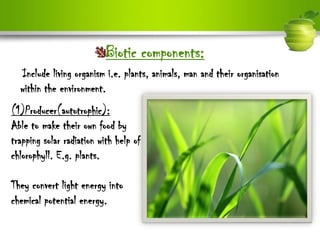
(1)Producer(autotrophic):
Able to make their own food by
trapping solar radiation with help of
chlorophyll. E.g. plants.

They convert light energy into
chemical potential energy.
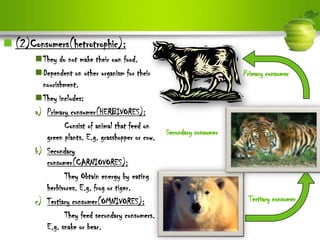
 (2)Consumers(hetrotrophic):
       They do not make their own food.
       Dependent on other organism for their
         nourishment.
       They includes:
       a) Primary consumer(HERBIVORES):
                Consist of animal that feed on
          green plants. E.g. grasshopper or cow.
       b) Secondary
          consumer(CARNIOVORES):
                They Obtain energy by eating
          herbivores. E.g. frog or tiger.
       c) Tertiary consumer(OMNIVORES):
                They feed secondary consumers.
          E.g. snake or bear.
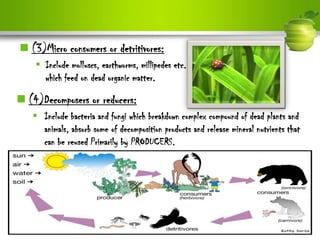
 (3)Micro consumers or detritivores:
     Include molluscs, earthworms, millipedes etc.
      which feed on dead organic matter.

 (4)Decomposers or reducers:
    Include bacteria and fungi which breakdown complex compound of dead plants and
     animals, absorb some of decomposition products and release mineral nutrients that
     can be reused Primarily by PRODUCERS.
REFERENCES:
 Google/images
 Environmental studies(F.Y.B.Com)
                                 -Rashmi Desai (Vipul Prakashan)
GROUP MEMBERS:
Pramita Nair        7201
Ankita Parandekar   7211
Yogesh Prajapati    7221
Siddhi Salunke             7231
Smruti Shirodkar    7241
Tushar Tari         7251
Jessy Vaz           7261
Thank you!
Your questions are welcomed to us….

Introduction to environment

  • 1.
    Introduction to environment Think Globally Act locally Save environment….
  • 2.
    Definition: “The aggregate ofall the circumstances, people, things, and events around us that influence our life.” “The circumstances, or conditions by which one is surrounded.” -Webster dictionary Source: Environmental studies(F.Y.B.Com) -Rashmi Desai (Vipul Prakashan)
  • 3.
    Origin of Word„Environment?‟ French Word- „environner‟ To encircle or surround
  • 4.
    Classification of environment…. Environment Physical/Natural Human environment environment Cultural Social Land, air, water, etc. Plants and animals Economic Political environment
  • 5.
    Components of environment….. Abiotic components: All those physical and chemical aspects of environment that exert an influence on living organism. (1)lithosphere: SiAL(Silica+Aluminimum) that make up landmasses or continents. SiMA(Silica+Magnesium) that forms beds of oceans.
  • 6.
    (2) Hydrosphere: Includes all oceans, seas, lakes, rivers that cover 71% of earth surface.
  • 7.
    (3)Atmosphere: A 100% envelope around earth.  Air comprises of 78% nitrogen, 21% oxygen, 0.03% of carbon dioxide and several other gases in small quantities and varying amounts of water vapour.  It is approx. 320km thick.
  • 8.
    Biotic components: Include living organism i.e. plants, animals, man and their organisation within the environment. (1)Producer(autotrophic): Able to make their own food by trapping solar radiation with help of chlorophyll. E.g. plants. They convert light energy into chemical potential energy.
  • 9.
     (2)Consumers(hetrotrophic): They do not make their own food. Dependent on other organism for their nourishment. They includes: a) Primary consumer(HERBIVORES): Consist of animal that feed on green plants. E.g. grasshopper or cow. b) Secondary consumer(CARNIOVORES): They Obtain energy by eating herbivores. E.g. frog or tiger. c) Tertiary consumer(OMNIVORES): They feed secondary consumers. E.g. snake or bear.
  • 10.
     (3)Micro consumersor detritivores:  Include molluscs, earthworms, millipedes etc. which feed on dead organic matter.  (4)Decomposers or reducers:  Include bacteria and fungi which breakdown complex compound of dead plants and animals, absorb some of decomposition products and release mineral nutrients that can be reused Primarily by PRODUCERS.
  • 11.
    REFERENCES:  Google/images  Environmentalstudies(F.Y.B.Com) -Rashmi Desai (Vipul Prakashan)
  • 12.
    GROUP MEMBERS: Pramita Nair 7201 Ankita Parandekar 7211 Yogesh Prajapati 7221 Siddhi Salunke 7231 Smruti Shirodkar 7241 Tushar Tari 7251 Jessy Vaz 7261
  • 13.
    Thank you! Your questionsare welcomed to us….