Economic Systems


http://www.slideshare.net/ansley22/economic-systems-notes-ab (adapted)
Economic Systems
  How a country’s economy is organized
    Because of the problem of scarcity,
     every country needs a system to
     determine how to use its productive
     resources

  An economic system must answer 3 basic
   questions…
WHAT TO PRODUCE? (What kinds of goods
and services should be produced?)
HOW TO PRODUCE? (What productive
resources are used to produce goods and
services?)
FOR WHOM TO PRODUCE? (Who gets to
have the goods and services?


      The way a society answers these
      questions determines its economic
      system.
4Types of Economic Systems:


      1. Traditional Economy
      2. Command Economy
      3. Market Economy
      4. Mixed Economy (Market + Command )
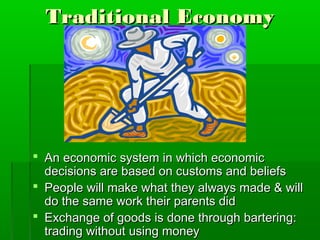
Traditional Economy


 An economic system in which economic
  decisions are based on customs and beliefs
 People will make what they always made & will
  do the same work their parents did
 Exchange of goods is done through bartering:
  trading without using money
Traditional Economy

 Who decides what to produce?
    People follow their customs and make what their
     ancestors made
 Who decides how to produce goods &
  services?
    People grow & make things the same way that
     their ancestors did
 Who are the goods & services produced for?
    People in the village who need them
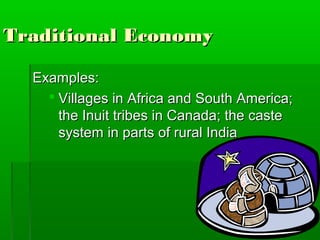
Traditional Economy

  Examples:
     Villages in Africa and South America;
      the Inuit tribes in Canada; the caste
      system in parts of rural India
Command System

  Government makes all economic decisions
   & owns most of the property
  Governmental planning groups determine
   such things as the prices of goods/services
   & the wages of workers

  This system has not been very successful &
   more and more countries are abandoning it
Command Economy
 Who decides what to produce?
   Government makes all economic decisions
 Who decides how to produce goods
   and services?
   Government decides how to make
    goods/services
 Who are the goods and services
  produced for?
   Whoever the government decides to give
    them to
Command System


   Countries with communist governments have
    Command economies
   Examples: Cuba, former Soviet Union, North
    Korea

    *Germany and Russia have moved away from
    having a Command economy since 1991. Now
    they have a Mixed economy.
Market Economy
  An economic system in which economic
   decisions are guided by the changes in prices
   that occur as individual buyers and sellers
   interact in the market place

  Most of the resources are owned by private
   citizens
  Economic decisions are based on Free
   Enterprise (competition between companies)
    Important economic questions are not answered
    by gov. but by individuals
    Gov. does not tell a business what goods to
    produce or what price to charge
Market Economy

  Who decides what to produce?
   Businesses base decisions on supply and
   demand and free enterprise (PRICE)
  Who decides how to produce goods and
   services?
   Businesses decide how to produce goods
  Who are the goods and services
   produced for?
   Consumers
Market Economy

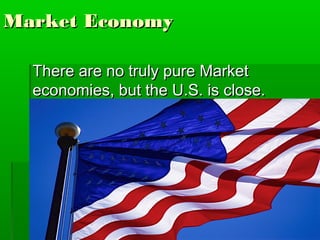
  There are no truly pure Market
  economies, but the U.S. is close.
Mixed Economy

  Market + Command = Mixed
  There are no pure command or market economies.
   To some degree, all modern economies exhibit
   characteristics of both systems and are often
   referred to as mixed economies.
      Most economies are closer to one type of
      economic system. than another
  Businesses own most resources and determine
   what and how to produce, but the Government
   regulates certain industries
Mixed Economy

  Who decides what to produce?
     Businesses
  Who decides how to produce goods &
   services?
      Businesses, but the government regulates
      certain industries
  Who are goods & services produced for?
      Consumers
Mixed Economy

  Most democratic countries fall into this
   category (there are no truly pure Market or
   Command economies).
  Examples: Brazil, Mexico, Canada, UK,
   etc.
Which Economic System Is Best?

  Market system - proven to be the best. It
   promotes the goals of growth, freedom, &
   efficiency
       Citizens are free to own their own
       property & use it more efficiently &
       profitably
  Command & Traditional systems sometimes
   offer more security, but are not as strong in
   efficiency, growth, freedom, and
   environmental quality

Economic systems

  • 1.
  • 2.
    Economic Systems How a country’s economy is organized  Because of the problem of scarcity, every country needs a system to determine how to use its productive resources  An economic system must answer 3 basic questions…
  • 3.
    WHAT TO PRODUCE?(What kinds of goods and services should be produced?) HOW TO PRODUCE? (What productive resources are used to produce goods and services?) FOR WHOM TO PRODUCE? (Who gets to have the goods and services? The way a society answers these questions determines its economic system.
  • 4.
    4Types of EconomicSystems:  1. Traditional Economy  2. Command Economy  3. Market Economy  4. Mixed Economy (Market + Command )
  • 5.
    Traditional Economy  Aneconomic system in which economic decisions are based on customs and beliefs  People will make what they always made & will do the same work their parents did  Exchange of goods is done through bartering: trading without using money
  • 6.
    Traditional Economy  Whodecides what to produce?  People follow their customs and make what their ancestors made  Who decides how to produce goods & services?  People grow & make things the same way that their ancestors did  Who are the goods & services produced for?  People in the village who need them
  • 7.
    Traditional Economy Examples:  Villages in Africa and South America; the Inuit tribes in Canada; the caste system in parts of rural India
  • 8.
    Command System Government makes all economic decisions & owns most of the property  Governmental planning groups determine such things as the prices of goods/services & the wages of workers  This system has not been very successful & more and more countries are abandoning it
  • 9.
    Command Economy  Whodecides what to produce?  Government makes all economic decisions  Who decides how to produce goods and services?  Government decides how to make goods/services  Who are the goods and services produced for?  Whoever the government decides to give them to
  • 10.
    Command System  Countries with communist governments have Command economies  Examples: Cuba, former Soviet Union, North Korea *Germany and Russia have moved away from having a Command economy since 1991. Now they have a Mixed economy.
  • 11.
    Market Economy An economic system in which economic decisions are guided by the changes in prices that occur as individual buyers and sellers interact in the market place  Most of the resources are owned by private citizens  Economic decisions are based on Free Enterprise (competition between companies) Important economic questions are not answered by gov. but by individuals Gov. does not tell a business what goods to produce or what price to charge
  • 12.
    Market Economy Who decides what to produce? Businesses base decisions on supply and demand and free enterprise (PRICE)  Who decides how to produce goods and services? Businesses decide how to produce goods  Who are the goods and services produced for? Consumers
  • 13.
    Market Economy There are no truly pure Market economies, but the U.S. is close.
  • 14.
    Mixed Economy Market + Command = Mixed  There are no pure command or market economies. To some degree, all modern economies exhibit characteristics of both systems and are often referred to as mixed economies. Most economies are closer to one type of economic system. than another  Businesses own most resources and determine what and how to produce, but the Government regulates certain industries
  • 15.
    Mixed Economy Who decides what to produce? Businesses  Who decides how to produce goods & services? Businesses, but the government regulates certain industries  Who are goods & services produced for? Consumers
  • 16.
    Mixed Economy Most democratic countries fall into this category (there are no truly pure Market or Command economies).  Examples: Brazil, Mexico, Canada, UK, etc.
  • 17.
    Which Economic SystemIs Best?  Market system - proven to be the best. It promotes the goals of growth, freedom, & efficiency Citizens are free to own their own property & use it more efficiently & profitably  Command & Traditional systems sometimes offer more security, but are not as strong in efficiency, growth, freedom, and environmental quality