Economic Systems
The way a society tries to answer the fundamental economic
questions is summarized by a concept known as economic
system.
economic system is the means by which societies or
governments organize and distribute available resources,
services, and goods across the country.
Economic systems regulate the factors of production,
including land, capital, labor, and physical resources.
Economic Factors of Production
Factors of production are the inputs used in the production of
goods or services to make an economic profit.
In economics, the factors of production are
 land,
 labor,
 capital, and
 entrepreneurship.
Land refers to the “gifts of nature”, or natural resources
not created by humans.
Land includes deserts, fertile fields, forests, mineral
deposits, livestock, sunshine, and the climate necessary
to grow crops.
Capital is the tools, equipment, machinery, and
factories used in the production of goods and services.
Capital includes building, machines, tools, tractors and
motors etc.
Capital is unique for being a good produced before the
production of another good
Labor refers to the people with all their efforts, abilities,
and skills.
This category includes all people except for a unique
group of individuals called entrepreneurs, which we
single out because of their special role in the economy
Entrepreneurs are those who organizes the other
resources of production and undertakes the risks and
uncertainties involved in production.
Entrepreneurs often are thought of as being the driving
force in an economy because they exhibit the ability to
start new businesses or bring new products to market.
The Decision-Making Units
There are three decision making units in any economy
“closed”. These are households, firms and the government.
Household: A household can be one person or more who live
under one roof and make joint financial decisions.
Households make two decisions;
 Selling of their resources, and
 Buying of goods and services
Firm: A firm is a production unit that uses economic
resources to produce goods and services.
Firms also make two decisions;
 Buying of economic resources
 Selling of their products
Government: A government is an organization that has
legal and political power to control or influence
households, firms and markets.
Government also provides some types of goods and
services known as public goods and services for the
society
Markets
The three economic agents interact in two markets
Product market: it is a market where goods and services
are transacted/ exchanged. That is, a market where Firms
and governments buy goods and services from business
firms.
Factor market (input market): it is a market where
economic units transact/exchange factors of production
(inputs). In this market, owners of resources (households)
sell their resources to business firms and governments
Circular-flow Diagram
The circular-flow diagram is a visual model of the economy
that shows how money, economic resources and goods and
services flows through markets among the decision making
units.
For simplicity, let‘s first see a two sector model where we
have only households and business firms.
In this case, therefore, we see the flow of goods and services
from producers to households and a flow of resources from
households to business firms.
Two Sector Model
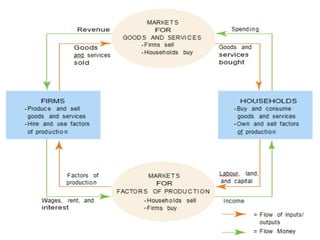
In the above diagram, a two sector model containing households and
firms is shown.
the clock – wise direction shows the flow of economic resources and
final goods and services.
Business firms sell goods and services to households in product
markets (upper part of the diagram).
On the other hand, the lower part shows, where households sell
factors of production to business firms through factor market.
The anti – clock wise direction indicates the flow of money (in the
form of revenue, income and spending on consumption).
Firms, by selling goods and services to households, receive money
in the form of revenue which is consumption expenditure for
households in the product market.
On the other hand, households by supplying their resources to
firms receive income.
This represents expenditure by firms to purchase factors of
production which is used as an input to produce goods and
services.
Three Sector Model
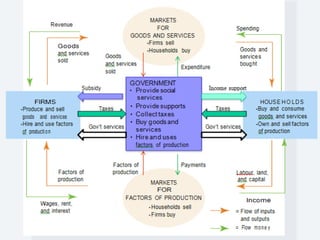
Let’s see a three sector model in which the government is involved
in the economic activities.
the only difference of the three sector model from the two sector
model is that it involves government participation in the market.
The government to provide public services purchase goods and
services from business firms through the product market with a
given amount of expenditure.
On the other hand, the government also needs resources required
for the provision of the services. This resource is purchased from
the factor market by making payments to the resource owners
(households).
Types of Economy
Customarily, economic systems can be identified in to
three types.
 Capitalist Economy
 Command Economy
 Mixed Economy
Capitalist Economy
This system is also called free market economy or market system
or laissez faire.
Is an economic system in which the factors of production can be
privately owned.
production and consumption of goods and services takes place
through mechanism of free market.
The most important feature of capitalism is the existence of private
property and the minimum government intervention in the market
Features of Capitalistic Economy
The right to private property
Freedom of Enterprise
Freedom of Choice by Consumers
Profit Motive and Competition
Minor role of government
Self-Interest
Inequalities of income
Existence of negative externalities
Advantages of Capitalistic
Economy
Flexibility or Adaptability
Decentralization of Economic Power
Increase in Per-Capita Income and Standard of Living
New Types of Consumer Goods
Growth of Entrepreneurship
Optimum Utilization of Productive Resources
High Rate of Capital Formation
Reward According to Ability
Disadvantages of Capitalistic
Economy
Inequality of Income
Unbalanced economic activity
Exploitation of labor
Negative externalities
Too Much Waste
Command Economy
also known as socialistic economy or planned economy
Is an economic system in which the government plans
and organizes the production and distribution of goods
and service
Under this economic system, the economic institutions
that are engaged in production and distribution are
owned and controlled by the state
Features of Command Economy
Collective ownership
Central economic planning
Strong government role
Maximum social welfare
Relative equality of incomes
Advantages of Command
Economy
Absence of wasteful competition
Balanced economic growth
Elimination of private monopolies and inequalities
Disadvantages of Command
Economy
Absence of automatic price determination
Absence of incentives for hard work and efficiency
Lack of economic freedom
Mixed Economy
Also known as Hybrid economy
It is neither pure capitalism nor pure command
Economy but a mixture of the two.
It incorporates some of the features of both and allows
private and public sectors to co-exist.
Features of Mixed Economy
Co-existence of public and private sectors
Economic welfare
Economic planning
Price mechanism
Economic equality
Advantages of Mixed Economy
Private Property, Profit Motive and Price Mechanism
Adequate Freedom
Rapid and Planned Economic Development
Social Welfare and Fewer Economic Inequalities
Disadvantages of Mixed
Economy
Ineffectiveness and inefficiency
Economic fluctuations
Corruption and black markets
END

part two chapter one.pptx

  • 2.
    Economic Systems The waya society tries to answer the fundamental economic questions is summarized by a concept known as economic system. economic system is the means by which societies or governments organize and distribute available resources, services, and goods across the country. Economic systems regulate the factors of production, including land, capital, labor, and physical resources.
  • 3.
    Economic Factors ofProduction Factors of production are the inputs used in the production of goods or services to make an economic profit. In economics, the factors of production are  land,  labor,  capital, and  entrepreneurship.
  • 4.
    Land refers tothe “gifts of nature”, or natural resources not created by humans. Land includes deserts, fertile fields, forests, mineral deposits, livestock, sunshine, and the climate necessary to grow crops.
  • 5.
    Capital is thetools, equipment, machinery, and factories used in the production of goods and services. Capital includes building, machines, tools, tractors and motors etc. Capital is unique for being a good produced before the production of another good
  • 6.
    Labor refers tothe people with all their efforts, abilities, and skills. This category includes all people except for a unique group of individuals called entrepreneurs, which we single out because of their special role in the economy
  • 7.
    Entrepreneurs are thosewho organizes the other resources of production and undertakes the risks and uncertainties involved in production. Entrepreneurs often are thought of as being the driving force in an economy because they exhibit the ability to start new businesses or bring new products to market.
  • 8.
    The Decision-Making Units Thereare three decision making units in any economy “closed”. These are households, firms and the government. Household: A household can be one person or more who live under one roof and make joint financial decisions. Households make two decisions;  Selling of their resources, and  Buying of goods and services
  • 9.
    Firm: A firmis a production unit that uses economic resources to produce goods and services. Firms also make two decisions;  Buying of economic resources  Selling of their products
  • 10.
    Government: A governmentis an organization that has legal and political power to control or influence households, firms and markets. Government also provides some types of goods and services known as public goods and services for the society
  • 11.
    Markets The three economicagents interact in two markets Product market: it is a market where goods and services are transacted/ exchanged. That is, a market where Firms and governments buy goods and services from business firms. Factor market (input market): it is a market where economic units transact/exchange factors of production (inputs). In this market, owners of resources (households) sell their resources to business firms and governments
  • 12.
    Circular-flow Diagram The circular-flowdiagram is a visual model of the economy that shows how money, economic resources and goods and services flows through markets among the decision making units. For simplicity, let‘s first see a two sector model where we have only households and business firms. In this case, therefore, we see the flow of goods and services from producers to households and a flow of resources from households to business firms.
  • 14.
    Two Sector Model Inthe above diagram, a two sector model containing households and firms is shown. the clock – wise direction shows the flow of economic resources and final goods and services. Business firms sell goods and services to households in product markets (upper part of the diagram). On the other hand, the lower part shows, where households sell factors of production to business firms through factor market.
  • 15.
    The anti –clock wise direction indicates the flow of money (in the form of revenue, income and spending on consumption). Firms, by selling goods and services to households, receive money in the form of revenue which is consumption expenditure for households in the product market. On the other hand, households by supplying their resources to firms receive income. This represents expenditure by firms to purchase factors of production which is used as an input to produce goods and services.
  • 16.
    Three Sector Model Let’ssee a three sector model in which the government is involved in the economic activities. the only difference of the three sector model from the two sector model is that it involves government participation in the market. The government to provide public services purchase goods and services from business firms through the product market with a given amount of expenditure. On the other hand, the government also needs resources required for the provision of the services. This resource is purchased from the factor market by making payments to the resource owners (households).
  • 18.
    Types of Economy Customarily,economic systems can be identified in to three types.  Capitalist Economy  Command Economy  Mixed Economy
  • 19.
    Capitalist Economy This systemis also called free market economy or market system or laissez faire. Is an economic system in which the factors of production can be privately owned. production and consumption of goods and services takes place through mechanism of free market. The most important feature of capitalism is the existence of private property and the minimum government intervention in the market
  • 20.
    Features of CapitalisticEconomy The right to private property Freedom of Enterprise Freedom of Choice by Consumers Profit Motive and Competition Minor role of government Self-Interest Inequalities of income Existence of negative externalities
  • 21.
    Advantages of Capitalistic Economy Flexibilityor Adaptability Decentralization of Economic Power Increase in Per-Capita Income and Standard of Living New Types of Consumer Goods Growth of Entrepreneurship Optimum Utilization of Productive Resources High Rate of Capital Formation Reward According to Ability
  • 22.
    Disadvantages of Capitalistic Economy Inequalityof Income Unbalanced economic activity Exploitation of labor Negative externalities Too Much Waste
  • 23.
    Command Economy also knownas socialistic economy or planned economy Is an economic system in which the government plans and organizes the production and distribution of goods and service Under this economic system, the economic institutions that are engaged in production and distribution are owned and controlled by the state
  • 24.
    Features of CommandEconomy Collective ownership Central economic planning Strong government role Maximum social welfare Relative equality of incomes
  • 25.
    Advantages of Command Economy Absenceof wasteful competition Balanced economic growth Elimination of private monopolies and inequalities
  • 26.
    Disadvantages of Command Economy Absenceof automatic price determination Absence of incentives for hard work and efficiency Lack of economic freedom
  • 27.
    Mixed Economy Also knownas Hybrid economy It is neither pure capitalism nor pure command Economy but a mixture of the two. It incorporates some of the features of both and allows private and public sectors to co-exist.
  • 28.
    Features of MixedEconomy Co-existence of public and private sectors Economic welfare Economic planning Price mechanism Economic equality
  • 29.
    Advantages of MixedEconomy Private Property, Profit Motive and Price Mechanism Adequate Freedom Rapid and Planned Economic Development Social Welfare and Fewer Economic Inequalities
  • 30.
    Disadvantages of Mixed Economy Ineffectivenessand inefficiency Economic fluctuations Corruption and black markets
  • 31.