




Market Forces and Resource Allocation
Geoff Riley, Tutor2u
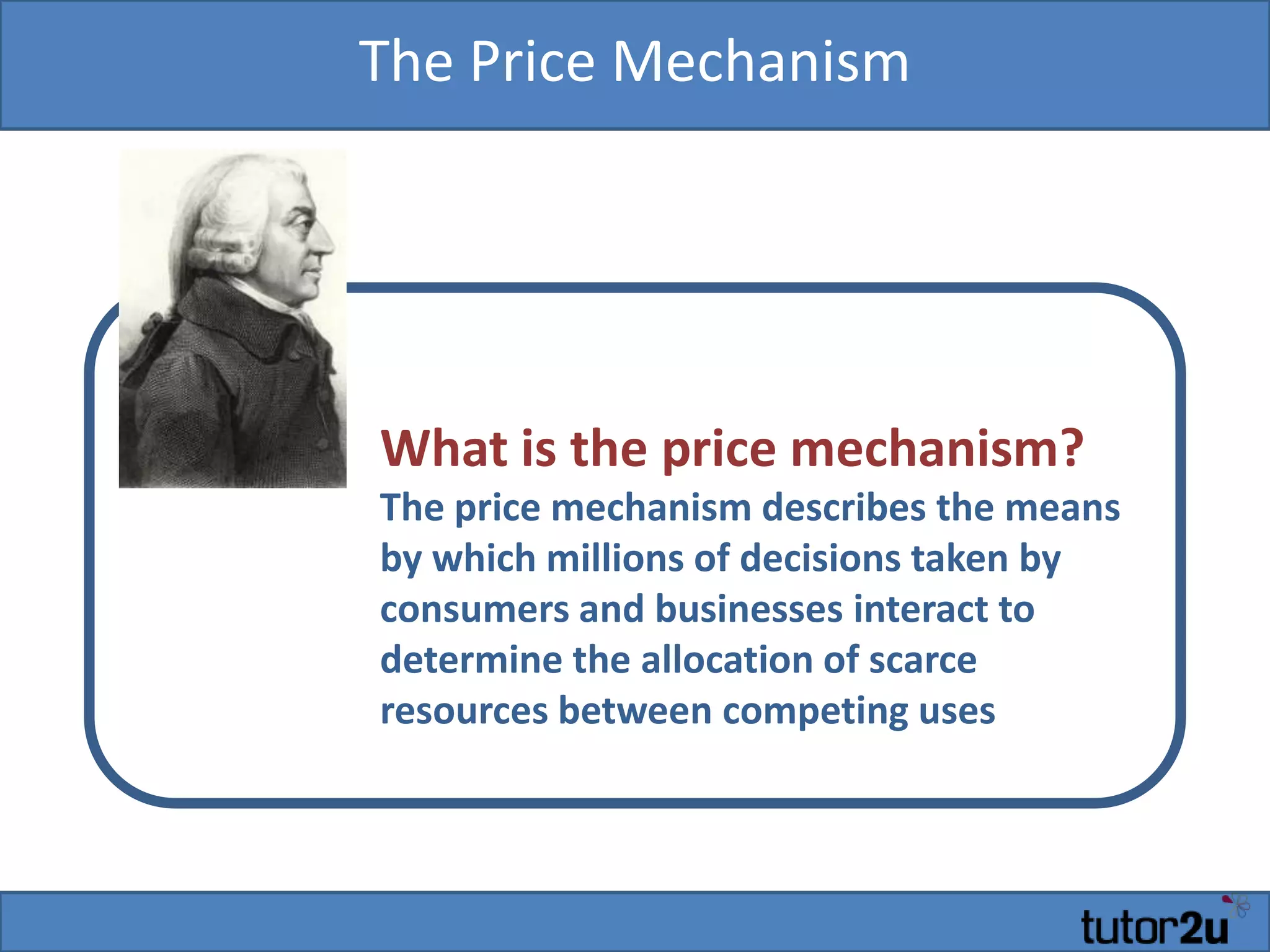
The Price Mechanism
What is the price mechanism?
The price mechanism describes the means
by which millions of decisions taken by
consumers and businesses interact to
determine the allocation of scarce
resources between competing uses
Functions of the price mechanism
• Rationing function
–Prices ration scarce resources when
demand outstrips supply
–When there is a shortage of a product, the
price will rise and thus deter some
consumers from purchasing the product
Functions of the price mechanism
• Signalling function
–If prices are rising because of stronger
demand, this is a signal to suppliers to
expand output if they can
–The ability to expand or contract production
depends on the price elasticity of supply
Functions of the price mechanism
• Incentive function
–Higher market prices act as an incentive to
raise output because the supplier stands to
make a higher profit
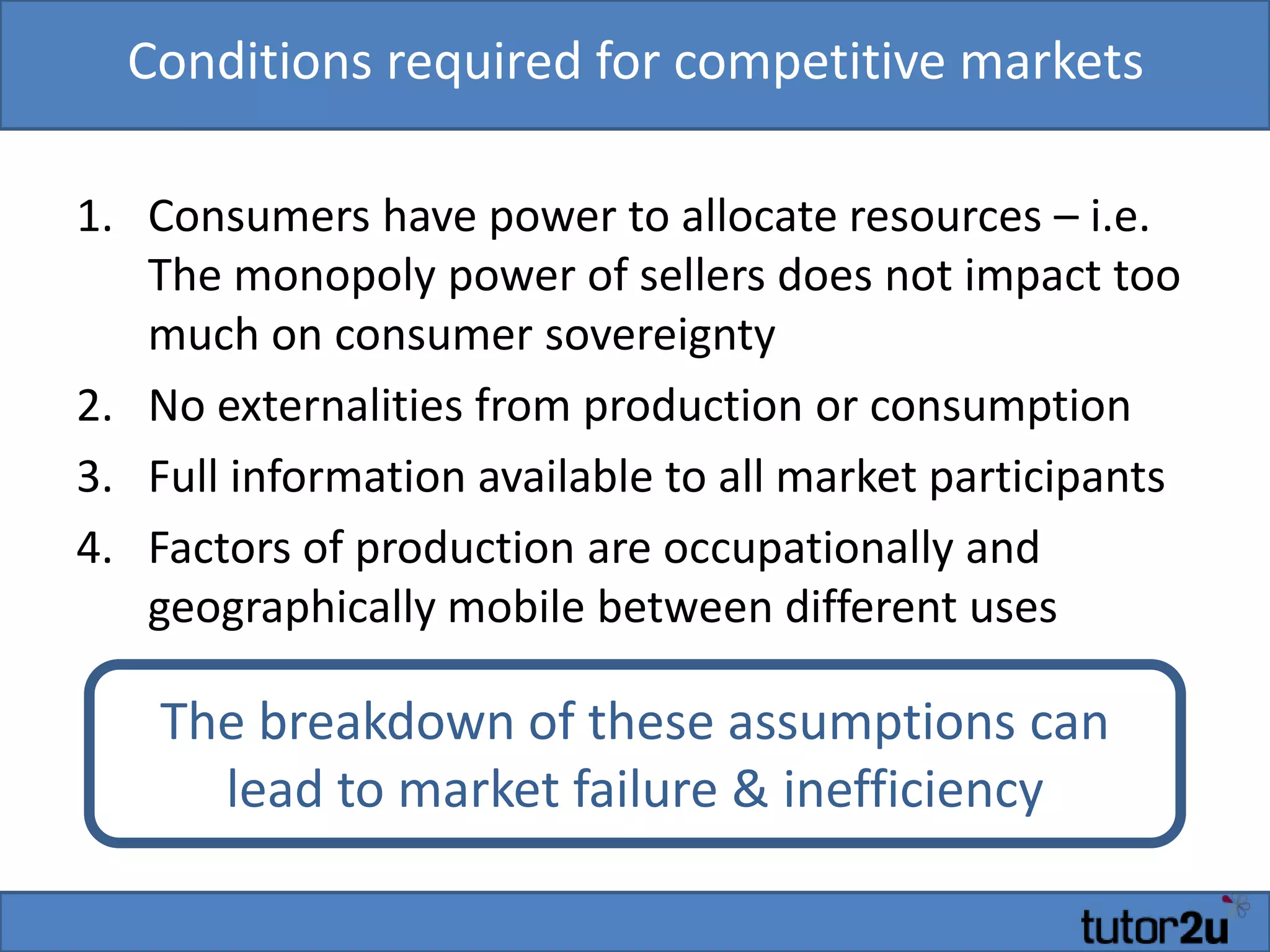
Conditions required for competitive markets
1. Consumers have power to allocate resources – i.e.
The monopoly power of sellers does not impact too
much on consumer sovereignty
2. No externalities from production or consumption
3. Full information available to all market participants
4. Factors of production are occupationally and
geographically mobile between different uses
The breakdown of these assumptions can
lead to market failure & inefficiency
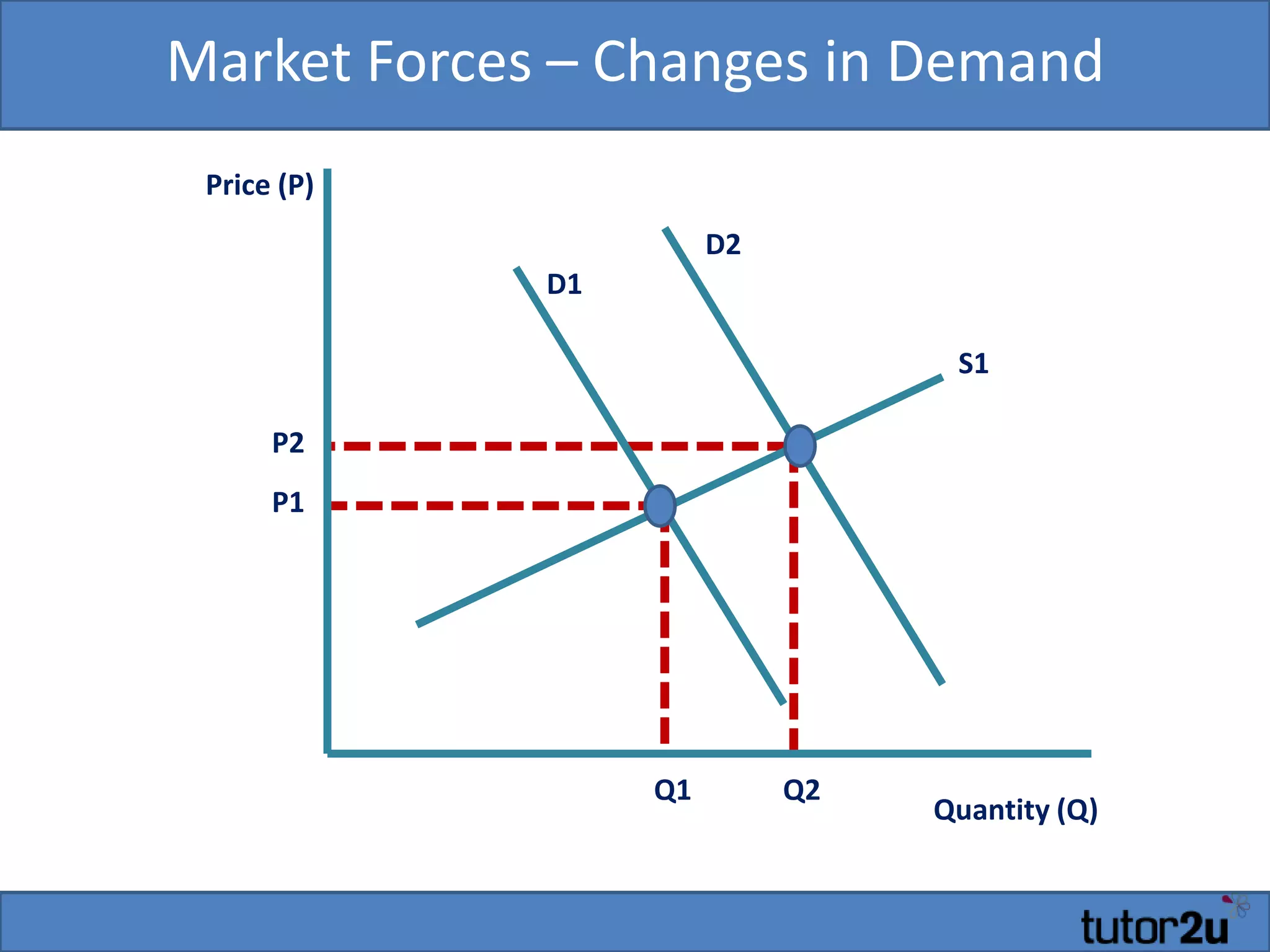
Market Forces – Changes in Demand
Price (P)
Quantity (Q)
D1
D2
S1
P1
P2
Q1 Q2
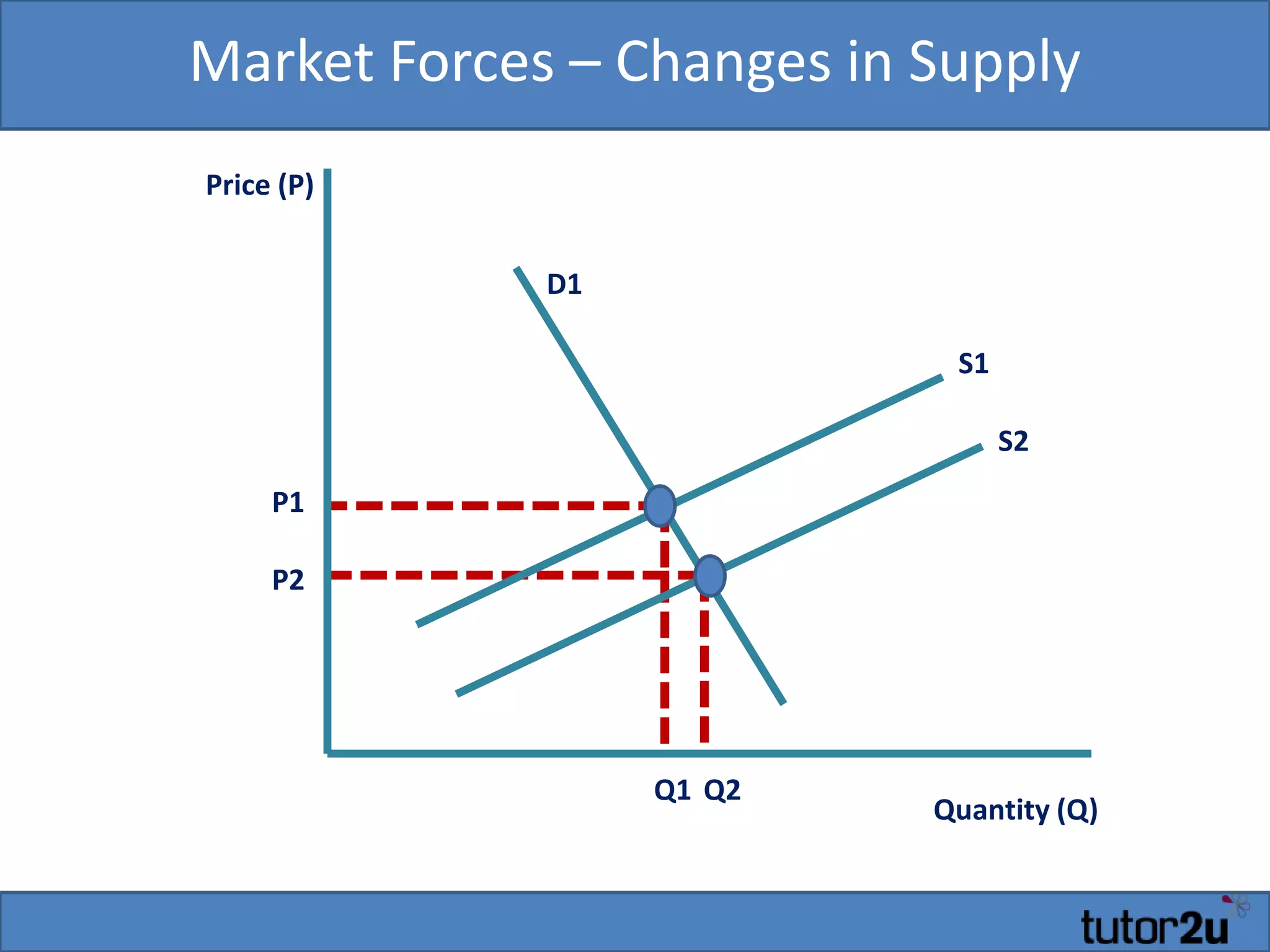
Market Forces – Changes in Supply
Price (P)
Quantity (Q)
D1
S1
P1
P2
Q1 Q2
S2
Revision Quiz on Supply and Demand (Click)
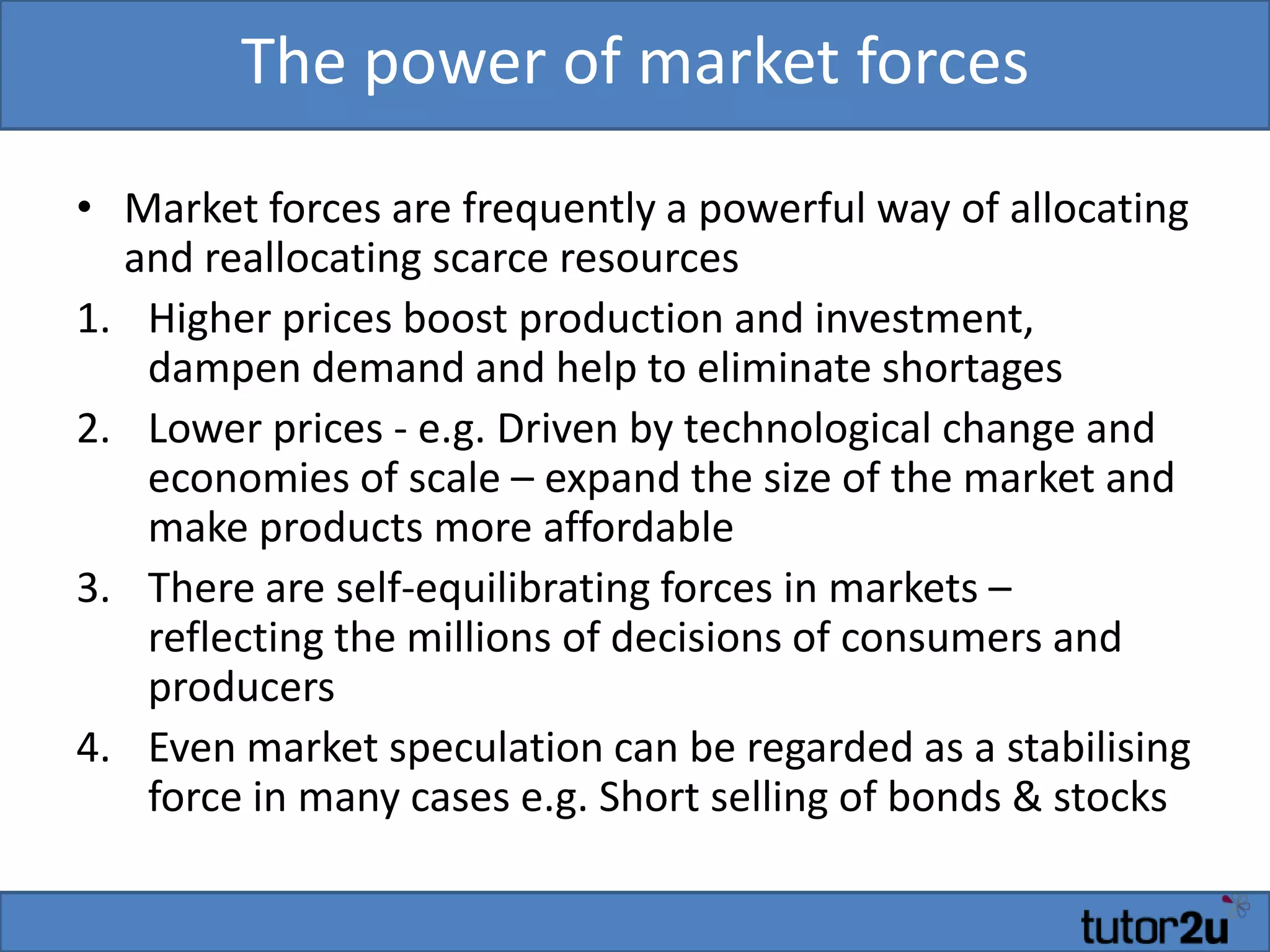
The power of market forces
• Market forces are frequently a powerful way of allocating
and reallocating scarce resources
1. Higher prices boost production and investment,
dampen demand and help to eliminate shortages
2. Lower prices - e.g. Driven by technological change and
economies of scale – expand the size of the market and
make products more affordable
3. There are self-equilibrating forces in markets –
reflecting the millions of decisions of consumers and
producers
4. Even market speculation can be regarded as a stabilising
force in many cases e.g. Short selling of bonds & stocks
Quiz – Markets in Action (Click)
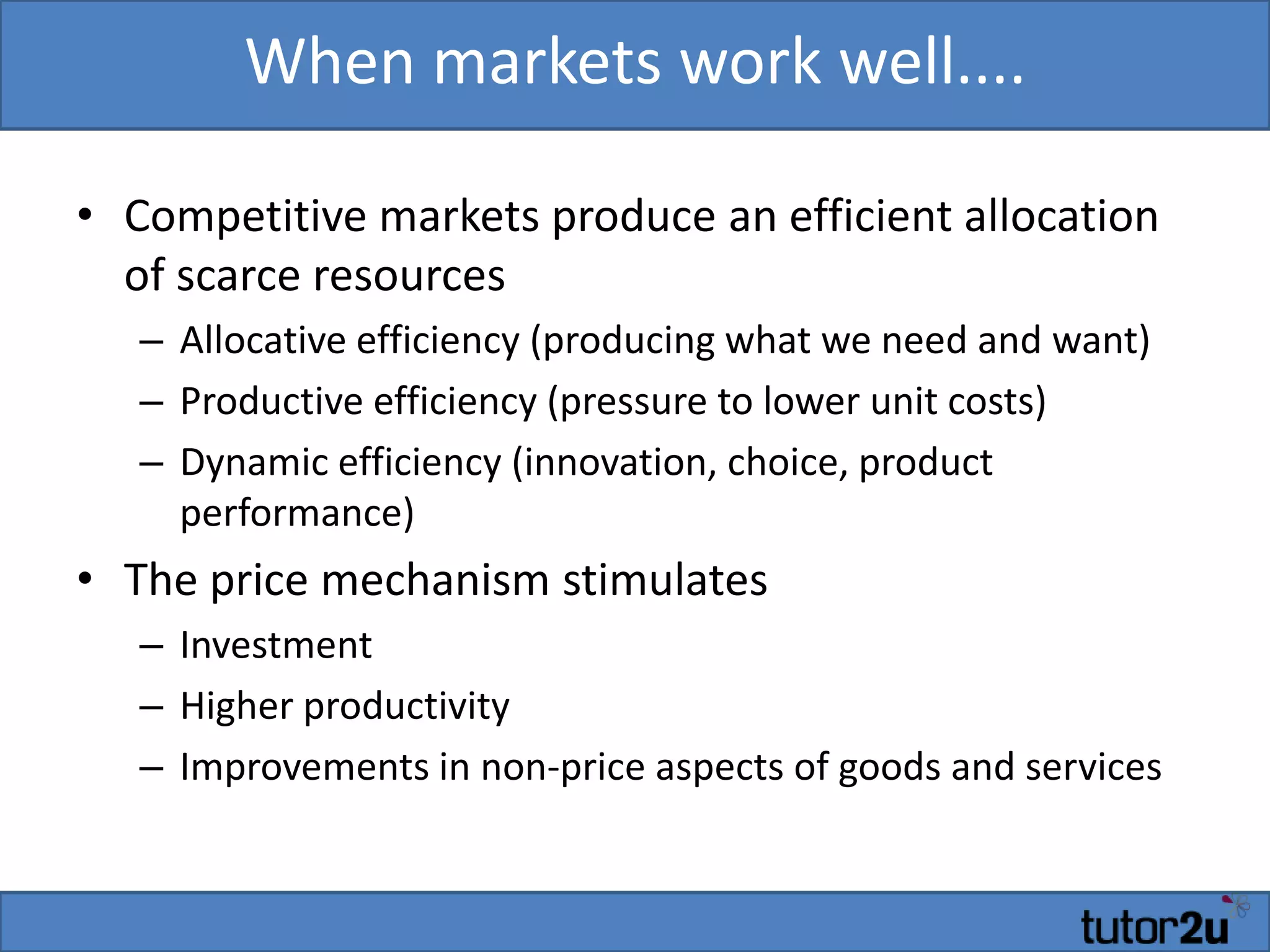
When markets work well....
• Competitive markets produce an efficient allocation
of scarce resources
– Allocative efficiency (producing what we need and want)
– Productive efficiency (pressure to lower unit costs)
– Dynamic efficiency (innovation, choice, product
performance)
• The price mechanism stimulates
– Investment
– Higher productivity
– Improvements in non-price aspects of goods and services
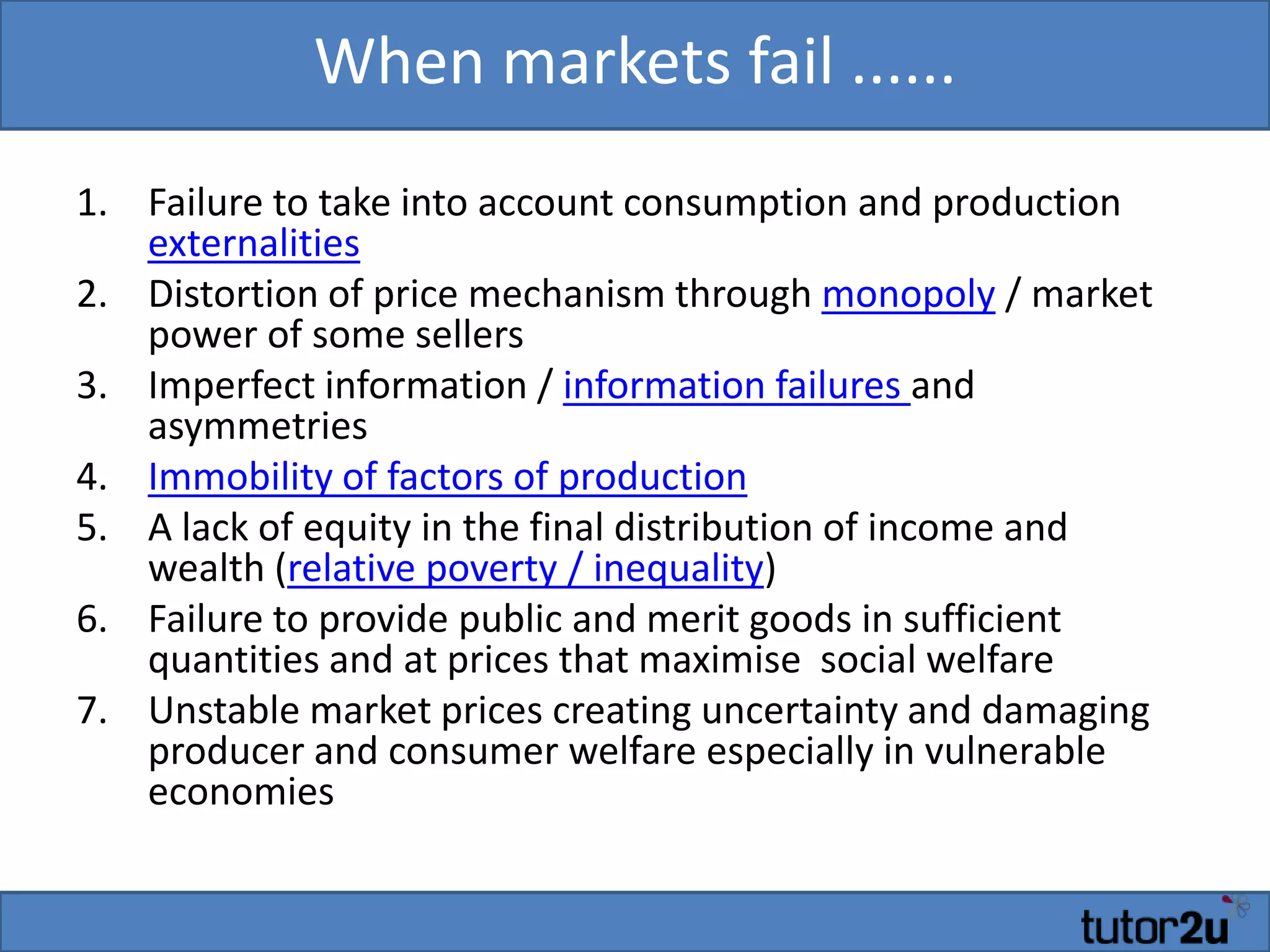
When markets fail ......
1. Failure to take into account consumption and production
externalities
2. Distortion of price mechanism through monopoly / market
power of some sellers
3. Imperfect information / information failures and
asymmetries
4. Immobility of factors of production
5. A lack of equity in the final distribution of income and
wealth (relative poverty / inequality)
6. Failure to provide public and merit goods in sufficient
quantities and at prices that maximise social welfare
7. Unstable market prices creating uncertainty and damaging
producer and consumer welfare especially in vulnerable
economies
Government Intervention Quiz (Click)
Tutor2u
Keep up-to-date with economics,
resources, quizzes and
worksheets for your economics
course.

Price Mechanism Introduction

  • 1.
    Market Forces andResource Allocation Geoff Riley, Tutor2u
  • 2.
    The Price Mechanism Whatis the price mechanism? The price mechanism describes the means by which millions of decisions taken by consumers and businesses interact to determine the allocation of scarce resources between competing uses
  • 3.
    Functions of theprice mechanism • Rationing function –Prices ration scarce resources when demand outstrips supply –When there is a shortage of a product, the price will rise and thus deter some consumers from purchasing the product
  • 4.
    Functions of theprice mechanism • Signalling function –If prices are rising because of stronger demand, this is a signal to suppliers to expand output if they can –The ability to expand or contract production depends on the price elasticity of supply
  • 5.
    Functions of theprice mechanism • Incentive function –Higher market prices act as an incentive to raise output because the supplier stands to make a higher profit
  • 6.
    Conditions required forcompetitive markets 1. Consumers have power to allocate resources – i.e. The monopoly power of sellers does not impact too much on consumer sovereignty 2. No externalities from production or consumption 3. Full information available to all market participants 4. Factors of production are occupationally and geographically mobile between different uses The breakdown of these assumptions can lead to market failure & inefficiency
  • 7.
    Market Forces –Changes in Demand Price (P) Quantity (Q) D1 D2 S1 P1 P2 Q1 Q2
  • 8.
    Market Forces –Changes in Supply Price (P) Quantity (Q) D1 S1 P1 P2 Q1 Q2 S2
  • 9.
    Revision Quiz onSupply and Demand (Click)
  • 10.
    The power ofmarket forces • Market forces are frequently a powerful way of allocating and reallocating scarce resources 1. Higher prices boost production and investment, dampen demand and help to eliminate shortages 2. Lower prices - e.g. Driven by technological change and economies of scale – expand the size of the market and make products more affordable 3. There are self-equilibrating forces in markets – reflecting the millions of decisions of consumers and producers 4. Even market speculation can be regarded as a stabilising force in many cases e.g. Short selling of bonds & stocks
  • 11.
    Quiz – Marketsin Action (Click)
  • 12.
    When markets workwell.... • Competitive markets produce an efficient allocation of scarce resources – Allocative efficiency (producing what we need and want) – Productive efficiency (pressure to lower unit costs) – Dynamic efficiency (innovation, choice, product performance) • The price mechanism stimulates – Investment – Higher productivity – Improvements in non-price aspects of goods and services
  • 13.
    When markets fail...... 1. Failure to take into account consumption and production externalities 2. Distortion of price mechanism through monopoly / market power of some sellers 3. Imperfect information / information failures and asymmetries 4. Immobility of factors of production 5. A lack of equity in the final distribution of income and wealth (relative poverty / inequality) 6. Failure to provide public and merit goods in sufficient quantities and at prices that maximise social welfare 7. Unstable market prices creating uncertainty and damaging producer and consumer welfare especially in vulnerable economies
  • 14.
  • 15.
    Tutor2u Keep up-to-date witheconomics, resources, quizzes and worksheets for your economics course.