What is Economics?
   Unit One, Lesson Two
    Berryhill Economics
Basic Economic Concepts
 Economics is concerned with economic
  products.
 Definition:
  Economic products are goods and services
  that are useful, relatively scarce, and
  transferable to others.
Goods and Services
 A good is an item that is economically
  useful or satisfies an economic want, such
  as a book, car, or compact disc player.
 A consumer good is intended for final use
  by individuals.
 When manufactured goods are used to
  produce other goods and services, they
  are called capital goods.
Consumer Goods vs. Capital Goods
 If I use a computer at home for email and
  other personal use, it would be considered
  a consumer good.
 If the same computer is purchased by an
  accountant and she uses it to do people’s
  taxes, it is now a capital good because it is
  being used to produced another service
  (taxes).
Consumer Goods vs. Capital Goods
 An oven in my home that I use to bake
  casseroles for my family is a consumer
  good.
 An oven in a bakery used to make cookies
  and cakes that is sold to the public is a
  capital good.
Service
 Another type of economic product is a
  service, or work that is performed for
  someone.
 This could include a haircut, home repairs,
  putting on a concert, doing your taxes for
  you, representing you in a court of law, or
  even educating someone.
Consumer
   A consumer is a person who uses goods
    and services to satisfy needs and wants.
The Simple Circular Flow
 There are a few terms we must define
  before you can understand the circular
  flow.
 Definitions:
  --The market is a location or other
  mechanism that allows buyers and sellers
  to exchange a certain economic product.
The Circular Flow
   Definitions (cont.)
    --Factor markets are markets where
    factors of production (or resources or
    capital goods and services) are bought
    and sold.
    --Product markets are where producers
    sell their goods and services and
    consumers buy those consumer goods and
    services.
Circular Flow
   The circular flow will be shown to you
    now.
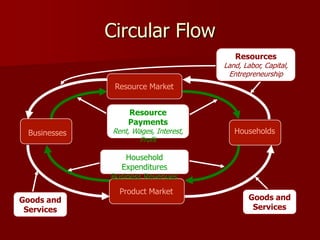
Circular Flow
                                          Resources
                                       Land, Labor, Capital,
                                        Entrepreneurship
               Resource Market


                  Resource
                  Payments
 Businesses   Rent, Wages, Interest,      Households
                      Profit

                  Household
                Expenditures
              Business Revenues
                Product Market
Goods and                                      Goods and
 Services                                       Services
Productivity and Economic Growth
 Economic growth occurs when a nation’s
  total output of goods and services
  increases over time.
 Productivity, or the measure of the
  amount of output produced by a given
  amount of inputs in a specific period of
  time, is one of the most important factors
  responsible for economic growth.
Productivity and Economic Growth
 Productivity goes up whenever more
  output can be produced with the same
  amount of inputs.
 Division of labor is an idea first developed
  by Adam Smith in The Wealth of Nations
  (one of the first economic books published
  in 1776).
Productivity and Economic Growth
   Division of labor takes place when work is
    arranged so that individual workers do
    fewer tasks than before. Because the
    worker is doing less, they should become
    really good at what they do, and should,
    in turn, be able to do more in the same
    amount of time (thus increasing
    productivity).
Productivity and Economic Growth
 Specialization takes place when factors of
  production perform tasks that they can do
  relatively more efficiently than others.
 Specialization and division of labor are
  huge determinants in productivity.
Productivity and Economic Growth
   Another contribution to productivity comes
    from investments in human capital, or the
    sum of the skills, abilities, health, and
    motivation of people.

Lesson 2--what-is-econ[1]

  • 1.
    What is Economics? Unit One, Lesson Two Berryhill Economics
  • 2.
    Basic Economic Concepts Economics is concerned with economic products.  Definition: Economic products are goods and services that are useful, relatively scarce, and transferable to others.
  • 3.
    Goods and Services A good is an item that is economically useful or satisfies an economic want, such as a book, car, or compact disc player.  A consumer good is intended for final use by individuals.  When manufactured goods are used to produce other goods and services, they are called capital goods.
  • 4.
    Consumer Goods vs.Capital Goods  If I use a computer at home for email and other personal use, it would be considered a consumer good.  If the same computer is purchased by an accountant and she uses it to do people’s taxes, it is now a capital good because it is being used to produced another service (taxes).
  • 5.
    Consumer Goods vs.Capital Goods  An oven in my home that I use to bake casseroles for my family is a consumer good.  An oven in a bakery used to make cookies and cakes that is sold to the public is a capital good.
  • 6.
    Service  Another typeof economic product is a service, or work that is performed for someone.  This could include a haircut, home repairs, putting on a concert, doing your taxes for you, representing you in a court of law, or even educating someone.
  • 7.
    Consumer  A consumer is a person who uses goods and services to satisfy needs and wants.
  • 8.
    The Simple CircularFlow  There are a few terms we must define before you can understand the circular flow.  Definitions: --The market is a location or other mechanism that allows buyers and sellers to exchange a certain economic product.
  • 9.
    The Circular Flow  Definitions (cont.) --Factor markets are markets where factors of production (or resources or capital goods and services) are bought and sold. --Product markets are where producers sell their goods and services and consumers buy those consumer goods and services.
  • 10.
    Circular Flow  The circular flow will be shown to you now.
  • 11.
    Circular Flow Resources Land, Labor, Capital, Entrepreneurship Resource Market Resource Payments Businesses Rent, Wages, Interest, Households Profit Household Expenditures Business Revenues Product Market Goods and Goods and Services Services
  • 12.
    Productivity and EconomicGrowth  Economic growth occurs when a nation’s total output of goods and services increases over time.  Productivity, or the measure of the amount of output produced by a given amount of inputs in a specific period of time, is one of the most important factors responsible for economic growth.
  • 13.
    Productivity and EconomicGrowth  Productivity goes up whenever more output can be produced with the same amount of inputs.  Division of labor is an idea first developed by Adam Smith in The Wealth of Nations (one of the first economic books published in 1776).
  • 14.
    Productivity and EconomicGrowth  Division of labor takes place when work is arranged so that individual workers do fewer tasks than before. Because the worker is doing less, they should become really good at what they do, and should, in turn, be able to do more in the same amount of time (thus increasing productivity).
  • 15.
    Productivity and EconomicGrowth  Specialization takes place when factors of production perform tasks that they can do relatively more efficiently than others.  Specialization and division of labor are huge determinants in productivity.
  • 16.
    Productivity and EconomicGrowth  Another contribution to productivity comes from investments in human capital, or the sum of the skills, abilities, health, and motivation of people.