PRINCIPLES OF
MACROECONOMICS 2e
Chapter 1 Welcome to Economics!
PowerPoint Slideshow
CH.1 OUTLINE
1.1: What is Economics, and Why Is It Important?
1.2: Microeconomics and Macroeconomics
1.3: How Economists Use Theories and Models
to Understand Economic Issues
1.4: How To Organize Economies: An Overview
of Economic Systems
1.1 What is Economics, and Why Is It
Important?
● Economics is the study of how humans make decisions in
the face of scarcity. These can be individual decisions, family
decisions, business decisions or societal decisions.
● Scarcity means that human wants for goods, services and
resources exceed what is available.
● The FRED website (https://openstax.org/l/FRED/) includes data
on nearly 400,000 domestic and international economic and
social variables over time, which will be used often in this course.
Economics in the social media age
Economics is greatly impacted by how well information travels
through society. Today, social media giants Twitter, Facebook, and
Instagram are major forces on the information superhighway.
(Credit: modification of work by Johan Larsson/Flickr Creative Commons)
Scarcity
Homeless people are a stark reminder that scarcity of resources is
real. (Credit: “daveynin”/Flickr Creative Commons)
Discussion Question: What are examples of critical goods and
services?
Comprehensive study of economics
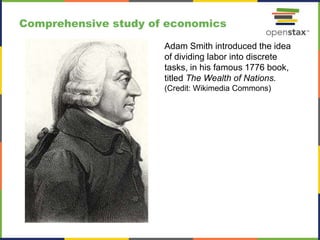
Adam Smith introduced the idea
of dividing labor into discrete
tasks, in his famous 1776 book,
titled The Wealth of Nations.
(Credit: Wikimedia Commons)
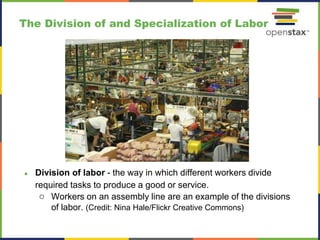
● Division of labor - the way in which different workers divide
required tasks to produce a good or service.
○ Workers on an assembly line are an example of the divisions
of labor. (Credit: Nina Hale/Flickr Creative Commons)
The Division of and Specialization of Labor
Why the Division of Labor Increases
Production
● Dividing and subdividing the tasks involved with producing a good
or service, produces a greater quantity of output.
● Specialization - when workers or firms focus on particular tasks
for which they are well-suited within the overall production
process.
• Specialization allows businesses to take advantage of
economies of scale, which means that for many goods,as
the level of production increases, the average cost of
producing each individual unit declines.
1.2 Microeconomics and Macroeconomics
● Economics is concerned with the well-being of all people,
including those with jobs and those without jobs, as well as those
with high incomes and those with low incomes.
● Microeconomics focuses on the actions of individual agents
within the economy, like households, workers, and businesses.
● Macroeconomics is the branch of economics that focuses on
broad issues such as growth, unemployment, inflation, and trade
balance.
Other Economic Terms
● Monetary policy - policy that involves altering the level of interest
rates, the availability of credit in the economy, and the extent of
borrowing.
• Determined by a nation’s central bank
● Fiscal policy - economic policies that involve government
spending and taxes.
• Determined by a nation’s legislative body
● One of the most influential
economists in modern times
was John Maynard Keynes.
(Credit: Wikimedia Commons)
● Keynes thought that
economics teaches you how
to think, not what to think.
1.3 How Economists Use Theories and
Models to Understand Economic Issues
Economic Theories and Models
● A theory is a simplified representation of how two or more
variables interact with each other.
• A good theory is simple enough to understand, while complex
enough to capture the key features of the object or situation
you are studying.
● Economists use models to test theories, but for this course we
will use the terms model and theory interchangeably.
Circular Flow Diagram
● The circular flow diagram shows how households and firms
interact in the goods and services market, and in the labor
market.
○ The direction of the arrows shows that in the goods and
services market, households receive goods and services
and pay firms for them.
○ In the labor market, households provide labor and receive
payment from firms through wages, salaries, and benefits.
1.4 How To Organize Economies: An
Overview of Economic Systems
There are at least three ways that societies organize an economy:
● 1) Traditional economy - typically an agricultural economy
where things are done the same as they have always been done.
• Oldest economic system
• Used in parts of Asia, Africa, and South America
• Occupations tend to stay in the family
• What you produce is what you consume
• Little economic progress or development
An Overview of Economic Systems
● 2) Command economy - an economy where economic decisions
are passed down from government authority and where the
government owns the resources.
• Government decides what goods and services will be
produced and what prices it will charge for them.
• The government decides what methods of production to use
and sets wages for workers.
• The government provides many necessities like healthcare
and education for free.
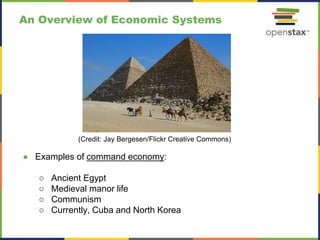
(Credit: Jay Bergesen/Flickr Creative Commons)
An Overview of Economic Systems
● Examples of command economy:
○ Ancient Egypt
○ Medieval manor life
○ Communism
○ Currently, Cuba and North Korea
An Overview of Economic Systems
● 3) Market economy - an
economy where economic
decisions are decentralized,
private individuals own
resources, and businesses
supply goods and services based
on demand.
● Market - interaction between
potential buyers and sellers; a
combination of demand and
supply.
● Private enterprise - system where private individuals or
groups of private individuals own and operate the means of
production (resources and businesses).
Nothing says “market” more than The New York Stock Exchange.
(Credit: Erik Drost/Flickr Creative Commons)
Real World Economies
Most economies in the real world are mixed. They combine elements
of command, traditional, and market systems.
● The U.S. economy is positioned toward the market-oriented end
of the spectrum.
● Many countries in Europe and Latin America, while primarily
market-oriented, have a greater degree of government
involvement in economic decisions than the U.S. economy.
● China and Russia, while they have moved more in the direction of
having a market-oriented system, remain closer to the command
economy end of the spectrum.
Regulations: The Rules of the Game
● There is no such thing as an absolutely free market.
● Regulations always define the “rules of the game” in the
economy.
● Economies that are primarily market-oriented have fewer
regulations—ideally just enough to maintain an even playing field
for participants.
● Heavily regulated economies often have underground
economies (or black markets), which are markets where the
buyers and sellers make transactions without the government’s
approval.
The Rise of Globalization
● Globalization - the trend in which buying and selling in markets
have increasingly crossed national borders.
● Exports - the goods and services that a nation produces
domestically and sells abroad.
● Imports - the goods and services that are produced abroad and
then sold domestically.
● Gross domestic product (GDP)- measures the size of total
production in an economy.
The Global Economy
Cargo ships are one mode of transportation for shipping goods in the
global economy. (Credit: Raul Valdez/Flickr Creative Commons)
Discussion question: What are examples of products and
services in the modern economy? How has this contributed to
globalization?
This OpenStax ancillary resource is © Rice University under a CC-BY 4.0 International
license; it may be reproduced or modified but must be attributed to OpenStax, Rice
University and any changes must be noted.

!MacroEconomics2e-Chapter01.pptx

  • 1.
    PRINCIPLES OF MACROECONOMICS 2e Chapter1 Welcome to Economics! PowerPoint Slideshow
  • 2.
    CH.1 OUTLINE 1.1: Whatis Economics, and Why Is It Important? 1.2: Microeconomics and Macroeconomics 1.3: How Economists Use Theories and Models to Understand Economic Issues 1.4: How To Organize Economies: An Overview of Economic Systems
  • 3.
    1.1 What isEconomics, and Why Is It Important? ● Economics is the study of how humans make decisions in the face of scarcity. These can be individual decisions, family decisions, business decisions or societal decisions. ● Scarcity means that human wants for goods, services and resources exceed what is available. ● The FRED website (https://openstax.org/l/FRED/) includes data on nearly 400,000 domestic and international economic and social variables over time, which will be used often in this course.
  • 4.
    Economics in thesocial media age Economics is greatly impacted by how well information travels through society. Today, social media giants Twitter, Facebook, and Instagram are major forces on the information superhighway. (Credit: modification of work by Johan Larsson/Flickr Creative Commons)
  • 5.
    Scarcity Homeless people area stark reminder that scarcity of resources is real. (Credit: “daveynin”/Flickr Creative Commons) Discussion Question: What are examples of critical goods and services?
  • 6.
    Comprehensive study ofeconomics Adam Smith introduced the idea of dividing labor into discrete tasks, in his famous 1776 book, titled The Wealth of Nations. (Credit: Wikimedia Commons)
  • 7.
    ● Division oflabor - the way in which different workers divide required tasks to produce a good or service. ○ Workers on an assembly line are an example of the divisions of labor. (Credit: Nina Hale/Flickr Creative Commons) The Division of and Specialization of Labor
  • 8.
    Why the Divisionof Labor Increases Production ● Dividing and subdividing the tasks involved with producing a good or service, produces a greater quantity of output. ● Specialization - when workers or firms focus on particular tasks for which they are well-suited within the overall production process. • Specialization allows businesses to take advantage of economies of scale, which means that for many goods,as the level of production increases, the average cost of producing each individual unit declines.
  • 9.
    1.2 Microeconomics andMacroeconomics ● Economics is concerned with the well-being of all people, including those with jobs and those without jobs, as well as those with high incomes and those with low incomes. ● Microeconomics focuses on the actions of individual agents within the economy, like households, workers, and businesses. ● Macroeconomics is the branch of economics that focuses on broad issues such as growth, unemployment, inflation, and trade balance.
  • 10.
    Other Economic Terms ●Monetary policy - policy that involves altering the level of interest rates, the availability of credit in the economy, and the extent of borrowing. • Determined by a nation’s central bank ● Fiscal policy - economic policies that involve government spending and taxes. • Determined by a nation’s legislative body
  • 11.
    ● One ofthe most influential economists in modern times was John Maynard Keynes. (Credit: Wikimedia Commons) ● Keynes thought that economics teaches you how to think, not what to think. 1.3 How Economists Use Theories and Models to Understand Economic Issues
  • 12.
    Economic Theories andModels ● A theory is a simplified representation of how two or more variables interact with each other. • A good theory is simple enough to understand, while complex enough to capture the key features of the object or situation you are studying. ● Economists use models to test theories, but for this course we will use the terms model and theory interchangeably.
  • 13.
    Circular Flow Diagram ●The circular flow diagram shows how households and firms interact in the goods and services market, and in the labor market. ○ The direction of the arrows shows that in the goods and services market, households receive goods and services and pay firms for them. ○ In the labor market, households provide labor and receive payment from firms through wages, salaries, and benefits.
  • 14.
    1.4 How ToOrganize Economies: An Overview of Economic Systems There are at least three ways that societies organize an economy: ● 1) Traditional economy - typically an agricultural economy where things are done the same as they have always been done. • Oldest economic system • Used in parts of Asia, Africa, and South America • Occupations tend to stay in the family • What you produce is what you consume • Little economic progress or development
  • 15.
    An Overview ofEconomic Systems ● 2) Command economy - an economy where economic decisions are passed down from government authority and where the government owns the resources. • Government decides what goods and services will be produced and what prices it will charge for them. • The government decides what methods of production to use and sets wages for workers. • The government provides many necessities like healthcare and education for free.
  • 16.
    (Credit: Jay Bergesen/FlickrCreative Commons) An Overview of Economic Systems ● Examples of command economy: ○ Ancient Egypt ○ Medieval manor life ○ Communism ○ Currently, Cuba and North Korea
  • 17.
    An Overview ofEconomic Systems ● 3) Market economy - an economy where economic decisions are decentralized, private individuals own resources, and businesses supply goods and services based on demand. ● Market - interaction between potential buyers and sellers; a combination of demand and supply. ● Private enterprise - system where private individuals or groups of private individuals own and operate the means of production (resources and businesses). Nothing says “market” more than The New York Stock Exchange. (Credit: Erik Drost/Flickr Creative Commons)
  • 18.
    Real World Economies Mosteconomies in the real world are mixed. They combine elements of command, traditional, and market systems. ● The U.S. economy is positioned toward the market-oriented end of the spectrum. ● Many countries in Europe and Latin America, while primarily market-oriented, have a greater degree of government involvement in economic decisions than the U.S. economy. ● China and Russia, while they have moved more in the direction of having a market-oriented system, remain closer to the command economy end of the spectrum.
  • 19.
    Regulations: The Rulesof the Game ● There is no such thing as an absolutely free market. ● Regulations always define the “rules of the game” in the economy. ● Economies that are primarily market-oriented have fewer regulations—ideally just enough to maintain an even playing field for participants. ● Heavily regulated economies often have underground economies (or black markets), which are markets where the buyers and sellers make transactions without the government’s approval.
  • 20.
    The Rise ofGlobalization ● Globalization - the trend in which buying and selling in markets have increasingly crossed national borders. ● Exports - the goods and services that a nation produces domestically and sells abroad. ● Imports - the goods and services that are produced abroad and then sold domestically. ● Gross domestic product (GDP)- measures the size of total production in an economy.
  • 21.
    The Global Economy Cargoships are one mode of transportation for shipping goods in the global economy. (Credit: Raul Valdez/Flickr Creative Commons) Discussion question: What are examples of products and services in the modern economy? How has this contributed to globalization?
  • 22.
    This OpenStax ancillaryresource is © Rice University under a CC-BY 4.0 International license; it may be reproduced or modified but must be attributed to OpenStax, Rice University and any changes must be noted.