Arthur CHARPENTIER - Welfare, Inequality and Poverty
Arthur Charpentier
charpentier.arthur@gmail.com
http://freakonometrics.hypotheses.org/
Université de Rennes 1, February 2016
Welfare, Inequality & Poverty, # 4
1
Arthur CHARPENTIER - Welfare, Inequality and Poverty
Regression?
Galton (1870, galton.org, 1886, galton.org ) and Pear-
son & Lee (1896, jstor.org, 1903 jstor.org) studied ge-
netic transmission of characterisitcs, e.g. the heigth.
On average the child of tall parents is taller than
other children, but less than his parents.
“I have called this peculiarity by the name of regres-
sion’, Francis Galton, 1886.
2
Arthur CHARPENTIER - Welfare, Inequality and Poverty
Regression?
1 > l i b r a r y ( HistData )
2 > attach ( Galton )
3 > Galton$ count <− 1
4 > df <− aggregate ( Galton , by=l i s t ( parent ,
c h i l d ) , FUN=sum) [ , c (1 ,2 ,5) ]
5 > plot ( df [ , 1 : 2 ] , cex=sqrt ( df [ , 3 ] / 3) )
6 > ab lin e ( a=0,b=1, l t y =2)
7 > ab lin e (lm( c h i l d ~parent , data=Galton ) )
q q q q q
q q q
q q q q q q q q
q q q q q q q
q q
q q
q q q q q
q q q q q q q q q
q q q q q q q q q
q
q q q q q q q q
q q q q q q q q q
q q q q q q q q
q q q q q q q
q q q q q q q q
q q q q q q
q q q q
64 66 68 70 72
62646668707274
height of the mid−parent
heightofthechild
q q q q q
q q q
q q q q q q q q
q q q q q q q
q q
q q
q q q q q
q q q q q q q q q
q q q q q q q q q
q
q q q q q q q q
q q q q q q q q q
q q q q q q q q
q q q q q q q
q q q q q q q q
q q q q q q
q q q q
3
Arthur CHARPENTIER - Welfare, Inequality and Poverty
Least Squares?
Recall that



E(Y ) = argmin
m∈R
Y − m 2
2
= E [Y − m]2
Var(Y ) = min
m∈R
E [Y − m]2
= E [Y − E(Y )]2
The empirical version is



y = argmin
m∈R
n
i=1
1
n
[yi − m]2
s2
= min
m∈R
n
i=1
1
n
[yi − m]2
=
n
i=1
1
n
[yi − y]2
The conditional version is



E(Y |X) = argmin
ϕ:Rk→R
Y − ϕ(X) 2
2
= E [Y − ϕ(X)]2
Var(Y |X) = min
ϕ:Rk→R
E [Y − ϕ(X)]2
= E [Y − E(Y |X)]2
4
Arthur CHARPENTIER - Welfare, Inequality and Poverty
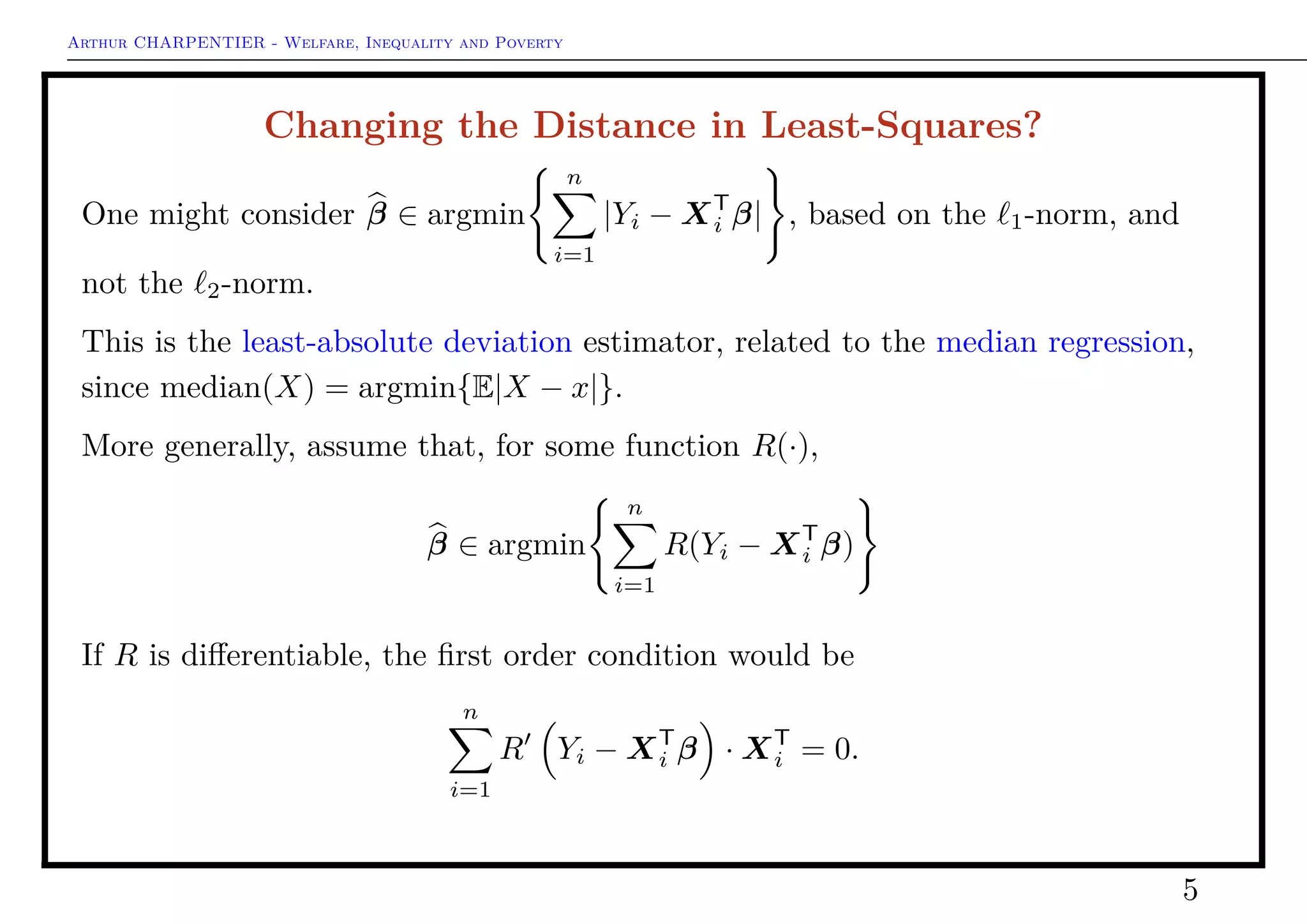
Changing the Distance in Least-Squares?
One might consider β ∈ argmin
n
i=1
|Yi − XT
i β| , based on the 1-norm, and
not the 2-norm.
This is the least-absolute deviation estimator, related to the median regression,
since median(X) = argmin{E|X − x|}.
More generally, assume that, for some function R(·),
β ∈ argmin
n
i=1
R(Yi − XT
i β)
If R is differentiable, the first order condition would be
n
i=1
R Yi − XT
i β · XT
i = 0.
5
Arthur CHARPENTIER - Welfare, Inequality and Poverty
Changing the Distance in Least-Squares?
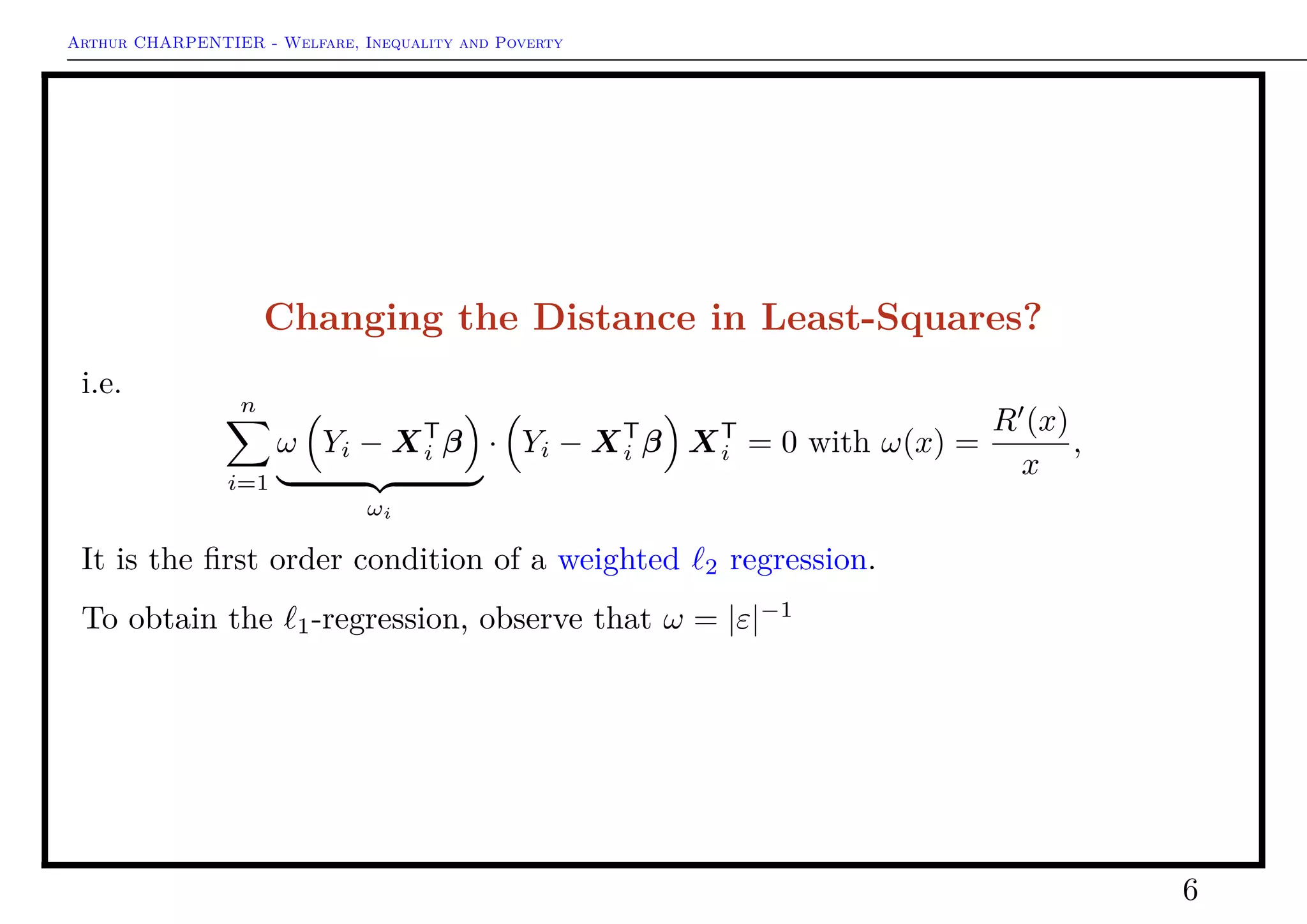
i.e.
n
i=1
ω Yi − XT
i β
ωi
· Yi − XT
i β XT
i = 0 with ω(x) =
R (x)
x
,
It is the first order condition of a weighted 2 regression.
To obtain the 1-regression, observe that ω = |ε|−1
6
Arthur CHARPENTIER - Welfare, Inequality and Poverty
Changing the Distance in Least-Squares?
=⇒ use iterative (weighted) least-square regressions.
Start with some standard 2 regression
1 > reg_0 <− lm(Y~X, data=db)
For the 1 regression consider weight function
1 > omega <− function ( e ) 1/abs ( e )
Then consider the following iterative algorithm
1 > r e s i d <− r e s i d u a l s ( reg_0)
2 > f o r ( i in 1:100) {
3 + W <− omega ( e )
4 + reg <− lm(Y~X, data=db , weights=W)
5 + e <− r e s i d u a l t s ( reg ) }
q
q
q
q
q
q
q
q
q
q
q
q
q
q
q
q
qq
q
q
q
q
q
q
q
q
q
q
q
q
q
q
q
q
q
q
q
q
q
q
q
q
q
q
q
q
qq
q
q
speed
dist
5 10 15 20 25
020406080100120
7
Arthur CHARPENTIER - Welfare, Inequality and Poverty
Quantile Regression
Observe that, for all τ ∈ (0, 1)
QX(τ) = F−1
X (τ) = argmin
m∈R
{E[Rτ (X − m)]}
where Rτ (x) = [τ − 1(x < 0)] · x.
From a statistical point of view
Qx(τ) = argmin
m∈R
1
n
n
i=1
Rτ (xi − m) .
The quantile-τ regression
β = argmin
n
i=1
Rτ (Yi − XT
i β) .
8
Arthur CHARPENTIER - Welfare, Inequality and Poverty
q
5 10 15 20 25
020406080100120
speed
dist
q
q
q
5 10 15 20 25
020406080100120
speed
dist
5 10 15 20 25
020406080100120
speed
dist
There are n(1 − p) points in the upper region, and np in the lower one.
1 > l i b r a r y ( quantreg )
2 > f i t 1 <− rq ( y ~ x1 + x2 , tau = . 1 , data = df )
see cran.r-project.org.
9
Arthur CHARPENTIER - Welfare, Inequality and Poverty
Quantile Regression: Empirical Analysis
Consider here some salaries, as a func-
tion of the experience (in years), see
data.princeton.edu
1 > s a l a r y=read . table ( " http : // data .
princeton . edu/wws509/ datasets
/ s a l a r y . dat " , header=TRUE)
2 > l i b r a r y ( quantreg )
3 > plot ( s a l a r y $yd , c )
4 > ab lin e ( rq ( s l ~yd , tau =.1 , data=
s a l a r y ) , c o l=" red " )
q
q
q
q
q
q
q
q q
q
q
q
q
q
q
q
q
q
q
q
q
q
q
q
q
q
q
q
q
q
q
q
q
q
q
q
q
q
q
q
q q
q
q
q
q q
q
q
q
q
q
0 5 10 15 20 25 30 35
1500020000250003000035000
Experience (years)
Salary
10
Arthur CHARPENTIER - Welfare, Inequality and Poverty
Quantile Regression: Empirical Analysis
1 > u <− seq ( . 0 5 , . 9 5 , by=.01)
2 > c o e f s t d <− function (u) summary(
rq ( s l ~yd , data=salary , tau=u) ) $
c o e f f i c i e n t s [ , 2 ]
3 > c o e f e s t <− function (u) summary(
rq ( s l ~yd , data=salary , tau=u) ) $
c o e f f i c i e n t s [ , 1 ]
4 > CS <− Vectorize ( c o e f s t d ) (u)
5 > CE <− Vectorize ( c o e f e s t ) (u)
6 > CEinf <− CE−2∗CS
7 > CEsup <− CE+2∗CS
8 > plot (u ,CE[ 2 , ] , ylim=c ( −500 ,2000)
, c o l=" red " )
9 > polygon ( c (u , rev (u) ) , c ( CEinf
[ 2 , ] , rev (CEsup [ 2 , ] ) ) , c o l="
yellow " , border=NA)
qqqqqqq
qqqqqqqqqqq
qqqqqqq
q
qqqqqqqqqq
qqqqqqq
qqqqqqqqqqqqqqqqqq
qqqqqqqqqqqqqq
qqqq
qq
qqq
qqqqqqq
0.2 0.4 0.6 0.8
−5000500100015002000
probability
CE[2,]
11
Arthur CHARPENTIER - Welfare, Inequality and Poverty
Quantile Regression: Empirical Analysis
Consider the evolution of the 90%−10%
quantile ratio,
1 > ratio9010 = function ( age ) {
2 + p r e d i c t (Q90 , newdata=data .
frame ( yd=age ) ) /
3 + p r e d i c t (Q10 , newdata=data .
frame ( yd=age ) )
4 + }
5 > ratio9010 (5)
6 1.401749
7 > A=0:30
8 > plot (A, Vectorize ( ratio9010 ) (A) ,
type=" l " , ylab=" 90−10 qua nti le
r a t i o " )
12
Arthur CHARPENTIER - Welfare, Inequality and Poverty
Local Regression: Empirical Analysis
which is smoother than the local esti-
mator
1 > ratio9010_k = function ( age , k
=10){
2 + idx=which ( rank ( abs ( s a l a r y $yd−
age ) )<=k)
3 + qu antil e ( s a l a r y $ s l [ idx ] , . 9 ) /
qu a ntile ( s a l a r y $ s l [ idx ] , . 1 ) }
4 > A=0:30
5 > plot (A, Vectorize ( ratio9010_k) (A
) , type=" l " , ylab=" 90−10
qu a ntile r a t i o " )
13
Arthur CHARPENTIER - Welfare, Inequality and Poverty
Local Regression: Empirical Analysis
1 > Gini ( s a l a r y $ s l )
2 [ 1 ] 0.1391865
We can also consider some local Gini
index
1 > Gini_k = function ( age , k=10){
2 + idx=which ( rank ( abs ( s a l a r y $yd−
age ) )<=k)
3 + Gini ( s a l a r y $ s l [ idx ] ) }
4 > A=0:30
5 > plot (A, Vectorize ( Gini_k ) (A) ,
type=" l " , ylab=" Local Gini
index " )
14
Arthur CHARPENTIER - Welfare, Inequality and Poverty
Datasets for Empirical Analysis
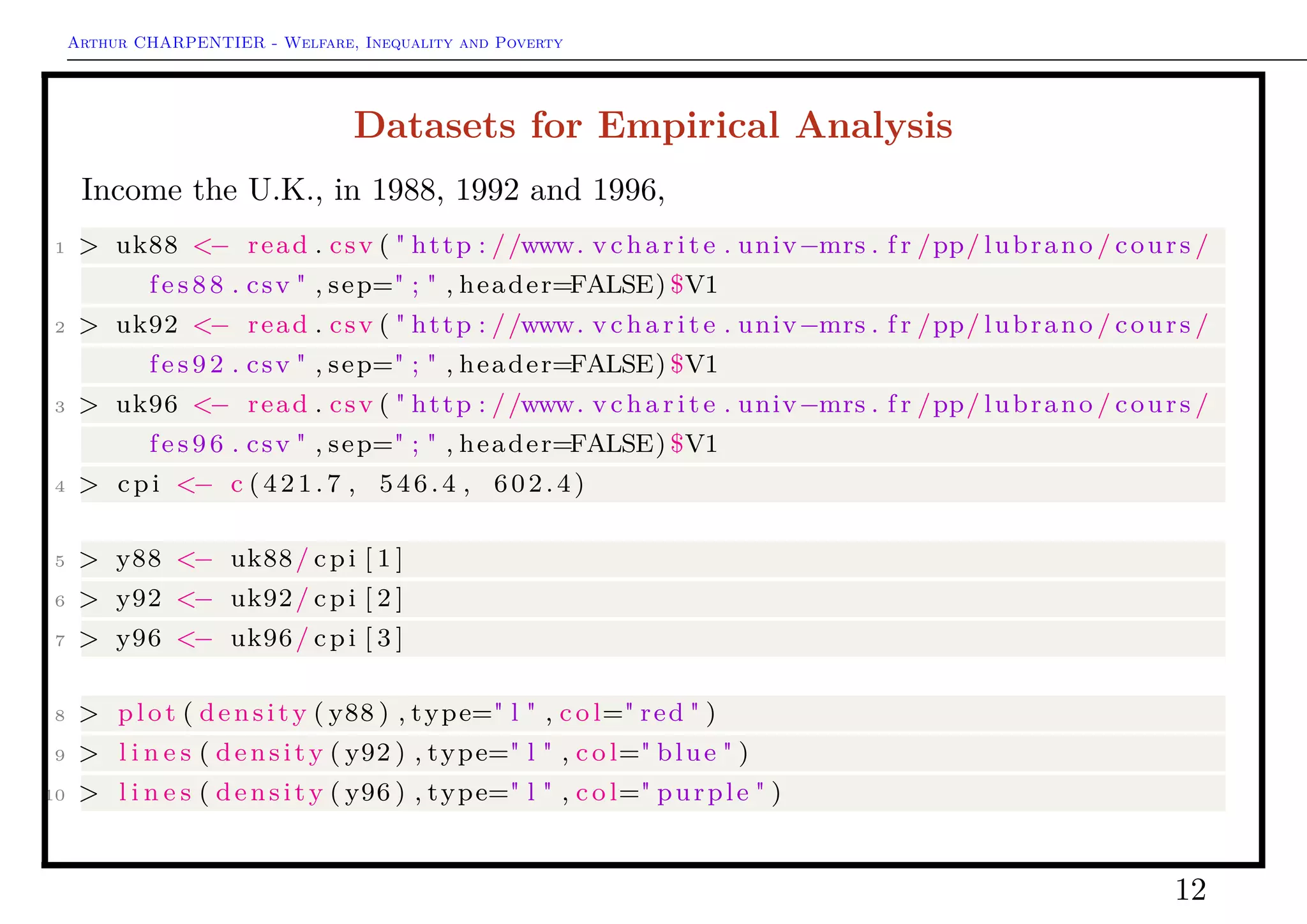
Income the U.K., in 1988, 1992 and 1996,
1 > uk88 <− read . csv ( " http : //www. v char it e . univ−mrs . f r /pp/ lubrano / cours /
f e s 8 8 . csv " , sep=" ; " , header=FALSE) $V1
2 > uk92 <− read . csv ( " http : //www. v char it e . univ−mrs . f r /pp/ lubrano / cours /
f e s 9 2 . csv " , sep=" ; " , header=FALSE) $V1
3 > uk96 <− read . csv ( " http : //www. v char it e . univ−mrs . f r /pp/ lubrano / cours /
f e s 9 6 . csv " , sep=" ; " , header=FALSE) $V1
4 > cpi <− c (421.7 , 546.4 , 602.4)
5 > y88 <− uk88/ cpi [ 1 ]
6 > y92 <− uk92/ cpi [ 2 ]
7 > y96 <− uk96/ cpi [ 3 ]
8 > plot ( density ( y88 ) , type=" l " , c o l=" red " )
9 > l i n e s ( density ( y92 ) , type=" l " , c o l=" blue " )
10 > l i n e s ( density ( y96 ) , type=" l " , c o l=" purple " )
15
Arthur CHARPENTIER - Welfare, Inequality and Poverty
Datasets for Empirical Analysis
16
Arthur CHARPENTIER - Welfare, Inequality and Poverty
Inequalities: Empirical Analysis
We can visualize empirical Lorenz curves, and theoretical version (lognormal)
1 > plot ( Lc ( y88 ) ) ; s=sd ( log ( y88 ) ) ; l i n e s ( Lc . lognorm , parameter=s )
2 > plot ( Lc ( y92 ) ) ; s=sd ( log ( y92 ) ) ; l i n e s ( Lc . lognorm , parameter=s )
3 > plot ( Lc ( y96 ) ) ; s=sd ( log ( y96 ) ) ; l i n e s ( Lc . lognorm , parameter=s )
17
Arthur CHARPENTIER - Welfare, Inequality and Poverty
Inequalities: Empirical Analysis
If we plot the three curves on the same
graph,
1 > plot ( Lc ( y88 ) , c o l=" red " )
2 > l i n e s ( Lc ( y92 ) , c o l=" blue " )
3 > l i n e s ( Lc ( y96 ) , c o l=" purple " )
18
Arthur CHARPENTIER - Welfare, Inequality and Poverty
Inequalities: Empirical Analysis
1 > i n e q u a l i t i e s=function ( f_ineq ) {
2 + z88 =f_ineq ( y88 ) ; z92 = f_ineq
( y92 ) ; z96 = f_ineq ( y96 )
3 + I=cbind ( z88 , z92 , z96 )
4 + names ( I )=c ( " 1988 " , " 1992 " , " 1996
" )
5 + cat ( " 1 9 8 8 . . . " , z88 , " n 1 9 9 2 . . .
" , z92 , " n 1 9 9 6 . . . " , z96 , " n" )
6 + barplot ( I , c o l=" l i g h t green " ,
names . arg=c ( " 1988 " , " 1992 " , "
1996 " ) )
7 + return ( I ) }
8 > I<−i n e q u a l i t i e s ( Gini )
9 1 9 8 8 . . . 0.3073511
10 1 9 9 2 . . . 0.3214023
11 1 9 9 6 . . . 0.2975789
19
Arthur CHARPENTIER - Welfare, Inequality and Poverty
Inequalities: Empirical Analysis
1 > I<−i n e q u a l i t i e s ( Theil )
2 1 9 8 8 . . . 0.1618547
3 1 9 9 2 . . . 0.1794008
4 1 9 9 6 . . . 0.1506973
20
Arthur CHARPENTIER - Welfare, Inequality and Poverty
Welfare Functions
A welfare function as a function with n arguments W(x) = W(x1, · · · , xn).
Assume that W is normalize, so that W(1) = 1.
It represents social preferences over the income distribution, and it should satisfy
some axioms,
Pareto axiom: The welfare function is increasing for all its inputs
W(x + ) ≥ W(x) for all ≥ 0.
Symmetry axiom or anonymity: We can permute the individuals without
changing the value of the function
W(x1, x2, · · · , xn) = W(x2, x1, · · · , xn)
21
Arthur CHARPENTIER - Welfare, Inequality and Poverty
Welfare Functions
Principle of transfers: the quasi concavity of the welfare function implies that if
we operate a monetary transfer from a rich to a poor, welfare is increased,
provided that the transfer does not modify the ordering of individuals
(Pigou-Dalton principle)
W(x1, · · · , xi, · · · , xj, · · · , xn) ≥ W(x1, · · · , xi+δ, · · · , xj−δ, · · · , xn)
Other axioms can be added, e.g. homogeneous of order 1,
W(λx) = λW(x) for all λ ≥ 0.
Thus (all homogeneous function of order 1 can be defined on the simplex)
W(x) = x · W
x
x
for all λ ≥ 0.
22
Arthur CHARPENTIER - Welfare, Inequality and Poverty
Welfare Functions
Observe that W(x1) = x. And because of the aversion for inequality, W(x) ≤ x.
One can denote
W(x) = x · [1 − I(x)]
for some function I(·), which takes values in [0, 1].
I(·) is then interpreted as an inequality measure and x · I(x) represents the
(social) cost of inequality.
See fao.org.
23
Arthur CHARPENTIER - Welfare, Inequality and Poverty
Welfare Functions
E.g. utilitarian (or Benthamian) function
W(x) = x =
1
n
n
i=1
xi
“dollar is a dollar” approach: no inequality aversion.
E.g. Rawlsian welfare function
W(x) = min{y1, · · · , yn}.
Social welfare cannot increase unless the income of the poorest individual is
increased: infinite inequality aversion.
24
Arthur CHARPENTIER - Welfare, Inequality and Poverty
From Welfare Functions to Inequality Indices
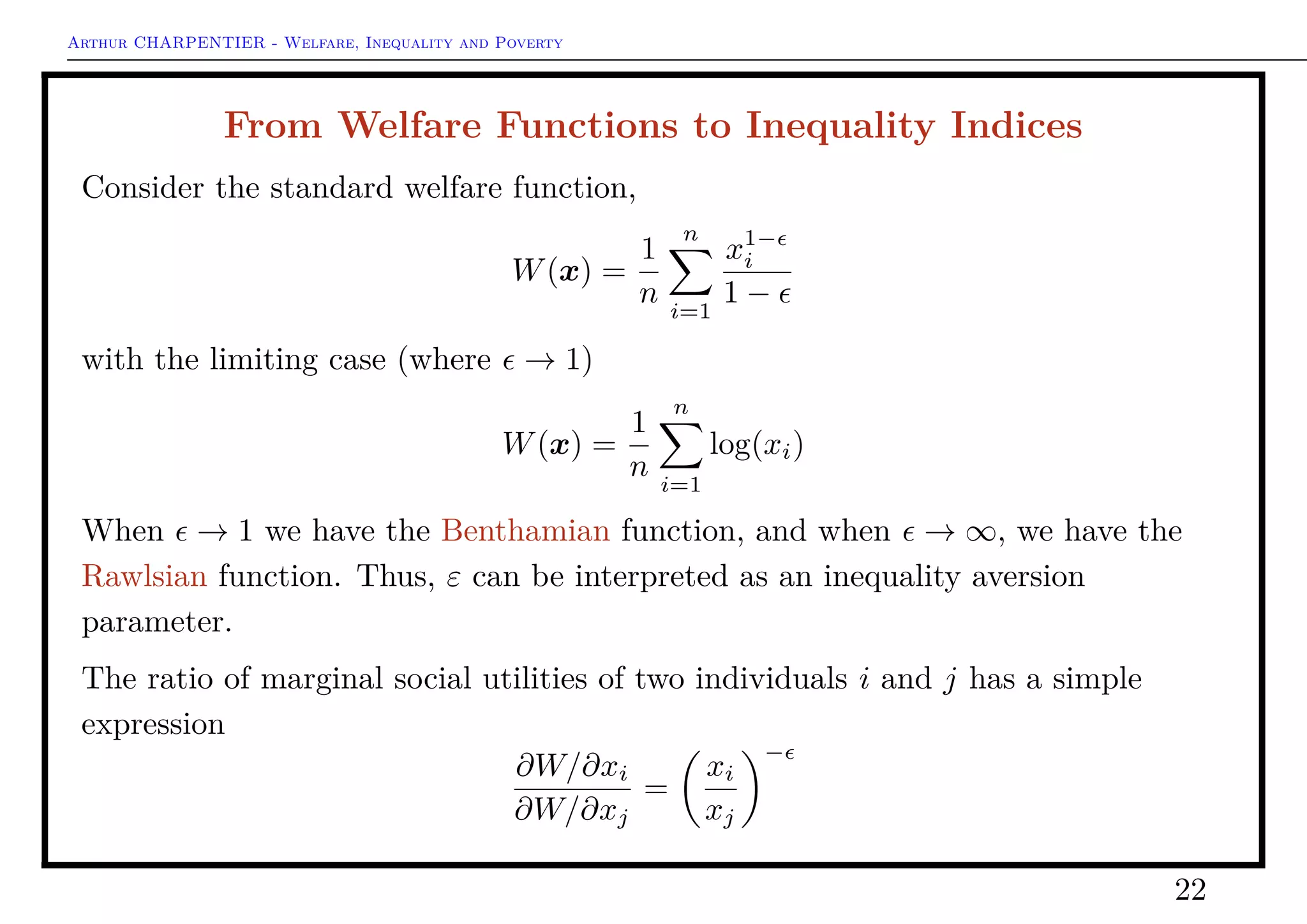
Consider the standard welfare function,
W(x) =
1
n
n
i=1
x1−
i
1 −
with the limiting case (where → 1)
W(x) =
1
n
n
i=1
log(xi)
When → 1 we have the Benthamian function, and when → ∞, we have the
Rawlsian function. Thus, ε can be interpreted as an inequality aversion
parameter.
The ratio of marginal social utilities of two individuals i and j has a simple
expression
∂W/∂xi
∂W/∂xj
=
xi
xj
−
25
Arthur CHARPENTIER - Welfare, Inequality and Poverty
When increases, the marginal utility of the poorest dominates, see Rawls (1971)
wikipedia.org, the objective of the society is to maximise the situation of the
poorest.
From that welfare function, define the implied inequality index,
I = 1 −
1
n
n
i=1
xi
x
1−
1
1−ε
which is Atkinson index.
26
Arthur CHARPENTIER - Welfare, Inequality and Poverty
Equally Distributed Equivalent
Given x define ξ (or ξ(x)) as
W(ξ1) = W(x)
From the principle of transfers, ξ ≤ x. Then one can define
I(x) = 1 −
ξ(x)
x
.
If I(·) satisfies the scale independence axiom, I(x) = I(λx), then
ξ(x) =
1
n
n
i=1
(xi)
1−
1
1−ε
This index has a simple interpretation : if I = 0.370% of the total income is
necessary to reach the same value of welfare, provided that income is equally
distributed.
27
Arthur CHARPENTIER - Welfare, Inequality and Poverty
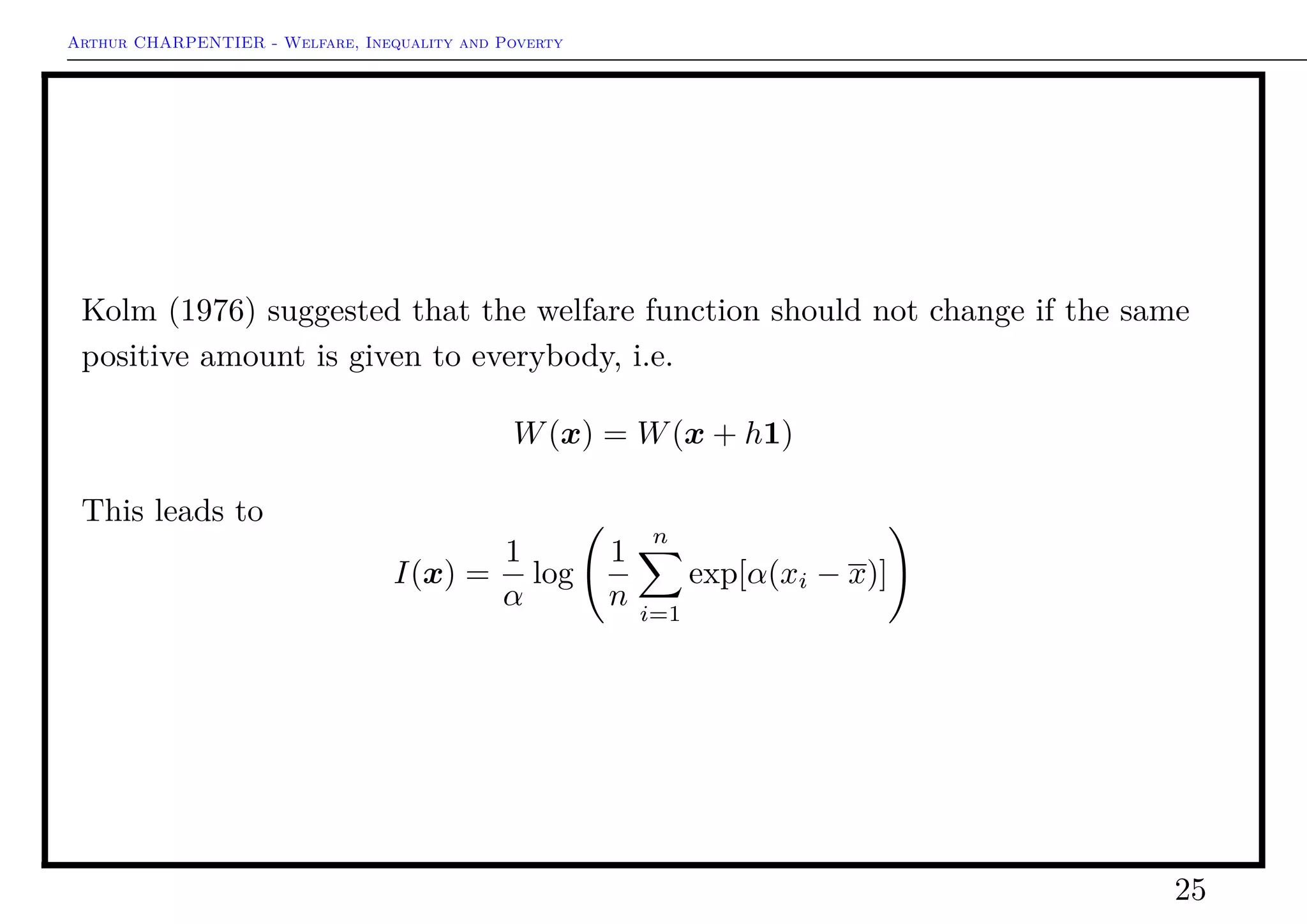
Kolm (1976) suggested that the welfare function should not change if the same
positive amount is given to everybody, i.e.
W(x) = W(x + h1)
This leads to
I(x) =
1
α
log
1
n
n
i=1
exp[α(xi − x)]
28
Arthur CHARPENTIER - Welfare, Inequality and Poverty
From Inequality Indices to Welfare Functions
Consider e.g. Gini index
G(x) =
2
n(n − 1)x
n
i=1
i · xi:n −
n + 1
n − 1
G(x) =
1
2n2x
n
i,j=1
|xi − xj|
then define
W(x) = x · [1 − G(x)]
as suggested in Sen (1976, jstor.org)
More generally, consider
W(x) = x · [1 − G(x)]σ
with σ ∈ [0, 1].
29
Arthur CHARPENTIER - Welfare, Inequality and Poverty
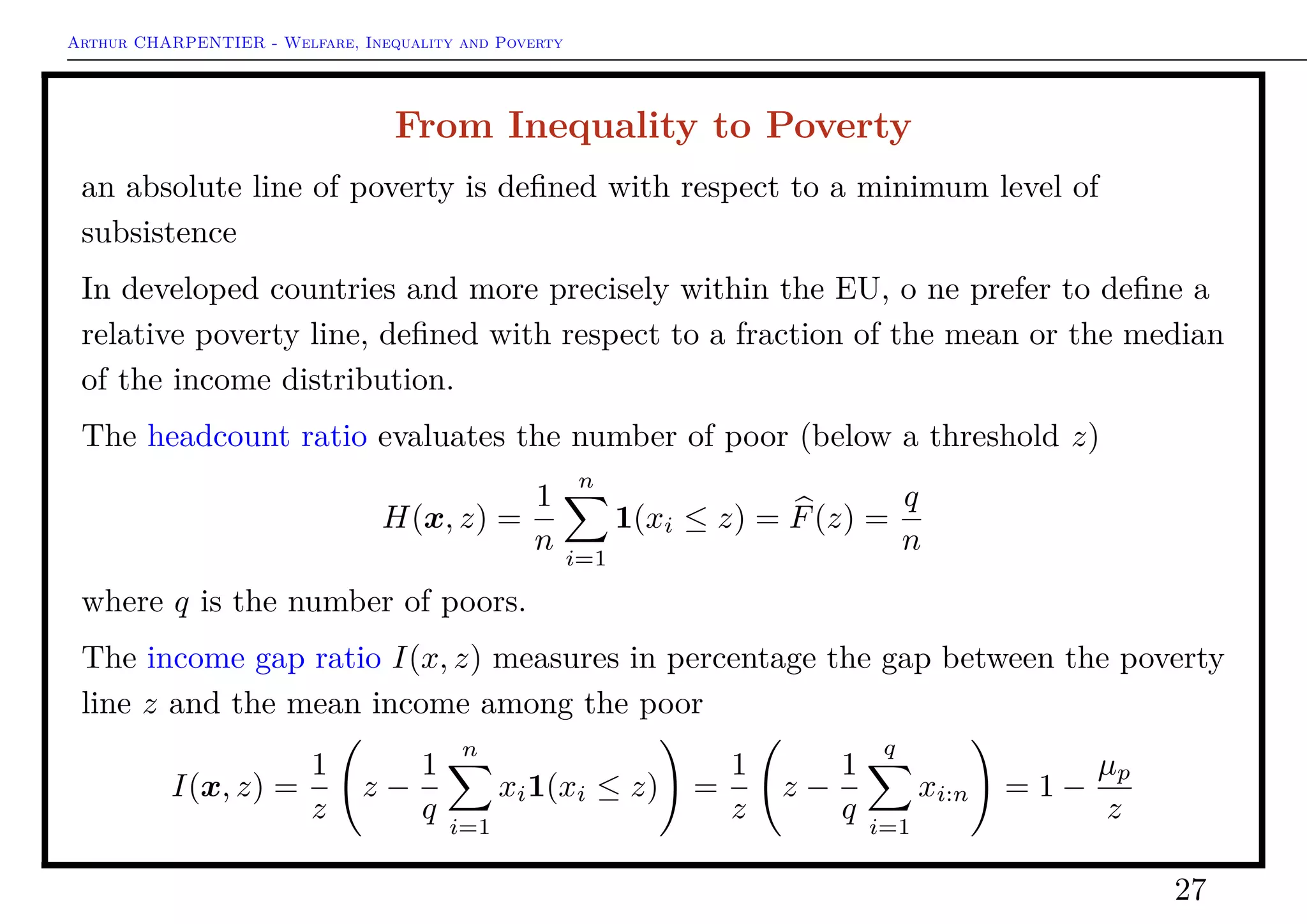
From Inequality to Poverty
an absolute line of poverty is defined with respect to a minimum level of
subsistence
In developed countries and more precisely within the EU, o ne prefer to define a
relative poverty line, defined with respect to a fraction of the mean or the median
of the income distribution.
The headcount ratio evaluates the number of poor (below a threshold z)
H(x, z) =
1
n
n
i=1
1(xi ≤ z) = F(z) =
q
n
where q is the number of poors.
The income gap ratio I(x, z) measures in percentage the gap between the poverty
line z and the mean income among the poor
I(x, z) =
1
z
z −
1
q
n
i=1
xi1(xi ≤ z) =
1
z
z −
1
q
q
i=1
xi:n = 1 −
µp
z
30
Arthur CHARPENTIER - Welfare, Inequality and Poverty
where µp is the average income of the poor.
The poverty gap ratio is defined as
HI(x, z) =
q
n
1 −
1
qz
q
i=1
xi:n
Watts (1968) suggested also
W(x, z) =
1
q
q
i=1
[log z − log xi:n]
which can be writen
W = H · (T − log(1 − I))
where T is Theil index (Generalize Entropy, with index 1)
T =
1
n
n
i=1
xi
x
log
xi
x
.
1 > Watts (x , z , na . rm = TRUE)
31
Arthur CHARPENTIER - Welfare, Inequality and Poverty
Sen Poverty Indices
S(x, z) = H(x, z) · [I(x, z) + [1 − (x, z)]Gp]
where Gp is Gini index of the poors.
• if Gp = 0 then S = HI
• if Gp = 1 then S = H
1 > Sen (x , z , na . rm = TRUE)
On can write
S =
2
(q + 1)nz
q
i=1
[z − xi:n][q + 1 − i]
Thon (1979) suggested a similar expression, but with (slightly) different weights
Thon =
2
n(n + 1)z
q
i=1
[z − xi:n][n + 1 − i]
32
Arthur CHARPENTIER - Welfare, Inequality and Poverty
But it suffers some drawbacks: it violates the principle of transfers and is not
continuous in x. Shorrocks (1995, jstor.org) suggested
SST(x, z) = [2 − H(x, z)] · H(x, z) · I(x, z) + H(x, z)2
[1 − I(x, z)] · GP
Observe that Sen index is defined as
S =
2
(q + 1)n
q
i=1
z − xi:n
z
˜xi
[q + 1 − i]
while
SST =
1
n2
q
i=1
z − xi:n
z
˜xi
[2n − 2i + 1]
This index is symmetric, monotonic, homogeneous of order 0 and takes values in
[0, 1]. Further it is continuous and consistent with the transfert axiom.
On can write
SST = ˜x · [1 − G(˜x)].
33
Arthur CHARPENTIER - Welfare, Inequality and Poverty
1 > SST(x , z , na . rm = TRUE)
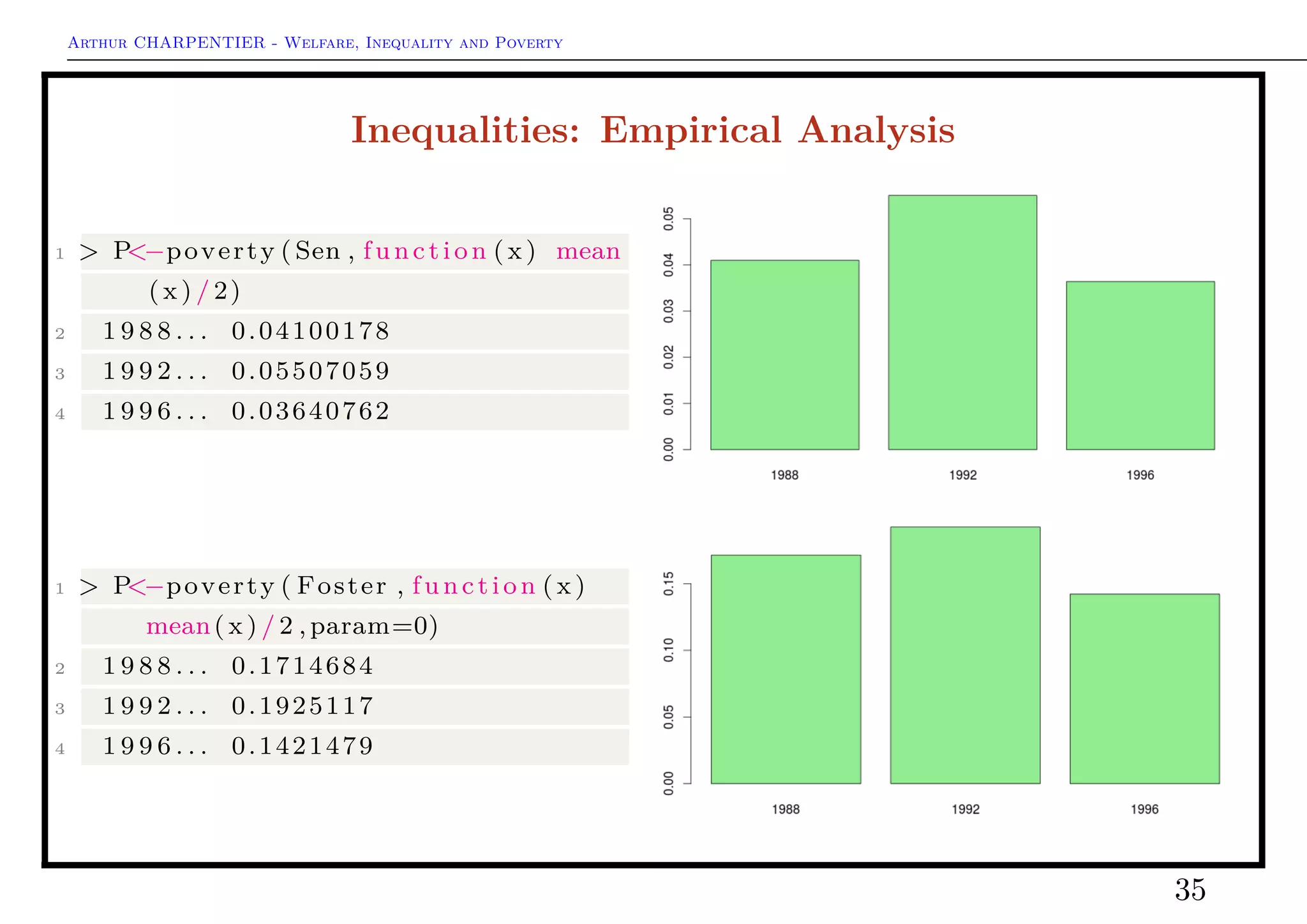
1 > poverty=function ( f_pov , z_fun=function (x ) mean( x ) / 2 , . . . ) {
2 + z88 =z_fun ( y88 ) ; z92 = z_fun ( y92 ) ; z96 = z_fun ( y96 )
3 + p88=f_pov ( y88 , z88 ) ; p92=f_pov ( y92 , z92 ) ; p96=f_pov ( y96 , z96 )
4 + P=cbind ( p88 , p92 , p96 )
5 + names (P)=c ( " 1988 " , " 1992 " , " 1996 " )
6 + cat ( " 1 9 8 8 . . . " , p88 , " n 1 9 9 2 . . . " , p92 , " n 1 9 9 6 . . . " , p96 , " n" )
7 + barplot (P, c o l=" l i g h t green " , names . arg=c ( " 1988 " , " 1992 " , " 1996 " ) )
8 + return (P) }
34
Arthur CHARPENTIER - Welfare, Inequality and Poverty
FGT Poverty Indices
Foster, Greer & Thorbecke (1984, darp.lse.ac.uk) suggested a class of poverty
indices that were decomposable,
Pα(x, z) =
1
n
q
i=1
1 −
xi
z
α
where α ∈ {0, 1, 2, · · · }.
When α = 0 we get the headcount measure,
P0 =
1
n
q
i=1
1(xi ≤ z) =
q
n
When α = 1 we get an average of poverty gap z − xi
P1 =
1
n
q
i=1
1 −
xi
z
1(xi ≤ z)
35
Arthur CHARPENTIER - Welfare, Inequality and Poverty
(see HI).
In R, the parameter is 1 + α
1 > Foster (x , k , parameter = 1 , na . rm = TRUE)
i.e. it gives for parameter 1 the headcount ratio and for parameter 2 the poverty
gap ratio.
When α = 2
P2 =
1
n
q
i=1
1 −
xi
z
2
1(xi ≤ z)
36
Arthur CHARPENTIER - Welfare, Inequality and Poverty
Inequalities: Empirical Analysis
1 > P<−poverty ( Watts , function ( x)
mean(x ) / 2)
2 1 9 8 8 . . . 0.03561864
3 1 9 9 2 . . . 0.05240638
4 1 9 9 6 . . . 0.03342492
1 > P<−poverty ( Watts , function ( x)
qu a ntile (x , . 1 ) )
2 1 9 8 8 . . . 0.01935494
3 1 9 9 2 . . . 0.0277594
4 1 9 9 6 . . . 0.02289631
37
Arthur CHARPENTIER - Welfare, Inequality and Poverty
Inequalities: Empirical Analysis
1 > P<−poverty ( Sen , function ( x) mean
( x ) / 2)
2 1 9 8 8 . . . 0.04100178
3 1 9 9 2 . . . 0.05507059
4 1 9 9 6 . . . 0.03640762
1 > P<−poverty ( Foster , function (x )
mean(x ) / 2 , param=0)
2 1 9 8 8 . . . 0.1714684
3 1 9 9 2 . . . 0.1925117
4 1 9 9 6 . . . 0.1421479
38
Arthur CHARPENTIER - Welfare, Inequality and Poverty
Group Decomposabilty
Assume that x is either x1 with probability p (e.g. urban) or x2 with probability
1 − p (e.g. rural). The (total) FGT index can be writen
Pα = p ·
1
n i,1
1 −
xi
z
α
+ [1 − p] ·
1
n i,2
1 −
xi
z
α
= pP(1)
α + [1 − p]P(2)
α
39
Arthur CHARPENTIER - Welfare, Inequality and Poverty
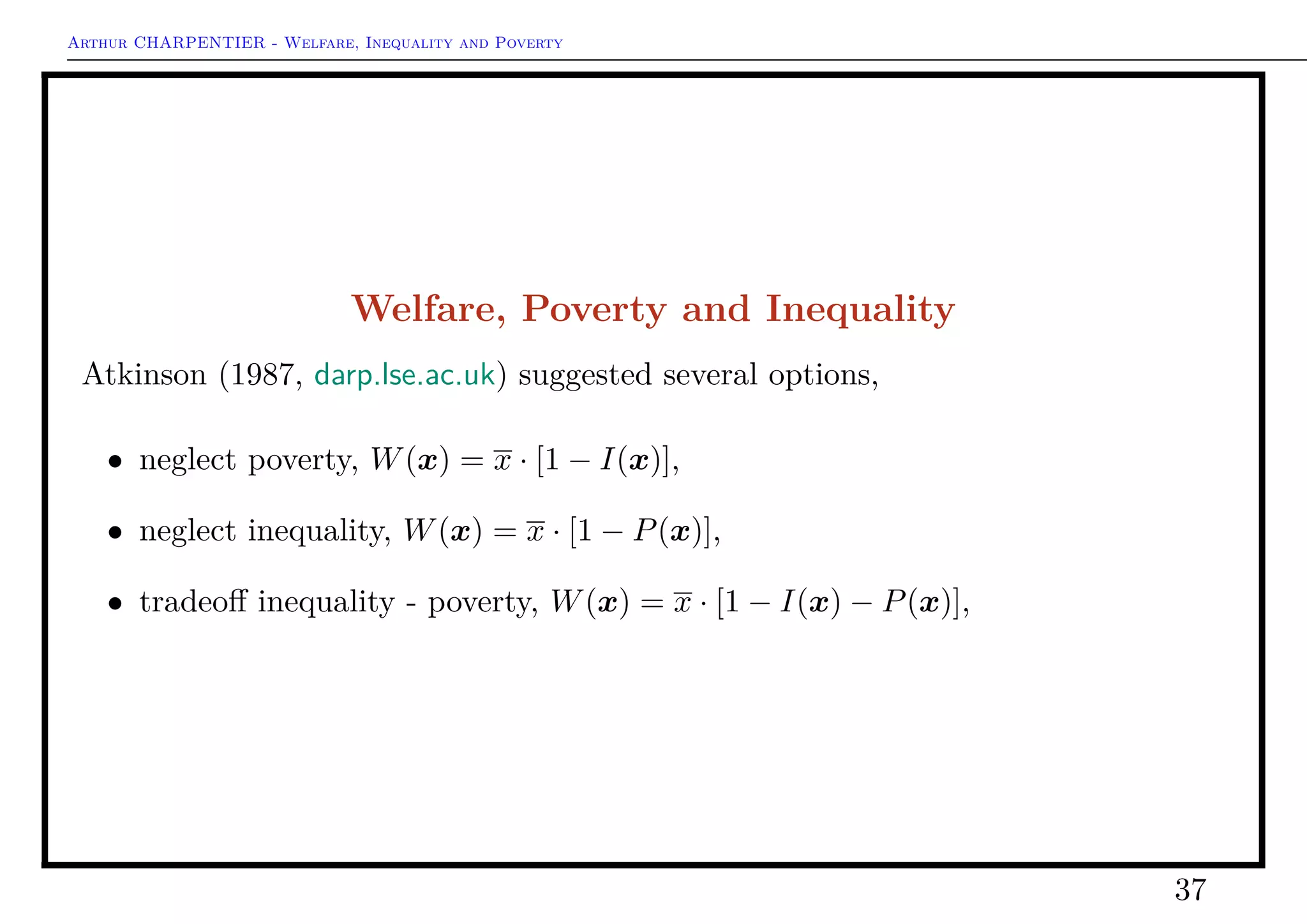
Welfare, Poverty and Inequality
Atkinson (1987, darp.lse.ac.uk) suggested several options,
• neglect poverty, W(x) = x · [1 − I(x)],
• neglect inequality, W(x) = x · [1 − P(x)],
• tradeoff inequality - poverty, W(x) = x · [1 − I(x) − P(x)],
40
Arthur CHARPENTIER - Welfare, Inequality and Poverty
Projects
• Une réduction de l’inégalité des chances dans l’obtention du revenu en France
? pdf, 2004
• Socioeconomic inequalities in health: Measurement, computation and
statistical inference pdf, 1997
• Gini ou Entropie pdf, 2003
41

Inequality #4

  • 1.
    Arthur CHARPENTIER -Welfare, Inequality and Poverty Arthur Charpentier charpentier.arthur@gmail.com http://freakonometrics.hypotheses.org/ Université de Rennes 1, February 2016 Welfare, Inequality & Poverty, # 4 1
  • 2.
    Arthur CHARPENTIER -Welfare, Inequality and Poverty Regression? Galton (1870, galton.org, 1886, galton.org ) and Pear- son & Lee (1896, jstor.org, 1903 jstor.org) studied ge- netic transmission of characterisitcs, e.g. the heigth. On average the child of tall parents is taller than other children, but less than his parents. “I have called this peculiarity by the name of regres- sion’, Francis Galton, 1886. 2
  • 3.
    Arthur CHARPENTIER -Welfare, Inequality and Poverty Regression? 1 > l i b r a r y ( HistData ) 2 > attach ( Galton ) 3 > Galton$ count <− 1 4 > df <− aggregate ( Galton , by=l i s t ( parent , c h i l d ) , FUN=sum) [ , c (1 ,2 ,5) ] 5 > plot ( df [ , 1 : 2 ] , cex=sqrt ( df [ , 3 ] / 3) ) 6 > ab lin e ( a=0,b=1, l t y =2) 7 > ab lin e (lm( c h i l d ~parent , data=Galton ) ) q q q q q q q q q q q q q q q q q q q q q q q q q q q q q q q q q q q q q q q q q q q q q q q q q q q q q q q q q q q q q q q q q q q q q q q q q q q q q q q q q q q q q q q q q q q q q q q q q q q q q 64 66 68 70 72 62646668707274 height of the mid−parent heightofthechild q q q q q q q q q q q q q q q q q q q q q q q q q q q q q q q q q q q q q q q q q q q q q q q q q q q q q q q q q q q q q q q q q q q q q q q q q q q q q q q q q q q q q q q q q q q q q q q q q q q q q 3
  • 4.
    Arthur CHARPENTIER -Welfare, Inequality and Poverty Least Squares? Recall that    E(Y ) = argmin m∈R Y − m 2 2 = E [Y − m]2 Var(Y ) = min m∈R E [Y − m]2 = E [Y − E(Y )]2 The empirical version is    y = argmin m∈R n i=1 1 n [yi − m]2 s2 = min m∈R n i=1 1 n [yi − m]2 = n i=1 1 n [yi − y]2 The conditional version is    E(Y |X) = argmin ϕ:Rk→R Y − ϕ(X) 2 2 = E [Y − ϕ(X)]2 Var(Y |X) = min ϕ:Rk→R E [Y − ϕ(X)]2 = E [Y − E(Y |X)]2 4
  • 5.
    Arthur CHARPENTIER -Welfare, Inequality and Poverty Changing the Distance in Least-Squares? One might consider β ∈ argmin n i=1 |Yi − XT i β| , based on the 1-norm, and not the 2-norm. This is the least-absolute deviation estimator, related to the median regression, since median(X) = argmin{E|X − x|}. More generally, assume that, for some function R(·), β ∈ argmin n i=1 R(Yi − XT i β) If R is differentiable, the first order condition would be n i=1 R Yi − XT i β · XT i = 0. 5
  • 6.
    Arthur CHARPENTIER -Welfare, Inequality and Poverty Changing the Distance in Least-Squares? i.e. n i=1 ω Yi − XT i β ωi · Yi − XT i β XT i = 0 with ω(x) = R (x) x , It is the first order condition of a weighted 2 regression. To obtain the 1-regression, observe that ω = |ε|−1 6
  • 7.
    Arthur CHARPENTIER -Welfare, Inequality and Poverty Changing the Distance in Least-Squares? =⇒ use iterative (weighted) least-square regressions. Start with some standard 2 regression 1 > reg_0 <− lm(Y~X, data=db) For the 1 regression consider weight function 1 > omega <− function ( e ) 1/abs ( e ) Then consider the following iterative algorithm 1 > r e s i d <− r e s i d u a l s ( reg_0) 2 > f o r ( i in 1:100) { 3 + W <− omega ( e ) 4 + reg <− lm(Y~X, data=db , weights=W) 5 + e <− r e s i d u a l t s ( reg ) } q q q q q q q q q q q q q q q q qq q q q q q q q q q q q q q q q q q q q q q q q q q q q q qq q q speed dist 5 10 15 20 25 020406080100120 7
  • 8.
    Arthur CHARPENTIER -Welfare, Inequality and Poverty Quantile Regression Observe that, for all τ ∈ (0, 1) QX(τ) = F−1 X (τ) = argmin m∈R {E[Rτ (X − m)]} where Rτ (x) = [τ − 1(x < 0)] · x. From a statistical point of view Qx(τ) = argmin m∈R 1 n n i=1 Rτ (xi − m) . The quantile-τ regression β = argmin n i=1 Rτ (Yi − XT i β) . 8
  • 9.
    Arthur CHARPENTIER -Welfare, Inequality and Poverty q 5 10 15 20 25 020406080100120 speed dist q q q 5 10 15 20 25 020406080100120 speed dist 5 10 15 20 25 020406080100120 speed dist There are n(1 − p) points in the upper region, and np in the lower one. 1 > l i b r a r y ( quantreg ) 2 > f i t 1 <− rq ( y ~ x1 + x2 , tau = . 1 , data = df ) see cran.r-project.org. 9
  • 10.
    Arthur CHARPENTIER -Welfare, Inequality and Poverty Quantile Regression: Empirical Analysis Consider here some salaries, as a func- tion of the experience (in years), see data.princeton.edu 1 > s a l a r y=read . table ( " http : // data . princeton . edu/wws509/ datasets / s a l a r y . dat " , header=TRUE) 2 > l i b r a r y ( quantreg ) 3 > plot ( s a l a r y $yd , c ) 4 > ab lin e ( rq ( s l ~yd , tau =.1 , data= s a l a r y ) , c o l=" red " ) q q q q q q q q q q q q q q q q q q q q q q q q q q q q q q q q q q q q q q q q q q q q q q q q q q q q 0 5 10 15 20 25 30 35 1500020000250003000035000 Experience (years) Salary 10
  • 11.
    Arthur CHARPENTIER -Welfare, Inequality and Poverty Quantile Regression: Empirical Analysis 1 > u <− seq ( . 0 5 , . 9 5 , by=.01) 2 > c o e f s t d <− function (u) summary( rq ( s l ~yd , data=salary , tau=u) ) $ c o e f f i c i e n t s [ , 2 ] 3 > c o e f e s t <− function (u) summary( rq ( s l ~yd , data=salary , tau=u) ) $ c o e f f i c i e n t s [ , 1 ] 4 > CS <− Vectorize ( c o e f s t d ) (u) 5 > CE <− Vectorize ( c o e f e s t ) (u) 6 > CEinf <− CE−2∗CS 7 > CEsup <− CE+2∗CS 8 > plot (u ,CE[ 2 , ] , ylim=c ( −500 ,2000) , c o l=" red " ) 9 > polygon ( c (u , rev (u) ) , c ( CEinf [ 2 , ] , rev (CEsup [ 2 , ] ) ) , c o l=" yellow " , border=NA) qqqqqqq qqqqqqqqqqq qqqqqqq q qqqqqqqqqq qqqqqqq qqqqqqqqqqqqqqqqqq qqqqqqqqqqqqqq qqqq qq qqq qqqqqqq 0.2 0.4 0.6 0.8 −5000500100015002000 probability CE[2,] 11
  • 12.
    Arthur CHARPENTIER -Welfare, Inequality and Poverty Quantile Regression: Empirical Analysis Consider the evolution of the 90%−10% quantile ratio, 1 > ratio9010 = function ( age ) { 2 + p r e d i c t (Q90 , newdata=data . frame ( yd=age ) ) / 3 + p r e d i c t (Q10 , newdata=data . frame ( yd=age ) ) 4 + } 5 > ratio9010 (5) 6 1.401749 7 > A=0:30 8 > plot (A, Vectorize ( ratio9010 ) (A) , type=" l " , ylab=" 90−10 qua nti le r a t i o " ) 12
  • 13.
    Arthur CHARPENTIER -Welfare, Inequality and Poverty Local Regression: Empirical Analysis which is smoother than the local esti- mator 1 > ratio9010_k = function ( age , k =10){ 2 + idx=which ( rank ( abs ( s a l a r y $yd− age ) )<=k) 3 + qu antil e ( s a l a r y $ s l [ idx ] , . 9 ) / qu a ntile ( s a l a r y $ s l [ idx ] , . 1 ) } 4 > A=0:30 5 > plot (A, Vectorize ( ratio9010_k) (A ) , type=" l " , ylab=" 90−10 qu a ntile r a t i o " ) 13
  • 14.
    Arthur CHARPENTIER -Welfare, Inequality and Poverty Local Regression: Empirical Analysis 1 > Gini ( s a l a r y $ s l ) 2 [ 1 ] 0.1391865 We can also consider some local Gini index 1 > Gini_k = function ( age , k=10){ 2 + idx=which ( rank ( abs ( s a l a r y $yd− age ) )<=k) 3 + Gini ( s a l a r y $ s l [ idx ] ) } 4 > A=0:30 5 > plot (A, Vectorize ( Gini_k ) (A) , type=" l " , ylab=" Local Gini index " ) 14
  • 15.
    Arthur CHARPENTIER -Welfare, Inequality and Poverty Datasets for Empirical Analysis Income the U.K., in 1988, 1992 and 1996, 1 > uk88 <− read . csv ( " http : //www. v char it e . univ−mrs . f r /pp/ lubrano / cours / f e s 8 8 . csv " , sep=" ; " , header=FALSE) $V1 2 > uk92 <− read . csv ( " http : //www. v char it e . univ−mrs . f r /pp/ lubrano / cours / f e s 9 2 . csv " , sep=" ; " , header=FALSE) $V1 3 > uk96 <− read . csv ( " http : //www. v char it e . univ−mrs . f r /pp/ lubrano / cours / f e s 9 6 . csv " , sep=" ; " , header=FALSE) $V1 4 > cpi <− c (421.7 , 546.4 , 602.4) 5 > y88 <− uk88/ cpi [ 1 ] 6 > y92 <− uk92/ cpi [ 2 ] 7 > y96 <− uk96/ cpi [ 3 ] 8 > plot ( density ( y88 ) , type=" l " , c o l=" red " ) 9 > l i n e s ( density ( y92 ) , type=" l " , c o l=" blue " ) 10 > l i n e s ( density ( y96 ) , type=" l " , c o l=" purple " ) 15
  • 16.
    Arthur CHARPENTIER -Welfare, Inequality and Poverty Datasets for Empirical Analysis 16
  • 17.
    Arthur CHARPENTIER -Welfare, Inequality and Poverty Inequalities: Empirical Analysis We can visualize empirical Lorenz curves, and theoretical version (lognormal) 1 > plot ( Lc ( y88 ) ) ; s=sd ( log ( y88 ) ) ; l i n e s ( Lc . lognorm , parameter=s ) 2 > plot ( Lc ( y92 ) ) ; s=sd ( log ( y92 ) ) ; l i n e s ( Lc . lognorm , parameter=s ) 3 > plot ( Lc ( y96 ) ) ; s=sd ( log ( y96 ) ) ; l i n e s ( Lc . lognorm , parameter=s ) 17
  • 18.
    Arthur CHARPENTIER -Welfare, Inequality and Poverty Inequalities: Empirical Analysis If we plot the three curves on the same graph, 1 > plot ( Lc ( y88 ) , c o l=" red " ) 2 > l i n e s ( Lc ( y92 ) , c o l=" blue " ) 3 > l i n e s ( Lc ( y96 ) , c o l=" purple " ) 18
  • 19.
    Arthur CHARPENTIER -Welfare, Inequality and Poverty Inequalities: Empirical Analysis 1 > i n e q u a l i t i e s=function ( f_ineq ) { 2 + z88 =f_ineq ( y88 ) ; z92 = f_ineq ( y92 ) ; z96 = f_ineq ( y96 ) 3 + I=cbind ( z88 , z92 , z96 ) 4 + names ( I )=c ( " 1988 " , " 1992 " , " 1996 " ) 5 + cat ( " 1 9 8 8 . . . " , z88 , " n 1 9 9 2 . . . " , z92 , " n 1 9 9 6 . . . " , z96 , " n" ) 6 + barplot ( I , c o l=" l i g h t green " , names . arg=c ( " 1988 " , " 1992 " , " 1996 " ) ) 7 + return ( I ) } 8 > I<−i n e q u a l i t i e s ( Gini ) 9 1 9 8 8 . . . 0.3073511 10 1 9 9 2 . . . 0.3214023 11 1 9 9 6 . . . 0.2975789 19
  • 20.
    Arthur CHARPENTIER -Welfare, Inequality and Poverty Inequalities: Empirical Analysis 1 > I<−i n e q u a l i t i e s ( Theil ) 2 1 9 8 8 . . . 0.1618547 3 1 9 9 2 . . . 0.1794008 4 1 9 9 6 . . . 0.1506973 20
  • 21.
    Arthur CHARPENTIER -Welfare, Inequality and Poverty Welfare Functions A welfare function as a function with n arguments W(x) = W(x1, · · · , xn). Assume that W is normalize, so that W(1) = 1. It represents social preferences over the income distribution, and it should satisfy some axioms, Pareto axiom: The welfare function is increasing for all its inputs W(x + ) ≥ W(x) for all ≥ 0. Symmetry axiom or anonymity: We can permute the individuals without changing the value of the function W(x1, x2, · · · , xn) = W(x2, x1, · · · , xn) 21
  • 22.
    Arthur CHARPENTIER -Welfare, Inequality and Poverty Welfare Functions Principle of transfers: the quasi concavity of the welfare function implies that if we operate a monetary transfer from a rich to a poor, welfare is increased, provided that the transfer does not modify the ordering of individuals (Pigou-Dalton principle) W(x1, · · · , xi, · · · , xj, · · · , xn) ≥ W(x1, · · · , xi+δ, · · · , xj−δ, · · · , xn) Other axioms can be added, e.g. homogeneous of order 1, W(λx) = λW(x) for all λ ≥ 0. Thus (all homogeneous function of order 1 can be defined on the simplex) W(x) = x · W x x for all λ ≥ 0. 22
  • 23.
    Arthur CHARPENTIER -Welfare, Inequality and Poverty Welfare Functions Observe that W(x1) = x. And because of the aversion for inequality, W(x) ≤ x. One can denote W(x) = x · [1 − I(x)] for some function I(·), which takes values in [0, 1]. I(·) is then interpreted as an inequality measure and x · I(x) represents the (social) cost of inequality. See fao.org. 23
  • 24.
    Arthur CHARPENTIER -Welfare, Inequality and Poverty Welfare Functions E.g. utilitarian (or Benthamian) function W(x) = x = 1 n n i=1 xi “dollar is a dollar” approach: no inequality aversion. E.g. Rawlsian welfare function W(x) = min{y1, · · · , yn}. Social welfare cannot increase unless the income of the poorest individual is increased: infinite inequality aversion. 24
  • 25.
    Arthur CHARPENTIER -Welfare, Inequality and Poverty From Welfare Functions to Inequality Indices Consider the standard welfare function, W(x) = 1 n n i=1 x1− i 1 − with the limiting case (where → 1) W(x) = 1 n n i=1 log(xi) When → 1 we have the Benthamian function, and when → ∞, we have the Rawlsian function. Thus, ε can be interpreted as an inequality aversion parameter. The ratio of marginal social utilities of two individuals i and j has a simple expression ∂W/∂xi ∂W/∂xj = xi xj − 25
  • 26.
    Arthur CHARPENTIER -Welfare, Inequality and Poverty When increases, the marginal utility of the poorest dominates, see Rawls (1971) wikipedia.org, the objective of the society is to maximise the situation of the poorest. From that welfare function, define the implied inequality index, I = 1 − 1 n n i=1 xi x 1− 1 1−ε which is Atkinson index. 26
  • 27.
    Arthur CHARPENTIER -Welfare, Inequality and Poverty Equally Distributed Equivalent Given x define ξ (or ξ(x)) as W(ξ1) = W(x) From the principle of transfers, ξ ≤ x. Then one can define I(x) = 1 − ξ(x) x . If I(·) satisfies the scale independence axiom, I(x) = I(λx), then ξ(x) = 1 n n i=1 (xi) 1− 1 1−ε This index has a simple interpretation : if I = 0.370% of the total income is necessary to reach the same value of welfare, provided that income is equally distributed. 27
  • 28.
    Arthur CHARPENTIER -Welfare, Inequality and Poverty Kolm (1976) suggested that the welfare function should not change if the same positive amount is given to everybody, i.e. W(x) = W(x + h1) This leads to I(x) = 1 α log 1 n n i=1 exp[α(xi − x)] 28
  • 29.
    Arthur CHARPENTIER -Welfare, Inequality and Poverty From Inequality Indices to Welfare Functions Consider e.g. Gini index G(x) = 2 n(n − 1)x n i=1 i · xi:n − n + 1 n − 1 G(x) = 1 2n2x n i,j=1 |xi − xj| then define W(x) = x · [1 − G(x)] as suggested in Sen (1976, jstor.org) More generally, consider W(x) = x · [1 − G(x)]σ with σ ∈ [0, 1]. 29
  • 30.
    Arthur CHARPENTIER -Welfare, Inequality and Poverty From Inequality to Poverty an absolute line of poverty is defined with respect to a minimum level of subsistence In developed countries and more precisely within the EU, o ne prefer to define a relative poverty line, defined with respect to a fraction of the mean or the median of the income distribution. The headcount ratio evaluates the number of poor (below a threshold z) H(x, z) = 1 n n i=1 1(xi ≤ z) = F(z) = q n where q is the number of poors. The income gap ratio I(x, z) measures in percentage the gap between the poverty line z and the mean income among the poor I(x, z) = 1 z z − 1 q n i=1 xi1(xi ≤ z) = 1 z z − 1 q q i=1 xi:n = 1 − µp z 30
  • 31.
    Arthur CHARPENTIER -Welfare, Inequality and Poverty where µp is the average income of the poor. The poverty gap ratio is defined as HI(x, z) = q n 1 − 1 qz q i=1 xi:n Watts (1968) suggested also W(x, z) = 1 q q i=1 [log z − log xi:n] which can be writen W = H · (T − log(1 − I)) where T is Theil index (Generalize Entropy, with index 1) T = 1 n n i=1 xi x log xi x . 1 > Watts (x , z , na . rm = TRUE) 31
  • 32.
    Arthur CHARPENTIER -Welfare, Inequality and Poverty Sen Poverty Indices S(x, z) = H(x, z) · [I(x, z) + [1 − (x, z)]Gp] where Gp is Gini index of the poors. • if Gp = 0 then S = HI • if Gp = 1 then S = H 1 > Sen (x , z , na . rm = TRUE) On can write S = 2 (q + 1)nz q i=1 [z − xi:n][q + 1 − i] Thon (1979) suggested a similar expression, but with (slightly) different weights Thon = 2 n(n + 1)z q i=1 [z − xi:n][n + 1 − i] 32
  • 33.
    Arthur CHARPENTIER -Welfare, Inequality and Poverty But it suffers some drawbacks: it violates the principle of transfers and is not continuous in x. Shorrocks (1995, jstor.org) suggested SST(x, z) = [2 − H(x, z)] · H(x, z) · I(x, z) + H(x, z)2 [1 − I(x, z)] · GP Observe that Sen index is defined as S = 2 (q + 1)n q i=1 z − xi:n z ˜xi [q + 1 − i] while SST = 1 n2 q i=1 z − xi:n z ˜xi [2n − 2i + 1] This index is symmetric, monotonic, homogeneous of order 0 and takes values in [0, 1]. Further it is continuous and consistent with the transfert axiom. On can write SST = ˜x · [1 − G(˜x)]. 33
  • 34.
    Arthur CHARPENTIER -Welfare, Inequality and Poverty 1 > SST(x , z , na . rm = TRUE) 1 > poverty=function ( f_pov , z_fun=function (x ) mean( x ) / 2 , . . . ) { 2 + z88 =z_fun ( y88 ) ; z92 = z_fun ( y92 ) ; z96 = z_fun ( y96 ) 3 + p88=f_pov ( y88 , z88 ) ; p92=f_pov ( y92 , z92 ) ; p96=f_pov ( y96 , z96 ) 4 + P=cbind ( p88 , p92 , p96 ) 5 + names (P)=c ( " 1988 " , " 1992 " , " 1996 " ) 6 + cat ( " 1 9 8 8 . . . " , p88 , " n 1 9 9 2 . . . " , p92 , " n 1 9 9 6 . . . " , p96 , " n" ) 7 + barplot (P, c o l=" l i g h t green " , names . arg=c ( " 1988 " , " 1992 " , " 1996 " ) ) 8 + return (P) } 34
  • 35.
    Arthur CHARPENTIER -Welfare, Inequality and Poverty FGT Poverty Indices Foster, Greer & Thorbecke (1984, darp.lse.ac.uk) suggested a class of poverty indices that were decomposable, Pα(x, z) = 1 n q i=1 1 − xi z α where α ∈ {0, 1, 2, · · · }. When α = 0 we get the headcount measure, P0 = 1 n q i=1 1(xi ≤ z) = q n When α = 1 we get an average of poverty gap z − xi P1 = 1 n q i=1 1 − xi z 1(xi ≤ z) 35
  • 36.
    Arthur CHARPENTIER -Welfare, Inequality and Poverty (see HI). In R, the parameter is 1 + α 1 > Foster (x , k , parameter = 1 , na . rm = TRUE) i.e. it gives for parameter 1 the headcount ratio and for parameter 2 the poverty gap ratio. When α = 2 P2 = 1 n q i=1 1 − xi z 2 1(xi ≤ z) 36
  • 37.
    Arthur CHARPENTIER -Welfare, Inequality and Poverty Inequalities: Empirical Analysis 1 > P<−poverty ( Watts , function ( x) mean(x ) / 2) 2 1 9 8 8 . . . 0.03561864 3 1 9 9 2 . . . 0.05240638 4 1 9 9 6 . . . 0.03342492 1 > P<−poverty ( Watts , function ( x) qu a ntile (x , . 1 ) ) 2 1 9 8 8 . . . 0.01935494 3 1 9 9 2 . . . 0.0277594 4 1 9 9 6 . . . 0.02289631 37
  • 38.
    Arthur CHARPENTIER -Welfare, Inequality and Poverty Inequalities: Empirical Analysis 1 > P<−poverty ( Sen , function ( x) mean ( x ) / 2) 2 1 9 8 8 . . . 0.04100178 3 1 9 9 2 . . . 0.05507059 4 1 9 9 6 . . . 0.03640762 1 > P<−poverty ( Foster , function (x ) mean(x ) / 2 , param=0) 2 1 9 8 8 . . . 0.1714684 3 1 9 9 2 . . . 0.1925117 4 1 9 9 6 . . . 0.1421479 38
  • 39.
    Arthur CHARPENTIER -Welfare, Inequality and Poverty Group Decomposabilty Assume that x is either x1 with probability p (e.g. urban) or x2 with probability 1 − p (e.g. rural). The (total) FGT index can be writen Pα = p · 1 n i,1 1 − xi z α + [1 − p] · 1 n i,2 1 − xi z α = pP(1) α + [1 − p]P(2) α 39
  • 40.
    Arthur CHARPENTIER -Welfare, Inequality and Poverty Welfare, Poverty and Inequality Atkinson (1987, darp.lse.ac.uk) suggested several options, • neglect poverty, W(x) = x · [1 − I(x)], • neglect inequality, W(x) = x · [1 − P(x)], • tradeoff inequality - poverty, W(x) = x · [1 − I(x) − P(x)], 40
  • 41.
    Arthur CHARPENTIER -Welfare, Inequality and Poverty Projects • Une réduction de l’inégalité des chances dans l’obtention du revenu en France ? pdf, 2004 • Socioeconomic inequalities in health: Measurement, computation and statistical inference pdf, 1997 • Gini ou Entropie pdf, 2003 41