Online is no longer a niche channel worthy of investment for the
future. It is a significant channel now and should be actively
managed.
Advantages:
Internet is where audience is moving
Ad targeting
Greater opportunities for interactivity
Disadvantages:
Cost versus benefit
How to adequately measure results
Supply of good venues to display ads
As consumers become more tech-savvy, businesses must work
harder to grab their attention.
1. The average person now spends more time online than with TV and all other
media (newspapers, magazines, etc.) combined. (Branding Bricks)
2. Total spending on Internet advertising is predicted to grow 12.9% next year.
The Internet will become the largest medium for advertising in 2016 (ahead of
TV). (MediaPost)
3. Less than 8% of total B2B product sales are closed directly through the
Internet, versus 15% for B2C products. (The CMO Survey)
4. Social ad spending has doubled over the past two years. (iMedia Connection)
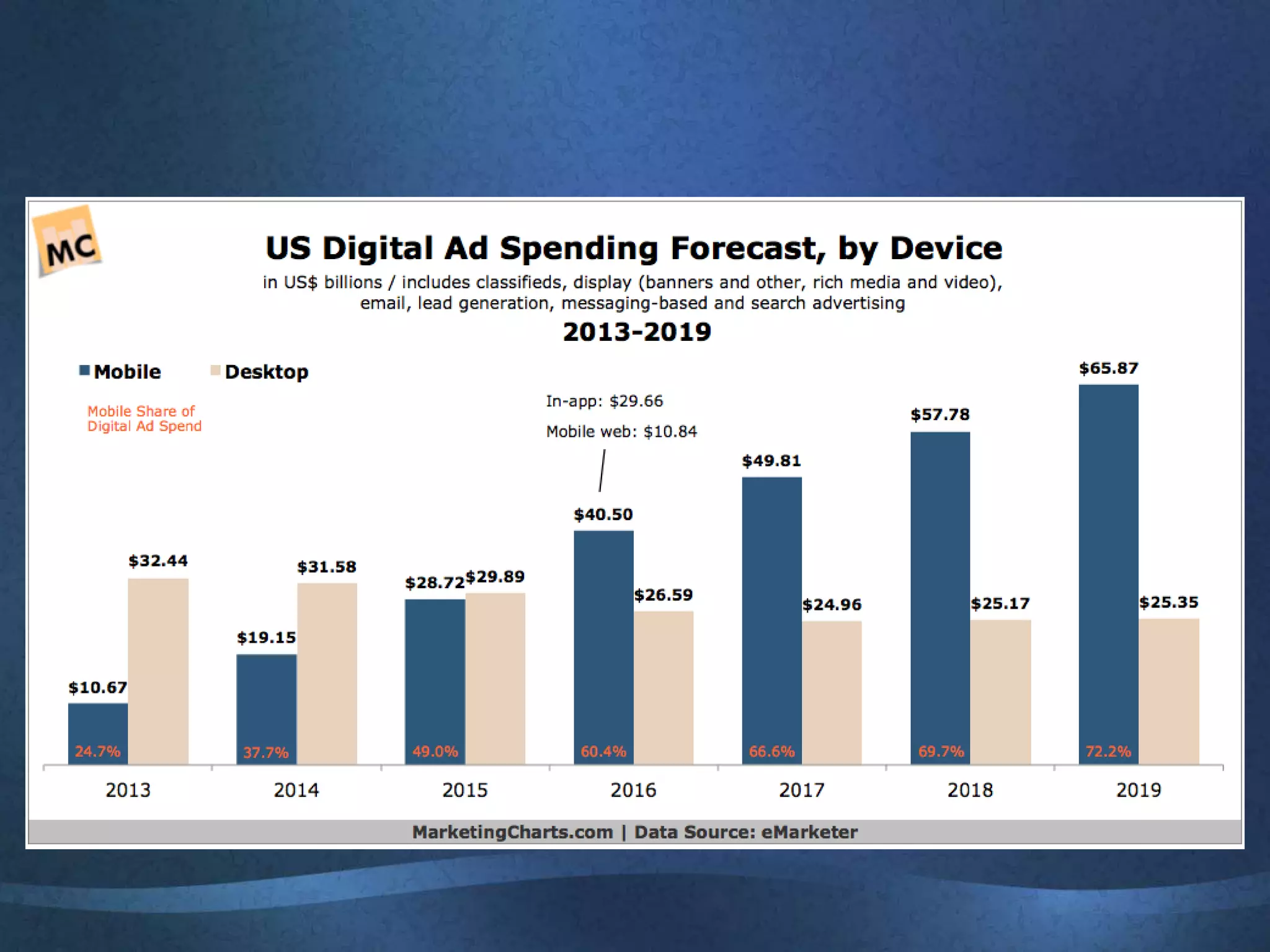
5. By 2019 mobile advertising will represent 72% of all digital ad spending.
(Payfirma)
400 million users of
Internet worldwide
Electronic Payment
Of Bills And
Banking Will Cost
US Postal Service
$17bn Over 10
Years.
There are three main opportunities that online sales present:
1. Incremental revenues:
The internet is a level playing field in terms of sales and marketing
Everyone can attract new clients through very targeted and measurable marketing
Global distribution reach is available to all, not just the major brands that have
global networks
2. Reduced cost of sale:
A brand web site has the lowest cost of sale
Enables business to be “channel shifted” from more expensive channels, such as
travel agency or call centres
A strong brand web site enables the reliance on OTAs to be reduced and
relationships to be renegotiated in order to bring down the overall cost of sale
3. Enhanced brand loyalty and client relationships
A direct client should be retained for future marketing and relationship building
A customer booking through an OTA is likely to remain loyal to the booking
channel
Actively seek to build relationships with clients delivered through OTAs for
future, cheaper marketing
Summary and examples of transaction alternatives between businesses, consumers and
governmental organisations
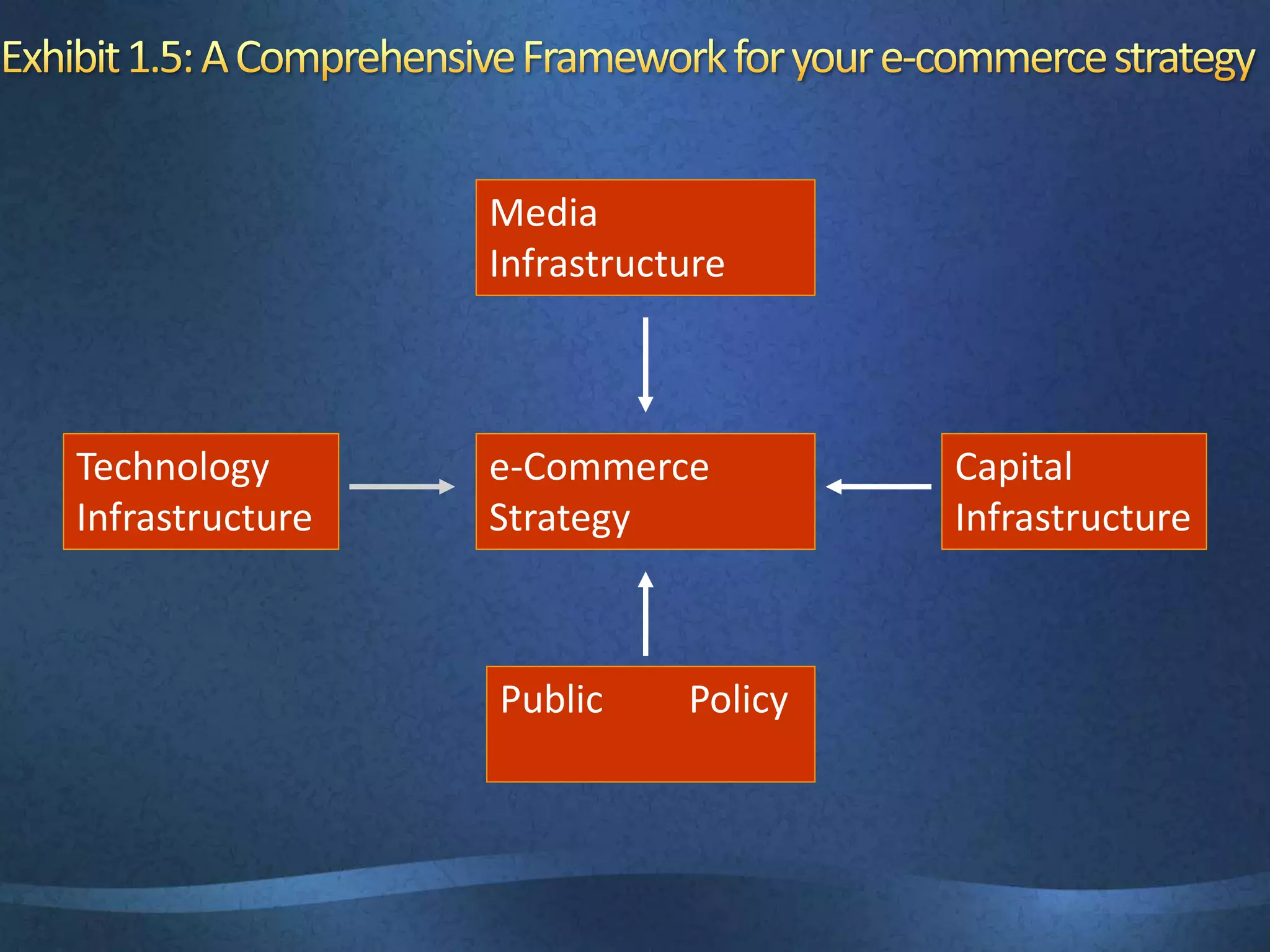
Media
Infrastructure
e-Commerce
Strategy
Public Policy
Technology
Infrastructure
Capital
Infrastructure
Sticky content keeps customers’ attention.
sticky content
information or features
that entice visitors to stay
for long periods of time
and return frequently
It helps to keep them on your Web site long enough to make a purchase.
Ways to Make Your Site Sticky
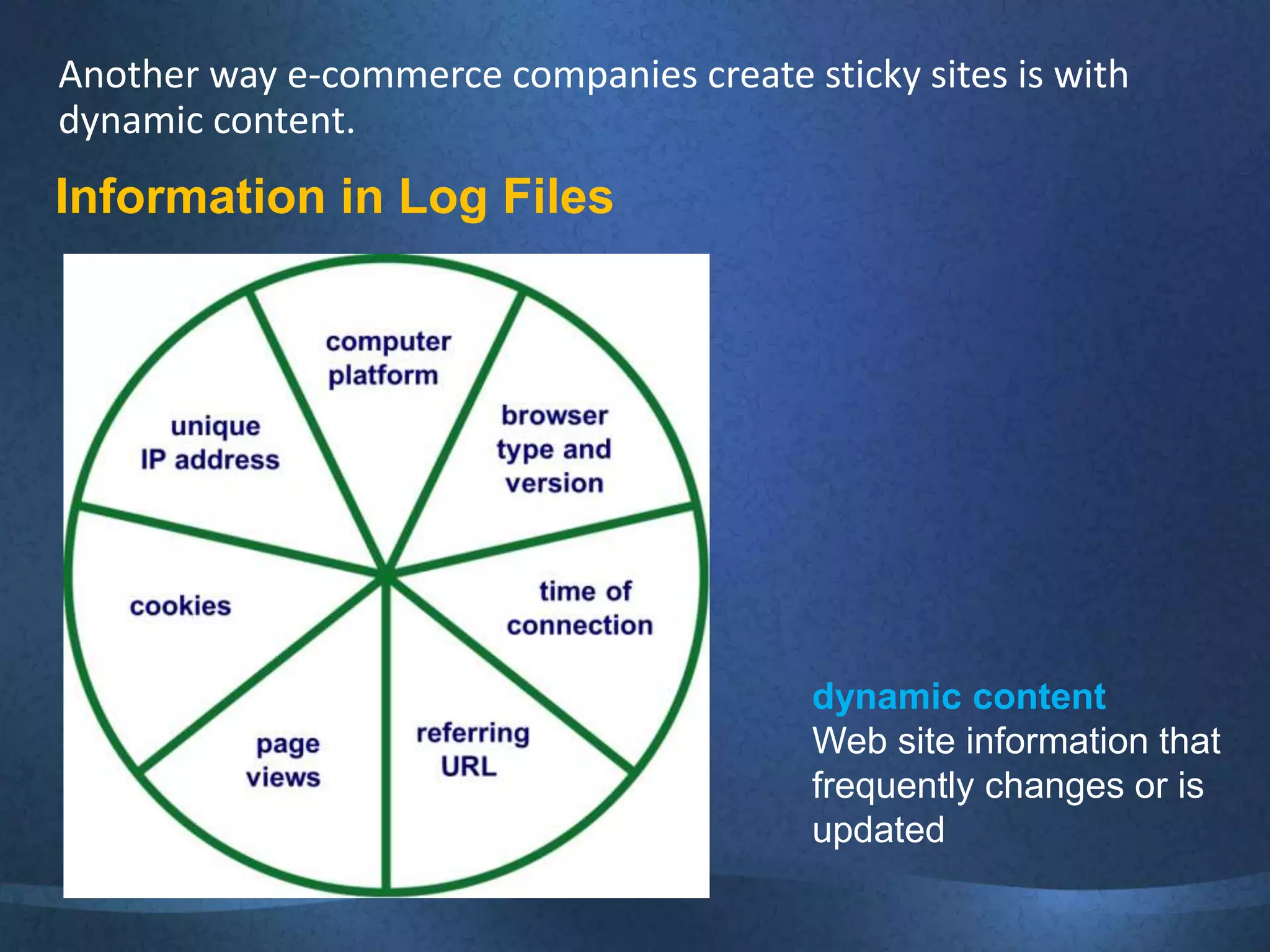
Another way e-commerce companies create sticky sites is with
dynamic content.
dynamic content
Web site information that
frequently changes or is
updated
Information in Log Files
You can use the number of unique visitors to track spikes and dips
in site traffic.
site traffic the total
activity on a site
Another problem is spoof e-mail.
spoof e-mail e-mail in
which the sender’s
address is forged to
appear as if it came from
a legitimate source
Spoof e-mail usually contains an urgent
warning for the customer to update
credit-card or other personal
information, with a link provided to a
“trusted” company site.
When customers click the link, they are
taken to a fake page where identity
thieves wait to steal their private
information.
Display and rich media ads
Search engine advertising: Paid search engine inclusion and
placement
Sponsorships
Referrals (affiliate relationship marketing)
E-mail marketing
Online catalogs
Online chat
Blog advertising
Display ads
Banners
Pop-ups and pop-unders
Rich media ads:
Employ Flash,
DHTML,
Java,
streaming audio
and/or video
Interstitials
Superstitials
Banner swapping: Arrangements among
firms allow each firm to have its banners
displayed on other affiliate sites for no cost
Banner exchanges: Arrange for banner
swapping among firms
Advertising networks: Act as brokers
between advertisers and publishers, placing
ads and tracking all activity related to the ad
One of fastest growing and most effective
forms of online marketing communications
Types:
Paid inclusion
Paid placement
Keyword advertising
Network keyword advertising
Google and Yahoo (Overture.com) leaders in this technology
Issues
Appropriate disclosure of paid inclusion and placement
practices
Search engine click fraud (when competitor hires third
parties to fraudulently click on competitor ads to drive up
costs)
Ad nonsense (Google AdSense ads that are inappropriate
for content)
Sponsorship: Paid effort to tie an advertiser’s name to
particular information, event, venue in way that reinforces
brand in a positive, yet not overtly commercial manner
 Advertorial a common form
Affiliate relationship: Permits a firm to put its logo or
banner ad on another firm’s Web site from which users of
that site can click through to the affiliate’s site
 Sometimes called tenancy deals
 Amazon/Toys “R” Us an example
 Customer hijacking an issue
Direct e-mail marketing: E-mail marketing messages sent directly
to interested consumers who “opt-in” or have not “opted-out”
Spam: Unsolicited commercial e-mail
 Spam is exploding out of control—Estimated 60%–70% of all
Internet e-mail purportedly was spam
 Efforts to control spam:
• Technology (Filtering software) (only partly effective)
• Government regulation (CAN-SPAM and state laws)
(largely unsuccessful)
• Self-regulation by industry (ineffective)
• Volunteer efforts (not enough)
Display ads
Banners
Pop-ups and pop-unders
Rich media ads: Employ Flash, DHTML, Java,
streaming audio and/or video
Interstitials
Superstitials
Traditional offline consumer-oriented industries
have learned to use Web to extend brand
images and sales campaigns
Online companies have learned how to use
traditional marketing communications to drive
sales to Web site
Most successful marketing campaigns
incorporate both online and offline tactics
Metrics that focus on success of Web site in achieving audience or
market share
Impressions
Click-through rate (CTR)
View-through rate (VTR)
Hits
Page views
Stickiness (duration)
Unique visitors
Loyalty
Reach
Recency
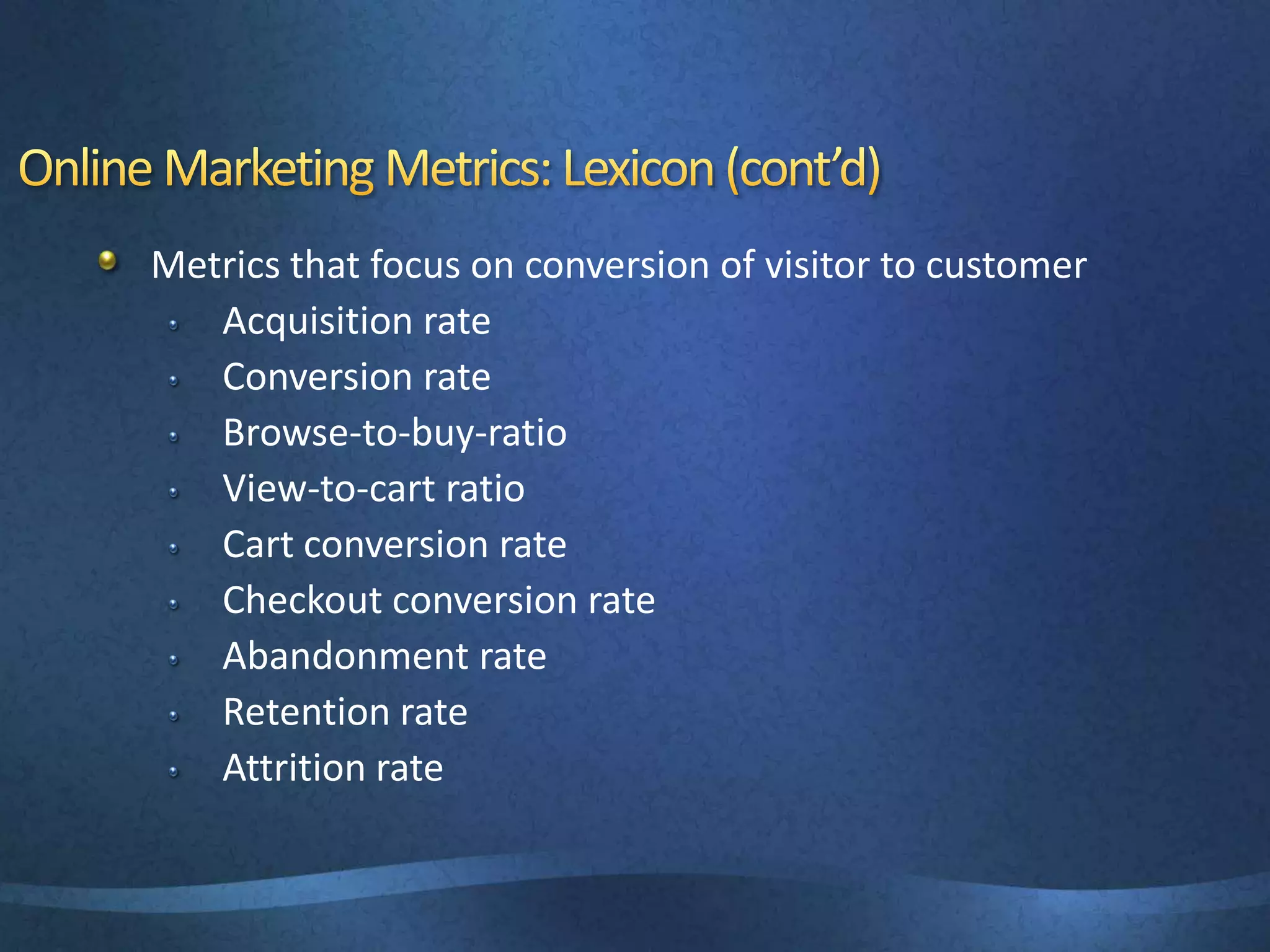
Metrics that focus on conversion of visitor to customer
Acquisition rate
Conversion rate
Browse-to-buy-ratio
View-to-cart ratio
Cart conversion rate
Checkout conversion rate
Abandonment rate
Retention rate
Attrition rate
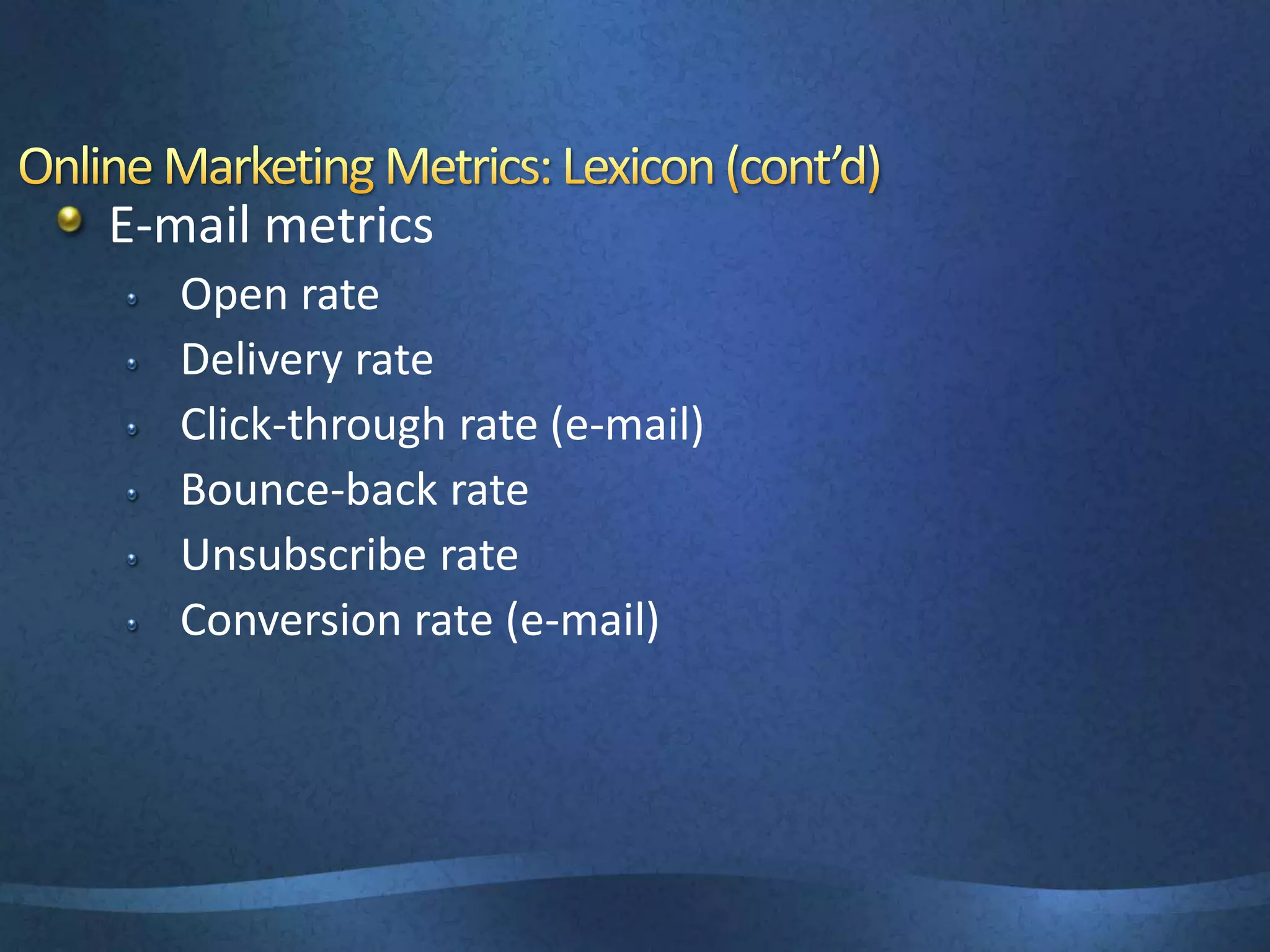
E-mail metrics
Open rate
Delivery rate
Click-through rate (e-mail)
Bounce-back rate
Unsubscribe rate
Conversion rate (e-mail)
Figure 8.11, Page 473
Click-through rates may be low, but these are
just one measure of effectiveness
Research indicates that most powerful
marketing campaigns include both online and
offline advertising
Cost per thousand (CPM): Advertiser pays
for impressions in 1,000 unit lots
Cost per click (CPC): Advertiser pays pre-
negotiated fee for each click ad receives
Cost per action (CPA): Advertiser pays pre-
negotiated amount only when user
performs a specific action
Hybrid: Two or more of the above models
used together
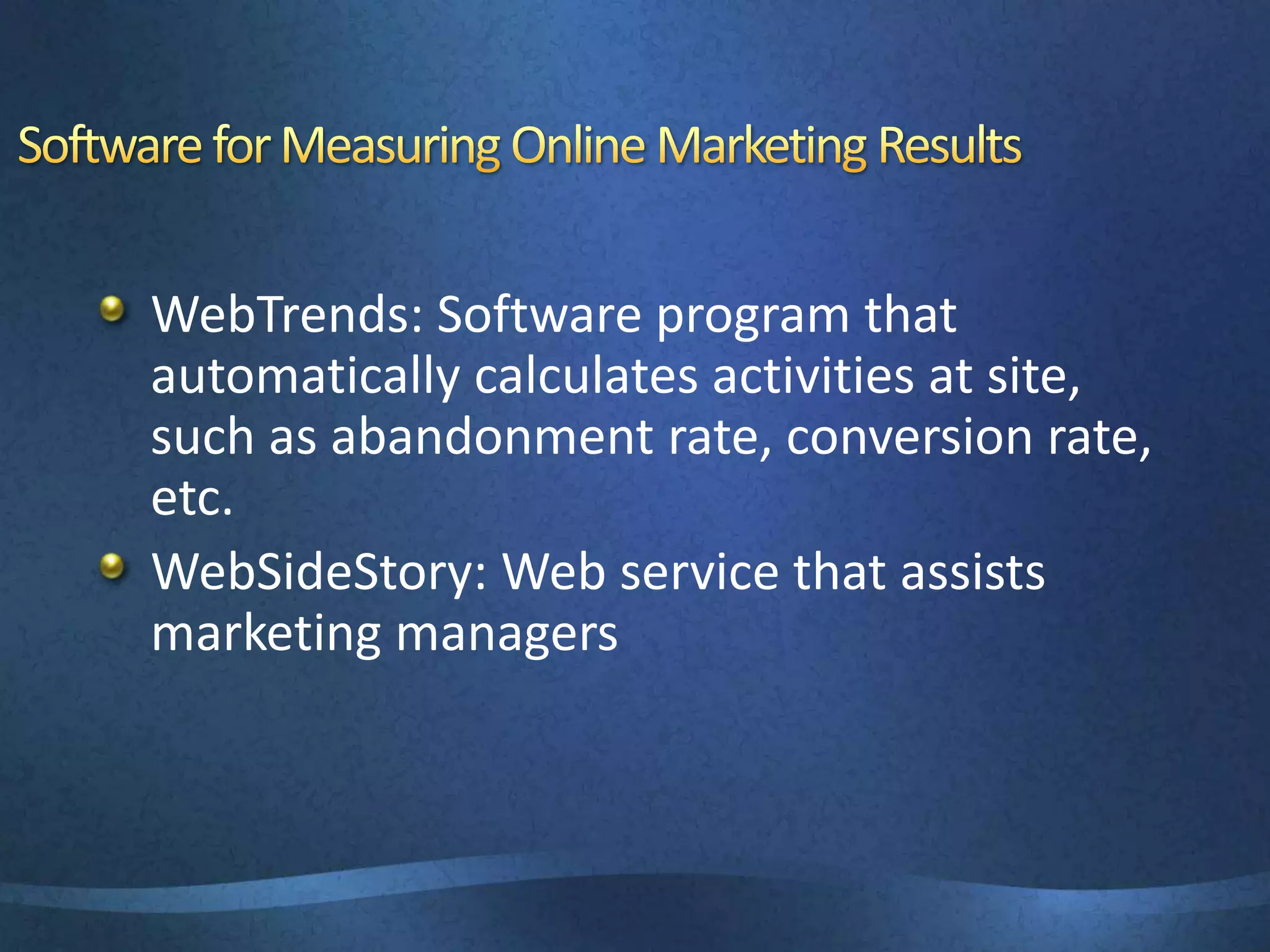
WebTrends: Software program that
automatically calculates activities at site,
such as abandonment rate, conversion rate,
etc.
WebSideStory: Web service that assists
marketing managers
“Many-to-many” model
Uses digitally enabled networks to spread ads
Blog advertising
Online ads related to content of blogs
Social network advertising
Ads on MySpace, Facebook, YouTube, etc.
Game advertising
Downloadable “advergames”
Placing brand-name products within games
Benefits of online marketing
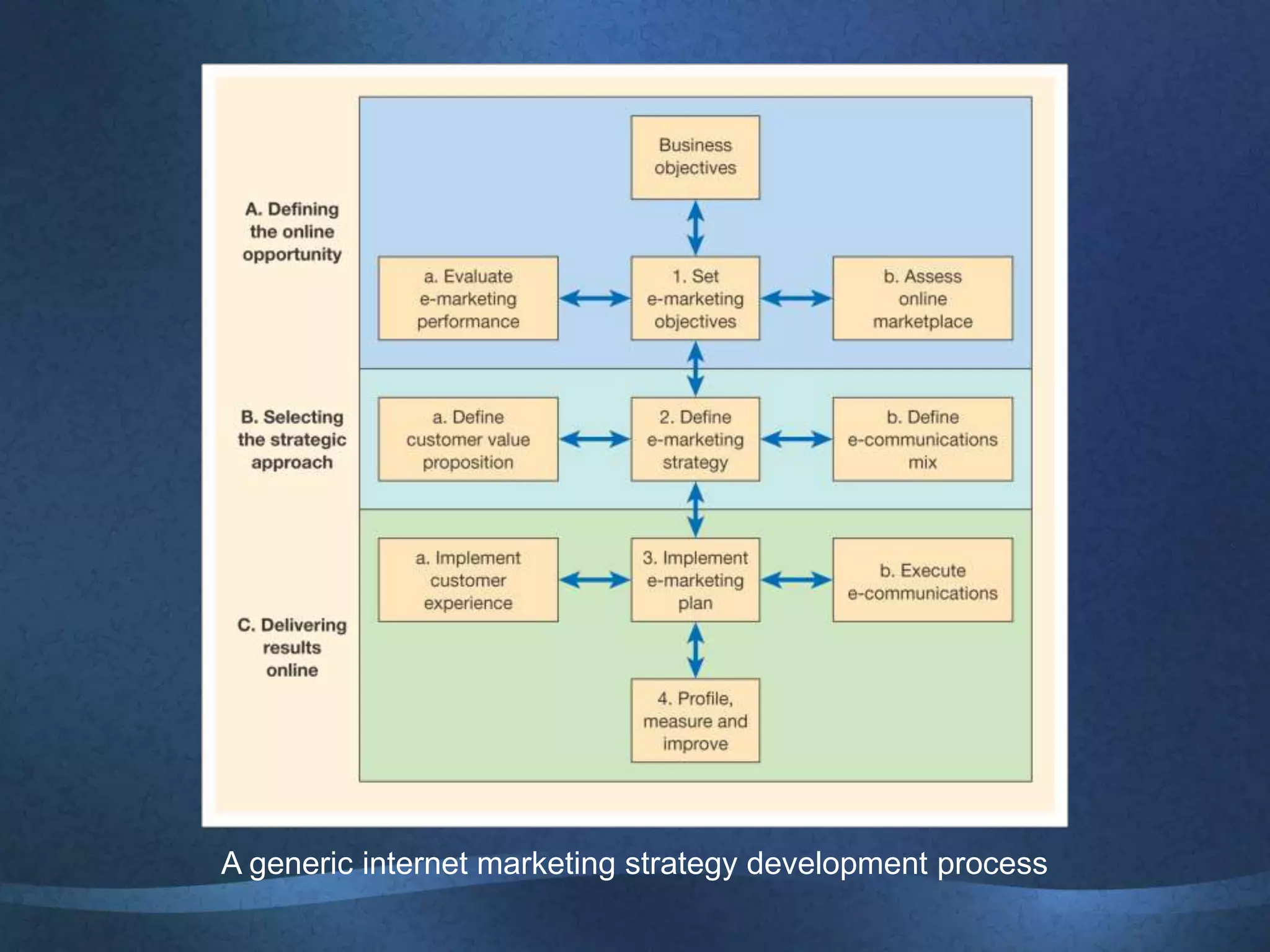
A generic internet marketing strategy development process
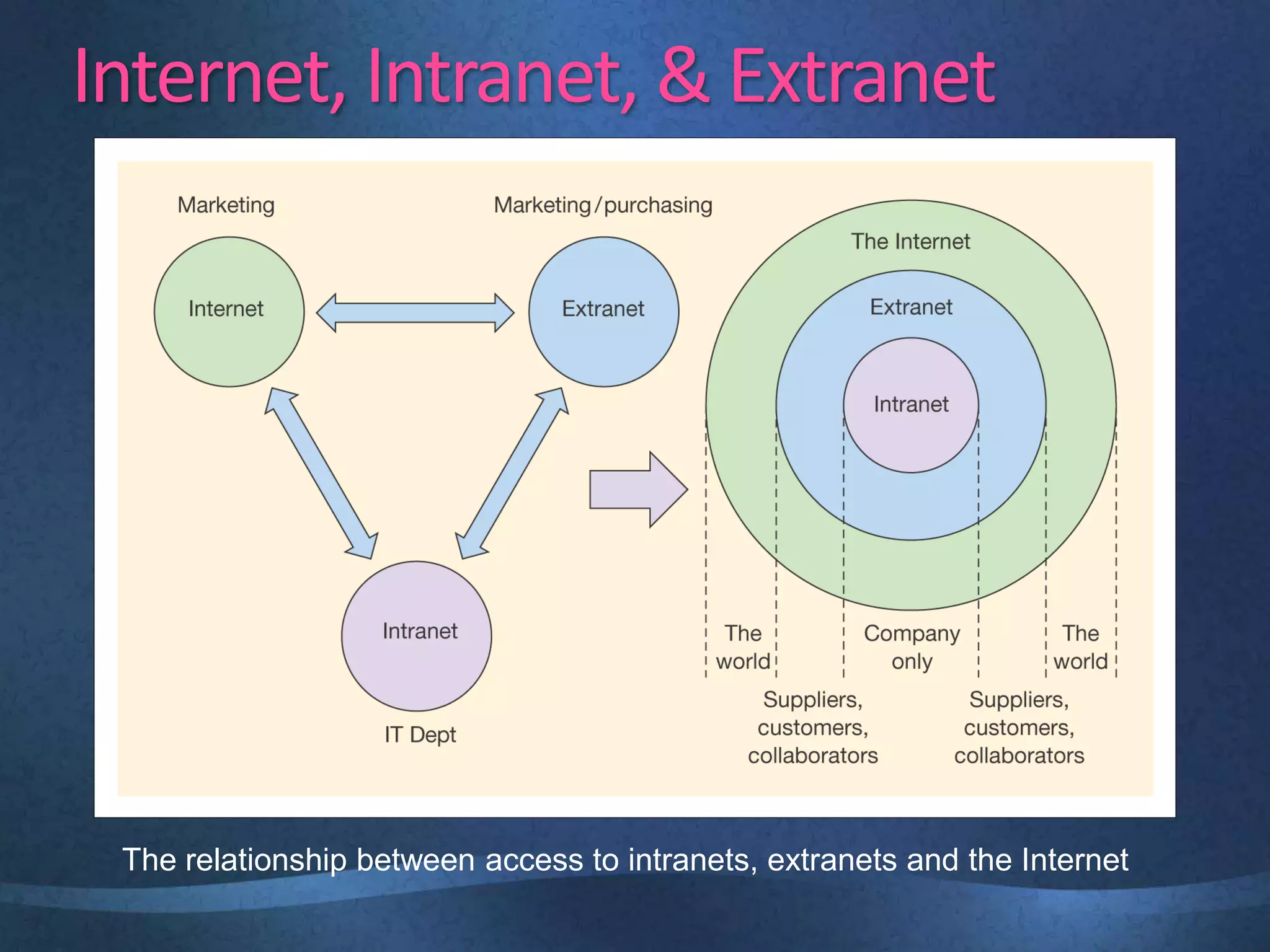
Internet, Intranet, & Extranet
The relationship between access to intranets, extranets and the Internet

E-Commerce in Marketing Communications

  • 2.
    Online is nolonger a niche channel worthy of investment for the future. It is a significant channel now and should be actively managed. Advantages: Internet is where audience is moving Ad targeting Greater opportunities for interactivity Disadvantages: Cost versus benefit How to adequately measure results Supply of good venues to display ads As consumers become more tech-savvy, businesses must work harder to grab their attention.
  • 4.
    1. The averageperson now spends more time online than with TV and all other media (newspapers, magazines, etc.) combined. (Branding Bricks) 2. Total spending on Internet advertising is predicted to grow 12.9% next year. The Internet will become the largest medium for advertising in 2016 (ahead of TV). (MediaPost) 3. Less than 8% of total B2B product sales are closed directly through the Internet, versus 15% for B2C products. (The CMO Survey) 4. Social ad spending has doubled over the past two years. (iMedia Connection) 5. By 2019 mobile advertising will represent 72% of all digital ad spending. (Payfirma)
  • 7.
    400 million usersof Internet worldwide Electronic Payment Of Bills And Banking Will Cost US Postal Service $17bn Over 10 Years.
  • 9.
    There are threemain opportunities that online sales present: 1. Incremental revenues: The internet is a level playing field in terms of sales and marketing Everyone can attract new clients through very targeted and measurable marketing Global distribution reach is available to all, not just the major brands that have global networks 2. Reduced cost of sale: A brand web site has the lowest cost of sale Enables business to be “channel shifted” from more expensive channels, such as travel agency or call centres A strong brand web site enables the reliance on OTAs to be reduced and relationships to be renegotiated in order to bring down the overall cost of sale 3. Enhanced brand loyalty and client relationships A direct client should be retained for future marketing and relationship building A customer booking through an OTA is likely to remain loyal to the booking channel Actively seek to build relationships with clients delivered through OTAs for future, cheaper marketing
  • 11.
    Summary and examplesof transaction alternatives between businesses, consumers and governmental organisations
  • 12.
  • 13.
    Sticky content keepscustomers’ attention. sticky content information or features that entice visitors to stay for long periods of time and return frequently It helps to keep them on your Web site long enough to make a purchase. Ways to Make Your Site Sticky
  • 14.
    Another way e-commercecompanies create sticky sites is with dynamic content. dynamic content Web site information that frequently changes or is updated Information in Log Files
  • 15.
    You can usethe number of unique visitors to track spikes and dips in site traffic. site traffic the total activity on a site Another problem is spoof e-mail. spoof e-mail e-mail in which the sender’s address is forged to appear as if it came from a legitimate source Spoof e-mail usually contains an urgent warning for the customer to update credit-card or other personal information, with a link provided to a “trusted” company site. When customers click the link, they are taken to a fake page where identity thieves wait to steal their private information.
  • 16.
    Display and richmedia ads Search engine advertising: Paid search engine inclusion and placement Sponsorships Referrals (affiliate relationship marketing) E-mail marketing Online catalogs Online chat Blog advertising
  • 17.
    Display ads Banners Pop-ups andpop-unders Rich media ads: Employ Flash, DHTML, Java, streaming audio and/or video Interstitials Superstitials
  • 18.
    Banner swapping: Arrangementsamong firms allow each firm to have its banners displayed on other affiliate sites for no cost Banner exchanges: Arrange for banner swapping among firms Advertising networks: Act as brokers between advertisers and publishers, placing ads and tracking all activity related to the ad
  • 19.
    One of fastestgrowing and most effective forms of online marketing communications Types: Paid inclusion Paid placement Keyword advertising Network keyword advertising
  • 20.
    Google and Yahoo(Overture.com) leaders in this technology Issues Appropriate disclosure of paid inclusion and placement practices Search engine click fraud (when competitor hires third parties to fraudulently click on competitor ads to drive up costs) Ad nonsense (Google AdSense ads that are inappropriate for content)
  • 21.
    Sponsorship: Paid effortto tie an advertiser’s name to particular information, event, venue in way that reinforces brand in a positive, yet not overtly commercial manner  Advertorial a common form Affiliate relationship: Permits a firm to put its logo or banner ad on another firm’s Web site from which users of that site can click through to the affiliate’s site  Sometimes called tenancy deals  Amazon/Toys “R” Us an example  Customer hijacking an issue
  • 22.
    Direct e-mail marketing:E-mail marketing messages sent directly to interested consumers who “opt-in” or have not “opted-out” Spam: Unsolicited commercial e-mail  Spam is exploding out of control—Estimated 60%–70% of all Internet e-mail purportedly was spam  Efforts to control spam: • Technology (Filtering software) (only partly effective) • Government regulation (CAN-SPAM and state laws) (largely unsuccessful) • Self-regulation by industry (ineffective) • Volunteer efforts (not enough)
  • 23.
    Display ads Banners Pop-ups andpop-unders Rich media ads: Employ Flash, DHTML, Java, streaming audio and/or video Interstitials Superstitials
  • 24.
    Traditional offline consumer-orientedindustries have learned to use Web to extend brand images and sales campaigns Online companies have learned how to use traditional marketing communications to drive sales to Web site Most successful marketing campaigns incorporate both online and offline tactics
  • 25.
    Metrics that focuson success of Web site in achieving audience or market share Impressions Click-through rate (CTR) View-through rate (VTR) Hits Page views Stickiness (duration) Unique visitors Loyalty Reach Recency
  • 26.
    Metrics that focuson conversion of visitor to customer Acquisition rate Conversion rate Browse-to-buy-ratio View-to-cart ratio Cart conversion rate Checkout conversion rate Abandonment rate Retention rate Attrition rate
  • 27.
    E-mail metrics Open rate Deliveryrate Click-through rate (e-mail) Bounce-back rate Unsubscribe rate Conversion rate (e-mail)
  • 28.
  • 29.
    Click-through rates maybe low, but these are just one measure of effectiveness Research indicates that most powerful marketing campaigns include both online and offline advertising
  • 30.
    Cost per thousand(CPM): Advertiser pays for impressions in 1,000 unit lots Cost per click (CPC): Advertiser pays pre- negotiated fee for each click ad receives Cost per action (CPA): Advertiser pays pre- negotiated amount only when user performs a specific action Hybrid: Two or more of the above models used together
  • 31.
    WebTrends: Software programthat automatically calculates activities at site, such as abandonment rate, conversion rate, etc. WebSideStory: Web service that assists marketing managers
  • 32.
    “Many-to-many” model Uses digitallyenabled networks to spread ads Blog advertising Online ads related to content of blogs Social network advertising Ads on MySpace, Facebook, YouTube, etc. Game advertising Downloadable “advergames” Placing brand-name products within games
  • 33.
  • 34.
    A generic internetmarketing strategy development process
  • 38.
    Internet, Intranet, &Extranet The relationship between access to intranets, extranets and the Internet