8 | 1
E- MARKETING
DR EMMANUEL CHAO
8 | 2
Objectives
• Define electronic marketing and commerce and
recognize increasing importance in strategic
planning
• Understand characteristics of electronic
marketing and differentiate them from traditional
marketing
• Examine how characteristics of electronic
marketing affect strategy
• Understand how electronic marketing and
information technology facilitate customer
relationship management
• Identify legal/ethical considerations in electronic
marketing
8 | 3
Electronic Marketing
• E-commerce – conducting business through
telecommunications networks
• E-marketing – creating, distributing, promoting,
and pricing products for targeted customers
over the Internet
8 | 4
E-MARKETING
E-Marketing:
• Refers to using technology such as the internet, website
and email, sms, including its wide variety of options and
tools to conduct your marketing activities and achieve
your marketing objectives.
8 | 5
E-MARKETING TOOLS
E-Marketing tools and strategies include:
• Business websites;
• Search Engine;
• Email;
• Online newsletters/e-zines;
• Online catalogues;
• Online press releases;
• Online surveys;
• Online customer service;
• Banner advertising;
• Affiliate marketing.
• Mobile telephone marketing;
• Online Community (Friendster, YouTube) - new
• Web Log (Blog) - new
8 | 6
THE E-MARKETING
CONCEPT
Examples of e-Marketing include:
• online surveys to conduct market research
• web site to display and sell your products
• internet advertising to promote your
business
• software to collect and analyse your
customer information
8 | 7
THE E-MARKETING
CONCEPT
The Key to e-Marketing:
• The key to successful e-Marketing in today's business
environment is to place your clients in control. Allow
them to choose how often and what type of messages
they receive, thus creating a more meaningful
relationship with your business.
• This is commonly referred to as Permission Marketing.
• Your e-Marketing messages and tools should aim to
deliver information that the consumer wants - that they
perceive to be valuable.
8 | 8
CAPABILITIES AND BENEFITS OF E-MARKETING
Global Reach
Personalization
Interactive Marketing
Right-time Marketing
Integrated Marketing
8 | 9
Characteristics Of
Electronic Marketing
• Addressability
• Interactivity
• Memory
• Control
• Accessibility
• Digitalization
8 | 10
Addressability
A marketer’s ability to identify customers
before they make a purchase.
8 | 11
Cookie
An identifying string of text stored on a
website visitor’s computer.
8 | 12
Interactivity
The ability to allow customers to express
their needs and wants directly to the firm
in response to the firm’s marketing
communications.
8 | 13
Community
A sense of group membership or feeling of
belonging by individual members.
8 | 14
Memory
The ability to access databases or data
warehouses containing individual customer
profiles and purchase histories and use
these data in real time to customize a
marketing offer.
8 | 15
Database
A collection of information arranged for easy
access and retrieval.
8 | 16
Control
Customers’ ability to regulate the
information they view and the rate and
sequence of their exposure to that
information.
8 | 17
Portal
A multiservice website that serves as a
gateway to other websites.
8 | 18
Accessibility
The ability to obtain information available
on the Internet.
8 | 19
Digitalization
The ability to represent a product, or at
least some of its benefits, as digital bits
of information
8 | 20
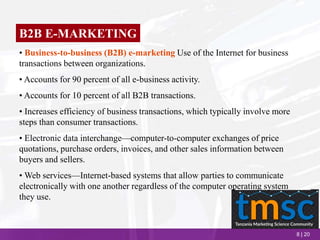
B2B E-MARKETING
• Business-to-business (B2B) e-marketing Use of the Internet for business
transactions between organizations.
• Accounts for 90 percent of all e-business activity.
• Accounts for 10 percent of all B2B transactions.
• Increases efficiency of business transactions, which typically involve more
steps than consumer transactions.
• Electronic data interchange—computer-to-computer exchanges of price
quotations, purchase orders, invoices, and other sales information between
buyers and sellers.
• Web services—Internet-based systems that allow parties to communicate
electronically with one another regardless of the computer operating system
they use.
8 | 21
• Extranets—secure networks used for e-marketing and accessible through
the firm’s Web site by external customers, suppliers, or other authorized
users.
• Private exchanges—secure Web site at which a company and its suppliers
share all types of data related to e-marketing, from product design through
delivery of orders.
• Electronic exchanges—online marketplaces that bring buyers and sellers
together in one electronic marketplace and cater to a specific industry’s
needs.
• E-procurement—Web-based systems that enable all types of organizations
to improve the efficiency of their bidding and purchasing processes.
8 | 22
ONLINE SHOPPING AND B2C E-MARKETING
• Business-to-consumer (B2C) e-marketing Selling directly to consumers
over the Internet. Also called e-tailing.
• Service providers such as banks are an important segment of e-tailing.
• Two types of B2C Web sites
• Shopping sites
• Information sites
8 | 23
ELECTRONIC STOREFRONTS
• Electronic storefront Company Web site that sells products to customers.
• Growth anticipated with the increase in broadband connections.
• Broadband shoppers typically spend 34 percent more online than
narrowband shoppers.
BENEFITS OF B2C E-MARKETING
• Lower prices.
• Convenience.
• Personalization.
8 | 24
ONLINE BUYERS AND SELLERS
• Demographics of customers are changing as Internet penetration grows.
8 | 25
E-BUSINESS AND E-MARKETING CHALLENGES
ONLINE PAYMENT SYSTEMS
• Companies have developed secure payment systems to protect customer
information.
• Encryption, Secure Sockets Layer, and electronic wallets.
PRIVACY ISSUES
• Protection of personal information is customers’ top security concern.
• Cookies and spyware allow companies to personalize Internet experience but
also invade computer users’ privacy.
• To reassure customers, many online merchants have signed on with online
privacy organizations such as TRUSTe.
• Companies install firewalls to protect private corporate data.
8 | 26
INTERNET FRAUD
• Internet Crime Complaint Center logged more than 231,000 complaints in a
recent year.
• Phishing High-tech scam that uses authentic-looking e-mail or pop-up
messages to get unsuspecting victims to reveal personal information.
• Payment fraud is also growing.
WEB SITE DESIGN AND SERVICE
• As many as 70 percent of Internet shopping carts are abandoned before any
purchase is made.
• Companies that have brick-and-mortar experience often have more
experience satisfying customers than Internet-only retailers.
CHANNEL CONFLICTS
• Direct sales to customers can compete with business partners such as
retailers and distributors, disputes called channel conflicts.
8 | 27
USING THE WEB’S COMMUNICATION FUNCTION
• Web has four main functions: e-business, entertainment, information, and
communication.
• Communication is Web’s most popular function.
• Firms use e-mail to communicate with customers, suppliers, and other
partners.
• ONLINE COMMUNITIES
• Internet forums, newsgroups, electronic bulletin boards, and Web
communities that appeal to people who share common interests.
8 | 28
BLOGS
• Blog Short for Web log, an online journal written by a blogger.
• Some incorporate wikis and podcasts.
• Corporate blogs can help build brand trust.
• Employee blogs can humanize a company, but negative comments can harm
it.
WEB-BASED PROMOTIONS
• Banner and pop-up ads on Web sites, and online coupons.
• Search marketing Paying search engines, such as Google, a fee to make
sure that the company’s listing appears toward the top of the search results.
8 | 29
• Planning and preparation—company’s goal for its Web site determines
scope, content, and design.
• Will the site be maintained in-house or by a contractor?
• What will the site be named?
• Content and connections—important factor for whether visitors return to
a site.
• Relevant to viewers, easy to access and understand, updated
regularly, and compelling and entertaining.
• Most small businesses are better off outsourcing to meet their hosting
and maintenance needs.
• Costs and maintenance—development, placing the site on a Web server,
and maintaining, updating, and promoting the site.
8 | 30
MEASURING WEB SITE EFFECTIVENESS
Click-through rate Percentage of people
presented with a banner ad who click on it.
Conversion rate Percentage of visitors to a
Web site who make a purchase.
8 | 31
E-Marketing Strategies
And Considerations
• Product
– Computers and related accessories
biggest seller online
– Customized orders
– Services growing
• Distribution
– Order processing
– Synchronization
• Promotion
– Augments traditional forms
– Consumer in control
• Pricing- More consumer information
8 | 32
Customer
Relationship Management
• Database Marketing
• Customer Lifetime Value
• Technology Driven
– Customer support
– Call-center software
• Customer Satisfaction
8 | 33
Elements Of
Database Marketing
1. Identify/build database
2. Differentiate messages to consumers
3. Track relationships
8 | 34
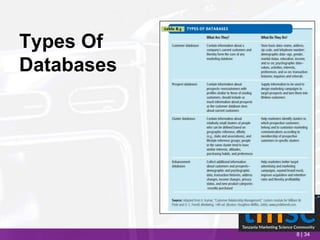
Types Of
Databases
8 | 35
Questions For CLV
• Which customers receive preferential
treatment?
• What channels used to interact with
customer?
• Timing of offering to customer?
• Which are good prospects?
• Allocation of resources?
• Method of monitoring customers?
8 | 36
Technology Drives CRM
• Customer Contact Points
– Telephone
– Fax
– Online
– Personal
• Data Analysis
• Customer support/call-center software
• Sales automation software
8 | 37
Customer Satisfaction and CRM
CRM is about relationships, not technology
– technology can help build long-term
relationships
8 | 38
Legal/Ethical Issues
In E-Marketing
• Privacy
• Spam- unsolicited commercial e-mail
8 | 39
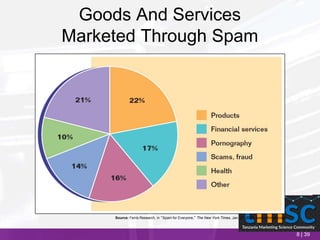
Goods And Services
Marketed Through Spam
Source: Ferris Research, in “Spam for Everyone,” The New York Times, Jan. 31, 2005, www.nytimes.com.
8 | 40
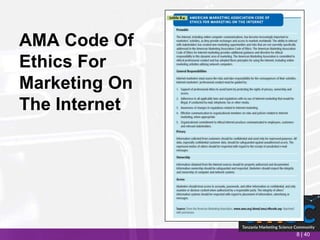
AMA Code Of
Ethics For
Marketing On
The Internet
8 | 41
THANK YOU!!!!

E marketing By E.J. Chao

  • 1.
    8 | 1 E-MARKETING DR EMMANUEL CHAO
  • 2.
    8 | 2 Objectives •Define electronic marketing and commerce and recognize increasing importance in strategic planning • Understand characteristics of electronic marketing and differentiate them from traditional marketing • Examine how characteristics of electronic marketing affect strategy • Understand how electronic marketing and information technology facilitate customer relationship management • Identify legal/ethical considerations in electronic marketing
  • 3.
    8 | 3 ElectronicMarketing • E-commerce – conducting business through telecommunications networks • E-marketing – creating, distributing, promoting, and pricing products for targeted customers over the Internet
  • 4.
    8 | 4 E-MARKETING E-Marketing: •Refers to using technology such as the internet, website and email, sms, including its wide variety of options and tools to conduct your marketing activities and achieve your marketing objectives.
  • 5.
    8 | 5 E-MARKETINGTOOLS E-Marketing tools and strategies include: • Business websites; • Search Engine; • Email; • Online newsletters/e-zines; • Online catalogues; • Online press releases; • Online surveys; • Online customer service; • Banner advertising; • Affiliate marketing. • Mobile telephone marketing; • Online Community (Friendster, YouTube) - new • Web Log (Blog) - new
  • 6.
    8 | 6 THEE-MARKETING CONCEPT Examples of e-Marketing include: • online surveys to conduct market research • web site to display and sell your products • internet advertising to promote your business • software to collect and analyse your customer information
  • 7.
    8 | 7 THEE-MARKETING CONCEPT The Key to e-Marketing: • The key to successful e-Marketing in today's business environment is to place your clients in control. Allow them to choose how often and what type of messages they receive, thus creating a more meaningful relationship with your business. • This is commonly referred to as Permission Marketing. • Your e-Marketing messages and tools should aim to deliver information that the consumer wants - that they perceive to be valuable.
  • 8.
    8 | 8 CAPABILITIESAND BENEFITS OF E-MARKETING Global Reach Personalization Interactive Marketing Right-time Marketing Integrated Marketing
  • 9.
    8 | 9 CharacteristicsOf Electronic Marketing • Addressability • Interactivity • Memory • Control • Accessibility • Digitalization
  • 10.
    8 | 10 Addressability Amarketer’s ability to identify customers before they make a purchase.
  • 11.
    8 | 11 Cookie Anidentifying string of text stored on a website visitor’s computer.
  • 12.
    8 | 12 Interactivity Theability to allow customers to express their needs and wants directly to the firm in response to the firm’s marketing communications.
  • 13.
    8 | 13 Community Asense of group membership or feeling of belonging by individual members.
  • 14.
    8 | 14 Memory Theability to access databases or data warehouses containing individual customer profiles and purchase histories and use these data in real time to customize a marketing offer.
  • 15.
    8 | 15 Database Acollection of information arranged for easy access and retrieval.
  • 16.
    8 | 16 Control Customers’ability to regulate the information they view and the rate and sequence of their exposure to that information.
  • 17.
    8 | 17 Portal Amultiservice website that serves as a gateway to other websites.
  • 18.
    8 | 18 Accessibility Theability to obtain information available on the Internet.
  • 19.
    8 | 19 Digitalization Theability to represent a product, or at least some of its benefits, as digital bits of information
  • 20.
    8 | 20 B2BE-MARKETING • Business-to-business (B2B) e-marketing Use of the Internet for business transactions between organizations. • Accounts for 90 percent of all e-business activity. • Accounts for 10 percent of all B2B transactions. • Increases efficiency of business transactions, which typically involve more steps than consumer transactions. • Electronic data interchange—computer-to-computer exchanges of price quotations, purchase orders, invoices, and other sales information between buyers and sellers. • Web services—Internet-based systems that allow parties to communicate electronically with one another regardless of the computer operating system they use.
  • 21.
    8 | 21 •Extranets—secure networks used for e-marketing and accessible through the firm’s Web site by external customers, suppliers, or other authorized users. • Private exchanges—secure Web site at which a company and its suppliers share all types of data related to e-marketing, from product design through delivery of orders. • Electronic exchanges—online marketplaces that bring buyers and sellers together in one electronic marketplace and cater to a specific industry’s needs. • E-procurement—Web-based systems that enable all types of organizations to improve the efficiency of their bidding and purchasing processes.
  • 22.
    8 | 22 ONLINESHOPPING AND B2C E-MARKETING • Business-to-consumer (B2C) e-marketing Selling directly to consumers over the Internet. Also called e-tailing. • Service providers such as banks are an important segment of e-tailing. • Two types of B2C Web sites • Shopping sites • Information sites
  • 23.
    8 | 23 ELECTRONICSTOREFRONTS • Electronic storefront Company Web site that sells products to customers. • Growth anticipated with the increase in broadband connections. • Broadband shoppers typically spend 34 percent more online than narrowband shoppers. BENEFITS OF B2C E-MARKETING • Lower prices. • Convenience. • Personalization.
  • 24.
    8 | 24 ONLINEBUYERS AND SELLERS • Demographics of customers are changing as Internet penetration grows.
  • 25.
    8 | 25 E-BUSINESSAND E-MARKETING CHALLENGES ONLINE PAYMENT SYSTEMS • Companies have developed secure payment systems to protect customer information. • Encryption, Secure Sockets Layer, and electronic wallets. PRIVACY ISSUES • Protection of personal information is customers’ top security concern. • Cookies and spyware allow companies to personalize Internet experience but also invade computer users’ privacy. • To reassure customers, many online merchants have signed on with online privacy organizations such as TRUSTe. • Companies install firewalls to protect private corporate data.
  • 26.
    8 | 26 INTERNETFRAUD • Internet Crime Complaint Center logged more than 231,000 complaints in a recent year. • Phishing High-tech scam that uses authentic-looking e-mail or pop-up messages to get unsuspecting victims to reveal personal information. • Payment fraud is also growing. WEB SITE DESIGN AND SERVICE • As many as 70 percent of Internet shopping carts are abandoned before any purchase is made. • Companies that have brick-and-mortar experience often have more experience satisfying customers than Internet-only retailers. CHANNEL CONFLICTS • Direct sales to customers can compete with business partners such as retailers and distributors, disputes called channel conflicts.
  • 27.
    8 | 27 USINGTHE WEB’S COMMUNICATION FUNCTION • Web has four main functions: e-business, entertainment, information, and communication. • Communication is Web’s most popular function. • Firms use e-mail to communicate with customers, suppliers, and other partners. • ONLINE COMMUNITIES • Internet forums, newsgroups, electronic bulletin boards, and Web communities that appeal to people who share common interests.
  • 28.
    8 | 28 BLOGS •Blog Short for Web log, an online journal written by a blogger. • Some incorporate wikis and podcasts. • Corporate blogs can help build brand trust. • Employee blogs can humanize a company, but negative comments can harm it. WEB-BASED PROMOTIONS • Banner and pop-up ads on Web sites, and online coupons. • Search marketing Paying search engines, such as Google, a fee to make sure that the company’s listing appears toward the top of the search results.
  • 29.
    8 | 29 •Planning and preparation—company’s goal for its Web site determines scope, content, and design. • Will the site be maintained in-house or by a contractor? • What will the site be named? • Content and connections—important factor for whether visitors return to a site. • Relevant to viewers, easy to access and understand, updated regularly, and compelling and entertaining. • Most small businesses are better off outsourcing to meet their hosting and maintenance needs. • Costs and maintenance—development, placing the site on a Web server, and maintaining, updating, and promoting the site.
  • 30.
    8 | 30 MEASURINGWEB SITE EFFECTIVENESS Click-through rate Percentage of people presented with a banner ad who click on it. Conversion rate Percentage of visitors to a Web site who make a purchase.
  • 31.
    8 | 31 E-MarketingStrategies And Considerations • Product – Computers and related accessories biggest seller online – Customized orders – Services growing • Distribution – Order processing – Synchronization • Promotion – Augments traditional forms – Consumer in control • Pricing- More consumer information
  • 32.
    8 | 32 Customer RelationshipManagement • Database Marketing • Customer Lifetime Value • Technology Driven – Customer support – Call-center software • Customer Satisfaction
  • 33.
    8 | 33 ElementsOf Database Marketing 1. Identify/build database 2. Differentiate messages to consumers 3. Track relationships
  • 34.
    8 | 34 TypesOf Databases
  • 35.
    8 | 35 QuestionsFor CLV • Which customers receive preferential treatment? • What channels used to interact with customer? • Timing of offering to customer? • Which are good prospects? • Allocation of resources? • Method of monitoring customers?
  • 36.
    8 | 36 TechnologyDrives CRM • Customer Contact Points – Telephone – Fax – Online – Personal • Data Analysis • Customer support/call-center software • Sales automation software
  • 37.
    8 | 37 CustomerSatisfaction and CRM CRM is about relationships, not technology – technology can help build long-term relationships
  • 38.
    8 | 38 Legal/EthicalIssues In E-Marketing • Privacy • Spam- unsolicited commercial e-mail
  • 39.
    8 | 39 GoodsAnd Services Marketed Through Spam Source: Ferris Research, in “Spam for Everyone,” The New York Times, Jan. 31, 2005, www.nytimes.com.
  • 40.
    8 | 40 AMACode Of Ethics For Marketing On The Internet
  • 41.
    8 | 41 THANKYOU!!!!