E-Marketing
Presented by:
 Paulo Sambo
 Bakhtyar Tajzada
 Salman Muhammad
 Omary
What is E-Marketing?
 Electronic marketing or E-marketing is
the use of electronic media and
applications to conduct marketing
research and communication activities.
 The term electronic marketing initially
served as an extension of "Internet
marketing" to address the growth of
mobile technology and digital applications
used in marketing.
What is E-Marketing
 E-Marketing is also known as Digital
Marketing.
 E-Marketing is any marketing done online
via websites or other online tools and
resources.
Definition
 Electronic Marketing is the marketing of
products using electronic technology to
determine the consumer market.
 E-marketing compasses all the activities a
business conduct via World Wide Web
(WWW) with the aim of attracting new
business , retaining current business and
developing its brand identify.
Objective
 Increase market share
 Increase sales revenue
 Reduce cost
 Achieve branding building goals
 Achieve customer relationship
management goals
Electronic Marketing
Vs
Traditional Marketing
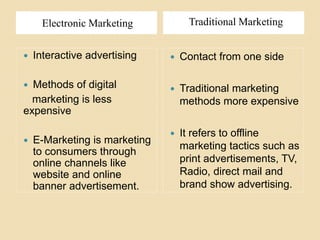
Electronic Marketing Traditional Marketing
 Interactive advertising
 Methods of digital
marketing is less
expensive
 E-Marketing is marketing
to consumers through
online channels like
website and online
banner advertisement.
 Contact from one side
 Traditional marketing
methods more expensive
 It refers to offline
marketing tactics such as
print advertisements, TV,
Radio, direct mail and
brand show advertising.
Scope of E-Marketing
 Internet marketing allows the marketer to
reach consumers in a wide range of ways.
 It is considered to be a broad scope.
 E marketing ties together the Creativity
and technical aspects.
Features
 Internet marketing allows global
marketing facility.
 It is less expensive.
 It makes marketing easier.
 It increases the choice of products,
services and sellers.
 Vast availability of information.
Internet marketing tools
 It includes Websites, social media and
online advertisement.
 Use of social media.
 Marketing plan.
 Social media is the latest marketing buzz,
touted by both online and offline
marketing experts way to reach
customers.
Internet marketing tools
Cont.…
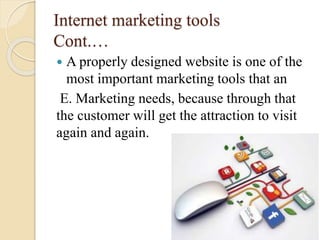
 A properly designed website is one of the
most important marketing tools that an
E. Marketing needs, because through that
the customer will get the attraction to visit
again and again.
Importance of E-Marketing
 The Internet has brought many unique
benefits to marketing, one of which being
lower costs for the distribution of
information and media to a global
audience. The interactive nature of
Internet Marketing, both in terms of
providing instant response and eliciting
response, is a unique quality of the
medium.
Importance of E-Marketing
Cont.…
 It helps in relating the product to their
customers and prospective consumers in a
convenient way..
 As of today, it is said that “EITHER
WAYS LEAD TO THE INTERNET.” Just
a simple click in surfing the Internet
would give you what you want and need.
Advantages of E-Marketing
 24/7
 Save time
 Extremely low risk
 Faster response to both marketers and the
end user
 Increased ability to measure and collect data
 Opens the possibility to a market of one
through personalization
 Increased interactivity
 Increased exposure of products and services
 Boundless universal accessibility
Disadvantages of E-Marketing
 Technology
 The consumer is unable to physically feel
or try on the product
 Higher transparency of pricing and
increased price competition
 Worldwide competition through
globalization
Conclusion
 Online marketing, especially search
engine marketing will continue growing in
double digits in the next few years.
 At the same time there are an increasing
number of householders using the internet
and search engines.
E marketing

E marketing

  • 1.
    E-Marketing Presented by:  PauloSambo  Bakhtyar Tajzada  Salman Muhammad  Omary
  • 2.
    What is E-Marketing? Electronic marketing or E-marketing is the use of electronic media and applications to conduct marketing research and communication activities.  The term electronic marketing initially served as an extension of "Internet marketing" to address the growth of mobile technology and digital applications used in marketing.
  • 3.
    What is E-Marketing E-Marketing is also known as Digital Marketing.  E-Marketing is any marketing done online via websites or other online tools and resources.
  • 4.
    Definition  Electronic Marketingis the marketing of products using electronic technology to determine the consumer market.  E-marketing compasses all the activities a business conduct via World Wide Web (WWW) with the aim of attracting new business , retaining current business and developing its brand identify.
  • 5.
    Objective  Increase marketshare  Increase sales revenue  Reduce cost  Achieve branding building goals  Achieve customer relationship management goals
  • 6.
  • 7.
    Electronic Marketing TraditionalMarketing  Interactive advertising  Methods of digital marketing is less expensive  E-Marketing is marketing to consumers through online channels like website and online banner advertisement.  Contact from one side  Traditional marketing methods more expensive  It refers to offline marketing tactics such as print advertisements, TV, Radio, direct mail and brand show advertising.
  • 8.
    Scope of E-Marketing Internet marketing allows the marketer to reach consumers in a wide range of ways.  It is considered to be a broad scope.  E marketing ties together the Creativity and technical aspects.
  • 9.
    Features  Internet marketingallows global marketing facility.  It is less expensive.  It makes marketing easier.  It increases the choice of products, services and sellers.  Vast availability of information.
  • 10.
    Internet marketing tools It includes Websites, social media and online advertisement.  Use of social media.  Marketing plan.  Social media is the latest marketing buzz, touted by both online and offline marketing experts way to reach customers.
  • 11.
    Internet marketing tools Cont.… A properly designed website is one of the most important marketing tools that an E. Marketing needs, because through that the customer will get the attraction to visit again and again.
  • 12.
    Importance of E-Marketing The Internet has brought many unique benefits to marketing, one of which being lower costs for the distribution of information and media to a global audience. The interactive nature of Internet Marketing, both in terms of providing instant response and eliciting response, is a unique quality of the medium.
  • 13.
    Importance of E-Marketing Cont.… It helps in relating the product to their customers and prospective consumers in a convenient way..  As of today, it is said that “EITHER WAYS LEAD TO THE INTERNET.” Just a simple click in surfing the Internet would give you what you want and need.
  • 14.
    Advantages of E-Marketing 24/7  Save time  Extremely low risk  Faster response to both marketers and the end user  Increased ability to measure and collect data  Opens the possibility to a market of one through personalization  Increased interactivity  Increased exposure of products and services  Boundless universal accessibility
  • 15.
    Disadvantages of E-Marketing Technology  The consumer is unable to physically feel or try on the product  Higher transparency of pricing and increased price competition  Worldwide competition through globalization
  • 16.
    Conclusion  Online marketing,especially search engine marketing will continue growing in double digits in the next few years.  At the same time there are an increasing number of householders using the internet and search engines.