Ecology
• interactions within and among populations
• nutrient cycling with energy flow through
ecosystems
• the effects of natural events and human
activities on ecosystems
Ecology- the scientific study of
interactions between organisms
and their environments, focusing
on energy transfer
• It is a science of relationships.
The environment is made up of two
factors:
Biotic factors- all living organisms
inhabiting the Earth
Abiotic factors- nonliving parts of
the environment (i.e. temperature,
soil, light, moisture, air currents)
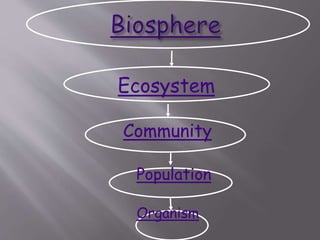
Ecosystem
Community
Population
Organism
•The lowest level of organization
Population-a group of organisms of
one species living in the same place
at the same time that interbreed
and compete with each other for
resources (ex. food, mates, shelter)
•The highest level of organization
“The ecological niche of an
organism depends not only on
where it lives but also on what
it does. By analogy, it may be
said that the habitat is the
organism's ‘address’, and the
niche is its ‘profession’,
biologically speaking.”
Odum - Fundamentals of Ecology
 Niche - the role a species plays in a community
(job)
 Habitat- the place in which an organism
lives out its life (address)
A niche is determined by the
tolerance limitations of an
organism, or a limiting factor.
Limiting factor- any biotic or
abiotic factor that restricts the
existence of organisms in a
specific environment.
• There are 3 main types of feeding
relationships
1. Producer- Consumer
2. Predator- Prey
3. Parasite- Host
Feeding Relationships
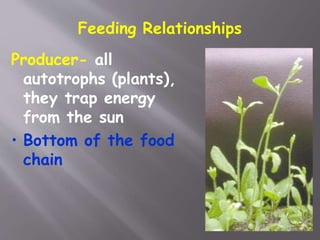
Producer- all
autotrophs (plants),
they trap energy
from the sun
• Bottom of the food
chain
Feeding Relationships
Consumer- all heterotrophs: they
ingest food containing the sun’s
energy
• Herbivores
• Carnivores
• Omnivores
• Decomposers
Herbivores
– Eat plants
• Primary
consumers
• Prey animals
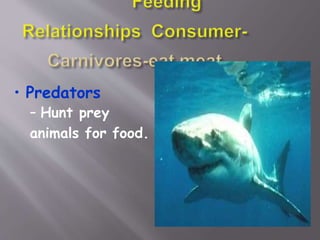
• Predators
– Hunt prey
animals for food.
• Scavengers
– Feed on carrion,
dead animals
Consumer- Omnivores -eat both plants
and animals
Consumer-
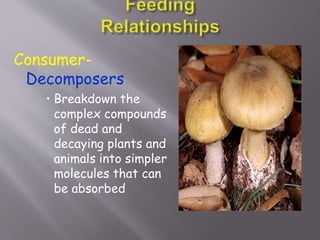
Decomposers
• Breakdown the
complex compounds
of dead and
decaying plants and
animals into simpler
molecules that can
be absorbed
Symbiosis- two species living together
3 Types of
symbiosis:
1. Commensalism
2. Parasitism
3. Mutualism
Commensalism-
one species benefits
and the other is
neither harmed nor
helped
Ex. orchids on a tree
Epiphytes: A plant, such as a
tropical orchid or a bromeliad,
that grows on another plant
upon which it depends for
mechanical support but not for
nutrients. Also called
aerophyte, air plant.
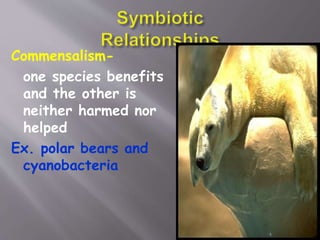
Commensalism-
one species benefits
and the other is
neither harmed nor
helped
Ex. polar bears and
cyanobacteria
Symbiotic Relationships
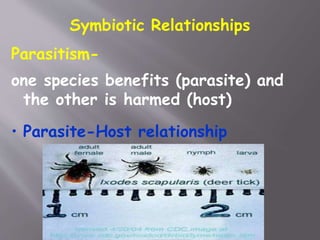
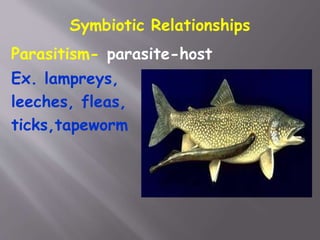
Parasitism-
one species benefits (parasite) and
the other is harmed (host)
• Parasite-Host relationship
Symbiotic Relationships
Parasitism- parasite-host
Ex. lampreys,
leeches, fleas,
ticks,tapeworm
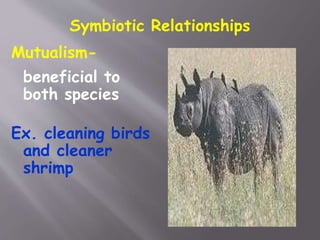
Symbiotic Relationships
Mutualism-
beneficial to
both species
Ex. cleaning birds
and cleaner
shrimp
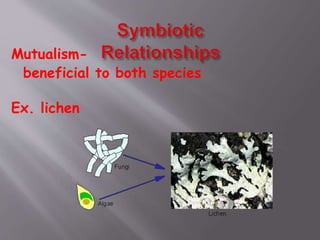
Mutualism-
beneficial to both species
Ex. lichen
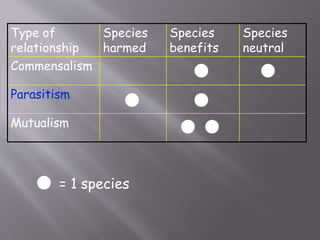
Type of
relationship
Species
harmed
Species
benefits
Species
neutral
Commensalism
Parasitism
Mutualism
= 1 species
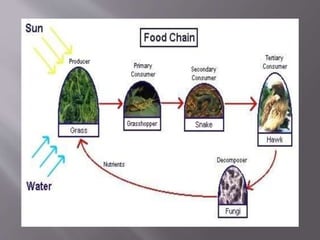
• Each link in a food chain is known
as a trophic level.
• Trophic levels represent a feeding
step in the transfer of energy
and matter in an ecosystem.
Biomass- the amount of organic matter
comprising a group of organisms in a
habitat.
• As you move up a food chain, both
available energy and biomass
decrease.
• Energy is transferred upwards but is
diminished with each transfer.
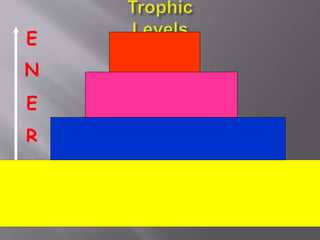
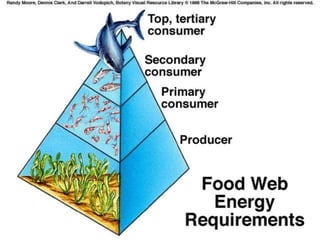
E Tertiary
consumers-
N top carnivores
Secondary consumers-
E small carnivores
R Primary consumers- Herbivores
G
Y
Producers- Autotrophs
Trophic Levels
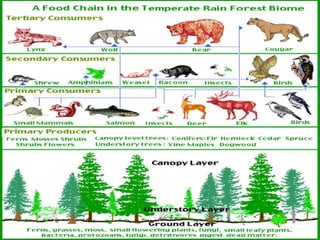
Food chain- simple model that
shows how matter and energy
move through an ecosystem
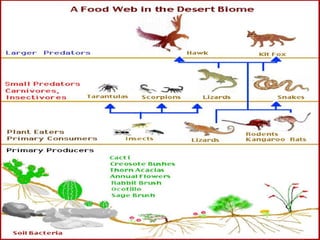
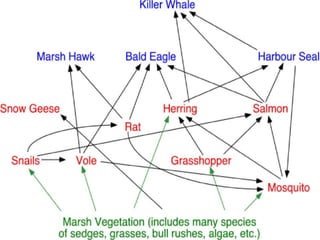
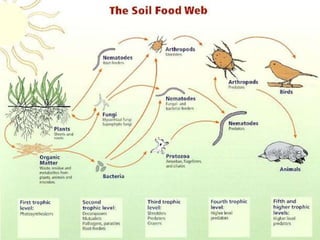
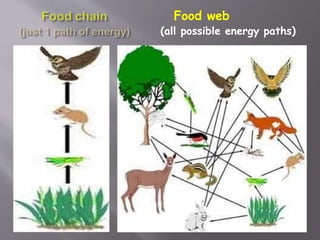
Food web- shows all possible
feeding relationships in a
community at each trophic level
• Represents a network of
interconnected food chains
Food web
(all possible energy paths)
Nutrient Cycles
Cycling maintains homeostasis
(balance) in the environment.
•3 cycles to investigate:
1. Water cycle
2. Carbon cycle
3. Nitrogen cycle
•Evaporation, transpiration,
condensation, precipitation
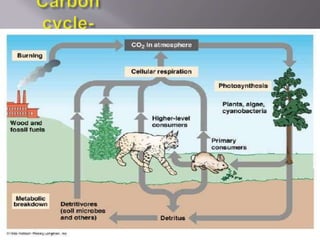
•Photosynthesis and respiration
cycle carbon and oxygen through
the environment.
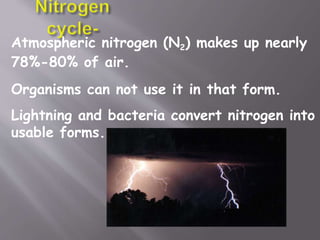
Atmospheric nitrogen (N2) makes up nearly
78%-80% of air.
Organisms can not use it in that form.
Lightning and bacteria convert nitrogen into
usable forms.
Only in certain bacteria and industrial
technologies can fix nitrogen.
Nitrogen fixation-convert atmospheric
4
nitrogen (N2) into ammonium (NH +)
which can be used to make organic
compounds like amino acids.
N2
NH4+
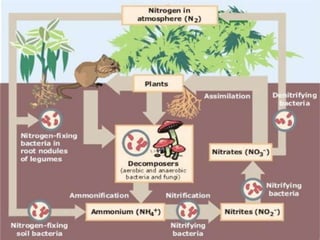
Nitrogen-fixing
bacteria:
Some live in a
symbiotic
relationship with
plants of the legume
family (e.g.,
soybeans, clover,
peanuts).
Nitrogen cycle-
•Some nitrogen-fixing bacteria live
free in the soil.
•Nitrogen-fixing cyanobacteria are
essential to maintaining the fertility
of semi-aquatic environments like rice
paddies.
Atmospheric
nitrogen
Lightning
Nitrogen
fixing bacteria
Ammonium
Nitrification
by bacteria
Nitrites Nitrates
Plants
Denitrification
by bacteria
Animals
Decomposers
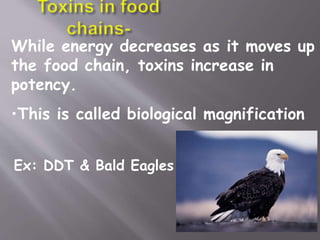
While energy decreases as it moves up
the food chain, toxins increase in
potency.
•This is called biological magnification
Ex: DDT & Bald Eagles

Ecology.pptx. Concept aspect and propects