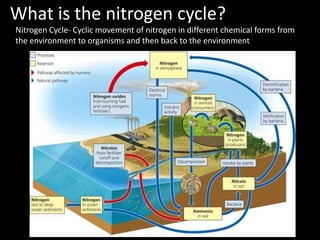
What is the nitrogen cycle?
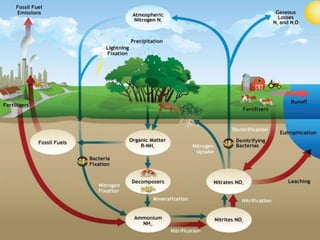
Nitrogen Cycle- Cyclic movement of nitrogen in different chemical forms from
the environment to organisms and then back to the environment
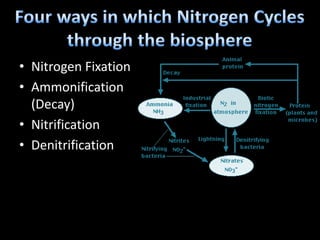
• Nitrogen Fixation
• Ammonification
(Decay)
• Nitrification
• Denitrification
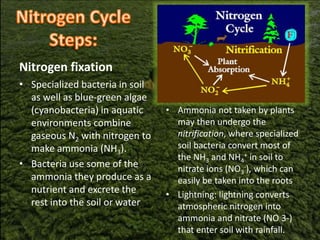
Nitrogen fixation
• Specialized bacteria in soil
as well as blue-green algae
(cyanobacteria) in aquatic
environments combine
gaseous N2 with nitrogen to
make ammonia (NH3).
• Bacteria use some of the
ammonia they produce as a
nutrient and excrete the
rest into the soil or water
• Ammonia not taken by plants
may then undergo the
nitrification, where specialized
soil bacteria convert most of
the NH3 and NH4
+ in soil to
nitrate ions (NO3
-), which can
easily be taken into the roots
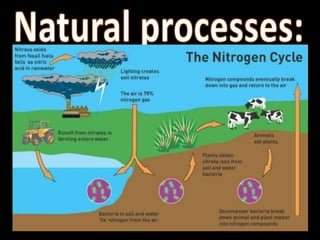
• Lightning: lightning converts
atmospheric nitrogen into
ammonia and nitrate (NO 3-)
that enter soil with rainfall.
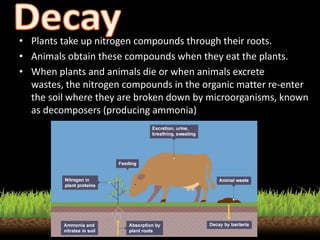
• Plants take up nitrogen compounds through their roots.
• Animals obtain these compounds when they eat the plants.
• When plants and animals die or when animals excrete
wastes, the nitrogen compounds in the organic matter re-enter
the soil where they are broken down by microorganisms, known
as decomposers (producing ammonia)
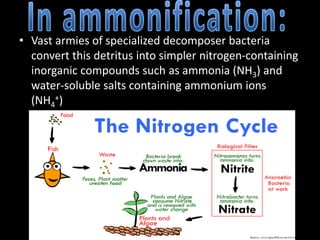
• Vast armies of specialized decomposer bacteria
convert this detritus into simpler nitrogen-containing
inorganic compounds such as ammonia (NH3) and
water-soluble salts containing ammonium ions
(NH4
+)
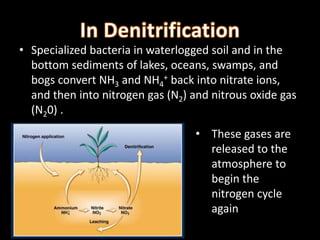
• Specialized bacteria in waterlogged soil and in the
bottom sediments of lakes, oceans, swamps, and
bogs convert NH3 and NH4
+ back into nitrate ions,
and then into nitrogen gas (N2) and nitrous oxide gas
(N20) .
• These gases are
released to the
atmosphere to
begin the
nitrogen cycle
again
• The major reservoir for nitrogen is the
atmosphere- acts as vast storage reservoir for
nitrogen because it is 78 percent nitrogen
• Aquatic systems, in soil, and in the roots of
some plants, where specialized bacteria called
nitrogen-fixing bacteria
• Organic reservoirs that contain nitrogen
include: amino acids, peptides, nucleic acids
and proteins- man-made fertilizers and
ammonia.
• Nitrogen is a crucial component of proteins,
many vitamins, and nucleic acids such as DNA
• Cannot be absorbed and used directly as a
nutrient by multicellular plants or animals
• Increased nitrogen inputs (into the soil) have
led to lots more food being produced to feed
more people – known as ‘the green
revolution’.
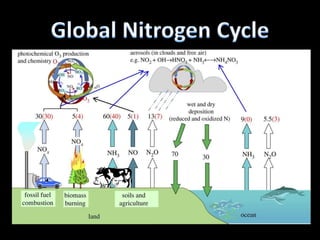
Global nitrogen fixation,
natural and anthropogenic in
both oxidized and reduced
forms through combustion,
biological fixation, lightning
and fertilizer and industrial
production. The arrows
indicate a transfer from the
atmospheric N2 reservoir to
terrestrial and marine
ecosystems, regardless of the
subsequent fate of the Nr.
Green arrows represent
natural sources, purple arrows
represent anthropogenic
sources.
Second way
• We add nitrous oxide (N2O)
to the atmosphere through
the action of anaerobic
bacteria on commercial
inorganic fertilizer or
organic animal manure
applied to the soil
• Greenhouse gas can warm
the atmosphere and
deplete stratosphere ozone,
which keeps most of the
sun’s harmful UV radiation
from reaching the earth’s
surface
Third Way
• We release large quantities
of nitrogen stored in soil
and plants as gaseous
compounds into the
atmosphere through
destruction of forests,
grasslands, and wetlands
Fourth Way
• We upset the nitrogen cycle
in aquatic ecosystems by
adding excess nitrates (NO3
-
) to bodies of water through
agricultural runoff of
fertilizers and animal
manure and through
discharges from municipal
sewage systems
• Can cause excess growth of
algae
Fifth Way
• We remove nitrogen from
topsoil when we harvest
nitrogen –rich crops, irrigate
crops (washing nitrates out
of the soil), and burn or
clear grasslands and forests
before planting crops.
• England, Nitrogen
Fertilizer: Nitrogen
fertilizers are used
in England for
agricultural
purposes resulting
in nitrogen
increasing in the
form of ammonia
from fertilizers and
a increase in the
rate of
dentrification.
• Eutrophication:
Excessive richness of
nutrients in a lake or
other body of water,
frequently due to
runoff from the land.
This causes growth
of plant life and
death of animals
from algae growth in
the water and lack of
oxygen.
Why? Will they
Stop?
• Want to help
their plants
grow quicker.
• Doing nothing
since they feel
fertilizers are
critical to
helping feed
the amount of
people in their
population.
MDC
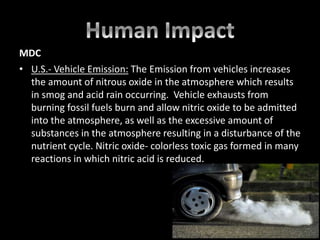
• U.S.- Vehicle Emission: The Emission from vehicles increases
the amount of nitrous oxide in the atmosphere which results
in smog and acid rain occurring. Vehicle exhausts from
burning fossil fuels burn and allow nitric oxide to be admitted
into the atmosphere, as well as the excessive amount of
substances in the atmosphere resulting in a disturbance of the
nutrient cycle. Nitric oxide- colorless toxic gas formed in many
reactions in which nitric acid is reduced.
• Because people would
rather drive a car instead of
riding a bicycle or using
public transportation.
• Its more comforting to be in
your own vehicle than in a
bus with a bunch of other
strangers you don’t know.
• Engineers are finding out
different ways to power a
vehicle that does not result
in vehicle emissions.
• Examples of zero-emission
vehicles include battery-
electric, plug-in hybrid-
electric, and hydrogen fuel-
cell-electric vehicles.
LDC
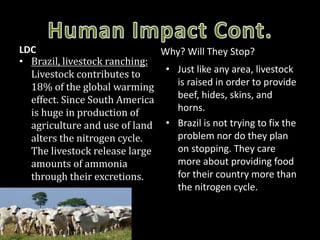
• Brazil, livestock ranching:
Livestock contributes to
18% of the global warming
effect. Since South America
is huge in production of
agriculture and use of land
alters the nitrogen cycle.
The livestock release large
amounts of ammonia
through their excretions.
• Just like any area, livestock
is raised in order to provide
beef, hides, skins, and
horns.
• Brazil is not trying to fix the
problem nor do they plan
on stopping. They care
more about providing food
for their country more than
the nitrogen cycle.
Why? Will They Stop?
LDC Why? Will They Stop
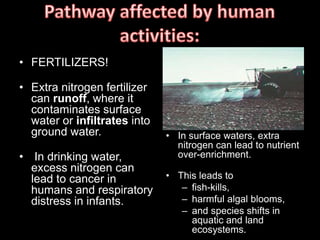
• FERTILIZERS!
• Extra nitrogen fertilizer
can runoff, where it
contaminates surface
water or infiltrates into
ground water.
• In drinking water,
excess nitrogen can
lead to cancer in
humans and respiratory
distress in infants.
• In surface waters, extra
nitrogen can lead to nutrient
over-enrichment.
• This leads to
– fish-kills,
– harmful algal blooms,
– and species shifts in
aquatic and land
ecosystems.
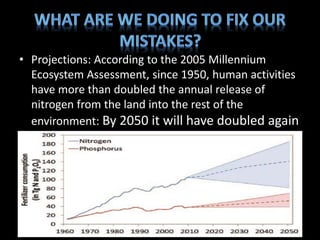
• Projections: According to the 2005 Millennium
Ecosystem Assessment, since 1950, human activities
have more than doubled the annual release of
nitrogen from the land into the rest of the
environment: By 2050 it will have doubled again
Bibliography:
• http://www.esa.org/esa/documents/2013/03/issues-
in-ecology-issue-1.pdf
• http://www.biology-pages.info/N/NitrogenCycle.html
• https://blogs.ntu.edu.sg/hp331-2014-
29/?page_id=110
• http://www.ncbi.nlm.nih.gov/pubmed/23011299
•
https://www.sciencedaily.com/releases/2010/08/1008
09093645.htm
• http://www.dec.ny.gov/chemical/8394.html

Nitrogen cycle PERIOD 5

  • 2.
    What is thenitrogen cycle? Nitrogen Cycle- Cyclic movement of nitrogen in different chemical forms from the environment to organisms and then back to the environment
  • 4.
    • Nitrogen Fixation •Ammonification (Decay) • Nitrification • Denitrification
  • 5.
    Nitrogen fixation • Specializedbacteria in soil as well as blue-green algae (cyanobacteria) in aquatic environments combine gaseous N2 with nitrogen to make ammonia (NH3). • Bacteria use some of the ammonia they produce as a nutrient and excrete the rest into the soil or water • Ammonia not taken by plants may then undergo the nitrification, where specialized soil bacteria convert most of the NH3 and NH4 + in soil to nitrate ions (NO3 -), which can easily be taken into the roots • Lightning: lightning converts atmospheric nitrogen into ammonia and nitrate (NO 3-) that enter soil with rainfall.
  • 6.
    • Plants takeup nitrogen compounds through their roots. • Animals obtain these compounds when they eat the plants. • When plants and animals die or when animals excrete wastes, the nitrogen compounds in the organic matter re-enter the soil where they are broken down by microorganisms, known as decomposers (producing ammonia)
  • 7.
    • Vast armiesof specialized decomposer bacteria convert this detritus into simpler nitrogen-containing inorganic compounds such as ammonia (NH3) and water-soluble salts containing ammonium ions (NH4 +)
  • 8.
    • Specialized bacteriain waterlogged soil and in the bottom sediments of lakes, oceans, swamps, and bogs convert NH3 and NH4 + back into nitrate ions, and then into nitrogen gas (N2) and nitrous oxide gas (N20) . • These gases are released to the atmosphere to begin the nitrogen cycle again
  • 9.
    • The majorreservoir for nitrogen is the atmosphere- acts as vast storage reservoir for nitrogen because it is 78 percent nitrogen • Aquatic systems, in soil, and in the roots of some plants, where specialized bacteria called nitrogen-fixing bacteria • Organic reservoirs that contain nitrogen include: amino acids, peptides, nucleic acids and proteins- man-made fertilizers and ammonia.
  • 11.
    • Nitrogen isa crucial component of proteins, many vitamins, and nucleic acids such as DNA • Cannot be absorbed and used directly as a nutrient by multicellular plants or animals • Increased nitrogen inputs (into the soil) have led to lots more food being produced to feed more people – known as ‘the green revolution’.
  • 12.
    Global nitrogen fixation, naturaland anthropogenic in both oxidized and reduced forms through combustion, biological fixation, lightning and fertilizer and industrial production. The arrows indicate a transfer from the atmospheric N2 reservoir to terrestrial and marine ecosystems, regardless of the subsequent fate of the Nr. Green arrows represent natural sources, purple arrows represent anthropogenic sources.
  • 14.
    Second way • Weadd nitrous oxide (N2O) to the atmosphere through the action of anaerobic bacteria on commercial inorganic fertilizer or organic animal manure applied to the soil • Greenhouse gas can warm the atmosphere and deplete stratosphere ozone, which keeps most of the sun’s harmful UV radiation from reaching the earth’s surface Third Way • We release large quantities of nitrogen stored in soil and plants as gaseous compounds into the atmosphere through destruction of forests, grasslands, and wetlands
  • 15.
    Fourth Way • Weupset the nitrogen cycle in aquatic ecosystems by adding excess nitrates (NO3 - ) to bodies of water through agricultural runoff of fertilizers and animal manure and through discharges from municipal sewage systems • Can cause excess growth of algae Fifth Way • We remove nitrogen from topsoil when we harvest nitrogen –rich crops, irrigate crops (washing nitrates out of the soil), and burn or clear grasslands and forests before planting crops.
  • 16.
    • England, Nitrogen Fertilizer:Nitrogen fertilizers are used in England for agricultural purposes resulting in nitrogen increasing in the form of ammonia from fertilizers and a increase in the rate of dentrification. • Eutrophication: Excessive richness of nutrients in a lake or other body of water, frequently due to runoff from the land. This causes growth of plant life and death of animals from algae growth in the water and lack of oxygen. Why? Will they Stop? • Want to help their plants grow quicker. • Doing nothing since they feel fertilizers are critical to helping feed the amount of people in their population.
  • 17.
    MDC • U.S.- VehicleEmission: The Emission from vehicles increases the amount of nitrous oxide in the atmosphere which results in smog and acid rain occurring. Vehicle exhausts from burning fossil fuels burn and allow nitric oxide to be admitted into the atmosphere, as well as the excessive amount of substances in the atmosphere resulting in a disturbance of the nutrient cycle. Nitric oxide- colorless toxic gas formed in many reactions in which nitric acid is reduced.
  • 18.
    • Because peoplewould rather drive a car instead of riding a bicycle or using public transportation. • Its more comforting to be in your own vehicle than in a bus with a bunch of other strangers you don’t know. • Engineers are finding out different ways to power a vehicle that does not result in vehicle emissions. • Examples of zero-emission vehicles include battery- electric, plug-in hybrid- electric, and hydrogen fuel- cell-electric vehicles.
  • 19.
    LDC • Brazil, livestockranching: Livestock contributes to 18% of the global warming effect. Since South America is huge in production of agriculture and use of land alters the nitrogen cycle. The livestock release large amounts of ammonia through their excretions. • Just like any area, livestock is raised in order to provide beef, hides, skins, and horns. • Brazil is not trying to fix the problem nor do they plan on stopping. They care more about providing food for their country more than the nitrogen cycle. Why? Will They Stop?
  • 20.
    LDC Why? WillThey Stop
  • 21.
    • FERTILIZERS! • Extranitrogen fertilizer can runoff, where it contaminates surface water or infiltrates into ground water. • In drinking water, excess nitrogen can lead to cancer in humans and respiratory distress in infants. • In surface waters, extra nitrogen can lead to nutrient over-enrichment. • This leads to – fish-kills, – harmful algal blooms, – and species shifts in aquatic and land ecosystems.
  • 22.
    • Projections: Accordingto the 2005 Millennium Ecosystem Assessment, since 1950, human activities have more than doubled the annual release of nitrogen from the land into the rest of the environment: By 2050 it will have doubled again
  • 23.
    Bibliography: • http://www.esa.org/esa/documents/2013/03/issues- in-ecology-issue-1.pdf • http://www.biology-pages.info/N/NitrogenCycle.html •https://blogs.ntu.edu.sg/hp331-2014- 29/?page_id=110 • http://www.ncbi.nlm.nih.gov/pubmed/23011299 • https://www.sciencedaily.com/releases/2010/08/1008 09093645.htm • http://www.dec.ny.gov/chemical/8394.html