Ecology Review Natural Cycles
Cycles Carbon Cycle Nitrogen Cycle Water Cycle
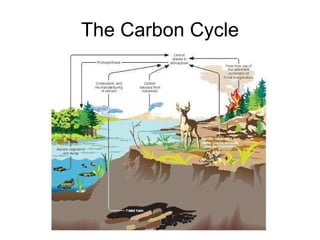
The Carbon Cycle
Sinks & Sources Carbon Sinks Places that absorb more carbon than they release Plants (photosynthesis) Forests Soil Carbon Sources Places or things that release more carbon than they absorb Combustion Respiration Decomposition
 
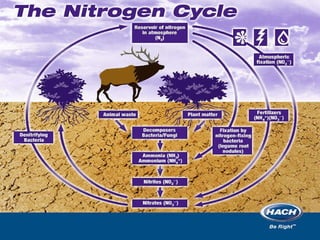
Nitrogen Fixation Conversion of Inert N 2  into bio-usable forms  atmospheric fixation  by lightning  biological fixation  by certain microbes alone symbiotic relationship with some plants and animals  industrial fixation –  Haber Process
Nitrification Nitrification – whatever form of ammonia is applied to the soil, it must be converted to be used by plants NH 3  + Nitrosomonas -> NO 2 NO 2  + Nitrobacter -> NO 3 NO 3  Very soluble form Only held loosely by soil colloids (clay & humus) ~ 5% of NO 3  dissolves in water and is lost by leaching
Hydrological Cycle
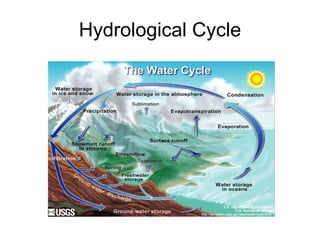
Hydrological Cycle Describes the continuous movement of water on, above, and below the surface of the Earth  Individual water molecules can come and go in a hurry, but there is always the same amount of water on the surface of the earth.

Ecology review 2

  • 1.
  • 2.
    Cycles Carbon CycleNitrogen Cycle Water Cycle
  • 3.
  • 4.
    Sinks & SourcesCarbon Sinks Places that absorb more carbon than they release Plants (photosynthesis) Forests Soil Carbon Sources Places or things that release more carbon than they absorb Combustion Respiration Decomposition
  • 5.
  • 6.
    Nitrogen Fixation Conversionof Inert N 2 into bio-usable forms atmospheric fixation by lightning biological fixation by certain microbes alone symbiotic relationship with some plants and animals industrial fixation – Haber Process
  • 7.
    Nitrification Nitrification –whatever form of ammonia is applied to the soil, it must be converted to be used by plants NH 3 + Nitrosomonas -> NO 2 NO 2 + Nitrobacter -> NO 3 NO 3 Very soluble form Only held loosely by soil colloids (clay & humus) ~ 5% of NO 3 dissolves in water and is lost by leaching
  • 8.
  • 9.
    Hydrological Cycle Describesthe continuous movement of water on, above, and below the surface of the Earth Individual water molecules can come and go in a hurry, but there is always the same amount of water on the surface of the earth.