


ECMO in Cardiac Arrest
Johnny iliff
references
 LITFL
 Alfred Hospital
 ECMO Project
What is it?
 ECMO is extra-corporeal membrane oxygenation
 extracorporeal life support (ECLS) may be a better term
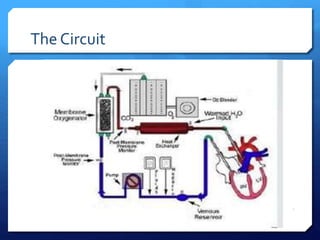
 The extracorporeal circuit allows for the oxygenation and
removal of carbon dioxide from blood
 used as a supportive strategy in patients who have a high risk
of death despite conventional therapy
Why are we considering it in the ED for
CardiacArrest
 “Patients with refractory ventricular fibrillation receiving E-
CPR tended to have higher survival rates and significantly
improved neurological outcomes when compared with those
receiving C-CPR”. Managing cardiac arrest with refractory ventricular fibrillation in
the emergency department:Conventional cardiopulmonary resuscitation versus
extracorporeal cardiopulmonary resuscitation􏰀 -Fu-Yuan Siao et al. RESUSCITATION April
2015
 Drive to start ECMO in SCGHED
Indications
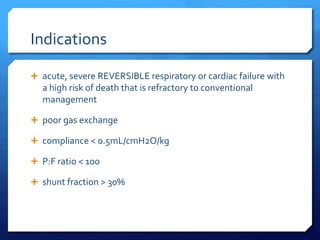
 acute, severe REVERSIBLE respiratory or cardiac failure with
a high risk of death that is refractory to conventional
management
 poor gas exchange
 compliance < 0.5mL/cmH2O/kg
 P:F ratio < 100
 shunt fraction > 30%
Absolute Contraindications
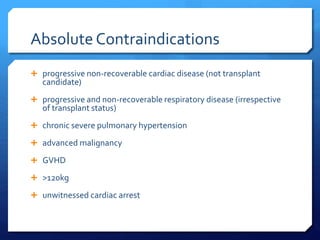
 progressive non-recoverable cardiac disease (not transplant
candidate)
 progressive and non-recoverable respiratory disease (irrespective
of transplant status)
 chronic severe pulmonary hypertension
 advanced malignancy
 GVHD
 >120kg
 unwitnessed cardiac arrest
Relative Contraindications
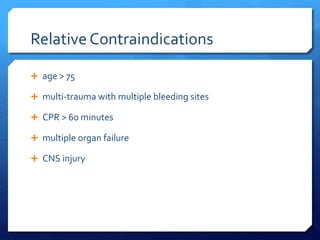
 age > 75
 multi-trauma with multiple bleeding sites
 CPR > 60 minutes
 multiple organ failure
 CNS injury
Types
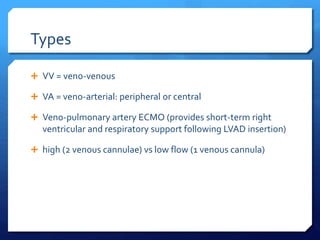
 VV = veno-venous
 VA = veno-arterial: peripheral or central
 Veno-pulmonary artery ECMO (provides short-term right
ventricular and respiratory support following LVAD insertion)
 high (2 venous cannulae) vs low flow (1 venous cannula)
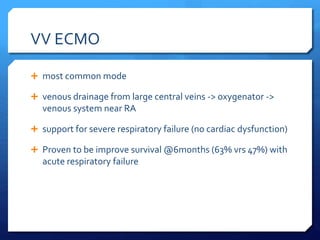
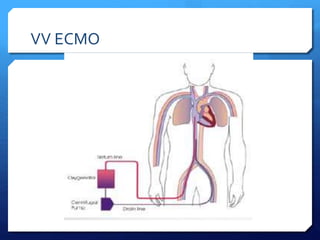
VV ECMO
 most common mode
 venous drainage from large central veins -> oxygenator ->
venous system near RA
 support for severe respiratory failure (no cardiac dysfunction)
 Proven to be improve survival @6months (63% vrs 47%) with
acute respiratory failure
VV ECMO
Pathology
 pneumonia
 ARDS
 -acute GVHD
 pulmonary contusion
 smoke inhalation
 status asthmaticus
 airway obstruction
 aspiration
 bridge to lung transplant
 drowning
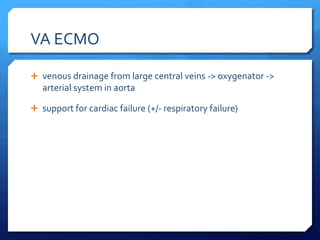
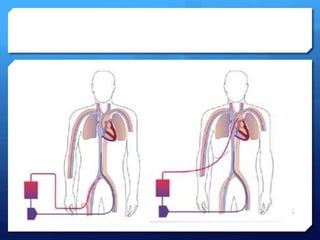
VA ECMO
 venous drainage from large central veins -> oxygenator ->
arterial system in aorta
 support for cardiac failure (+/- respiratory failure)
Pathology
 graft failure post heart or heart lung transplant
 non-ischaemic cardiogenic shock
 failure to wean post CPB
 bridge to LVAD
 drug OD
 Sepsis
 PE
 cardiac or major vessel trauma
 massive pulmonary haemorrhage
 pulmonary trauma
 acute anaphylaxis
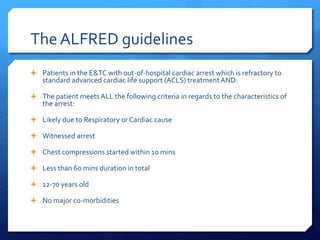
The ALFRED guidelines
 Patients in the E&TC with out-of-hospital cardiac arrest which is refractory to
standard advanced cardiac life support (ACLS) treatmentAND:
 The patient meets ALL the following criteria in regards to the characteristics of
the arrest:
 Likely due to Respiratory or Cardiac cause
 Witnessed arrest
 Chest compressions started within 10 mins
 Less than 60 mins duration in total
 12-70 years old
 No major co-morbidities
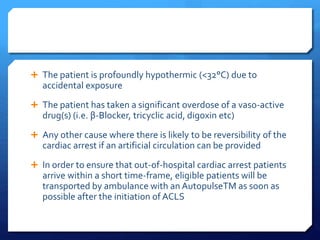
 The patient is profoundly hypothermic (<32°C) due to
accidental exposure
 The patient has taken a significant overdose of a vaso-active
drug(s) (i.e. β-Blocker, tricyclic acid, digoxin etc)
 Any other cause where there is likely to be reversibility of the
cardiac arrest if an artificial circulation can be provided
 In order to ensure that out-of-hospital cardiac arrest patients
arrive within a short time-frame, eligible patients will be
transported by ambulance with an AutopulseTM as soon as
possible after the initiation of ACLS
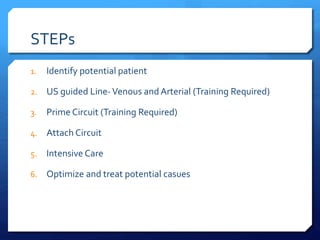
STEPs
1. Identify potential patient
2. US guided Line-Venous and Arterial (Training Required)
3. Prime Circuit (Training Required)
4. Attach Circuit
5. Intensive Care
6. Optimize and treat potential casues
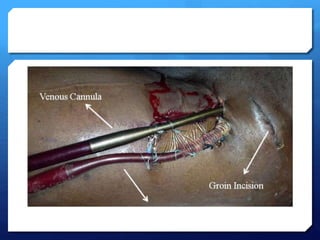
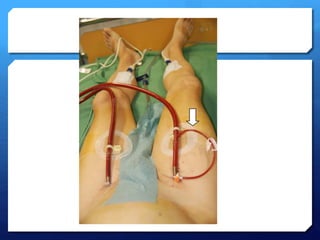
Cannulation
 It’s central access, what’s the big deal?
The Circuit
 https://www.youtube.com/watch?v=OM27HovykWY

ECMO in Cardiac Arrest

  • 1.
    ECMO in CardiacArrest Johnny iliff
  • 2.
    references  LITFL  AlfredHospital  ECMO Project
  • 3.
    What is it? ECMO is extra-corporeal membrane oxygenation  extracorporeal life support (ECLS) may be a better term  The extracorporeal circuit allows for the oxygenation and removal of carbon dioxide from blood  used as a supportive strategy in patients who have a high risk of death despite conventional therapy
  • 4.
    Why are weconsidering it in the ED for CardiacArrest  “Patients with refractory ventricular fibrillation receiving E- CPR tended to have higher survival rates and significantly improved neurological outcomes when compared with those receiving C-CPR”. Managing cardiac arrest with refractory ventricular fibrillation in the emergency department:Conventional cardiopulmonary resuscitation versus extracorporeal cardiopulmonary resuscitation􏰀 -Fu-Yuan Siao et al. RESUSCITATION April 2015  Drive to start ECMO in SCGHED
  • 5.
    Indications  acute, severeREVERSIBLE respiratory or cardiac failure with a high risk of death that is refractory to conventional management  poor gas exchange  compliance < 0.5mL/cmH2O/kg  P:F ratio < 100  shunt fraction > 30%
  • 6.
    Absolute Contraindications  progressivenon-recoverable cardiac disease (not transplant candidate)  progressive and non-recoverable respiratory disease (irrespective of transplant status)  chronic severe pulmonary hypertension  advanced malignancy  GVHD  >120kg  unwitnessed cardiac arrest
  • 7.
    Relative Contraindications  age> 75  multi-trauma with multiple bleeding sites  CPR > 60 minutes  multiple organ failure  CNS injury
  • 8.
    Types  VV =veno-venous  VA = veno-arterial: peripheral or central  Veno-pulmonary artery ECMO (provides short-term right ventricular and respiratory support following LVAD insertion)  high (2 venous cannulae) vs low flow (1 venous cannula)
  • 9.
    VV ECMO  mostcommon mode  venous drainage from large central veins -> oxygenator -> venous system near RA  support for severe respiratory failure (no cardiac dysfunction)  Proven to be improve survival @6months (63% vrs 47%) with acute respiratory failure
  • 10.
  • 11.
    Pathology  pneumonia  ARDS -acute GVHD  pulmonary contusion  smoke inhalation  status asthmaticus  airway obstruction  aspiration  bridge to lung transplant  drowning
  • 12.
    VA ECMO  venousdrainage from large central veins -> oxygenator -> arterial system in aorta  support for cardiac failure (+/- respiratory failure)
  • 14.
    Pathology  graft failurepost heart or heart lung transplant  non-ischaemic cardiogenic shock  failure to wean post CPB  bridge to LVAD  drug OD  Sepsis  PE  cardiac or major vessel trauma  massive pulmonary haemorrhage  pulmonary trauma  acute anaphylaxis
  • 15.
    The ALFRED guidelines Patients in the E&TC with out-of-hospital cardiac arrest which is refractory to standard advanced cardiac life support (ACLS) treatmentAND:  The patient meets ALL the following criteria in regards to the characteristics of the arrest:  Likely due to Respiratory or Cardiac cause  Witnessed arrest  Chest compressions started within 10 mins  Less than 60 mins duration in total  12-70 years old  No major co-morbidities
  • 16.
     The patientis profoundly hypothermic (<32°C) due to accidental exposure  The patient has taken a significant overdose of a vaso-active drug(s) (i.e. β-Blocker, tricyclic acid, digoxin etc)  Any other cause where there is likely to be reversibility of the cardiac arrest if an artificial circulation can be provided  In order to ensure that out-of-hospital cardiac arrest patients arrive within a short time-frame, eligible patients will be transported by ambulance with an AutopulseTM as soon as possible after the initiation of ACLS
  • 17.
    STEPs 1. Identify potentialpatient 2. US guided Line-Venous and Arterial (Training Required) 3. Prime Circuit (Training Required) 4. Attach Circuit 5. Intensive Care 6. Optimize and treat potential casues
  • 18.
    Cannulation  It’s centralaccess, what’s the big deal?
  • 22.
  • 23.

Editor's Notes

  • #5 RETROSPECTIVE CHART REVIEW STUDY over 2 years of 60 patients who had VF refractory to CPR for more than 10mins
  • #12  ----- Meeting Notes (13/04/16 16:08) ----- ADVANTAGES normal lung blood flow oxygenated lung blood pulsatile blood pressure oxygenated blood delivered to root of aorta must be used when native cardiac output is high VENTILATION no need to ventilate at normal level must maintain alveolar volume and oxygenation
  • #14 Advantages of periperhal good Q can create high oxygen tensions Disadvantages relative lung ischaemia non-pulsatile blood flow possible poor perfusion of coronaries and cerebral vessels distal limb ischaemia risk of lung overventilation -> tissue alkalosis (monitor with ETCO2) Advantages of Central no preferential perfusion to lower body no possibility of hypoxic perfusion of cerebral vessels can use very large cannulae (high flows)