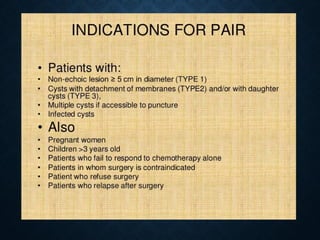
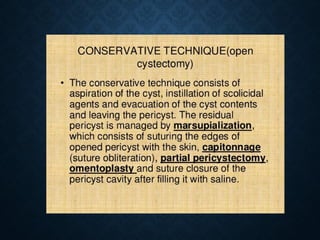
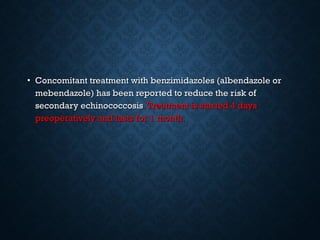
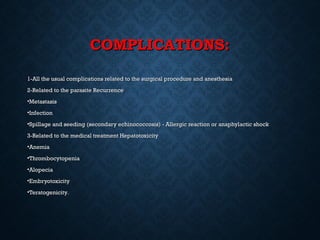
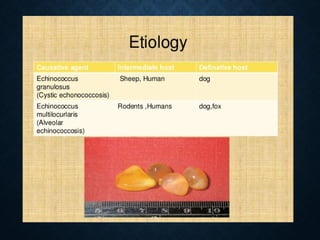
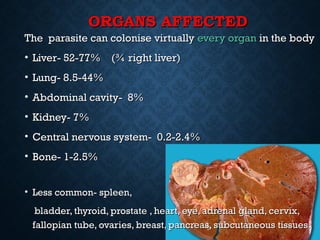
Hydatid cyst, caused by the tapeworm Echinococcus granulosus, is a parasitic infection that can affect various organs in the body. It is commonly found in the liver and lungs. The parasite is transmitted between canine hosts that shed eggs and intermediate hosts such as sheep that humans can become infected by ingesting. Symptoms depend on the location and size of cysts. Diagnosis involves imaging and serology. Treatment options include medical management with anti-parasitic drugs, surgery, and puncture-aspiration-injection-reaspiration (PAIR). Preventing contact between infected dog feces and food sources can help reduce transmission.













![WORK UPWORK UP
• Generally, routine laboratory tests do not show specific results.Generally, routine laboratory tests do not show specific results.
• In patients with rupture of the cyst in the biliary tree,In patients with rupture of the cyst in the biliary tree,
marked andmarked and transient elevation of cholestatic enzymetransient elevation of cholestatic enzyme
levelslevels occurs, often in association withoccurs, often in association with
hyperamylasemiahyperamylasemia andand eosinophiliaeosinophilia (as many as 60%).(as many as 60%).
• Indirect hemagglutination test and enzyme-linkedIndirect hemagglutination test and enzyme-linked
immunosorbent assay are the most widely usedimmunosorbent assay are the most widely used
methods for detection of anti-Echinococcus antibodiesmethods for detection of anti-Echinococcus antibodies
(immunoglobulin G [IgG]).These tests give false(immunoglobulin G [IgG]).These tests give false
positive results in cases of schistosomiasis andpositive results in cases of schistosomiasis and
nematode infestations that is why they are not specificnematode infestations that is why they are not specific
for diagnosing hydatidosis.for diagnosing hydatidosis.](https://image.slidesharecdn.com/echinococcus-160424131521/85/Echinococcus-granulosus-dr-sunil-negi-23-320.jpg)