ECG IN STEMI
DR AZERIN OTHMAN
HRPZ II KOTA BHARU
STEMIWORKSHOP
• Diagnosis of acute STEMI
• Correlate ECG changes and candidate for reperfusion
therapy
• Assess the success of reperfusion therapy
• Correlate location of MI & extent of myocardial
injury - stratification/prognostication/complications
- optimal treatment
ROLES OF ECG IN STEMI
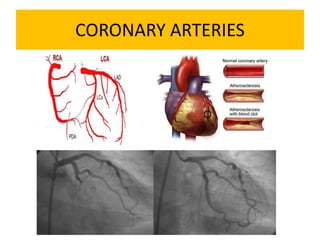
CORONARY ARTERIES
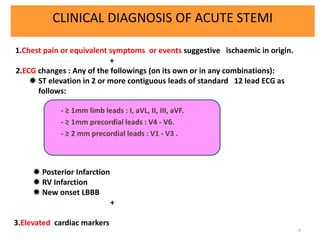
CLINICAL DIAGNOSIS OF ACUTE STEMI
1.Chest pain or equivalent symptoms or events suggestive ischaemic in origin.
+
2.ECG changes : Any of the followings (on its own or in any combinations):
 ST elevation in 2 or more contiguous leads of standard 12 lead ECG as
follows:
 Posterior Infarction
 RV Infarction
 New onset LBBB
+
3.Elevated cardiac markers
4
- ≥ 1mm limb leads : I, aVL, II, III, aVF.
- ≥ 1mm precordial leads : V4 - V6.
- ≥ 2 mm precordial leads : V1 - V3 .
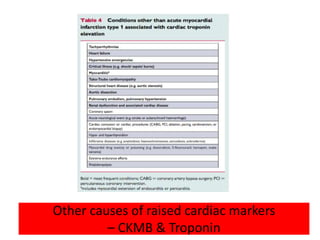
Other causes of raised cardiac markers
– CKMB & Troponin
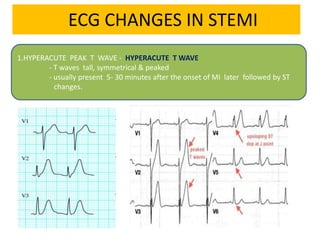
ECG CHANGES IN STEMI
1.HYPERACUTE PEAK T WAVE - HYPERACUTE T WAVE
- T waves tall, symmetrical & peaked
- usually present 5- 30 minutes after the onset of MI later followed by ST
changes.
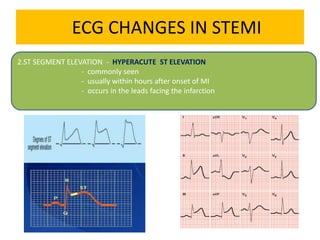
ECG CHANGES IN STEMI
2.ST SEGMENT ELEVATION - HYPERACUTE ST ELEVATION
- commonly seen
- usually within hours after onset of MI
- occurs in the leads facing the infarction
ECG CHANGES IN STEMI
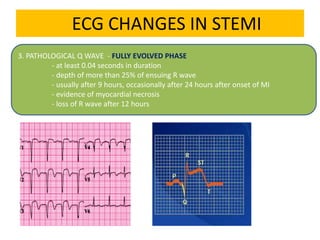
3. PATHOLOGICAL Q WAVE - FULLY EVOLVED PHASE
- at least 0.04 seconds in duration
- depth of more than 25% of ensuing R wave
- usually after 9 hours, occasionally after 24 hours after onset of MI
- evidence of myocardial necrosis
- loss of R wave after 12 hours
ECG CHANGES IN STEMI
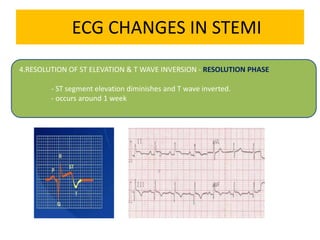
4.RESOLUTION OF ST ELEVATION & T WAVE INVERSION - RESOLUTION PHASE
- ST segment elevation diminishes and T wave inverted.
- occurs around 1 week
ECG CHANGES IN STEMI
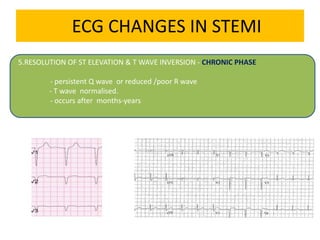
5.RESOLUTION OF ST ELEVATION & T WAVE INVERSION - CHRONIC PHASE
- persistent Q wave or reduced /poor R wave
- T wave normalised.
- occurs after months-years
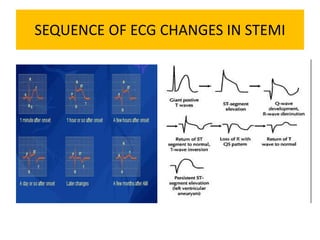
SEQUENCE OF ECG CHANGES IN STEMI
ST ELEVATION IN ACUTE STEMI
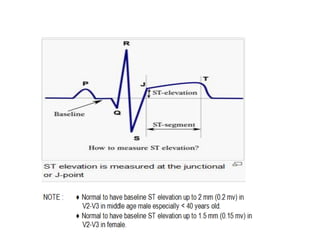
ST elevation in 2 or more contiguous leads of
standard 12 lead ECG as follows:
- ≥ 1mm limb leads : I, aVL, II, III, aVF.
- ≥ 1mm precordial leads : V4 - V6.
- ≥ 2 mm precordial leads : V1 - V3 .
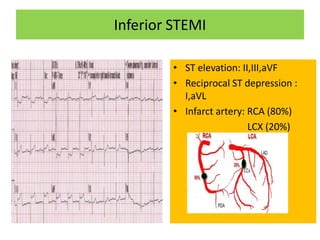
Inferior STEMI
• ST elevation: II,III,aVF
• Reciprocal ST depression :
I,aVL
• Infarct artery: RCA (80%)
LCX (20%)
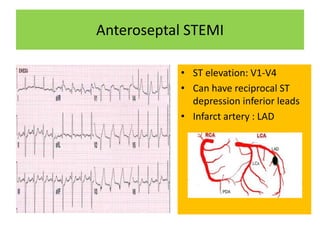
Anteroseptal STEMI
• ST elevation: V1-V4
• Can have reciprocal ST
depression inferior leads
• Infarct artery : LAD
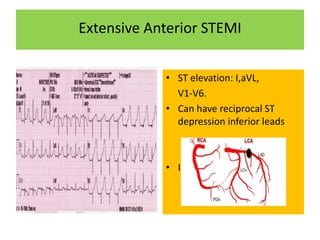
Extensive Anterior STEMI
• ST elevation: I,aVL,
V1-V6.
• Can have reciprocal ST
depression inferior leads
• Infarct artery : LAD
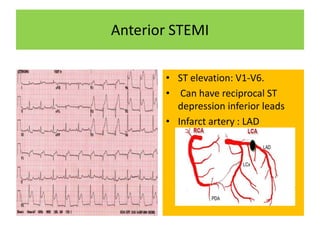
Anterior STEMI
• ST elevation: V1-V6.
• Can have reciprocal ST
depression inferior leads
• Infarct artery : LAD
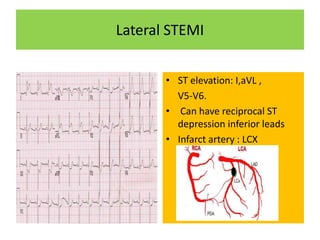
Lateral STEMI
• ST elevation: I,aVL ,
V5-V6.
• Can have reciprocal ST
depression inferior leads
• Infarct artery : LCX
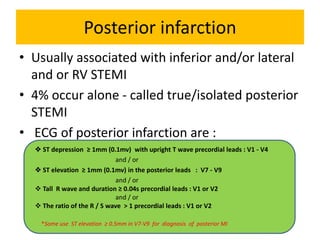
Posterior infarction
• Usually associated with inferior and/or lateral
and or RV STEMI
• 4% occur alone - called true/isolated posterior
STEMI
• ECG of posterior infarction are :
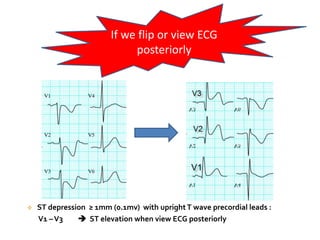
 ST depression ≥ 1mm (0.1mv) with upright T wave precordial leads : V1 - V4
and / or
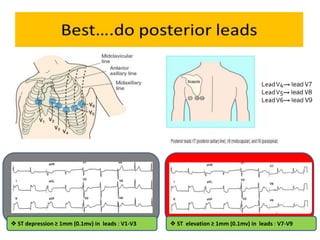
 ST elevation ≥ 1mm (0.1mv) in the posterior leads : V7 - V9
and / or
 Tall R wave and duration ≥ 0.04s precordial leads : V1 or V2
and / or
 The ratio of the R / S wave > 1 precordial leads : V1 or V2
*Some use ST elevation ≥ 0.5mm in V7-V9 for diagnosis of posterior MI
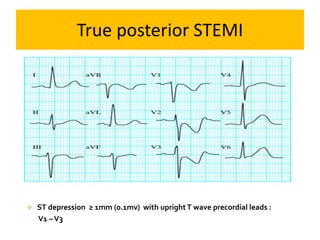
True posterior STEMI
 ST depression ≥ 1mm (0.1mv) with uprightT wave precordial leads :
V1 –V3
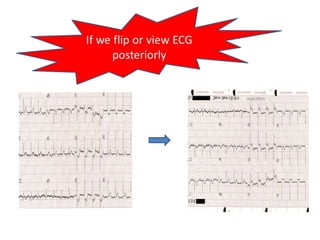
If we flip or view ECG
posteriorly
 ST depression ≥ 1mm (0.1mv) with uprightT wave precordial leads :
V1 –V3  ST elevation when view ECG posteriorly
 ST depression ≥ 1mm (0.1mv) in leads : V1-V3  ST elevation ≥ 1mm (0.1mv) in leads : V7-V9
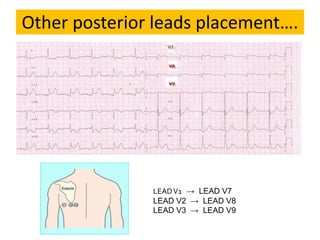
Other posterior leads placement….
LEADV1 → LEAD V7
LEAD V2 → LEAD V8
LEAD V3 → LEAD V9
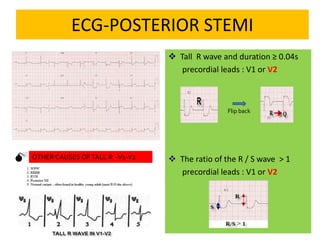
ECG-POSTERIOR STEMI
 Tall R wave and duration ≥ 0.04s
precordial leads : V1 or V2
 The ratio of the R / S wave > 1
precordial leads : V1 or V2
Flip back
 OTHER CAUSES OFTALL R -V1-V2
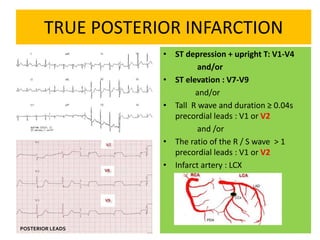
TRUE POSTERIOR INFARCTION
• ST depression + upright T: V1-V4
and/or
• ST elevation : V7-V9
and/or
• Tall R wave and duration ≥ 0.04s
precordial leads : V1 or V2
and /or
• The ratio of the R / S wave > 1
precordial leads : V1 or V2
• Infarct artery : LCX
POSTERIOR LEADS
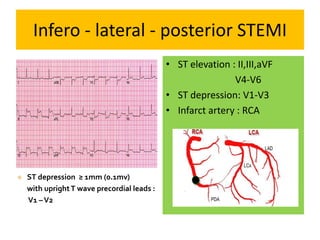
Infero - lateral - posterior STEMI
• ST elevation : II,III,aVF
V4-V6
• ST depression: V1-V3
• Infarct artery : RCA
 ST depression ≥ 1mm (0.1mv)
with uprightT wave precordial leads :
V1 –V2
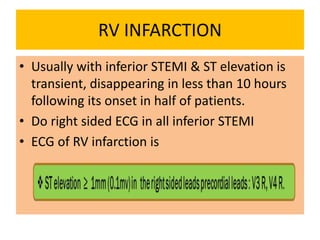
RV INFARCTION
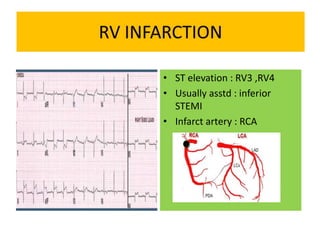
• Usually with inferior STEMI & ST elevation is
transient, disappearing in less than 10 hours
following its onset in half of patients.
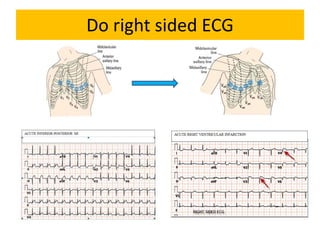
• Do right sided ECG in all inferior STEMI
• ECG of RV infarction is
Do right sided ECG
• ST elevation : RV3 ,RV4
• Usually asstd : inferior
STEMI
• Infarct artery : RCA
LBBB AND STEMI
• New onset LBBB - as STEMI presentation
• STEMI AS LBBB - higher hospital mortality
• Guidelines  new LBBB  STEMI  reperfusion RX
• Beside STEMI  many other causes of LBBB
• LBBB obscure classical STEMI ECG-Q wave & ST-T changes

• How do we predict the likelihood of LBBB as true STEMI
( the best & goal standard is coronary angiogram !!)
 
BUT…. PCI NOT READILY AVAILABLE
EVERYWHERE & WITHIN TIME
?? ENSURE GIVE FIBRINOLYSIS
TO “TRUE “ STEMI…
LBBB IN STEMI
LBBB can be associated with
STEMI in the following ways
• True STEMI - with massive
myocardial damage
• Preexisting LBBB with acute
STEMI
• Transient ischemic LBBB during
STEMI
• Rate dependent LBBB (Usually
tachycardia related )
• STEMI in pacemaker rhythms
CAUSES OF LBBB
- STEMI
- HYPERTENSION
- AORTIC VALVE DISEASE
- EXTENSIVE CAD
- DEGENERATIVE DISEASE
- CONGENITAL HEART
DISEASE
- PACEMAKER RHYTHM
So we analyse with ….
SGARBOSSA
CRITERIA
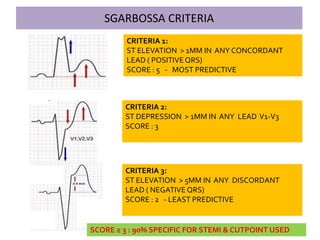
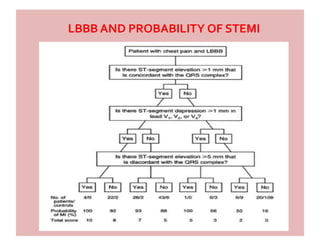
SGARBOSSA CRITERIA
CRITERIA 1:
ST ELEVATION > 1MM IN ANY CONCORDANT
LEAD ( POSITIVEQRS)
SCORE : 5 - MOST PREDICTIVE
CRITERIA 2:
ST DEPRESSION > 1MM IN ANY LEAD V1-V3
SCORE : 3
CRITERIA 3:
ST ELEVATION > 5MM IN ANY DISCORDANT
LEAD ( NEGATIVE QRS)
SCORE : 2 - LEAST PREDICTIVE
SCORE ≥ 3 : 90% SPECIFIC FOR STEMI & CUTPOINT USED
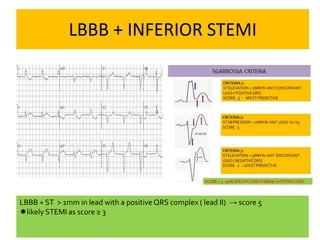
LBBB + INFERIOR STEMI
LBBB + ST > 1mm in lead with a positiveQRS complex ( lead II) → score 5
likely STEMI as score ≥ 3
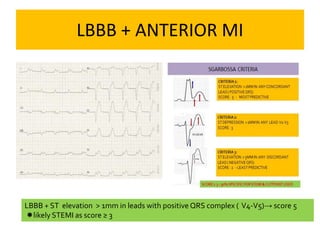
LBBB + ANTERIOR MI
LBBB + ST elevation > 1mm in leads with positive QRS complex ( V4-V5)→ score 5
likely STEMI as score ≥ 3
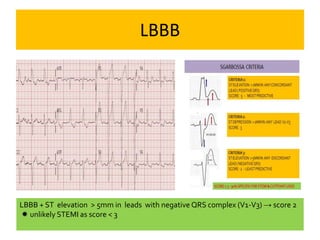
LBBB
LBBB + ST elevation > 5mm in leads with negative QRS complex (V1-V3) → score 2
 unlikely STEMI as score < 3
LBBB AND PROBABILITY OF STEMI
CLINICAL ASSESSMENTOF SUCCESSFUL
REPERFUSION
 RESOLUTION OF CHEST PAIN
 ABSOLUTE RESOLUTION OF ST ELEVATION OR
REDUCTION OF ≥ 50% OF ST ELEVATION
 EARLY PEAK CARDIAC ENZYME
 IDIOVENTRICULAR RHYTHM
 TWAVE INVERSION WITHIN 4 HOURS
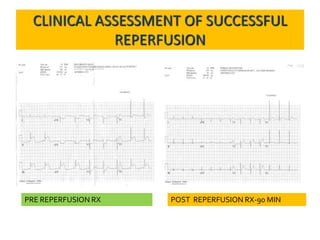
PRE REPERFUSION RX POST REPERFUSION RX-90 MIN
CLINICAL ASSESSMENT OF SUCCESSFUL
REPERFUSION
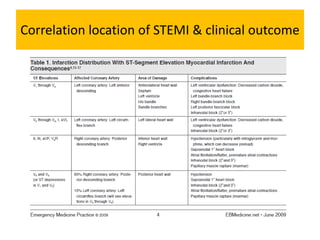
Correlation location of STEMI & clinical outcome

ECG IN STEMI.ppt

  • 1.
    ECG IN STEMI DRAZERIN OTHMAN HRPZ II KOTA BHARU STEMIWORKSHOP
  • 2.
    • Diagnosis ofacute STEMI • Correlate ECG changes and candidate for reperfusion therapy • Assess the success of reperfusion therapy • Correlate location of MI & extent of myocardial injury - stratification/prognostication/complications - optimal treatment ROLES OF ECG IN STEMI
  • 3.
  • 4.
    CLINICAL DIAGNOSIS OFACUTE STEMI 1.Chest pain or equivalent symptoms or events suggestive ischaemic in origin. + 2.ECG changes : Any of the followings (on its own or in any combinations):  ST elevation in 2 or more contiguous leads of standard 12 lead ECG as follows:  Posterior Infarction  RV Infarction  New onset LBBB + 3.Elevated cardiac markers 4 - ≥ 1mm limb leads : I, aVL, II, III, aVF. - ≥ 1mm precordial leads : V4 - V6. - ≥ 2 mm precordial leads : V1 - V3 .
  • 5.
    Other causes ofraised cardiac markers – CKMB & Troponin
  • 6.
    ECG CHANGES INSTEMI 1.HYPERACUTE PEAK T WAVE - HYPERACUTE T WAVE - T waves tall, symmetrical & peaked - usually present 5- 30 minutes after the onset of MI later followed by ST changes.
  • 7.
    ECG CHANGES INSTEMI 2.ST SEGMENT ELEVATION - HYPERACUTE ST ELEVATION - commonly seen - usually within hours after onset of MI - occurs in the leads facing the infarction
  • 8.
    ECG CHANGES INSTEMI 3. PATHOLOGICAL Q WAVE - FULLY EVOLVED PHASE - at least 0.04 seconds in duration - depth of more than 25% of ensuing R wave - usually after 9 hours, occasionally after 24 hours after onset of MI - evidence of myocardial necrosis - loss of R wave after 12 hours
  • 9.
    ECG CHANGES INSTEMI 4.RESOLUTION OF ST ELEVATION & T WAVE INVERSION - RESOLUTION PHASE - ST segment elevation diminishes and T wave inverted. - occurs around 1 week
  • 10.
    ECG CHANGES INSTEMI 5.RESOLUTION OF ST ELEVATION & T WAVE INVERSION - CHRONIC PHASE - persistent Q wave or reduced /poor R wave - T wave normalised. - occurs after months-years
  • 11.
    SEQUENCE OF ECGCHANGES IN STEMI
  • 13.
    ST ELEVATION INACUTE STEMI ST elevation in 2 or more contiguous leads of standard 12 lead ECG as follows: - ≥ 1mm limb leads : I, aVL, II, III, aVF. - ≥ 1mm precordial leads : V4 - V6. - ≥ 2 mm precordial leads : V1 - V3 .
  • 14.
    Inferior STEMI • STelevation: II,III,aVF • Reciprocal ST depression : I,aVL • Infarct artery: RCA (80%) LCX (20%)
  • 15.
    Anteroseptal STEMI • STelevation: V1-V4 • Can have reciprocal ST depression inferior leads • Infarct artery : LAD
  • 16.
    Extensive Anterior STEMI •ST elevation: I,aVL, V1-V6. • Can have reciprocal ST depression inferior leads • Infarct artery : LAD
  • 17.
    Anterior STEMI • STelevation: V1-V6. • Can have reciprocal ST depression inferior leads • Infarct artery : LAD
  • 18.
    Lateral STEMI • STelevation: I,aVL , V5-V6. • Can have reciprocal ST depression inferior leads • Infarct artery : LCX
  • 19.
    Posterior infarction • Usuallyassociated with inferior and/or lateral and or RV STEMI • 4% occur alone - called true/isolated posterior STEMI • ECG of posterior infarction are :  ST depression ≥ 1mm (0.1mv) with upright T wave precordial leads : V1 - V4 and / or  ST elevation ≥ 1mm (0.1mv) in the posterior leads : V7 - V9 and / or  Tall R wave and duration ≥ 0.04s precordial leads : V1 or V2 and / or  The ratio of the R / S wave > 1 precordial leads : V1 or V2 *Some use ST elevation ≥ 0.5mm in V7-V9 for diagnosis of posterior MI
  • 20.
    True posterior STEMI ST depression ≥ 1mm (0.1mv) with uprightT wave precordial leads : V1 –V3
  • 21.
    If we flipor view ECG posteriorly  ST depression ≥ 1mm (0.1mv) with uprightT wave precordial leads : V1 –V3  ST elevation when view ECG posteriorly
  • 23.
     ST depression≥ 1mm (0.1mv) in leads : V1-V3  ST elevation ≥ 1mm (0.1mv) in leads : V7-V9
  • 24.
    Other posterior leadsplacement…. LEADV1 → LEAD V7 LEAD V2 → LEAD V8 LEAD V3 → LEAD V9
  • 25.
    ECG-POSTERIOR STEMI  TallR wave and duration ≥ 0.04s precordial leads : V1 or V2  The ratio of the R / S wave > 1 precordial leads : V1 or V2 Flip back  OTHER CAUSES OFTALL R -V1-V2
  • 26.
    TRUE POSTERIOR INFARCTION •ST depression + upright T: V1-V4 and/or • ST elevation : V7-V9 and/or • Tall R wave and duration ≥ 0.04s precordial leads : V1 or V2 and /or • The ratio of the R / S wave > 1 precordial leads : V1 or V2 • Infarct artery : LCX POSTERIOR LEADS
  • 27.
    Infero - lateral- posterior STEMI • ST elevation : II,III,aVF V4-V6 • ST depression: V1-V3 • Infarct artery : RCA  ST depression ≥ 1mm (0.1mv) with uprightT wave precordial leads : V1 –V2
  • 28.
    RV INFARCTION • Usuallywith inferior STEMI & ST elevation is transient, disappearing in less than 10 hours following its onset in half of patients. • Do right sided ECG in all inferior STEMI • ECG of RV infarction is
  • 29.
  • 30.
    • ST elevation: RV3 ,RV4 • Usually asstd : inferior STEMI • Infarct artery : RCA
  • 31.
    LBBB AND STEMI •New onset LBBB - as STEMI presentation • STEMI AS LBBB - higher hospital mortality • Guidelines  new LBBB  STEMI  reperfusion RX • Beside STEMI  many other causes of LBBB • LBBB obscure classical STEMI ECG-Q wave & ST-T changes  • How do we predict the likelihood of LBBB as true STEMI ( the best & goal standard is coronary angiogram !!)   BUT…. PCI NOT READILY AVAILABLE EVERYWHERE & WITHIN TIME ?? ENSURE GIVE FIBRINOLYSIS TO “TRUE “ STEMI…
  • 32.
    LBBB IN STEMI LBBBcan be associated with STEMI in the following ways • True STEMI - with massive myocardial damage • Preexisting LBBB with acute STEMI • Transient ischemic LBBB during STEMI • Rate dependent LBBB (Usually tachycardia related ) • STEMI in pacemaker rhythms CAUSES OF LBBB - STEMI - HYPERTENSION - AORTIC VALVE DISEASE - EXTENSIVE CAD - DEGENERATIVE DISEASE - CONGENITAL HEART DISEASE - PACEMAKER RHYTHM
  • 33.
    So we analysewith …. SGARBOSSA CRITERIA
  • 34.
    SGARBOSSA CRITERIA CRITERIA 1: STELEVATION > 1MM IN ANY CONCORDANT LEAD ( POSITIVEQRS) SCORE : 5 - MOST PREDICTIVE CRITERIA 2: ST DEPRESSION > 1MM IN ANY LEAD V1-V3 SCORE : 3 CRITERIA 3: ST ELEVATION > 5MM IN ANY DISCORDANT LEAD ( NEGATIVE QRS) SCORE : 2 - LEAST PREDICTIVE SCORE ≥ 3 : 90% SPECIFIC FOR STEMI & CUTPOINT USED
  • 35.
    LBBB + INFERIORSTEMI LBBB + ST > 1mm in lead with a positiveQRS complex ( lead II) → score 5 likely STEMI as score ≥ 3
  • 36.
    LBBB + ANTERIORMI LBBB + ST elevation > 1mm in leads with positive QRS complex ( V4-V5)→ score 5 likely STEMI as score ≥ 3
  • 37.
    LBBB LBBB + STelevation > 5mm in leads with negative QRS complex (V1-V3) → score 2  unlikely STEMI as score < 3
  • 38.
  • 39.
    CLINICAL ASSESSMENTOF SUCCESSFUL REPERFUSION RESOLUTION OF CHEST PAIN  ABSOLUTE RESOLUTION OF ST ELEVATION OR REDUCTION OF ≥ 50% OF ST ELEVATION  EARLY PEAK CARDIAC ENZYME  IDIOVENTRICULAR RHYTHM  TWAVE INVERSION WITHIN 4 HOURS
  • 40.
    PRE REPERFUSION RXPOST REPERFUSION RX-90 MIN CLINICAL ASSESSMENT OF SUCCESSFUL REPERFUSION
  • 41.
    Correlation location ofSTEMI & clinical outcome