Subfertility
Subfertility
Dr.Mudathir
Dr.Mudathir Omer Abdelmaboud
Omer Abdelmaboud
Lecturer
Lecturer-
-Obstetrics & Gynaecology
Obstetrics & Gynaecology
15/09/2009
15/09/2009
Definition
Definition:
:
-
-failure to conceive after a year of regular
failure to conceive after a year of regular
unprotected intercourse.
-
-15% of couples
15% of couples
-
-Primary
Primary→
→ female never conceived.
female never conceived.
-
-secondary
secondary→
→ previously conceived
previously conceived.
.
Basic requirements:
Basic requirements:
-
-Ovulation.
Ovulation.
-
-Adequate sperm production & release.
Adequate sperm production & release.
-
-Sperm must reach egg.
Sperm must reach egg.
-
-Fertilized egg must implant.
Fertilized egg must implant.
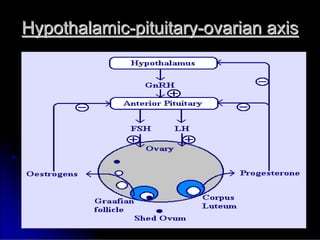
Hypothalamic
Hypothalamic-
-pituitary
pituitary-
-ovarian axis
ovarian axis
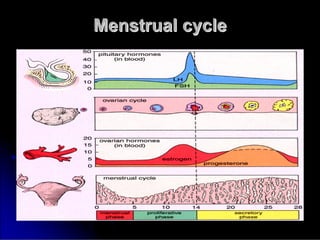
Menstrual cycle
Menstrual cycle
History
History

 Remember
Remember –
– male & female partners
male & female partners

 General medical
General medical –
– chronic illness, cancer, (mumps,
chronic illness, cancer, (mumps,
epididymitis, undescended testes)

 Surgical
Surgical

 Gynaecology
Gynaecology-
- PID?, adhesions?, Menstrual
PID?, adhesions?, Menstrual hx
hx

 Obstetric ?TOP
Obstetric ?TOP

 Meds ? taking folic acid
Meds ? taking folic acid

 Social
Social

 Smoking/C2H5OH/illicit drugs
Smoking/C2H5OH/illicit drugs

 Rubella status
Rubella status
Examination
Examination
Female
Female:
:

 BMI
BMI-
- check height &
check height &
weight
weight

 Underweight/overweight
Underweight/overweight

 General medical
General medical
examination
examination

 Exopthalmos
Exopthalmos, anaemia,
, anaemia,
goitre,
goitre, hirsutism
hirsutism

 Pelvic examination
Pelvic examination

 Cervical smear
Cervical smear
Male:
Male:

 General medical
General medical
examination, height (?
Kleinfelters
Kleinfelters syndrome
syndrome
47XXY)
47XXY)

 Inguinal scars
Inguinal scars

 Size/site of testes
Size/site of testes

 Varicocoele/epididymal
Varicocoele/epididymal
cysts
cysts
Causes
Causes
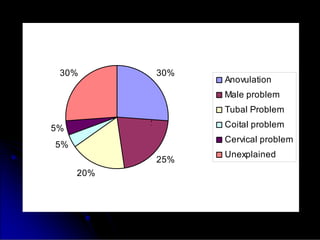
Anovulation(30%) PCOS, hypothalamic
Anovulation(30%) PCOS, hypothalamic hypogonadism
hypogonadism,
,
hyperprolactinemia
hyperprolactinemia
thyroid dysfunction, ovarian fa
thyroid dysfunction, ovarian failure
ilure
Male factor(25%) idiopathic,
Male factor(25%) idiopathic, varicocele
varicocele, antibodies,
, antibodies,
drugs/chemical exposure
No fertilization Tubal damage
No fertilization Tubal damage →
→infection, surgery,
infection, surgery,
endometriosis(25%)
endometriosis(25%)
cervical factor
cervical factor
sexual factor
sexual factor
Unexplained (%30)
Unexplained (%30)
30%
25%
20%
5%
5%
30%
Anovulation
Male problem
Tubal Problem
Coital problem
Cervical problem
Unexplained
3
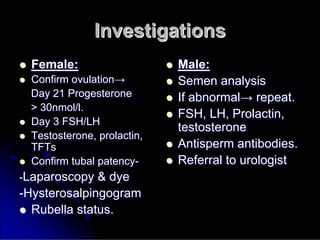
Investigations
Investigations

 Female:
Female:

 Confirm ovulation
Confirm ovulation→
→
Day 21 Progesterone
Day 21 Progesterone
> 30nmol/l.
> 30nmol/l.

 Day 3 FSH/LH
Day 3 FSH/LH

 Testosterone, prolactin,
Testosterone, prolactin,
TFTs
TFTs

 Confirm tubal patency
Confirm tubal patency-
-
-
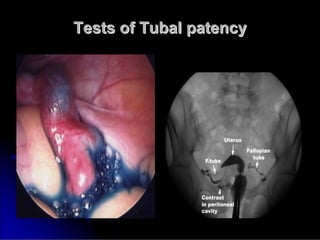
-Laparoscopy & dye
Laparoscopy & dye
-
-Hysterosalpingogram
Hysterosalpingogram

 Rubella status.
Rubella status.

 Male:
Male:

 Semen analysis
Semen analysis

 If abnormal
If abnormal→
→ repeat.
repeat.

 FSH, LH, Prolactin,
FSH, LH, Prolactin,
testosterone
testosterone

 Antisperm
Antisperm antibodies.
antibodies.

 Referral to urologist
Referral to urologist
Tests of Tubal patency
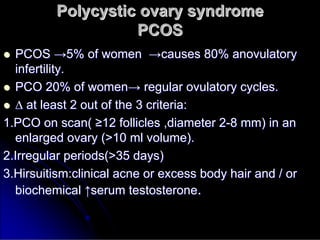
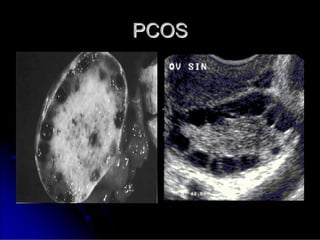
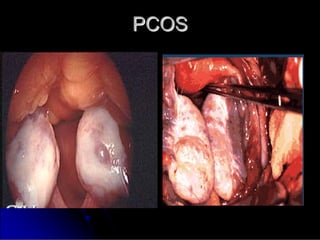
Polycystic ovary syndrome
PCOS
PCOS

 PCOS
PCOS →
→5% of women
5% of women →
→causes 80%
causes 80% anovulatory
anovulatory
infertility.
infertility.

 PCO 20% of women
PCO 20% of women→
→ regular
regular ovulatory
ovulatory cycles.
cycles.

 ∆
∆ at least 2 out of the 3 criteria:
at least 2 out of the 3 criteria:
1.PCO on scan(
1.PCO on scan( ≥
≥12 follicles ,diameter 2
12 follicles ,diameter 2-
-8 mm) in an
8 mm) in an
enlarged ovary (>10 ml volume).
2.Irregular periods(>35 days)
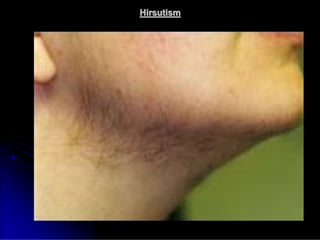
3.Hirsuitism:clinical acne or excess body hair and / or
biochemical
biochemical ↑
↑serum testosterone
serum testosterone.
.
Hirsutism
Hirsutism
PCOS
PCOS
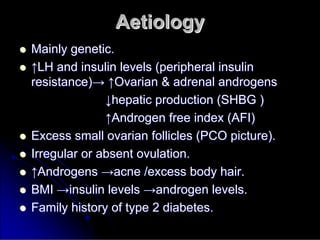
Aetiology
Aetiology

 Mainly genetic.
Mainly genetic.

 ↑
↑LH and insulin levels (peripheral insulin
LH and insulin levels (peripheral insulin
resistance)
resistance)→
→ ↑
↑Ovarian & adrenal androgens
Ovarian & adrenal androgens
↓
↓hepatic production (SHBG )
hepatic production (SHBG )
↑
↑Androgen free index (AFI)
Androgen free index (AFI)

 Excess small ovarian follicles (PCO picture).
Excess small ovarian follicles (PCO picture).

 Irregular or absent ovulation.
Irregular or absent ovulation.

 ↑
↑Androgens
Androgens →
→acne /excess body hair.
acne /excess body hair.

 BMI
BMI →
→insulin levels
insulin levels →
→androgen levels.
androgen levels.

 Family history of type 2 diabetes.
Family history of type 2 diabetes.
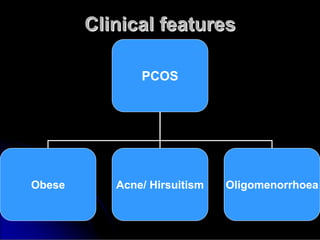
Clinical features
Clinical features
PCOS
Obese Acne/ Hirsuitism Oligomenorrhoea
Investigations
Investigations

 ↑
↑LH(3:1)
LH(3:1)

 FSH
FSH

 ↑
↑Serum testosterone
Serum testosterone

 Prolactin
Prolactin →
→exclude
exclude prolactinoma
prolactinoma.
.

 TSH
TSH

 USS
USS →
→PCO .
PCO .

 Fasting lipid profile & glucose screen.
Fasting lipid profile & glucose screen.
PCOS
PCOS
Complications
Complications

 Type 2 diabetes in later life (50%).
Type 2 diabetes in later life (50%).

 Gestational diabetes (30%).
Gestational diabetes (30%).

 Endometrial cancer.
Endometrial cancer.

 Subfertility
Subfertility or recurrent miscarriage.
or recurrent miscarriage.
Treatment
Treatment

 Symptomatic:
Symptomatic:

 Weight loss, diet and exercise.
Weight loss, diet and exercise.

 COCP
COCP→
→ regular menses/ treat
regular menses/ treat hirsuitism
hirsuitism.
.

 Cyproterone
Cyproterone acetate.
acetate.

 Meformin
Meformin.
.

 Elfornithine
Elfornithine.
.

 Infertility:
Infertility:
1/Ovulation induction
1/Ovulation induction:
:

 A)Clomiphene
A)Clomiphene citrate
citrate →
→anti
anti-
-oestrogen
oestrogen.
.

 Limited to 6/12 (D2
Limited to 6/12 (D2-
-D6)
D6)

 70% ovulation rate / 40% birth rate/ 10% multiple pregnancy.
70% ovulation rate / 40% birth rate/ 10% multiple pregnancy.

 B/
B/Metformin
Metformin

 ↓
↓birth rates compared to
birth rates compared to clomiphene
clomiphene.
.

 Effective in
Effective in clomiphene
clomiphene -
-resistant women
resistant women.
.

 Treat
Treat hirsuitism
hirsuitism/no risk of multiple pregnancy
/no risk of multiple pregnancy.
.

 ↓
↓Early miscarriage and GDM
Early miscarriage and GDM
C)
C) Gonadotrophins
Gonadotrophins:
:

 Recombinant or purified urinary FSH
Recombinant or purified urinary FSH ±
±LH
LH

 Used if
Used if clomiphene
clomiphene failed.
failed.

 Needs scan monitoring for follicular development.
Needs scan monitoring for follicular development.

 ↑
↑Multiple pregnancy.
Multiple pregnancy.

 Ovarian
Ovarian hyperstimulation
hyperstimulation syndrome
syndrome.
.

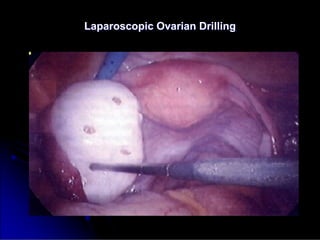
 2/Lapraoscopic Ovarian diathermy
2/Lapraoscopic Ovarian diathermy:
:
-
-As effective as
As effective as gonadotrophins
gonadotrophins.
.
-
-Lower multiple pregnancy rate.
Lower multiple pregnancy rate.
-
-using
using monopolar
monopolar diathermy.
diathermy.
-
-Test tubal patency and treat endometriosis.
Test tubal patency and treat endometriosis.
-
-Regular ovulation for years..
Regular ovulation for years..
Laparoscopic Ovarian Drilling
Premature Ovarian Failure

 Menopause
Menopause occuring
occuring < age 40.
< age 40.

 Radiotherapy/Chemotherapy.
Radiotherapy/Chemotherapy.

 Autoantibodies
Autoantibodies.
.

 Turners syndrome.
Turners syndrome.
Pituitary Causes of
Pituitary Causes of
Subfertility
Subfertility
Hyperprolactinaemia
Hyperprolactinaemia

 Prolactin
Prolactin ↔
↔ posterior lobe of pituitary.
posterior lobe of pituitary.

 ↓
↓GnRH
GnRH release.
release.

 Anovulation
Anovulation.
.
Hyperprolactinaemia
Hyperprolactinaemia
Causes
Causes

 Physiological:
Physiological:

 Stress
Stress

 Exercise
Exercise

 Pregnancy/Lactation
Pregnancy/Lactation

 Pharmacological:
Pharmacological:
-
-Phenothiazines
Phenothiazines
-
-Methyldopa
Methyldopa
-
-Opiates
Opiates

 Pathological:
Pathological:

 1
1º
º Pituitary neoplasm
Pituitary neoplasm

 Macroprolactinoma
Macroprolactinoma

 Microprolactinoma
Microprolactinoma

 Hypothyroidism ( TSH) stimulates pituitary
Hypothyroidism ( TSH) stimulates pituitary
Hyperprolactinaemia
Hyperprolactinaemia
Presentation:
Presentation:

 Primary/secondary
Primary/secondary
amenorrhoea
amenorrhoea

 I
I0
0 Infertility
Infertility

 Gallactorrhoea
Gallactorrhoea

 Visual disturbance
Visual disturbance

 Frontal headache
Frontal headache
∆
∆

 Serum
Serum prolactin
prolactin.
.

 CT/MRI brain.
CT/MRI brain.

 Assessment of visual
Assessment of visual
fields (
fields (bitemporal
bitemporal
hemianopia
hemianopia )
)
Management
Management

 Dopamine agonists
Dopamine agonists

 Bromocriptine
Bromocriptine

 Cabergoline
Cabergoline

 Surgery
Surgery
Sheehan
Sheehan’
’s syndrome
s syndrome

 Pituitary infarction
Pituitary infarction

 Following massive PPH
Following massive PPH
Congenital adrenal hyperplasia
(CAH)
(CAH)

 XX but look male( female pseudo
XX but look male( female pseudo
hermaphrodism
hermaphrodism)
)

 Enzyme defect in aldosterone synthesis
Enzyme defect in aldosterone synthesis→
→ ↑
↑
androgens
androgens

 21 hydroxalase deficiency commonest
21 hydroxalase deficiency commonest

 Ambiguous genitalia.
Ambiguous genitalia.

 ↑
↑ 17 hydroxyprogesterone
17 hydroxyprogesterone
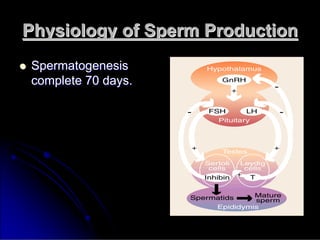
Physiology of Sperm Production

 Spermatogenesis
Spermatogenesis
complete 70 days.
complete 70 days.
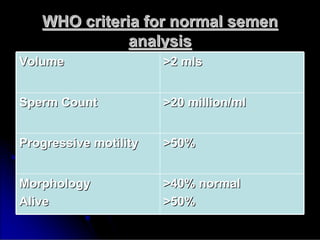
WHO criteria for normal semen
analysis
analysis
Volume
Volume >2
>2 mls
mls
Sperm Count
Sperm Count >20 million/ml
>20 million/ml
Progressive motility
Progressive motility >50%
>50%
Morphology
Morphology
Alive
Alive
>40% normal
>40% normal
>50%
>50%
Causes
Causes
Abnormal semen analysis

 Unknown.
Unknown.

 Smoking/C2H5OH/Drugs.
Smoking/C2H5OH/Drugs.

 Varicocoele
Varicocoele.
.

 Antisperm
Antisperm antibodies.
antibodies.

 Kleinfelters
Kleinfelters syndrome
syndrome-
- 47XXY.
47XXY.

 CF mutation carrier.
CF mutation carrier.

 Drugs
Drugs eg
eg sulphaslazine
sulphaslazine.
.
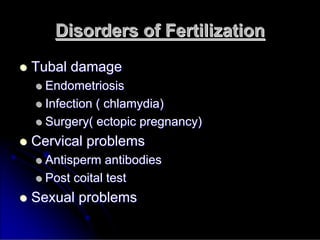
Disorders of Fertilization

 Tubal damage
Tubal damage

 Endometriosis
Endometriosis

 Infection (
Infection ( chlamydia
chlamydia)
)

 Surgery( ectopic pregnancy)
Surgery( ectopic pregnancy)

 Cervical problems
Cervical problems

 Antisperm
Antisperm antibodies
antibodies

 Post coital test
Post coital test

 Sexual problems
Sexual problems
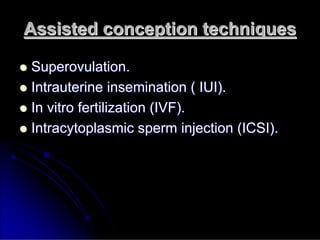
Assisted conception techniques

 Superovulation
Superovulation.
.

 Intrauterine insemination ( IUI).
Intrauterine insemination ( IUI).

 In vitro fertilization (IVF).
In vitro fertilization (IVF).

 Intracytoplasmic
Intracytoplasmic sperm injection (ICSI).
sperm injection (ICSI).
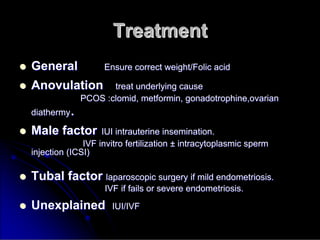
Treatment
Treatment

 General
General Ensure correct weight/Folic acid
Ensure correct weight/Folic acid

 Anovulation
Anovulation treat underlying cause
treat underlying cause
PCOS :
PCOS :clomid
clomid,
, metformin
metformin,
, gonadotrophine,ovarian
gonadotrophine,ovarian
diathermy
diathermy.
.

 Male factor
Male factor IUI intrauterine insemination.
IUI intrauterine insemination.
IVF invitro fertilization
IVF invitro fertilization ±
± intracytoplasmic
intracytoplasmic sperm
sperm
injection (ICSI)
injection (ICSI)

 Tubal factor
Tubal factor laparoscopic surgery if mild endometriosis.
laparoscopic surgery if mild endometriosis.
IVF if fails or severe endome
IVF if fails or severe endometriosis.
triosis.

 Unexplained
Unexplained IUI/IVF
IUI/IVF

Infertility.pdf

  • 1.
    Subfertility Subfertility Dr.Mudathir Dr.Mudathir Omer Abdelmaboud OmerAbdelmaboud Lecturer Lecturer- -Obstetrics & Gynaecology Obstetrics & Gynaecology 15/09/2009 15/09/2009
  • 2.
    Definition Definition: : - -failure to conceiveafter a year of regular failure to conceive after a year of regular unprotected intercourse. unprotected intercourse. - -15% of couples 15% of couples - -Primary Primary→ → female never conceived. female never conceived. - -secondary secondary→ → previously conceived previously conceived. . Basic requirements: Basic requirements: - -Ovulation. Ovulation. - -Adequate sperm production & release. Adequate sperm production & release. - -Sperm must reach egg. Sperm must reach egg. - -Fertilized egg must implant. Fertilized egg must implant.
  • 3.
  • 4.
  • 5.
    History History   Remember Remember – –male & female partners male & female partners   General medical General medical – – chronic illness, cancer, (mumps, chronic illness, cancer, (mumps, epididymitis, undescended testes) epididymitis, undescended testes)   Surgical Surgical   Gynaecology Gynaecology- - PID?, adhesions?, Menstrual PID?, adhesions?, Menstrual hx hx   Obstetric ?TOP Obstetric ?TOP   Meds ? taking folic acid Meds ? taking folic acid   Social Social   Smoking/C2H5OH/illicit drugs Smoking/C2H5OH/illicit drugs   Rubella status Rubella status
  • 6.
    Examination Examination Female Female: :   BMI BMI- - checkheight & check height & weight weight   Underweight/overweight Underweight/overweight   General medical General medical examination examination   Exopthalmos Exopthalmos, anaemia, , anaemia, goitre, goitre, hirsutism hirsutism   Pelvic examination Pelvic examination   Cervical smear Cervical smear Male: Male:   General medical General medical examination, height (? examination, height (? Kleinfelters Kleinfelters syndrome syndrome 47XXY) 47XXY)   Inguinal scars Inguinal scars   Size/site of testes Size/site of testes   Varicocoele/epididymal Varicocoele/epididymal cysts cysts
  • 7.
    Causes Causes Anovulation(30%) PCOS, hypothalamic Anovulation(30%)PCOS, hypothalamic hypogonadism hypogonadism, , hyperprolactinemia hyperprolactinemia thyroid dysfunction, ovarian fa thyroid dysfunction, ovarian failure ilure Male factor(25%) idiopathic, Male factor(25%) idiopathic, varicocele varicocele, antibodies, , antibodies, drugs/chemical exposure drugs/chemical exposure No fertilization Tubal damage No fertilization Tubal damage → →infection, surgery, infection, surgery, endometriosis(25%) endometriosis(25%) cervical factor cervical factor sexual factor sexual factor Unexplained (%30) Unexplained (%30)
  • 8.
  • 9.
    Investigations Investigations   Female: Female:   Confirmovulation Confirm ovulation→ → Day 21 Progesterone Day 21 Progesterone > 30nmol/l. > 30nmol/l.   Day 3 FSH/LH Day 3 FSH/LH   Testosterone, prolactin, Testosterone, prolactin, TFTs TFTs   Confirm tubal patency Confirm tubal patency- - - -Laparoscopy & dye Laparoscopy & dye - -Hysterosalpingogram Hysterosalpingogram   Rubella status. Rubella status.   Male: Male:   Semen analysis Semen analysis   If abnormal If abnormal→ → repeat. repeat.   FSH, LH, Prolactin, FSH, LH, Prolactin, testosterone testosterone   Antisperm Antisperm antibodies. antibodies.   Referral to urologist Referral to urologist
  • 10.
    Tests of Tubalpatency Tests of Tubal patency
  • 11.
    Polycystic ovary syndrome Polycysticovary syndrome PCOS PCOS   PCOS PCOS → →5% of women 5% of women → →causes 80% causes 80% anovulatory anovulatory infertility. infertility.   PCO 20% of women PCO 20% of women→ → regular regular ovulatory ovulatory cycles. cycles.   ∆ ∆ at least 2 out of the 3 criteria: at least 2 out of the 3 criteria: 1.PCO on scan( 1.PCO on scan( ≥ ≥12 follicles ,diameter 2 12 follicles ,diameter 2- -8 mm) in an 8 mm) in an enlarged ovary (>10 ml volume). enlarged ovary (>10 ml volume). 2.Irregular periods(>35 days) 2.Irregular periods(>35 days) 3.Hirsuitism:clinical acne or excess body hair and / or 3.Hirsuitism:clinical acne or excess body hair and / or biochemical biochemical ↑ ↑serum testosterone serum testosterone. .
  • 12.
  • 13.
  • 14.
    Aetiology Aetiology   Mainly genetic. Mainlygenetic.   ↑ ↑LH and insulin levels (peripheral insulin LH and insulin levels (peripheral insulin resistance) resistance)→ → ↑ ↑Ovarian & adrenal androgens Ovarian & adrenal androgens ↓ ↓hepatic production (SHBG ) hepatic production (SHBG ) ↑ ↑Androgen free index (AFI) Androgen free index (AFI)   Excess small ovarian follicles (PCO picture). Excess small ovarian follicles (PCO picture).   Irregular or absent ovulation. Irregular or absent ovulation.   ↑ ↑Androgens Androgens → →acne /excess body hair. acne /excess body hair.   BMI BMI → →insulin levels insulin levels → →androgen levels. androgen levels.   Family history of type 2 diabetes. Family history of type 2 diabetes.
  • 15.
    Clinical features Clinical features PCOS ObeseAcne/ Hirsuitism Oligomenorrhoea
  • 16.
    Investigations Investigations   ↑ ↑LH(3:1) LH(3:1)   FSH FSH  ↑ ↑Serum testosterone Serum testosterone   Prolactin Prolactin → →exclude exclude prolactinoma prolactinoma. .   TSH TSH   USS USS → →PCO . PCO .   Fasting lipid profile & glucose screen. Fasting lipid profile & glucose screen.
  • 17.
  • 18.
    Complications Complications   Type 2diabetes in later life (50%). Type 2 diabetes in later life (50%).   Gestational diabetes (30%). Gestational diabetes (30%).   Endometrial cancer. Endometrial cancer.   Subfertility Subfertility or recurrent miscarriage. or recurrent miscarriage.
  • 19.
    Treatment Treatment   Symptomatic: Symptomatic:   Weightloss, diet and exercise. Weight loss, diet and exercise.   COCP COCP→ → regular menses/ treat regular menses/ treat hirsuitism hirsuitism. .   Cyproterone Cyproterone acetate. acetate.   Meformin Meformin. .   Elfornithine Elfornithine. .   Infertility: Infertility: 1/Ovulation induction 1/Ovulation induction: :   A)Clomiphene A)Clomiphene citrate citrate → →anti anti- -oestrogen oestrogen. .   Limited to 6/12 (D2 Limited to 6/12 (D2- -D6) D6)   70% ovulation rate / 40% birth rate/ 10% multiple pregnancy. 70% ovulation rate / 40% birth rate/ 10% multiple pregnancy.   B/ B/Metformin Metformin   ↓ ↓birth rates compared to birth rates compared to clomiphene clomiphene. .   Effective in Effective in clomiphene clomiphene - -resistant women resistant women. .   Treat Treat hirsuitism hirsuitism/no risk of multiple pregnancy /no risk of multiple pregnancy. .   ↓ ↓Early miscarriage and GDM Early miscarriage and GDM
  • 20.
    C) C) Gonadotrophins Gonadotrophins: :   Recombinantor purified urinary FSH Recombinant or purified urinary FSH ± ±LH LH   Used if Used if clomiphene clomiphene failed. failed.   Needs scan monitoring for follicular development. Needs scan monitoring for follicular development.   ↑ ↑Multiple pregnancy. Multiple pregnancy.   Ovarian Ovarian hyperstimulation hyperstimulation syndrome syndrome. .   2/Lapraoscopic Ovarian diathermy 2/Lapraoscopic Ovarian diathermy: : - -As effective as As effective as gonadotrophins gonadotrophins. . - -Lower multiple pregnancy rate. Lower multiple pregnancy rate. - -using using monopolar monopolar diathermy. diathermy. - -Test tubal patency and treat endometriosis. Test tubal patency and treat endometriosis. - -Regular ovulation for years.. Regular ovulation for years..
  • 21.
  • 22.
    Premature Ovarian Failure PrematureOvarian Failure   Menopause Menopause occuring occuring < age 40. < age 40.   Radiotherapy/Chemotherapy. Radiotherapy/Chemotherapy.   Autoantibodies Autoantibodies. .   Turners syndrome. Turners syndrome.
  • 23.
    Pituitary Causes of PituitaryCauses of Subfertility Subfertility
  • 24.
    Hyperprolactinaemia Hyperprolactinaemia   Prolactin Prolactin ↔ ↔posterior lobe of pituitary. posterior lobe of pituitary.   ↓ ↓GnRH GnRH release. release.   Anovulation Anovulation. .
  • 25.
    Hyperprolactinaemia Hyperprolactinaemia Causes Causes   Physiological: Physiological:   Stress Stress  Exercise Exercise   Pregnancy/Lactation Pregnancy/Lactation   Pharmacological: Pharmacological: - -Phenothiazines Phenothiazines - -Methyldopa Methyldopa - -Opiates Opiates   Pathological: Pathological:   1 1º º Pituitary neoplasm Pituitary neoplasm   Macroprolactinoma Macroprolactinoma   Microprolactinoma Microprolactinoma   Hypothyroidism ( TSH) stimulates pituitary Hypothyroidism ( TSH) stimulates pituitary
  • 26.
    Hyperprolactinaemia Hyperprolactinaemia Presentation: Presentation:   Primary/secondary Primary/secondary amenorrhoea amenorrhoea   I I0 0Infertility Infertility   Gallactorrhoea Gallactorrhoea   Visual disturbance Visual disturbance   Frontal headache Frontal headache ∆ ∆   Serum Serum prolactin prolactin. .   CT/MRI brain. CT/MRI brain.   Assessment of visual Assessment of visual fields ( fields (bitemporal bitemporal hemianopia hemianopia ) )
  • 27.
    Management Management   Dopamine agonists Dopamineagonists   Bromocriptine Bromocriptine   Cabergoline Cabergoline   Surgery Surgery
  • 28.
    Sheehan Sheehan’ ’s syndrome s syndrome  Pituitary infarction Pituitary infarction   Following massive PPH Following massive PPH
  • 29.
    Congenital adrenal hyperplasia Congenitaladrenal hyperplasia (CAH) (CAH)   XX but look male( female pseudo XX but look male( female pseudo hermaphrodism hermaphrodism) )   Enzyme defect in aldosterone synthesis Enzyme defect in aldosterone synthesis→ → ↑ ↑ androgens androgens   21 hydroxalase deficiency commonest 21 hydroxalase deficiency commonest   Ambiguous genitalia. Ambiguous genitalia.   ↑ ↑ 17 hydroxyprogesterone 17 hydroxyprogesterone
  • 30.
    Physiology of SpermProduction Physiology of Sperm Production   Spermatogenesis Spermatogenesis complete 70 days. complete 70 days.
  • 31.
    WHO criteria fornormal semen WHO criteria for normal semen analysis analysis Volume Volume >2 >2 mls mls Sperm Count Sperm Count >20 million/ml >20 million/ml Progressive motility Progressive motility >50% >50% Morphology Morphology Alive Alive >40% normal >40% normal >50% >50%
  • 32.
    Causes Causes Abnormal semen analysis Abnormalsemen analysis   Unknown. Unknown.   Smoking/C2H5OH/Drugs. Smoking/C2H5OH/Drugs.   Varicocoele Varicocoele. .   Antisperm Antisperm antibodies. antibodies.   Kleinfelters Kleinfelters syndrome syndrome- - 47XXY. 47XXY.   CF mutation carrier. CF mutation carrier.   Drugs Drugs eg eg sulphaslazine sulphaslazine. .
  • 33.
    Disorders of Fertilization Disordersof Fertilization   Tubal damage Tubal damage   Endometriosis Endometriosis   Infection ( Infection ( chlamydia chlamydia) )   Surgery( ectopic pregnancy) Surgery( ectopic pregnancy)   Cervical problems Cervical problems   Antisperm Antisperm antibodies antibodies   Post coital test Post coital test   Sexual problems Sexual problems
  • 34.
    Assisted conception techniques Assistedconception techniques   Superovulation Superovulation. .   Intrauterine insemination ( IUI). Intrauterine insemination ( IUI).   In vitro fertilization (IVF). In vitro fertilization (IVF).   Intracytoplasmic Intracytoplasmic sperm injection (ICSI). sperm injection (ICSI).
  • 35.
    Treatment Treatment   General General Ensurecorrect weight/Folic acid Ensure correct weight/Folic acid   Anovulation Anovulation treat underlying cause treat underlying cause PCOS : PCOS :clomid clomid, , metformin metformin, , gonadotrophine,ovarian gonadotrophine,ovarian diathermy diathermy. .   Male factor Male factor IUI intrauterine insemination. IUI intrauterine insemination. IVF invitro fertilization IVF invitro fertilization ± ± intracytoplasmic intracytoplasmic sperm sperm injection (ICSI) injection (ICSI)   Tubal factor Tubal factor laparoscopic surgery if mild endometriosis. laparoscopic surgery if mild endometriosis. IVF if fails or severe endome IVF if fails or severe endometriosis. triosis.   Unexplained Unexplained IUI/IVF IUI/IVF