
ECG MONITORING
PRESENTED BY-
MR. ABHAY RAJPOOT
INTRODUCTION:
The word is derived from the Greek..
Electro: meaning related to electrical activity;
Kardia: meaning heart; and
Graph: meaning “to write”.
DEFINITION
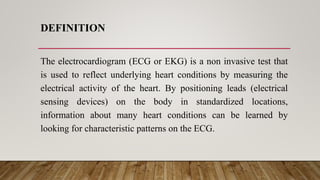
The electrocardiogram (ECG or EKG) is a non invasive test that
is used to reflect underlying heart conditions by measuring the
electrical activity of the heart. By positioning leads (electrical
sensing devices) on the body in standardized locations,
information about many heart conditions can be learned by
looking for characteristic patterns on the ECG.
INDICATIONS
• Chest pain or suspected myocardial infarction (heart attack),
such as ST elevated myocardial infarction (STEMI) or non-ST
elevated myocardial infarction (NSTEMI)
• Symptoms such as Shortness of Breath, Murmurs, Fainting,
Seizures, funny turns or arrhythmias including new onset
palpitations or monitoring of known cardiac arrhythmias
• Medication monitoring (e.g. drug-induced QT prolongation,
Digoxin toxicity) and management of overdose (e.g. tricyclic
overdose)
• Electrolyte abnormalities, such as hyperkalemia
• Perioperative monitoring in which any form of anesthesia is involved (e.g.
monitored anesthesia care, general anesthesia). This includes preoperative
asessment, intraoperative and postoperative monitoring.
• Cardiac stress testing
• Computed tomography angiography (CTA) and magnetic resonance angiography
(MRA) of the heart (ECG is used to "gate" the scanning so that the anatomical
position of the heart is steady)
ARTICLES-
• ECG machine
• Jelly
PLACEMENT OF LEADS
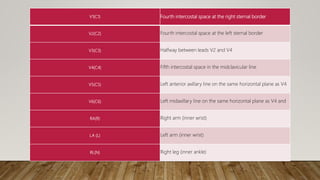
V1(C1) Fourth intercostal space at the right sternal border
V2(C2) Fourth intercostal space at the left sternal border
V3(C3) Halfway between leads V2 and V4
V4(C4) Fifth intercostal space in the midclavicular line
V5(C5) Left anterior axillary line on the same horizontal plane as V4
V6(C6) Left midaxillary line on the same horizontal plane as V4 and
RA(R) Right arm (inner wrist)
LA (L) Left arm (inner wrist)
RL(N) Right leg (inner ankle)
PROCEDURE:
• An electrocardiogram, or ECG, is a reading assessing the magnitude and
direction of the electrical currents of the heart, and measuring the
depolarisation and repolarisation of the cardiac muscle cells
• Preparing a Patient for an ECG
• As with all procedures, we should obtain informed consent from the patient;
explaining the purpose of the procedure; the procedure itself and obtaining
consent to proceed. Maintain good infection control practice by washing your
hands prior to patient contact.
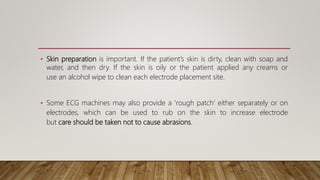
• Skin preparation is important. If the patient’s skin is dirty, clean with soap and
water, and then dry. If the skin is oily or the patient applied any creams or
use an alcohol wipe to clean each electrode placement site.
• Some ECG machines may also provide a ‘rough patch’ either separately or on
electrodes, which can be used to rub on the skin to increase electrode
but care should be taken not to cause abrasions.
• Patients with chest hair should have hair at the electrode placement sites
removed with a razor (Coviello 2016).
• Where possible, place the patient in a semi-recumbent position (Baillie 2014). If
If this is not possible or uncomfortable for the patient, it is acceptable to record
the ECG in another position.
• The patient must be completely relaxed. Ensure the environment is at a
comfortably warm temperature (Jevon 2010). This will prevent muscular tension
or movements producing artefact on the ECG recording. Ensure privacy and
dignity: e.g. closing the room door or drawing around the curtains.
• 12-Lead ECG Placement
• The patient’s chest and all four limbs should be exposed in order to apply the
ECG electrodes correctly.
• There are different methods for identifying the correct landmarks for ECG
electrode placement, the two most common being the ‘Angle of Louis’ Method
and the ‘Clavicular’ Method
AFTER CARE
• Make the patient comfortable
• Recording and reporting
• Replace all articles
BIBLIOGRAPHY
• https://www.medicinenet.com/electrocardiogram_ecg_or_ekg/article.htm#what_is_measu
red_or_can_be_detected_on_the_ecg__ekg
• https://dictionary.reverso.net/english-definition/ECG+monitoring
• https://www.medicinenet.com/script/main/art.asp?articlekey=3212
• https://en.wikipedia.org/wiki/Electrocardiography
• https://www.ausmed.com/cpd/articles/ecg-lead-placement
ECG

ECG

  • 1.
  • 2.
    INTRODUCTION: The word isderived from the Greek.. Electro: meaning related to electrical activity; Kardia: meaning heart; and Graph: meaning “to write”.
  • 3.
    DEFINITION The electrocardiogram (ECGor EKG) is a non invasive test that is used to reflect underlying heart conditions by measuring the electrical activity of the heart. By positioning leads (electrical sensing devices) on the body in standardized locations, information about many heart conditions can be learned by looking for characteristic patterns on the ECG.
  • 4.
    INDICATIONS • Chest painor suspected myocardial infarction (heart attack), such as ST elevated myocardial infarction (STEMI) or non-ST elevated myocardial infarction (NSTEMI) • Symptoms such as Shortness of Breath, Murmurs, Fainting, Seizures, funny turns or arrhythmias including new onset palpitations or monitoring of known cardiac arrhythmias • Medication monitoring (e.g. drug-induced QT prolongation, Digoxin toxicity) and management of overdose (e.g. tricyclic overdose) • Electrolyte abnormalities, such as hyperkalemia
  • 5.
    • Perioperative monitoringin which any form of anesthesia is involved (e.g. monitored anesthesia care, general anesthesia). This includes preoperative asessment, intraoperative and postoperative monitoring. • Cardiac stress testing • Computed tomography angiography (CTA) and magnetic resonance angiography (MRA) of the heart (ECG is used to "gate" the scanning so that the anatomical position of the heart is steady)
  • 6.
  • 8.
  • 9.
    V1(C1) Fourth intercostalspace at the right sternal border V2(C2) Fourth intercostal space at the left sternal border V3(C3) Halfway between leads V2 and V4 V4(C4) Fifth intercostal space in the midclavicular line V5(C5) Left anterior axillary line on the same horizontal plane as V4 V6(C6) Left midaxillary line on the same horizontal plane as V4 and RA(R) Right arm (inner wrist) LA (L) Left arm (inner wrist) RL(N) Right leg (inner ankle)
  • 10.
    PROCEDURE: • An electrocardiogram,or ECG, is a reading assessing the magnitude and direction of the electrical currents of the heart, and measuring the depolarisation and repolarisation of the cardiac muscle cells • Preparing a Patient for an ECG • As with all procedures, we should obtain informed consent from the patient; explaining the purpose of the procedure; the procedure itself and obtaining consent to proceed. Maintain good infection control practice by washing your hands prior to patient contact.
  • 11.
    • Skin preparationis important. If the patient’s skin is dirty, clean with soap and water, and then dry. If the skin is oily or the patient applied any creams or use an alcohol wipe to clean each electrode placement site. • Some ECG machines may also provide a ‘rough patch’ either separately or on electrodes, which can be used to rub on the skin to increase electrode but care should be taken not to cause abrasions.
  • 12.
    • Patients withchest hair should have hair at the electrode placement sites removed with a razor (Coviello 2016). • Where possible, place the patient in a semi-recumbent position (Baillie 2014). If If this is not possible or uncomfortable for the patient, it is acceptable to record the ECG in another position. • The patient must be completely relaxed. Ensure the environment is at a comfortably warm temperature (Jevon 2010). This will prevent muscular tension or movements producing artefact on the ECG recording. Ensure privacy and dignity: e.g. closing the room door or drawing around the curtains.
  • 13.
    • 12-Lead ECGPlacement • The patient’s chest and all four limbs should be exposed in order to apply the ECG electrodes correctly. • There are different methods for identifying the correct landmarks for ECG electrode placement, the two most common being the ‘Angle of Louis’ Method and the ‘Clavicular’ Method
  • 14.
    AFTER CARE • Makethe patient comfortable • Recording and reporting • Replace all articles
  • 15.
    BIBLIOGRAPHY • https://www.medicinenet.com/electrocardiogram_ecg_or_ekg/article.htm#what_is_measu red_or_can_be_detected_on_the_ecg__ekg • https://dictionary.reverso.net/english-definition/ECG+monitoring •https://www.medicinenet.com/script/main/art.asp?articlekey=3212 • https://en.wikipedia.org/wiki/Electrocardiography • https://www.ausmed.com/cpd/articles/ecg-lead-placement