EBSTEIN’S ANOMALI
Dr.Tanvir Rahman
MS(CTS) final part student
NHFH & RI
Ebstein’s anomaly is a congenital malformation
of the heart that is characterized by
• Delamination failure of TV
leaflets(adherence of tricuspid leaflet to
underlying myocardium)
• Apical displacement of functional
annulus(septal>anterior>posterior)
• Atrialization & Dilatation of atrialized
portion of RV
• Redundency fenestration and tethering of
anterior leaflet
• Dilatation of true tricuspid annulus
• Variable ventricular myocardial
dysfunction
History and background
• Wilhelm Ebstein first described a patient with
cardiac defects typical of Ebstein anomaly in
1866.
• In 1927, Alfred Arnstein suggested the name
Ebstein's anomaly for these defects.
• It presented an ongoing challenge since its
initial repair attempts in 1958
• First successful replacement in 1963 by
Barnard and Schrire
epidemiology
The natural course of the disease varies according
to the severity of tricuspid valve displacement.
Patients presenting in infancy generally have severe
disease and unfavorable prognosis.
Mean age of presentation is in the middle teenage
years.
approximately 5% of these patients survive beyond
age 50 years.
The oldest recorded patient lived to age 85 years.
pathophysiology
The ultimate hemodynamic consequences of Ebstein’s
anomaly is heart failure due to
•malformed tricuspid leaflets leading to regurgitation(The
severity of regurgitation depends on the extent of leaflet
displacement)
•The atrialized portion of the right ventricle(although
anatomically part of the right atrium) contracts paradoxically
Leads to stagnation of blood in RA during RV relaxation and
causes a backward flow of blood into the right atrium during
RV systole
And deformed TV leaflet may lead to RVOT obstruction and
cyanosis
presentation
• Patients can have a variety of symptoms related
to the anatomical abnormalities of Ebstein’s
anomaly and their hemodynamic effects or
associated structural and conduction system
disease.
SOB on exertion
Occasional palpitation
fatigue
Features of heart failure
Physical examination findings
• Cyanosis
• JVP- normal or large V wave
• Liver palpable but not pulsatile
• Ascitis & Peripheral oedema at advanced stage
• Apex beat shifted to left
• Left parasternal heave
• Wide splitting of both 1st
and 2nd
heart sound
• Soft Systolic murmur over left parasternal area due to TR
investigations
ECG
ECG-
P pulmonale,
RBBB,
SVT, paroxysmal SVT,
atrial flutter,
atrial fibrillation,
ventricular tachycardia
Chest Xray
• Globular shaped heart (due
to RA hypertrophy and
outward and upward
displacement of RVOT)
• Oligemic lung field
ECHO
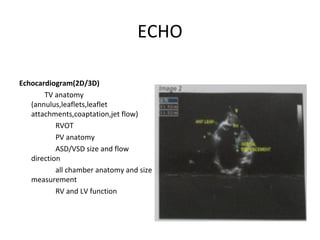
Echocardiogram(2D/3D)
TV anatomy
(annulus,leaflets,leaflet
attachments,coaptation,jet flow)
RVOT
PV anatomy
ASD/VSD size and flow
direction
all chamber anatomy and size
measurement
RV and LV function
Cardiac cath (haemodynamic cath)
done in selective cases
particularly in LV dysfunction,
and when
BDCP shunt is planned
to see LV and RV pressure
Other investigations
CT angiogram
MRI-quantitive
measurement of LV and
RV size
Intra operative TEE
Invasive ECG
classification
• Based on morphology
of RV and TV
(Carpentier’s
classification-1988)
Risk Assessment Great Ormond Street
Echo Score
Area of (RA + aRV)
Area of (RV + LV + LA)
1 <0.5 8%
2 0.5-1.0 8%
3 (acyanotic) 1.1-1.4 10% E, 45% L
3 (cyanotic) 1.1-1.4 100%
4 >1.5 100%
GOSE Ratio Mortality
Score
Treatment options
• Mostly Surgical management
biventricular repair approach
Univentricular /RV exclusion approach
Heart lung transplant
Medical treatment can be given for symptom
alleviation and control of heart failure
Indication of surgical management
• Severe symptomatic
• NYHA Class III/IV
• Severe cyanotic
• Paradoxical embolism
• Cardiomegaly
• Systolic dysfunction
Relative contra indication of surgery
• Relative Contra indications:
• Older age(>50 years)
• Moderate pulmonary hypertension
• LVEF <30%
• Complete failure /poor delamination of leaflets
• Severe RV enlargement
• Severe dilatation of true tricuspid annulus
Surgical Procedures
• Danielson (valvuloplasty by annuloplasty with/without
annuloplasty ring +horizontal plication of non
functional/atrialized portion of RV)
• Modified Danielson( annular remodeling)
• Carpentier ( rotation valvuloplasty –annuloplasty)
• Cone procedure
• Bichell procedure
• TVR (without plication)
• Starnes procedure (single ventricle palliation strategy)
Cone procedure of TV repair -the latest option
• Surgical Delamination Of Fibrous &
Muscular Attachments
• Clockwise rotation of the leaflets and
Suturing margin of PL to SL to form a
cone
• Vertical Plication of Large Atrialized
RV
• Annular Reduction and Re suturing of
leaflets
• Complete reconstruction with partial
closure of ASD/PFO
Clockwise rotation of the leaflets and Suturing margin of PL to SL to
form a cone
Plication of Large Atrialized RV
• Decreases tension at annulus
• Beware of coronary arteries!!
Annular
reduction
Annular Reduction and Re suturing of leaflets
Advantage of Cone repair
Leaflet to leaflet coaptation
Re constractedTV reattached to true annulus
Hinge part of valve is in normal anatomical position
Plication of thin transparent atriaalized RV eliminates chance
of dyskinesia
Excision of redundant RA
Vertical plication allow mentainance of near normal
ventricular anatomy
Heart transplantation
Indications:
•Severe biventricular dysfunction(RV dilatation
and dysfunction with severe LV dysfunction
LVEF <25%)
•Left ventricular dilatation and dysfunction with
MR
THANK YOU
Univentricular/RV exclusion approach (Starnes and Colleagues)
• Patch closure of TV (4-5 mm
fenestrated patch for RV
decompression as it progressively fills
with thebesian venous return)
• Enlargement of interatrial connection
• Placement of systemic to pulmonary
arterial shunt
• RA reduction
• Ligation of MPA (if there is
incompetent PV with patent RVOT
Modified Starnes/total RV exclusion(Sano and Associates)
Resection of Free wall of RV followed by
primary closure
PTFE closure

ebstein's anomali

  • 1.
  • 2.
    Ebstein’s anomaly isa congenital malformation of the heart that is characterized by • Delamination failure of TV leaflets(adherence of tricuspid leaflet to underlying myocardium) • Apical displacement of functional annulus(septal>anterior>posterior) • Atrialization & Dilatation of atrialized portion of RV • Redundency fenestration and tethering of anterior leaflet • Dilatation of true tricuspid annulus • Variable ventricular myocardial dysfunction
  • 3.
    History and background •Wilhelm Ebstein first described a patient with cardiac defects typical of Ebstein anomaly in 1866. • In 1927, Alfred Arnstein suggested the name Ebstein's anomaly for these defects. • It presented an ongoing challenge since its initial repair attempts in 1958 • First successful replacement in 1963 by Barnard and Schrire
  • 4.
    epidemiology The natural courseof the disease varies according to the severity of tricuspid valve displacement. Patients presenting in infancy generally have severe disease and unfavorable prognosis. Mean age of presentation is in the middle teenage years. approximately 5% of these patients survive beyond age 50 years. The oldest recorded patient lived to age 85 years.
  • 5.
    pathophysiology The ultimate hemodynamicconsequences of Ebstein’s anomaly is heart failure due to •malformed tricuspid leaflets leading to regurgitation(The severity of regurgitation depends on the extent of leaflet displacement) •The atrialized portion of the right ventricle(although anatomically part of the right atrium) contracts paradoxically Leads to stagnation of blood in RA during RV relaxation and causes a backward flow of blood into the right atrium during RV systole And deformed TV leaflet may lead to RVOT obstruction and cyanosis
  • 6.
    presentation • Patients canhave a variety of symptoms related to the anatomical abnormalities of Ebstein’s anomaly and their hemodynamic effects or associated structural and conduction system disease. SOB on exertion Occasional palpitation fatigue Features of heart failure
  • 7.
    Physical examination findings •Cyanosis • JVP- normal or large V wave • Liver palpable but not pulsatile • Ascitis & Peripheral oedema at advanced stage • Apex beat shifted to left • Left parasternal heave • Wide splitting of both 1st and 2nd heart sound • Soft Systolic murmur over left parasternal area due to TR
  • 8.
  • 9.
    ECG ECG- P pulmonale, RBBB, SVT, paroxysmalSVT, atrial flutter, atrial fibrillation, ventricular tachycardia
  • 10.
    Chest Xray • Globularshaped heart (due to RA hypertrophy and outward and upward displacement of RVOT) • Oligemic lung field
  • 11.
    ECHO Echocardiogram(2D/3D) TV anatomy (annulus,leaflets,leaflet attachments,coaptation,jet flow) RVOT PVanatomy ASD/VSD size and flow direction all chamber anatomy and size measurement RV and LV function
  • 12.
    Cardiac cath (haemodynamiccath) done in selective cases particularly in LV dysfunction, and when BDCP shunt is planned to see LV and RV pressure
  • 13.
    Other investigations CT angiogram MRI-quantitive measurementof LV and RV size Intra operative TEE Invasive ECG
  • 14.
    classification • Based onmorphology of RV and TV (Carpentier’s classification-1988)
  • 15.
    Risk Assessment GreatOrmond Street Echo Score Area of (RA + aRV) Area of (RV + LV + LA) 1 <0.5 8% 2 0.5-1.0 8% 3 (acyanotic) 1.1-1.4 10% E, 45% L 3 (cyanotic) 1.1-1.4 100% 4 >1.5 100% GOSE Ratio Mortality Score
  • 16.
    Treatment options • MostlySurgical management biventricular repair approach Univentricular /RV exclusion approach Heart lung transplant Medical treatment can be given for symptom alleviation and control of heart failure
  • 17.
    Indication of surgicalmanagement • Severe symptomatic • NYHA Class III/IV • Severe cyanotic • Paradoxical embolism • Cardiomegaly • Systolic dysfunction
  • 18.
    Relative contra indicationof surgery • Relative Contra indications: • Older age(>50 years) • Moderate pulmonary hypertension • LVEF <30% • Complete failure /poor delamination of leaflets • Severe RV enlargement • Severe dilatation of true tricuspid annulus
  • 19.
    Surgical Procedures • Danielson(valvuloplasty by annuloplasty with/without annuloplasty ring +horizontal plication of non functional/atrialized portion of RV) • Modified Danielson( annular remodeling) • Carpentier ( rotation valvuloplasty –annuloplasty) • Cone procedure • Bichell procedure • TVR (without plication) • Starnes procedure (single ventricle palliation strategy)
  • 20.
    Cone procedure ofTV repair -the latest option • Surgical Delamination Of Fibrous & Muscular Attachments • Clockwise rotation of the leaflets and Suturing margin of PL to SL to form a cone • Vertical Plication of Large Atrialized RV • Annular Reduction and Re suturing of leaflets • Complete reconstruction with partial closure of ASD/PFO
  • 21.
    Clockwise rotation ofthe leaflets and Suturing margin of PL to SL to form a cone
  • 22.
    Plication of LargeAtrialized RV • Decreases tension at annulus • Beware of coronary arteries!!
  • 23.
  • 24.
    Advantage of Conerepair Leaflet to leaflet coaptation Re constractedTV reattached to true annulus Hinge part of valve is in normal anatomical position Plication of thin transparent atriaalized RV eliminates chance of dyskinesia Excision of redundant RA Vertical plication allow mentainance of near normal ventricular anatomy
  • 25.
    Heart transplantation Indications: •Severe biventriculardysfunction(RV dilatation and dysfunction with severe LV dysfunction LVEF <25%) •Left ventricular dilatation and dysfunction with MR
  • 26.
  • 28.
    Univentricular/RV exclusion approach(Starnes and Colleagues) • Patch closure of TV (4-5 mm fenestrated patch for RV decompression as it progressively fills with thebesian venous return) • Enlargement of interatrial connection • Placement of systemic to pulmonary arterial shunt • RA reduction • Ligation of MPA (if there is incompetent PV with patent RVOT
  • 30.
    Modified Starnes/total RVexclusion(Sano and Associates) Resection of Free wall of RV followed by primary closure PTFE closure