Ebstein’s Anomaly - Review
NEERAJ
VARYANI
History
 Wilhelm Ebstein – German
physician(1866) presented account
titled “On a Very Rare Case of
Insufficiency of the Tricuspid Valve
Caused by a Severe Congenital
Malformation of the Same”.
 By 1950 only 3 case reports had been
published.
Figure from Ebstein’s case
report
Prevalence
 1 in 200,000 live births. 1% of all
cases of CHD.
 40% of congenital malformations of
tricuspid valve.
Pathologic
Anatomy
 Normally 3 leaflets : anterior,
inferior(posterior) and septal.
 Anterior : semicircular or quadrangular
and
 Posterior: scalloped
 Septal : attaches ventricular septum and
posterior wall of right ventricle. Apical
displacement of basal attachment
compared to mitral valve : 15mm in
children, and 20mm in adults.Normally <
8mm/m2.
Contd…
 Leaflets develop equally from
endocardial cushion and myocardium.
 Leaflets and tensile apparatus develop
from delamination of the inner layer of
inlet zone of ventricles.
 Ebstein ‘s anomaly : DELAMINATION
FAILURE.
 Mechanism unknown probably TV
leaflets displacement.
Ebstein’s
characteristics
 Adherence of septal and inferior
leaflets to myocardium.
 Apical displacement of functional
annulus(septal>inferior>anterior).
 Dilatation of “atrialized” RV
(ARV).Devoid of muscular tissue.
 Redundancy,fenestrations, and
tethering of the anterior leaflet.
 Dilation of the right AV junction.
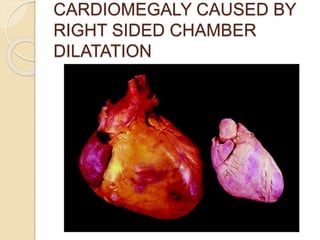
CARDIOMEGALY CAUSED BY
RIGHT SIDED CHAMBER
DILATATION
Tricuspid Valve
 TV morphology in ebstein’s is variable.
 Tricuspid orifice is typically
incompetent,occasionally stenotic and
rarely imperforate.
 Anterior Leaflet: In ebstein’s redundant
and may contain several fenestrations
and chordae tendineae are short and
malformed.Anterior leaflet mobile
tissue may get displaced into RVOT.
 Inferior and septal leaflet development
is variable.
 Apical displacement is maximal at
inferior and septal leaflets
commisure.TV annulus is dilated but
not displaced.
 RCA demarcates true annulus and is
vulnerable to kinking during RV
plication,annuloplasty or TV
replacement.
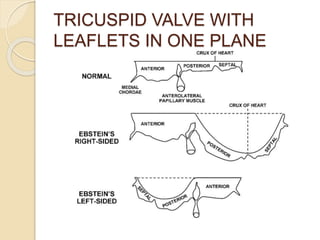
 THE RANGE OF VARIABILITY IS
Ebstein’s malformation of TV
TRICUSPID VALVE WITH
LEAFLETS IN ONE PLANE
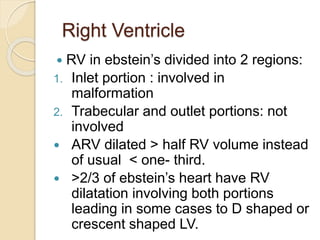
Right Ventricle
 RV in ebstein’s divided into 2 regions:
1. Inlet portion : involved in
malformation
2. Trabecular and outlet portions: not
involved
 ARV dilated > half RV volume instead
of usual < one- third.
 >2/3 of ebstein’s heart have RV
dilatation involving both portions
leading in some cases to D shaped or
crescent shaped LV.
Classification
s
 Difficult as no two hearts are alike.
 Echocardiographic appearance: mild,
moderate and severe according to :
Extent of apical displacement, degree of
TR, degree of RV dilatation and
dysfunction.
 Four types based on anatomic findings
during surgery.
1988 Carpentier et al. 4 types:
 Type A : true RV volume adequate
 Type B: large ARV but mobile anterior
leaflet
 Type C: anterior leaflet movement
restricted causing RVOT obstruction.
 Type D: complete atrialization
Celermajer et al.ECHO
GRADING
 For neonates with ebstein’s anomaly the
Great Ormond Street Echocardiography
(GOSE)score
 Ratio of combined area of the RA and
ARV is compared to the functional RV
and left heart.
o Grade 1 : ratio < 0.5
o Grade 2 : ratio of 0.5 to 0.99
o Grade 3 : ratio of 1.0 to 1.49
o Grade 4 : ratio ≥ 1.5
Genetic
Factors
 Most cases are sporadic hence males
and females are equally affected;
familial ebstein’s anomaly is rare.
 Cardiac transcription factors: NKX2.5
mutation, 10p13-p14 deletion and
1p34.3-p36.11 deletion.
 MYH 7 mutation in subset with LV
noncompaction and this warrants
genetic testing and family evaluation.
Environmental and reproductive factors
 More common in twins
 Family history of congenital heart disease
 Maternal exposure to lithium( 28 fold
increased risk) and benzodiazepines.
Associated Cardiac Defects
 Interatrial septal defects: patent PFO
or ASD mostly secundum type present
in 80% to 94%
 VSD with or without pulmonary
atresia.
 RVOT obstruction: pulmonary valve
stenosis or pulmonary atresia, branch
pulmonary artery stenosis and rarely
displaced TV.
 Patent ductus arteriosus
 Coarctation of aorta
 Accessory pathways:15% to 20%
patients.Majority around orifice of
malformed TV.
 Left side heart lesions: 39% patients
o Diastolic and systolic dysfunction
o Mitral valve prolapse
o Subaortic stenosis
o Bicuspid or atretic aortic valve
o Muscle bands of LV
o Myocardial changes resembling LV
noncompaction
 Congenitally corrected transposition of
the great arteries(cc-TGA):
o 15% to 50% of cc-TGA have
ebstenoid displacement of
morphologic TV but lack ARV and
dilated morphologic RV unlike right
sided ebstein anomaly.
Pathophysiology
 Functional impairement of RV and TR
retard forward flow.
 ARV acts as a passive reservoir during
atrial systole and ballons out decreasing
volume of ejected blood.
 RA dilates increasing size of interatrial
communication.TR increases with
annular dilatation.
 Symptomatic neonates have massive
cardiomegaly with lung hypoplasia.
Contd…
 Decreased forward flow leads to
physiologic pulmonary atresia and
child is duct dependent.
 LV output is compromised in sick
neonates with severe cyanosis and
acidosis.
 Mild cyanosis may not be noted till
adult life .
Clinical Presentation
 Varies widely
 Symptoms are related to anatomic
severity
 Most common presentation varies with
age at presentation
o Fetuses- abnormal routine prenatal
scan(86%). Ebstein’s anomaly is
common lesion referred for fetal
echocardiography because severe forms
lead to cardiomegaly,hydrops and
tachyarrhythmias.
Contd..
o Neonates- cyanosis(74%)
o Infants-heart failure(43%)
o Children- incidental murmur(63%)
o Adolescents and adults-
arrhythmia(42%),decrease exercise
tolerance , fatigue or right sided heart
failure
Symptoms
o Cyanosis and Heart failure
 From TR
 TRANSIENT NEONATAL CYANOSIS:
appears soon after birth due to high
pulmonary vascular resistance and
improves as pulmonary vascular
resistance decreases.
 May appear first during pregnancy
o Exertional Dyspnea,
Fatigue,Cyanosis(50% cases), AND
Palpitations
 May occur at a later age
 May recur and may be insidious in
onset
o Palpitations
 Due to atrial tachyarrhythmias
 Present in 20%-30% cases
 Some may be due to WPW
 Paradoxical Embolization:leading to
brain abscesses and sudden death
 Chest pain –
enigma.Retrosternal,sharp,shooting
suggesting serous origin (fibrinous
pericardium over ARV.
Physical Examination
o Vary with severity of pathology and
magnitude of right to left shunting.
Precordial asymmetry usually left
parasternal prominence occasionally
right anterior chest wall because of
enlarged RA
Murmur and click
Cyanosis: digital clubbing will depend
on degree of cyanosis
 JVP: prominent “a” wave but large V
wave is rare despite severe TR
because large RA engulfs increased
volume ,thin walled toneless ARV and
as TR is low pressure and hypokinetic.
 Hepatomegaly:passive hepatic
congestion and is pulsatile .
 Palpable prominent diffuse apical
impulse
 Systolic thrill at the left lower sternal
border
 First heart sound: widely split due to
RBBB,hypokinetic RV,large size and
increased excursion of anterior leaflet
requiring longer time to reach fully
tensed closed position.Single S1 (T1)
due to prolonged PR and preexcited
RV.Loud T1 (sail sound) sign of anterior
leaflet mobility.
 Second heart sound: widely split due to
RBBB. Single S2 (A2) due to low
pressure in pulmonary trunk.Paradoxical
split due to preexcited RV
 Prominent S3 and/or a loud S4 give the
impression of multiple heart sounds
(triple or quadruple gallop)
 Systolic murmur: from TR
,decresendo,grade 2/6 to 3/6 ,prominent
in leftward location towards apex,
intensity increases with inspiration . Mid-
diastolic murmur due to high diastolic
flow volume.Soft or absent in adults
because of low velocity to- and –fro flow
and rapid equalization of pressure
across TV
Diagnostic
Evaluation
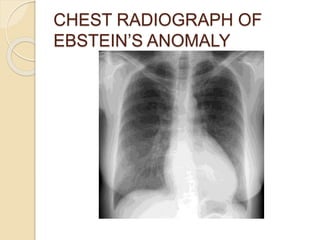
 Chest Radiography: normal to globe
shaped with narrow waist(pulmonary
trunk is not border forming and
ascending aorta is small or absent.
 CT ratio > 0.65 indicates poor prognosis.
 Infundibulum straightens the left cardiac
border or forms a convex border
 Lungs fields may be normal or
decreased due to hypoplasia
 MOST CONSISTENT FEATURE IS
ENLARGED RA SILHOUETTE
CHEST RADIOGRAPH OF
EBSTEIN’S ANOMALY
Electrocardiograph
y
 Ebstein’s anomaly may be diagnosed
using ECG
 Rarely normal even with a mild
anomaly.
 Rarely and oddly ECG may be normal
even when the anomaly is severe
 Major findings are:
Intraatrial conduction disturbance: right
atrial P wave(Himalayan)and prolonged
PR
Atrioventricular nodal conduction:
prolonged PR
Infranodal conduction
 Intra-His or infra-His conduction
abnormality
 RBBB
 Bizarre second QRS attached to
preceding normal QRS
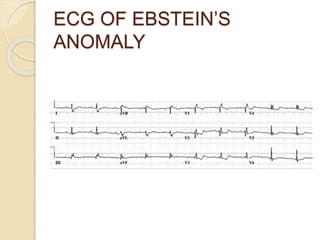
ECG OF EBSTEIN’S
ANOMALY
WPW preexcitation
Supraventricular tachycardia
Atrial fibrillation or flutter
Arrhythmogenic ARV
Deep Q waves in leads V1-V4 and
inferior leads
Complete heart block is rare but first
degree AV block occurs in 42%
patients.
Echocardiograph
y
 2D echocardiography is the diagnostic
test of choice
 3D echocardiography provides
additional details of TV anatomy and
size and function of different cardiac
chambers.
 Apical displacement of septal leaflet
by at least 8mm/m2 body surface area
is the diagnostic feature
ECHOCARDIOGRAM OF
PATIENT WITH EBSTEIN’S
ANOMALY
 Presence of at least three accessory
attachments of leaflets to the
ventricular wall confirms tethering.
 Marked enlargement of RA and ARV is
present when combined area of RA
and ARV is larger than combined area
of functional RV ,LA and LV in apical 4
chamber view in end diastole.
 Helps assess site and degree of TR
and feasibility of its repair.
 Ebstein’s anomaly can be diagnosed
in utero as early as 18th week of
pregnancy.
 Patency of RVOT and GOSE score
can predict outcome in neonatal
ebstein’s anomaly
Cardiac Catheterization
 Rarely required apart from
preoperative coronary angiography in
older patients
 Required in patients with LV
dysfunction and suspected elevated
pulmonary artery pressure and
elevated LVEDP. Important if
bidirectional cavopulmonary
anastomosis is being considered.
Magnetic Resonance Imaging
 Quantitative measurement of RA and
ventricular size and function in
presence of distorted RV anatomy.
 Axial imaging provides new
expressions of disease severity such
as atrialized RV volume.
 3D images provide greater dilineation
of disease severity
MANAGEMEN
T
 Neonatal Ebstein
Poor prognosis: 2o% to 40% do not
survive 1 month and less than 50%
survive to 5 years.
Surgery required in presence of heart
failure or cyanosis. Options include:
(a)biventricular repair(Knott-Craig
approach), (b) single ventricle pathway
with right ventricular exclusion ( Starnes’
approach), and , rarely, (c) cardiac
transplantation
 Biventricular repair( Knott-Craig
approach):TV repaired and atrial septum
partially closed along with routine right
atrial reduction.High early mortality
(25%) intermediate outcome is
promising.
 Right ventricular exclusion
Starnes approach: useful with RVOT
obstruction (a) fenestrated patch closure
of the TV orifice, (b) enlarging the
interatrial communication, (c) right atrial
reduction, (d) placing systemic to
Modified Starnes Repair( Total
Ventricular Exclusion): RV free wall is
resected and closed primarily.
 Cardiac Transplantation:rarely
performed in current era.Option in
patients with significant LV
dysfunction.
Management in Children and
Adults
 Medical
Bacterial endocarditis prophylaxis
Those not candidates for surgery
managed with ACEI’s and heart failure
regimes.
Arrhythmias managed medically with
operative or catheter based
interventions
 Catheter Ablation: success rate is
lower.Atrial fibrillation and flutter are
treated surgically at the time of operation.
 Surgery
Indications:symptoms ,cyanosis and
paradoxical embolization, decreased
exercise performance, progressive
increase in cardiothoracic ratio,
progressive right ventricular dilatation and
dysfunction, onset and progression of
arrhythmias,NYHA class III or IV
symptoms and echocardiographic
probability of successful valve repair.
 Principles of surgery
Closure of intracardiac
communications
TV repair or replacement
Ablation of arrhythmias
Plication of ARV
Reduction right atrioplasty
Repair of associated defects
 TV Repair
Mayo Clinic Experience
o Danielson Repair
o Modified Danielson repair
BRAZIL Experience(da Silva
Approach):cone repair;most anatomic
repair.
FRENCH EXPERIENCE (BROUSSAIS
Approach)
Ventriculization procedure
Tricuspid Valve
Replacement
 If TV repair not feasible
 Porcine bioprosthetic valve is good
alternative over mechanical valve due
to good durability and lack of need for
anticoagulation.
TV REPLACEMENT
TECHNIQUE
o One and Half Ventricle repair
 BDCPA: reduces venous return to
dysfunctional enlarged RV and
provides preload to LV.
 Indications for BDCPA:
Severe RV enlargement
D shaped LV
Moderate TS(mean gradient
>6mmHg)
RA/LA pressure ratio > 1.5
Preoperative cyanosis at rest or with
exercise
o Disadvantages of BDCPA:
Pulsations of head and neck veins
Facial swelling
Development of pulmonary AV fistulae
Compromised access to the heart
using internal jugular vein approach
o Plication of ARV
 ADVANTAGES: (a) decreases size of
nonfunctioning RV, (b) minimizes
pancake effect of RV on LV.
 Potential risk of RCA injury
o Right reduction atrioplasty: performed
routinely. Avoid suture in crista
terminalis.
Surgical Treatment of
Arrhythmias
 In atrial fibrillation right sided cut and
sew lesions of Cox-maze III procedure
 Bilateral maze done in chronic AF, LA
dilation and MR.
 In atrial flutter right atrial isthmus
lesion is added.
 AVNRT unsuccessful ablation in
preoperative EP laboratory treated by
perinodal cryoablation
 Heart Transplantation
o In presence of severe biventricular
failure ( LV Ejection Fraction < 25%),
severe LV dilatation and severe MR
with LV dysfunction.

Ebstein anomaly

  • 1.
    Ebstein’s Anomaly -Review NEERAJ VARYANI
  • 2.
    History  Wilhelm Ebstein– German physician(1866) presented account titled “On a Very Rare Case of Insufficiency of the Tricuspid Valve Caused by a Severe Congenital Malformation of the Same”.  By 1950 only 3 case reports had been published.
  • 3.
  • 4.
    Prevalence  1 in200,000 live births. 1% of all cases of CHD.  40% of congenital malformations of tricuspid valve.
  • 5.
    Pathologic Anatomy  Normally 3leaflets : anterior, inferior(posterior) and septal.  Anterior : semicircular or quadrangular and  Posterior: scalloped  Septal : attaches ventricular septum and posterior wall of right ventricle. Apical displacement of basal attachment compared to mitral valve : 15mm in children, and 20mm in adults.Normally < 8mm/m2.
  • 6.
    Contd…  Leaflets developequally from endocardial cushion and myocardium.  Leaflets and tensile apparatus develop from delamination of the inner layer of inlet zone of ventricles.  Ebstein ‘s anomaly : DELAMINATION FAILURE.  Mechanism unknown probably TV leaflets displacement.
  • 7.
    Ebstein’s characteristics  Adherence ofseptal and inferior leaflets to myocardium.  Apical displacement of functional annulus(septal>inferior>anterior).  Dilatation of “atrialized” RV (ARV).Devoid of muscular tissue.  Redundancy,fenestrations, and tethering of the anterior leaflet.  Dilation of the right AV junction.
  • 8.
    CARDIOMEGALY CAUSED BY RIGHTSIDED CHAMBER DILATATION
  • 9.
    Tricuspid Valve  TVmorphology in ebstein’s is variable.  Tricuspid orifice is typically incompetent,occasionally stenotic and rarely imperforate.  Anterior Leaflet: In ebstein’s redundant and may contain several fenestrations and chordae tendineae are short and malformed.Anterior leaflet mobile tissue may get displaced into RVOT.
  • 10.
     Inferior andseptal leaflet development is variable.  Apical displacement is maximal at inferior and septal leaflets commisure.TV annulus is dilated but not displaced.  RCA demarcates true annulus and is vulnerable to kinking during RV plication,annuloplasty or TV replacement.  THE RANGE OF VARIABILITY IS
  • 11.
  • 12.
  • 13.
    Right Ventricle  RVin ebstein’s divided into 2 regions: 1. Inlet portion : involved in malformation 2. Trabecular and outlet portions: not involved  ARV dilated > half RV volume instead of usual < one- third.  >2/3 of ebstein’s heart have RV dilatation involving both portions leading in some cases to D shaped or crescent shaped LV.
  • 14.
    Classification s  Difficult asno two hearts are alike.  Echocardiographic appearance: mild, moderate and severe according to : Extent of apical displacement, degree of TR, degree of RV dilatation and dysfunction.  Four types based on anatomic findings during surgery.
  • 15.
    1988 Carpentier etal. 4 types:  Type A : true RV volume adequate  Type B: large ARV but mobile anterior leaflet  Type C: anterior leaflet movement restricted causing RVOT obstruction.  Type D: complete atrialization
  • 16.
    Celermajer et al.ECHO GRADING For neonates with ebstein’s anomaly the Great Ormond Street Echocardiography (GOSE)score  Ratio of combined area of the RA and ARV is compared to the functional RV and left heart. o Grade 1 : ratio < 0.5 o Grade 2 : ratio of 0.5 to 0.99 o Grade 3 : ratio of 1.0 to 1.49 o Grade 4 : ratio ≥ 1.5
  • 17.
    Genetic Factors  Most casesare sporadic hence males and females are equally affected; familial ebstein’s anomaly is rare.  Cardiac transcription factors: NKX2.5 mutation, 10p13-p14 deletion and 1p34.3-p36.11 deletion.  MYH 7 mutation in subset with LV noncompaction and this warrants genetic testing and family evaluation.
  • 18.
    Environmental and reproductivefactors  More common in twins  Family history of congenital heart disease  Maternal exposure to lithium( 28 fold increased risk) and benzodiazepines.
  • 19.
    Associated Cardiac Defects Interatrial septal defects: patent PFO or ASD mostly secundum type present in 80% to 94%  VSD with or without pulmonary atresia.  RVOT obstruction: pulmonary valve stenosis or pulmonary atresia, branch pulmonary artery stenosis and rarely displaced TV.  Patent ductus arteriosus  Coarctation of aorta
  • 20.
     Accessory pathways:15%to 20% patients.Majority around orifice of malformed TV.  Left side heart lesions: 39% patients o Diastolic and systolic dysfunction o Mitral valve prolapse o Subaortic stenosis o Bicuspid or atretic aortic valve o Muscle bands of LV o Myocardial changes resembling LV noncompaction
  • 21.
     Congenitally correctedtransposition of the great arteries(cc-TGA): o 15% to 50% of cc-TGA have ebstenoid displacement of morphologic TV but lack ARV and dilated morphologic RV unlike right sided ebstein anomaly.
  • 22.
    Pathophysiology  Functional impairementof RV and TR retard forward flow.  ARV acts as a passive reservoir during atrial systole and ballons out decreasing volume of ejected blood.  RA dilates increasing size of interatrial communication.TR increases with annular dilatation.  Symptomatic neonates have massive cardiomegaly with lung hypoplasia.
  • 23.
    Contd…  Decreased forwardflow leads to physiologic pulmonary atresia and child is duct dependent.  LV output is compromised in sick neonates with severe cyanosis and acidosis.  Mild cyanosis may not be noted till adult life .
  • 24.
    Clinical Presentation  Varieswidely  Symptoms are related to anatomic severity  Most common presentation varies with age at presentation o Fetuses- abnormal routine prenatal scan(86%). Ebstein’s anomaly is common lesion referred for fetal echocardiography because severe forms lead to cardiomegaly,hydrops and tachyarrhythmias.
  • 25.
    Contd.. o Neonates- cyanosis(74%) oInfants-heart failure(43%) o Children- incidental murmur(63%) o Adolescents and adults- arrhythmia(42%),decrease exercise tolerance , fatigue or right sided heart failure
  • 26.
    Symptoms o Cyanosis andHeart failure  From TR  TRANSIENT NEONATAL CYANOSIS: appears soon after birth due to high pulmonary vascular resistance and improves as pulmonary vascular resistance decreases.  May appear first during pregnancy
  • 27.
    o Exertional Dyspnea, Fatigue,Cyanosis(50%cases), AND Palpitations  May occur at a later age  May recur and may be insidious in onset o Palpitations  Due to atrial tachyarrhythmias  Present in 20%-30% cases  Some may be due to WPW
  • 28.
     Paradoxical Embolization:leadingto brain abscesses and sudden death  Chest pain – enigma.Retrosternal,sharp,shooting suggesting serous origin (fibrinous pericardium over ARV.
  • 29.
    Physical Examination o Varywith severity of pathology and magnitude of right to left shunting. Precordial asymmetry usually left parasternal prominence occasionally right anterior chest wall because of enlarged RA Murmur and click Cyanosis: digital clubbing will depend on degree of cyanosis
  • 30.
     JVP: prominent“a” wave but large V wave is rare despite severe TR because large RA engulfs increased volume ,thin walled toneless ARV and as TR is low pressure and hypokinetic.  Hepatomegaly:passive hepatic congestion and is pulsatile .  Palpable prominent diffuse apical impulse  Systolic thrill at the left lower sternal border
  • 31.
     First heartsound: widely split due to RBBB,hypokinetic RV,large size and increased excursion of anterior leaflet requiring longer time to reach fully tensed closed position.Single S1 (T1) due to prolonged PR and preexcited RV.Loud T1 (sail sound) sign of anterior leaflet mobility.  Second heart sound: widely split due to RBBB. Single S2 (A2) due to low pressure in pulmonary trunk.Paradoxical split due to preexcited RV
  • 32.
     Prominent S3and/or a loud S4 give the impression of multiple heart sounds (triple or quadruple gallop)  Systolic murmur: from TR ,decresendo,grade 2/6 to 3/6 ,prominent in leftward location towards apex, intensity increases with inspiration . Mid- diastolic murmur due to high diastolic flow volume.Soft or absent in adults because of low velocity to- and –fro flow and rapid equalization of pressure across TV
  • 33.
    Diagnostic Evaluation  Chest Radiography:normal to globe shaped with narrow waist(pulmonary trunk is not border forming and ascending aorta is small or absent.  CT ratio > 0.65 indicates poor prognosis.  Infundibulum straightens the left cardiac border or forms a convex border  Lungs fields may be normal or decreased due to hypoplasia  MOST CONSISTENT FEATURE IS ENLARGED RA SILHOUETTE
  • 34.
  • 35.
    Electrocardiograph y  Ebstein’s anomalymay be diagnosed using ECG  Rarely normal even with a mild anomaly.  Rarely and oddly ECG may be normal even when the anomaly is severe
  • 36.
     Major findingsare: Intraatrial conduction disturbance: right atrial P wave(Himalayan)and prolonged PR Atrioventricular nodal conduction: prolonged PR Infranodal conduction  Intra-His or infra-His conduction abnormality  RBBB  Bizarre second QRS attached to preceding normal QRS
  • 37.
  • 38.
    WPW preexcitation Supraventricular tachycardia Atrialfibrillation or flutter Arrhythmogenic ARV Deep Q waves in leads V1-V4 and inferior leads Complete heart block is rare but first degree AV block occurs in 42% patients.
  • 39.
    Echocardiograph y  2D echocardiographyis the diagnostic test of choice  3D echocardiography provides additional details of TV anatomy and size and function of different cardiac chambers.  Apical displacement of septal leaflet by at least 8mm/m2 body surface area is the diagnostic feature
  • 40.
    ECHOCARDIOGRAM OF PATIENT WITHEBSTEIN’S ANOMALY
  • 41.
     Presence ofat least three accessory attachments of leaflets to the ventricular wall confirms tethering.  Marked enlargement of RA and ARV is present when combined area of RA and ARV is larger than combined area of functional RV ,LA and LV in apical 4 chamber view in end diastole.
  • 42.
     Helps assesssite and degree of TR and feasibility of its repair.  Ebstein’s anomaly can be diagnosed in utero as early as 18th week of pregnancy.  Patency of RVOT and GOSE score can predict outcome in neonatal ebstein’s anomaly
  • 43.
    Cardiac Catheterization  Rarelyrequired apart from preoperative coronary angiography in older patients  Required in patients with LV dysfunction and suspected elevated pulmonary artery pressure and elevated LVEDP. Important if bidirectional cavopulmonary anastomosis is being considered.
  • 44.
    Magnetic Resonance Imaging Quantitative measurement of RA and ventricular size and function in presence of distorted RV anatomy.  Axial imaging provides new expressions of disease severity such as atrialized RV volume.  3D images provide greater dilineation of disease severity
  • 45.
    MANAGEMEN T  Neonatal Ebstein Poorprognosis: 2o% to 40% do not survive 1 month and less than 50% survive to 5 years. Surgery required in presence of heart failure or cyanosis. Options include: (a)biventricular repair(Knott-Craig approach), (b) single ventricle pathway with right ventricular exclusion ( Starnes’ approach), and , rarely, (c) cardiac transplantation
  • 46.
     Biventricular repair(Knott-Craig approach):TV repaired and atrial septum partially closed along with routine right atrial reduction.High early mortality (25%) intermediate outcome is promising.  Right ventricular exclusion Starnes approach: useful with RVOT obstruction (a) fenestrated patch closure of the TV orifice, (b) enlarging the interatrial communication, (c) right atrial reduction, (d) placing systemic to
  • 47.
    Modified Starnes Repair(Total Ventricular Exclusion): RV free wall is resected and closed primarily.  Cardiac Transplantation:rarely performed in current era.Option in patients with significant LV dysfunction.
  • 48.
    Management in Childrenand Adults  Medical Bacterial endocarditis prophylaxis Those not candidates for surgery managed with ACEI’s and heart failure regimes. Arrhythmias managed medically with operative or catheter based interventions
  • 49.
     Catheter Ablation:success rate is lower.Atrial fibrillation and flutter are treated surgically at the time of operation.  Surgery Indications:symptoms ,cyanosis and paradoxical embolization, decreased exercise performance, progressive increase in cardiothoracic ratio, progressive right ventricular dilatation and dysfunction, onset and progression of arrhythmias,NYHA class III or IV symptoms and echocardiographic probability of successful valve repair.
  • 50.
     Principles ofsurgery Closure of intracardiac communications TV repair or replacement Ablation of arrhythmias Plication of ARV Reduction right atrioplasty Repair of associated defects
  • 51.
     TV Repair MayoClinic Experience o Danielson Repair o Modified Danielson repair BRAZIL Experience(da Silva Approach):cone repair;most anatomic repair. FRENCH EXPERIENCE (BROUSSAIS Approach) Ventriculization procedure
  • 52.
    Tricuspid Valve Replacement  IfTV repair not feasible  Porcine bioprosthetic valve is good alternative over mechanical valve due to good durability and lack of need for anticoagulation.
  • 53.
  • 54.
    o One andHalf Ventricle repair  BDCPA: reduces venous return to dysfunctional enlarged RV and provides preload to LV.  Indications for BDCPA: Severe RV enlargement D shaped LV Moderate TS(mean gradient >6mmHg) RA/LA pressure ratio > 1.5 Preoperative cyanosis at rest or with exercise
  • 55.
    o Disadvantages ofBDCPA: Pulsations of head and neck veins Facial swelling Development of pulmonary AV fistulae Compromised access to the heart using internal jugular vein approach
  • 56.
    o Plication ofARV  ADVANTAGES: (a) decreases size of nonfunctioning RV, (b) minimizes pancake effect of RV on LV.  Potential risk of RCA injury o Right reduction atrioplasty: performed routinely. Avoid suture in crista terminalis.
  • 57.
    Surgical Treatment of Arrhythmias In atrial fibrillation right sided cut and sew lesions of Cox-maze III procedure  Bilateral maze done in chronic AF, LA dilation and MR.  In atrial flutter right atrial isthmus lesion is added.  AVNRT unsuccessful ablation in preoperative EP laboratory treated by perinodal cryoablation
  • 58.
     Heart Transplantation oIn presence of severe biventricular failure ( LV Ejection Fraction < 25%), severe LV dilatation and severe MR with LV dysfunction.