Eb1vocless6
above /ə'bʌv/
above /ə'bʌv/
above /ə'bʌv/
above /ə'bʌv/
above /ə'bʌv/
adverb,

preposition
above /ə'bʌv/
adverb,

preposition
higher than, more than, or at a
level greater than
above /ə'bʌv/
adverb,

preposition
higher than, more than, or at a
level greater than
The kettle was above the fire.
above /ə'bʌv/
adverb,

preposition
higher than, more than, or at a
level greater than
The kettle was above the fire.
‫بال‬
at all / æt̬ ɔ:l/
‫/‪at all / æt̬ ɔ:l‬‬
‫به هیچ‬

‫وجه،اصل‪‬‬
at all / æt̬ ɔ:l/
‫وجه،اصل‬
adverb

‫به هیچ‬
at all / æt̬ ɔ:l/
‫وجه،اصل‬

‫به هیچ‬

adverb
in

any way or of any type
at all / æt̬ ɔ:l/
‫وجه،اصل‬

‫به هیچ‬

adverb
in

any way or of any type
 I don’t like him at all .
at all / æt̬ ɔ:l/
‫وجه،اصل‬

‫به هیچ‬

adverb
in

any way or of any type
 I don’t like him at all .
He’s had no food at all.
at all / æt̬ ɔ:l/
‫وجه،اصل‬

‫به هیچ‬

adverb
in

any way or of any type
 I don’t like him at all .
He’s had no food at all.
I’m not at all worried about it.
last /læst/
last /læst/
FINAL=

‫آخر‬
last /læst/
‫آخر‬
AT LAST = FINALLY
‫سرانجام‬
FINAL=
last /læst/
‫آخر‬
AT LAST = FINALLY
‫سرانجام‬
FINAL=
last /læst/
‫آخر‬
AT LAST = FINALLY
‫سرانجام‬
He tried hard and at last he could solve the
problem.
FINAL=
attractive / ə'træk·tɪv/
‫جذاب‬
attractive / ə'træk·tɪv/
‫جذاب‬
Pretty=beautiful
attractive / ə'træk·tɪv/
‫جذاب‬
Pretty=beautiful
adjective
attractive / ə'træk·tɪv/
‫جذاب‬
Pretty=beautiful
adjective
causing

interest or pleasure
attractive / ə'træk·tɪv/
‫جذاب‬
Pretty=beautiful
adjective
causing
They

interest or pleasure

made me a very attractive job offer.
attractive / ə'træk·tɪv/
‫جذاب‬
Pretty=beautiful
adjective
causing
They

interest or pleasure

made me a very attractive job offer.
They are an attractive family.
attractive / ə'træk·tɪv/
‫جذاب‬
Pretty=beautiful
adjective
causing
They

interest or pleasure

made me a very attractive job offer.
They are an attractive family.
“How does she look like?” “She’s very
attractive.”
Be going to
Be going to
be

going to + verb ( ‫) فعل‬
Be going to
going to + verb ( ‫) فعل‬
‫تصمیم داشتن ، قصد داشتن‬
be
Be going to
going to + verb ( ‫) فعل‬
‫تصمیم داشتن ، قصد داشتن‬
am going to, is going to , are going to
be
Be going to
going to + verb ( ‫) فعل‬
‫تصمیم داشتن ، قصد داشتن‬
am going to, is going to , are going to
When are you going to return the book?
be
Be going to
going to + verb ( ‫) فعل‬
‫تصمیم داشتن ، قصد داشتن‬
am going to, is going to , are going to
When are you going to return the book?
He is going to live in Shiraz.
be
Be going to
going to + verb ( ‫) فعل‬
‫تصمیم داشتن ، قصد داشتن‬
am going to, is going to , are going to
When are you going to return the book?
He is going to live in Shiraz.
I am going to eat some mushrooms.
be
Wrong /rɔ:ŋ/
Wrong /rɔ:ŋ/
Wrong /rɔ:ŋ/
Wrong /rɔ:ŋ/
‫غلط‬

، ‫اشتباه‬
Wrong /rɔ:ŋ/
‫غلط‬

، ‫اشتباه‬
Adjective
Wrong /rɔ:ŋ/
‫غلط‬

، ‫اشتباه‬
adjective
not correct or not accurate
Wrong /rɔ:ŋ/
‫غلط‬

، ‫اشتباه‬
adjective
not correct or not accurate
Three of your answers were wrong.
Wrong /rɔ:ŋ/
‫غلط‬

، ‫اشتباه‬
adjective
not correct or not accurate
Three of your answers were wrong.
That clock is wrong – it’s 12:30, not
12:15.
Wrong /rɔ:ŋ/
‫غلط‬

، ‫اشتباه‬
adjective
not correct or not accurate
Three of your answers were wrong.
That clock is wrong – it’s 12:30, not
12:15.
You

wrote “korrect” so this is wrong.
boat / boʊt/
boat / boʊt/
boat / boʊt/
boat / boʊt/
boat / boʊt/
boat / boʊt/
‫قایق‬
boat / boʊt/
‫قایق‬
noun

C
build /bɪld/
build /bɪld/
build /bɪld/
build /bɪld/
build /bɪld/
‫ساختن‬
build /bɪld/
‫ساختن‬
verb

I/T
build /bɪld/
‫ساختن‬
verb

I/T
Pt: built
build /bɪld/
‫ساختن‬
verb

I/T
Pt: built
to make
build /bɪld/
‫ساختن‬
verb

I/T
Pt: built
to make
We

wanted to build a house on high
ground, above the river.
build /bɪld/
‫ساختن‬
verb

I/T
Pt: built
to make
We

wanted to build a house on high
ground, above the river.
They are building new houses in front of
our school.
Burn /bɜrn/
Burn /bɜrn/
Burn /bɜrn/
Burn /bɜrn/
Burn /bɜrn/
verb

I/T
Burn /bɜrn/
verb

I/T
past burned , past burnt
Burn /bɜrn/
verb

I/T
past burned , past burnt
‫سوختن،سوزاندن‬
Burn /bɜrn/
verb

I/T
past burned , past burnt
‫سوختن،سوزاندن‬
A

fire still burned in the fireplace.
Burn /bɜrn/
verb

I/T
past burned , past burnt
‫سوختن،سوزاندن‬
A

fire still burned in the fireplace.

Be

careful. The water is hot. You may burn
your hand.
Burn /bɜrn/
verb

I/T
past burned , past burnt
‫سوختن،سوزاندن‬
A

fire still burned in the fireplace.

Be

careful. The water is hot. You may burn
your hand.
Why does the fire burn ?
But /bʌt , bət/
But /bʌt , bət/
‫جز‬

‫به‬
But /bʌt , bət/
‫جز‬

‫به‬
Preposition
But /bʌt , bət/
‫جز‬

‫به‬
preposition
Except
But /bʌt , bət/
‫جز‬

‫به‬
preposition
except
Nobody but John was willing to talk to her.
But /bʌt , bət/
‫جز‬

‫به‬
preposition
except
Nobody but John was willing to talk to her.
There is nothing in the pan, but water.
Change

/tʃeɪndʒ/
Change

/tʃeɪndʒ/
Change

/tʃeɪndʒ/
‫/‪/tʃeɪndʒ‬‬

‫‪Change‬‬

‫تغییر دادن ، تبدیل شدن‬

‫به‪‬‬
Change
‫به‬

/tʃeɪndʒ/

‫تغییر دادن ، تبدیل شدن‬
verb I/T
Change
‫به‬

/tʃeɪndʒ/

‫تغییر دادن ، تبدیل شدن‬
verb I/T
to make or become different,
Change
‫به‬

/tʃeɪndʒ/

‫تغییر دادن ، تبدیل شدن‬
verb I/T
to make or become different,
I’ve changed jobs twice in the past ten
years.
Dark /dɑrk/
Dark /dɑrk/
Dark /dɑrk/
‫/‪Dark /dɑrk‬‬
‫تیره،‬

‫تاریک،تاریکی‪‬‬
Dark /dɑrk/
‫تاریک،تاریکی‬

،‫تیره‬
adjective -er/-est
Dark /dɑrk/
‫تاریک،تاریکی‬

،‫تیره‬
adjective -er/-est
It was too dark to see much of anything.
Dark /dɑrk/
‫تاریک،تاریکی‬

،‫تیره‬
adjective -er/-est
It was too dark to see much of anything.
What time does it get dark in the summer?
Dark /dɑrk/
‫تاریک،تاریکی‬

،‫تیره‬
adjective -er/-est
It was too dark to see much of anything.
What time does it get dark in the summer?
a dark blue dress
Dark /dɑrk/
‫تاریک،تاریکی‬

،‫تیره‬
adjective -er/-est
It was too dark to see much of anything.
What time does it get dark in the summer?
a dark blue dress
dark hair/eyes
Dark /dɑrk/
‫تاریک،تاریکی‬

،‫تیره‬
adjective -er/-est
It was too dark to see much of anything.
What time does it get dark in the summer?
a dark blue dress
dark hair/eyes
Dark brown
else /els/
else /els/
‫دیگری‬
else /els/
‫دیگری‬
Adverb
else /els/
‫دیگری‬
Adverb
another,
else /els/
‫دیگری‬
Adverb
another,
If

it doesn’t work, try something else .
else /els/
‫دیگری‬
Adverb
another,
If

it doesn’t work, try something else .
Let’s go before anyone else arrives.
else /els/
‫دیگری‬
Adverb
another,
If

it doesn’t work, try something else .
Let’s go before anyone else arrives.
The book isn’t here – where else should I
look?
else /els/
‫دیگری‬
Adverb
another,
If

it doesn’t work, try something else .
Let’s go before anyone else arrives.
The book isn’t here – where else should I
look?
I know there must be something else in it.
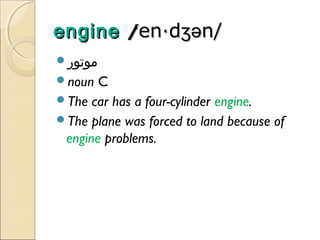
engine /en·dʒən/
'
engine /en·dʒən/
'
engine /en·dʒən/
'
engine /en·dʒən/
'
engine /en·dʒən/
'
engine /en·dʒən/
'
‫موتور‬
engine /en·dʒən/
'
‫موتور‬
noun

C
engine /en·dʒən/
'
‫موتور‬
noun

C
The car has a four-cylinder engine.
engine /en·dʒən/
'
‫موتور‬
noun

C
The car has a four-cylinder engine.
The plane was forced to land because of
engine problems.
engine /en·dʒən/
'
‫موتور‬
noun

C
The car has a four-cylinder engine.
The plane was forced to land because of
engine problems.
He built a steam engine that could work.
enough / ɪ'nʌf/
‫/‪enough / ɪ'nʌf‬‬
‫کافی، به اندازه‬

‫لزم‪‬‬
enough / ɪ'nʌf/
‫لزم‬

‫کافی، به اندازه‬
adjective, adverb, pronoun
enough / ɪ'nʌf/
‫لزم‬

‫کافی، به اندازه‬
adjective, adverb, pronoun
as much as is necessary
enough / ɪ'nʌf/
‫لزم‬

‫کافی، به اندازه‬
adjective, adverb, pronoun
as much as is necessary
Do we have enough tomatoes for a salad?
enough / ɪ'nʌf/
‫لزم‬

‫کافی، به اندازه‬
adjective, adverb, pronoun
as much as is necessary
Do we have enough tomatoes for a salad?
He had enough time to study carefully.
enough / ɪ'nʌf/
‫لزم‬

‫کافی، به اندازه‬
adjective, adverb, pronoun
as much as is necessary
Do we have enough tomatoes for a salad?
He had enough time to study carefully.
Have you had enough to eat?
enough / ɪ'nʌf/
‫لزم‬

‫کافی، به اندازه‬
adjective, adverb, pronoun
as much as is necessary
Do we have enough tomatoes for a salad?
He had enough time to study carefully.
Have you had enough to eat?
He doesn’t have enough money to buy the
car.
Fireplace /'fɑɪr·pleɪs/
‫/‪Fireplace /'fɑɪr·pleɪs‬‬
‫اجاق، شومینه،بخاری‬

‫دیواری‪‬‬
Fireplace /'fɑɪr·pleɪs/
‫دیواری‬

‫اجاق، شومینه،بخاری‬
noun C
Fireplace /'fɑɪr·pleɪs/
‫دیواری‬

‫اجاق، شومینه،بخاری‬
noun C
a space in the wall of a room for
a fire to burn in,
Fireplace /'fɑɪr·pleɪs/
‫دیواری‬

‫اجاق، شومینه،بخاری‬
noun C
a space in the wall of a room for
a fire to burn in,
One day he was sitting near the fireplace
in the kitchen.
good-looking
‫‪good-looking‬‬
‫خوش تیپ ، خوش‬

‫قیافه‪‬‬
good-looking
‫قیافه‬

‫خوش تیپ ، خوش‬
adjective
good-looking
‫قیافه‬

‫خوش تیپ ، خوش‬
adjective
attractive
good-looking
‫قیافه‬

‫خوش تیپ ، خوش‬
adjective
attractive
How does he look like?
good-looking
‫قیافه‬

‫خوش تیپ ، خوش‬
adjective
attractive
How does he look like?
He’s good-looking.
grandmother /'grændmʌð·ər/
/græm·ə, græn·mɑ/
granny /græn·i/

grandma
grandmother /'grændmʌð·ər/
/græm·ə, græn·mɑ/
granny /græn·i/
noun C
grandma
grandmother /'grændmʌð·ər/
/græm·ə, græn·mɑ/
granny /græn·i/
noun C
the mother of a person’s father
or mother
grandma
grandmother /'grændmʌð·ər/
/græm·ə, græn·mɑ/
granny /græn·i/
noun C
the mother of a person’s father
or mother
‫مادربزرگ، بی بی‬
grandma
Hardly / hɑrd·li /
Hardly / hɑrd·li /
‫سختی‬

‫ = به‬Not easily
Hardly / hɑrd·li /
‫سختی‬
Adverb

‫ = به‬Not easily
Hardly / hɑrd·li /
‫سختی‬

‫ = به‬Not easily

Adverb
Something

is wrong with the phone – I can
hardly hear you.
Hardly / hɑrd·li /
‫سختی‬

‫ = به‬Not easily

Adverb
Something

is wrong with the phone – I can
hardly hear you.
I can hardly wait for your visit.
Hardly / hɑrd·li /
‫سختی‬

‫ = به‬Not easily

Adverb
Something

is wrong with the phone – I can
hardly hear you.
I can hardly wait for your visit.
We hardly see them anymore.
Hardly / hɑrd·li /
‫سختی‬

‫ = به‬Not easily

Adverb
Something

is wrong with the phone – I can
hardly hear you.
I can hardly wait for your visit.
We hardly see them anymore.
He was too tired. He could hardly walk.
Hardly / hɑrd·li /
‫سختی‬

‫ = به‬Not easily

Adverb
Something

is wrong with the phone – I can
hardly hear you.
I can hardly wait for your visit.
We hardly see them anymore.
He was too tired. He could hardly walk.
You can hardly see the steam.
Odd

/ɑd/
Odd
‫عجیب‬

/ɑd/
Odd

/ɑd/

‫عجیب‬
adjective

-er/-est
Odd

/ɑd/

‫عجیب‬
adjective

-er/-est
an odd person
Odd

/ɑd/

‫عجیب‬
adjective

-er/-est
an odd person
That’s odd – I thought I left my glasses on
the table but they’re not here.
Odd

/ɑd/

‫عجیب‬
adjective

-er/-est
an odd person
That’s odd – I thought I left my glasses on
the table but they’re not here.
How

odd =
Odd

/ɑd/

‫عجیب‬
adjective

-er/-est
an odd person
That’s odd – I thought I left my glasses on
the table but they’re not here.
How

odd =

‫عجیب‬

‫چقدر‬
Ice / ɑɪs/
Ice / ɑɪs/
Ice / ɑɪs/
Ice / ɑɪs/
Ice / ɑɪs/
‫یخ‬
Ice / ɑɪs/
‫یخ‬
noun

U
Ice / ɑɪs/
‫یخ‬
noun

U
Water changes into ice when it is very
cold.
In front of
‫جلوی‬

‫در‬
They are going to build new houses in front
of our school.
kettle /ket· ə l/
̬
kettle /ket· ə l/
̬
kettle /ket· ə l/
̬
kettle /ket· ə l/
̬
kettle /ket· ə l/
̬
‫کتری‬
kettle /ket· ə l/
̬
‫کتری‬
noun

C
kettle /ket· ə l/
̬
‫کتری‬
noun

C
The kettle was above the fire.
kettle /ket· ə l/
̬
‫کتری‬
noun

C
The kettle was above the fire.
The water in the kettle was boiling.
lid / lɪd/
lid / lɪd/
lid / lɪd/
lid / lɪd/
lid / lɪd/
lid / lɪd/
lid / lɪd/
lid / lɪd/
‫سر‬

، ‫درپوش‬
lid / lɪd/
‫سر‬

، ‫درپوش‬
noun C
lid / lɪd/
‫سر‬

، ‫درپوش‬
noun C
The water could move the heavy lid of
the kettle
Light /lɑɪt/
Light /lɑɪt/
Light /lɑɪt/
‫روشن‬

،‫باز‬
Light /lɑɪt/
‫روشن‬

،‫باز‬
adjective, adverb -er/-est
Light /lɑɪt/
‫روشن‬

،‫باز‬
adjective, adverb -er/-est
(of colors) pale
Light /lɑɪt/
‫روشن‬

،‫باز‬
adjective, adverb -er/-est
(of colors) pale a
light-colored car
Light /lɑɪt/
‫روشن‬

،‫باز‬
adjective, adverb -er/-est
(of colors) pale a
light-colored car
The walls were light green.
Light /lɑɪt/
‫روشن‬

،‫باز‬
adjective, adverb -er/-est
(of colors) pale a
light-colored car
The walls were light green.
Light brown hair
Look for
‫گشتن‬

‫دنبال چیزی‬
‫جستجو کردن‬
He began to look for ways to make
steam move other things .
Man /mæn/
noun

C/U

men
‫انسان‬

، ‫بشر‬
He built the first steam engine that could
really do work for man.
Member /mem·bər/
Member /mem·bər/
‫عضو‬
Member /mem·bər/
‫عضو‬
noun

C
Member /mem·bər/
‫عضو‬
noun

C
a person or thing that is part of a
group
Member /mem·bər/
‫عضو‬
noun

C
a person or thing that is part of a
group
She’s a member of our team.
Member /mem·bər/
‫عضو‬
noun

C
a person or thing that is part of a
group
She’s a member of our team.
The lion is a member of the cat
family.
once more
once more
‫دیگر‬

‫یک بار‬
once more
‫دیگر‬

‫یک بار‬
once again
once more
‫دیگر‬

‫یک بار‬
once again
another time
once more
‫دیگر‬

‫یک بار‬
once again
another time
I’ll explain it once more, but listen this time.
once more
‫دیگر‬

‫یک بار‬
once again
another time
I’ll explain it once more, but listen this time.
He sat in the kitchen once more.
nothing /nʌθ·ɪŋ/
nothing /nʌθ·ɪŋ/
‫چیز‬

‫هیچ‬
nothing /nʌθ·ɪŋ/
‫چیز‬

‫هیچ‬
pronoun
nothing /nʌθ·ɪŋ/
‫چیز‬

‫هیچ‬
pronoun
not anything
nothing /nʌθ·ɪŋ/
‫چیز‬

‫هیچ‬
pronoun
not anything
There’s nothing in the room – I took
everything out.
nothing /nʌθ·ɪŋ/
‫چیز‬

‫هیچ‬
pronoun
not anything
There’s nothing in the room – I took
everything out.
Money means nothing to him (is not
important) .
nothing /nʌθ·ɪŋ/
‫چیز‬

‫هیچ‬
pronoun
not anything
There’s nothing in the room – I took
everything out.
Money means nothing to him (is not
important) .
“What’s in the kettle?” “Nothing, but
water.”
Opposite /'ɑp·ə·zət/
‫مخالف‬

، ‫متضاد‬
Opposite /'ɑp·ə·zət/
‫مخالف‬

، ‫متضاد‬
adjective
Opposite /'ɑp·ə·zət/
‫مخالف‬

، ‫متضاد‬
adjective
completely different
Opposite /'ɑp·ə·zət/
‫مخالف‬

، ‫متضاد‬
adjective
completely different
We turned and walked in the opposite
direction.
Opposite /'ɑp·ə·zət/
‫مخالف‬

، ‫متضاد‬
adjective
completely different
We turned and walked in the opposite
direction.
The opposite of clean is dirty.
Opposite /'ɑp·ə·zət/
‫مخالف‬

، ‫متضاد‬
adjective
completely different
We turned and walked in the opposite
direction.
The opposite of clean is dirty.
Big is the opposite of small.
Other

/'ʌð·ər/
Other
‫دیگری‬

/'ʌð·ər/
Other
‫دیگری‬
Pronoun

/'ʌð·ər/
Other

/'ʌð·ər/

‫دیگری‬
pronoun
the

second of two things or people
Other

/'ʌð·ər/

‫دیگری‬
pronoun
the

second of two things or people
Keep the racket in one hand and the ball
in the other.
Other

/'ʌð·ər/

‫دیگری‬
pronoun
the

second of two things or people
Keep the racket in one hand and the ball
in the other.
I found one of my shoes. Where is the
other one?
really /ri:·li/
really /ri:·li/
‫حقیقتا‬

،‫واقعا‬
really /ri:·li/
‫حقیقتا‬
adverb

،‫واقعا‬
really /ri:·li/
‫حقیقتا‬

،‫واقعا‬

adverb
What

really happened that day?
really /ri:·li/
‫حقیقتا‬

،‫واقعا‬

adverb
What

really happened that day?
I just don’t know if we would really use it
that much.
really /ri:·li/
‫حقیقتا‬

،‫واقعا‬

adverb
What

really happened that day?
I just don’t know if we would really use it
that much.
He built the first steam engine that could
really do work for man.
Rise / rɑɪz/
‫/‪Rise / rɑɪz‬‬
‫بال رفتن، بال‬

‫آمدن‪‬‬
Rise / rɑɪz/
‫آمدن‬
verb

I

‫بال رفتن، بال‬
Rise / rɑɪz/
‫آمدن‬
verb

‫بال رفتن، بال‬

I
rose , risen
Rise / rɑɪz/
‫آمدن‬
verb

‫بال رفتن، بال‬

I
rose , risen
to move up = go up
Rise / rɑɪz/
‫آمدن‬
verb

‫بال رفتن، بال‬

I
rose , risen
to move up = go up
Smoke rose from the fire.
Rise / rɑɪz/
‫آمدن‬
verb

‫بال رفتن، بال‬

I
rose , risen
to move up = go up
Smoke rose from the fire.
Steam rises from hot water.
Rise / rɑɪz/
‫آمدن‬
verb

‫بال رفتن، بال‬

I
rose , risen
to move up = go up
Smoke rose from the fire.
Steam rises from hot water.
The steam rising from water looked like
smoke.
Scotland
Scotland
Scotland
Scotland
A

country in Europe
‫اسکاتلند‬
Seat /si:t/
Seat /si:t/
Seat /si:t/
Seat /si:t/
Seat /si:t/
‫نشستن‬

‫جای‬
Seat /si:t/
‫نشستن‬

‫جای‬
noun C
Seat /si:t/
‫نشستن‬

‫جای‬
noun C
place for someone to sit
Seat /si:t/
‫نشستن‬

‫جای‬
noun C
place for someone to sit
She left her coat on the back of her seat.
Seat /si:t/
‫نشستن‬

‫جای‬
noun C
place for someone to sit
She left her coat on the back of her seat.
I got a seat on the bus to Tehran.
Seat /si:t/
‫نشستن‬

‫جای‬
noun C
place for someone to sit
She left her coat on the back of her seat.
I got a seat on the bus to Tehran.
Please take a seat.
Seat /si:t/
‫نشستن‬

‫جای‬
noun C
place for someone to sit
She left her coat on the back of her seat.
I got a seat on the bus to Tehran.
Please take a seat.
When you are tired you look for a seat to
sit on.
sing / sɪŋ/
‫/‪sing / sɪŋ‬‬
‫آواز خواندن ، سوت‬

‫زدن‪‬‬
‫/‪sing / sɪŋ‬‬
‫زدن‪‬‬

‫آواز خواندن ، سوت‬
‫‪verb I/T‬‬
sing / sɪŋ/
‫زدن‬

‫آواز خواندن ، سوت‬
verb I/T
sang , sung , sung
sing / sɪŋ/
‫آواز خواندن ، سوت زدن‬
verb I/T
sang , sung , sung
She sings really terrible songs
in the shower.

sing / sɪŋ/
‫آواز خواندن ، سوت زدن‬
verb I/T
sang , sung , sung
She sings really terrible songs
in the shower.
In the morning, the birds began
to sing.

Smoke / smoʊk/
Smoke / smoʊk/
Smoke / smoʊk/
Smoke / smoʊk/
Smoke / smoʊk/
‫دود‬
noun

U
So many
‫زیاد‬

‫خیلی‬
He asked so many questions.
Some more
‫بیشتر‬

‫قدری‬
He watched the kettle some more.
I need some more money to buy the car.
steam / sti:m/
steam / sti:m/
steam / sti:m/
steam / sti:m/
steam / sti:m/
steam / sti:m/
‫بخار‬
steam / sti:m/
‫بخار‬
noun

U
steam / sti:m/
‫بخار‬
noun

U
a steam engine
steam / sti:m/
‫بخار‬
noun

U
a steam engine
You can hardly see the steam but it can
move the heavy lid of the kettle.
steam / sti:m/
‫بخار‬
noun

U
a steam engine
You can hardly see the steam but it can
move the heavy lid of the kettle.
Steam rises from hot water.
Steam engine
Steam engine
Steam engine
Steam engine
‫بخار‬

‫موتور‬
Succeed /sək'si:d/
Succeed /sək'si:d/
‫شدن‬

‫موفق‬
Succeed /sək'si:d/
‫شدن‬
verb

I

‫موفق‬
Succeed /sək'si:d/
‫شدن‬
verb

‫موفق‬

I
She tried to pass her driving test for years
and she finally succeeded.
Succeed /sək'si:d/
‫شدن‬
verb

‫موفق‬

I
She tried to pass her driving test for years
and she finally succeeded.
He succeeded in building the new house.
Succeed /sək'si:d/
‫شدن‬
verb

‫موفق‬

I
She tried to pass her driving test for years
and she finally succeeded.
He succeeded in building the new house.
James Watt succeeded in building the first
steam engine.
team / ti:m/
team / ti:m/
team / ti:m/
team / ti:m/
team / ti:m/
‫تیم،گروه‬
team / ti:m/
‫تیم،گروه‬
noun

C
team / ti:m/
‫تیم،گروه‬
noun

C
a number of people who act together as
a group,
team / ti:m/
‫تیم،گروه‬
noun

C
a number of people who act together as
a group,
Baseball / basketball / football team
team / ti:m/
‫تیم،گروه‬
noun

C
a number of people who act together as
a group,
Baseball / basketball / football team
the legal / medical team
team / ti:m/
‫تیم،گروه‬
noun

C
a number of people who act together as
a group,
Baseball / basketball / football team
the legal / medical team
My favorite team is the Barcelona.
Turn / tɜrn/
‫/‪Turn / tɜrn‬‬
‫چرخیدن ،تبدیل‬

‫شدن‪‬‬
Turn / tɜrn/
‫شدن‬

‫چرخیدن ،تبدیل‬
verb I/T
Turn / tɜrn/
‫شدن‬

‫چرخیدن ،تبدیل‬
verb I/T
The earth turns on its axis once every 24
hours.
Turn / tɜrn/
‫شدن‬

‫چرخیدن ،تبدیل‬
verb I/T
The earth turns on its axis once every 24
hours.
She turned the doorknob and opened the
door.
Turn / tɜrn/
‫شدن‬

‫چرخیدن ،تبدیل‬
verb I/T
The earth turns on its axis once every 24
hours.
She turned the doorknob and opened the
door.
Water turns to ice when it is very cold
and it turns into steam when it boils.
wagon /wæg·ən/
wagon /wæg·ən/
wagon /wæg·ən/
wagon /wæg·ən/
wagon /wæg·ən/
wagon /wæg·ən/
wagon /wæg·ən/
‫واگن‬
noun

C
He built a steam engine that could move
things like boats and wagons.
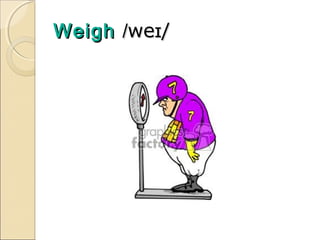
Weigh /weɪ/
Weigh /weɪ/
Weigh /weɪ/
Weigh /weɪ/
Weigh /weɪ/
Weigh /weɪ/
‫داشتن‬

‫وزن‬
Weigh /weɪ/
‫داشتن‬
verb

‫وزن‬
Weigh /weɪ/
‫داشتن‬

‫وزن‬

verb
The

baby weighed 3 kilos at birth.
Weigh /weɪ/
‫داشتن‬

‫وزن‬

verb
The

baby weighed 3 kilos at birth.
 This table weighs a lot.
Weigh /weɪ/
‫داشتن‬

‫وزن‬

verb
The

baby weighed 3 kilos at birth.
 This table weighs a lot.
She weighs herself every morning.
Weigh /weɪ/
‫داشتن‬

‫وزن‬

verb
The

baby weighed 3 kilos at birth.
 This table weighs a lot.
She weighs herself every morning.
“how much do you weigh?” “ I weigh about
60 kilos.”
Weigh /weɪ/
‫داشتن‬

‫وزن‬

verb
The

baby weighed 3 kilos at birth.
 This table weighs a lot.
She weighs herself every morning.
“how much do you weigh?” “ I weigh about
60 kilos.”
Weight /weɪt/= ‫وزن‬
Weigh /weɪ/
‫داشتن‬

‫وزن‬

verb
The

baby weighed 3 kilos at birth.
 This table weighs a lot.
She weighs herself every morning.
“how much do you weigh?” “ I weigh about
60 kilos.”
Weight /weɪt/= ‫وزن‬
Way /weɪ/
Way /weɪ/
Way /weɪ/
Way /weɪ/
Way /weɪ/
‫روش‬

، ‫راه‬
Way /weɪ/
‫روش‬

، ‫راه‬
noun C
Way /weɪ/
‫روش‬

، ‫راه‬
noun C
Do you know the way to the train station?
Way /weɪ/
‫روش‬

، ‫راه‬
noun C
Do you know the way to the train station?
He looked for ways to make steam move
other things.
Make / meɪk/
‫/‪Make / meɪk‬‬
‫باعث شدن، وادار‬

‫کردن‪‬‬
‫/‪Make / meɪk‬‬
‫کردن‪‬‬

‫باعث شدن، وادار‬
‫‪verb T‬‬
Make / meɪk/
‫کردن‬

‫باعث شدن، وادار‬
verb T
 past made
Make / meɪk/
‫کردن‬

‫باعث شدن، وادار‬
verb T
 past made
James Watt is a man who made steam
work for man.
Make / meɪk/
‫کردن‬

‫باعث شدن، وادار‬
verb T
 past made
James Watt is a man who made steam
work for man.
He looked for ways to make steam move
other things.
Make / meɪk/
‫کردن‬

‫باعث شدن، وادار‬
verb T
 past made
James Watt is a man who made steam
work for man.
He looked for ways to make steam move
other things.
Things that make us laugh are funny
things.
Move /mu:v/
Move /mu:v/
Move /mu:v/
Move /mu:v/
‫/‪Move /mu:v‬‬
‫حرکت دادن ، جابجا‬

‫کردن‪‬‬
‫/‪Move /mu:v‬‬
‫کردن‪‬‬

‫حرکت دادن ، جابجا‬
‫‪verb I/T‬‬
Move /mu:v/
‫کردن‬

‫حرکت دادن ، جابجا‬
verb I/T
to change the place
Move /mu:v/
‫کردن‬

‫حرکت دادن ، جابجا‬
verb I/T
to change the place
"Can you move your fingers?" the doctor
asked.
Move /mu:v/
‫کردن‬

‫حرکت دادن ، جابجا‬
verb I/T
to change the place
"Can you move your fingers?" the doctor
asked.
She could see the lid moving.
Move /mu:v/
‫کردن‬

‫حرکت دادن ، جابجا‬
verb I/T
to change the place
"Can you move your fingers?" the doctor
asked.
She could see the lid moving.
He looked for ways to make steam move
other things.
Good

luck

Eb1vocless6