Indirect Speech
‫‪Indirect Speech‬‬
‫نقل قول غیر مستقیم‬
‫یاد آوری‬
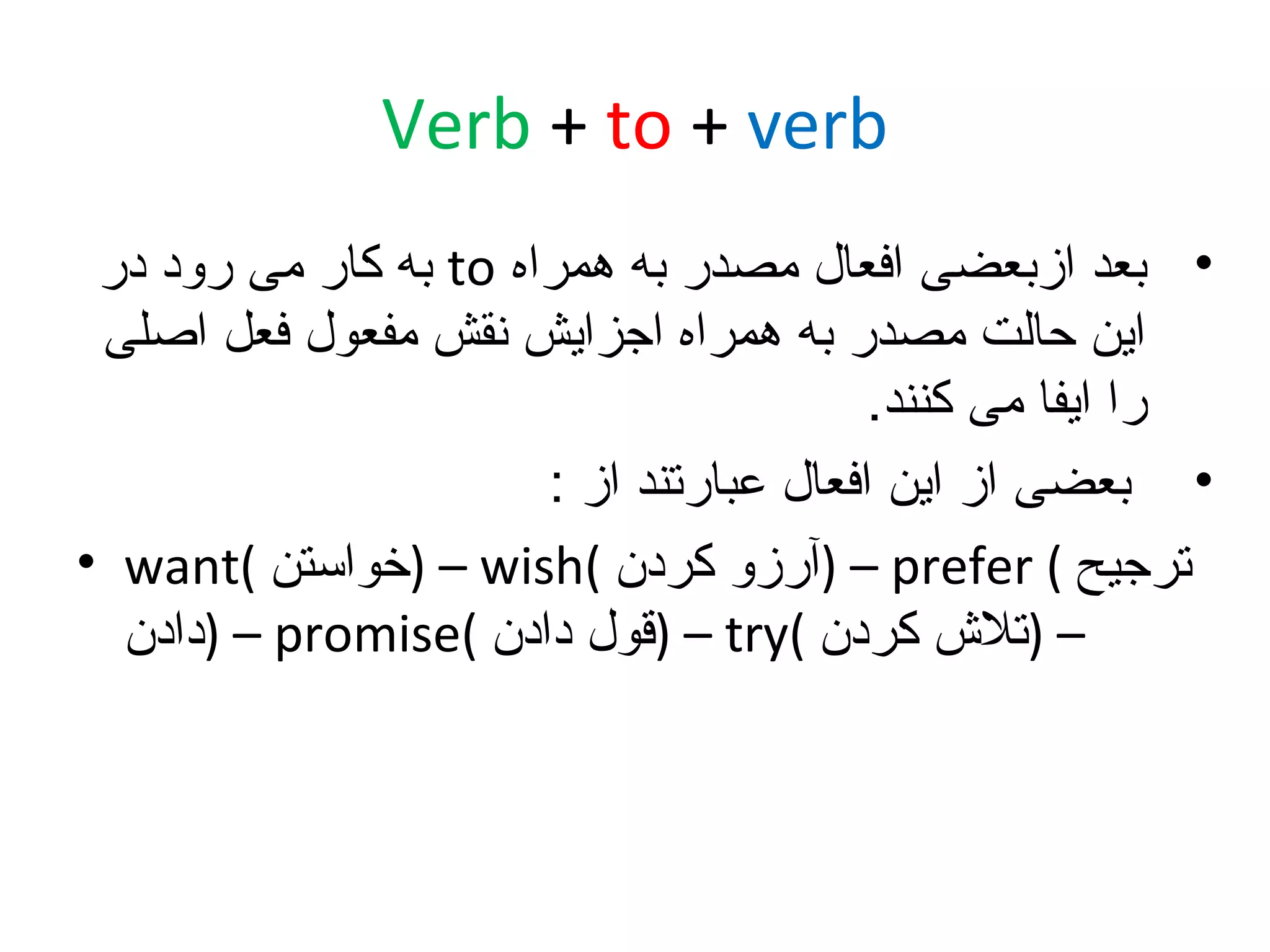
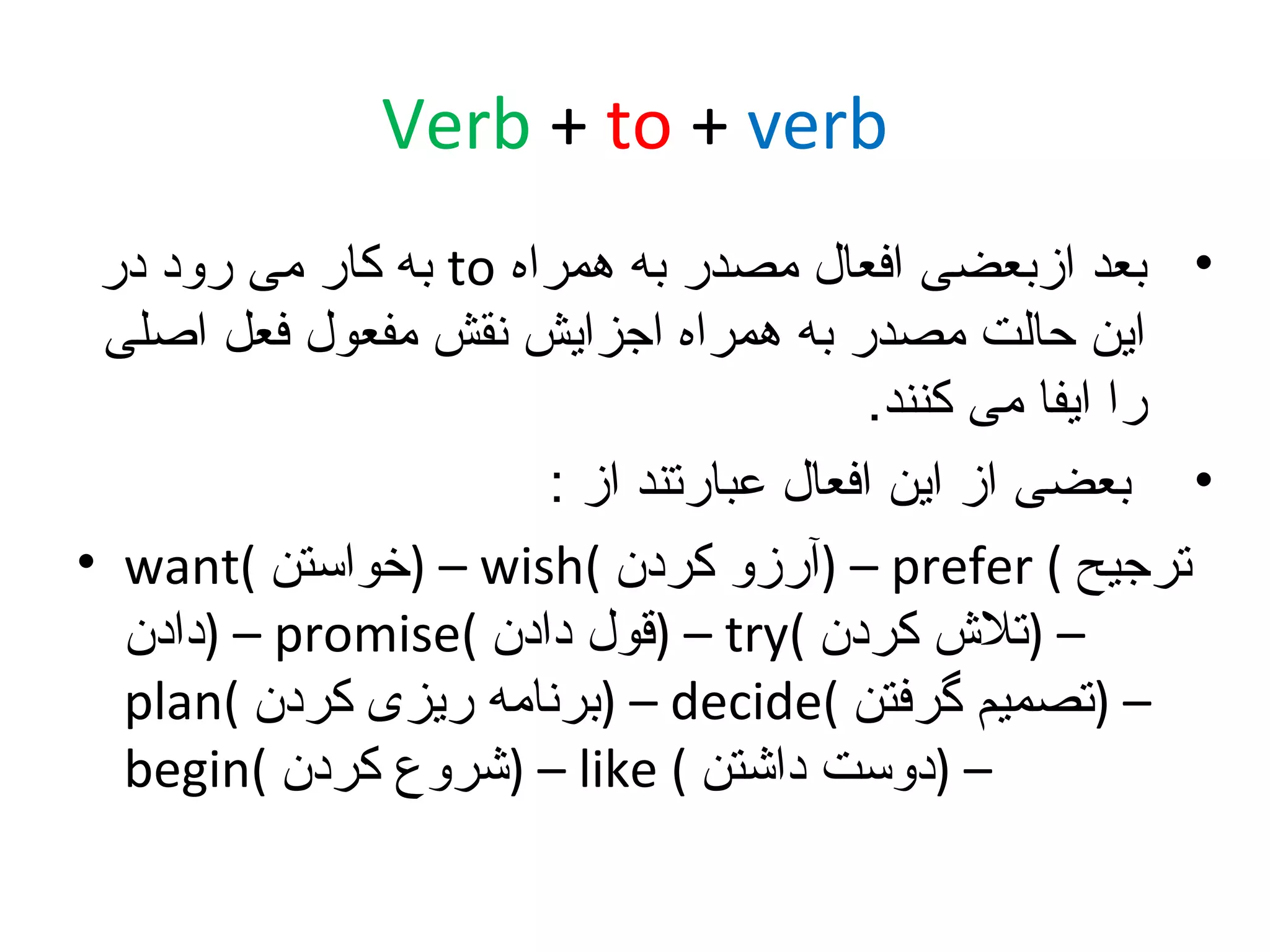
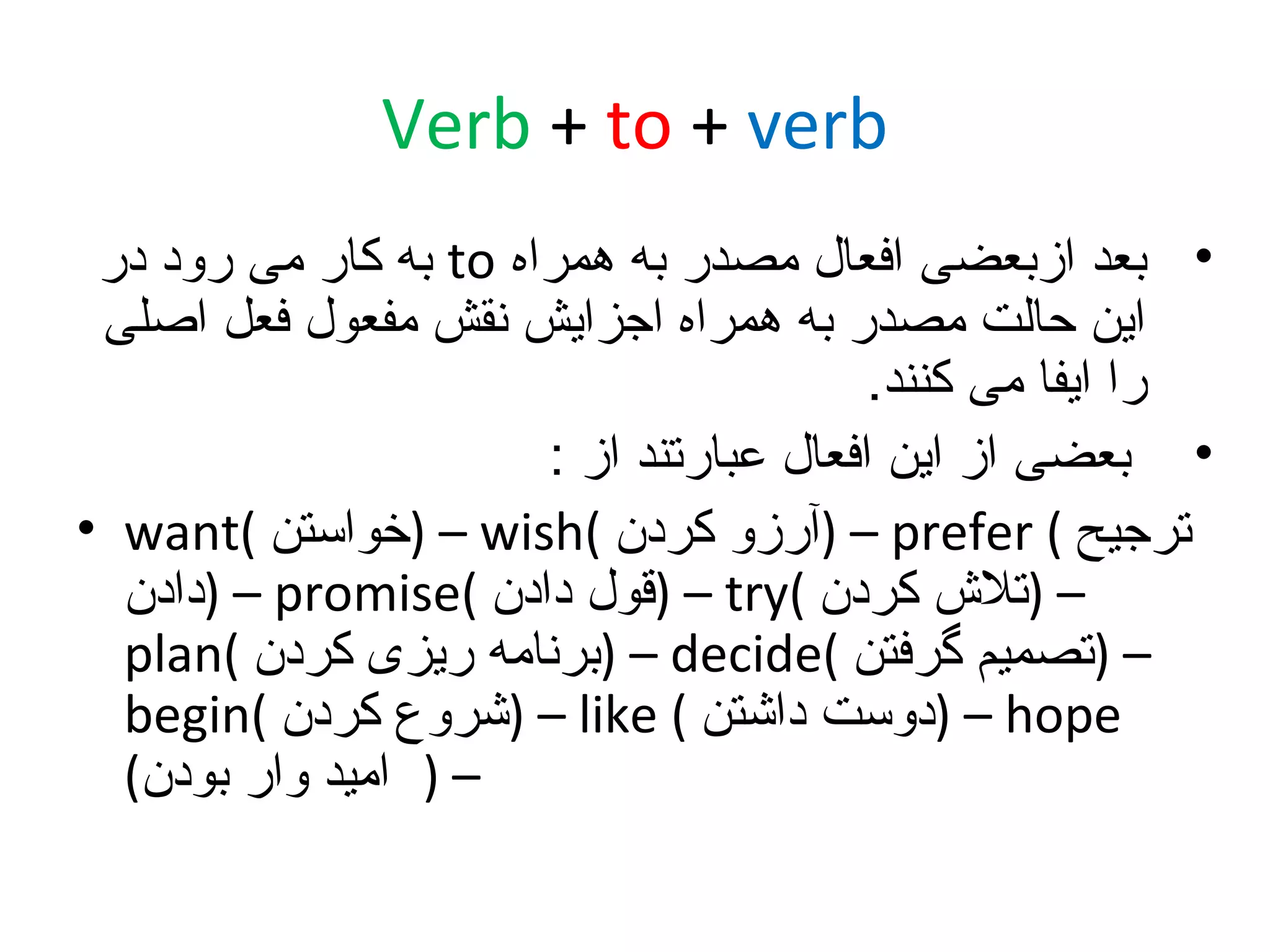
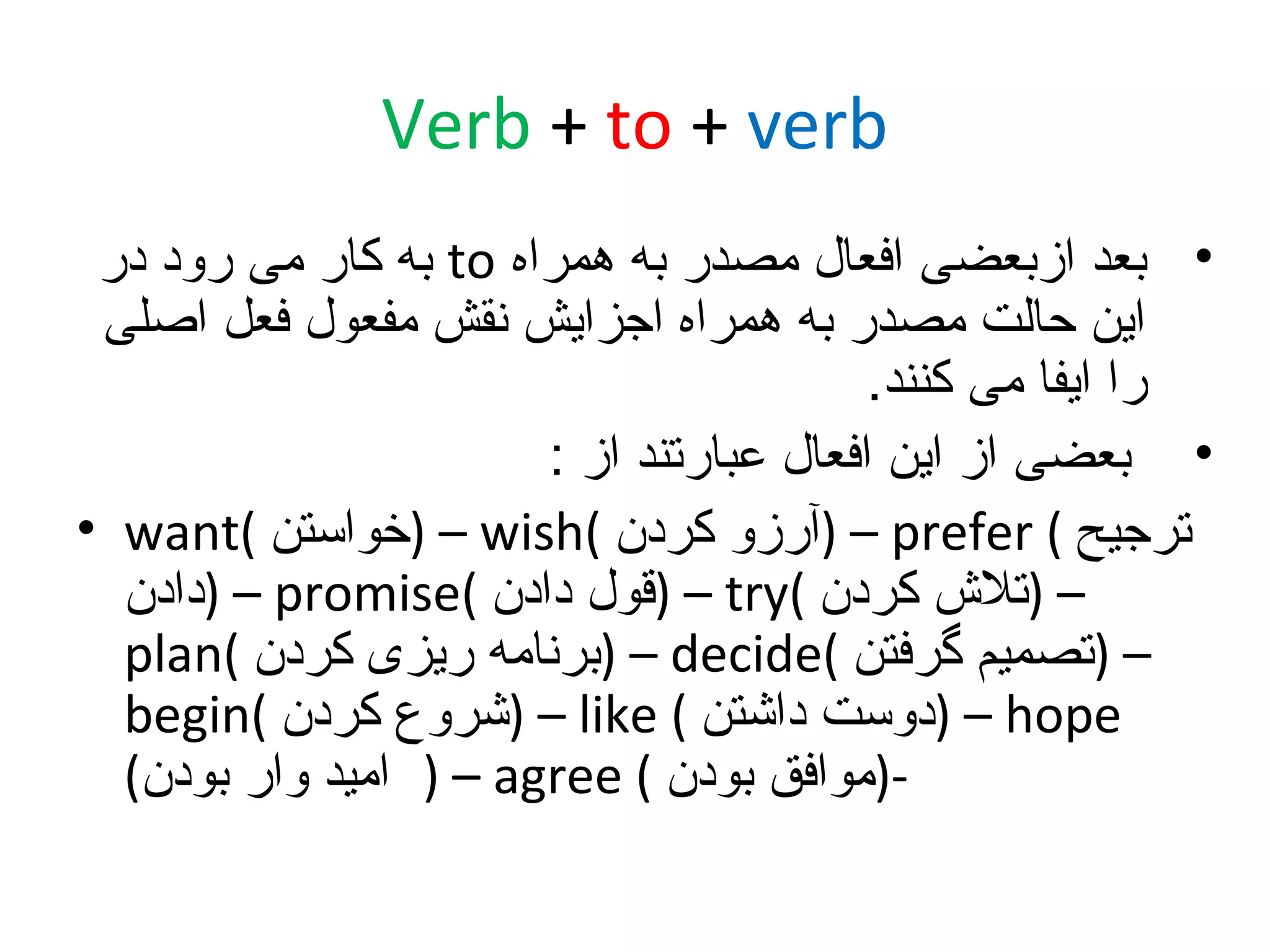
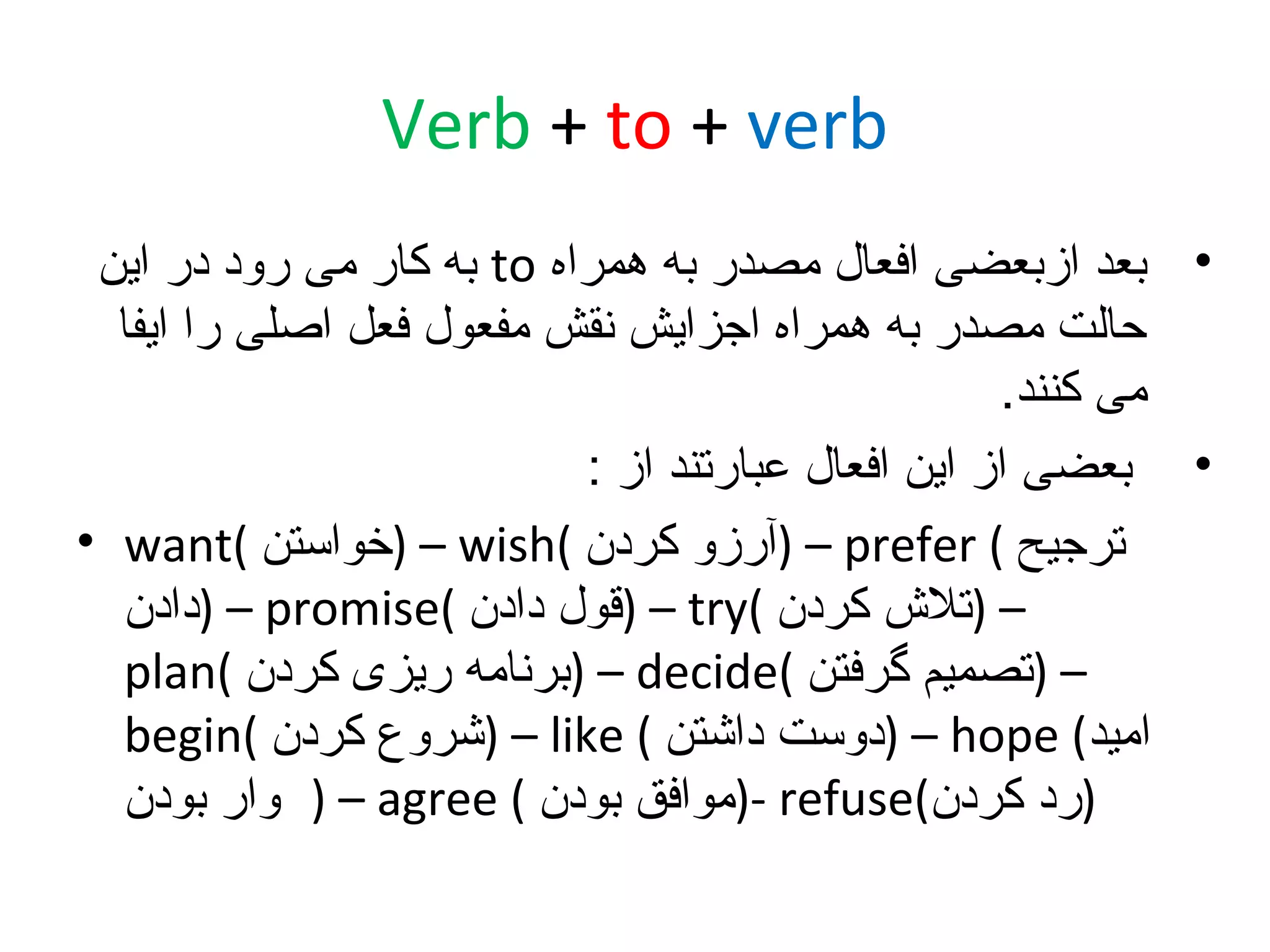
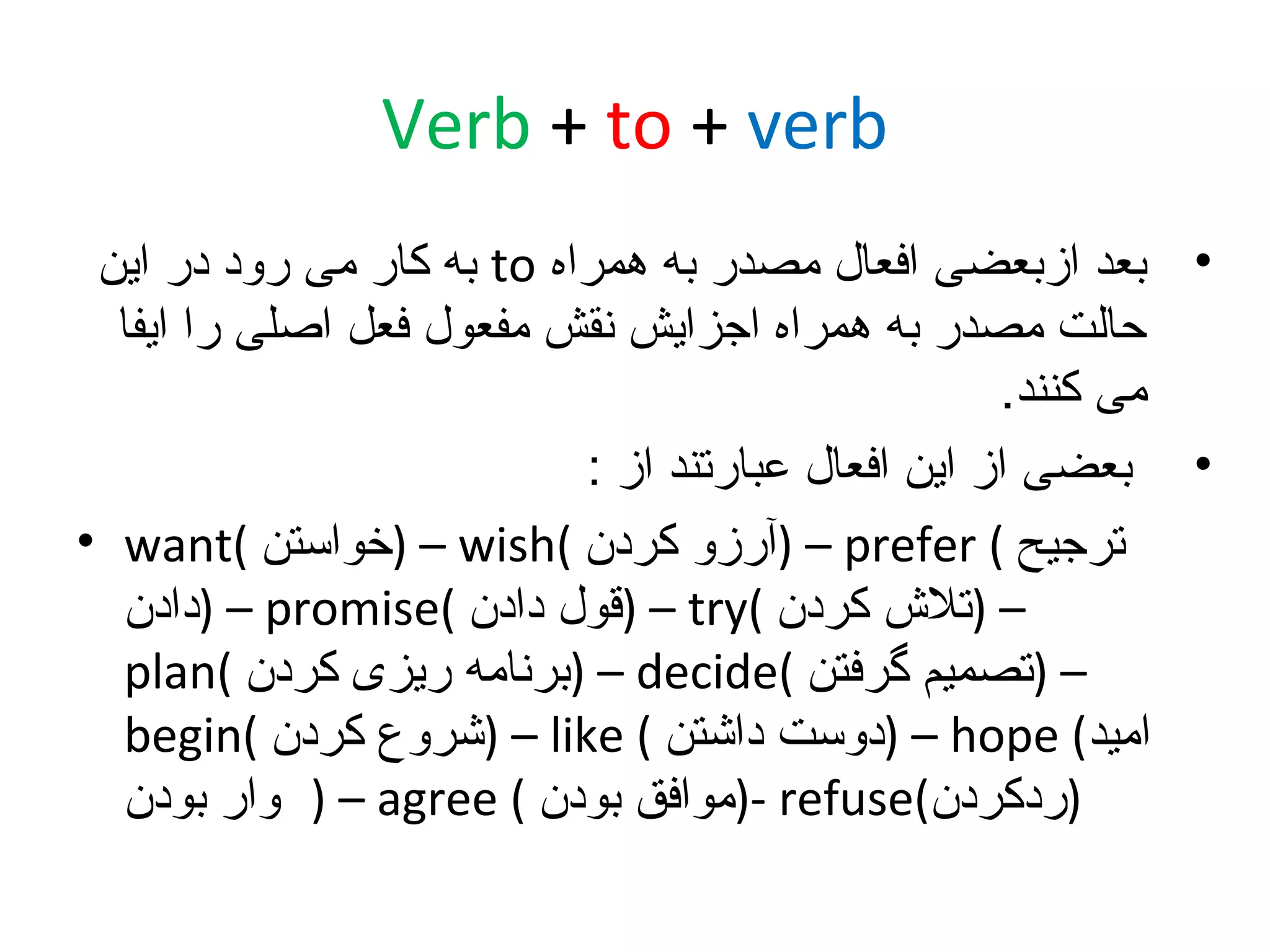
‫‪Verb + to + verb‬‬
‫• بعد ازبعضی افعال مصدر به همراه ‪ to‬به کار می رود در‬
‫این حالت مصدر به همراه اجزایش نقش مفعول فعل اصلی‬
‫را ایفا می کنند.‬
‫• بعضی از این افعال عبارتند از :‬
‫– )خواستن (‪• want‬‬
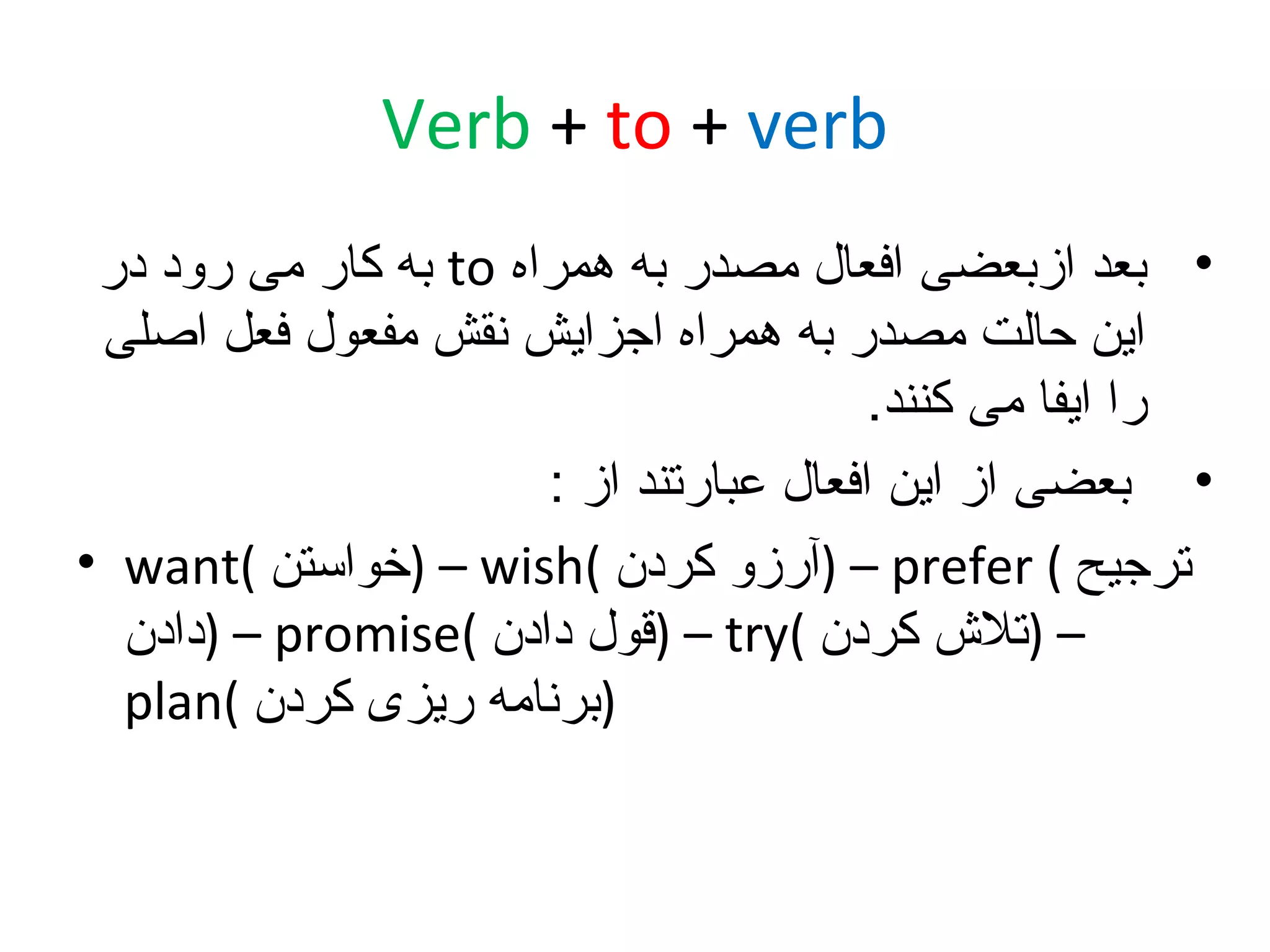
‫‪Verb + to + verb‬‬
‫• بعد ازبعضی افعال مصدر به همراه ‪ to‬به کار می رود در‬
‫این حالت مصدر به همراه اجزایش نقش مفعول فعل اصلی‬
‫را ایفا می کنند.‬
‫• بعضی از این افعال عبارتند از :‬
‫– )آرزو کردن (‪) – wish‬خواستن (‪• want‬‬
‫‪Verb + to + verb‬‬
‫• بعد ازبعضی افعال مصدر به همراه ‪ to‬به کار می رود در‬
‫این حالت مصدر به همراه اجزایش نقش مفعول فعل اصلی‬
‫را ایفا می کنند.‬
‫• بعضی از این افعال عبارتند از :‬
‫ترجیح ( ‪) – prefer‬آرزو کردن (‪) – wish‬خواستن (‪• want‬‬
‫– )دادن‬
‫‪Verb + to + verb‬‬
‫• بعد ازبعضی افعال مصدر به همراه ‪ to‬به کار می رود در‬
‫این حالت مصدر به همراه اجزایش نقش مفعول فعل اصلی‬
‫را ایفا می کنند.‬
‫• بعضی از این افعال عبارتند از :‬
‫ترجیح ( ‪) – prefer‬آرزو کردن (‪) – wish‬خواستن (‪• want‬‬
‫– )قول دادن (‪) – promise‬دادن‬
‫‪Verb + to + verb‬‬
‫• بعد ازبعضی افعال مصدر به همراه ‪ to‬به کار می رود در‬
‫این حالت مصدر به همراه اجزایش نقش مفعول فعل اصلی‬
‫را ایفا می کنند.‬
‫• بعضی از این افعال عبارتند از :‬
‫ترجیح ( ‪) – prefer‬آرزو کردن (‪) – wish‬خواستن (‪• want‬‬
‫– )تل ش کردن (‪) – try‬قول دادن (‪) – promise‬دادن‬
‫‪Verb + to + verb‬‬
‫• بعد ازبعضی افعال مصدر به همراه ‪ to‬به کار می رود در‬
‫این حالت مصدر به همراه اجزایش نقش مفعول فعل اصلی‬
‫را ایفا می کنند.‬
‫• بعضی از این افعال عبارتند از :‬
‫ترجیح ( ‪) – prefer‬آرزو کردن (‪) – wish‬خواستن (‪• want‬‬
‫– )تل ش کردن (‪) – try‬قول دادن (‪) – promise‬دادن‬
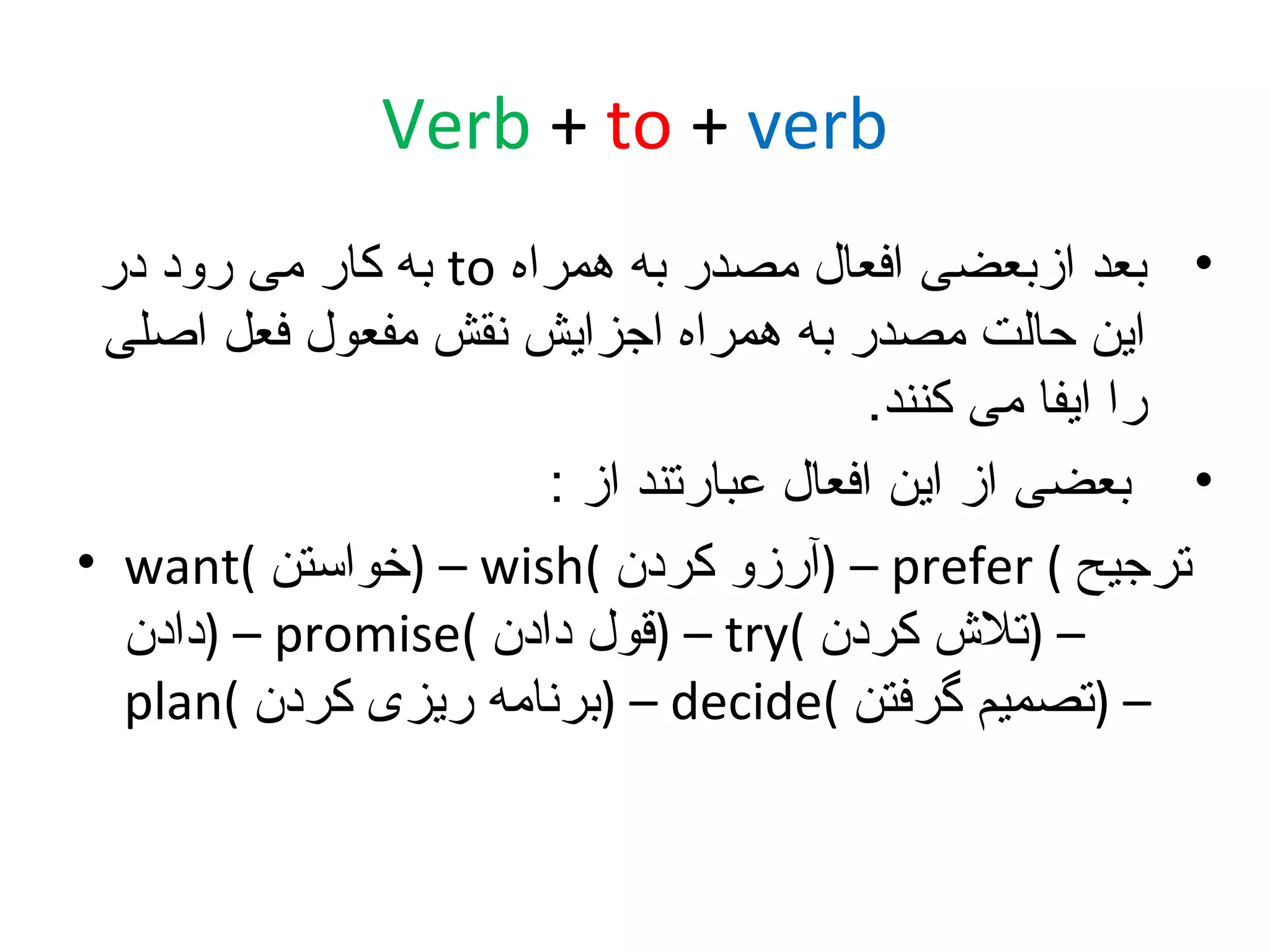
‫)برنامه ریزی کردن (‪plan‬‬
‫‪Verb + to + verb‬‬
‫• بعد ازبعضی افعال مصدر به همراه ‪ to‬به کار می رود در‬
‫این حالت مصدر به همراه اجزایش نقش مفعول فعل اصلی‬
‫را ایفا می کنند.‬
‫• بعضی از این افعال عبارتند از :‬
‫ترجیح ( ‪) – prefer‬آرزو کردن (‪) – wish‬خواستن (‪• want‬‬
‫– )تل ش کردن (‪) – try‬قول دادن (‪) – promise‬دادن‬
‫– )تصمیم گرفتن (‪) – decide‬برنامه ریزی کردن (‪plan‬‬
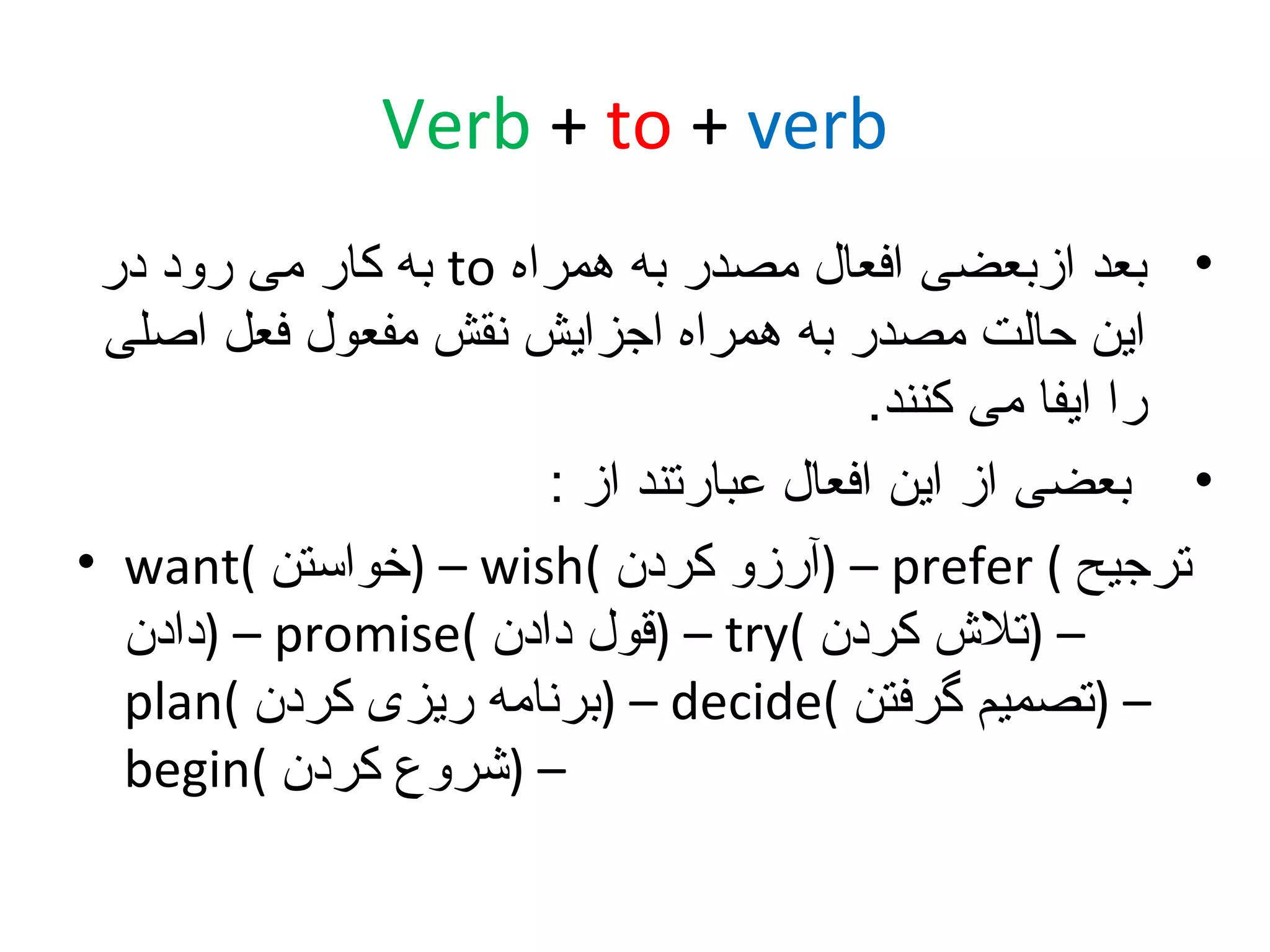
‫‪Verb + to + verb‬‬
‫• بعد ازبعضی افعال مصدر به همراه ‪ to‬به کار می رود در‬
‫این حالت مصدر به همراه اجزایش نقش مفعول فعل اصلی‬
‫را ایفا می کنند.‬
‫• بعضی از این افعال عبارتند از :‬
‫ترجیح ( ‪) – prefer‬آرزو کردن (‪) – wish‬خواستن (‪• want‬‬
‫– )تل ش کردن (‪) – try‬قول دادن (‪) – promise‬دادن‬
‫– )تصمیم گرفتن (‪) – decide‬برنامه ریزی کردن (‪plan‬‬
‫– )شروع کردن (‪begin‬‬
‫‪Verb + to + verb‬‬
‫• بعد ازبعضی افعال مصدر به همراه ‪ to‬به کار می رود در‬
‫این حالت مصدر به همراه اجزایش نقش مفعول فعل اصلی‬
‫را ایفا می کنند.‬
‫• بعضی از این افعال عبارتند از :‬
‫ترجیح ( ‪) – prefer‬آرزو کردن (‪) – wish‬خواستن (‪• want‬‬
‫– )تل ش کردن (‪) – try‬قول دادن (‪) – promise‬دادن‬
‫– )تصمیم گرفتن (‪) – decide‬برنامه ریزی کردن (‪plan‬‬
‫– )دوست داشتن ( ‪) – like‬شروع کردن (‪begin‬‬
‫‪Verb + to + verb‬‬
‫• بعد ازبعضی افعال مصدر به همراه ‪ to‬به کار می رود در‬
‫این حالت مصدر به همراه اجزایش نقش مفعول فعل اصلی‬
‫را ایفا می کنند.‬
‫• بعضی از این افعال عبارتند از :‬
‫ترجیح ( ‪) – prefer‬آرزو کردن (‪) – wish‬خواستن (‪• want‬‬
‫– )تل ش کردن (‪) – try‬قول دادن (‪) – promise‬دادن‬
‫– )تصمیم گرفتن (‪) – decide‬برنامه ریزی کردن (‪plan‬‬
‫‪) – hope‬دوست داشتن ( ‪) – like‬شروع کردن (‪begin‬‬
‫– ) امید وار بودن(‬
‫‪Verb + to + verb‬‬
‫• بعد ازبعضی افعال مصدر به همراه ‪ to‬به کار می رود در‬
‫این حالت مصدر به همراه اجزایش نقش مفعول فعل اصلی‬
‫را ایفا می کنند.‬
‫• بعضی از این افعال عبارتند از :‬
‫ترجیح ( ‪) – prefer‬آرزو کردن (‪) – wish‬خواستن (‪• want‬‬
‫– )تل ش کردن (‪) – try‬قول دادن (‪) – promise‬دادن‬
‫– )تصمیم گرفتن (‪) – decide‬برنامه ریزی کردن (‪plan‬‬
‫‪) – hope‬دوست داشتن ( ‪) – like‬شروع کردن (‪begin‬‬
‫-)موافق بودن ( ‪ ) – agree‬امید وار بودن(‬
‫‪Verb + to + verb‬‬
‫• بعد ازبعضی افعال مصدر به همراه ‪ to‬به کار می رود در این‬
‫حالت مصدر به همراه اجزایش نقش مفعول فعل اصلی را ایفا‬
‫می کنند.‬
‫• بعضی از این افعال عبارتند از :‬
‫ترجیح ( ‪) – prefer‬آرزو کردن (‪) – wish‬خواستن (‪• want‬‬
‫– )تل ش کردن (‪) – try‬قول دادن (‪) – promise‬دادن‬
‫– )تصمیم گرفتن (‪) – decide‬برنامه ریزی کردن (‪plan‬‬
‫امید( ‪) – hope‬دوست داشتن ( ‪) – like‬شروع کردن (‪begin‬‬
‫)رد کردن(‪)- refuse‬موافق بودن ( ‪ ) – agree‬وار بودن‬
‫‪Verb + to + verb‬‬
‫• بعد ازبعضی افعال مصدر به همراه ‪ to‬به کار می رود در این‬
‫حالت مصدر به همراه اجزایش نقش مفعول فعل اصلی را ایفا‬
‫می کنند.‬
‫• بعضی از این افعال عبارتند از :‬
‫ترجیح ( ‪) – prefer‬آرزو کردن (‪) – wish‬خواستن (‪• want‬‬
‫– )تل ش کردن (‪) – try‬قول دادن (‪) – promise‬دادن‬
‫– )تصمیم گرفتن (‪) – decide‬برنامه ریزی کردن (‪plan‬‬
‫امید( ‪) – hope‬دوست داشتن ( ‪) – like‬شروع کردن (‪begin‬‬
‫)ردکردن(‪)- refuse‬موافق بودن ( ‪ ) – agree‬وار بودن‬
‫‪Verb + to + verb‬‬
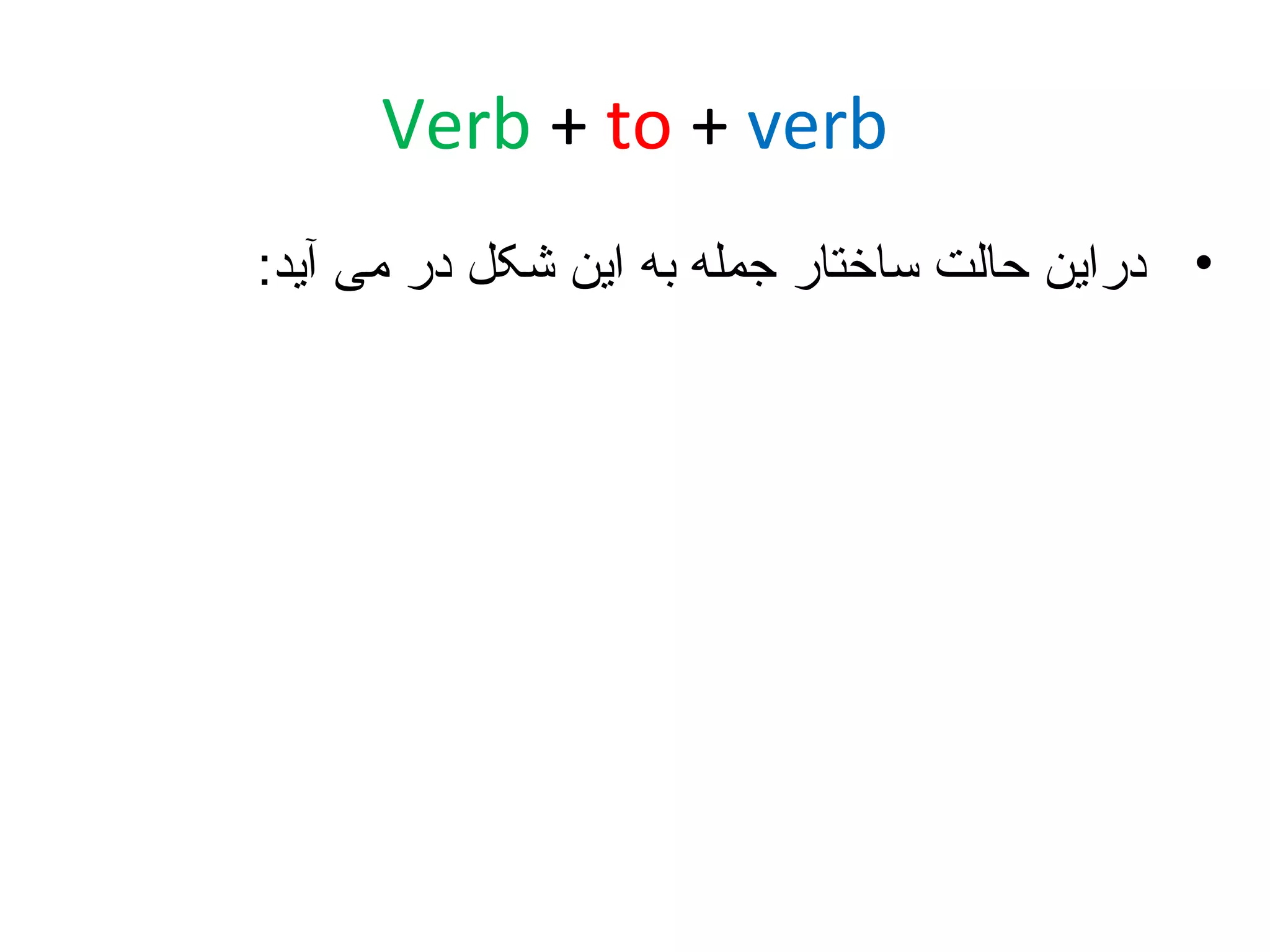
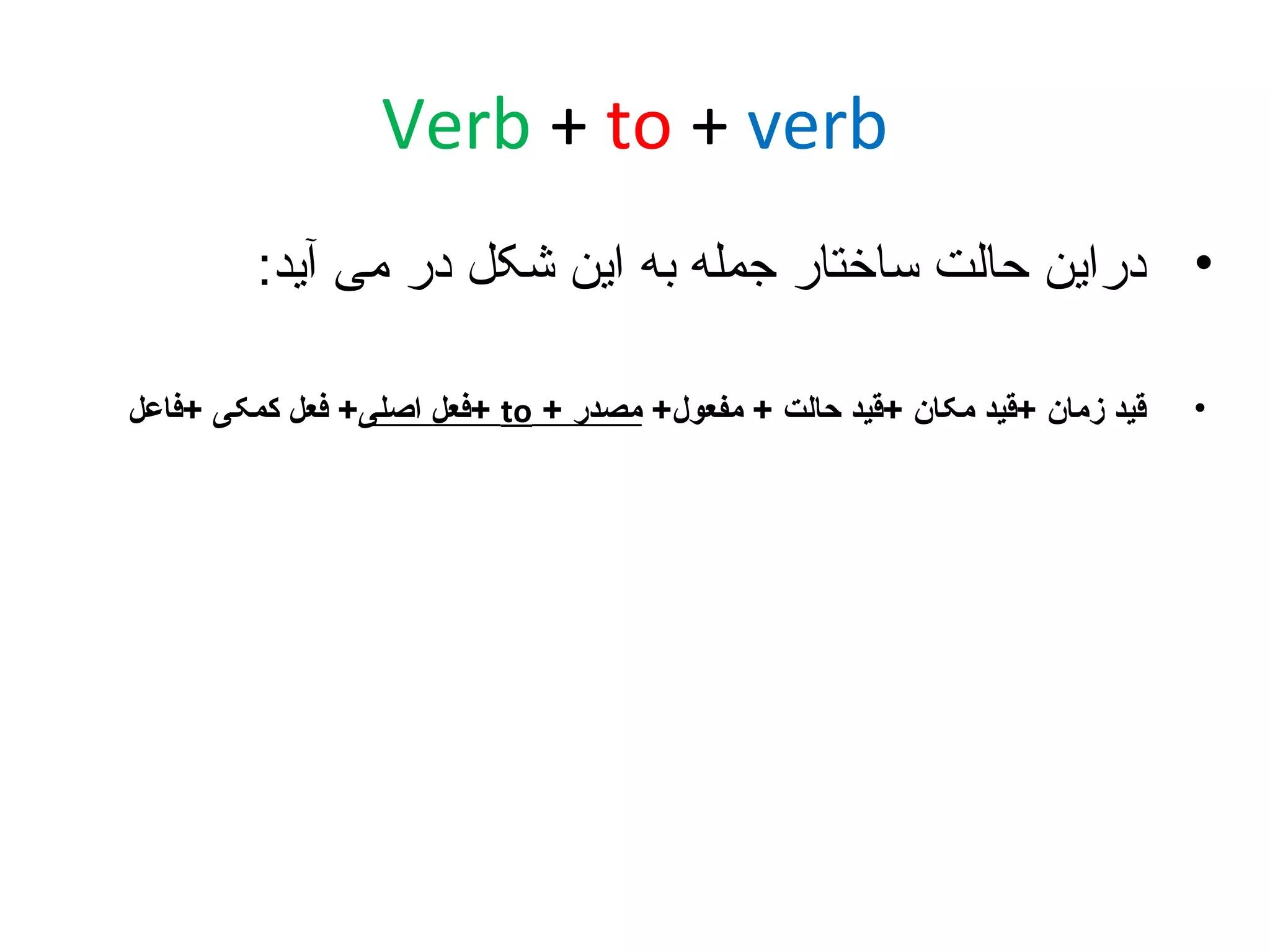
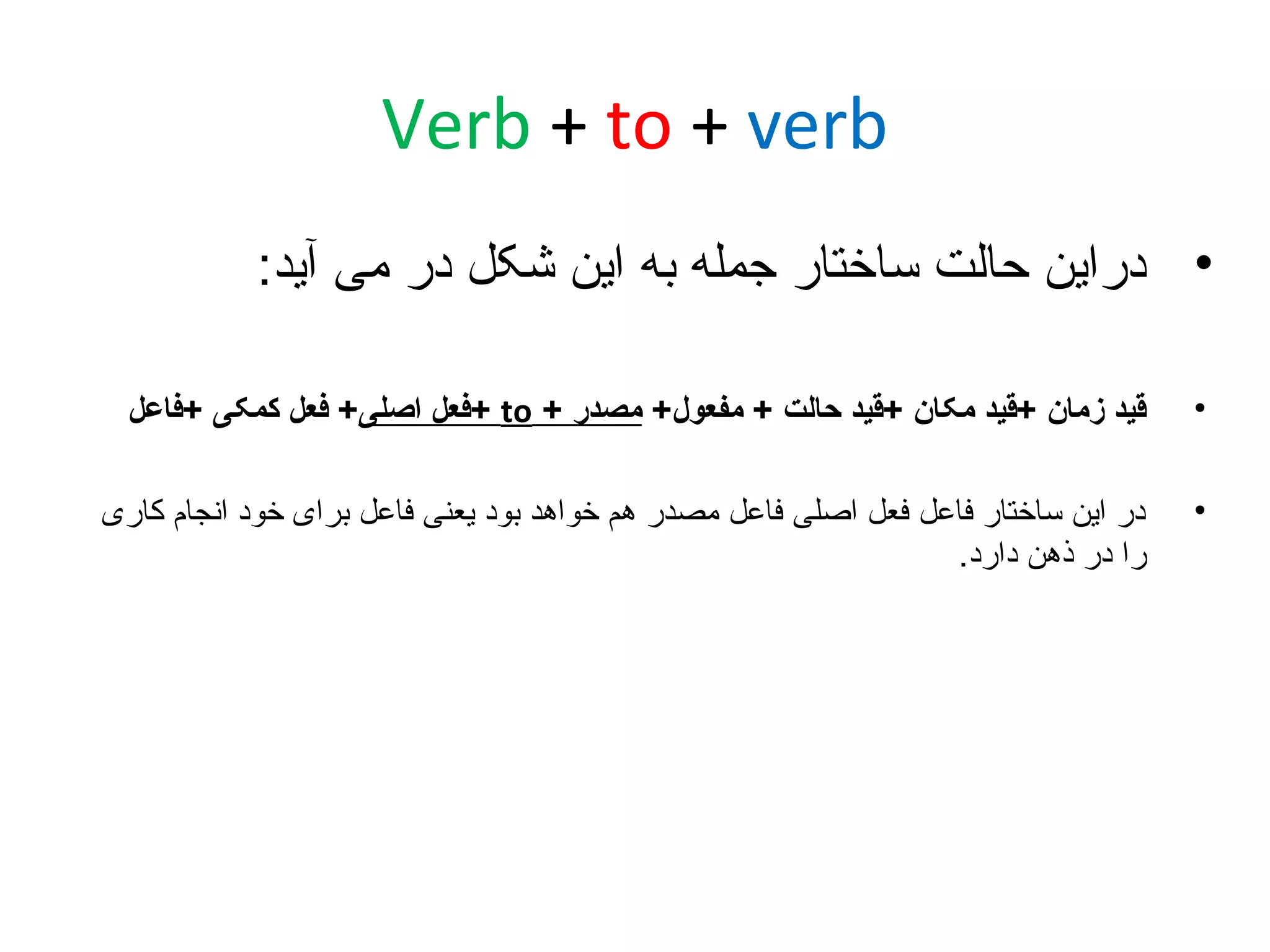
‫• دراین حالت ساختار جمله به این شکل در می آید:‬
‫‪Verb + to + verb‬‬
‫• دراین حالت ساختار جمله به این شکل در می آید:‬
‫•‬

‫قید زمان +قید مکان +قید حالت + مفعول+ مصدر + ‪+ to‬فعل اصلی+ فعل کمکی +فاعل‬
‫‪Verb + to + verb‬‬
‫• دراین حالت ساختار جمله به این شکل در می آید:‬
‫•‬

‫قید زمان +قید مکان +قید حالت + مفعول+ مصدر + ‪+ to‬فعل اصلی+ فعل کمکی +فاعل‬

‫•‬

‫در این ساختار فاعل فعل اصلی فاعل مصدر هم خواهد بود یعنی فاعل برای خود انجام کاری‬
‫را در ذهن دارد.‬
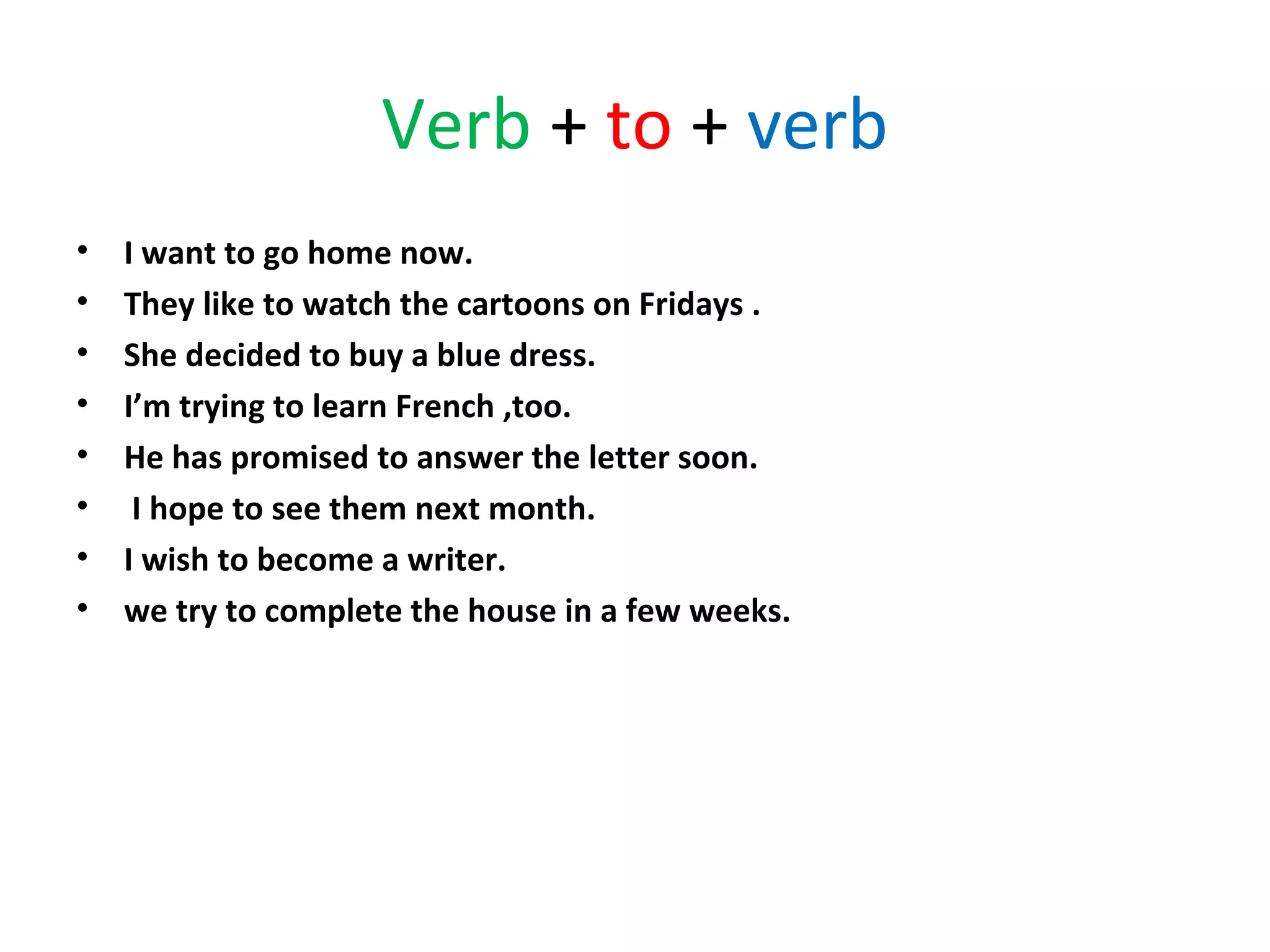
Verb + to + verb
•
•
•
•
•
•
•
•

I want to go home now.
They like to watch the cartoons on Fridays .
She decided to buy a blue dress.
I’m trying to learn French ,too.
He has promised to answer the letter soon.
I hope to see them next month.
I wish to become a writer.
we try to complete the house in a few weeks.
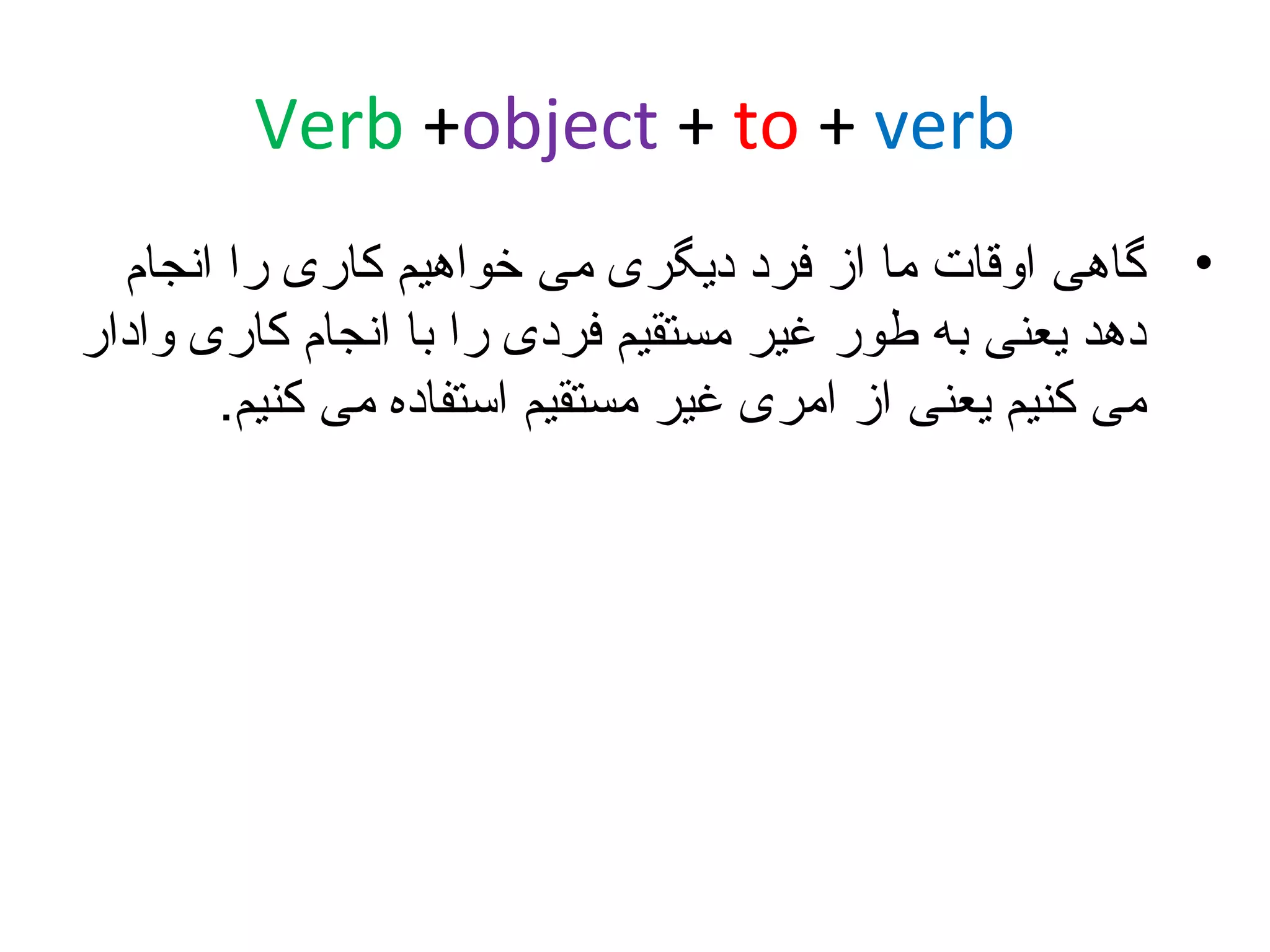
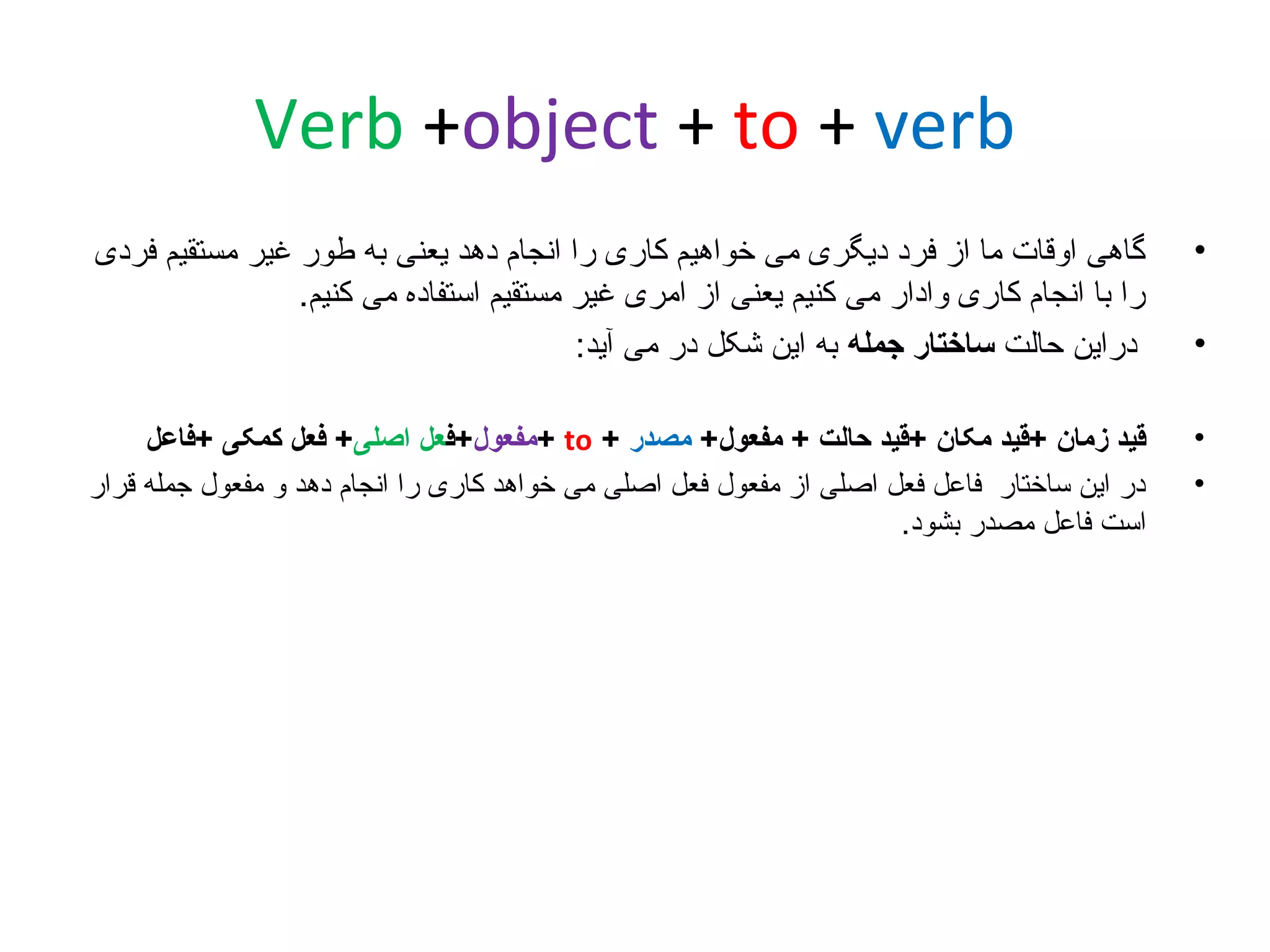
‫‪Verb +object + to + verb‬‬
‫• گاهی اوقات ما از فرد دیگری می خواهیم کاری را انجام‬
‫دهد یعنی به طور غیر مستقیم فردی را با انجام کاری وادار‬
‫می کنیم یعنی از امری غیر مستقیم استفاده می کنیم.‬
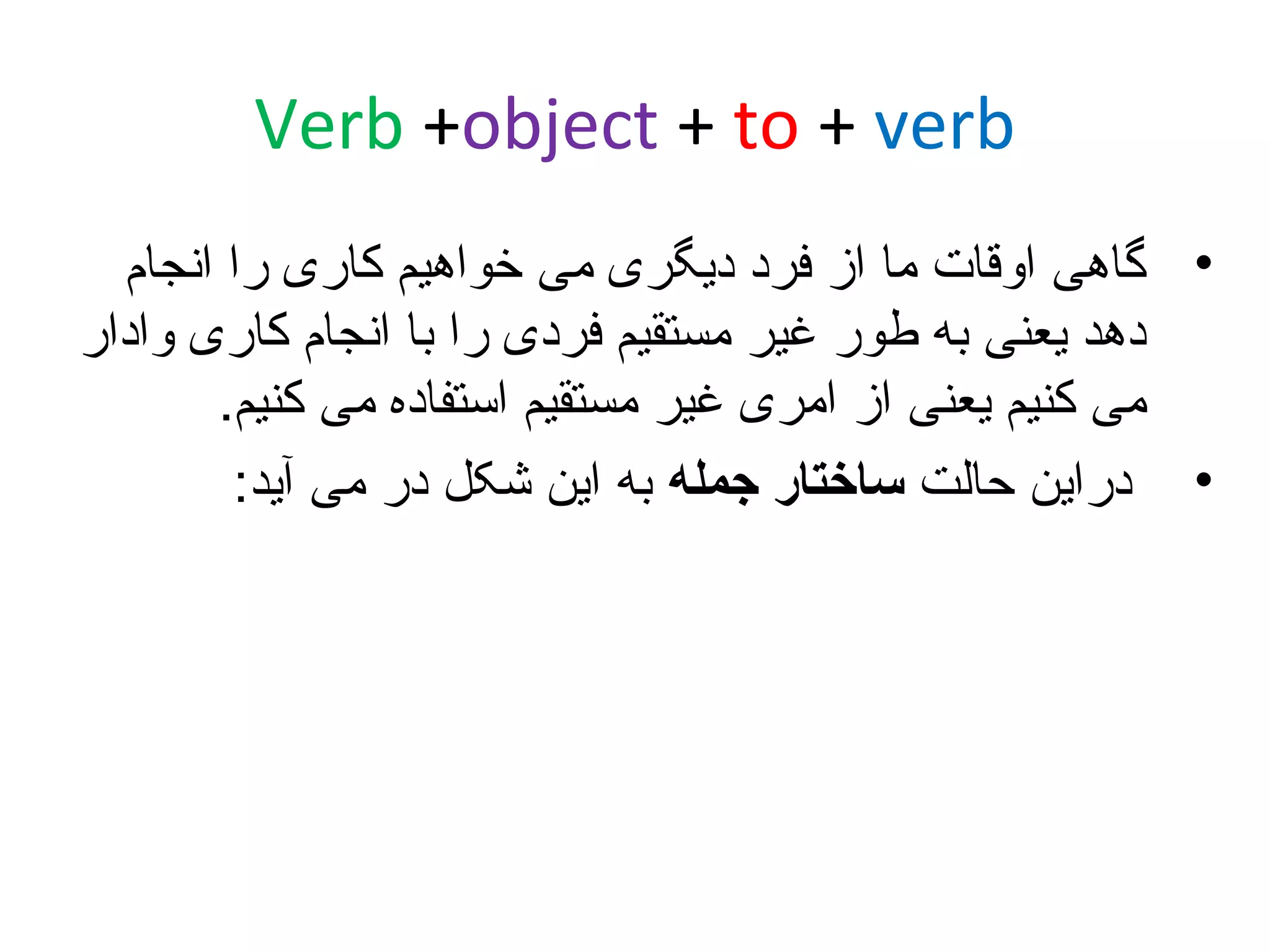
‫‪Verb +object + to + verb‬‬
‫• گاهی اوقات ما از فرد دیگری می خواهیم کاری را انجام‬
‫دهد یعنی به طور غیر مستقیم فردی را با انجام کاری وادار‬
‫می کنیم یعنی از امری غیر مستقیم استفاده می کنیم.‬
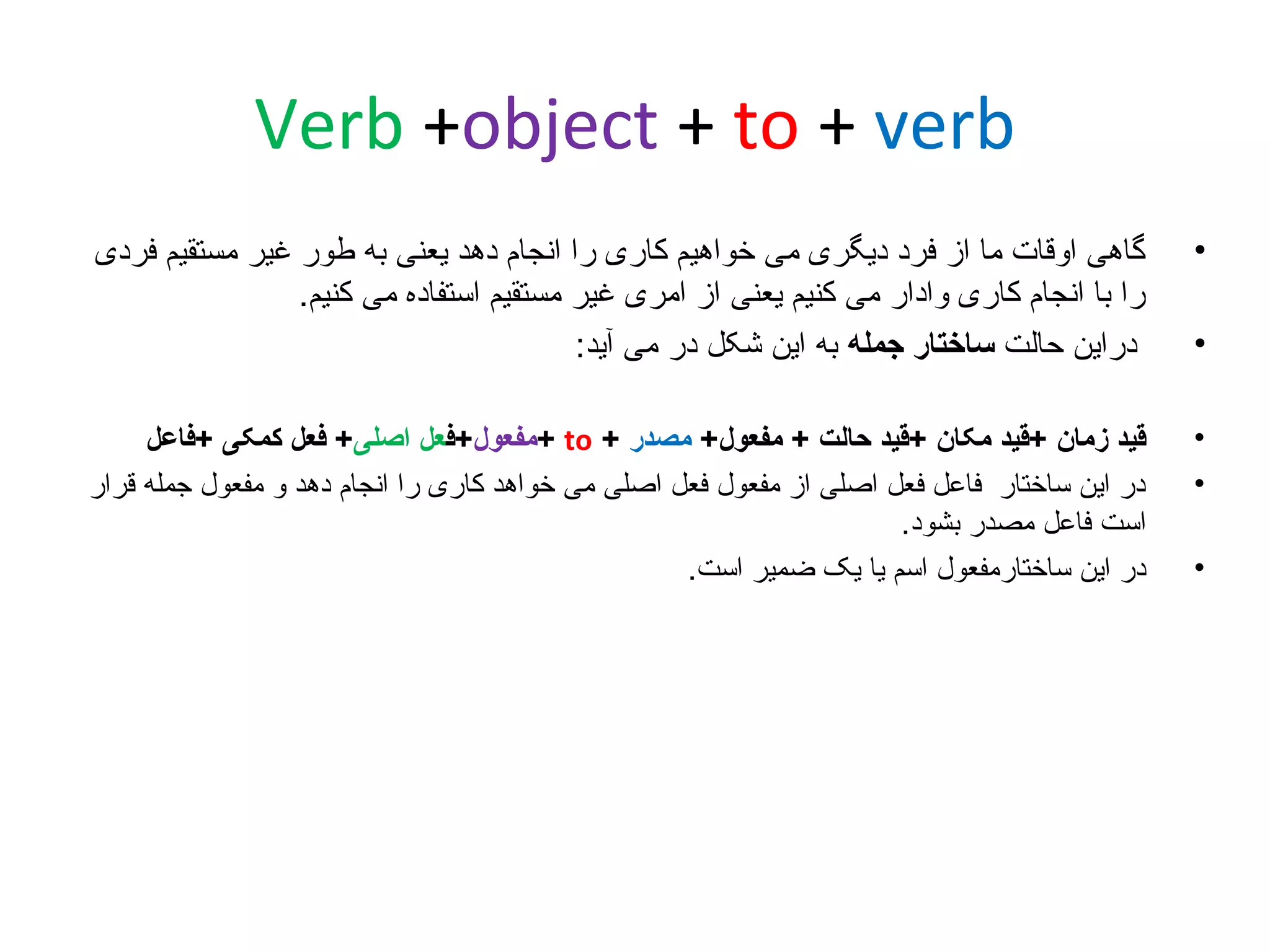
‫• دراین حالت ساختار جمله به این شکل در می آید:‬
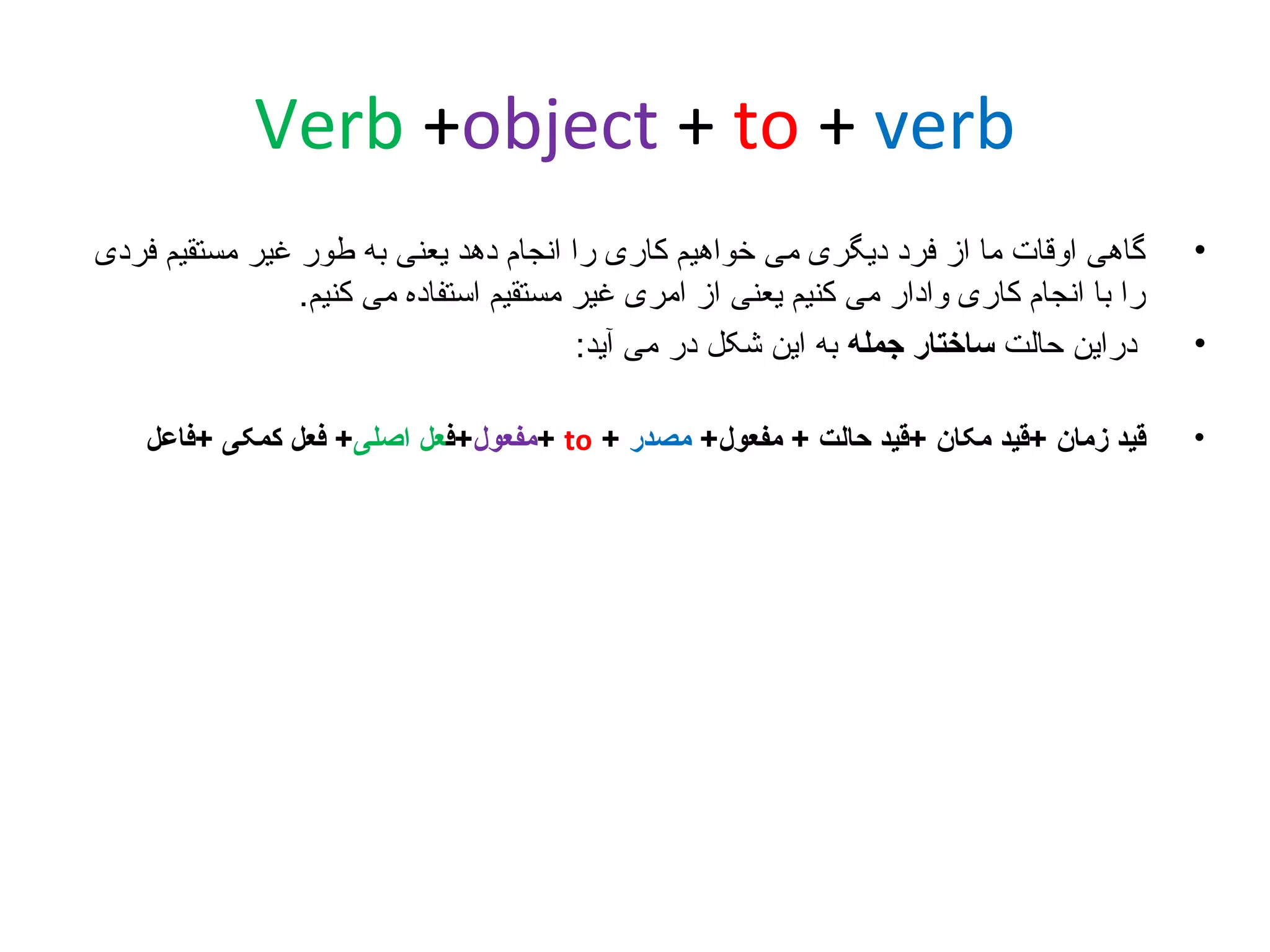
‫‪Verb +object + to + verb‬‬
‫•‬

‫گاهی اوقات ما از فرد دیگری می خواهیم کاری را انجام دهد یعنی به طور غیر مستقیم فردی‬
‫را با انجام کاری وادار می کنیم یعنی از امری غیر مستقیم استفاده می کنیم.‬
‫دراین حالت ساختار جمله به این شکل در می آید:‬

‫•‬

‫قید زمان +قید مکان +قید حالت + مفعول+ مصدر + ‪+ to‬مفعول+فعل اصلی+ فعل کمکی +فاعل‬

‫•‬
‫‪Verb +object + to + verb‬‬
‫•‬

‫گاهی اوقات ما از فرد دیگری می خواهیم کاری را انجام دهد یعنی به طور غیر مستقیم فردی‬
‫را با انجام کاری وادار می کنیم یعنی از امری غیر مستقیم استفاده می کنیم.‬
‫دراین حالت ساختار جمله به این شکل در می آید:‬

‫•‬
‫•‬

‫قید زمان +قید مکان +قید حالت + مفعول+ مصدر + ‪+ to‬مفعول+فعل اصلی+ فعل کمکی +فاعل‬
‫در این ساختار فاعل فعل اصلی از مفعول فعل اصلی می خواهد کاری را انجام دهد و مفعول جمله قرار‬
‫است فاعل مصدر بشود.‬

‫•‬
‫‪Verb +object + to + verb‬‬
‫•‬

‫گاهی اوقات ما از فرد دیگری می خواهیم کاری را انجام دهد یعنی به طور غیر مستقیم فردی‬
‫را با انجام کاری وادار می کنیم یعنی از امری غیر مستقیم استفاده می کنیم.‬
‫دراین حالت ساختار جمله به این شکل در می آید:‬

‫•‬
‫•‬

‫قید زمان +قید مکان +قید حالت + مفعول+ مصدر + ‪+ to‬مفعول+فعل اصلی+ فعل کمکی +فاعل‬
‫در این ساختار فاعل فعل اصلی از مفعول فعل اصلی می خواهد کاری را انجام دهد و مفعول جمله قرار‬
‫است فاعل مصدر بشود.‬
‫در این ساختارمفعول اسم یا یک ضمیر است.‬

‫•‬

‫•‬
‫‪Verb +object + to + verb‬‬
‫•‬

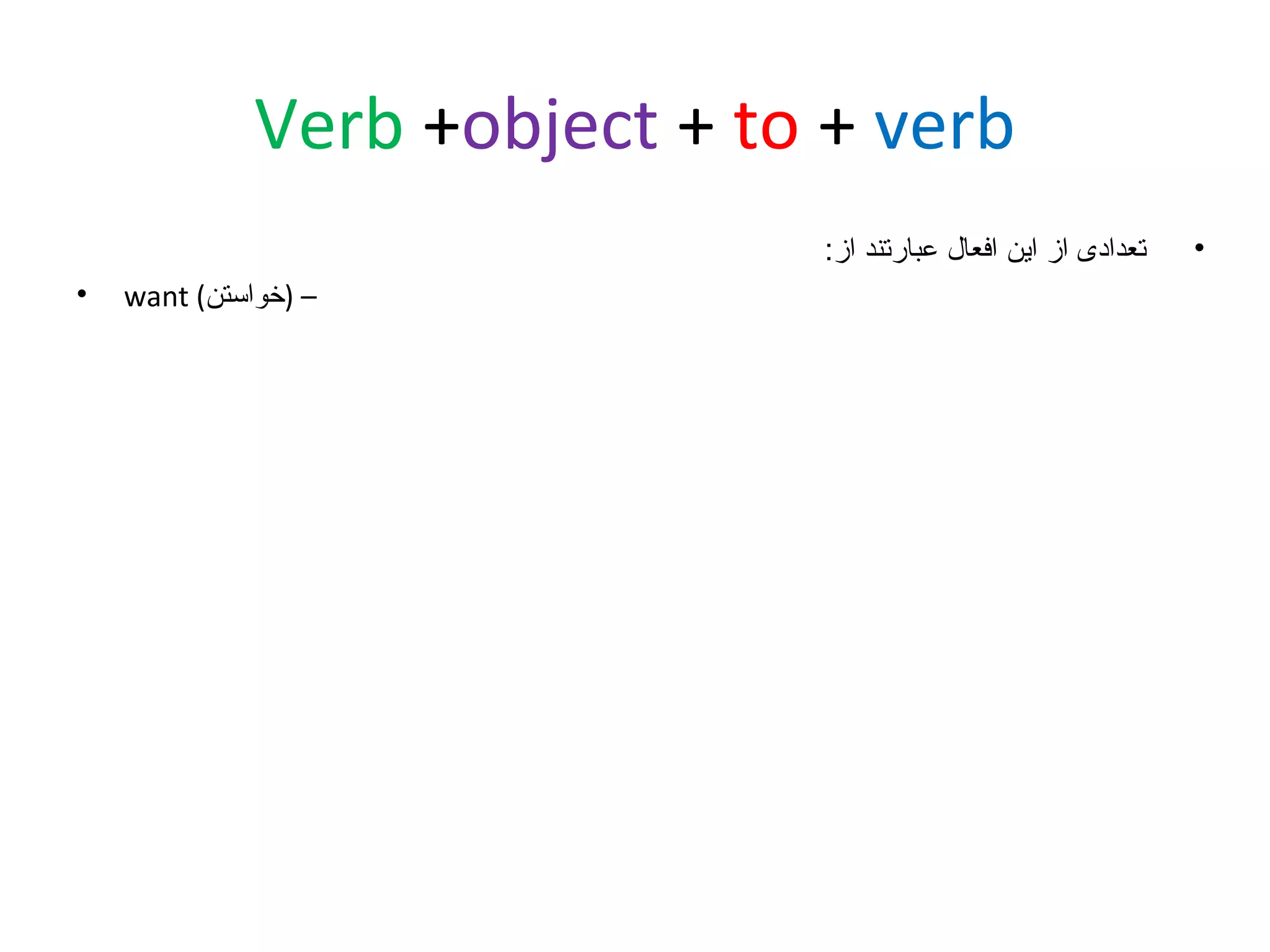
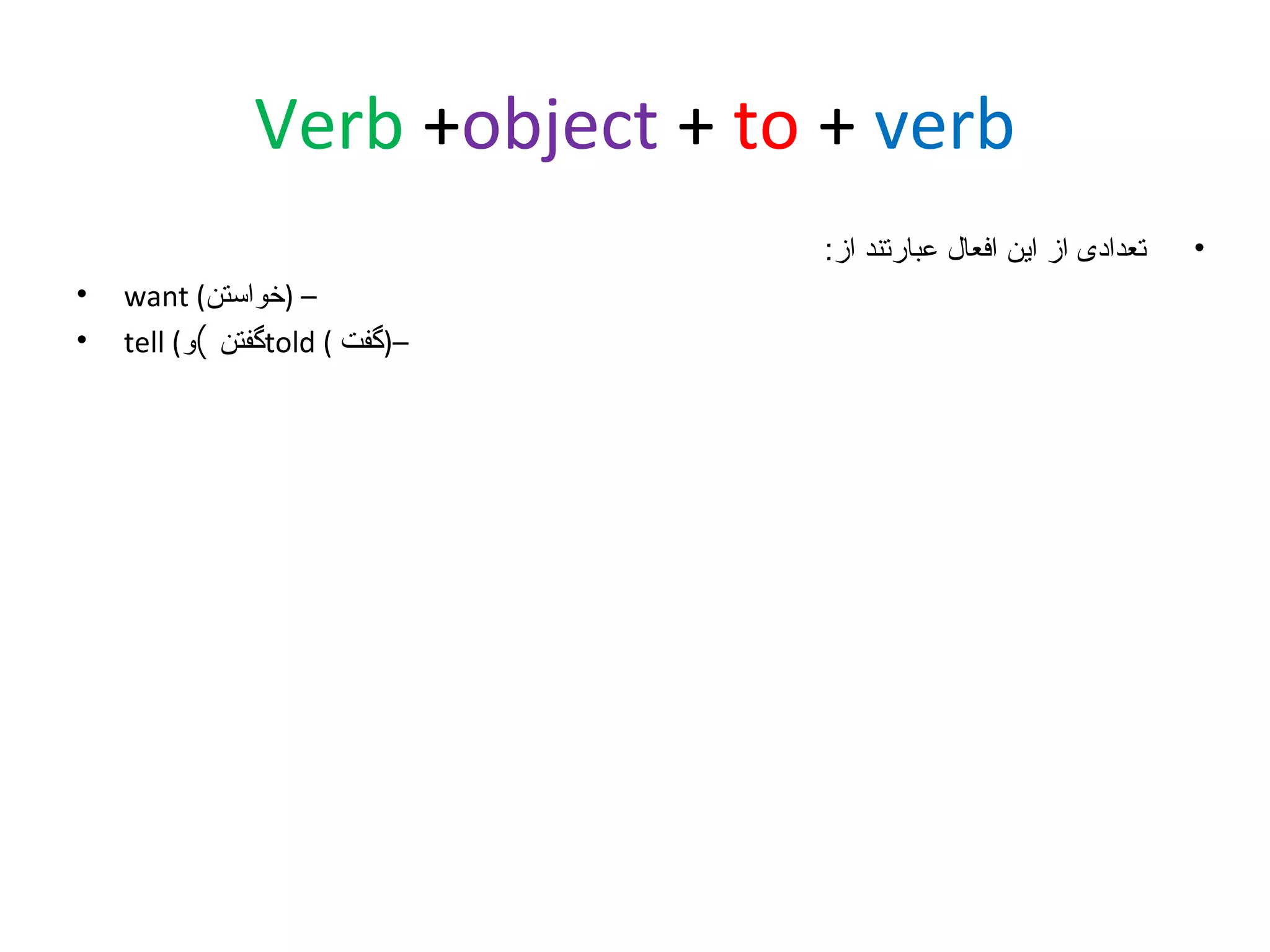
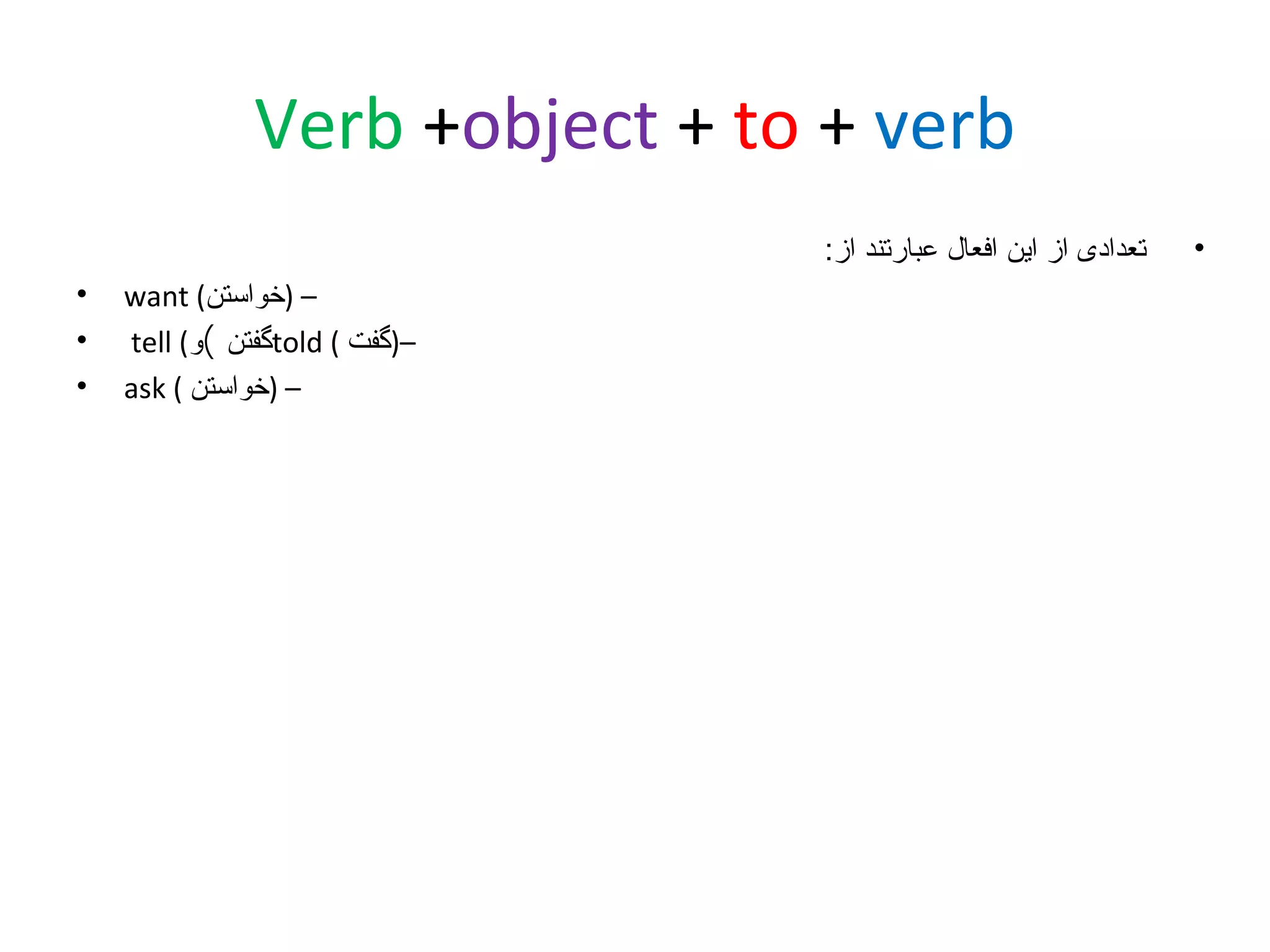
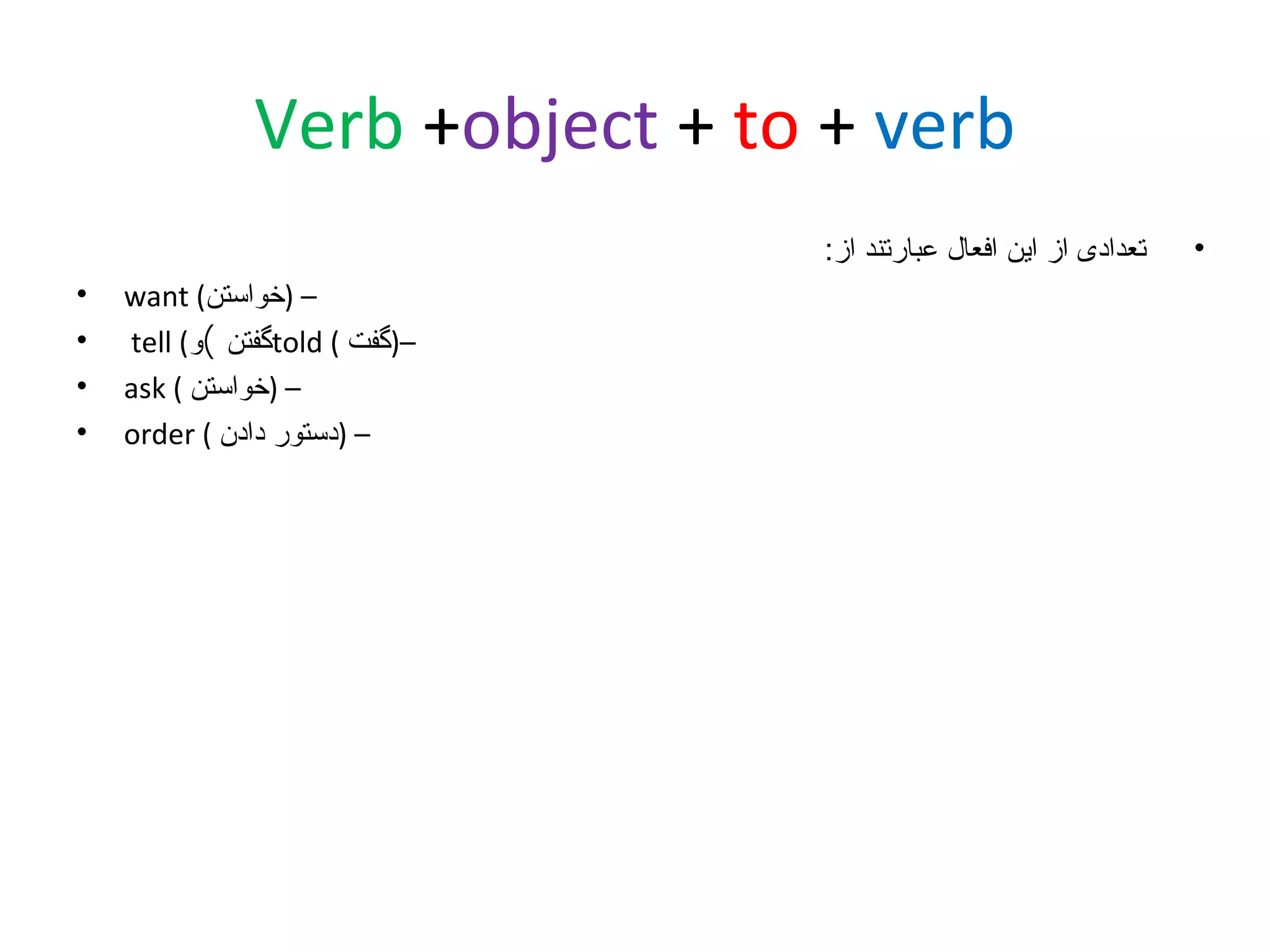
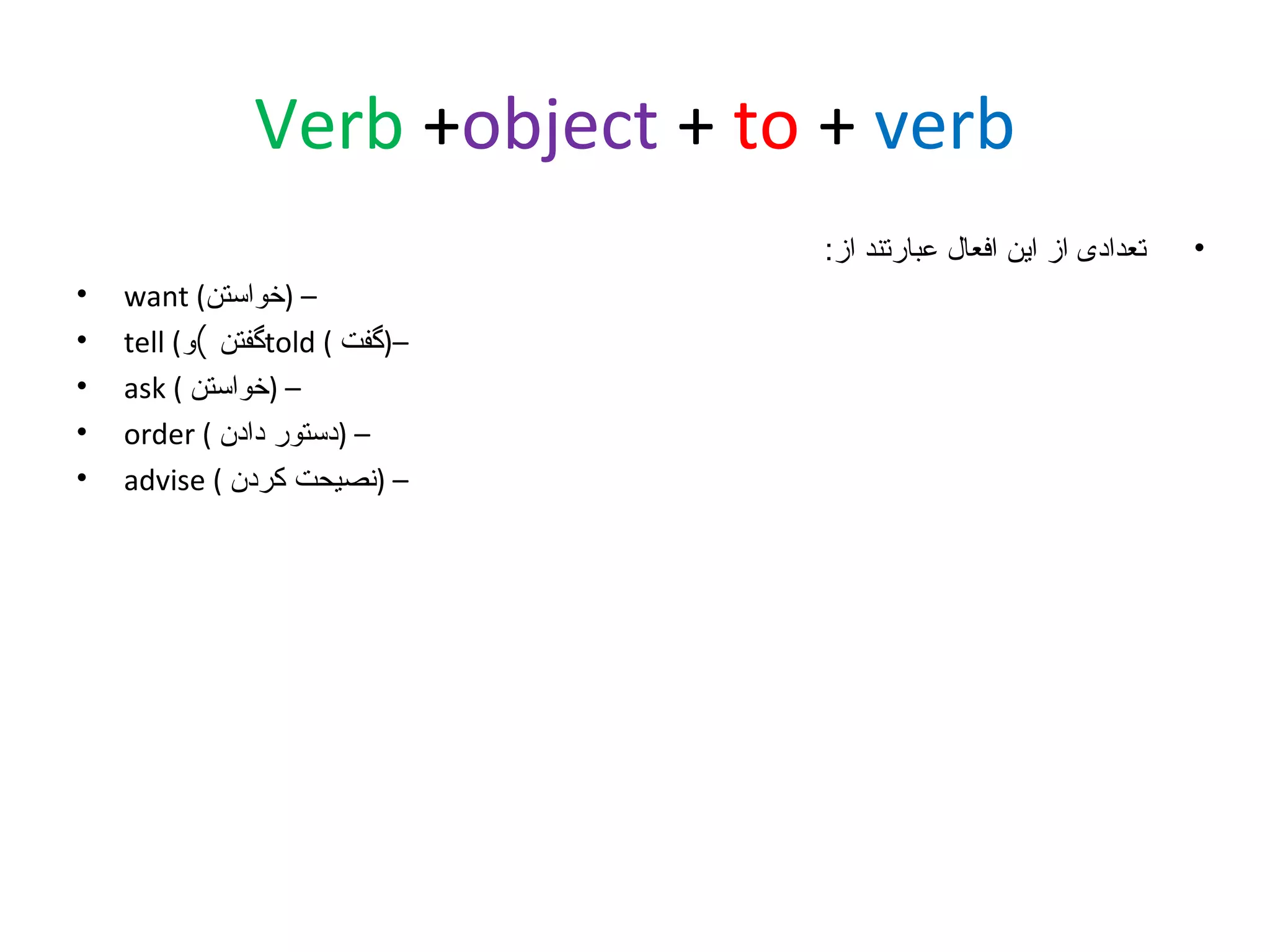
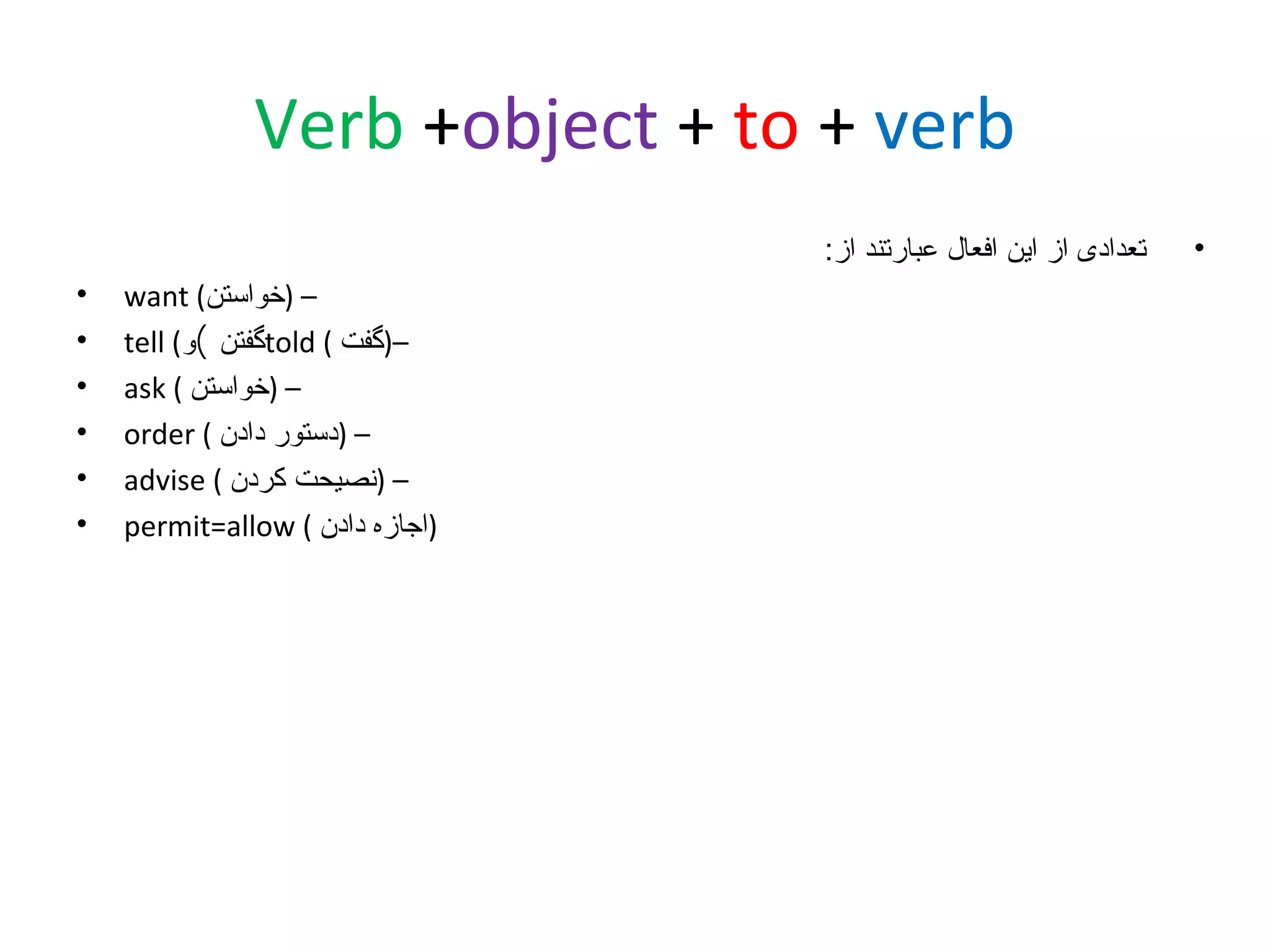
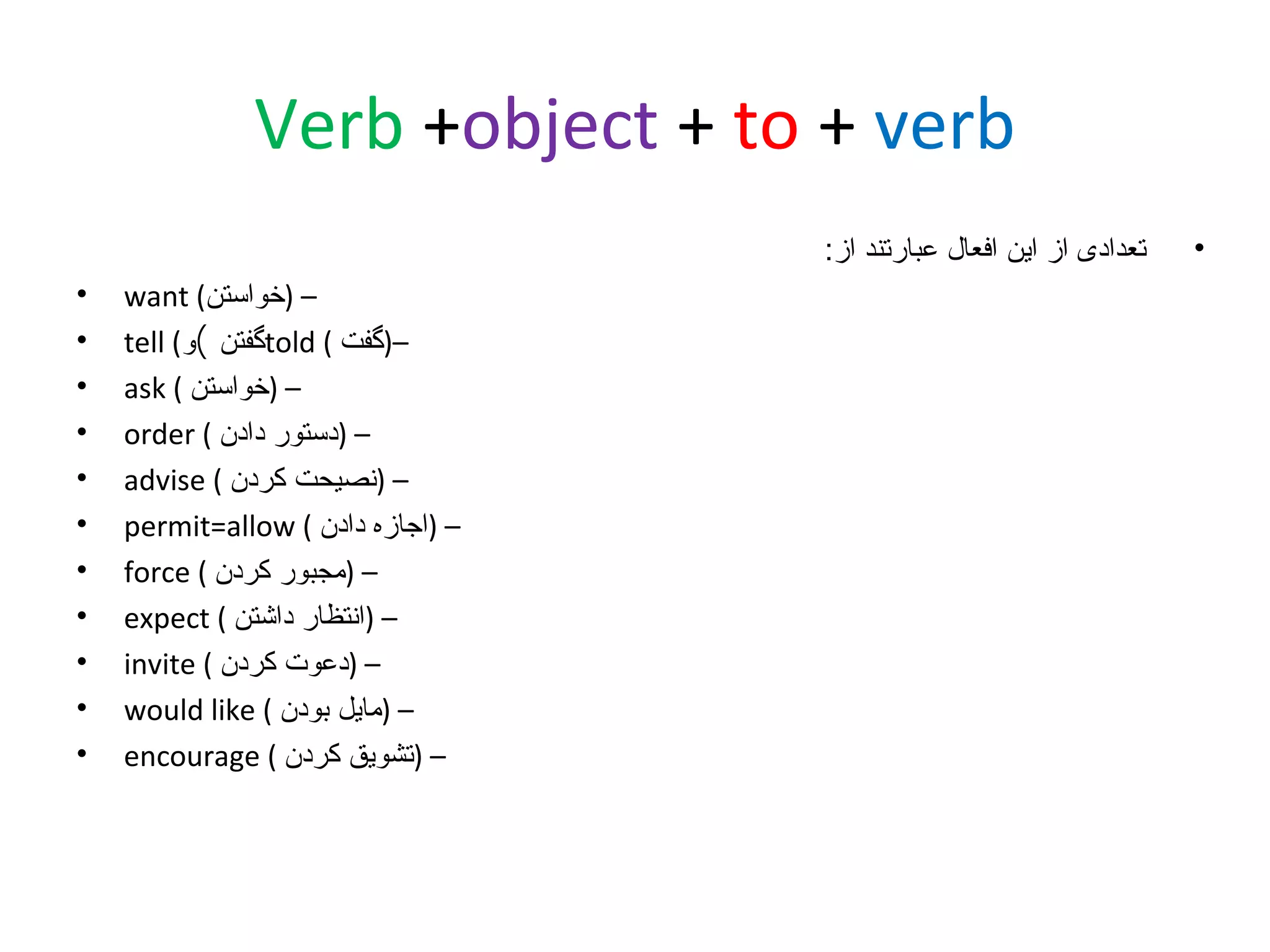
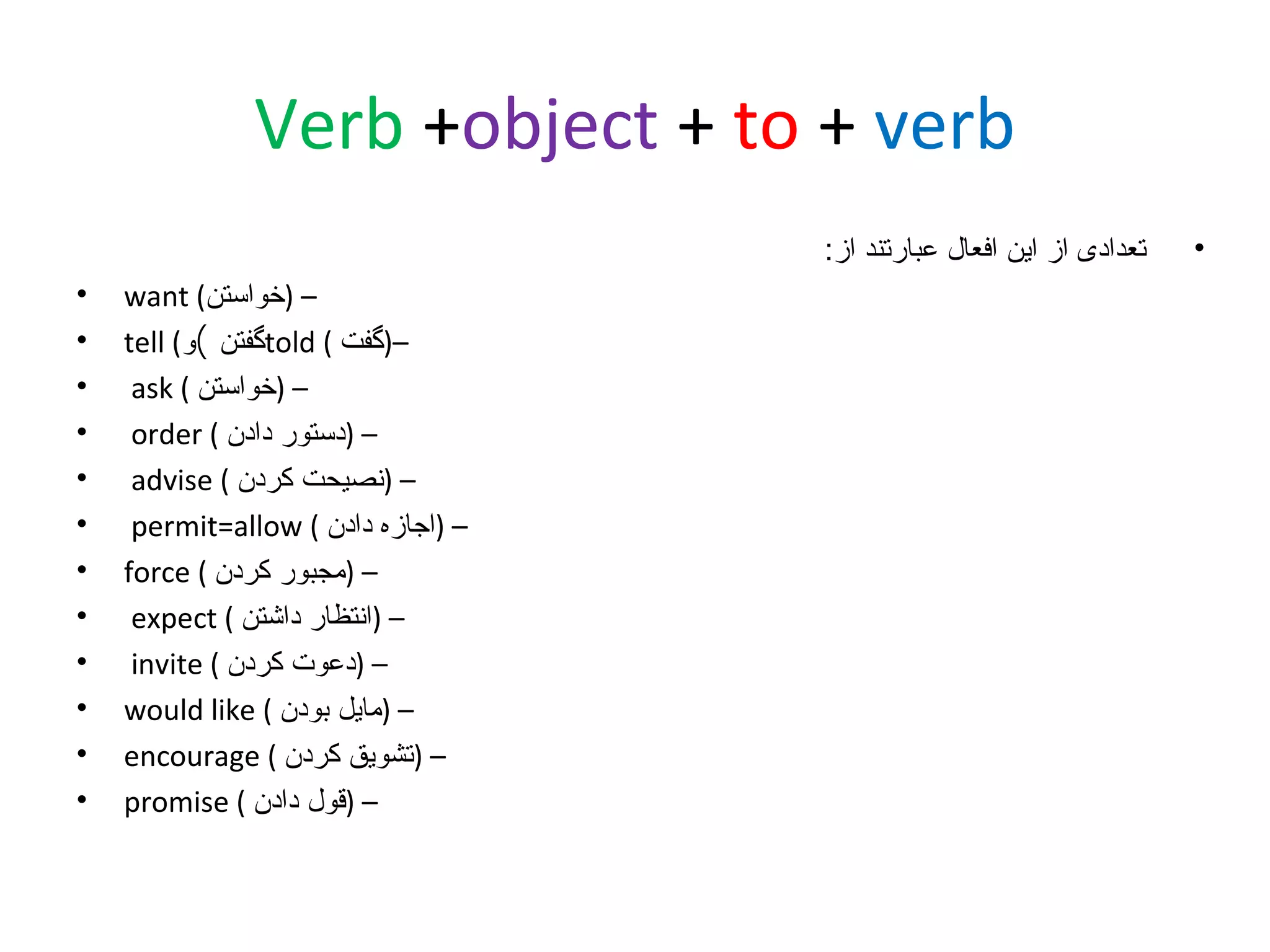
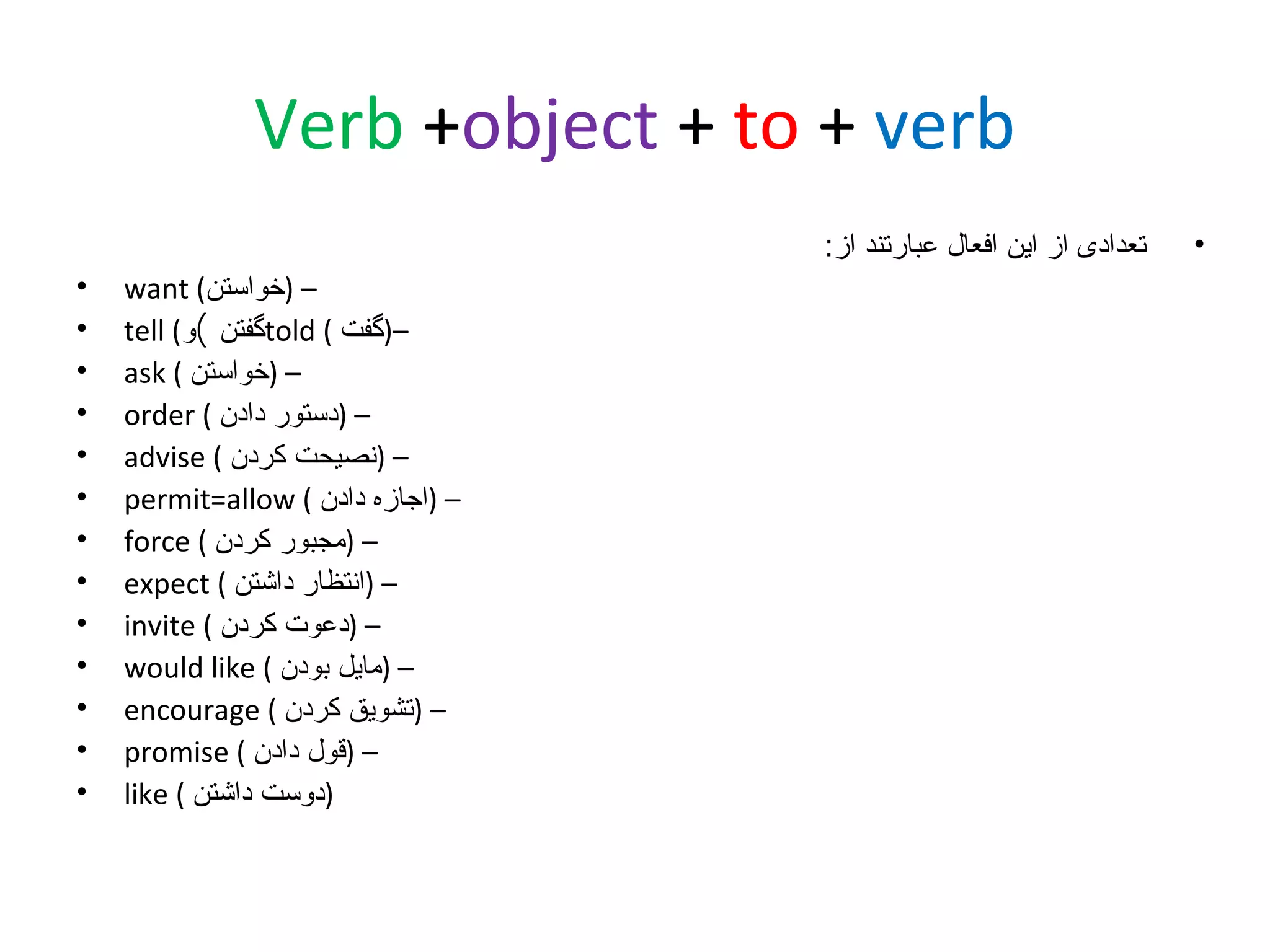
‫تعدادی از این افعال عبارتند از:‬
‫– )خواستن( ‪want‬‬

‫•‬
‫‪Verb +object + to + verb‬‬
‫•‬

‫تعدادی از این افعال عبارتند از:‬
‫– )خواستن( ‪want‬‬
‫–)گفت ( ‪told‬گفتن (و( ‪tell‬‬

‫•‬
‫•‬
‫‪Verb +object + to + verb‬‬
‫•‬

‫تعدادی از این افعال عبارتند از:‬
‫– )خواستن( ‪want‬‬
‫–)گفت ( ‪told‬گفتن (و( ‪tell‬‬
‫– )خواستن ( ‪ask‬‬

‫•‬
‫•‬
‫•‬
‫‪Verb +object + to + verb‬‬
‫•‬

‫تعدادی از این افعال عبارتند از:‬
‫– )خواستن( ‪want‬‬
‫–)گفت ( ‪told‬گفتن (و( ‪tell‬‬
‫– )خواستن ( ‪ask‬‬
‫– )دستور دادن ( ‪order‬‬

‫•‬
‫•‬
‫•‬
‫•‬
‫‪Verb +object + to + verb‬‬
‫•‬

‫تعدادی از این افعال عبارتند از:‬
‫– )خواستن( ‪want‬‬
‫–)گفت ( ‪told‬گفتن (و( ‪tell‬‬
‫– )خواستن ( ‪ask‬‬
‫– )دستور دادن ( ‪order‬‬
‫– )نصیحت کردن ( ‪advise‬‬

‫•‬
‫•‬
‫•‬
‫•‬
‫•‬
‫‪Verb +object + to + verb‬‬
‫•‬

‫تعدادی از این افعال عبارتند از:‬
‫– )خواستن( ‪want‬‬
‫–)گفت ( ‪told‬گفتن (و( ‪tell‬‬
‫– )خواستن ( ‪ask‬‬
‫– )دستور دادن ( ‪order‬‬
‫– )نصیحت کردن ( ‪advise‬‬
‫)اجازه دادن ( ‪permit=allow‬‬

‫•‬
‫•‬
‫•‬
‫•‬
‫•‬
‫•‬
‫‪Verb +object + to + verb‬‬
‫•‬

‫تعدادی از این افعال عبارتند از:‬
‫– )خواستن( ‪want‬‬
‫–)گفت ( ‪told‬گفتن (و( ‪tell‬‬
‫– )خواستن ( ‪ask‬‬
‫– )دستور دادن ( ‪order‬‬
‫– )نصیحت کردن ( ‪advise‬‬
‫– )اجازه دادن ( ‪permit=allow‬‬
‫– )مجبور کردن ( ‪force‬‬

‫•‬
‫•‬
‫•‬
‫•‬
‫•‬
‫•‬
‫•‬
‫‪Verb +object + to + verb‬‬
‫•‬

‫تعدادی از این افعال عبارتند از:‬
‫– )خواستن( ‪want‬‬
‫–)گفت ( ‪told‬گفتن (و( ‪tell‬‬
‫– )خواستن ( ‪ask‬‬
‫– )دستور دادن ( ‪order‬‬
‫– )نصیحت کردن ( ‪advise‬‬
‫– )اجازه دادن ( ‪permit=allow‬‬
‫– )مجبور کردن ( ‪force‬‬
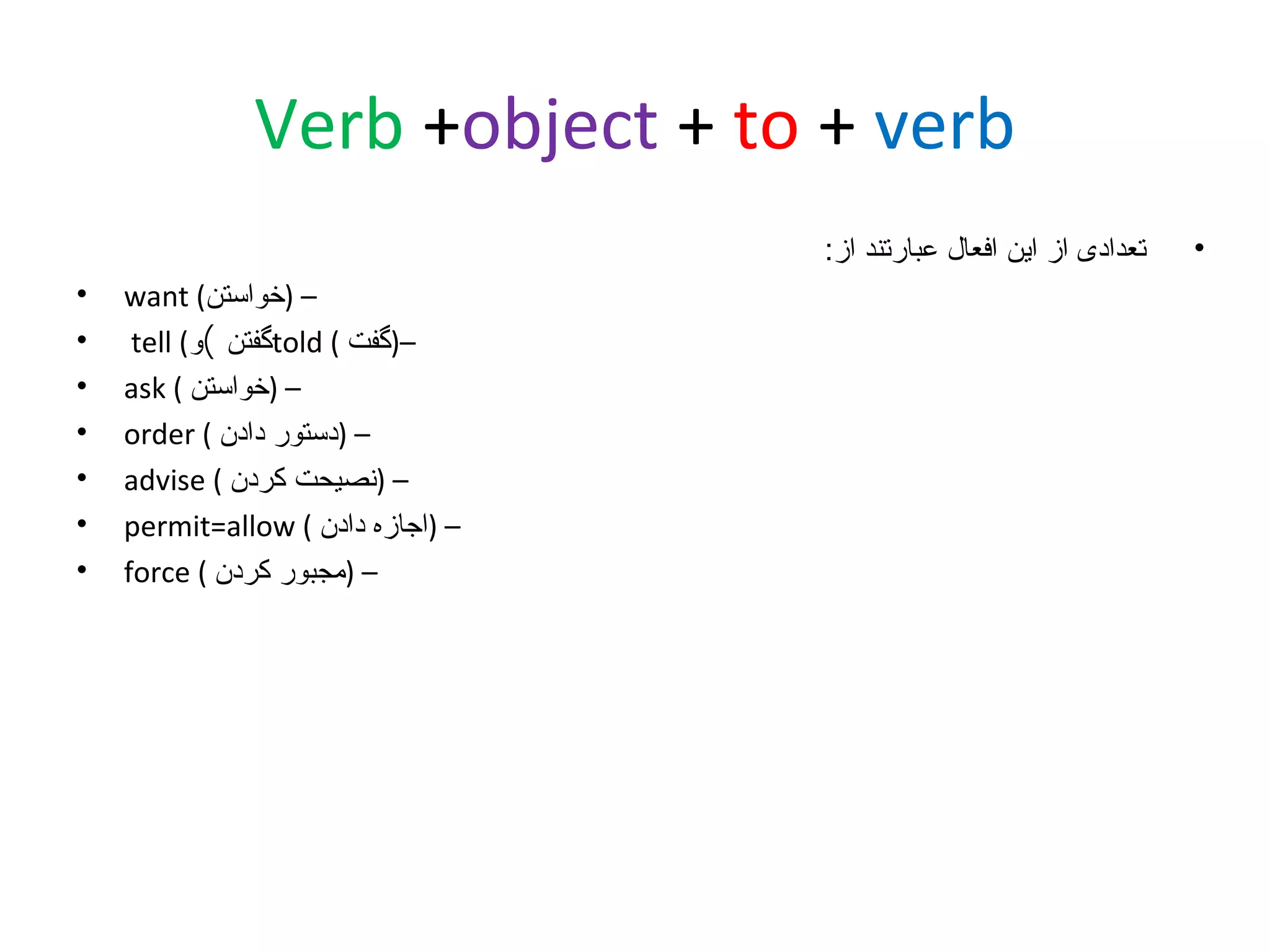
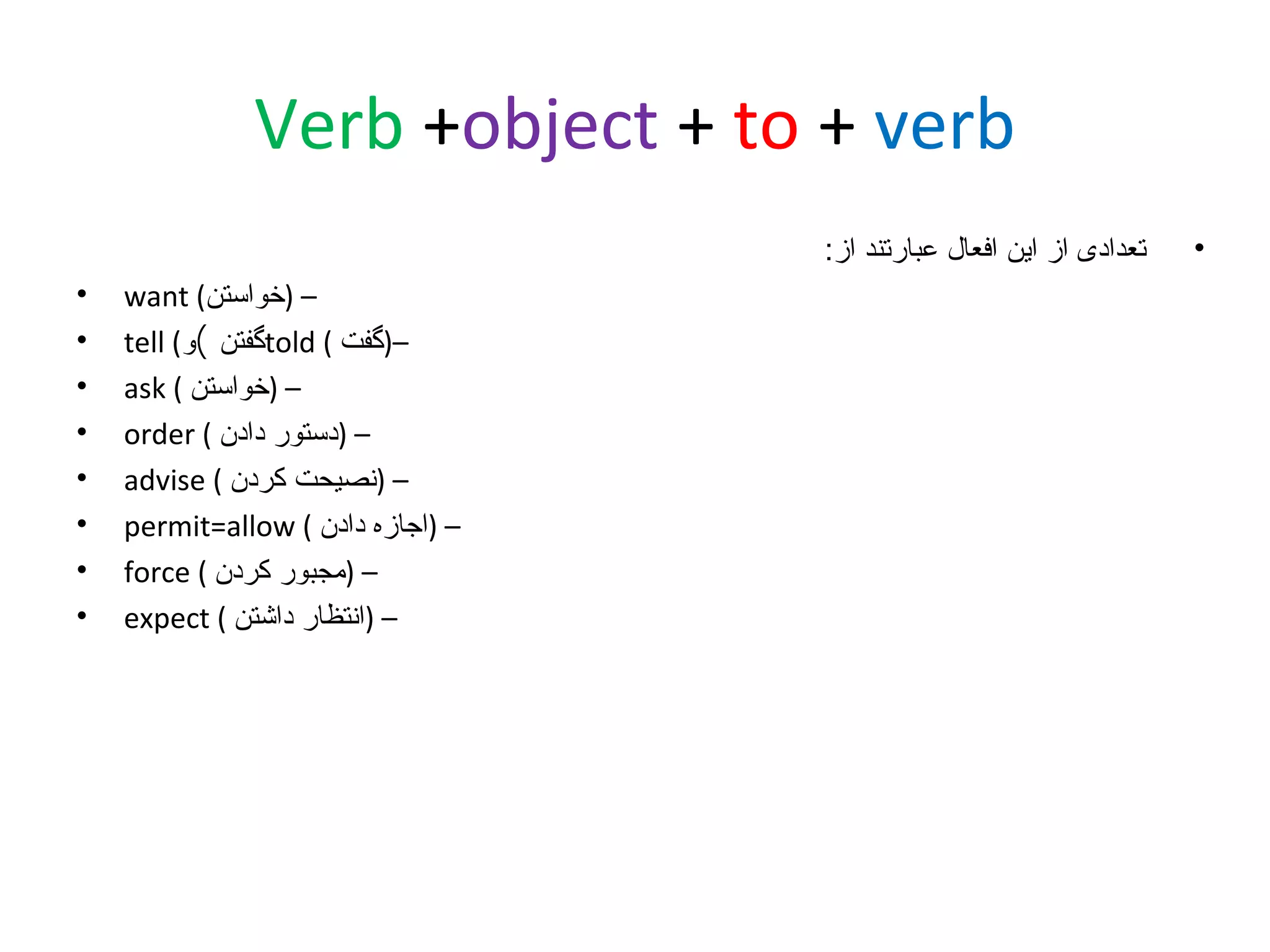
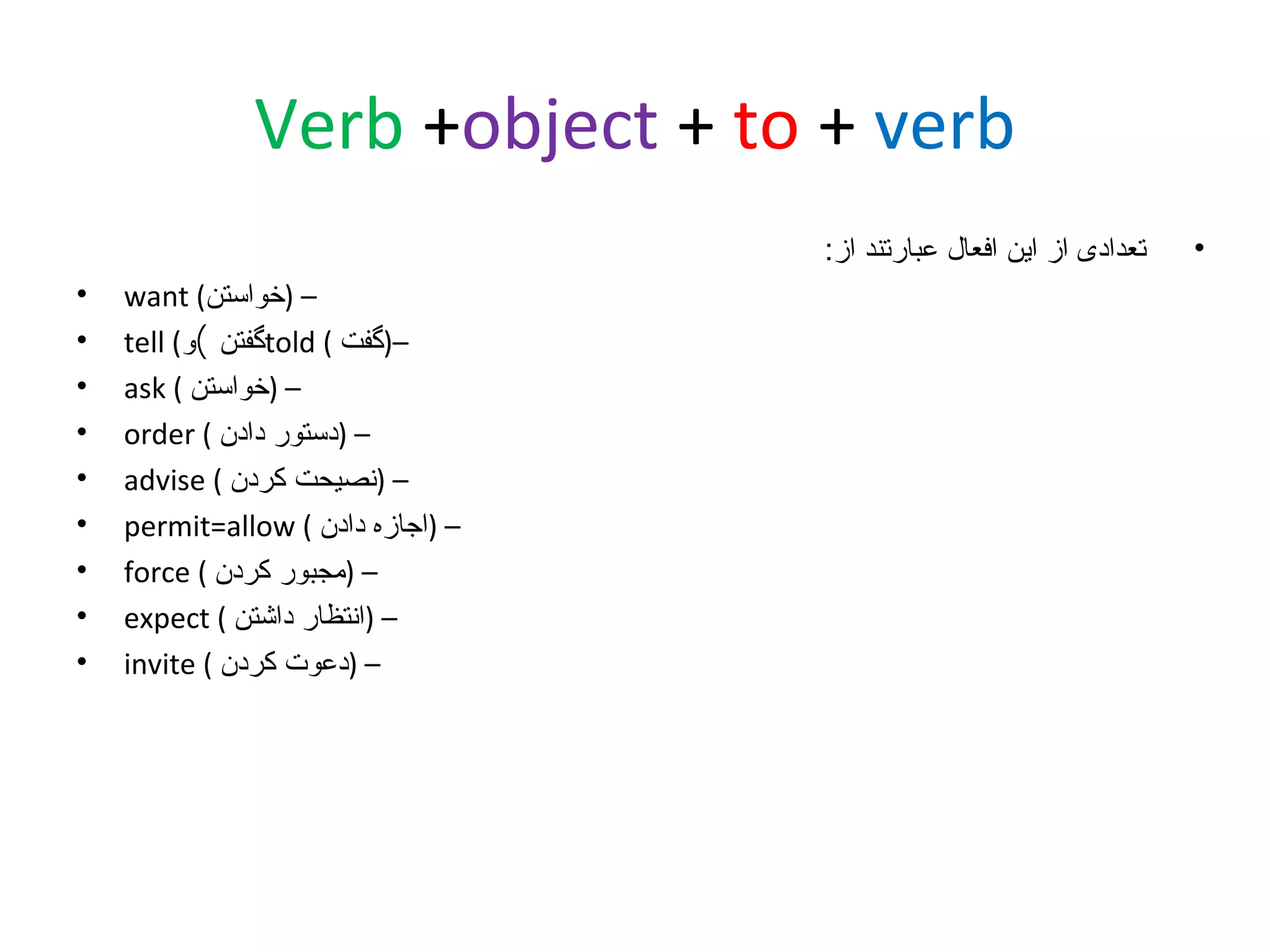
‫– )انتظار داشتن ( ‪expect‬‬

‫•‬
‫•‬
‫•‬
‫•‬
‫•‬
‫•‬
‫•‬
‫•‬
‫‪Verb +object + to + verb‬‬
‫•‬

‫تعدادی از این افعال عبارتند از:‬
‫– )خواستن( ‪want‬‬
‫–)گفت ( ‪told‬گفتن (و( ‪tell‬‬
‫– )خواستن ( ‪ask‬‬
‫– )دستور دادن ( ‪order‬‬
‫– )نصیحت کردن ( ‪advise‬‬
‫– )اجازه دادن ( ‪permit=allow‬‬
‫– )مجبور کردن ( ‪force‬‬
‫– )انتظار داشتن ( ‪expect‬‬
‫– )دعوت کردن ( ‪invite‬‬

‫•‬
‫•‬
‫•‬
‫•‬
‫•‬
‫•‬
‫•‬
‫•‬
‫•‬
‫‪Verb +object + to + verb‬‬
‫•‬

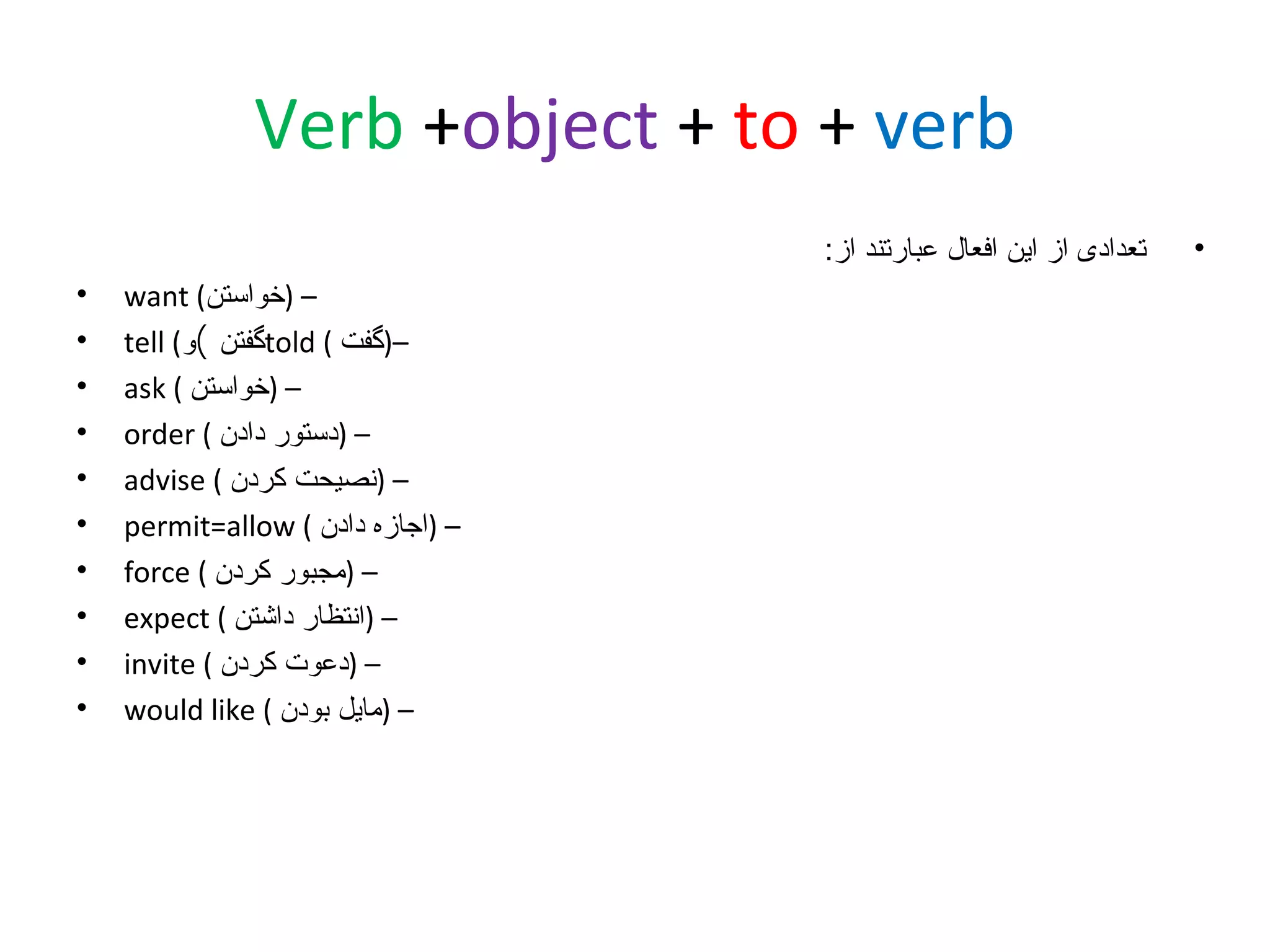
‫تعدادی از این افعال عبارتند از:‬
‫– )خواستن( ‪want‬‬
‫–)گفت ( ‪told‬گفتن (و( ‪tell‬‬
‫– )خواستن ( ‪ask‬‬
‫– )دستور دادن ( ‪order‬‬
‫– )نصیحت کردن ( ‪advise‬‬
‫– )اجازه دادن ( ‪permit=allow‬‬
‫– )مجبور کردن ( ‪force‬‬
‫– )انتظار داشتن ( ‪expect‬‬
‫– )دعوت کردن ( ‪invite‬‬
‫– )مایل بودن ( ‪would like‬‬

‫•‬
‫•‬
‫•‬
‫•‬
‫•‬
‫•‬
‫•‬
‫•‬
‫•‬
‫•‬
‫‪Verb +object + to + verb‬‬
‫•‬

‫تعدادی از این افعال عبارتند از:‬
‫– )خواستن( ‪want‬‬
‫–)گفت ( ‪told‬گفتن (و( ‪tell‬‬
‫– )خواستن ( ‪ask‬‬
‫– )دستور دادن ( ‪order‬‬
‫– )نصیحت کردن ( ‪advise‬‬
‫– )اجازه دادن ( ‪permit=allow‬‬
‫– )مجبور کردن ( ‪force‬‬
‫– )انتظار داشتن ( ‪expect‬‬
‫– )دعوت کردن ( ‪invite‬‬
‫– )مایل بودن ( ‪would like‬‬
‫– )تشویق کردن ( ‪encourage‬‬

‫•‬
‫•‬
‫•‬
‫•‬
‫•‬
‫•‬
‫•‬
‫•‬
‫•‬
‫•‬
‫•‬
‫‪Verb +object + to + verb‬‬
‫•‬

‫تعدادی از این افعال عبارتند از:‬
‫– )خواستن( ‪want‬‬
‫–)گفت ( ‪told‬گفتن (و( ‪tell‬‬
‫– )خواستن ( ‪ask‬‬
‫– )دستور دادن ( ‪order‬‬
‫– )نصیحت کردن ( ‪advise‬‬
‫– )اجازه دادن ( ‪permit=allow‬‬
‫– )مجبور کردن ( ‪force‬‬
‫– )انتظار داشتن ( ‪expect‬‬
‫– )دعوت کردن ( ‪invite‬‬
‫– )مایل بودن ( ‪would like‬‬
‫– )تشویق کردن ( ‪encourage‬‬
‫– )قول دادن ( ‪promise‬‬

‫•‬
‫•‬
‫•‬
‫•‬
‫•‬
‫•‬
‫•‬
‫•‬
‫•‬
‫•‬
‫•‬
‫•‬
‫‪Verb +object + to + verb‬‬
‫•‬

‫تعدادی از این افعال عبارتند از:‬
‫– )خواستن( ‪want‬‬
‫–)گفت ( ‪told‬گفتن (و( ‪tell‬‬
‫– )خواستن ( ‪ask‬‬
‫– )دستور دادن ( ‪order‬‬
‫– )نصیحت کردن ( ‪advise‬‬
‫– )اجازه دادن ( ‪permit=allow‬‬
‫– )مجبور کردن ( ‪force‬‬
‫– )انتظار داشتن ( ‪expect‬‬
‫– )دعوت کردن ( ‪invite‬‬
‫– )مایل بودن ( ‪would like‬‬
‫– )تشویق کردن ( ‪encourage‬‬
‫– )قول دادن ( ‪promise‬‬
‫)دوست داشتن ( ‪like‬‬

‫•‬
‫•‬
‫•‬
‫•‬
‫•‬
‫•‬
‫•‬
‫•‬
‫•‬
‫•‬
‫•‬
‫•‬
‫•‬
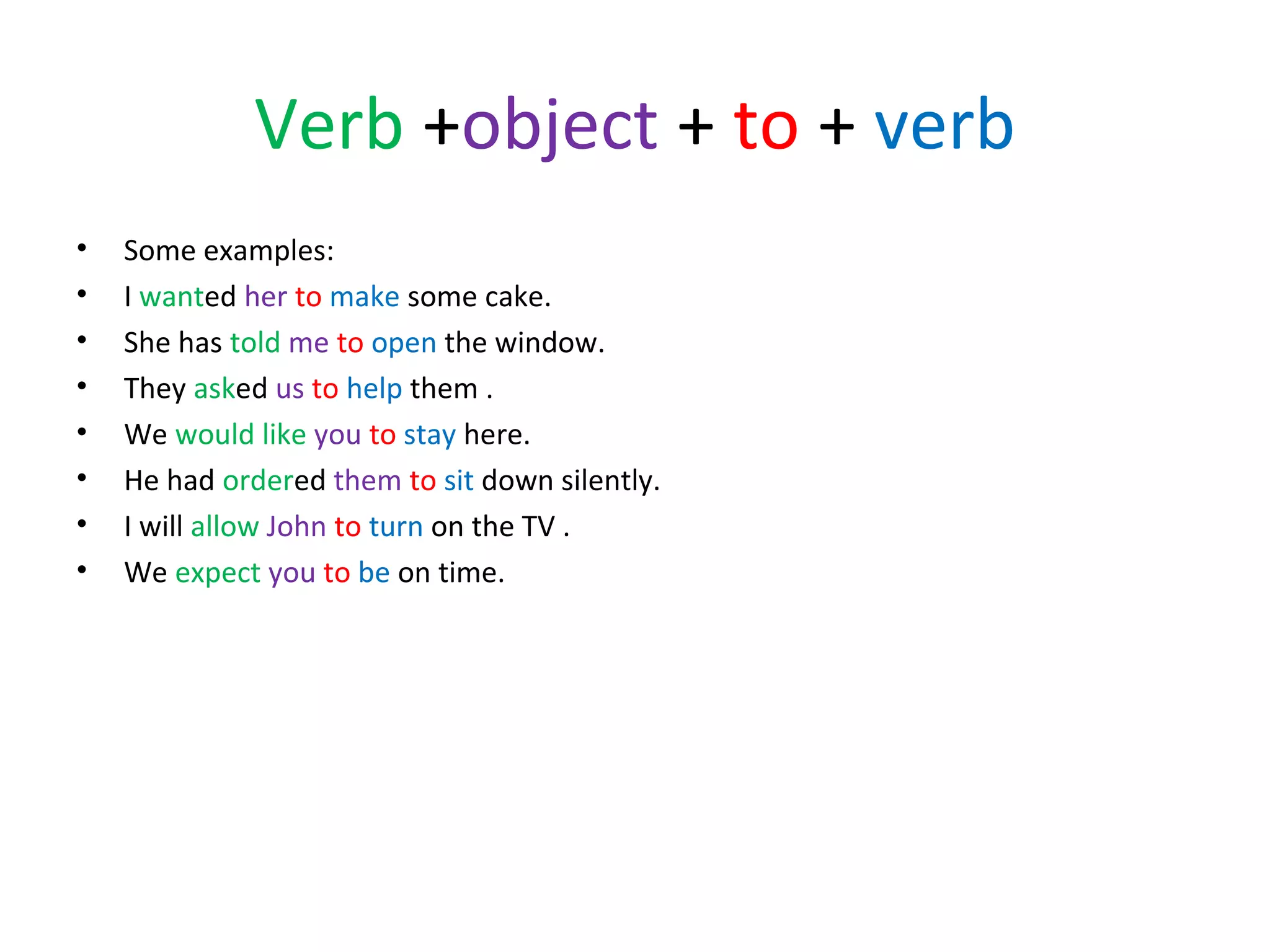
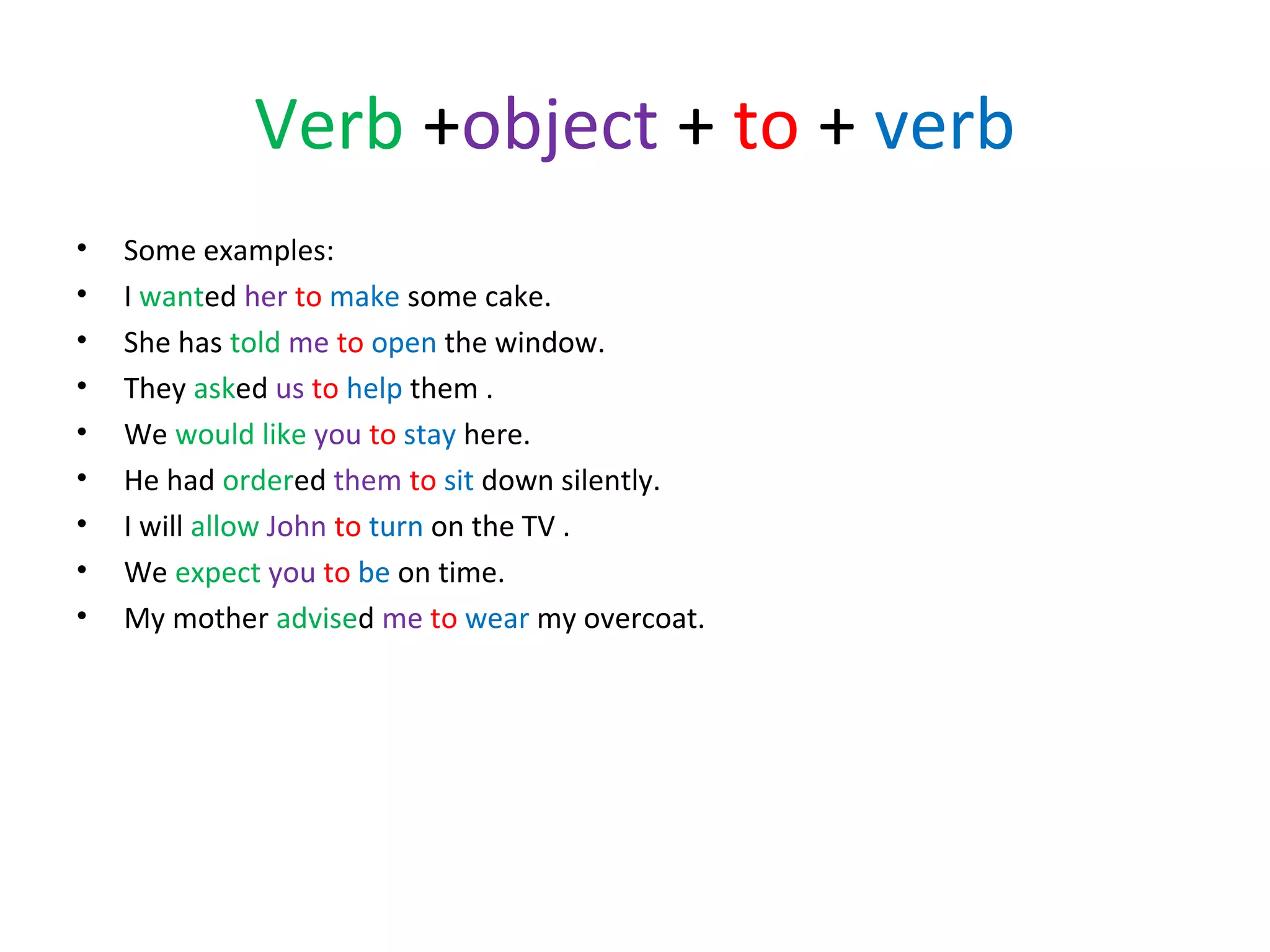
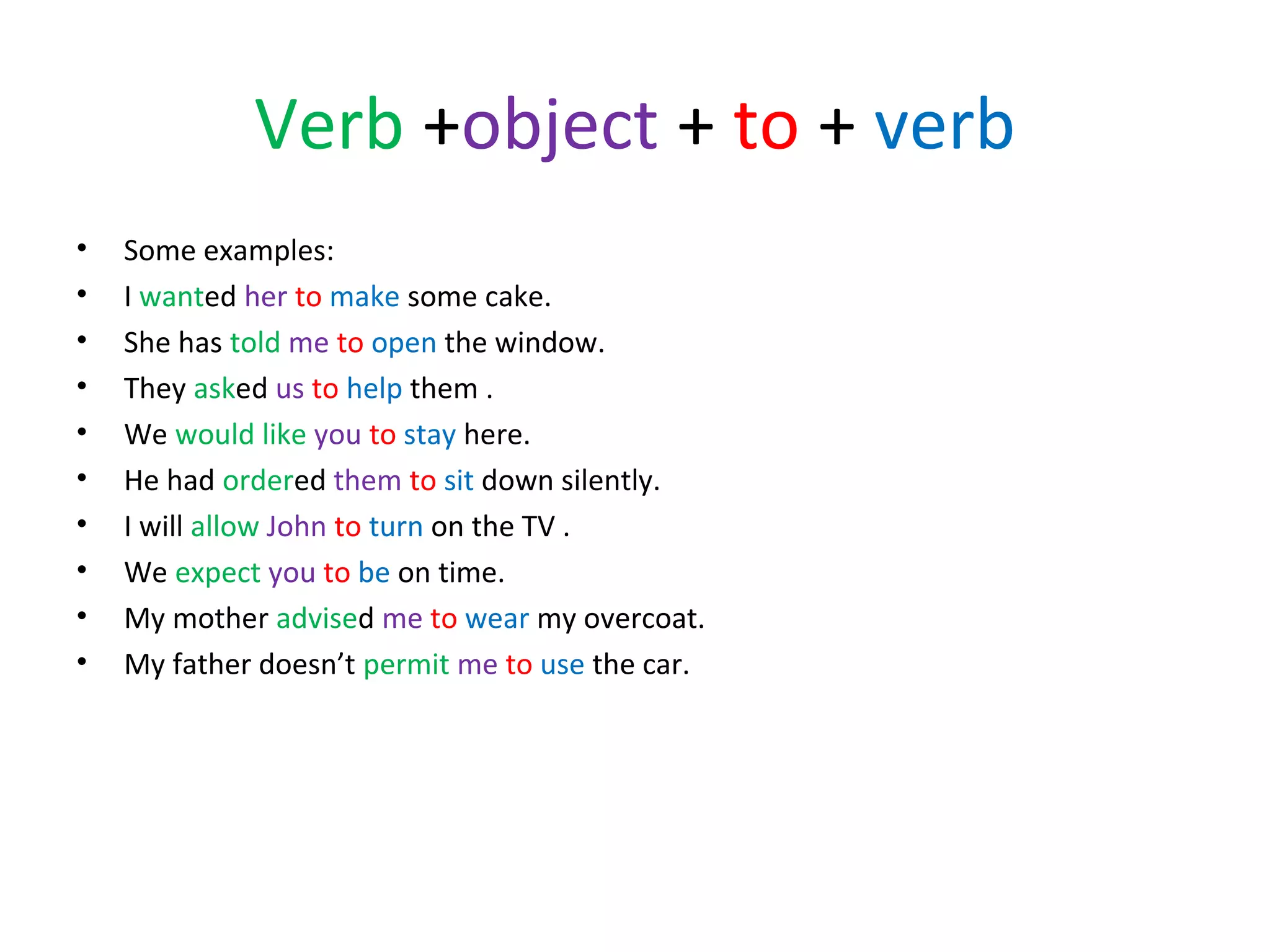
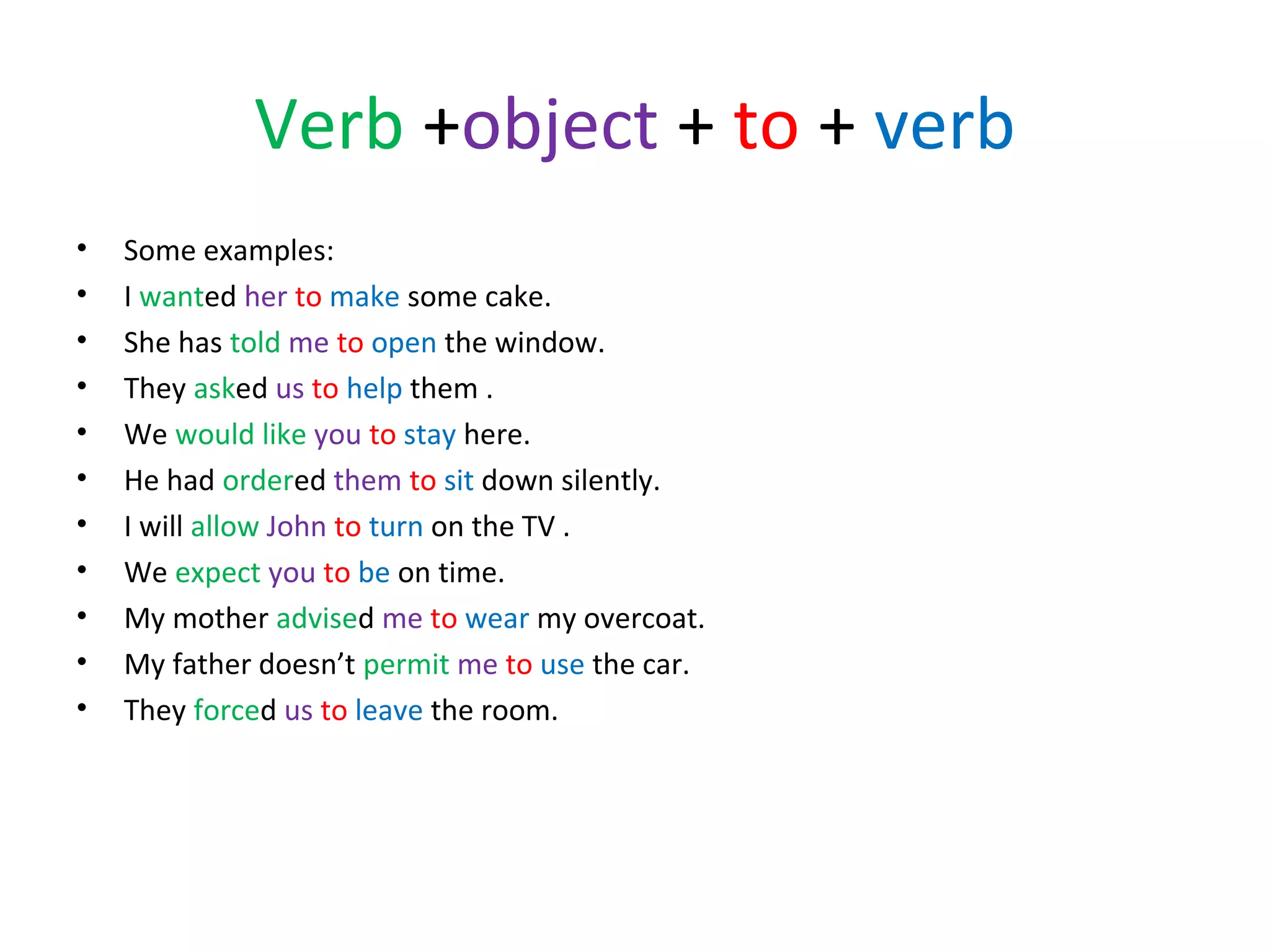
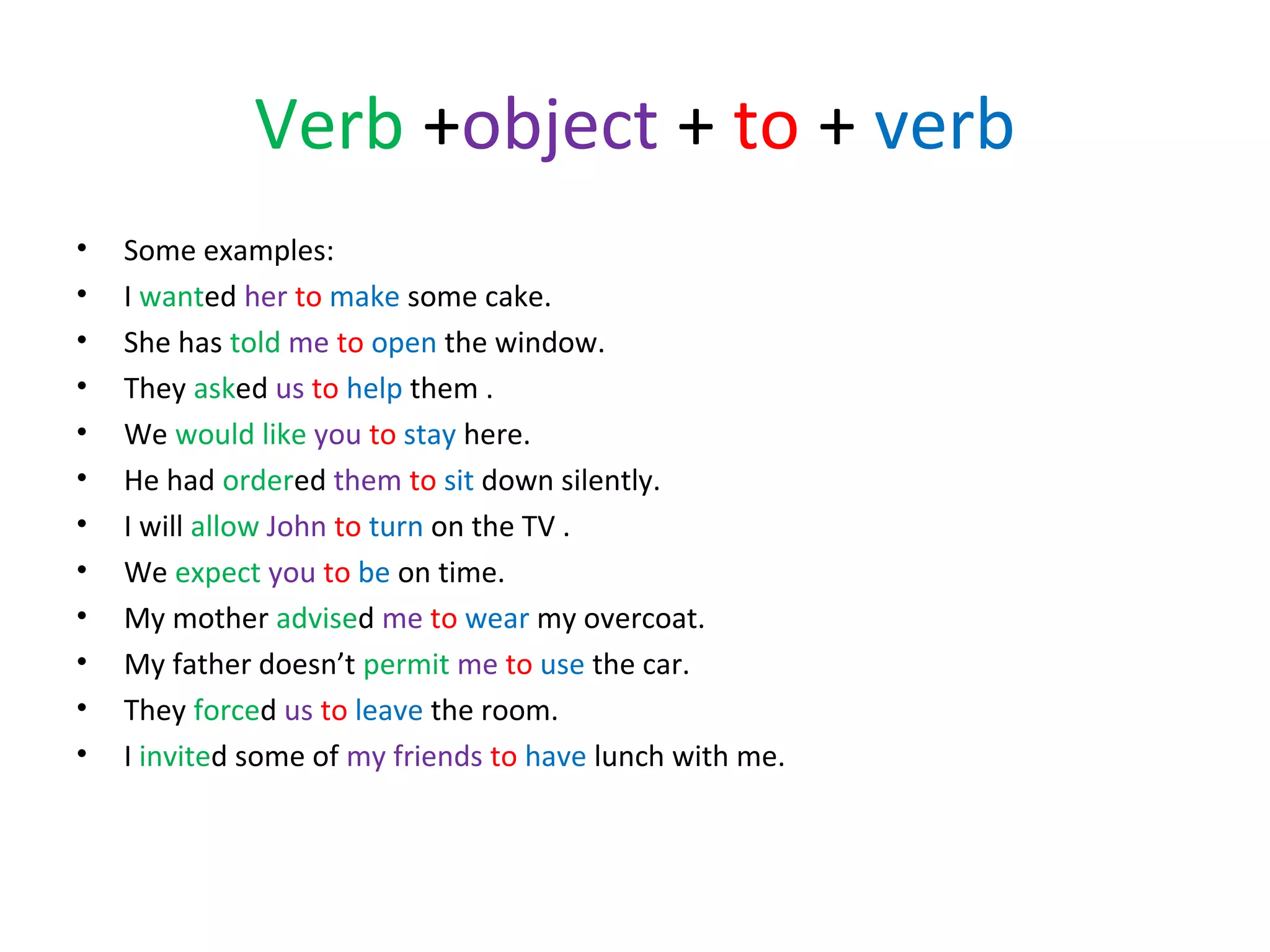
Verb +object + to + verb
•
•

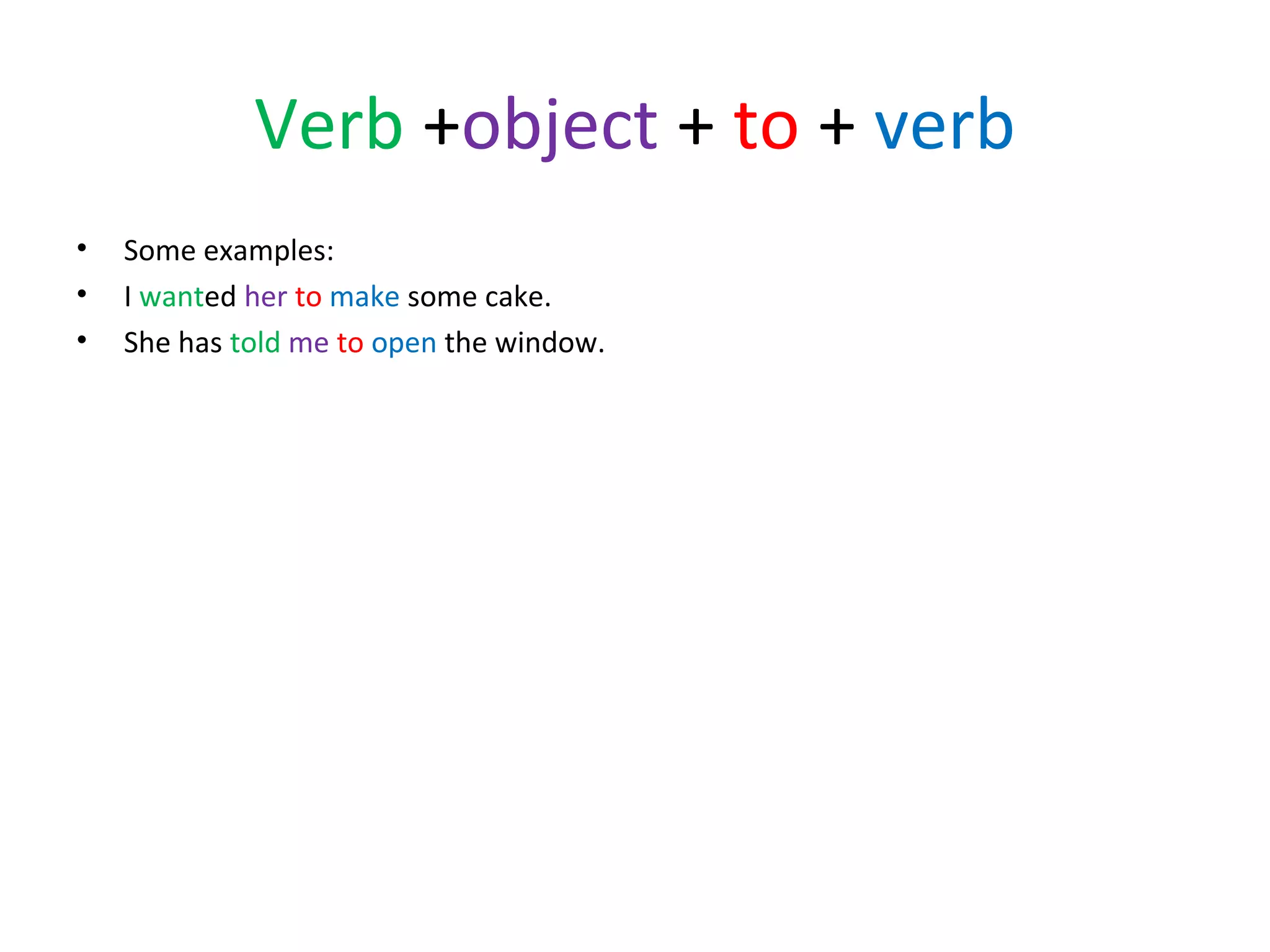
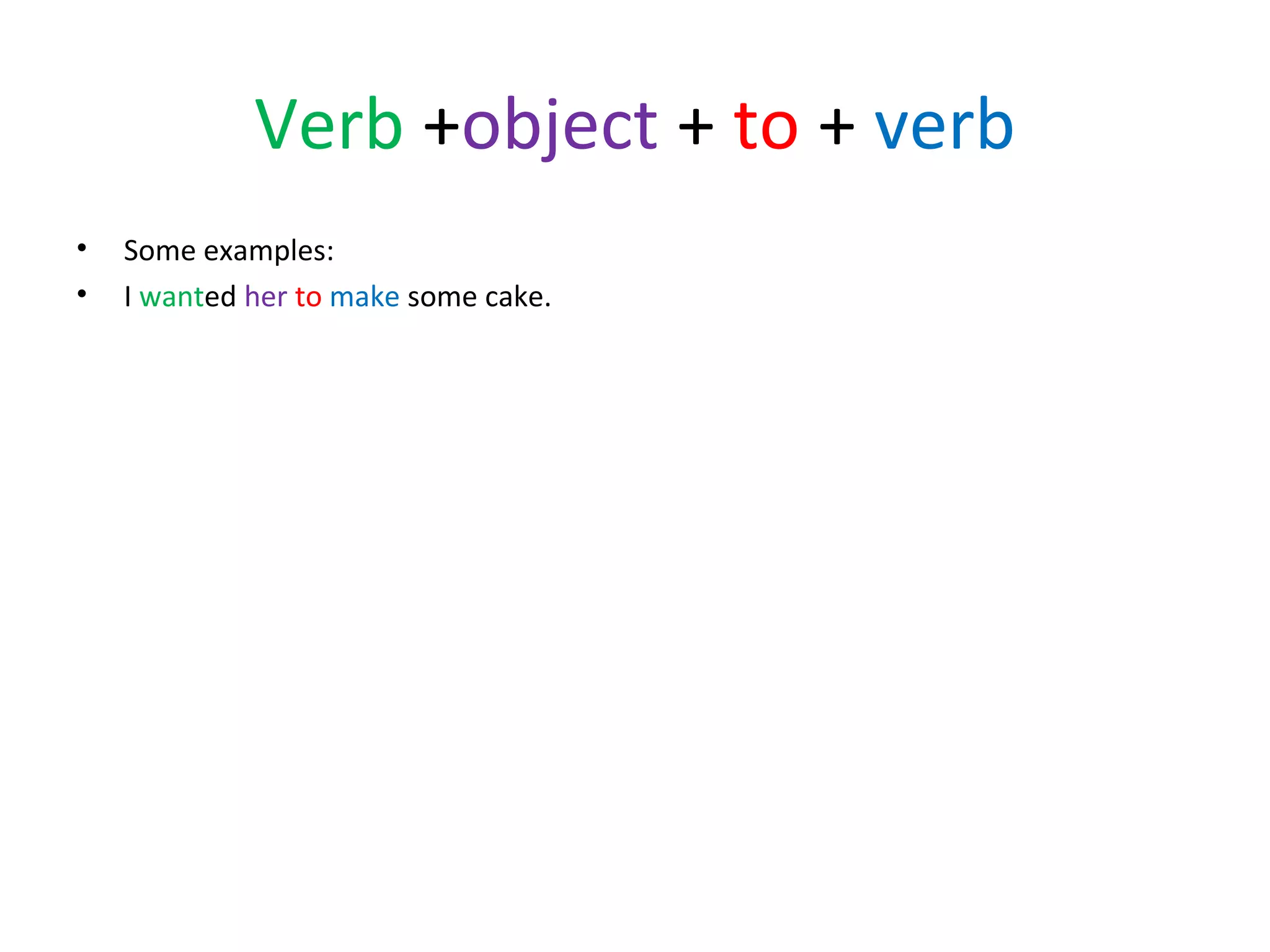
Some examples:
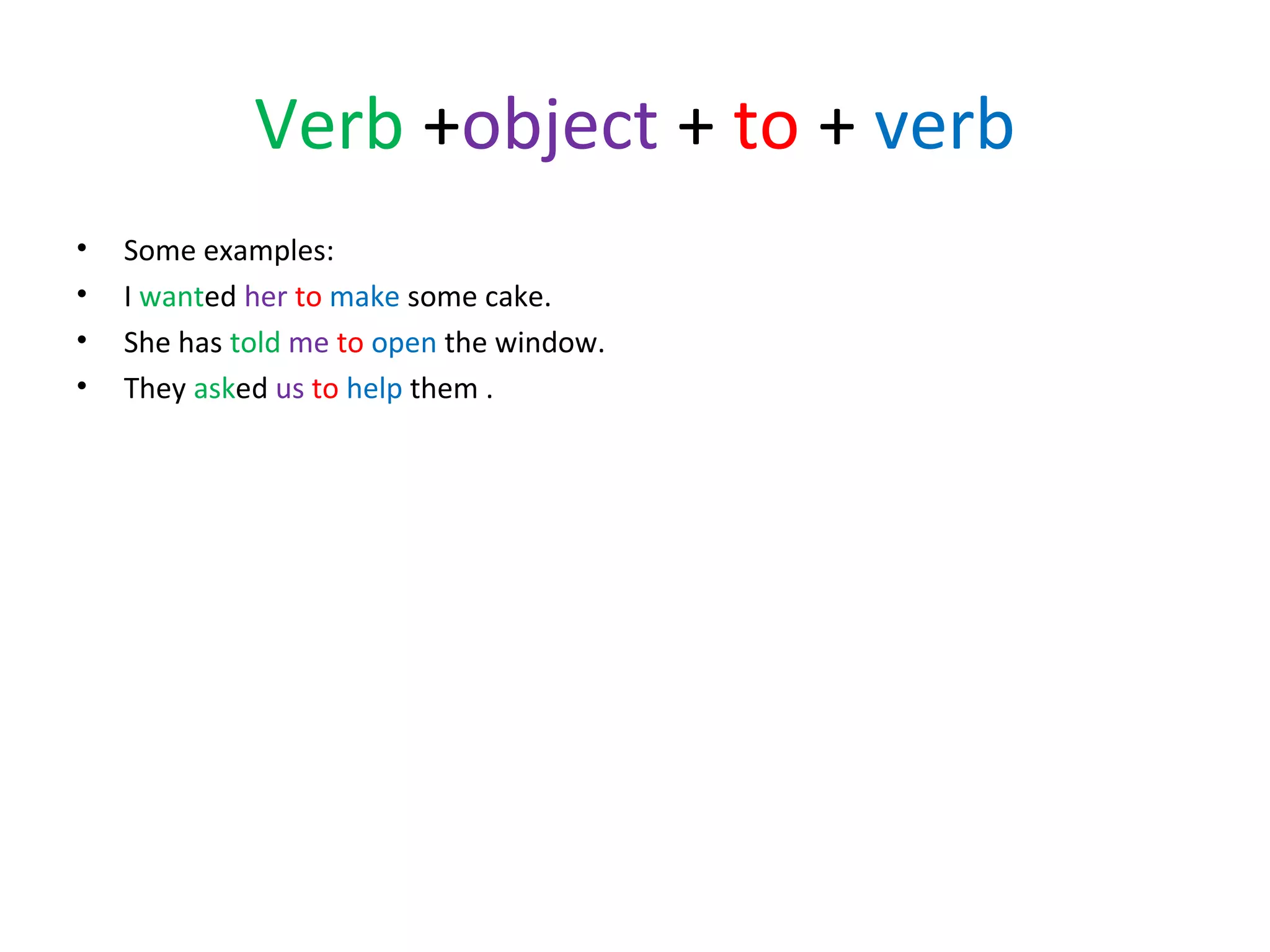
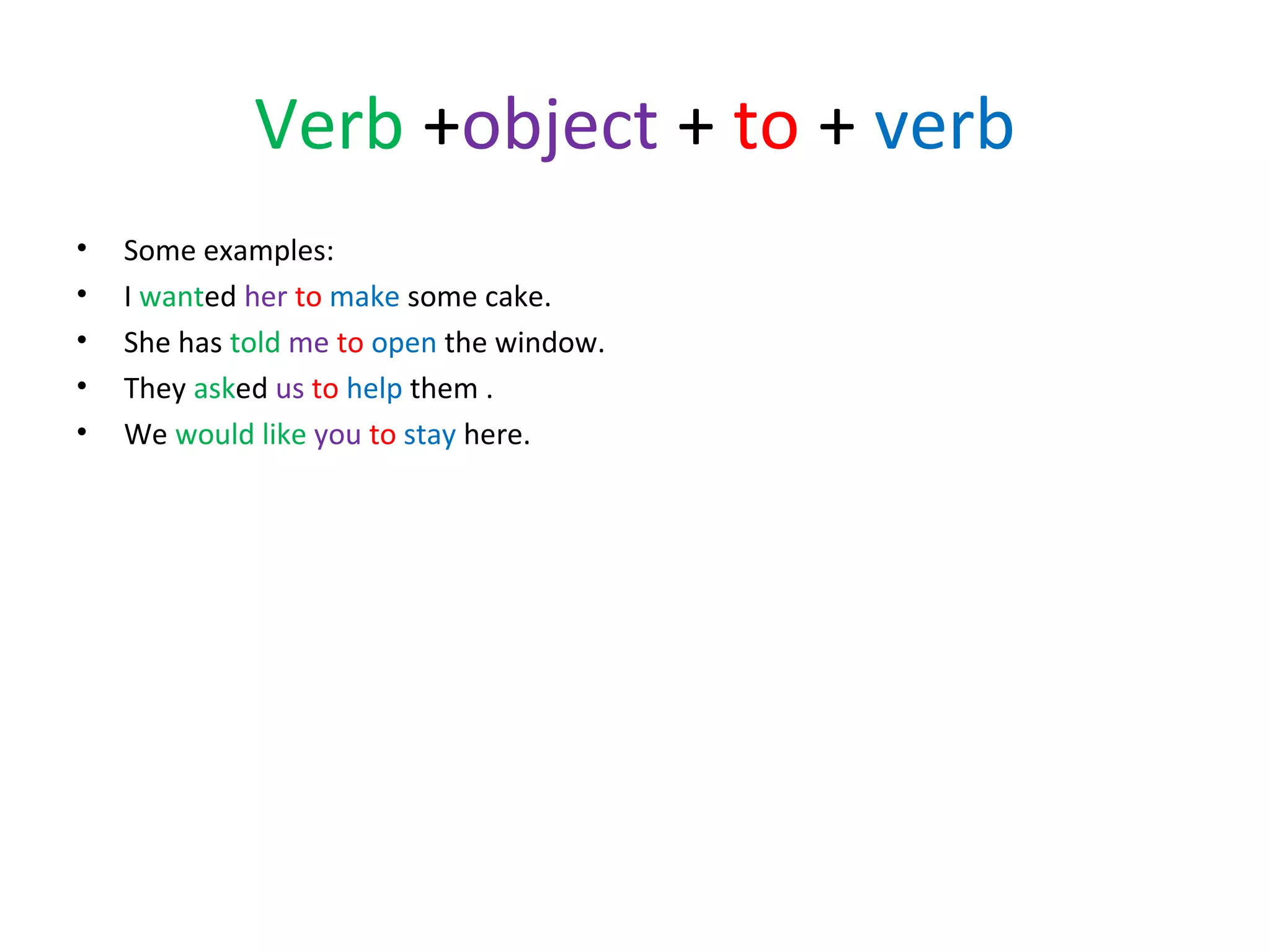
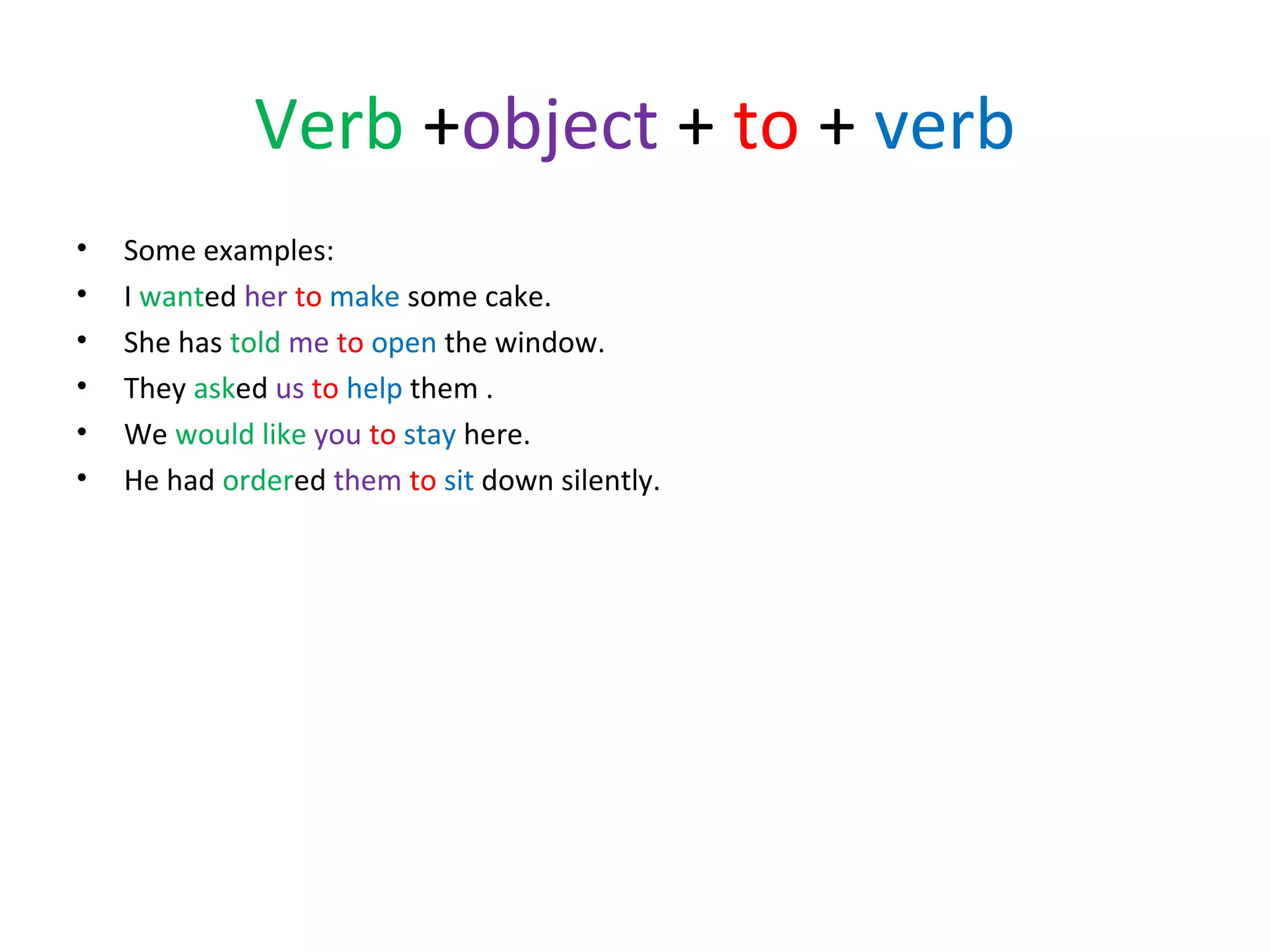
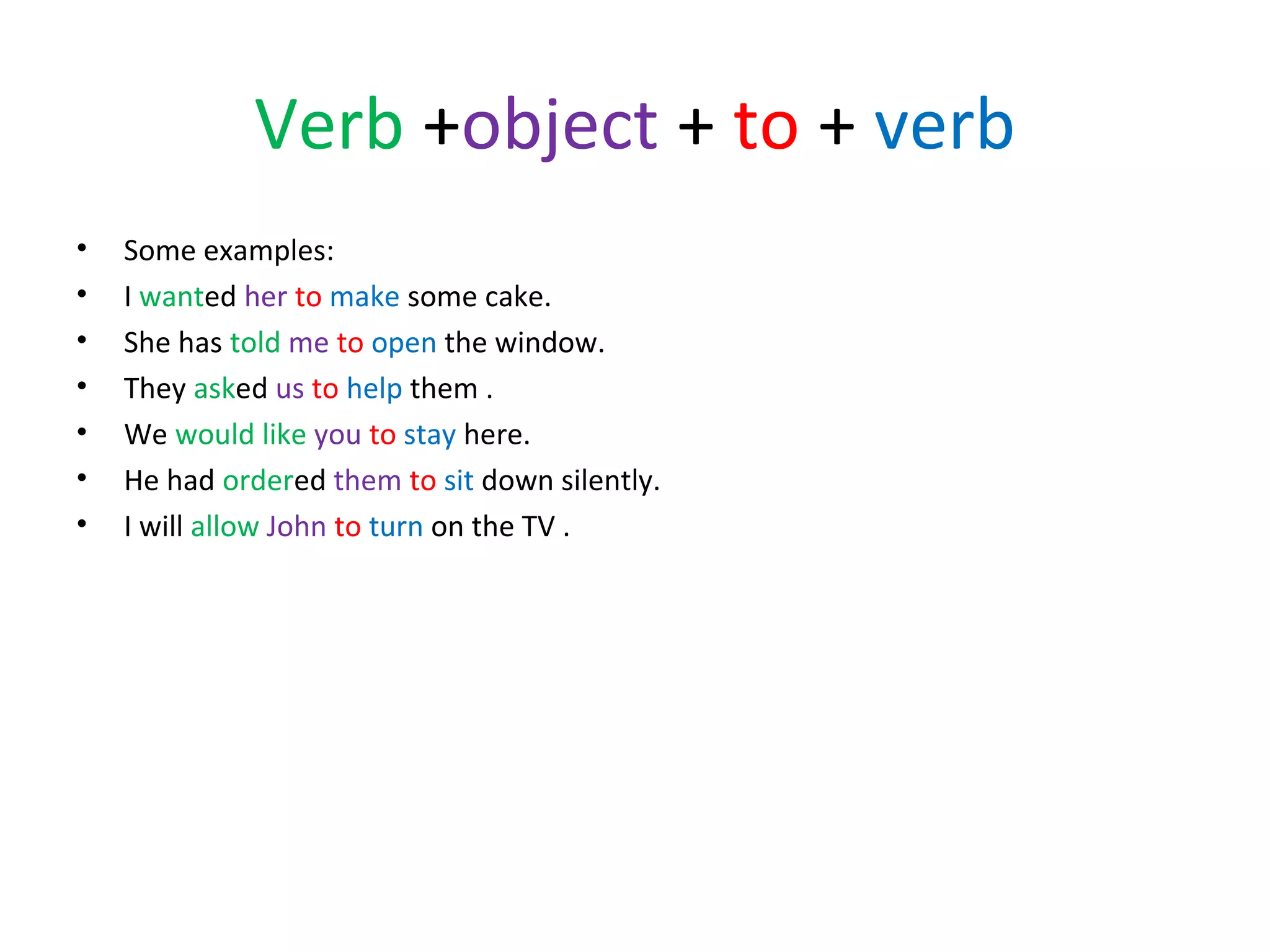
I wanted her to make some cake.
Verb +object + to + verb
•
•
•

Some examples:
I wanted her to make some cake.
She has told me to open the window.
Verb +object + to + verb
•
•
•
•

Some examples:
I wanted her to make some cake.
She has told me to open the window.
They asked us to help them .
Verb +object + to + verb
•
•
•
•
•

Some examples:
I wanted her to make some cake.
She has told me to open the window.
They asked us to help them .
We would like you to stay here.
Verb +object + to + verb
•
•
•
•
•
•

Some examples:
I wanted her to make some cake.
She has told me to open the window.
They asked us to help them .
We would like you to stay here.
He had ordered them to sit down silently.
Verb +object + to + verb
•
•
•
•
•
•
•

Some examples:
I wanted her to make some cake.
She has told me to open the window.
They asked us to help them .
We would like you to stay here.
He had ordered them to sit down silently.
I will allow John to turn on the TV .
Verb +object + to + verb
•
•
•
•
•
•
•
•

Some examples:
I wanted her to make some cake.
She has told me to open the window.
They asked us to help them .
We would like you to stay here.
He had ordered them to sit down silently.
I will allow John to turn on the TV .
We expect you to be on time.
Verb +object + to + verb
•
•
•
•
•
•
•
•
•

Some examples:
I wanted her to make some cake.
She has told me to open the window.
They asked us to help them .
We would like you to stay here.
He had ordered them to sit down silently.
I will allow John to turn on the TV .
We expect you to be on time.
My mother advised me to wear my overcoat.
Verb +object + to + verb
•
•
•
•
•
•
•
•
•
•

Some examples:
I wanted her to make some cake.
She has told me to open the window.
They asked us to help them .
We would like you to stay here.
He had ordered them to sit down silently.
I will allow John to turn on the TV .
We expect you to be on time.
My mother advised me to wear my overcoat.
My father doesn’t permit me to use the car.
Verb +object + to + verb
•
•
•
•
•
•
•
•
•
•
•

Some examples:
I wanted her to make some cake.
She has told me to open the window.
They asked us to help them .
We would like you to stay here.
He had ordered them to sit down silently.
I will allow John to turn on the TV .
We expect you to be on time.
My mother advised me to wear my overcoat.
My father doesn’t permit me to use the car.
They forced us to leave the room.
Verb +object + to + verb
•
•
•
•
•
•
•
•
•
•
•
•

Some examples:
I wanted her to make some cake.
She has told me to open the window.
They asked us to help them .
We would like you to stay here.
He had ordered them to sit down silently.
I will allow John to turn on the TV .
We expect you to be on time.
My mother advised me to wear my overcoat.
My father doesn’t permit me to use the car.
They forced us to leave the room.
I invited some of my friends to have lunch with me.
Verb +object + to + verb
•
•
•
•
•
•
•
•
•
•
•
•
•

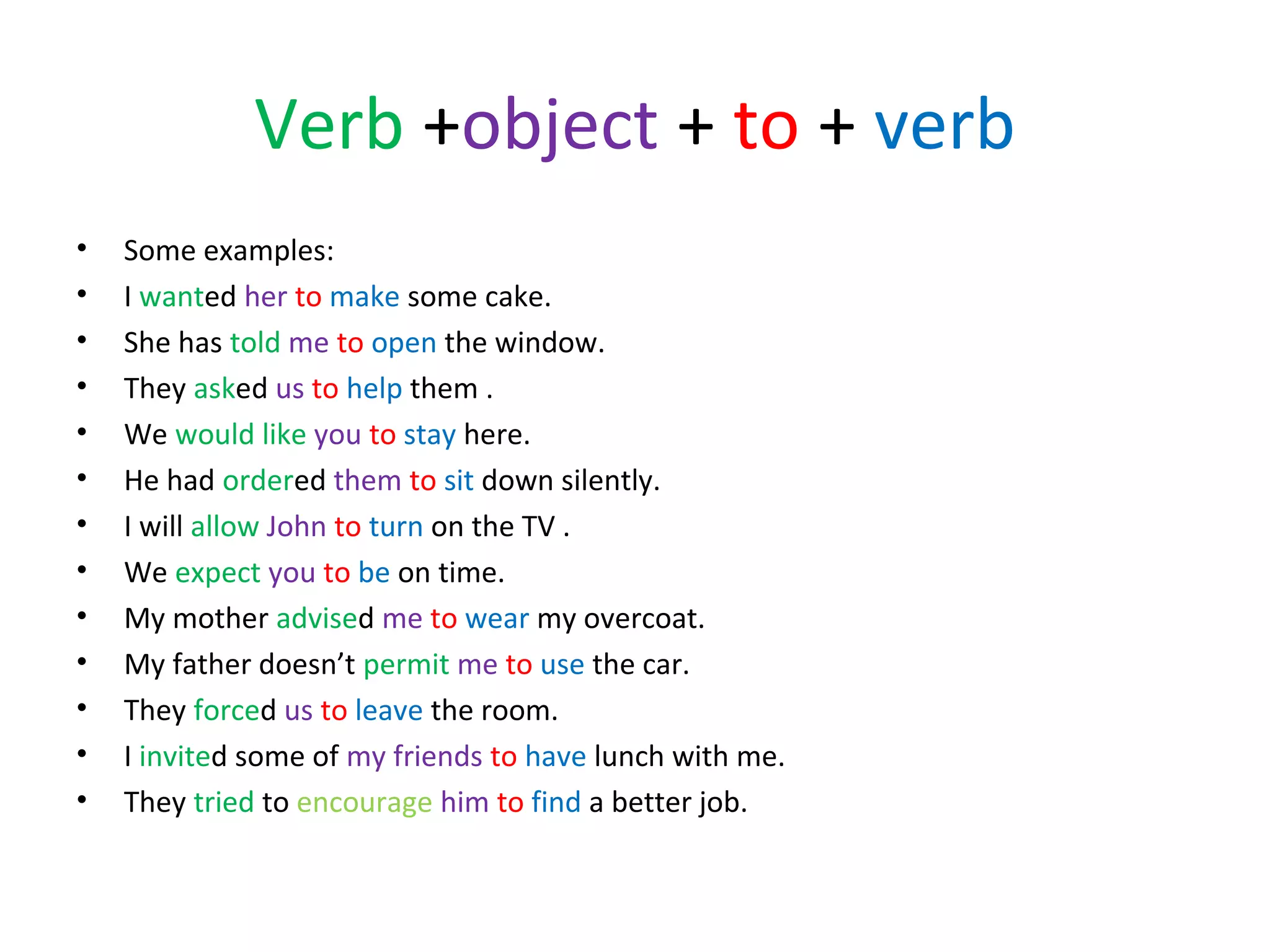
Some examples:
I wanted her to make some cake.
She has told me to open the window.
They asked us to help them .
We would like you to stay here.
He had ordered them to sit down silently.
I will allow John to turn on the TV .
We expect you to be on time.
My mother advised me to wear my overcoat.
My father doesn’t permit me to use the car.
They forced us to leave the room.
I invited some of my friends to have lunch with me.
They tried to encourage him to find a better job.
Verb +object + to + verb
•
•
•
•
•
•
•
•
•
•
•
•
•

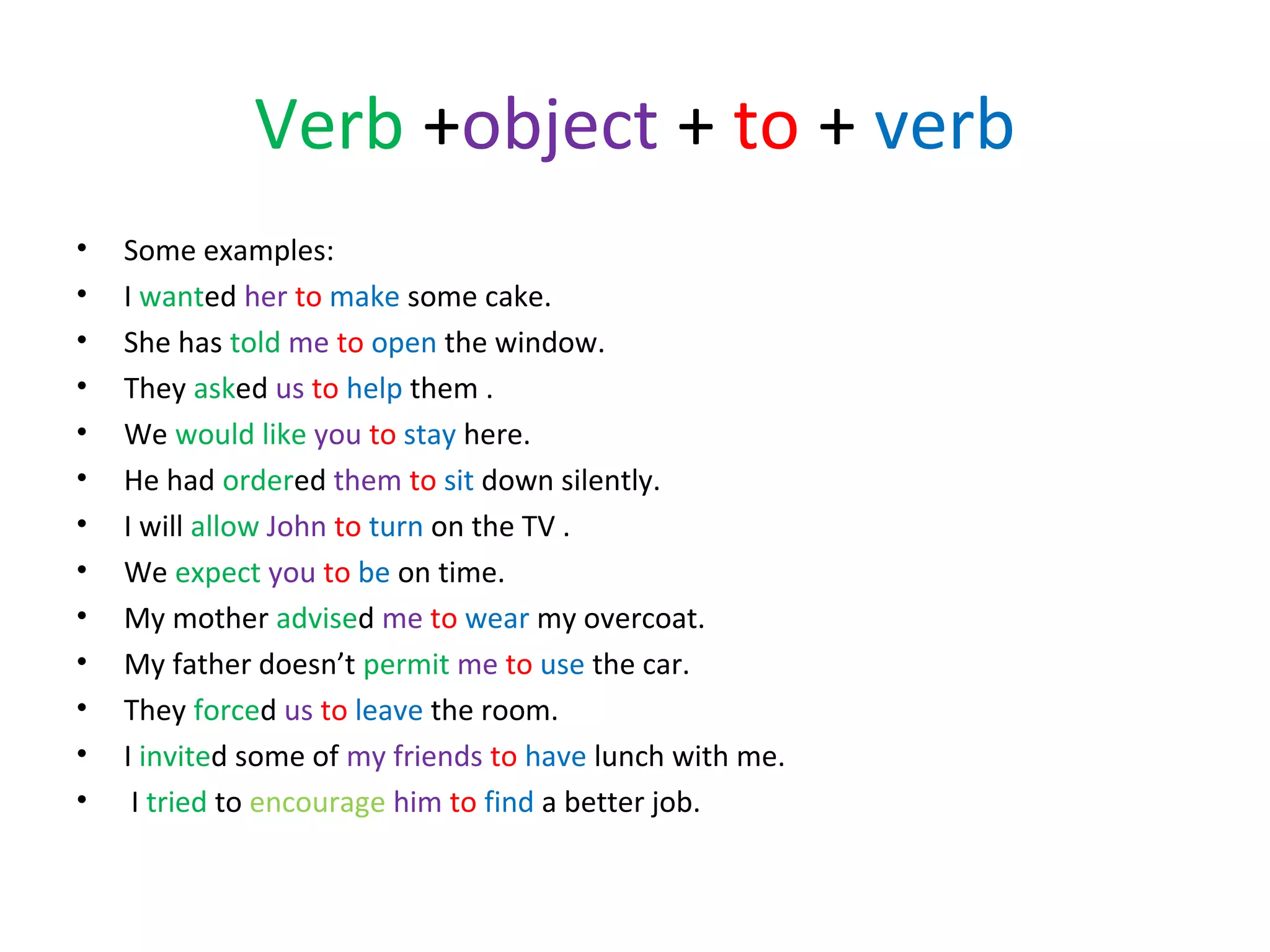
Some examples:
I wanted her to make some cake.
She has told me to open the window.
They asked us to help them .
We would like you to stay here.
He had ordered them to sit down silently.
I will allow John to turn on the TV .
We expect you to be on time.
My mother advised me to wear my overcoat.
My father doesn’t permit me to use the car.
They forced us to leave the room.
I invited some of my friends to have lunch with me.
I tried to encourage him to find a better job.
‫نقل قول‬
‫• نقل قول بر2 نوع است:‬
‫نقل قول‬
‫• نقل قول بر2 نوع است:‬
‫• 1- نقل قول مستقیم‬
‫نقل قول‬
‫• نقل قول بر2 نوع است:‬
‫• 1- نقل قول مستقیم‬
‫• 2- نقل قول غیر مستقیم‬
‫نقل قول‬
‫• نقل قول بر2 نوع است:‬
‫• 1- نقل قول مستقیم‬
‫• اگر سخن کسی را بدون هیچ تغییری نقل کنیم نقل قول‬
‫مستقیم انجام داده ایم در این حالت سخن فرد را در گیومه یا‬
‫علمت نقل قول)” ”( قرار می دهیم‬
‫نقل قول‬
‫• نقل قول بر2 نوع است:‬
‫• 2- نقل قول غیر مستقیم‬
‫• اما اگر در سخن فرد تغییری ایجاد کنیم نقل غیرمستقیم‬
‫انجام داده ایم.‬
‫نقل قول‬
‫• نقل قول می تواند برای یک جمله خبری ، پرسشی یا امری‬
‫انجام شود‬
‫نقل قول‬
‫• نقل قول می تواند برای یک جمله خبری ، پرسشی یا امری‬
‫انجام شود‬
‫• در این درس نقل قول در جمله امری بررسی می شود.‬
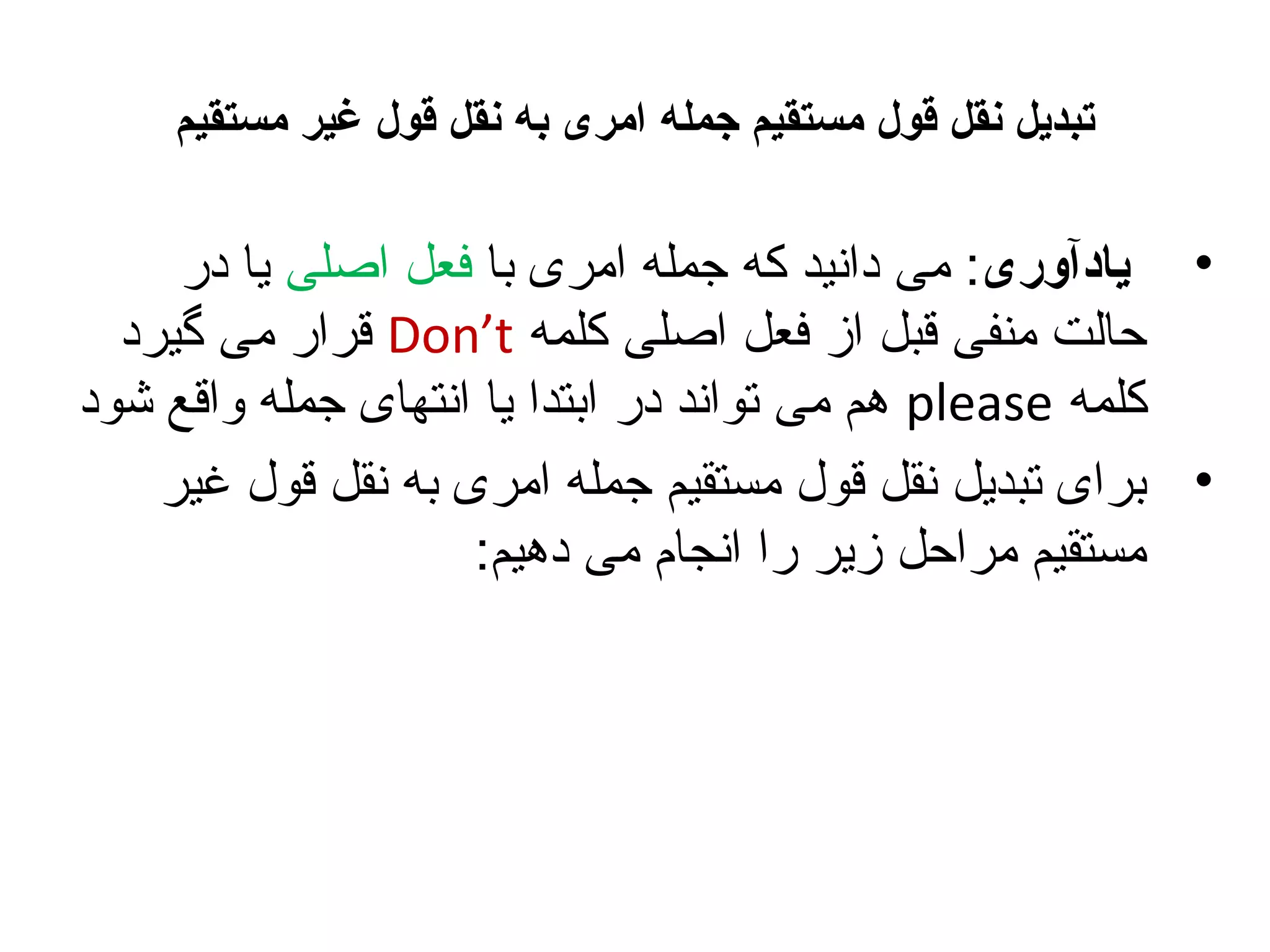
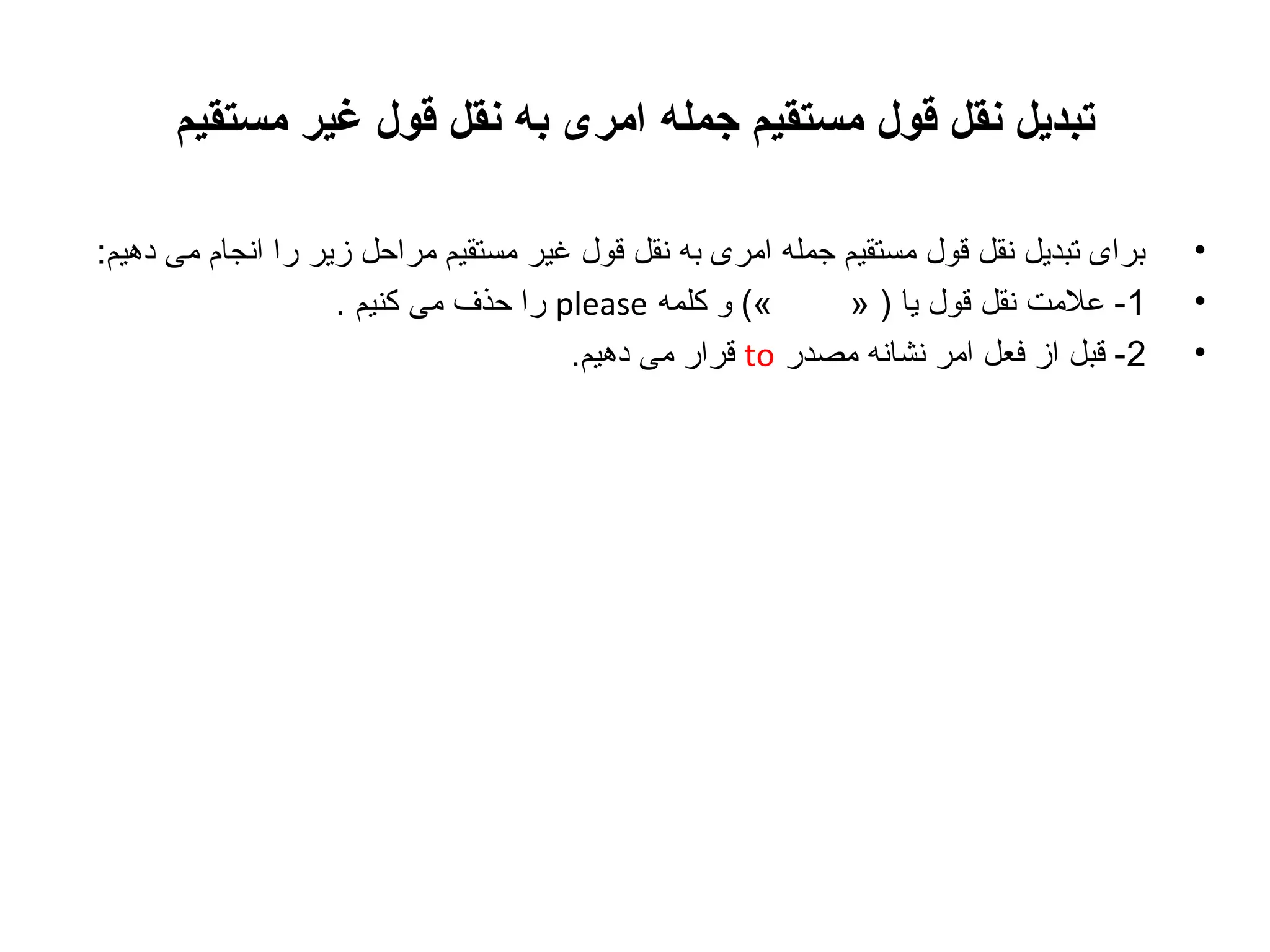
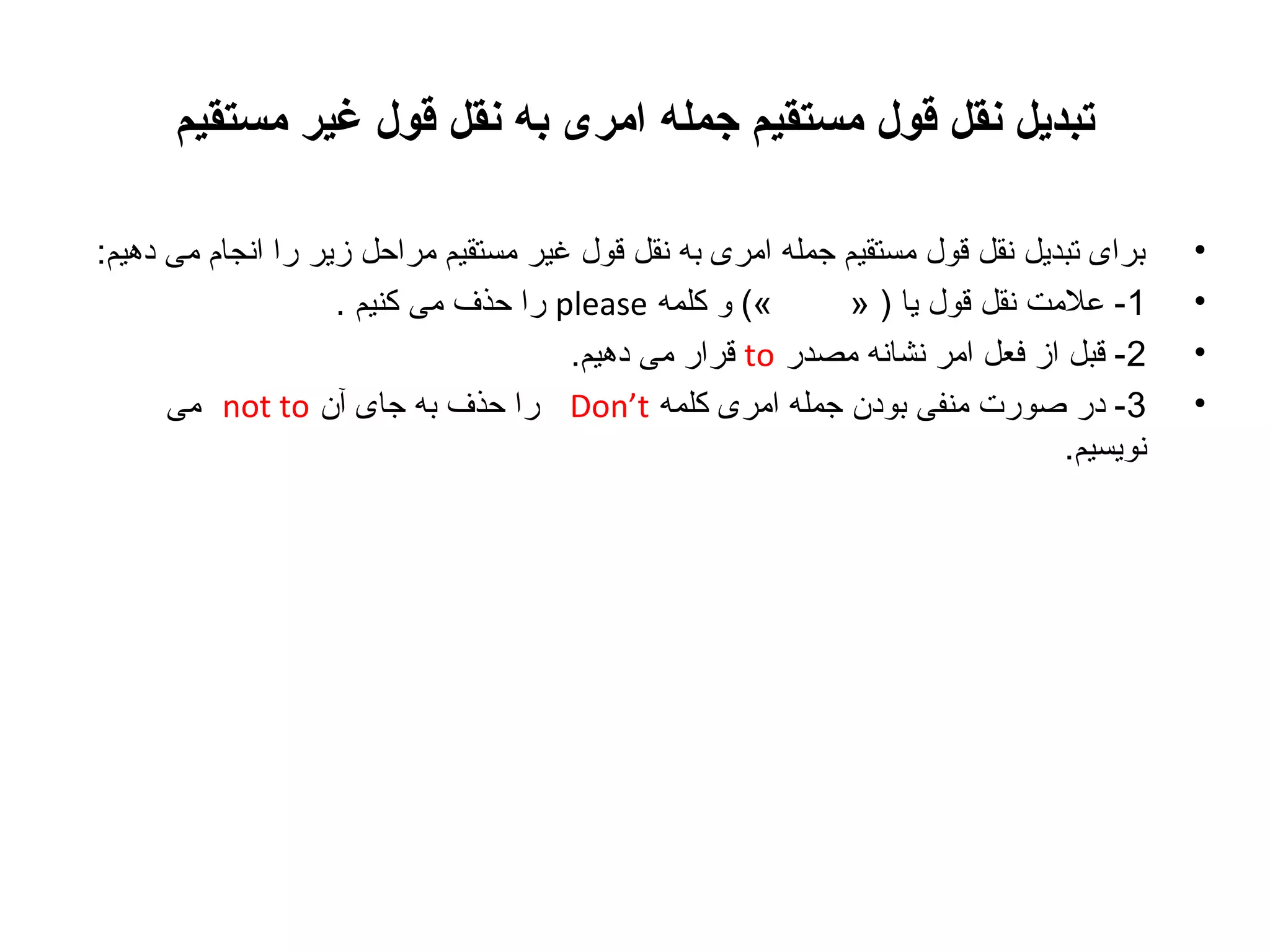
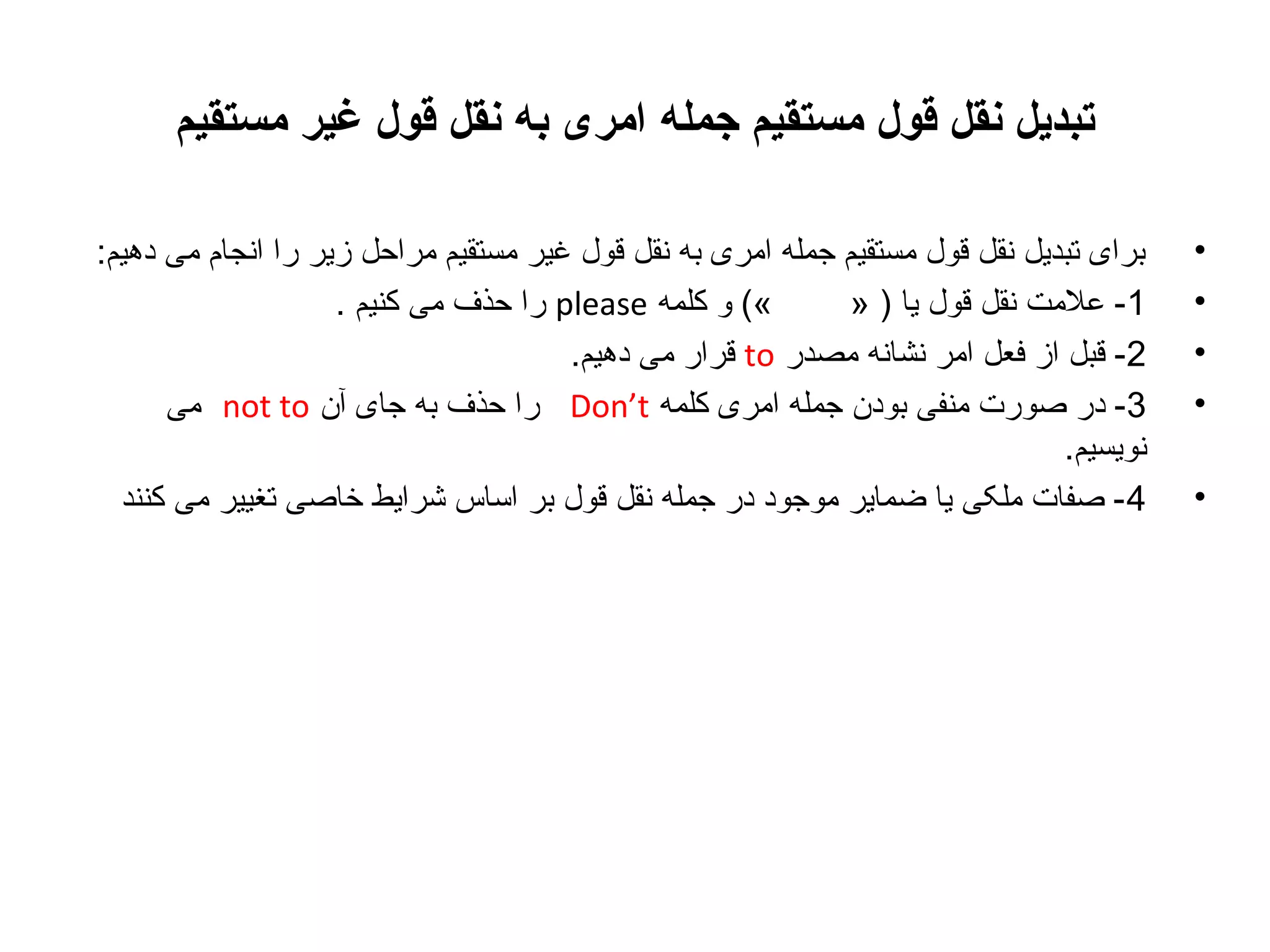
‫تبدیل نقل قول مستقیم جمله امری به نقل قول غیر مستقیم‬

‫• یادآوری: می دانید که جمله امری با فعل اصلی یا در‬
‫حالت منفی قبل از فعل اصلی کلمه ‪ Don’t‬قرار می گیرد‬
‫کلمه ‪ please‬هم می تواند در ابتدا یا انتهای جمله واقع شود‬
‫تبدیل نقل قول مستقیم جمله امری به نقل قول غیر مستقیم‬

‫• یادآوری: می دانید که جمله امری با فعل اصلی یا در‬
‫حالت منفی قبل از فعل اصلی کلمه ‪ Don’t‬قرار می گیرد‬
‫کلمه ‪ please‬هم می تواند در ابتدا یا انتهای جمله واقع شود‬
‫• برای تبدیل نقل قول مستقیم جمله امری به نقل قول غیر‬
‫مستقیم مراحل زیر را انجام می دهیم:‬
‫:توضیح‬

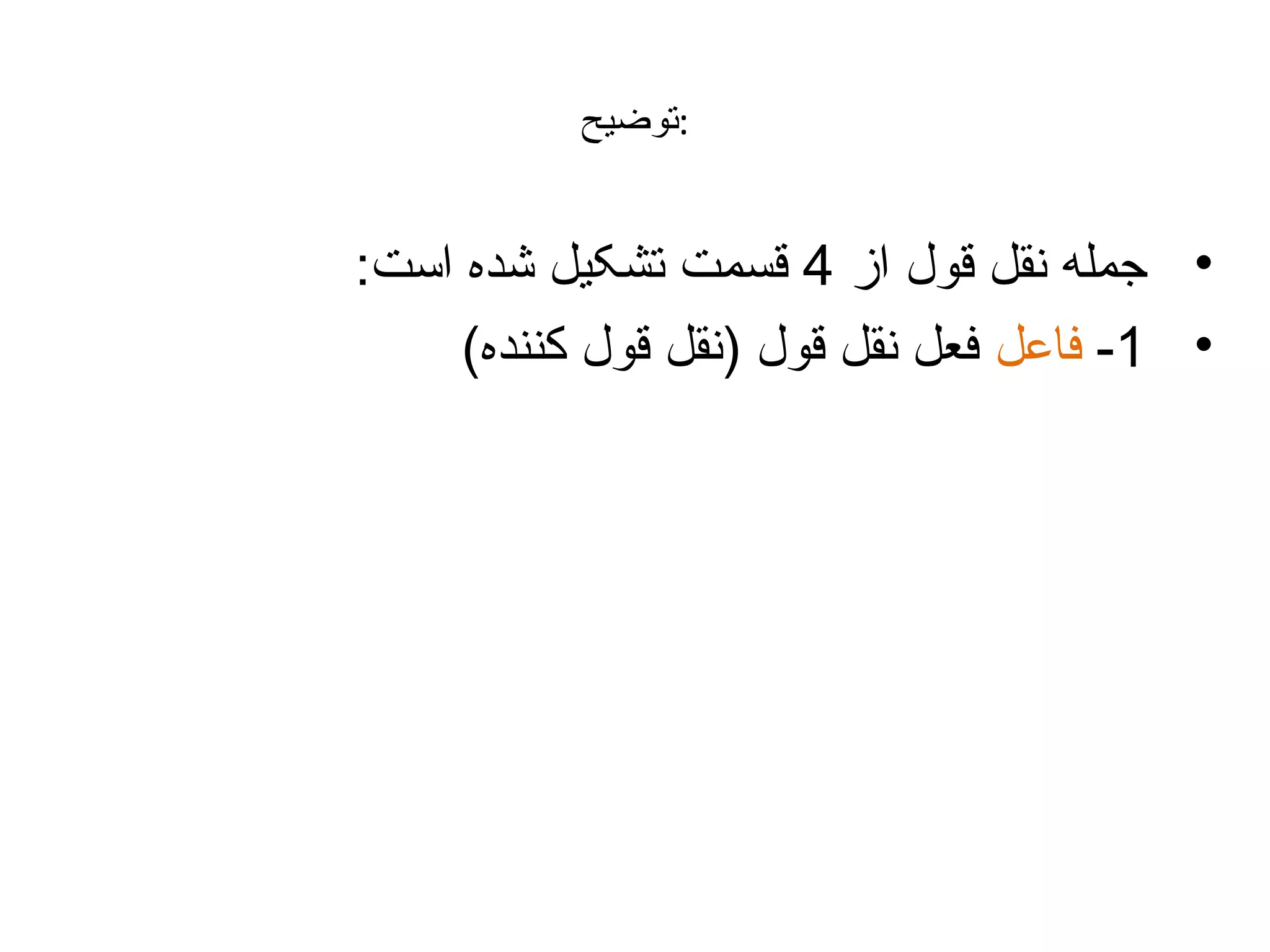
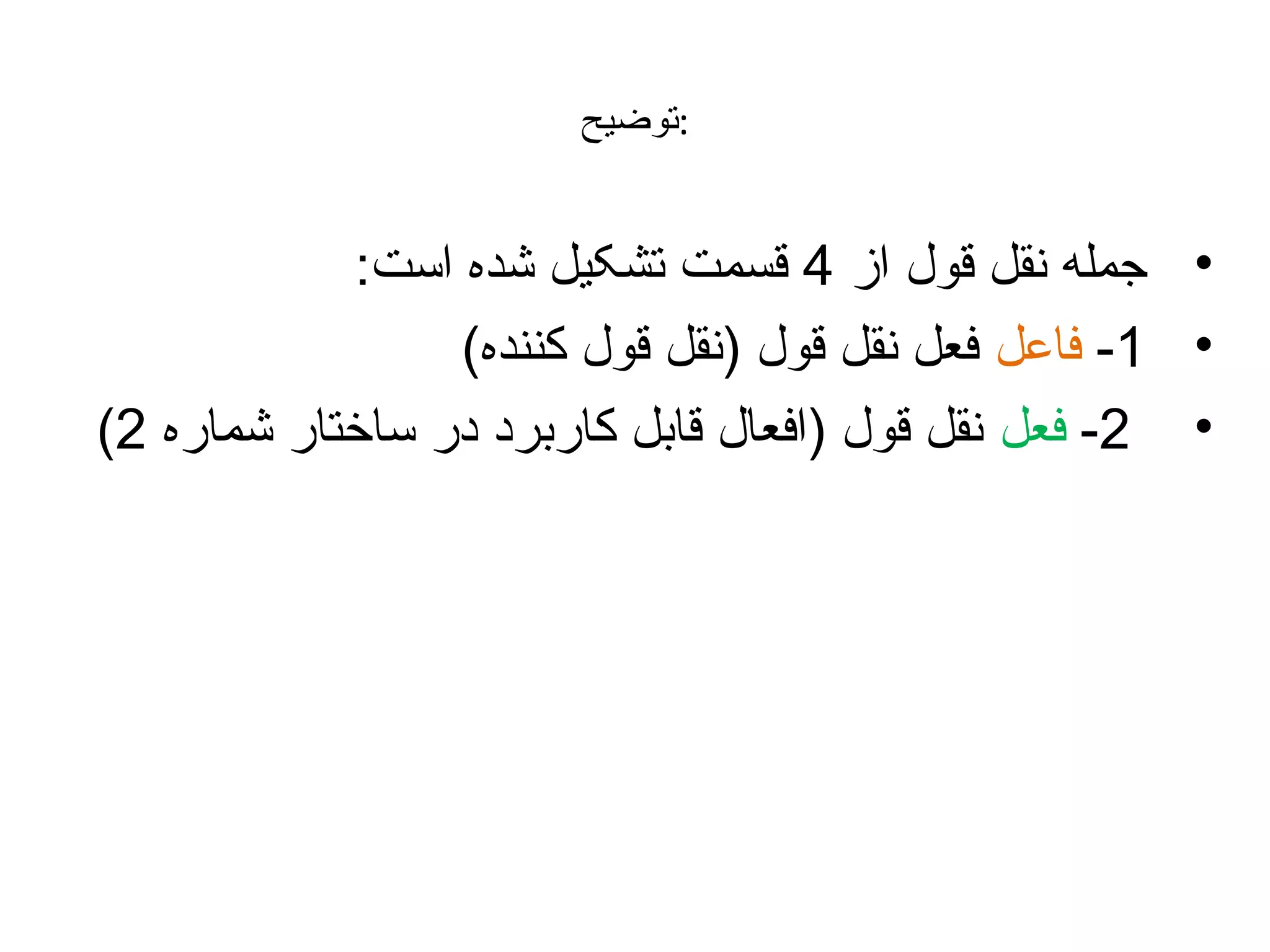
‫• جمله نقل قول از 4 قسمت تشکیل شده است:‬
‫:توضیح‬

‫• جمله نقل قول از 4 قسمت تشکیل شده است:‬
‫• 1- فاعل فعل نقل قول )نقل قول کننده(‬
‫:توضیح‬

‫• جمله نقل قول از 4 قسمت تشکیل شده است:‬
‫• 1- فاعل فعل نقل قول )نقل قول کننده(‬
‫• 2- فعل نقل قول )افعال قابل کاربرد در ساختار شماره 2(‬
‫:توضیح‬

‫•‬
‫•‬
‫•‬
‫•‬

‫جمله نقل قول از 4 قسمت تشکیل شده است:‬
‫1- فاعل فعل نقل قول )نقل قول کننده(‬
‫2- فعل نقل قول )افعال قابل کاربرد در ساختار شماره 2(‬
‫3- مفعول فعل نقل قول )مخاطب (‬
‫:توضیح‬

‫•‬
‫•‬
‫•‬
‫•‬
‫•‬

‫جمله نقل قول از 4 قسمت تشکیل شده است:‬
‫1- فاعل فعل نقل قول )نقل قول کننده(‬
‫2- فعل نقل قول )افعال قابل کاربرد در ساختار شماره 2(‬
‫3- مفعول فعل نقل قول )مخاطب (‬
‫4- جمله نقل شونده‬
‫تبدیل نقل قول مستقیم جمله امری به نقل قول غیر مستقیم‬
‫•‬

‫برای تبدیل نقل قول مستقیم جمله امری به نقل قول غیر مستقیم مراحل زیر را انجام می دهیم:‬
‫تبدیل نقل قول مستقیم جمله امری به نقل قول غیر مستقیم‬
‫•‬
‫•‬

‫برای تبدیل نقل قول مستقیم جمله امری به نقل قول غیر مستقیم مراحل زیر را انجام می دهیم:‬
‫«( و کلمه ‪ please‬را حذف می کنیم .‬
‫1- علمت نقل قول یا ) »‬
‫تبدیل نقل قول مستقیم جمله امری به نقل قول غیر مستقیم‬
‫•‬
‫•‬
‫•‬

‫برای تبدیل نقل قول مستقیم جمله امری به نقل قول غیر مستقیم مراحل زیر را انجام می دهیم:‬
‫«( و کلمه ‪ please‬را حذف می کنیم .‬
‫1- علمت نقل قول یا ) »‬
‫2- قبل از فعل امر نشانه مصدر ‪ to‬قرار می دهیم.‬
‫تبدیل نقل قول مستقیم جمله امری به نقل قول غیر مستقیم‬
‫•‬
‫•‬
‫•‬
‫•‬

‫برای تبدیل نقل قول مستقیم جمله امری به نقل قول غیر مستقیم مراحل زیر را انجام می دهیم:‬
‫«( و کلمه ‪ please‬را حذف می کنیم .‬
‫1- علمت نقل قول یا ) »‬
‫2- قبل از فعل امر نشانه مصدر ‪ to‬قرار می دهیم.‬
‫3- در صورت منفی بودن جمله امری کلمه ‪ Don’t‬را حذف به جای آن ‪ not to‬می‬
‫نویسیم.‬
‫تبدیل نقل قول مستقیم جمله امری به نقل قول غیر مستقیم‬
‫•‬
‫•‬
‫•‬
‫•‬
‫•‬

‫برای تبدیل نقل قول مستقیم جمله امری به نقل قول غیر مستقیم مراحل زیر را انجام می دهیم:‬
‫«( و کلمه ‪ please‬را حذف می کنیم .‬
‫1- علمت نقل قول یا ) »‬
‫2- قبل از فعل امر نشانه مصدر ‪ to‬قرار می دهیم.‬
‫3- در صورت منفی بودن جمله امری کلمه ‪ Don’t‬را حذف به جای آن ‪ not to‬می‬
‫نویسیم.‬
‫4 - صفات ملکی یا ضمایر موجود در جمله نقل قول بر اساس شرایط خاصی تغییر می کنند‬
‫تغییرات خاص‬
‫•‬

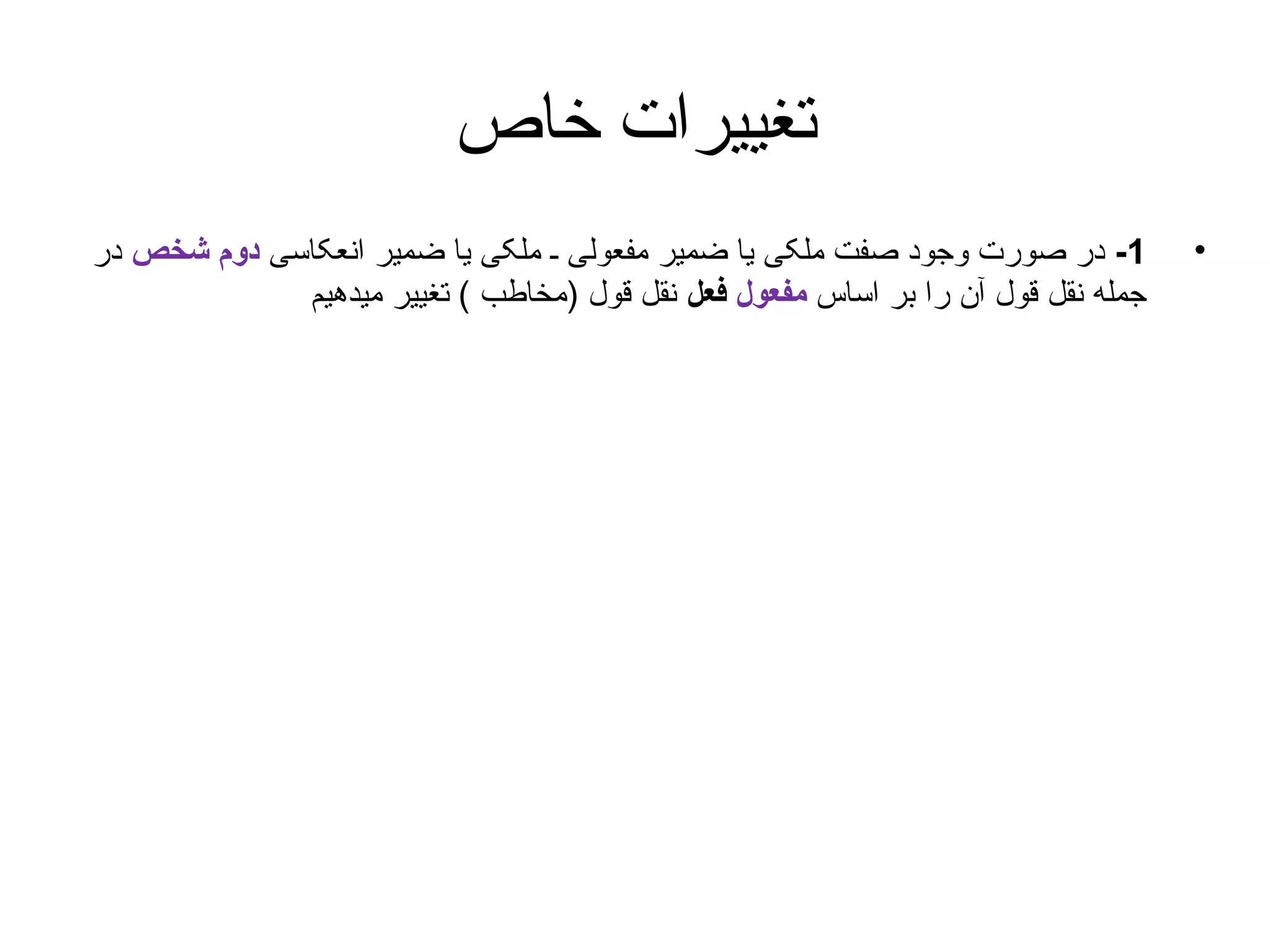
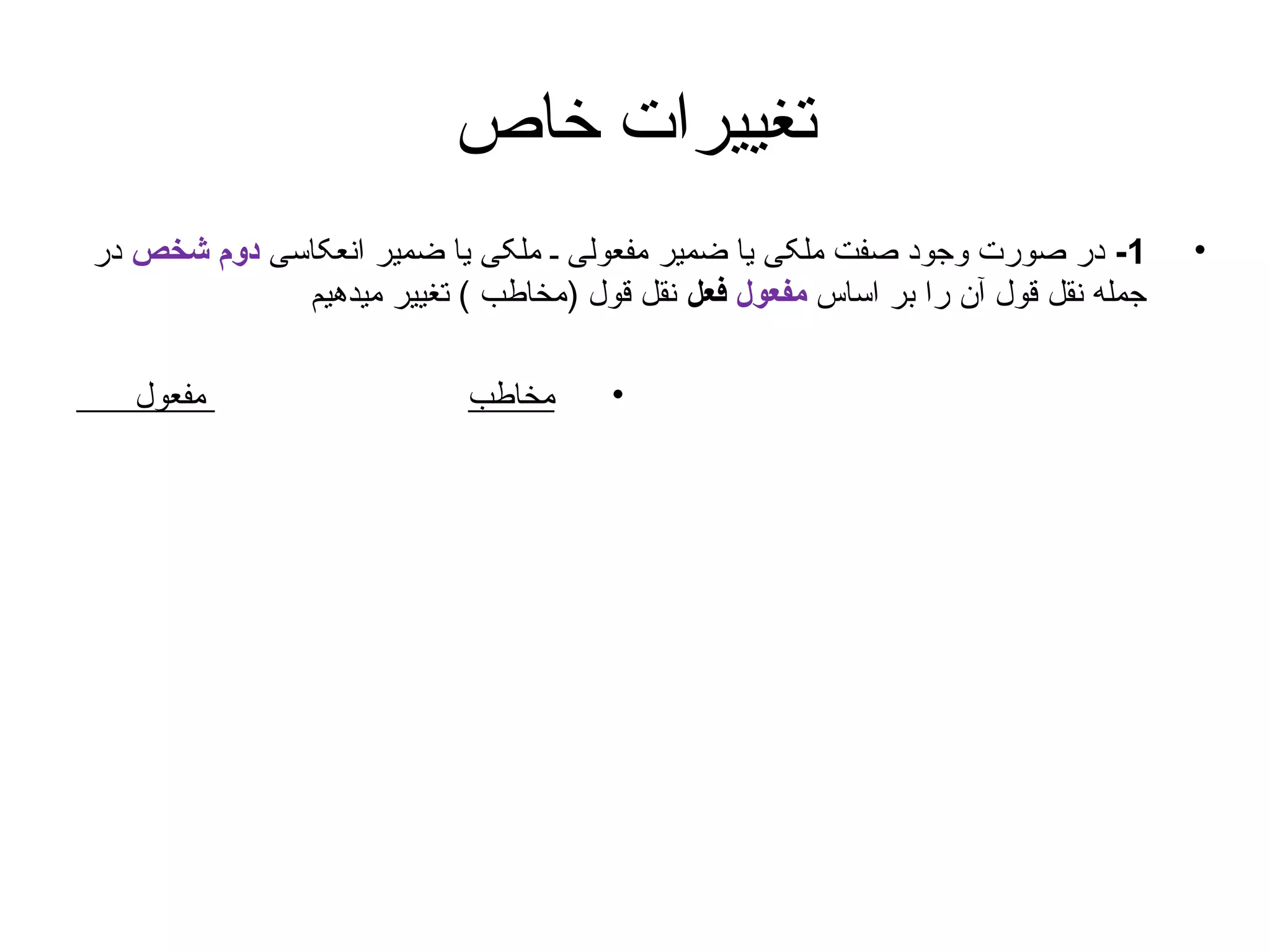
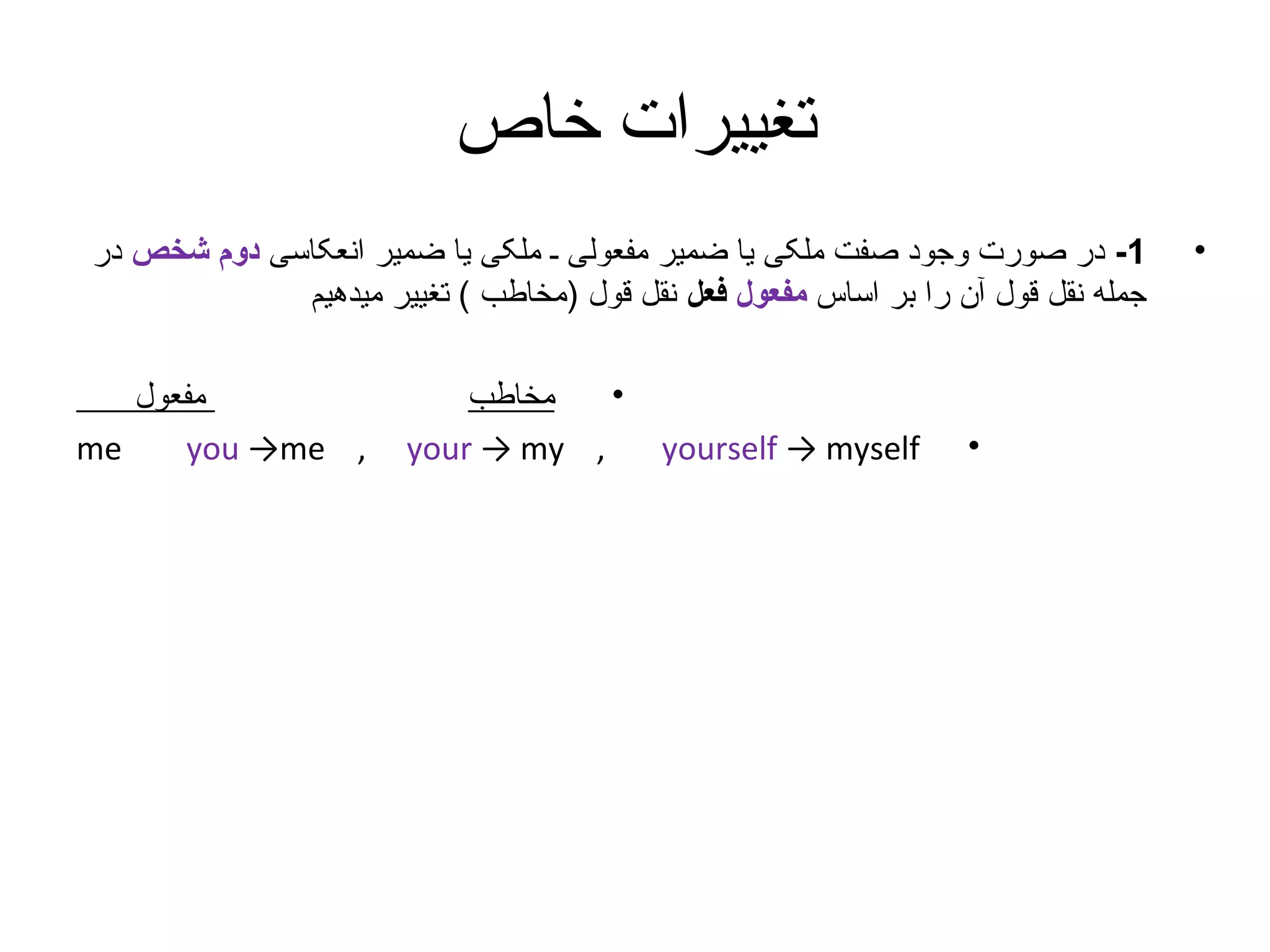
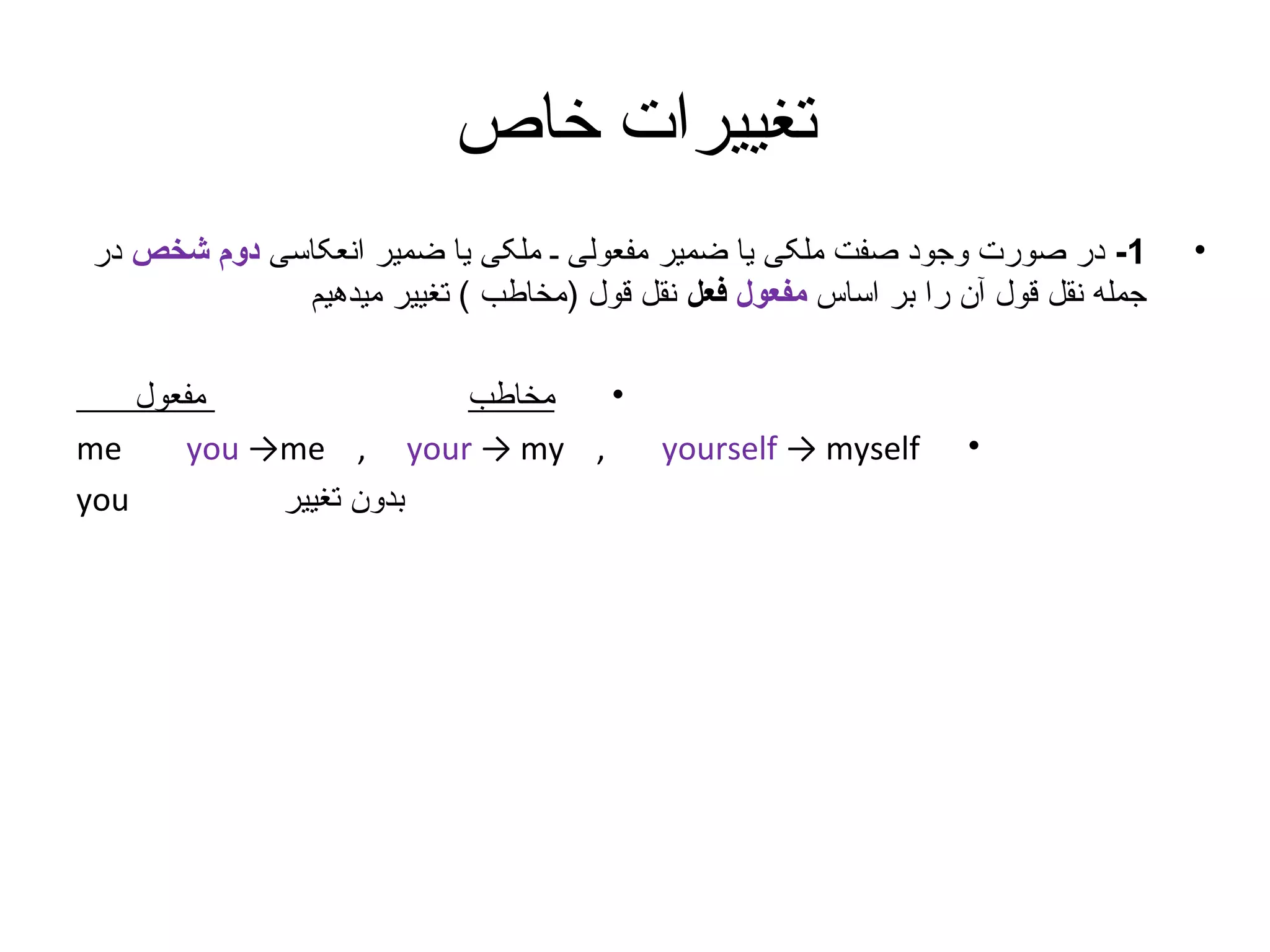
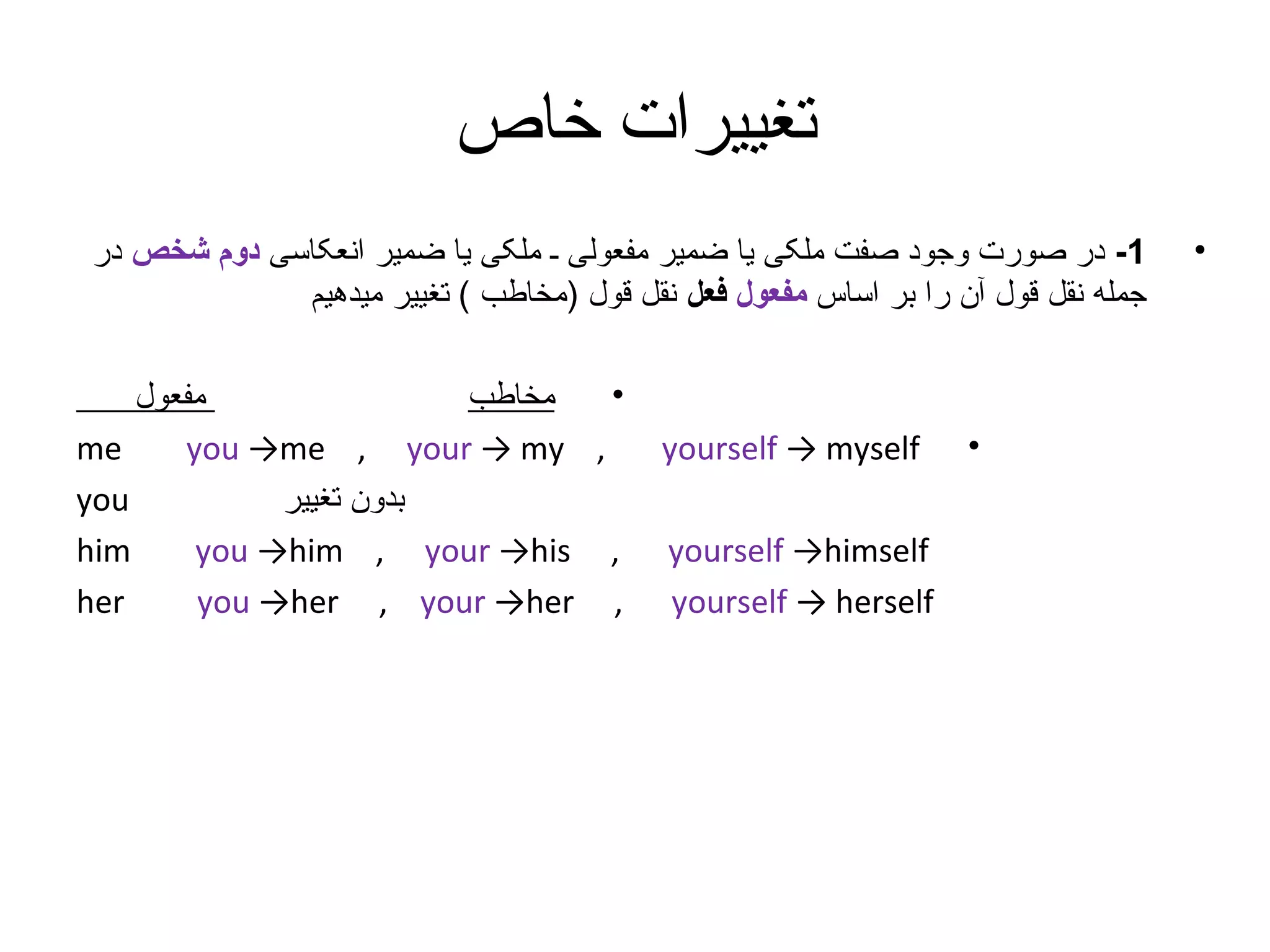
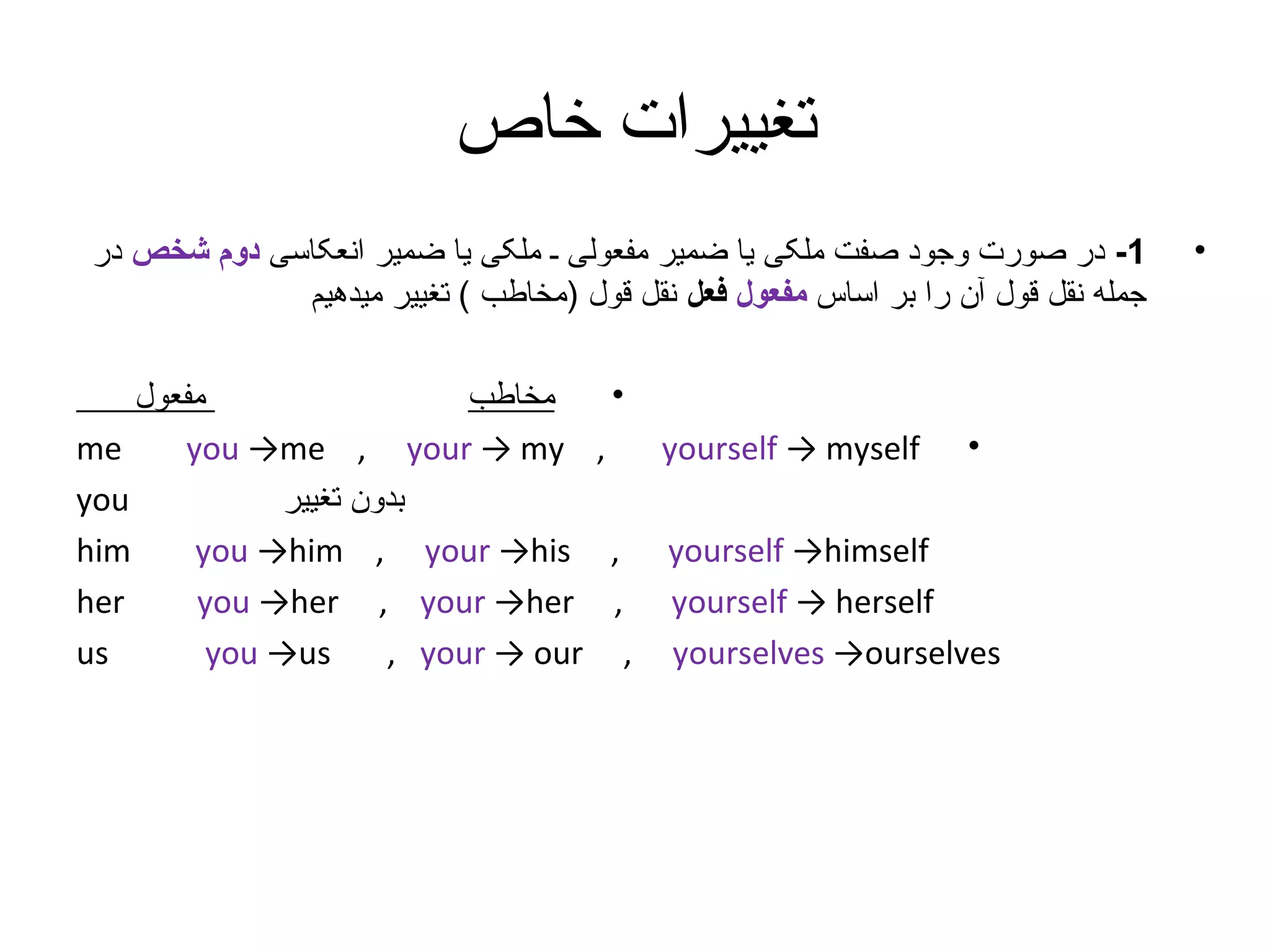
‫1- در صورت وجود صفت ملکی یا ضمیر مفعولی ـ ملکی یا ضمیر انعکاسی دوم شخص در‬
‫جمله نقل قول آن را بر اساس مفعول فعل نقل قول )مخاطب ( تغییر میدهیم‬
‫تغییرات خاص‬
‫•‬

‫1- در صورت وجود صفت ملکی یا ضمیر مفعولی ـ ملکی یا ضمیر انعکاسی دوم شخص در‬
‫جمله نقل قول آن را بر اساس مفعول فعل نقل قول )مخاطب ( تغییر میدهیم‬
‫•‬

‫مخاطب‬

‫مفعول‬
‫تغییرات خاص‬
‫•‬

‫1- در صورت وجود صفت ملکی یا ضمیر مفعولی ـ ملکی یا ضمیر انعکاسی دوم شخص در‬
‫جمله نقل قول آن را بر اساس مفعول فعل نقل قول )مخاطب ( تغییر میدهیم‬

‫•‬

‫‪yourself → myself‬‬

‫•‬
‫مخاطب‬
‫, ‪your → my‬‬

‫مفعول‬
‫‪me‬‬
‫, ‪you →me‬‬
‫تغییرات خاص‬
‫•‬

‫1- در صورت وجود صفت ملکی یا ضمیر مفعولی ـ ملکی یا ضمیر انعکاسی دوم شخص در‬
‫جمله نقل قول آن را بر اساس مفعول فعل نقل قول )مخاطب ( تغییر میدهیم‬

‫•‬

‫‪yourself → myself‬‬

‫•‬
‫مفعول‬
‫مخاطب‬
‫‪me‬‬
‫, ‪you →me , your → my‬‬
‫‪you‬‬
‫بدون تغییر‬
‫تغییرات خاص‬
‫•‬

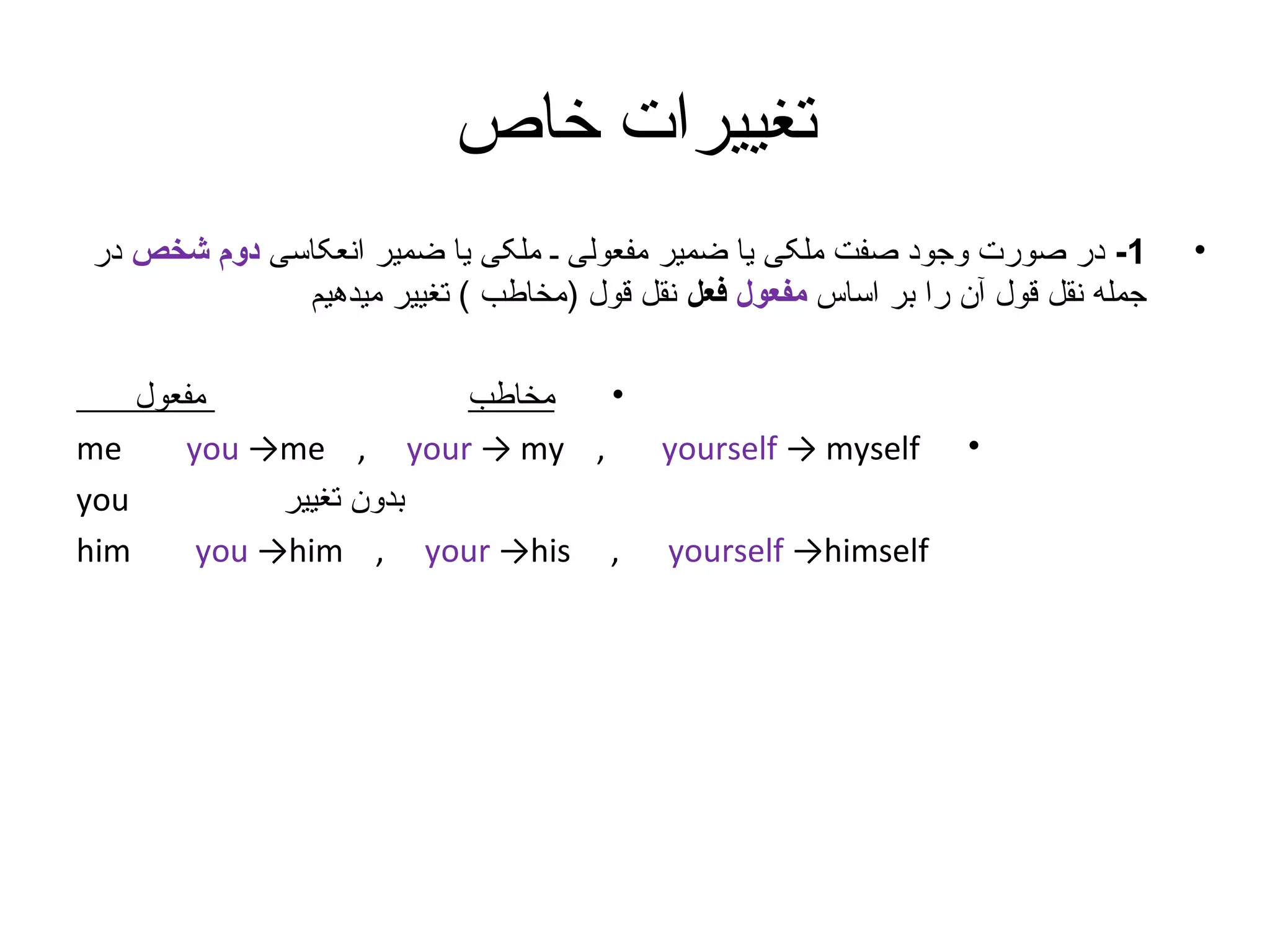
‫1- در صورت وجود صفت ملکی یا ضمیر مفعولی ـ ملکی یا ضمیر انعکاسی دوم شخص در‬
‫جمله نقل قول آن را بر اساس مفعول فعل نقل قول )مخاطب ( تغییر میدهیم‬

‫•‬

‫‪yourself → myself‬‬
‫‪yourself →himself‬‬

‫•‬
‫مفعول‬
‫مخاطب‬
‫‪me‬‬
‫, ‪you →me , your → my‬‬
‫‪you‬‬
‫بدون تغییر‬
‫‪him‬‬
‫, ‪you →him , your →his‬‬
‫تغییرات خاص‬
‫•‬

‫1- در صورت وجود صفت ملکی یا ضمیر مفعولی ـ ملکی یا ضمیر انعکاسی دوم شخص در‬
‫جمله نقل قول آن را بر اساس مفعول فعل نقل قول )مخاطب ( تغییر میدهیم‬

‫•‬

‫‪yourself → myself‬‬
‫‪yourself →himself‬‬
‫‪yourself → herself‬‬

‫•‬
‫مفعول‬
‫مخاطب‬
‫‪me‬‬
‫, ‪you →me , your → my‬‬
‫‪you‬‬
‫بدون تغییر‬
‫‪him‬‬
‫, ‪you →him , your →his‬‬
‫‪her‬‬
‫, ‪you →her , your →her‬‬
‫تغییرات خاص‬
‫•‬

‫1- در صورت وجود صفت ملکی یا ضمیر مفعولی ـ ملکی یا ضمیر انعکاسی دوم شخص در‬
‫جمله نقل قول آن را بر اساس مفعول فعل نقل قول )مخاطب ( تغییر میدهیم‬
‫•‬
‫•‬

‫‪yourself → myself‬‬

‫‪yourself →himself‬‬
‫‪yourself → herself‬‬
‫‪yourselves →ourselves‬‬

‫,‬
‫,‬
‫,‬
‫,‬

‫مفعول‬
‫مخاطب‬
‫‪me‬‬
‫‪you →me , your → my‬‬
‫‪you‬‬
‫بدون تغییر‬
‫‪him‬‬
‫‪you →him , your →his‬‬
‫‪her‬‬
‫‪you →her , your →her‬‬
‫‪us‬‬
‫‪you →us‬‬
‫‪, your → our‬‬
‫تغییرات خاص‬
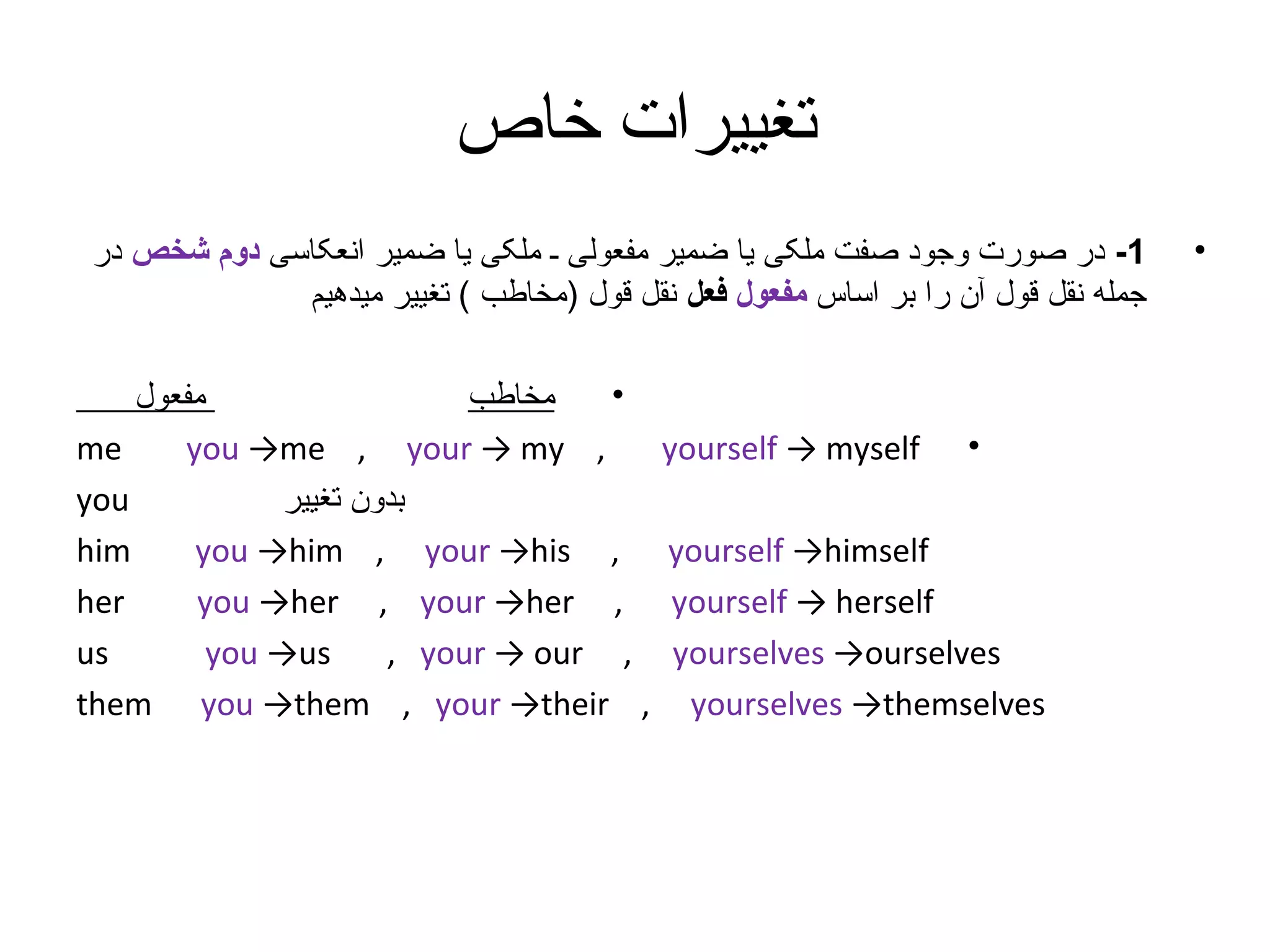
‫1- در صورت وجود صفت ملکی یا ضمیر مفعولی ـ ملکی یا ضمیر انعکاسی دوم شخص در‬
‫جمله نقل قول آن را بر اساس مفعول فعل نقل قول )مخاطب ( تغییر میدهیم‬
•
‫مفعول‬
‫مخاطب‬
me
you →me , your → my ,
you
‫بدون تغییر‬
him
you →him , your →his ,
her
you →her , your →her ,
us
you →us
, your → our ,
them you →them , your →their ,

yourself → myself

•

yourself →himself
yourself → herself
yourselves →ourselves
yourselves →themselves

•
‫تغییرات خاص‬
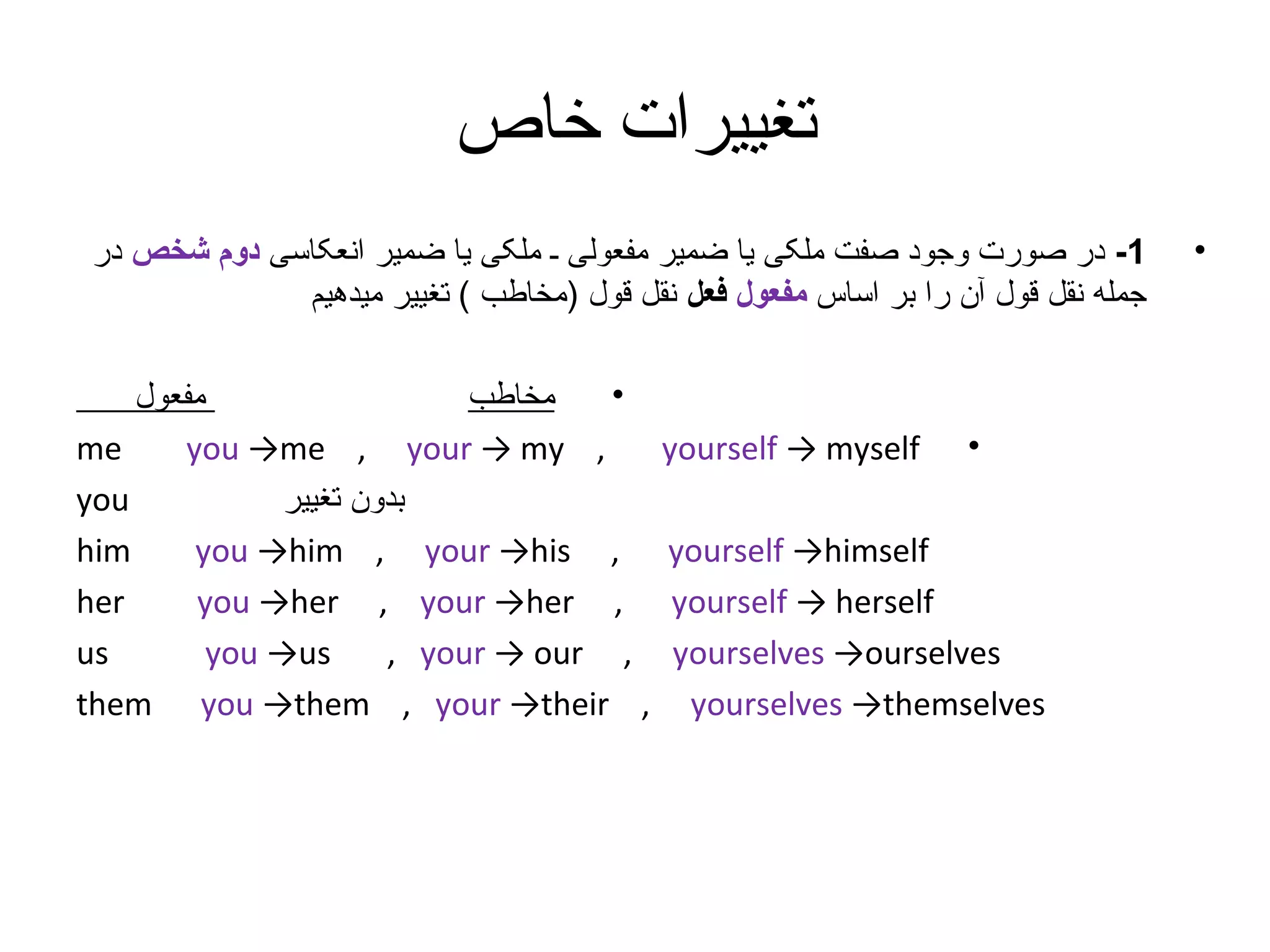
‫1- در صورت وجود صفت ملکی یا ضمیر مفعولی ـ ملکی یا ضمیر انعکاسی دوم شخص در‬
‫جمله نقل قول آن را بر اساس مفعول فعل نقل قول )مخاطب ( تغییر میدهیم‬
•
‫مفعول‬
‫مخاطب‬
me
you →me , your → my ,
you
‫بدون تغییر‬
him
you →him , your →his ,
her
you →her , your →her ,
us
you →us
, your → our ,
them you →them , your →their ,

yourself → myself

•

yourself →himself
yourself → herself
yourselves →ourselves
yourselves →themselves

•
‫تغییرات خاص‬
‫•‬

‫2‬
‫تغییرات خاص‬
‫•‬

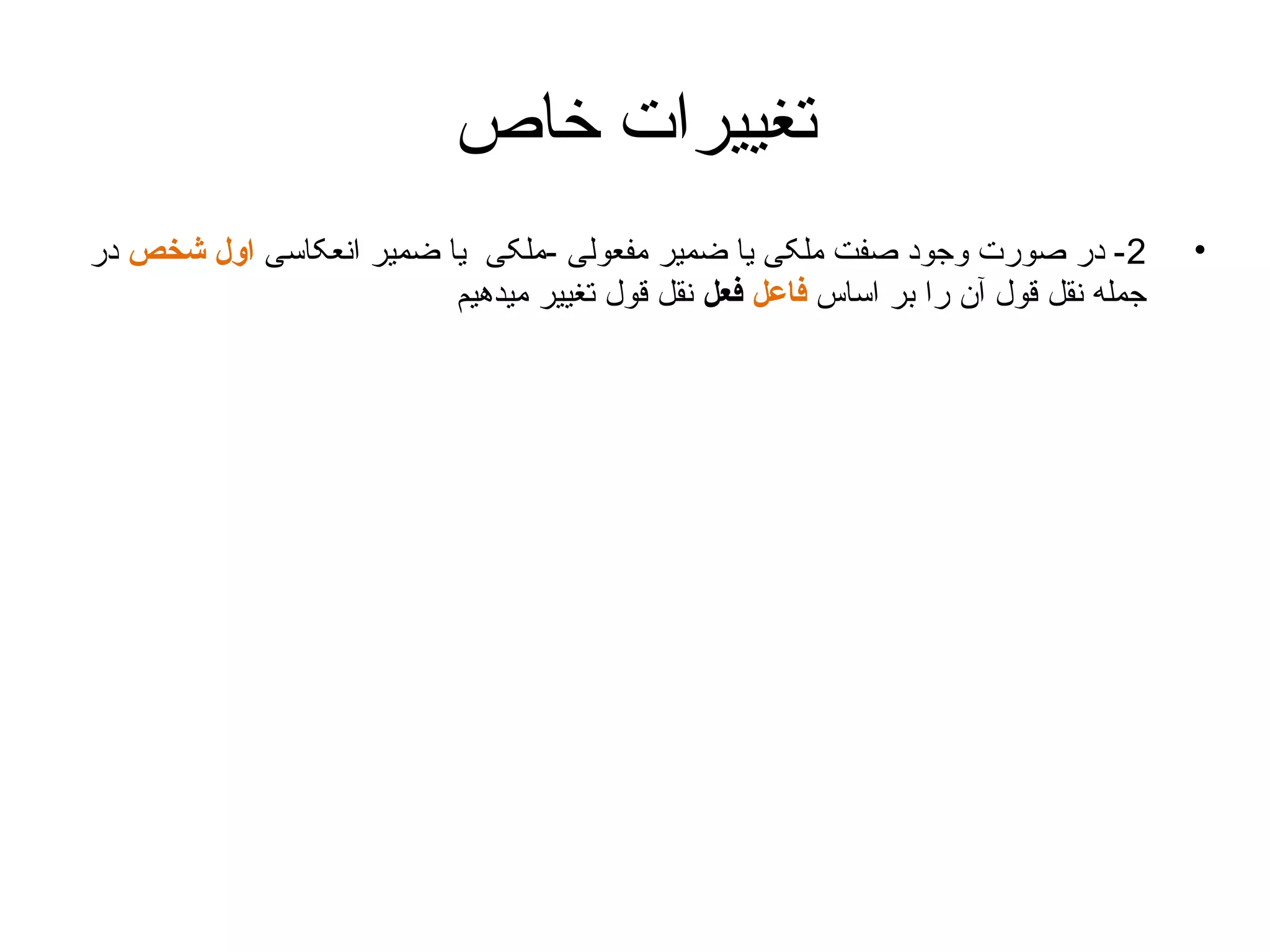
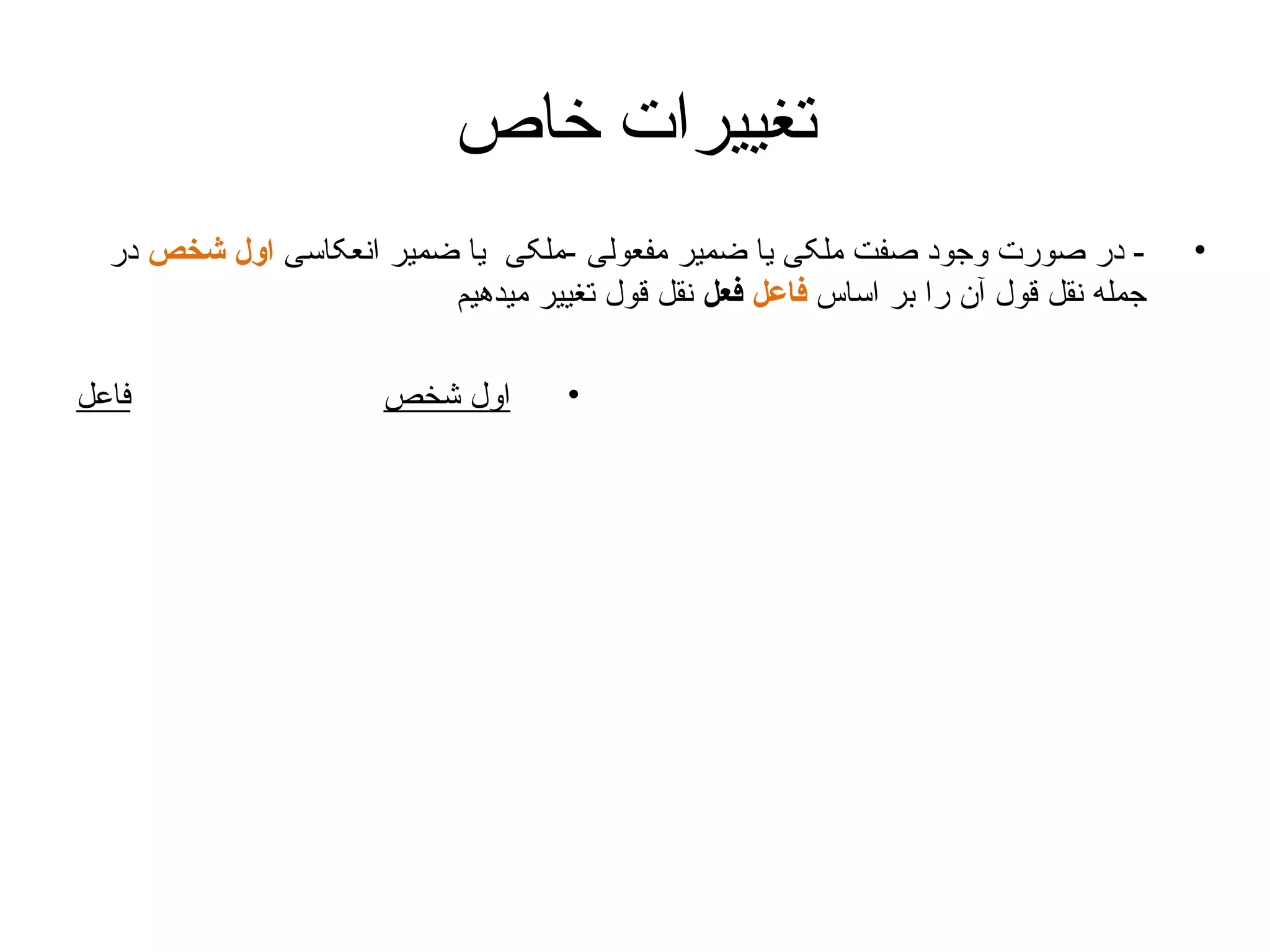
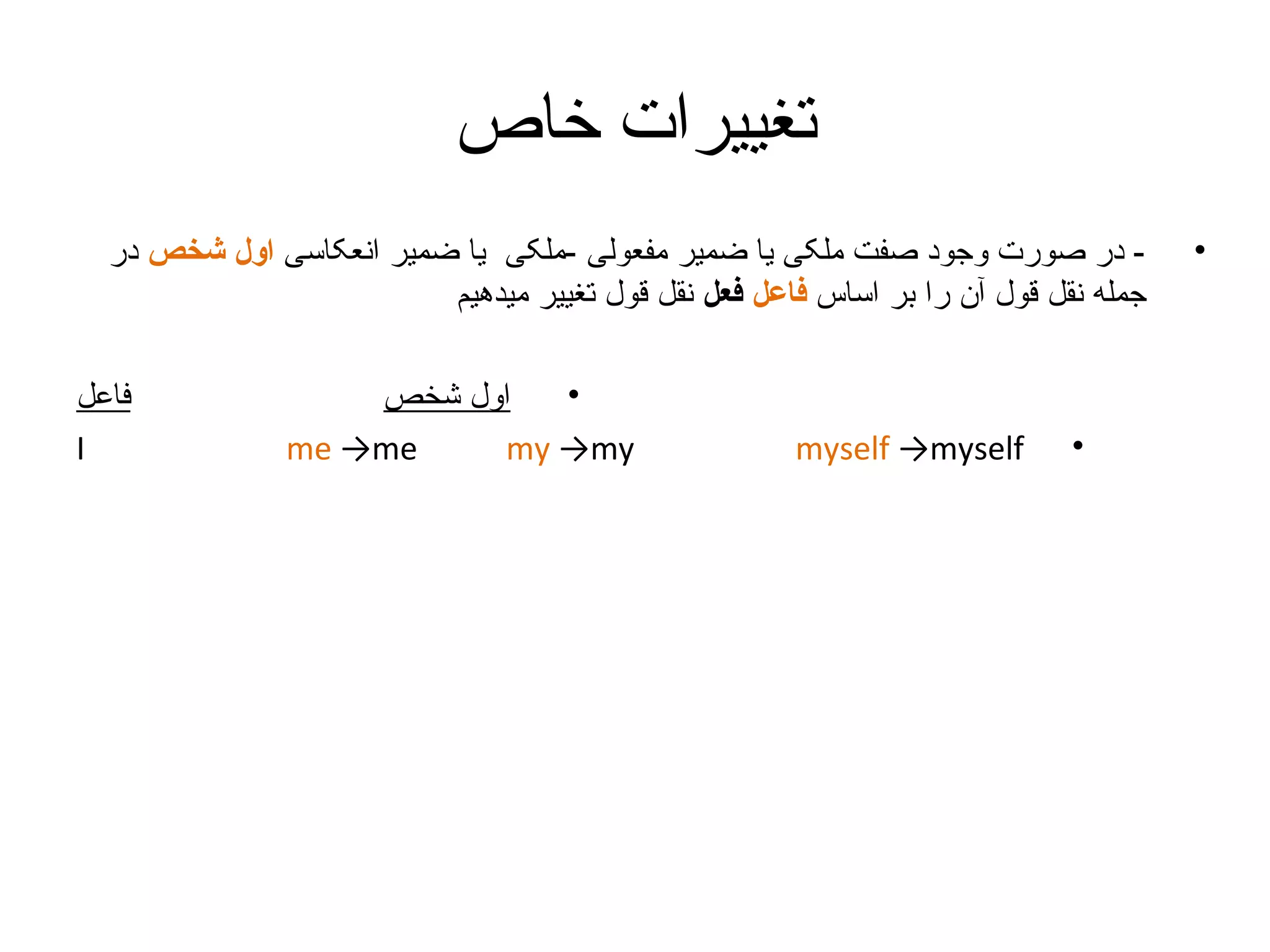
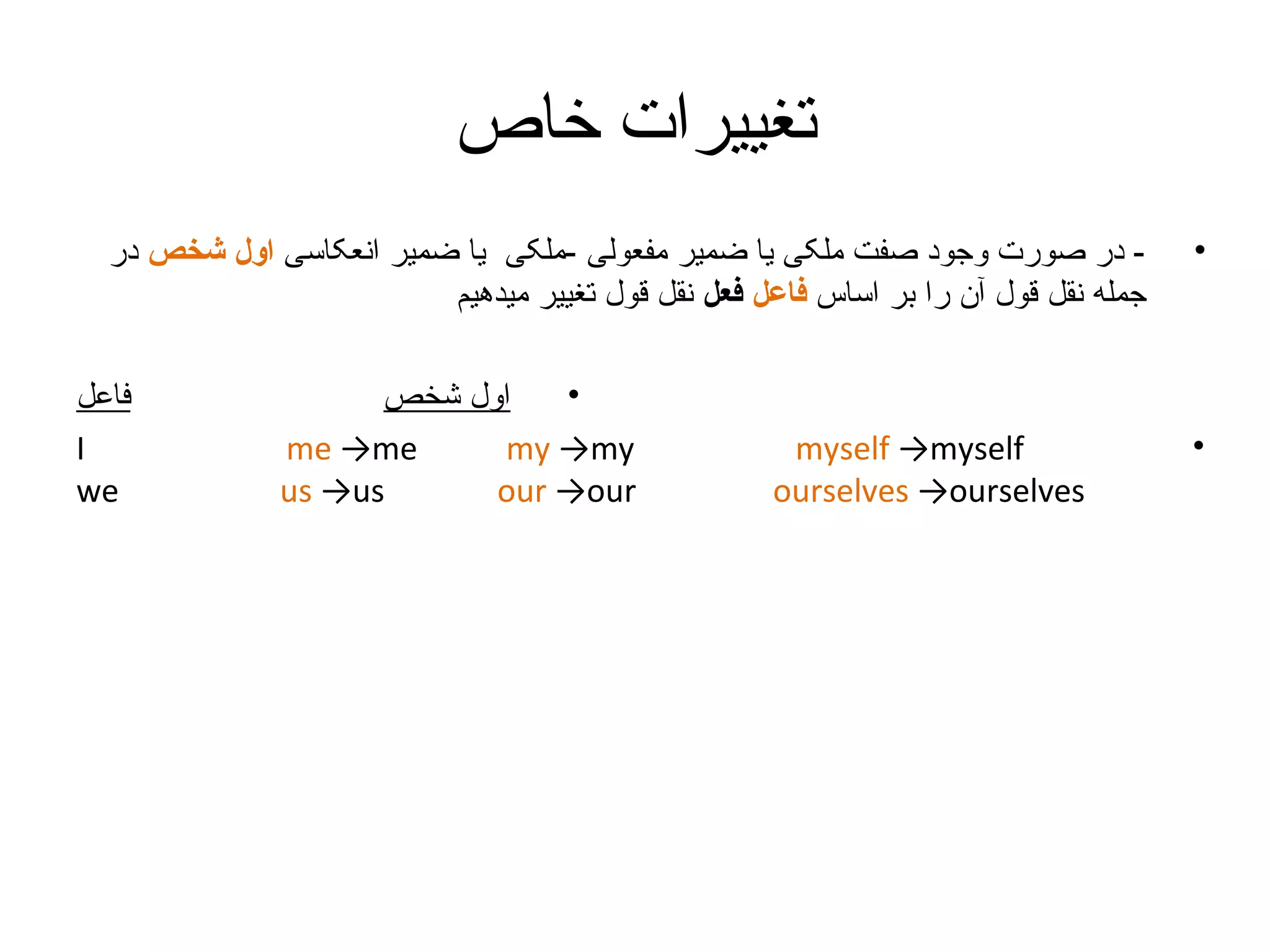
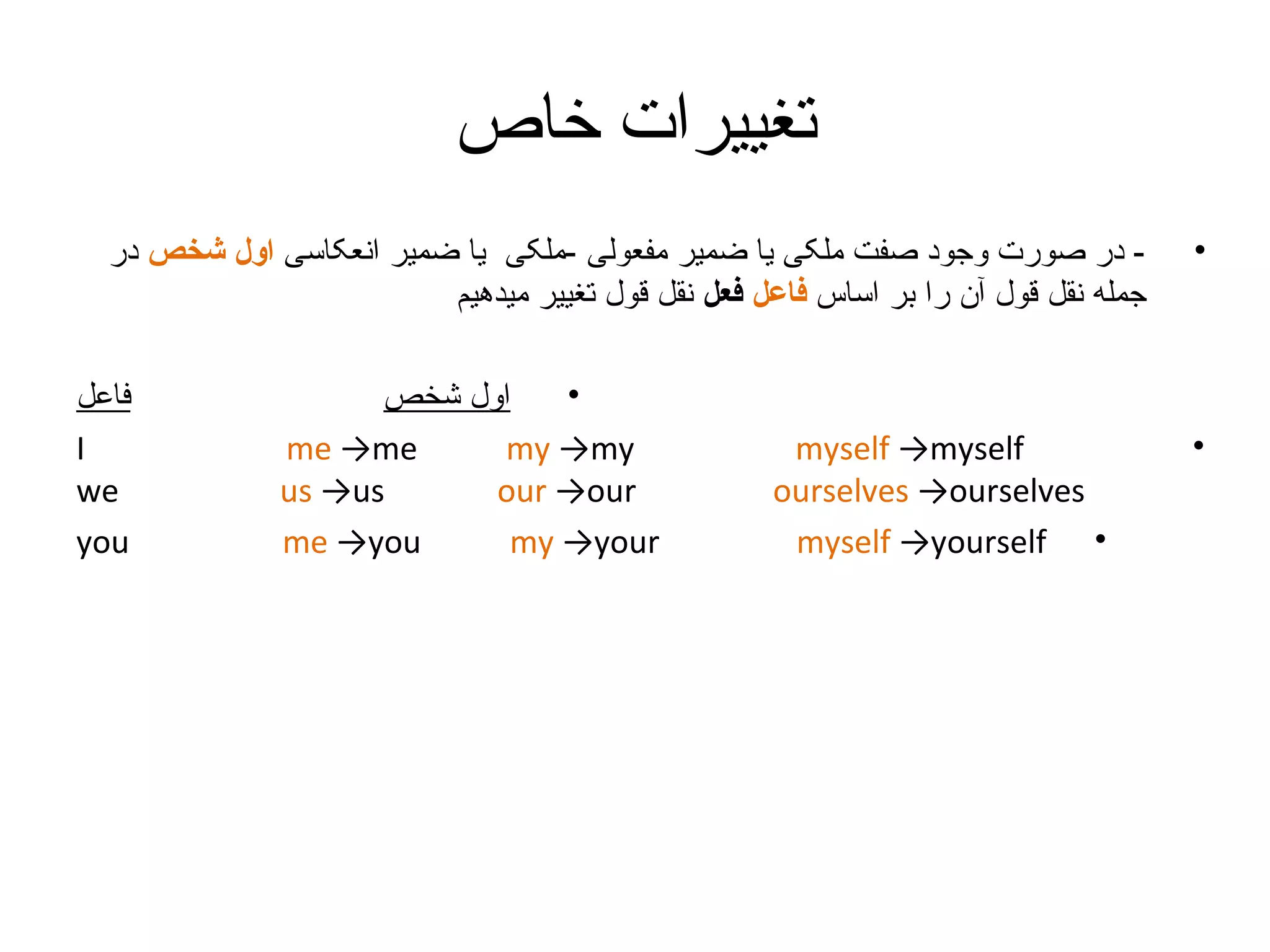
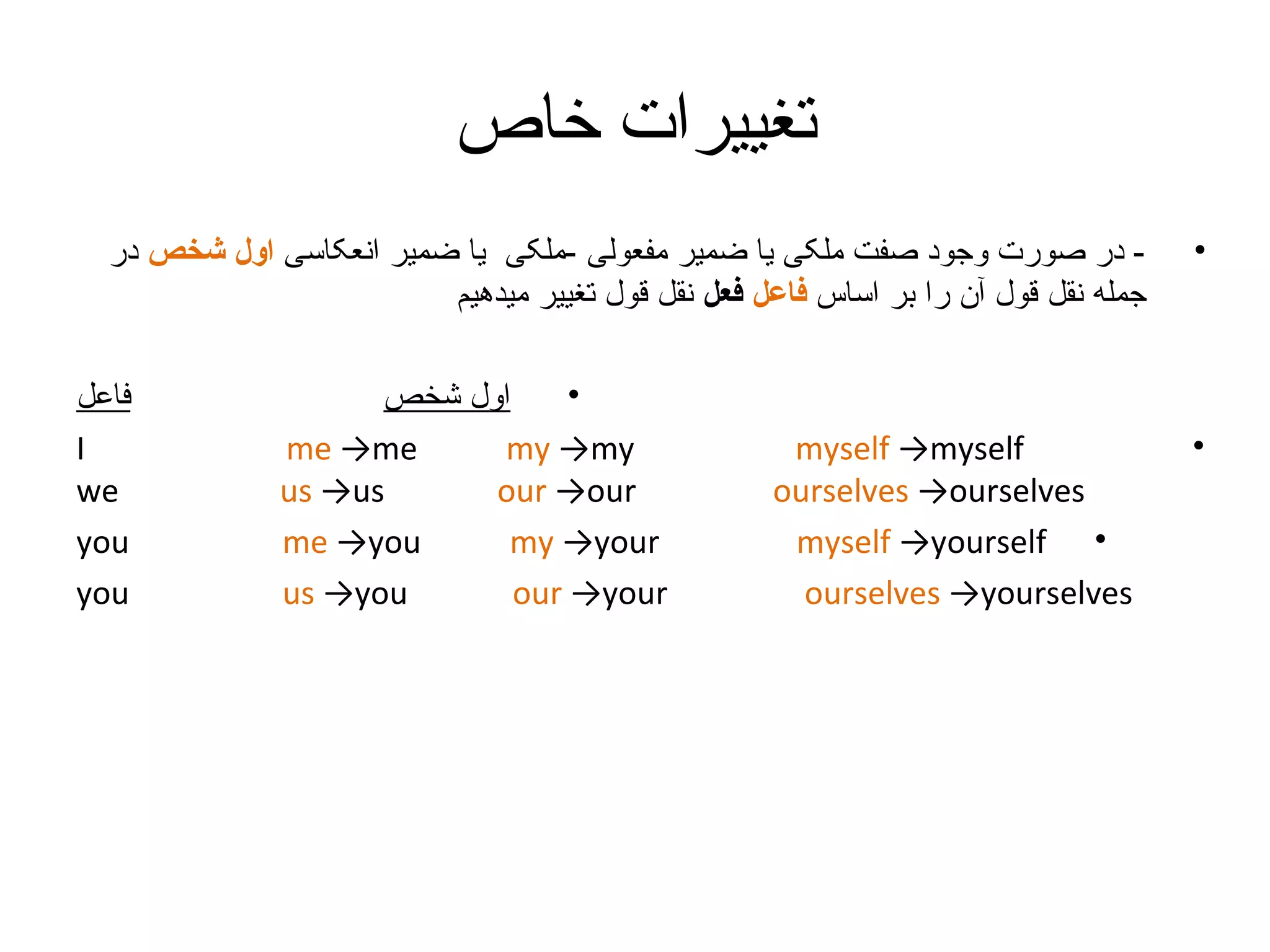
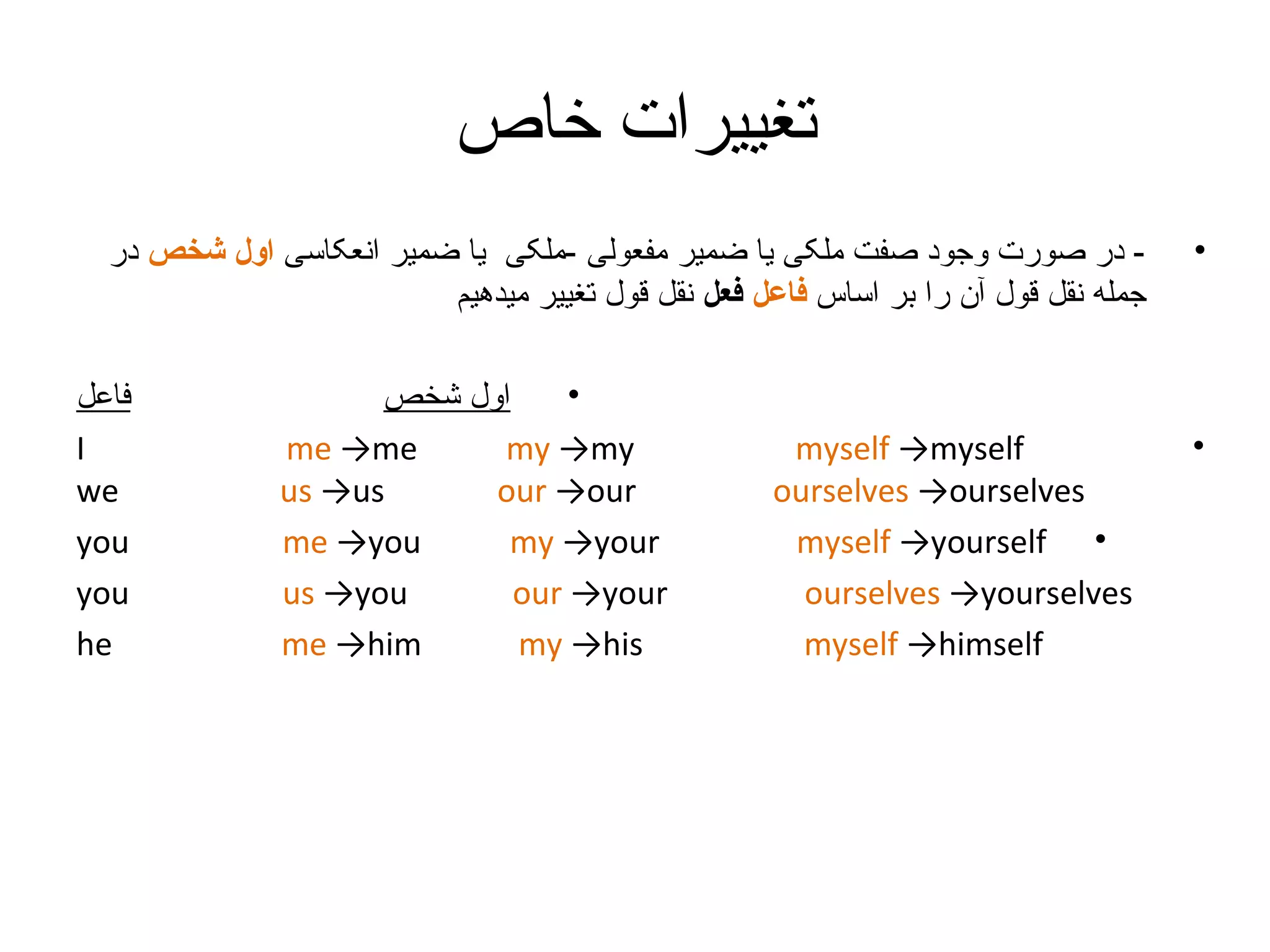
‫2 - در صورت وجود صفت ملکی یا ضمیر مفعولی -ملکی یا ضمیر انعکاسی اول شخص در‬
‫جمله نقل قول آن را بر اساس فاعل فعل نقل قول تغییر میدهیم‬
‫تغییرات خاص‬
‫•‬

‫ در صورت وجود صفت ملکی یا ضمیر مفعولی -ملکی یا ضمیر انعکاسی اول شخص در‬‫جمله نقل قول آن را بر اساس فاعل فعل نقل قول تغییر میدهیم‬
‫•‬

‫اول شخص‬

‫فاعل‬
‫تغییرات خاص‬
‫•‬

‫ در صورت وجود صفت ملکی یا ضمیر مفعولی -ملکی یا ضمیر انعکاسی اول شخص در‬‫جمله نقل قول آن را بر اساس فاعل فعل نقل قول تغییر میدهیم‬

‫•‬

‫‪myself →myself‬‬

‫•‬
‫اول شخص‬
‫‪me →me‬‬
‫‪my →my‬‬

‫فاعل‬
‫‪I‬‬
‫تغییرات خاص‬
‫•‬

‫•‬

‫ در صورت وجود صفت ملکی یا ضمیر مفعولی -ملکی یا ضمیر انعکاسی اول شخص در‬‫جمله نقل قول آن را بر اساس فاعل فعل نقل قول تغییر میدهیم‬

‫‪myself →myself‬‬
‫‪ourselves →ourselves‬‬

‫•‬
‫اول شخص‬
‫‪me →me‬‬
‫‪my →my‬‬
‫‪us →us‬‬
‫‪our →our‬‬

‫فاعل‬
‫‪I‬‬
‫‪we‬‬
‫تغییرات خاص‬
‫•‬

‫•‬

‫ در صورت وجود صفت ملکی یا ضمیر مفعولی -ملکی یا ضمیر انعکاسی اول شخص در‬‫جمله نقل قول آن را بر اساس فاعل فعل نقل قول تغییر میدهیم‬

‫‪myself →myself‬‬
‫‪ourselves →ourselves‬‬
‫• ‪myself →yourself‬‬

‫•‬
‫اول شخص‬
‫‪me →me‬‬
‫‪my →my‬‬
‫‪us →us‬‬
‫‪our →our‬‬
‫‪me →you‬‬
‫‪my →your‬‬

‫فاعل‬
‫‪I‬‬
‫‪we‬‬
‫‪you‬‬
‫تغییرات خاص‬
‫•‬

‫•‬

‫ در صورت وجود صفت ملکی یا ضمیر مفعولی -ملکی یا ضمیر انعکاسی اول شخص در‬‫جمله نقل قول آن را بر اساس فاعل فعل نقل قول تغییر میدهیم‬

‫‪myself →myself‬‬
‫‪ourselves →ourselves‬‬
‫• ‪myself →yourself‬‬
‫‪ourselves →yourselves‬‬

‫•‬
‫اول شخص‬
‫‪me →me‬‬
‫‪my →my‬‬
‫‪us →us‬‬
‫‪our →our‬‬
‫‪me →you‬‬
‫‪my →your‬‬
‫‪us →you‬‬
‫‪our →your‬‬

‫فاعل‬
‫‪I‬‬
‫‪we‬‬
‫‪you‬‬
‫‪you‬‬
‫تغییرات خاص‬
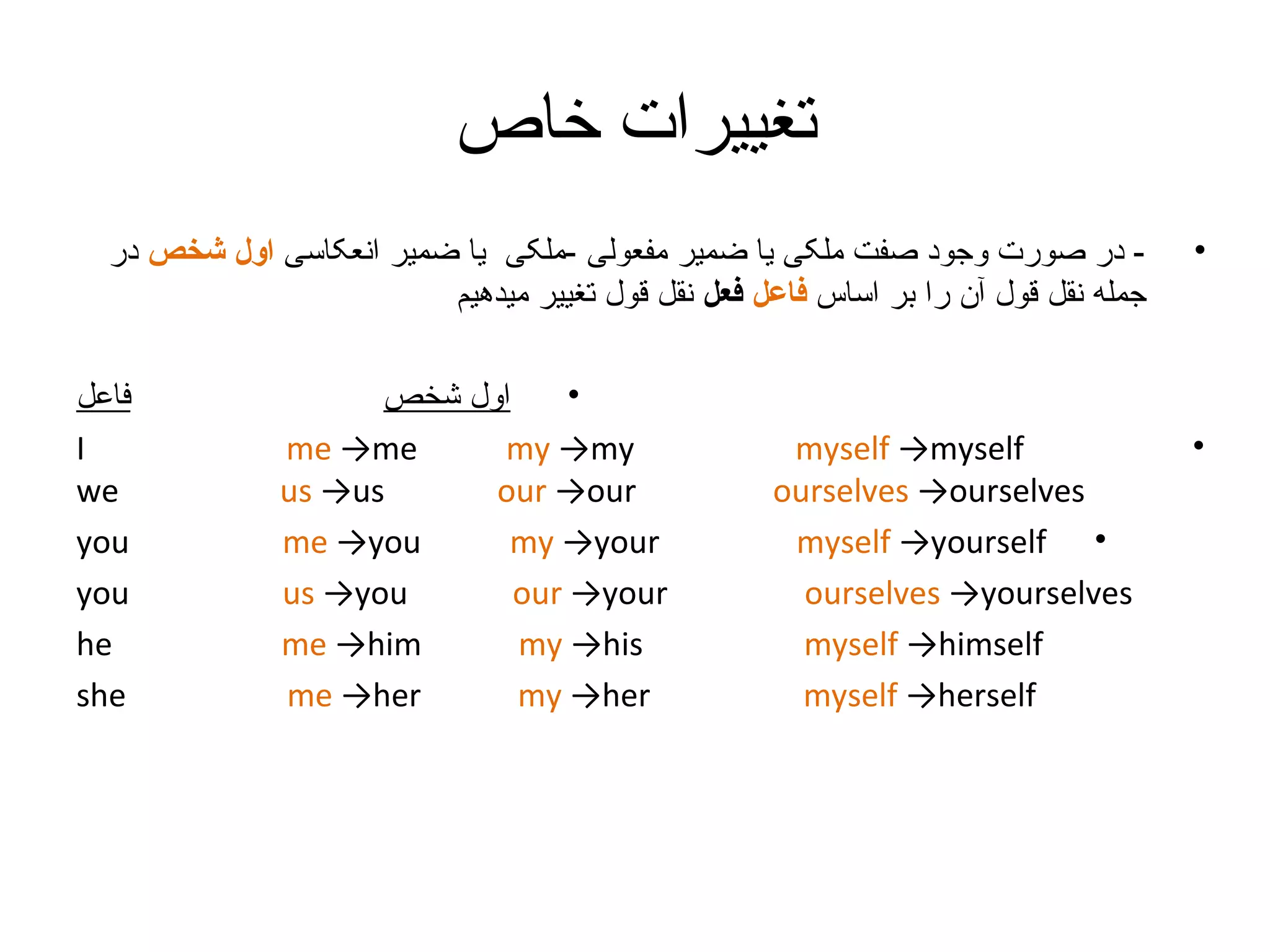
‫ در صورت وجود صفت ملکی یا ضمیر مفعولی -ملکی یا ضمیر انعکاسی اول شخص در‬‫جمله نقل قول آن را بر اساس فاعل فعل نقل قول تغییر میدهیم‬
‫فاعل‬
I
we
you
you
he

•
‫اول شخص‬
me →me
my →my
us →us
our →our
me →you
my →your
us →you
our →your
me →him
my →his

myself →myself
ourselves →ourselves
myself →yourself •
ourselves →yourselves
myself →himself

•

•
‫تغییرات خاص‬
‫ در صورت وجود صفت ملکی یا ضمیر مفعولی -ملکی یا ضمیر انعکاسی اول شخص در‬‫جمله نقل قول آن را بر اساس فاعل فعل نقل قول تغییر میدهیم‬
‫فاعل‬
I
we
you
you
he
she

•
‫اول شخص‬
me →me
my →my
us →us
our →our
me →you
my →your
us →you
our →your
me →him
my →his
me →her
my →her

myself →myself
ourselves →ourselves
myself →yourself •
ourselves →yourselves
myself →himself
myself →herself

•

•
‫تغییرات خاص‬
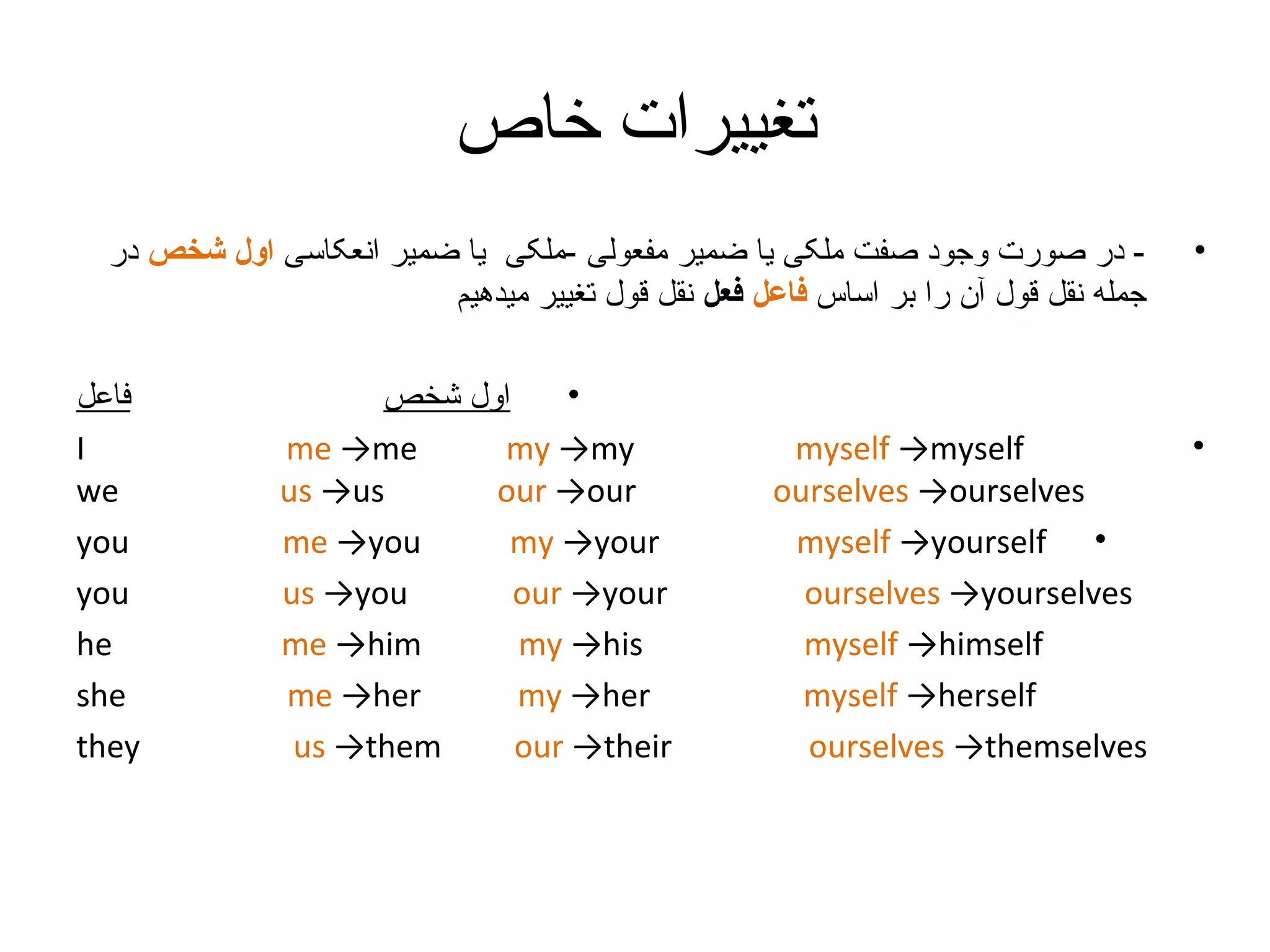
‫ در صورت وجود صفت ملکی یا ضمیر مفعولی -ملکی یا ضمیر انعکاسی اول شخص در‬‫جمله نقل قول آن را بر اساس فاعل فعل نقل قول تغییر میدهیم‬
‫فاعل‬
I
we
you
you
he
she
they

•
‫اول شخص‬
me →me
my →my
us →us
our →our
me →you
my →your
us →you
our →your
me →him
my →his
me →her
my →her
us →them
our →their

myself →myself
ourselves →ourselves
myself →yourself •
ourselves →yourselves
myself →himself
myself →herself
ourselves →themselves

•

•
‫تغییرات خاص‬
‫•‬

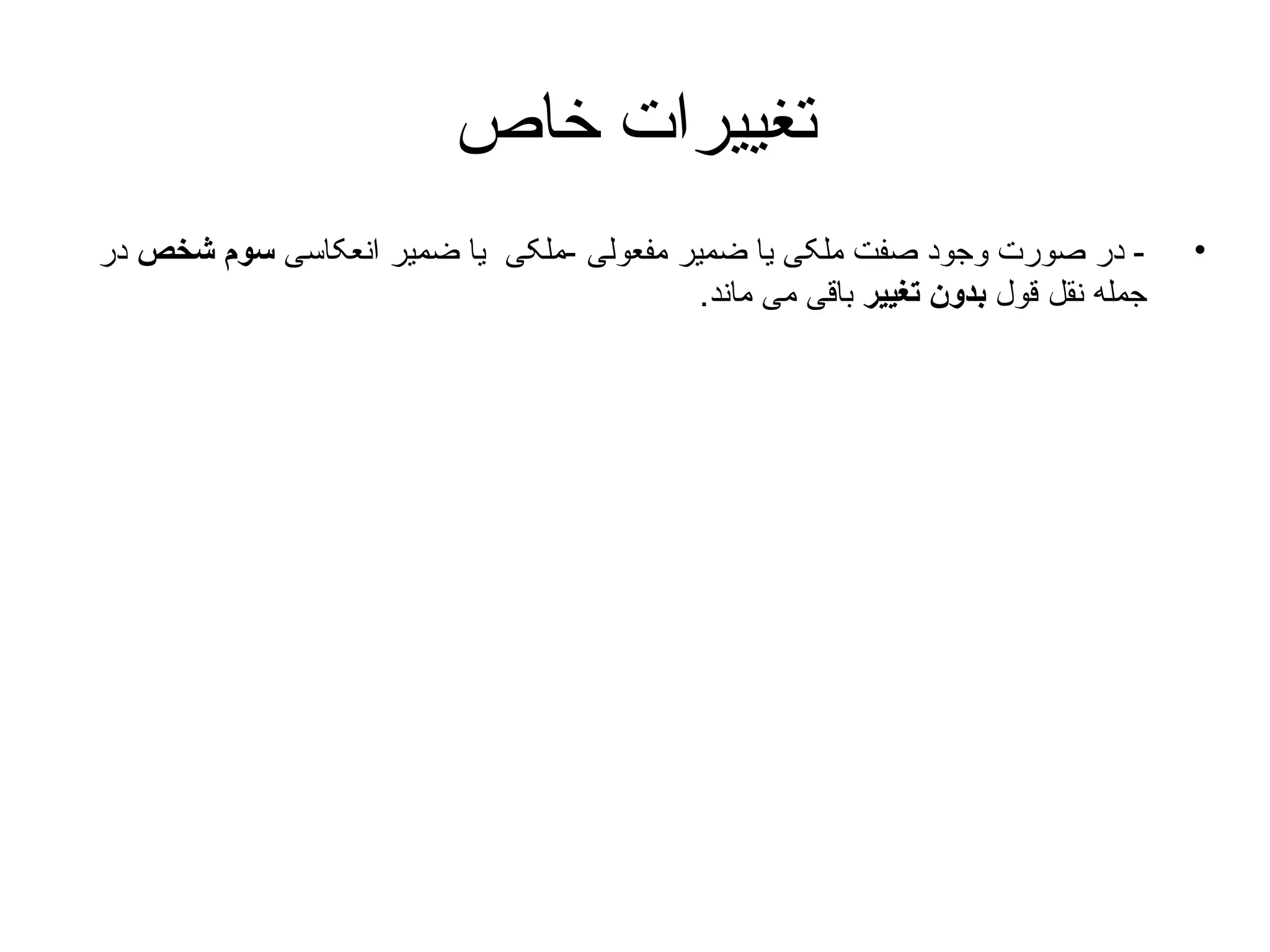
‫ در صورت وجود صفت ملکی یا ضمیر مفعولی -ملکی یا ضمیر انعکاسی سوم شخص در‬‫جمله نقل قول بدون تغییر باقی می ماند.‬
‫:مثال‬
•

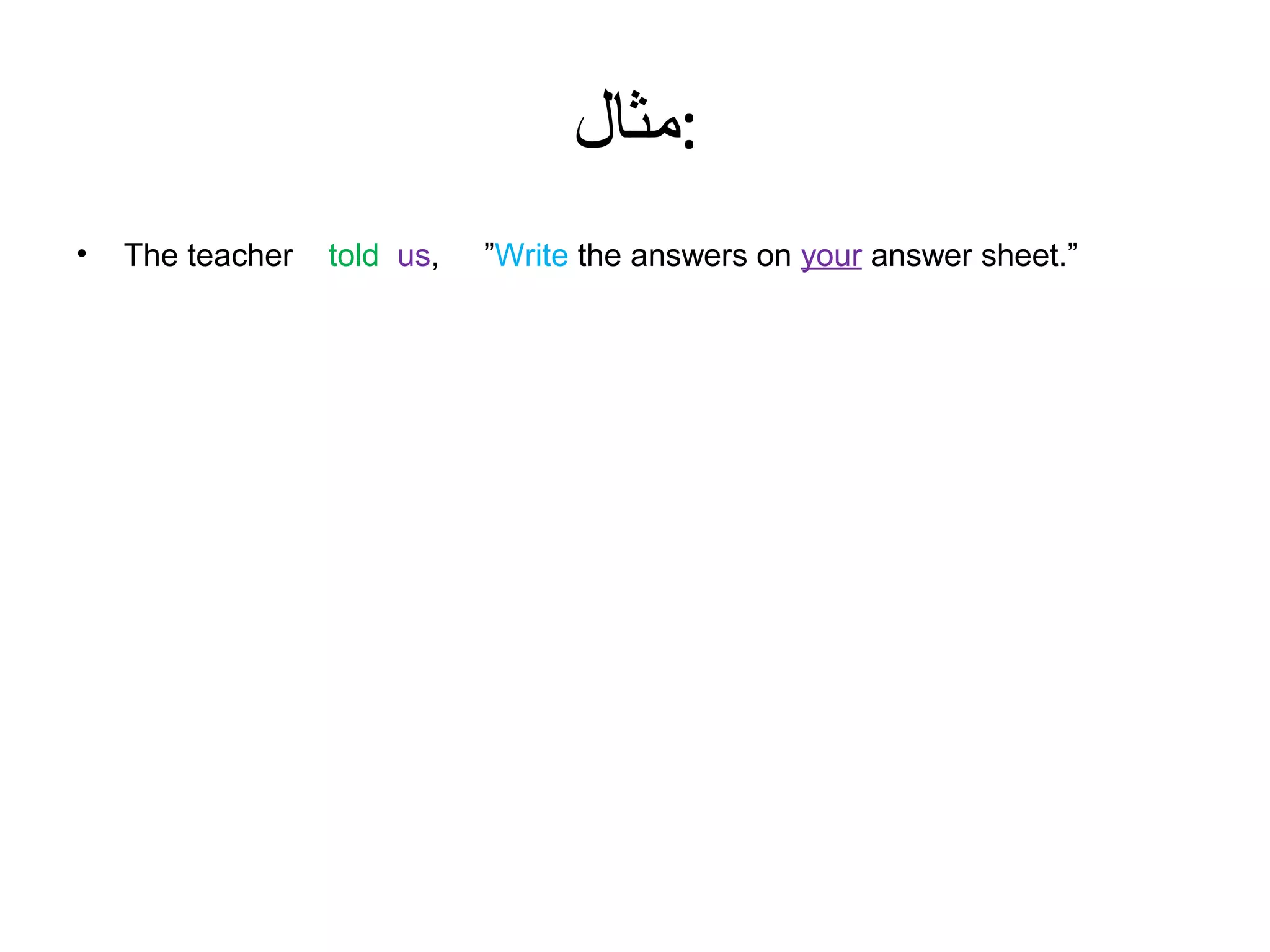
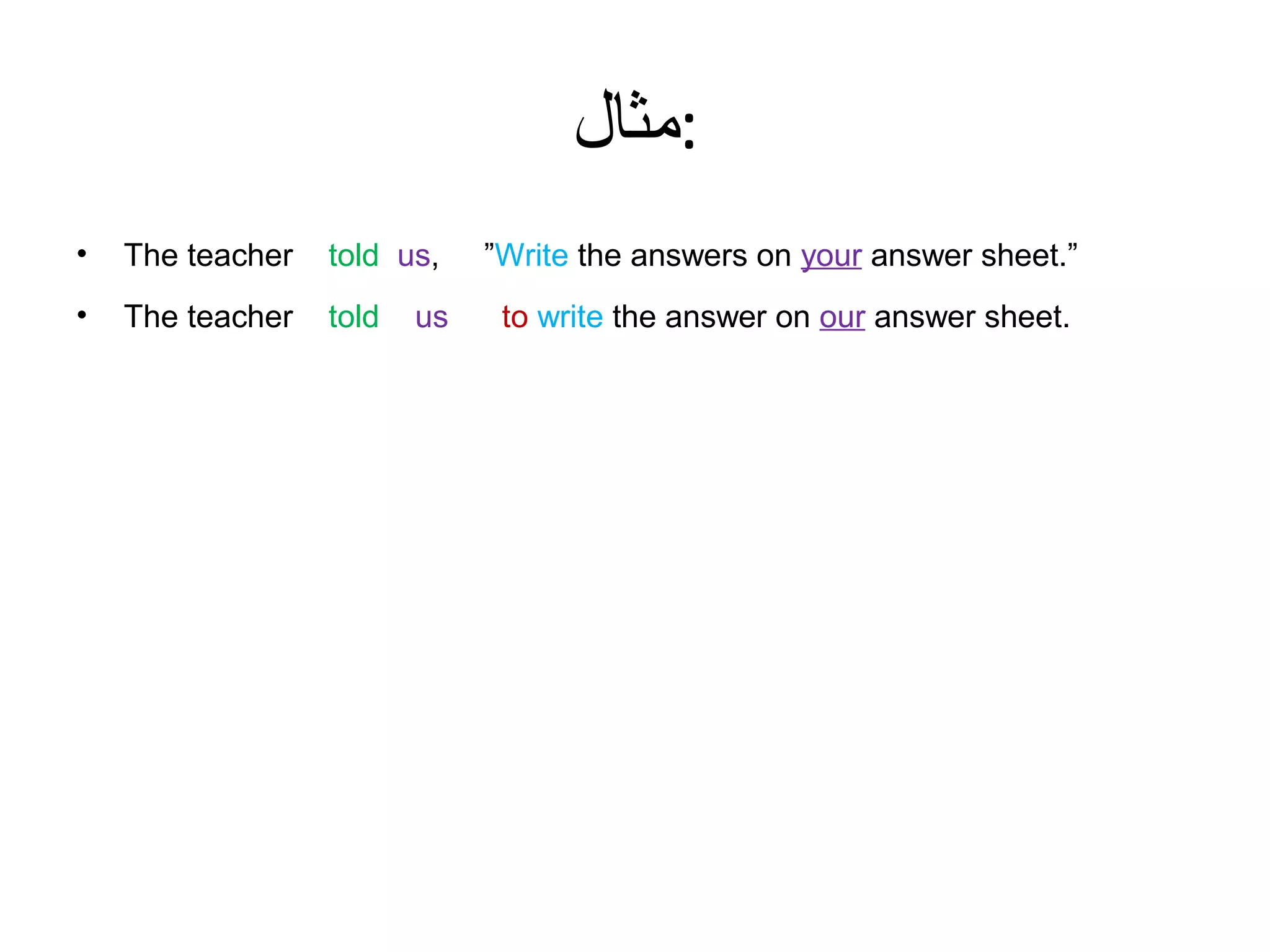
The teacher

told us,

”Write the answers on your answer sheet.”
‫:مثال‬
•

The teacher

told us,

•

The teacher

told

us

”Write the answers on your answer sheet.”
to write the answer on our answer sheet.
‫:مثال‬
•

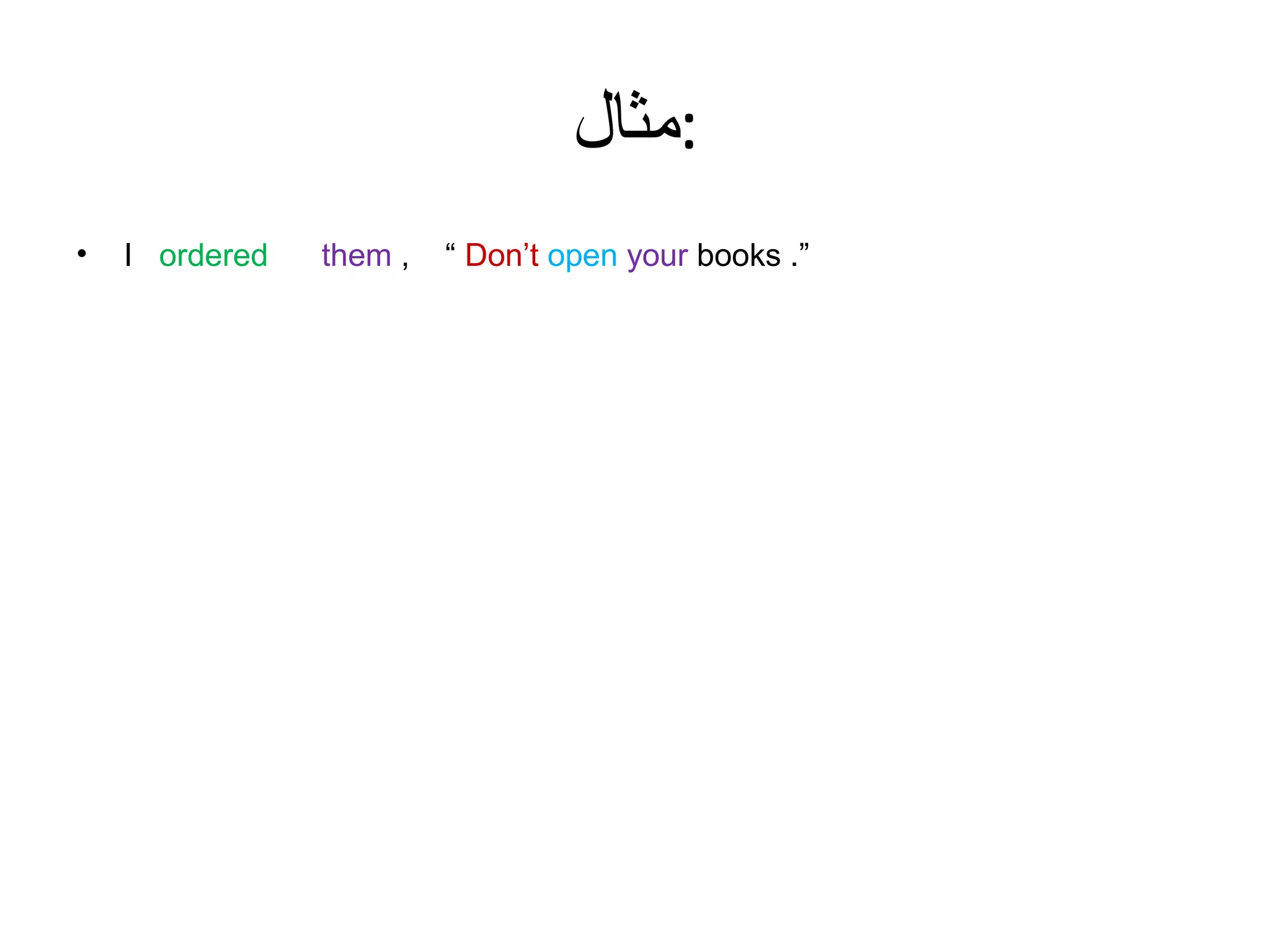
I ordered

them ,

“ Don’t open your books .”
‫:مثال‬
•

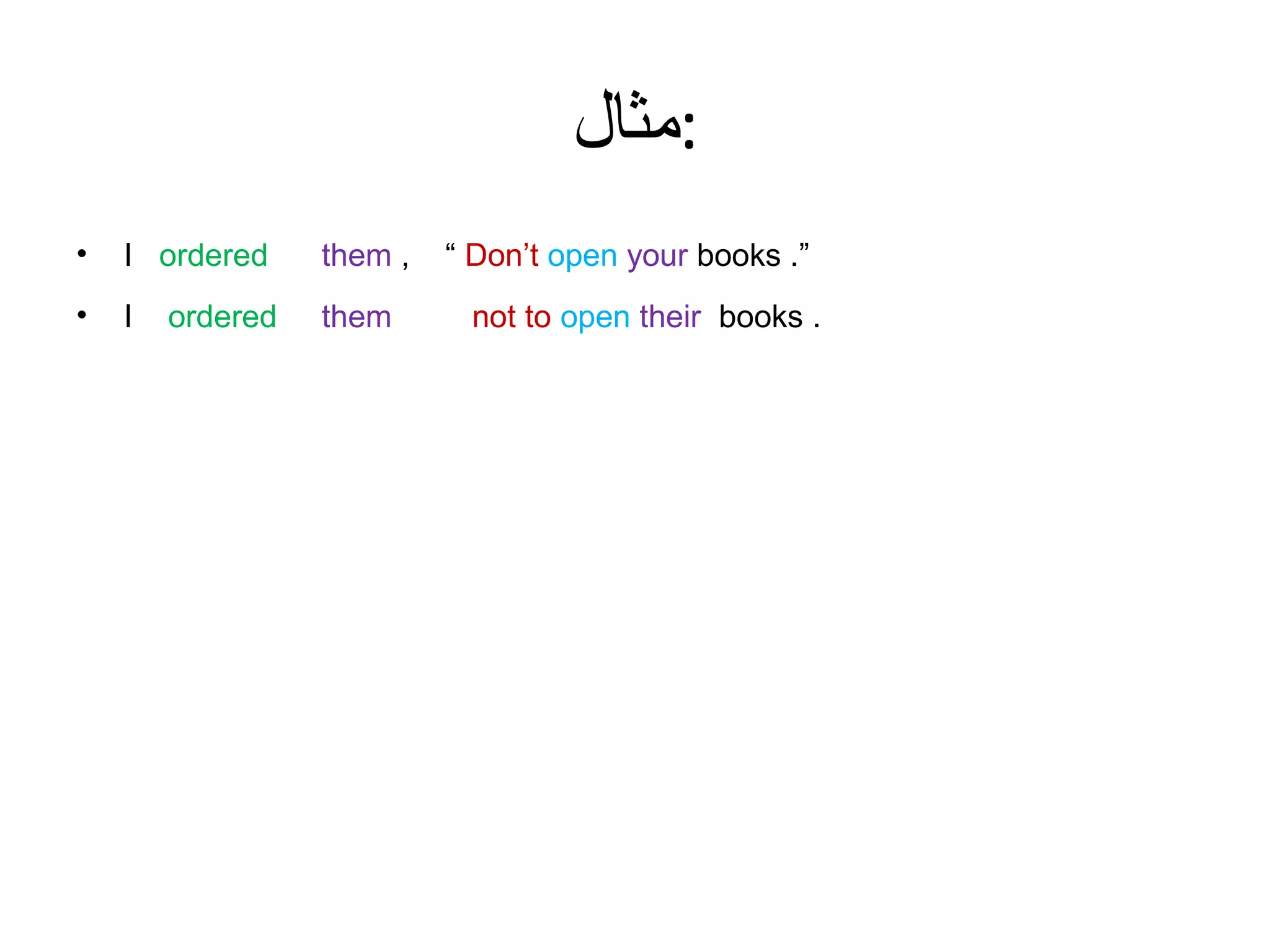
I ordered

them ,

•

I

them

ordered

“ Don’t open your books .”
not to open their books .
‫:مثال‬
•

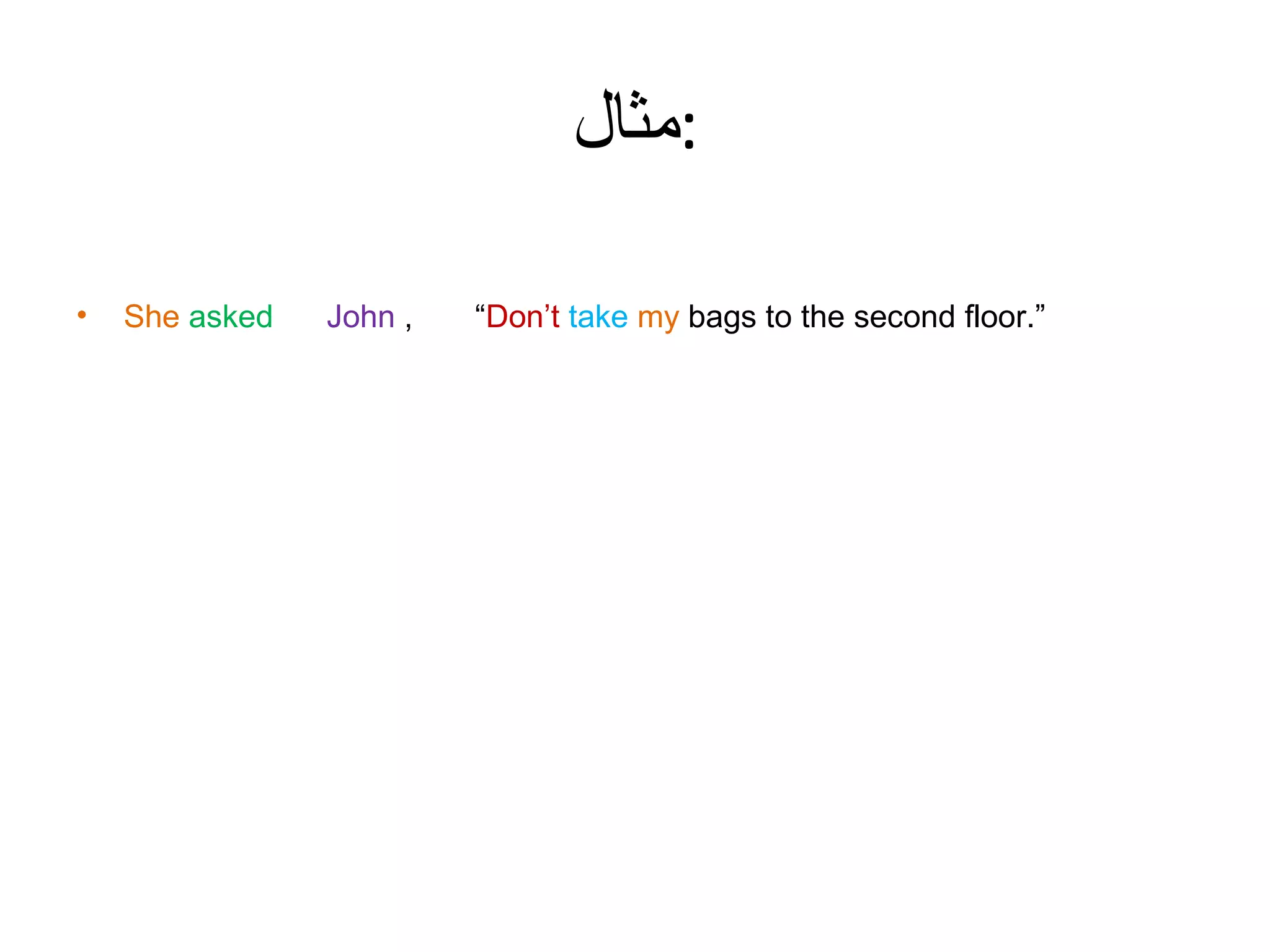
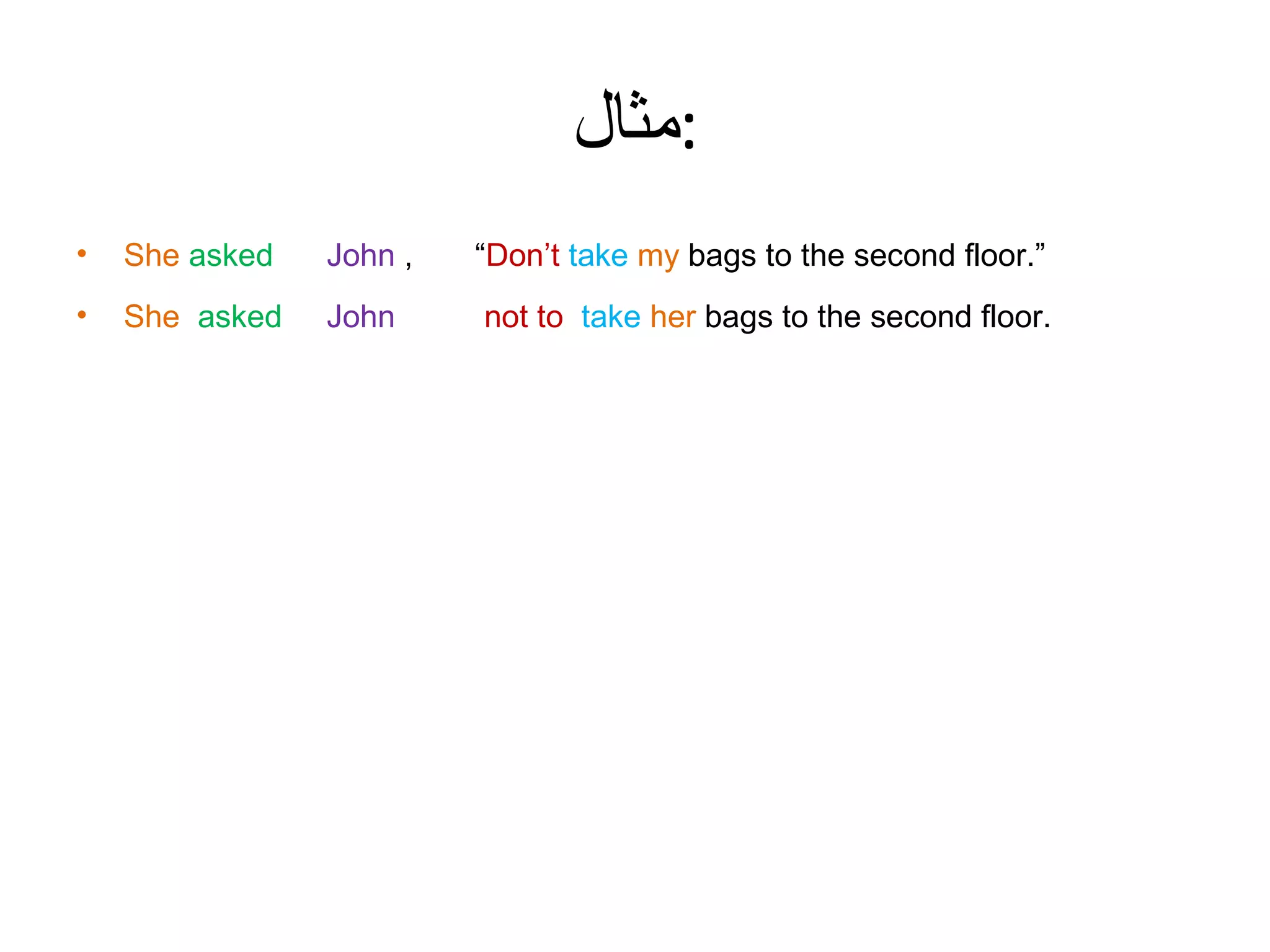
She asked

John ,

“Don’t take my bags to the second floor.”
‫:مثال‬
•

She asked

John ,

“Don’t take my bags to the second floor.”

•

She asked

John

not to take her bags to the second floor.
‫:مثال‬
•

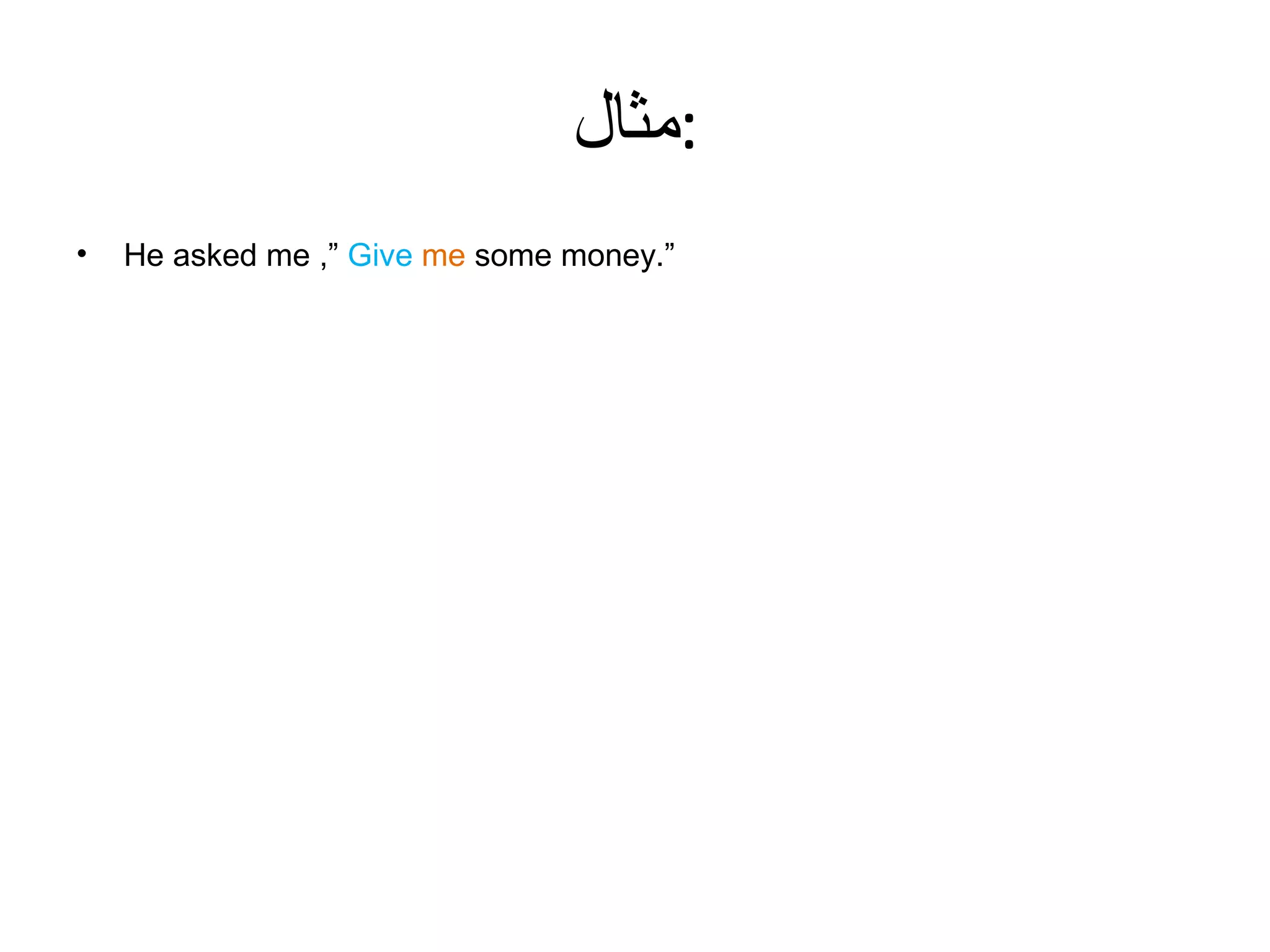
He asked me ,” Give me some money.”
‫:مثال‬
•

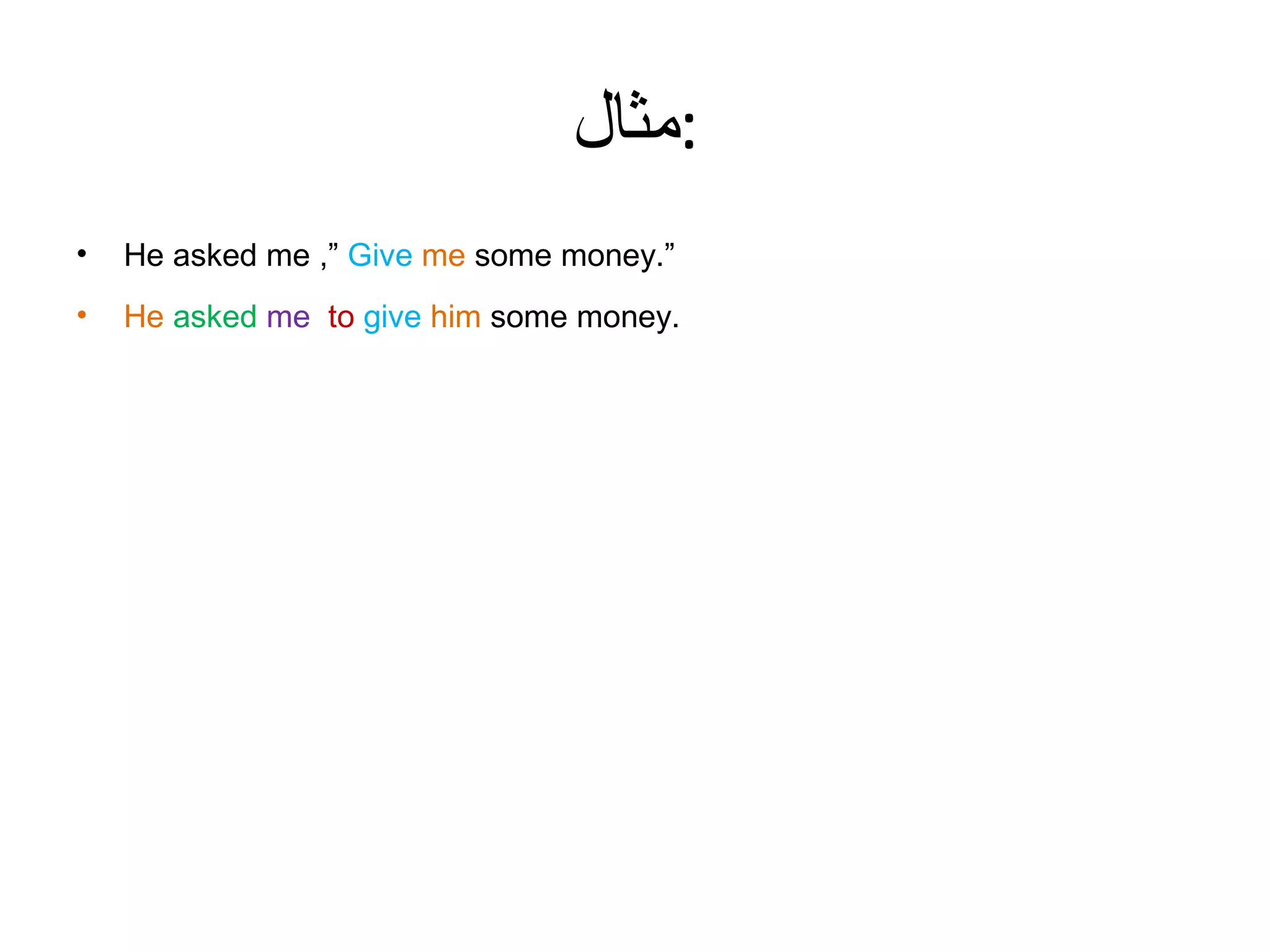
He asked me ,” Give me some money.”

•

He asked me to give him some money.
‫:مثال‬
•

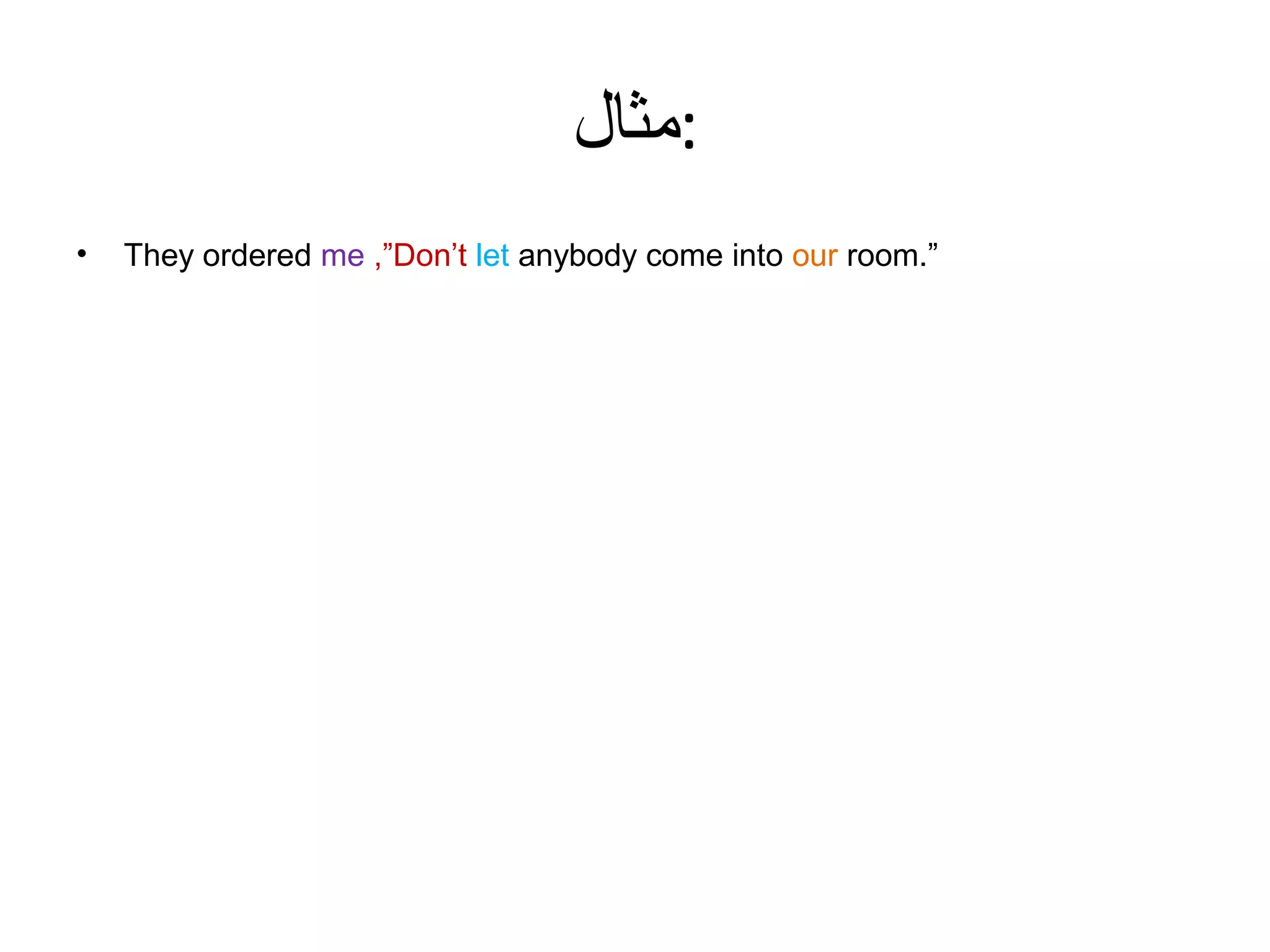
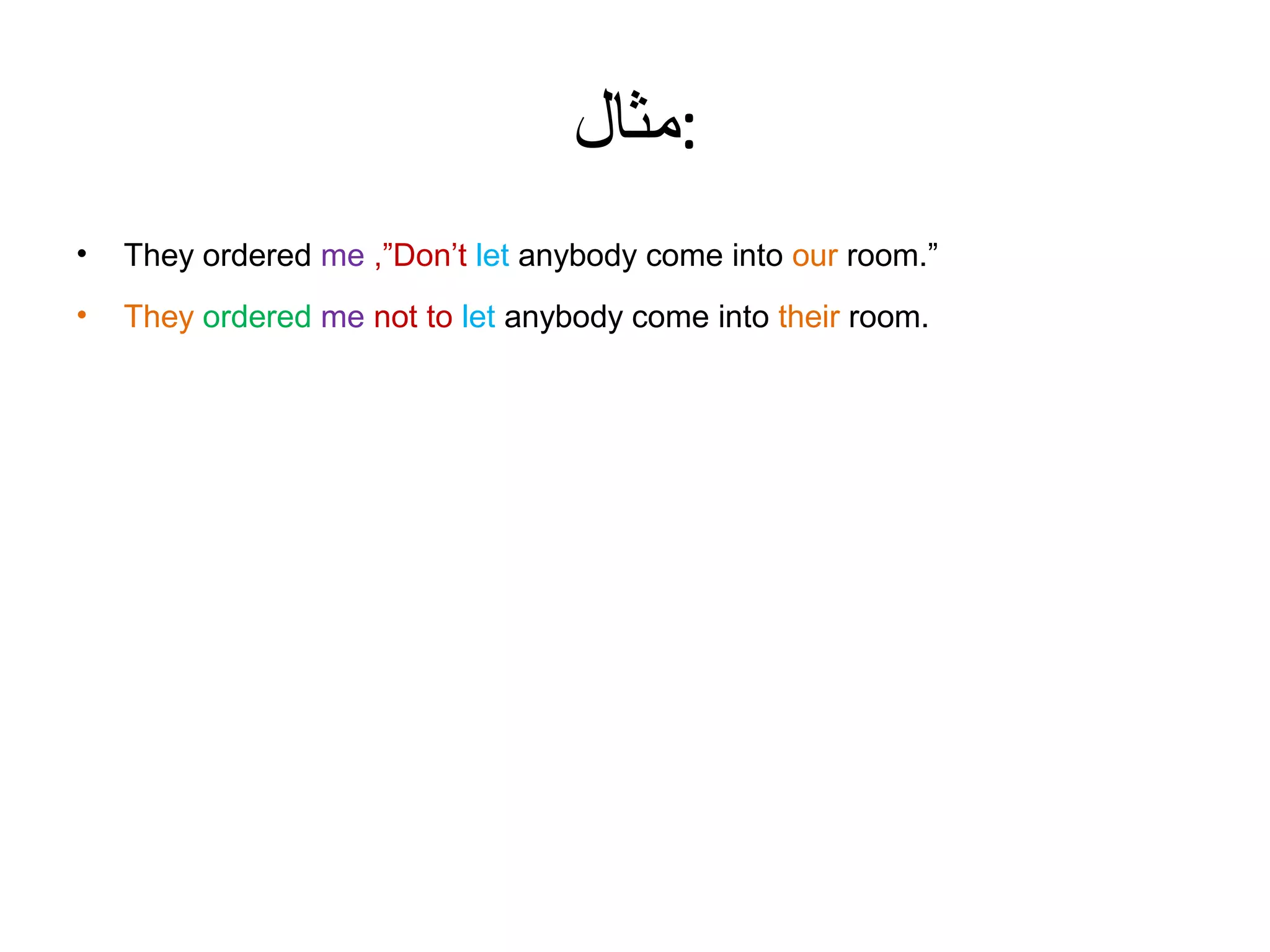
They ordered me ,”Don’t let anybody come into our room.”
‫:مثال‬
•

They ordered me ,”Don’t let anybody come into our room.”

•

They ordered me not to let anybody come into their room.
‫:مثال‬
•

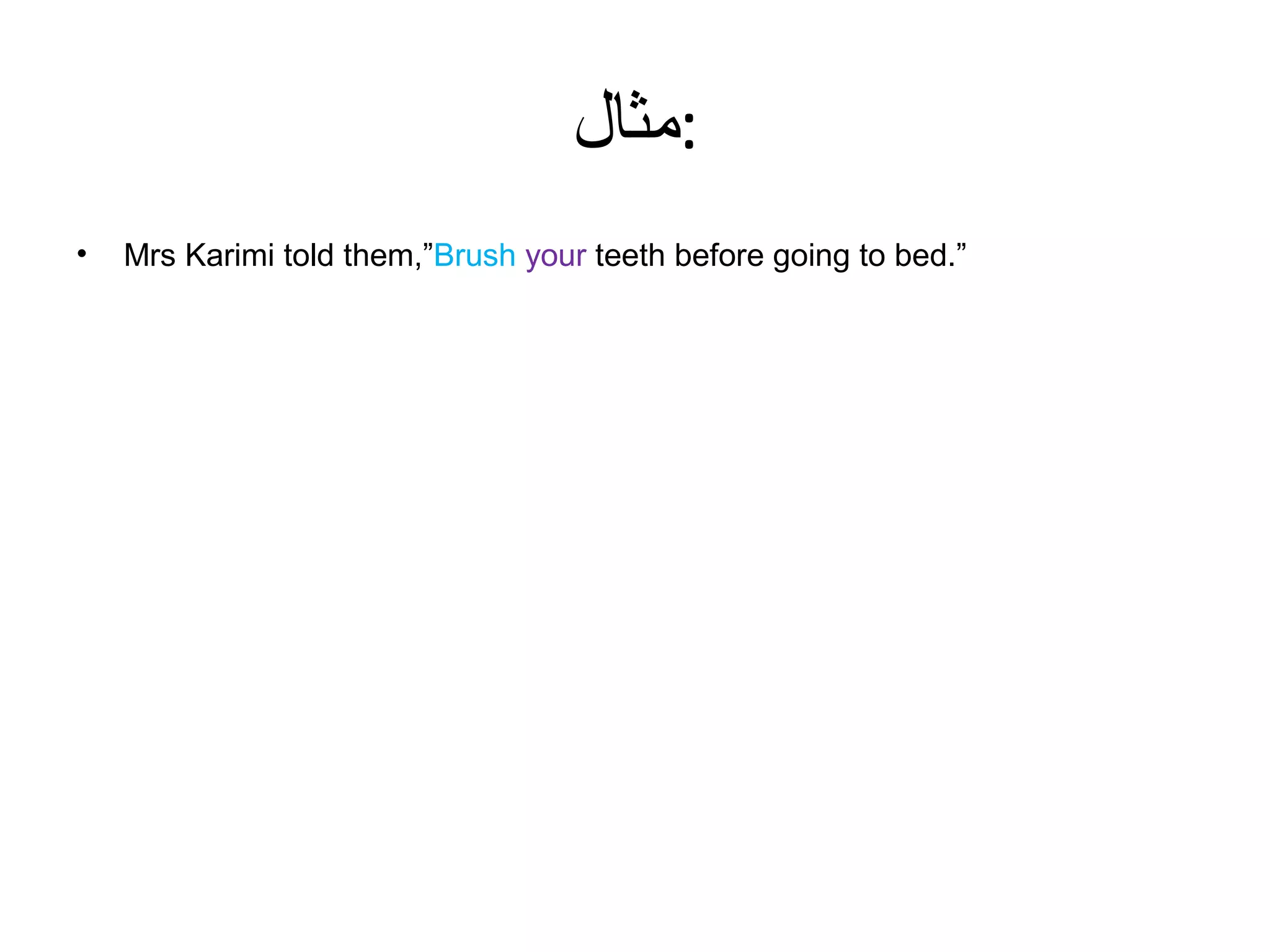
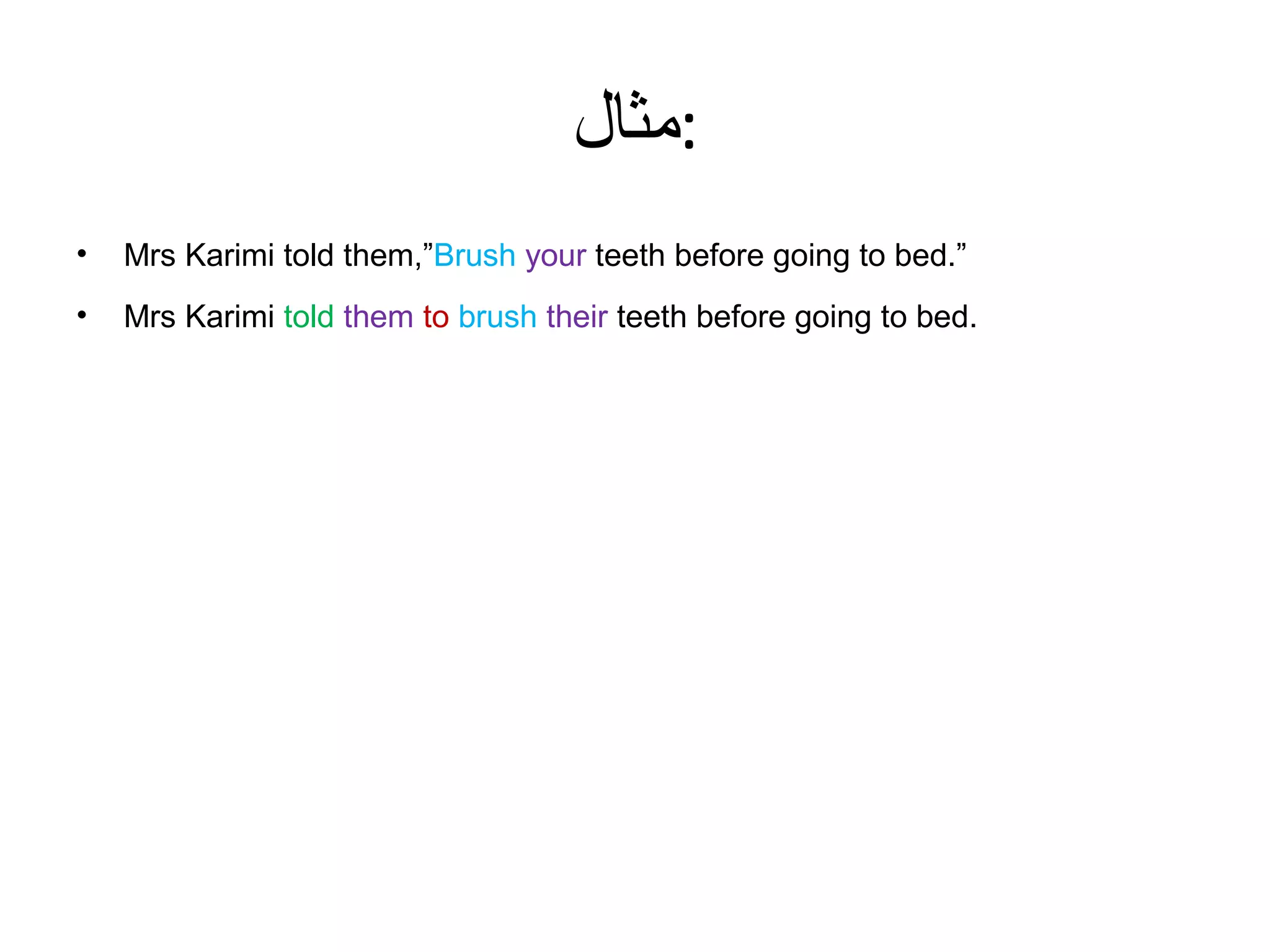
Mrs Karimi told them,”Brush your teeth before going to bed.”
‫:مثال‬
•

Mrs Karimi told them,”Brush your teeth before going to bed.”

•

Mrs Karimi told them to brush their teeth before going to bed.
‫:مثال‬
•

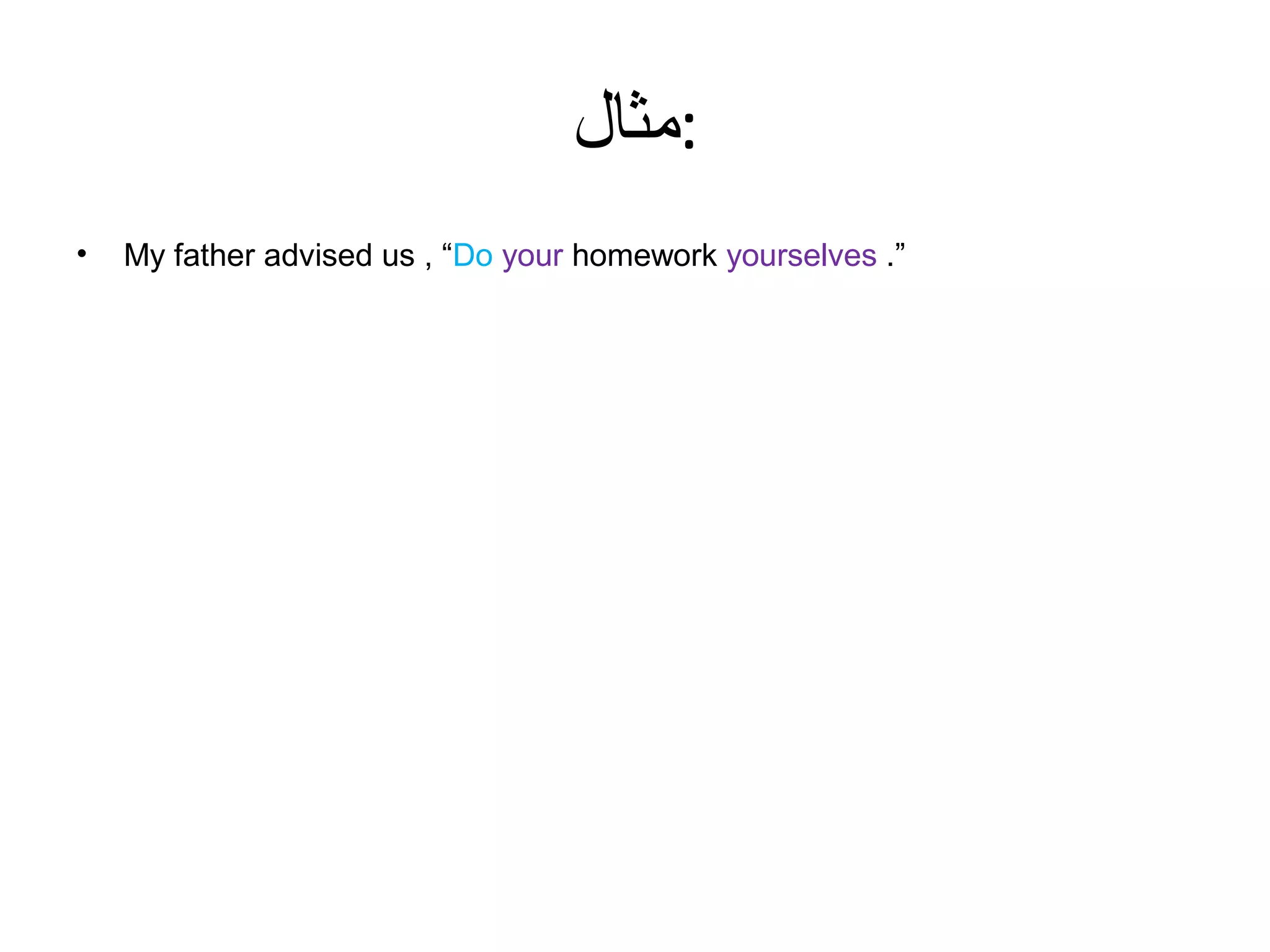
My father advised us , “Do your homework yourselves .”
‫:مثال‬
•

My father advised us , “Do your homework yourselves .”

•

My father advised us to do our homework ourselves .
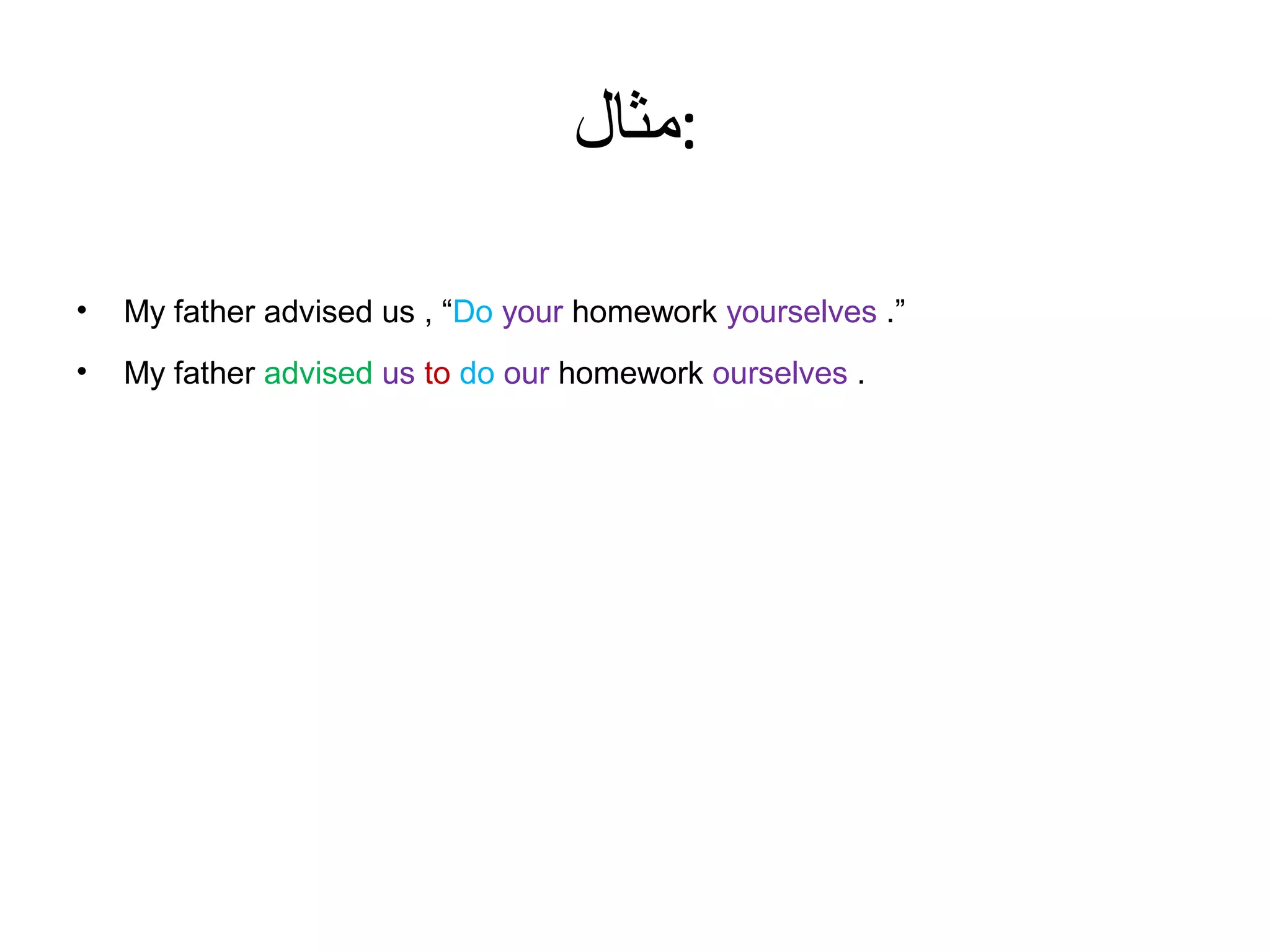
‫:مثال‬
•

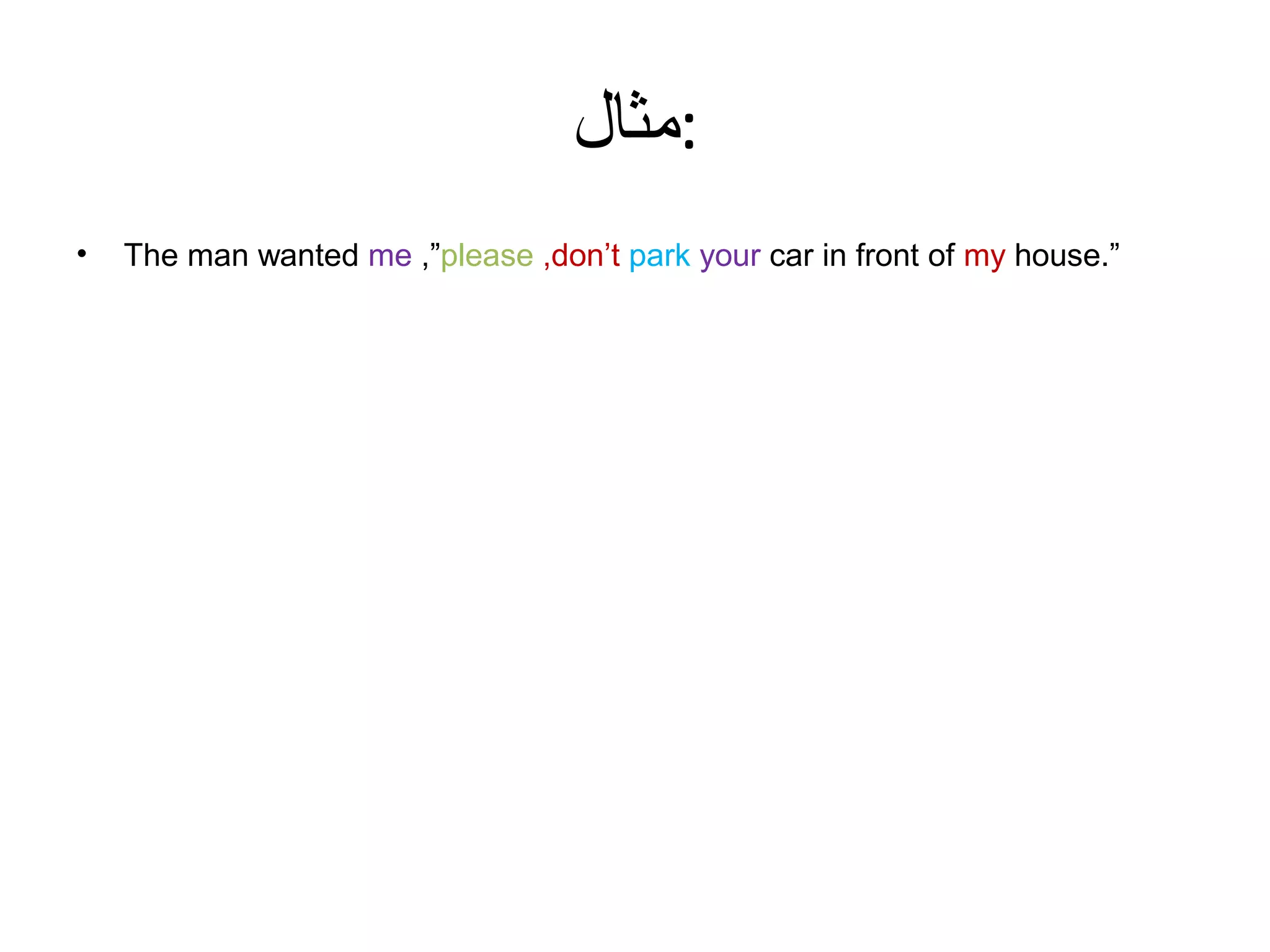
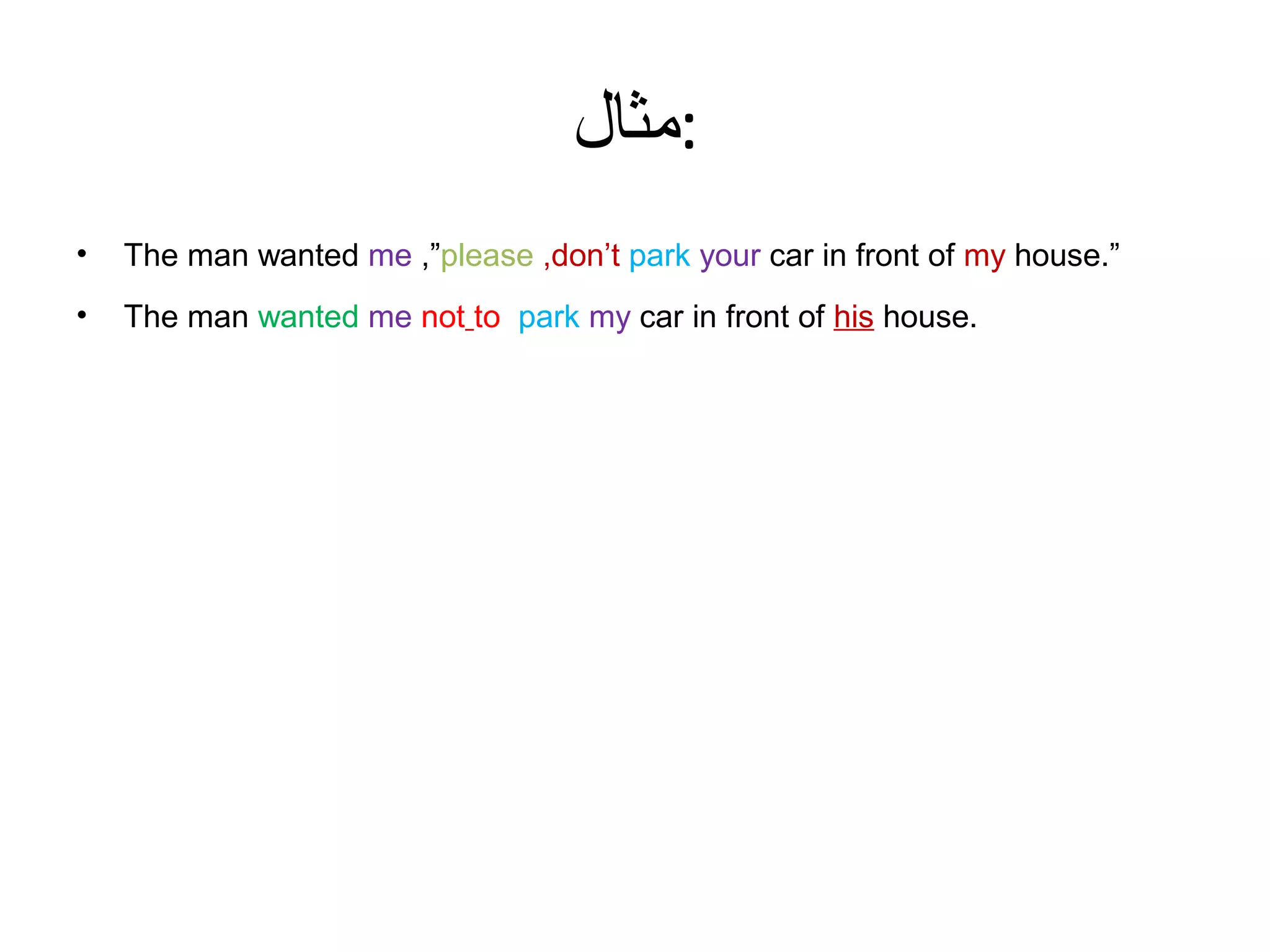
The man wanted me ,”please ,don’t park your car in front of my house.”
‫:مثال‬
•

The man wanted me ,”please ,don’t park your car in front of my house.”

•

The man wanted me not to park my car in front of his house.
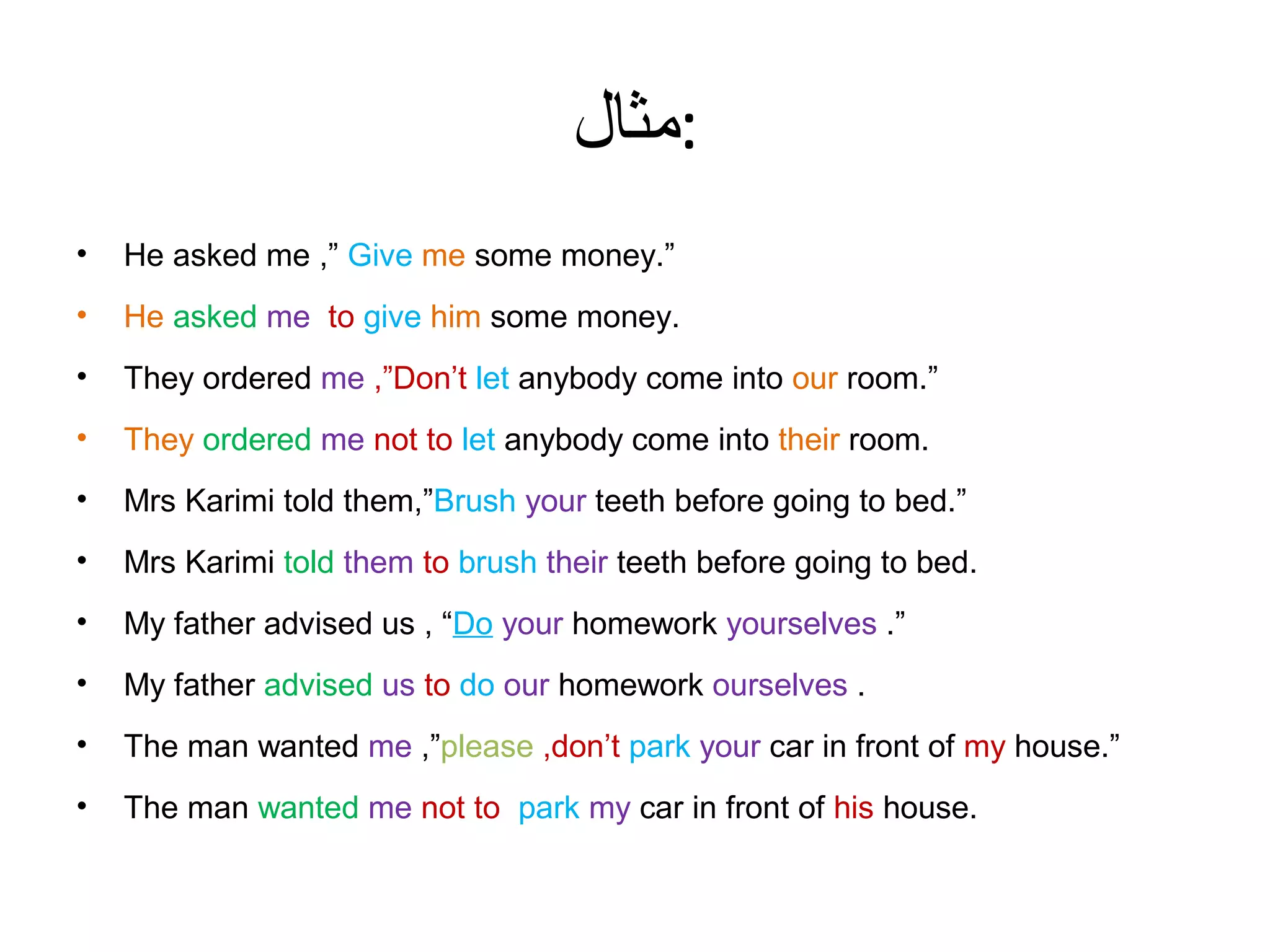
‫:مثال‬
•

He asked me ,” Give me some money.”

•

He asked me to give him some money.

•

They ordered me ,”Don’t let anybody come into our room.”

•

They ordered me not to let anybody come into their room.

•

Mrs Karimi told them,”Brush your teeth before going to bed.”

•

Mrs Karimi told them to brush their teeth before going to bed.

•

My father advised us , “Do your homework yourselves .”

•

My father advised us to do our homework ourselves .

•

The man wanted me ,”please ,don’t park your car in front of my house.”

•

The man wanted me not to park my car in front of his house.
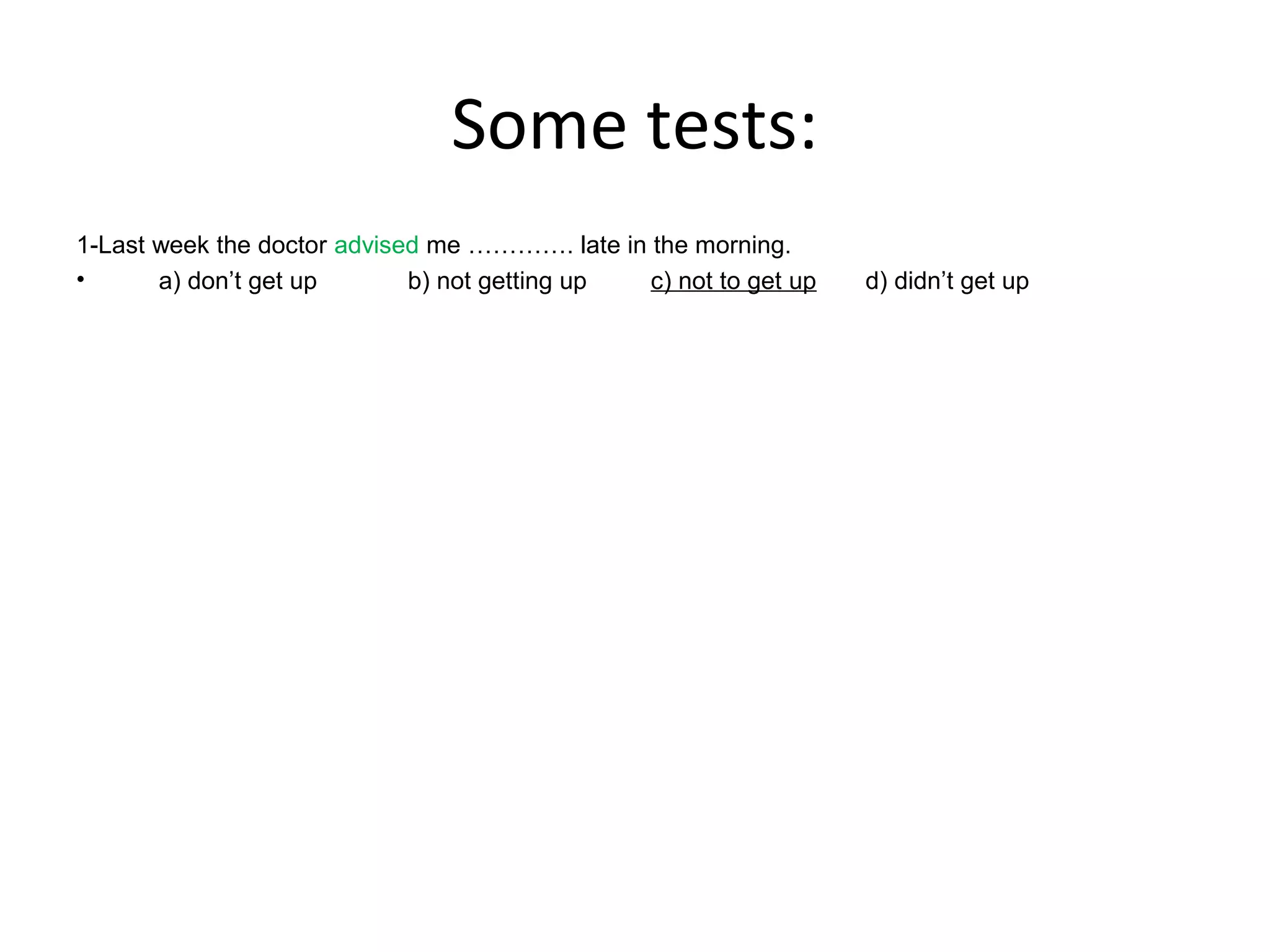
Some tests:
1-Last week the doctor advised me …………. late in the morning.
•
a) don’t get up
b) not getting up
c) not to get up

d) didn’t get up
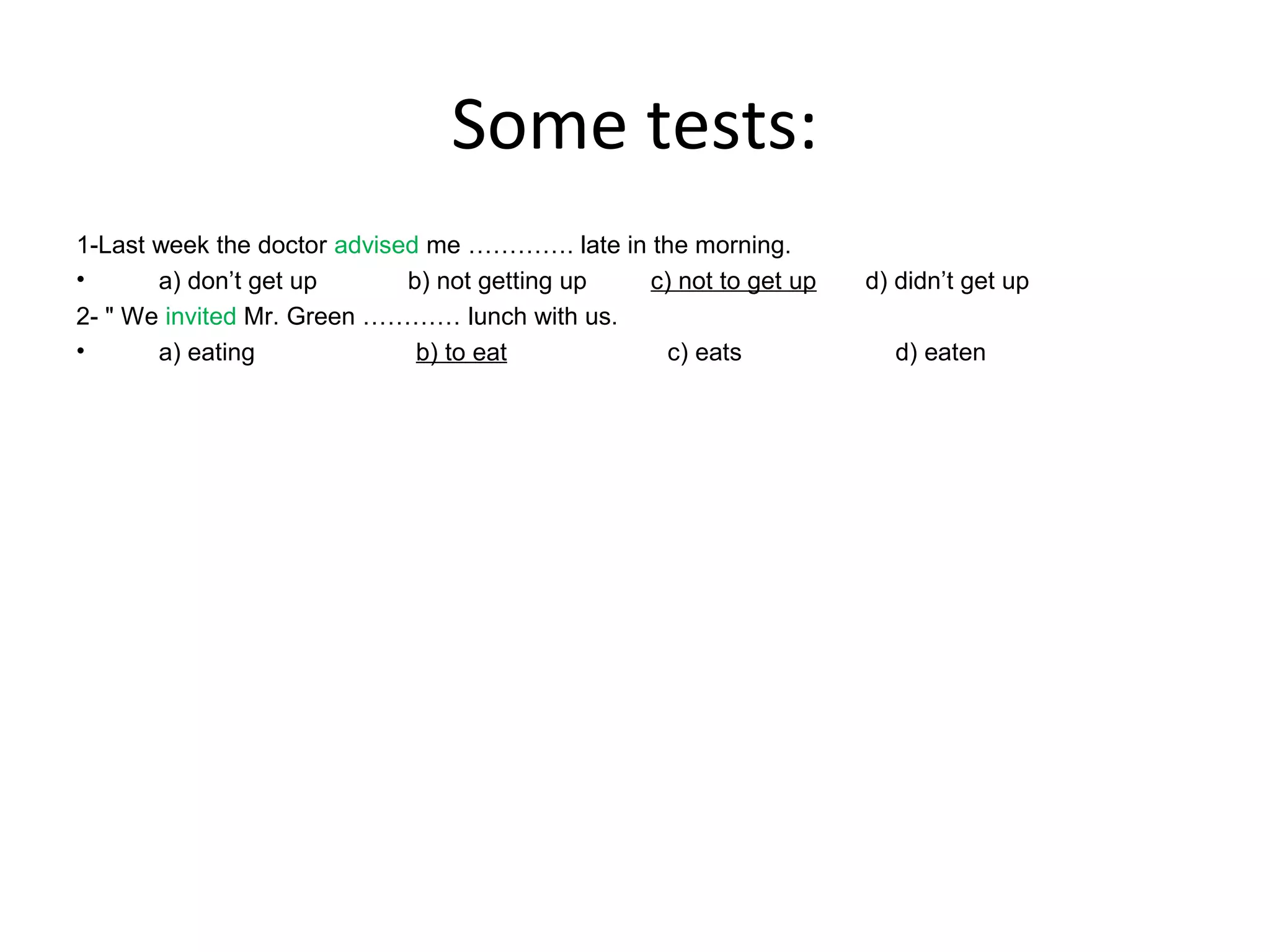
Some tests:
1-Last week the doctor advised me …………. late in the morning.
•
a) don’t get up
b) not getting up
c) not to get up
2- " We invited Mr. Green ………… lunch with us.
•
a) eating
b) to eat
c) eats

d) didn’t get up
d) eaten
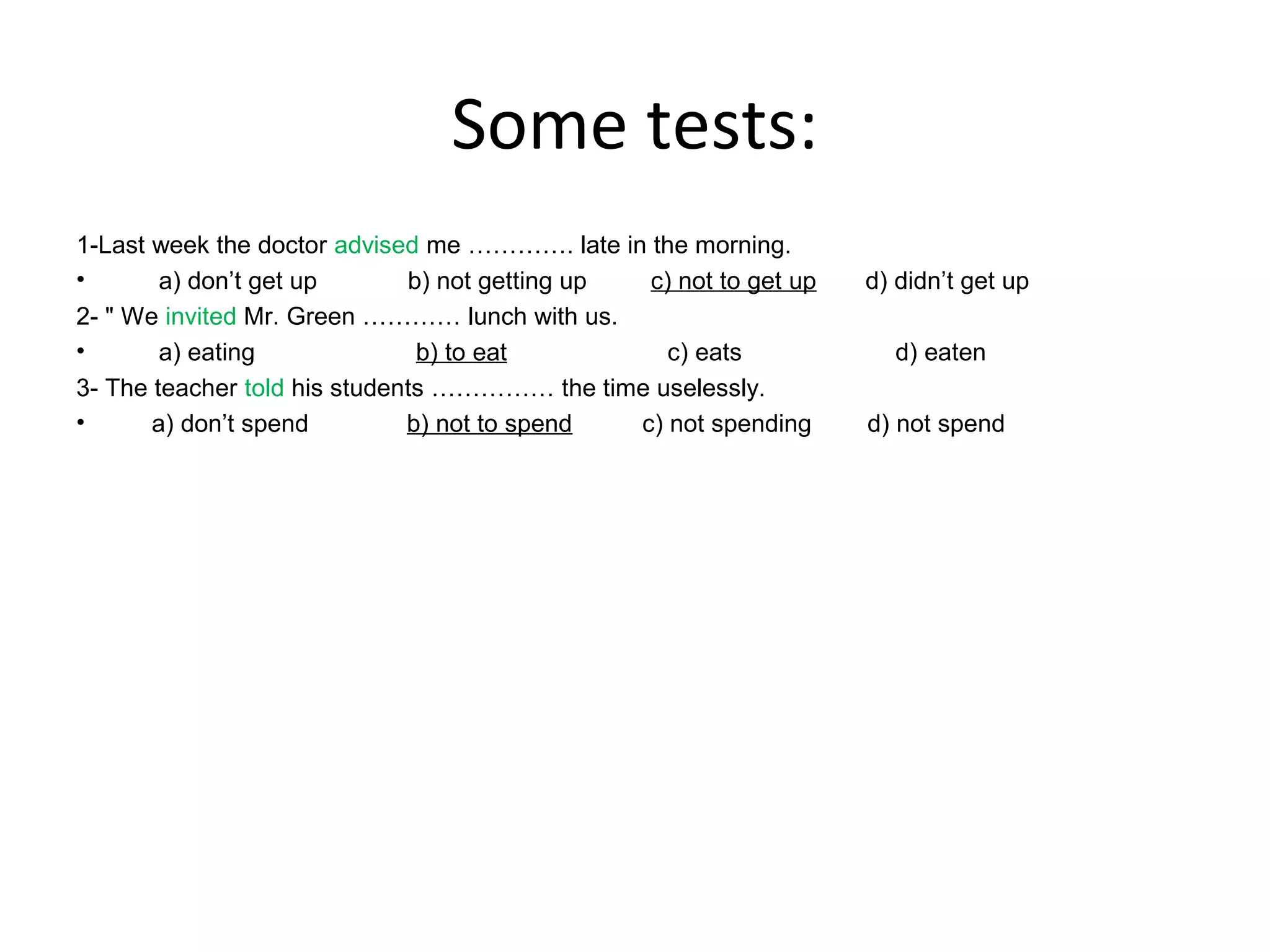
Some tests:
1-Last week the doctor advised me …………. late in the morning.
•
a) don’t get up
b) not getting up
c) not to get up
2- " We invited Mr. Green ………… lunch with us.
•
a) eating
b) to eat
c) eats
3- The teacher told his students …………… the time uselessly.
•
a) don’t spend
b) not to spend
c) not spending

d) didn’t get up
d) eaten
d) not spend
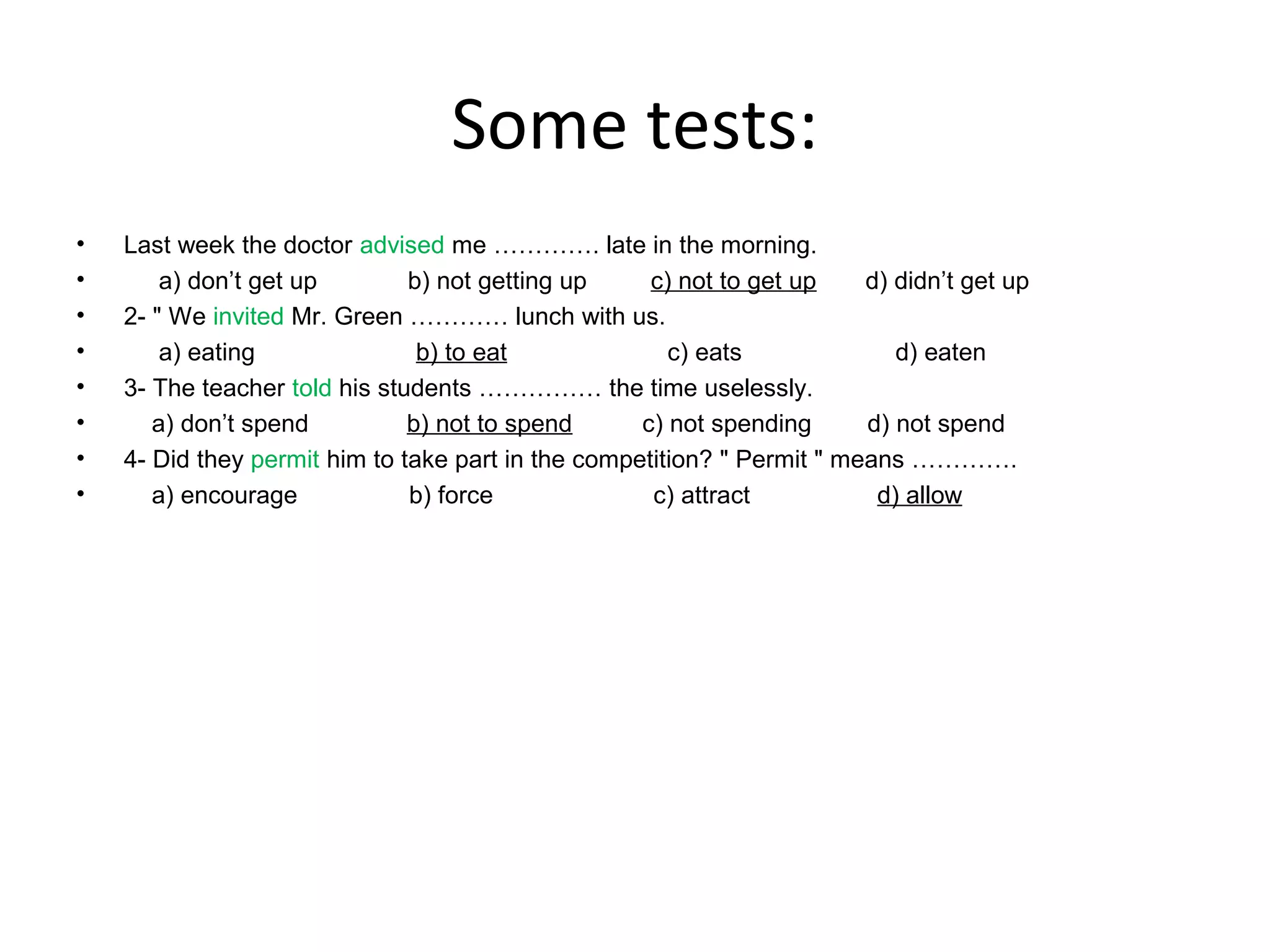
Some tests:
•
•
•
•
•
•
•
•

Last week the doctor advised me …………. late in the morning.
a) don’t get up
b) not getting up
c) not to get up
d) didn’t get up
2- " We invited Mr. Green ………… lunch with us.
a) eating
b) to eat
c) eats
d) eaten
3- The teacher told his students …………… the time uselessly.
a) don’t spend
b) not to spend
c) not spending
d) not spend
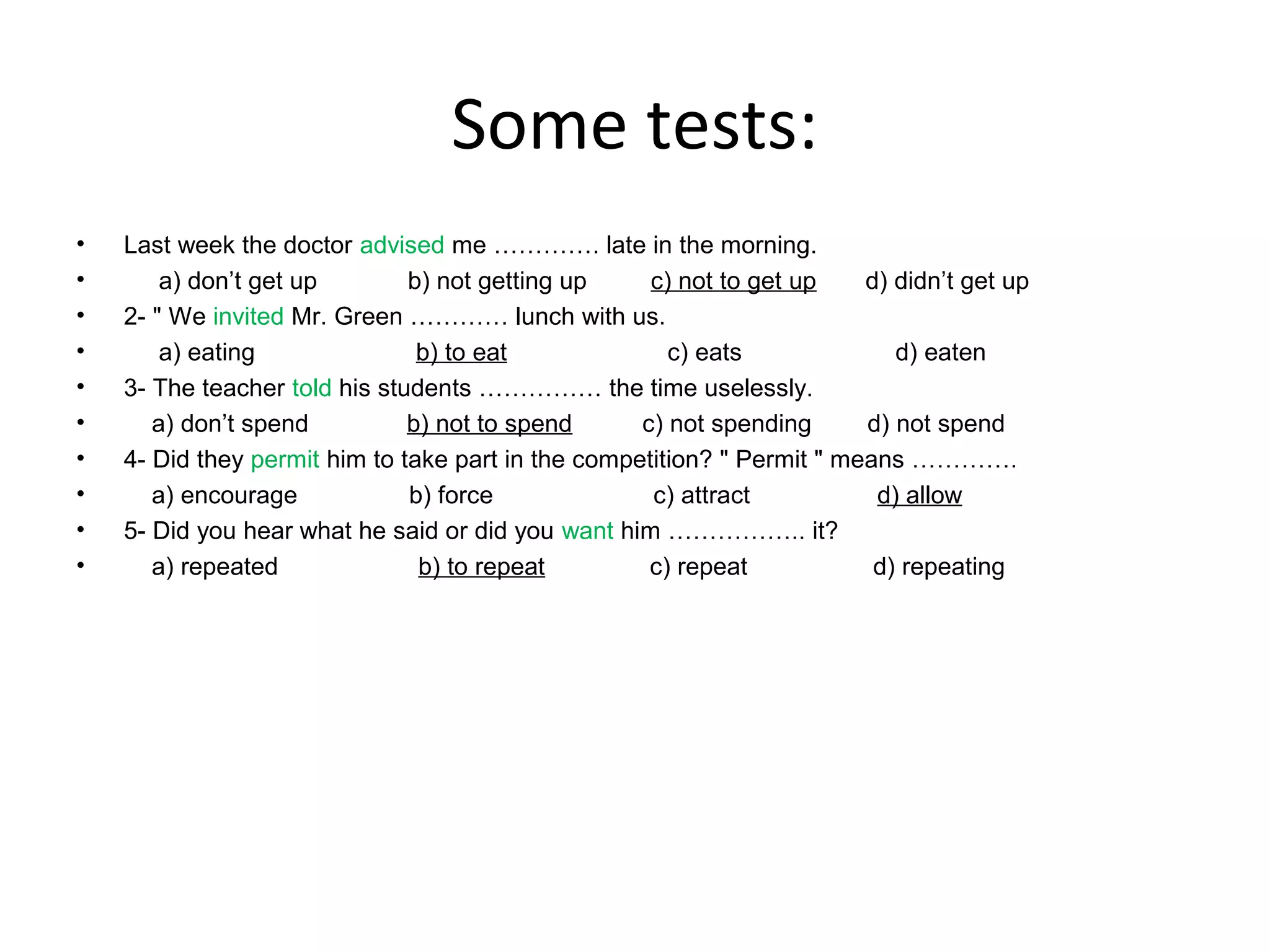
4- Did they permit him to take part in the competition? " Permit " means ………….
a) encourage
b) force
c) attract
d) allow
Some tests:
•
•
•
•
•
•
•
•
•
•

Last week the doctor advised me …………. late in the morning.
a) don’t get up
b) not getting up
c) not to get up
d) didn’t get up
2- " We invited Mr. Green ………… lunch with us.
a) eating
b) to eat
c) eats
d) eaten
3- The teacher told his students …………… the time uselessly.
a) don’t spend
b) not to spend
c) not spending
d) not spend
4- Did they permit him to take part in the competition? " Permit " means ………….
a) encourage
b) force
c) attract
d) allow
5- Did you hear what he said or did you want him …………….. it?
a) repeated
b) to repeat
c) repeat
d) repeating
Some tests:
•
•
•
•
•
•
•
•
•
•
•
•

Last week the doctor advised me …………. late in the morning.
a) don’t get up
b) not getting up
c) not to get up
d) didn’t get up
2- " We invited Mr. Green ………… lunch with us.
a) eating
b) to eat
c) eats
d) eaten
3- The teacher told his students …………… the time uselessly.
a) don’t spend
b) not to spend
c) not spending
d) not spend
4- Did they permit him to take part in the competition? " Permit " means ………….
a) encourage
b) force
c) attract
d) allow
5- Did you hear what he said or did you want him …………….. it?
a) repeated
b) to repeat
c) repeat
d) repeating
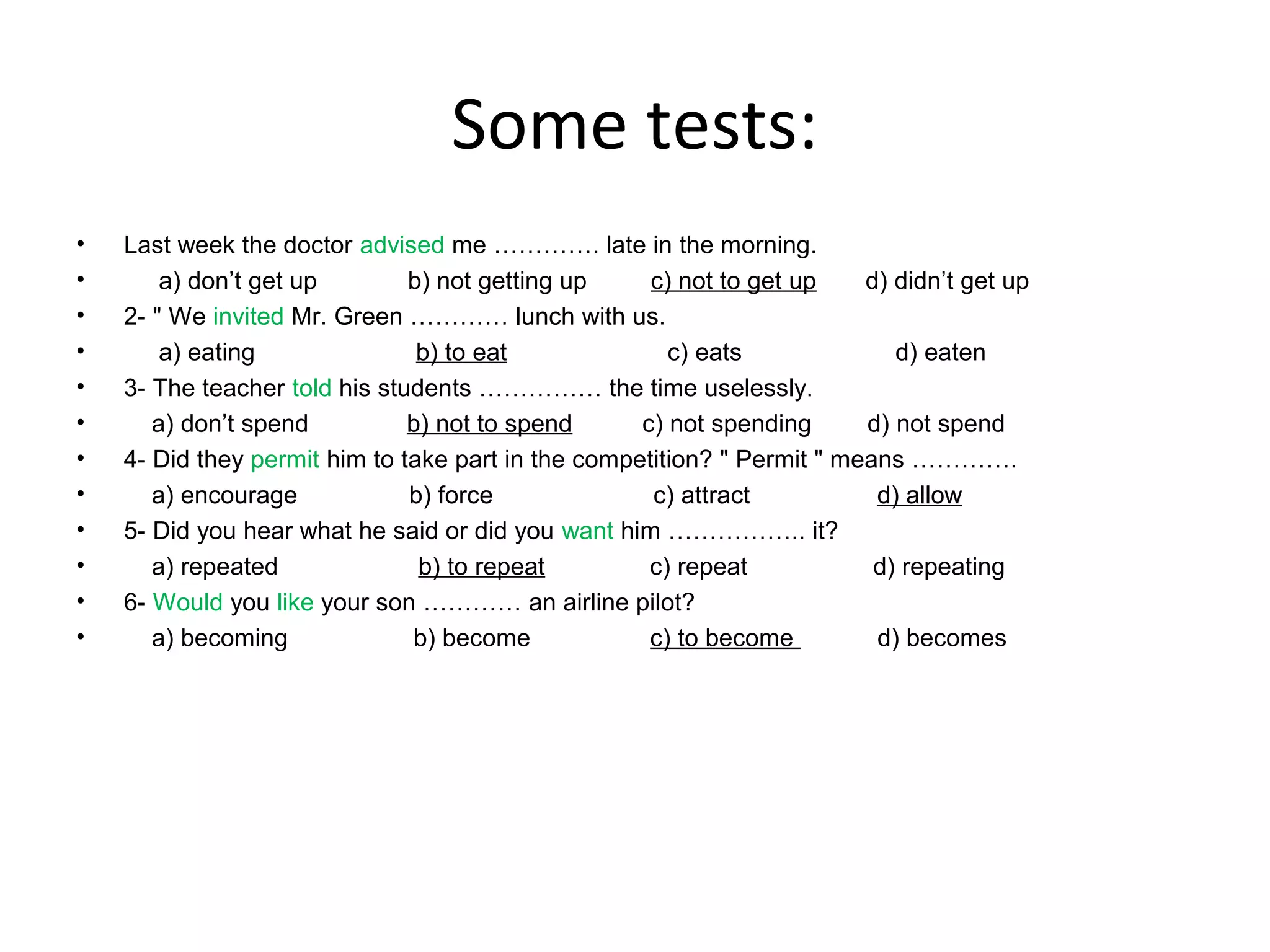
6- Would you like your son ………… an airline pilot?
a) becoming
b) become
c) to become
d) becomes
Some tests:
•
•
•
•
•
•
•
•
•
•
•
•
•
•

Last week the doctor advised me …………. late in the morning.
a) don’t get up
b) not getting up
c) not to get up
d) didn’t get up
2- " We invited Mr. Green ………… lunch with us.
a) eating
b) to eat
c) eats
d) eaten
3- The teacher told his students …………… the time uselessly.
a) don’t spend
b) not to spend
c) not spending
d) not spend
4- Did they permit him to take part in the competition? " Permit " means ………….
a) encourage
b) force
c) attract
d) allow
5- Did you hear what he said or did you want him …………….. it?
a) repeated
b) to repeat
c) repeat
d) repeating
6- Would you like your son ………… an airline pilot?
a) becoming
b) become
c) to become
d) becomes
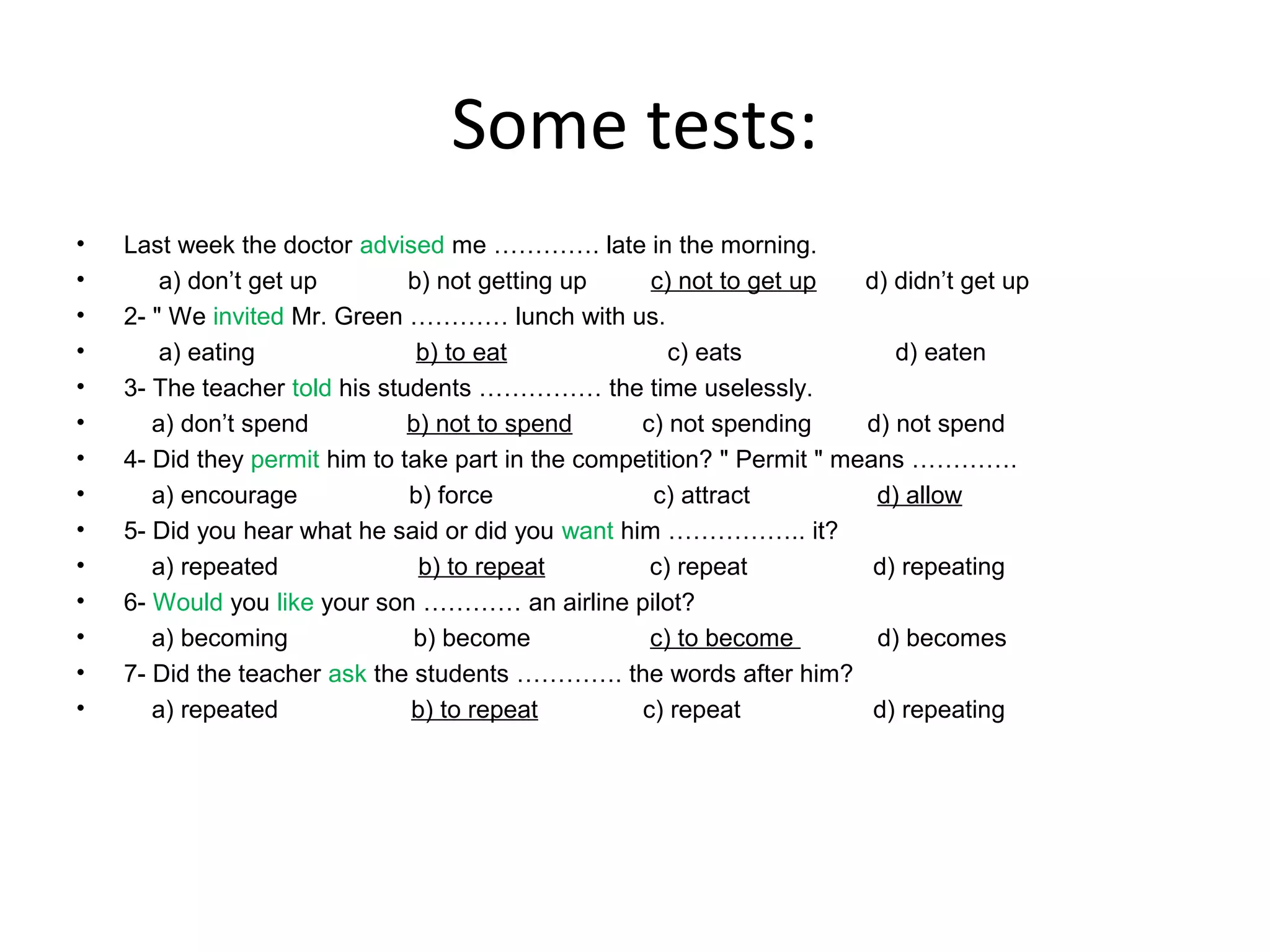
7- Did the teacher ask the students …………. the words after him?
a) repeated
b) to repeat
c) repeat
d) repeating
Some tests:
•
•
•
•
•
•
•
•
•
•
•
•
•
•
•
•

Last week the doctor advised me …………. late in the morning.
a) don’t get up
b) not getting up
c) not to get up
d) didn’t get up
2- " We invited Mr. Green ………… lunch with us.
a) eating
b) to eat
c) eats
d) eaten
3- The teacher told his students …………… the time uselessly.
a) don’t spend
b) not to spend
c) not spending
d) not spend
4- Did they permit him to take part in the competition? " Permit " means ………….
a) encourage
b) force
c) attract
d) allow
5- Did you hear what he said or did you want him …………….. it?
a) repeated
b) to repeat
c) repeat
d) repeating
6- Would you like your son ………… an airline pilot?
a) becoming
b) become
c) to become
d) becomes
7- Did the teacher ask the students …………. the words after him?
a) repeated
b) to repeat
c) repeat
d) repeating
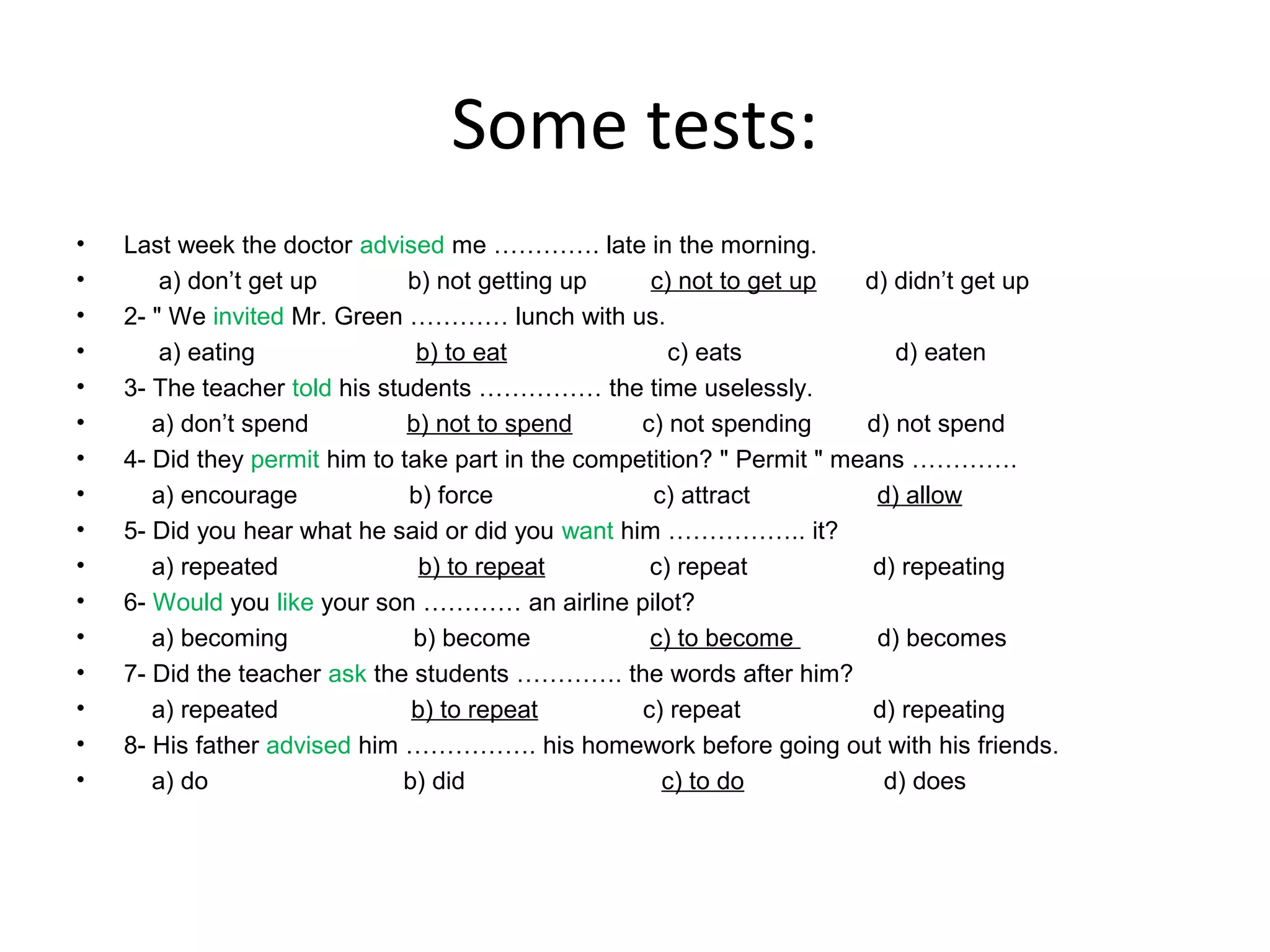
8- His father advised him ……………. his homework before going out with his friends.
a) do
b) did
c) to do
d) does
Some tests:
•

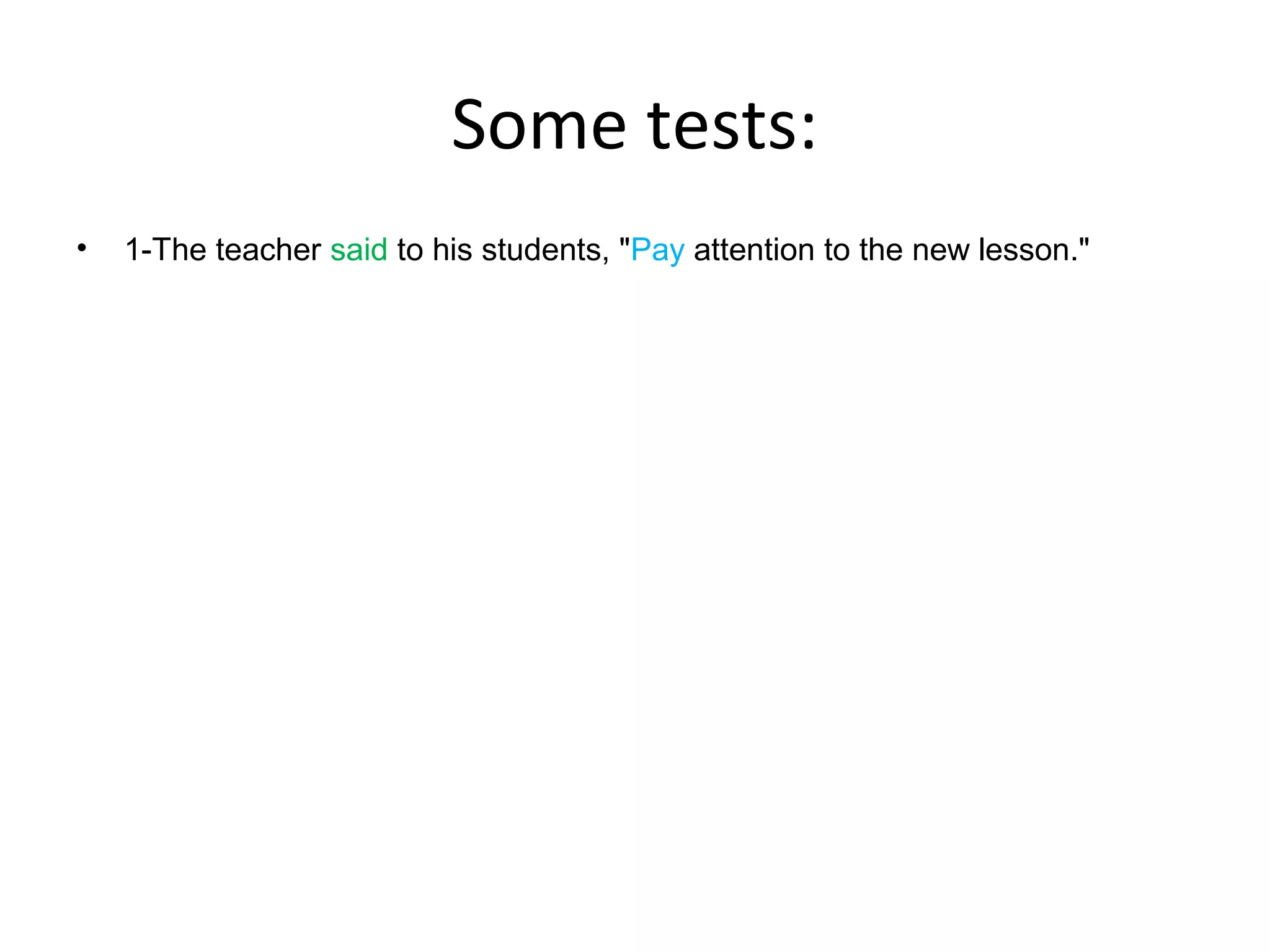
1-The teacher said to his students, "Pay attention to the new lesson."
Some tests:
•
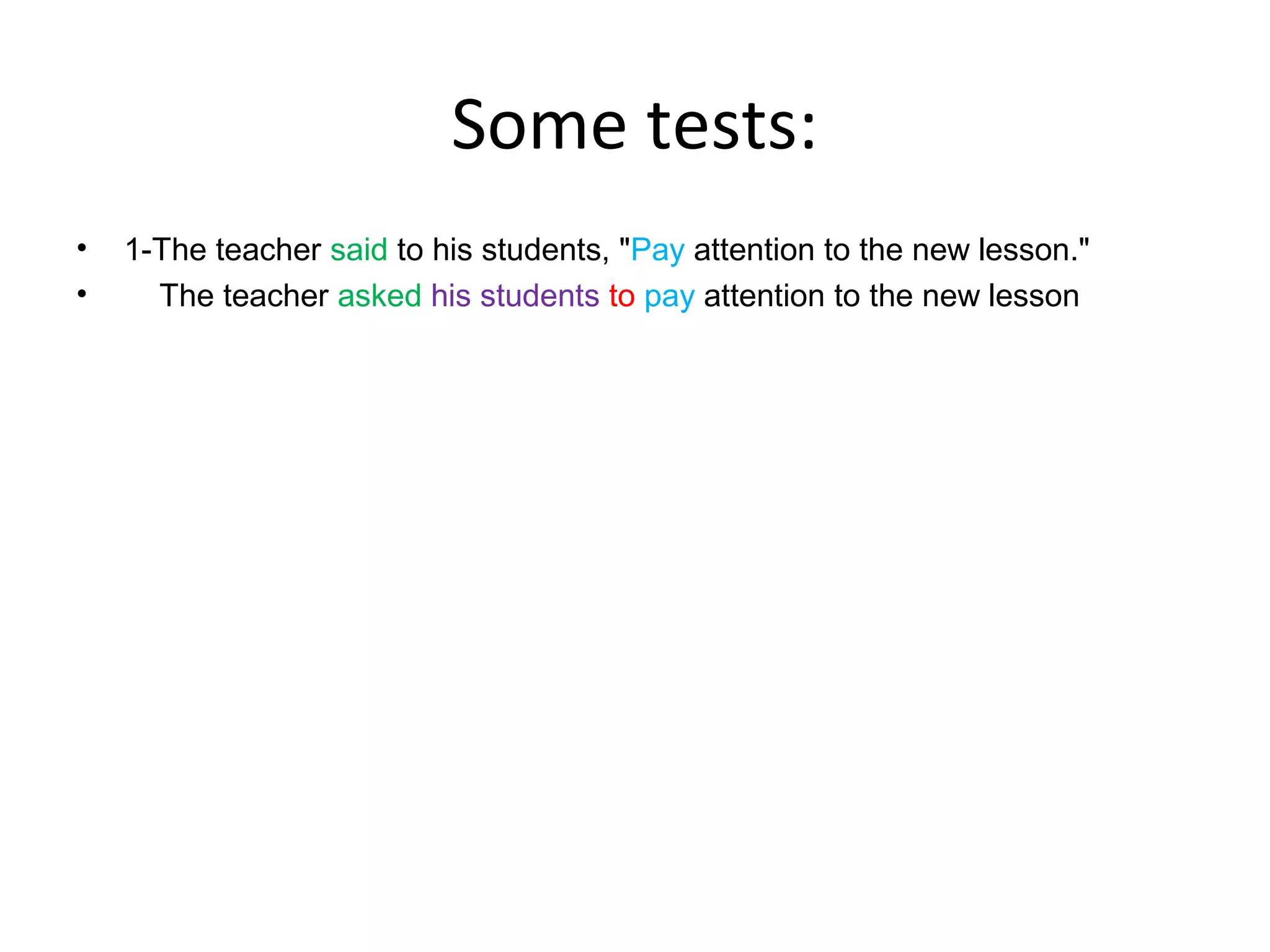
•

1-The teacher said to his students, "Pay attention to the new lesson."
The teacher asked his students to pay attention to the new lesson
Some tests:
•

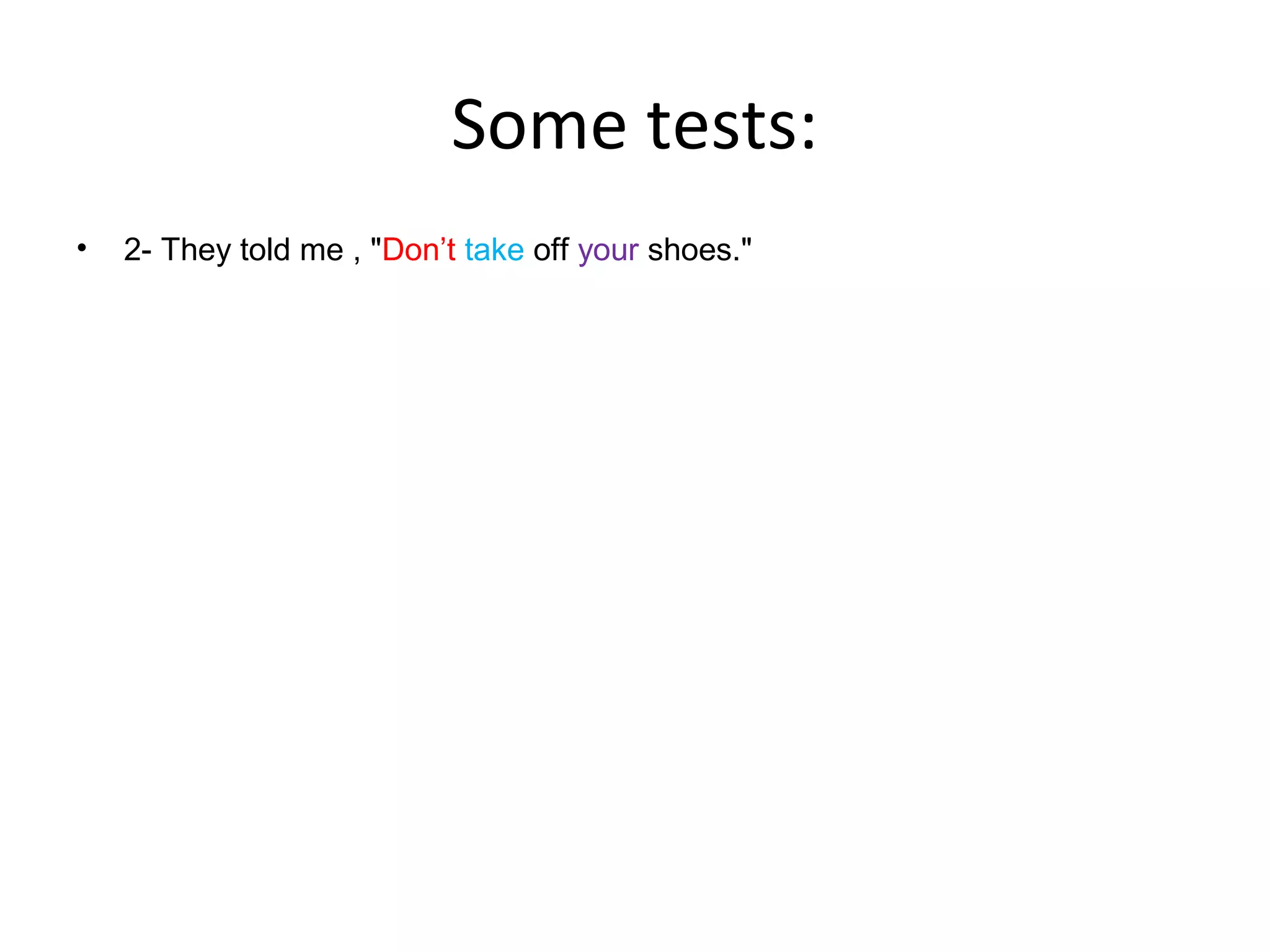
2- They told me , "Don’t take off your shoes."
Some tests:
•
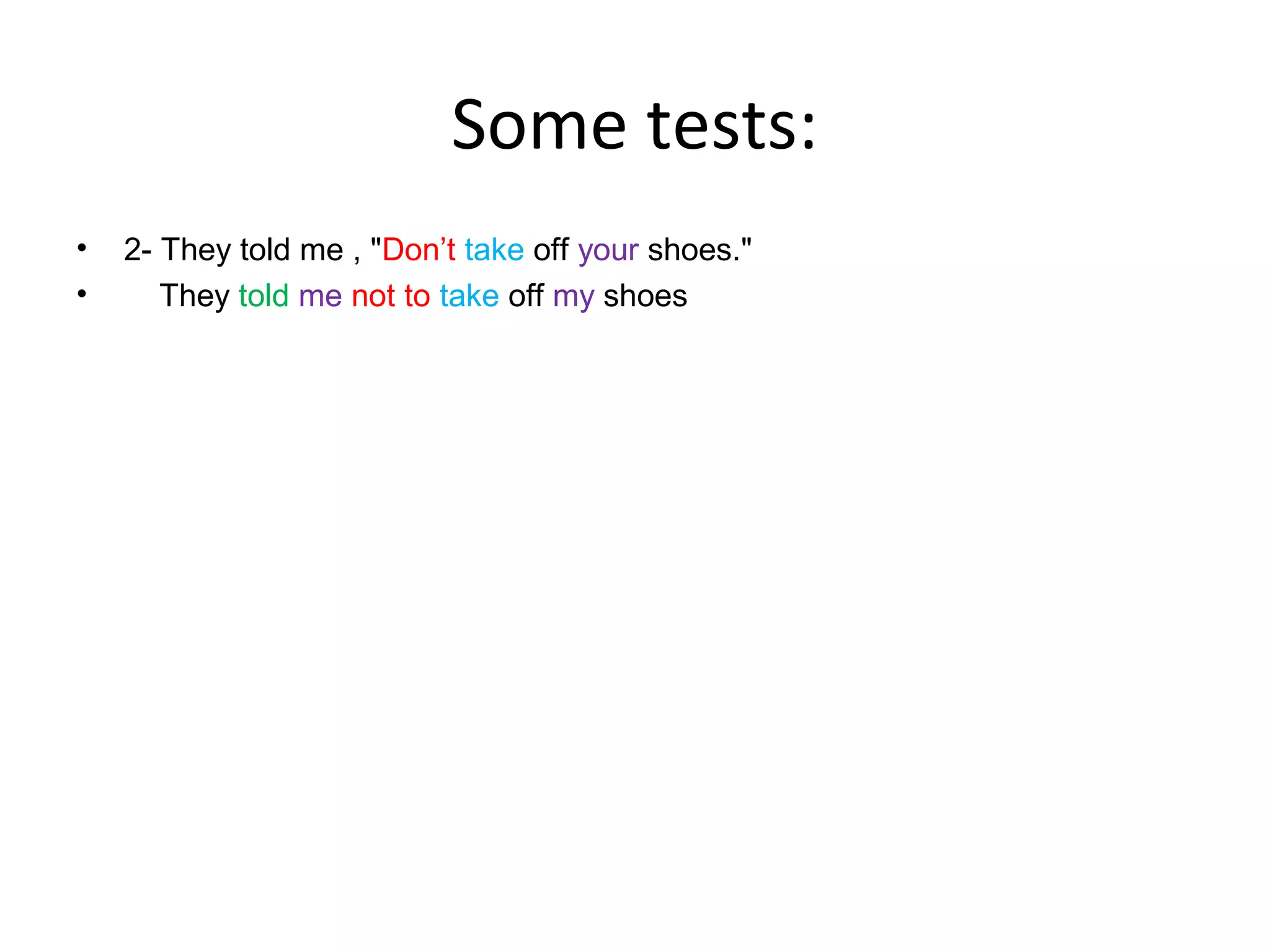
•

2- They told me , "Don’t take off your shoes."
They told me not to take off my shoes
Some tests:
•

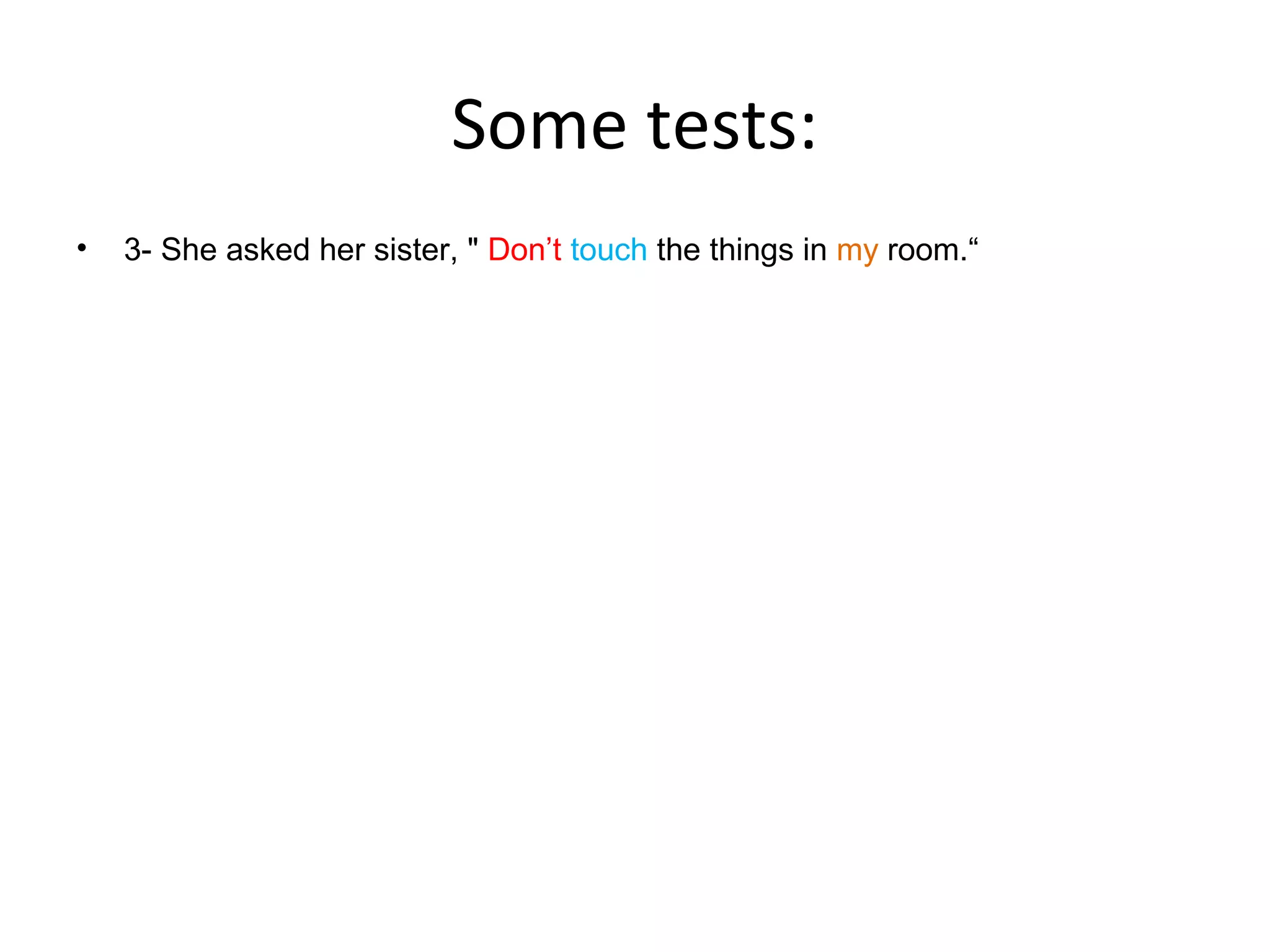
3- She asked her sister, " Don’t touch the things in my room.“
Some tests:
•
•

3- She asked her sister, " Don’t touch the things in my room."
She asked her sister not to touch the things in her room
Some tests:
•

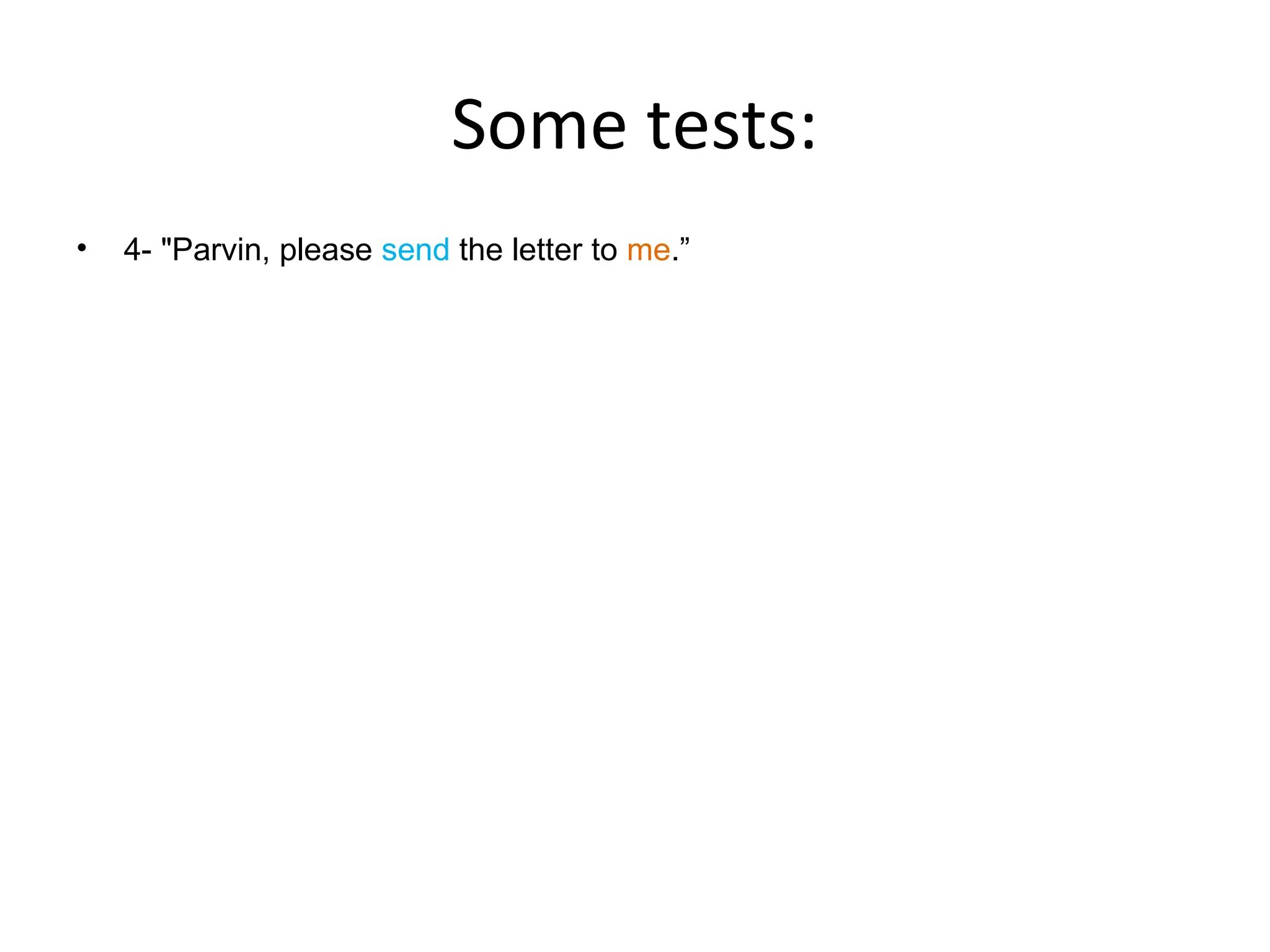
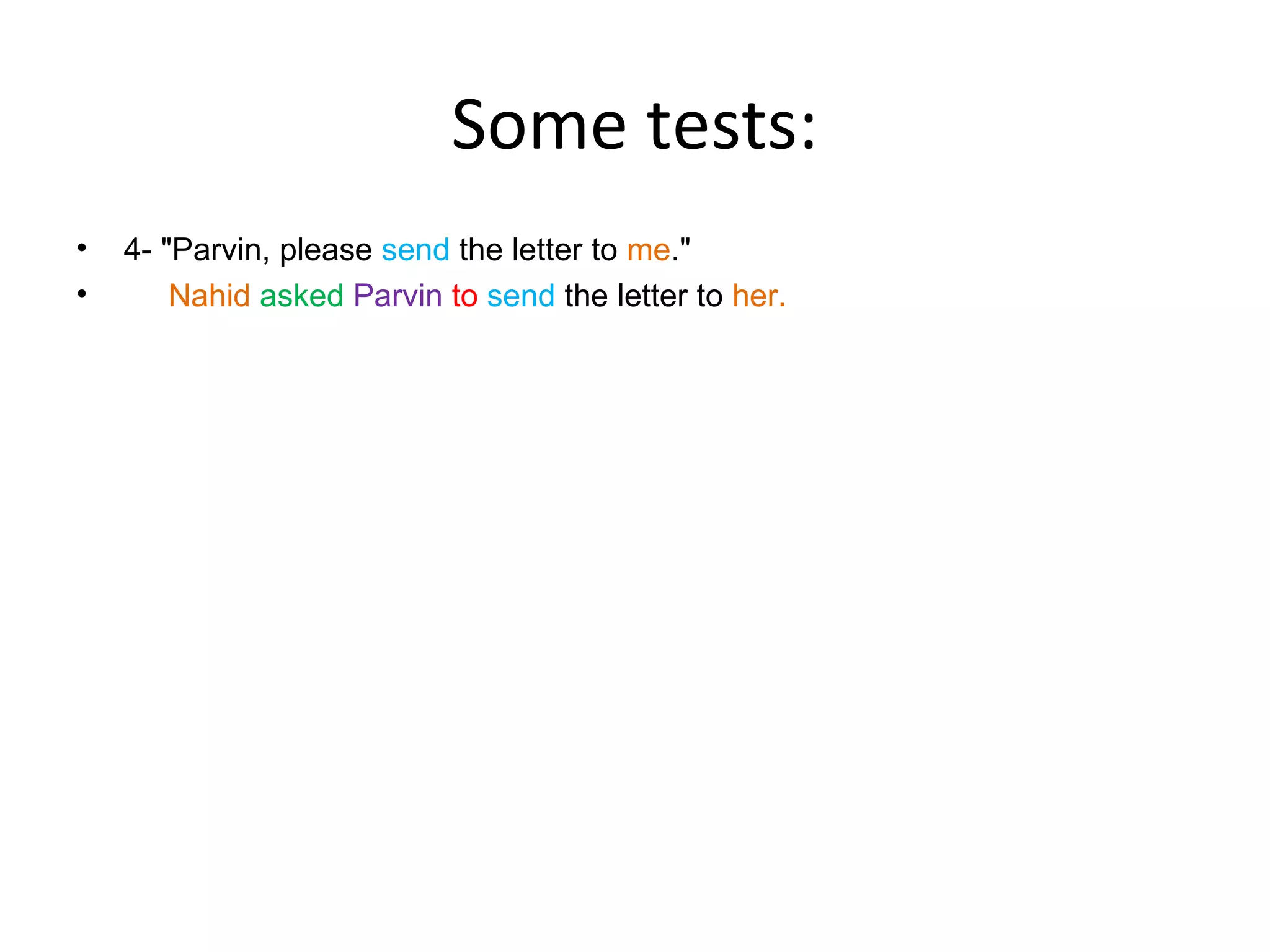
4- "Parvin, please send the letter to me.”
Some tests:
•
•

4- "Parvin, please send the letter to me."
Nahid asked Parvin to send the letter to her.
Some tests:
•

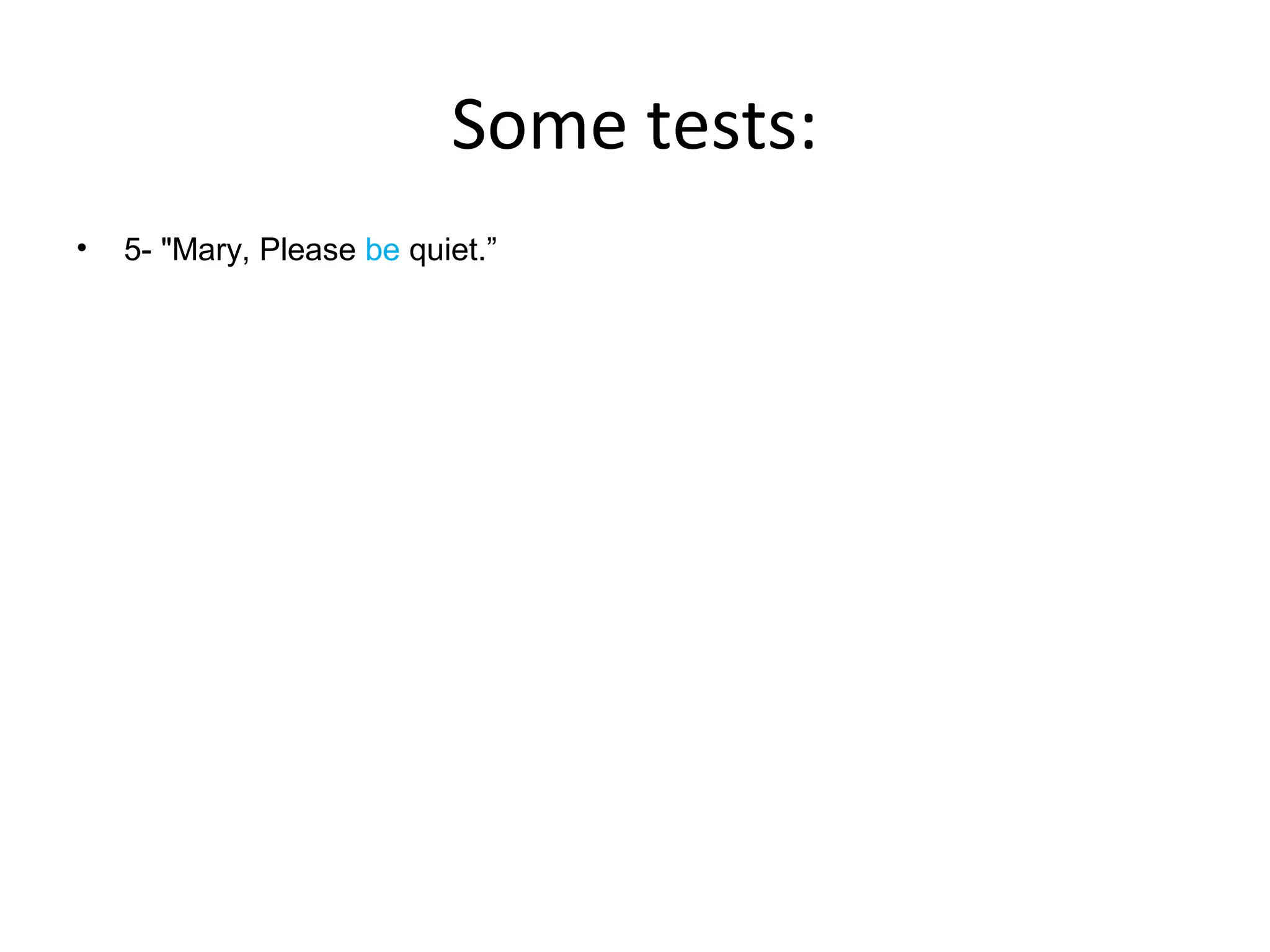
5- "Mary, Please be quiet.”
Some tests:
•
•

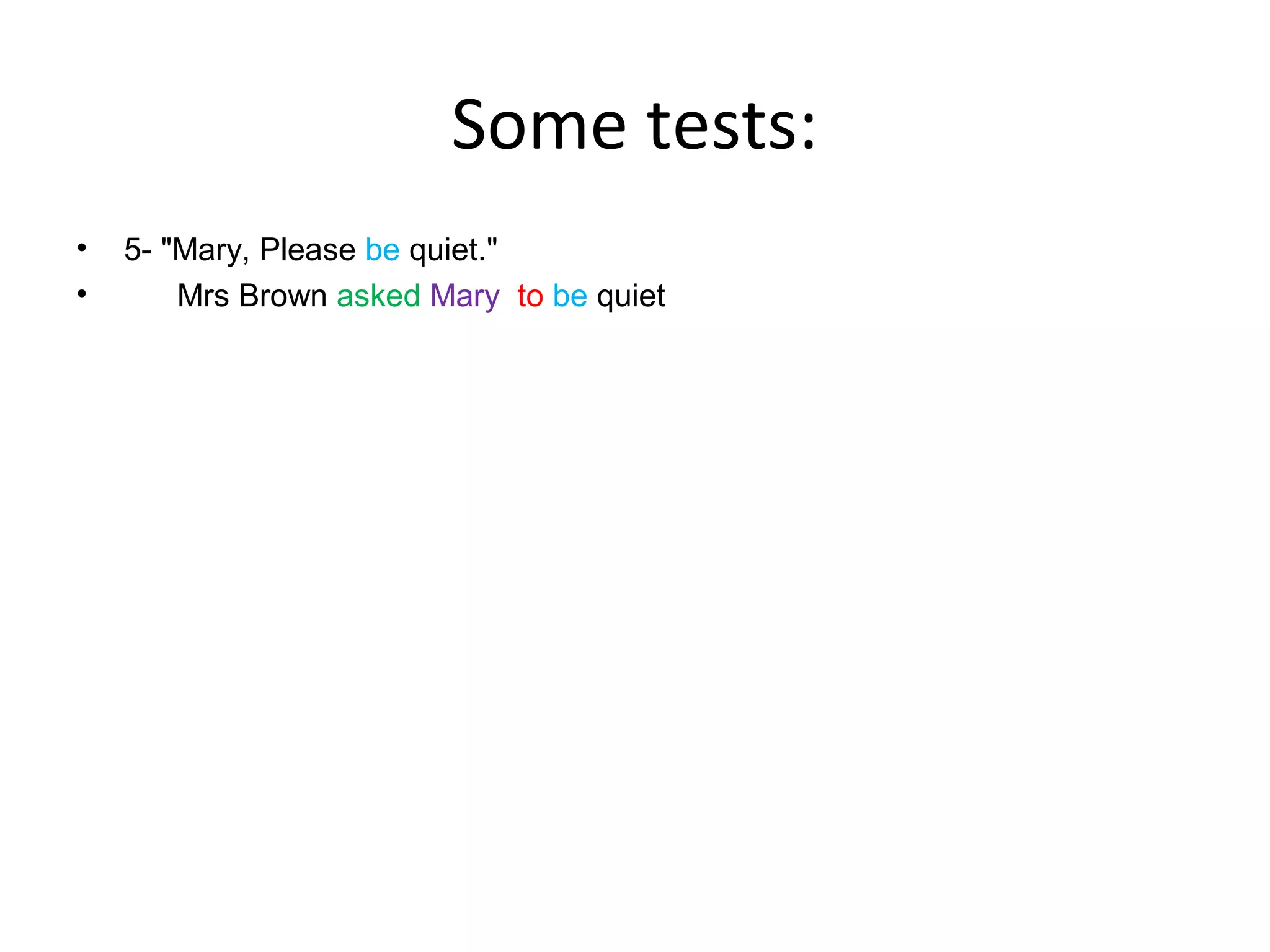
5- "Mary, Please be quiet."
Mrs Brown asked Mary to be quiet
Some tests:
•

6- Jack told me , "Study your lessons carefully."
Some tests:
•
•

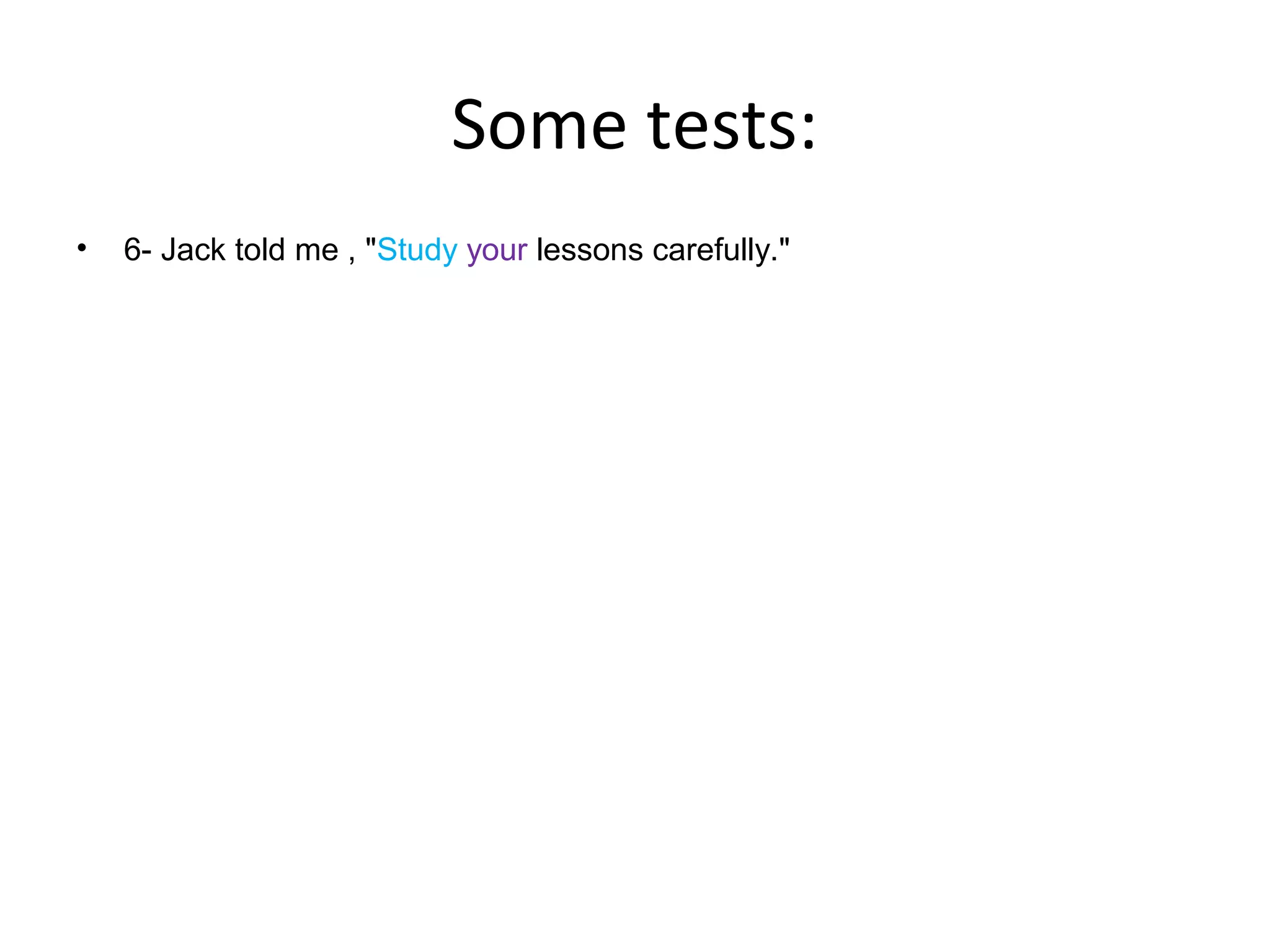
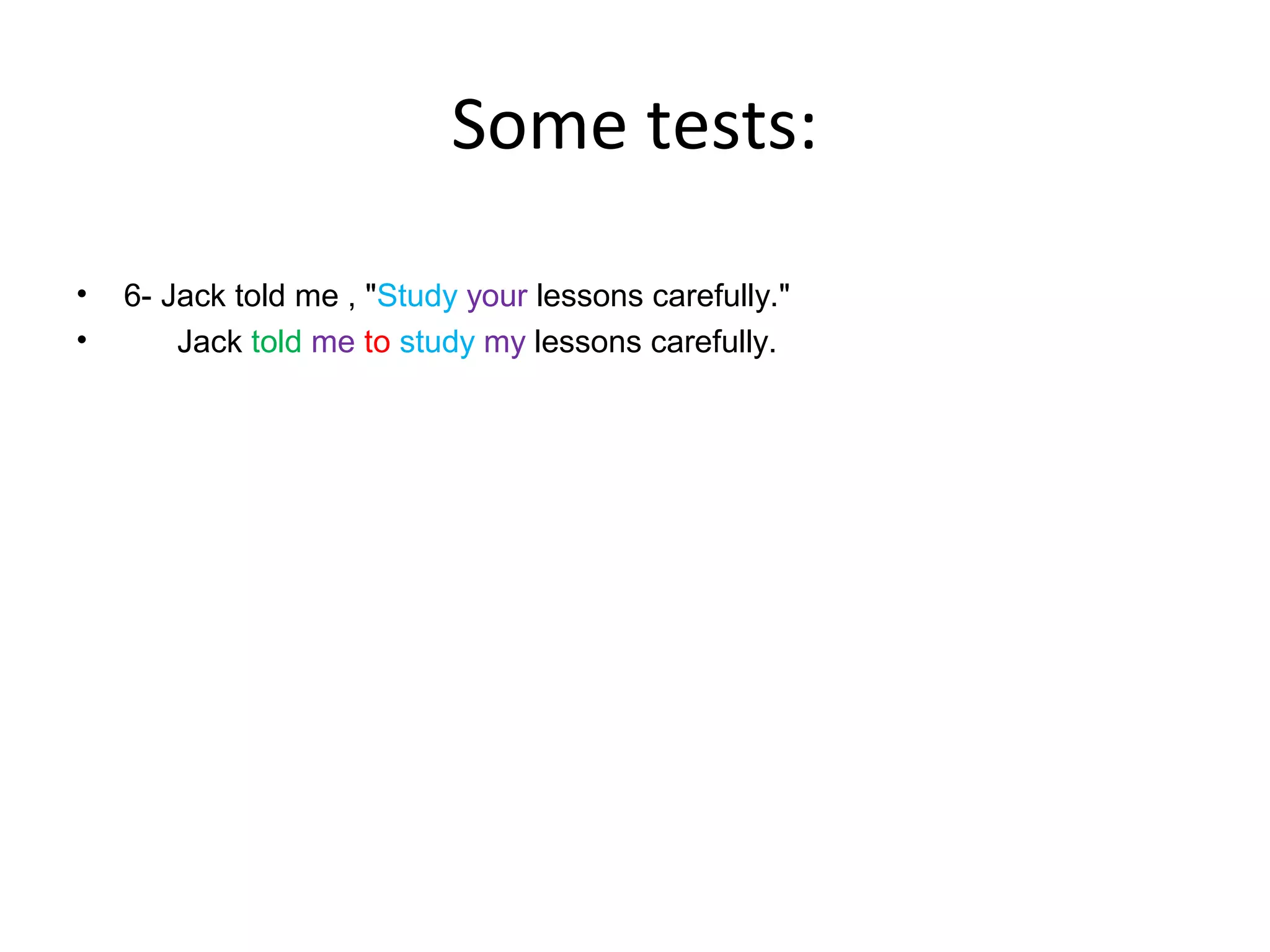
6- Jack told me , "Study your lessons carefully."
Jack told me to study my lessons carefully.
Some tests:
•
•
•
•
•
•
•
•
•
•
•
•

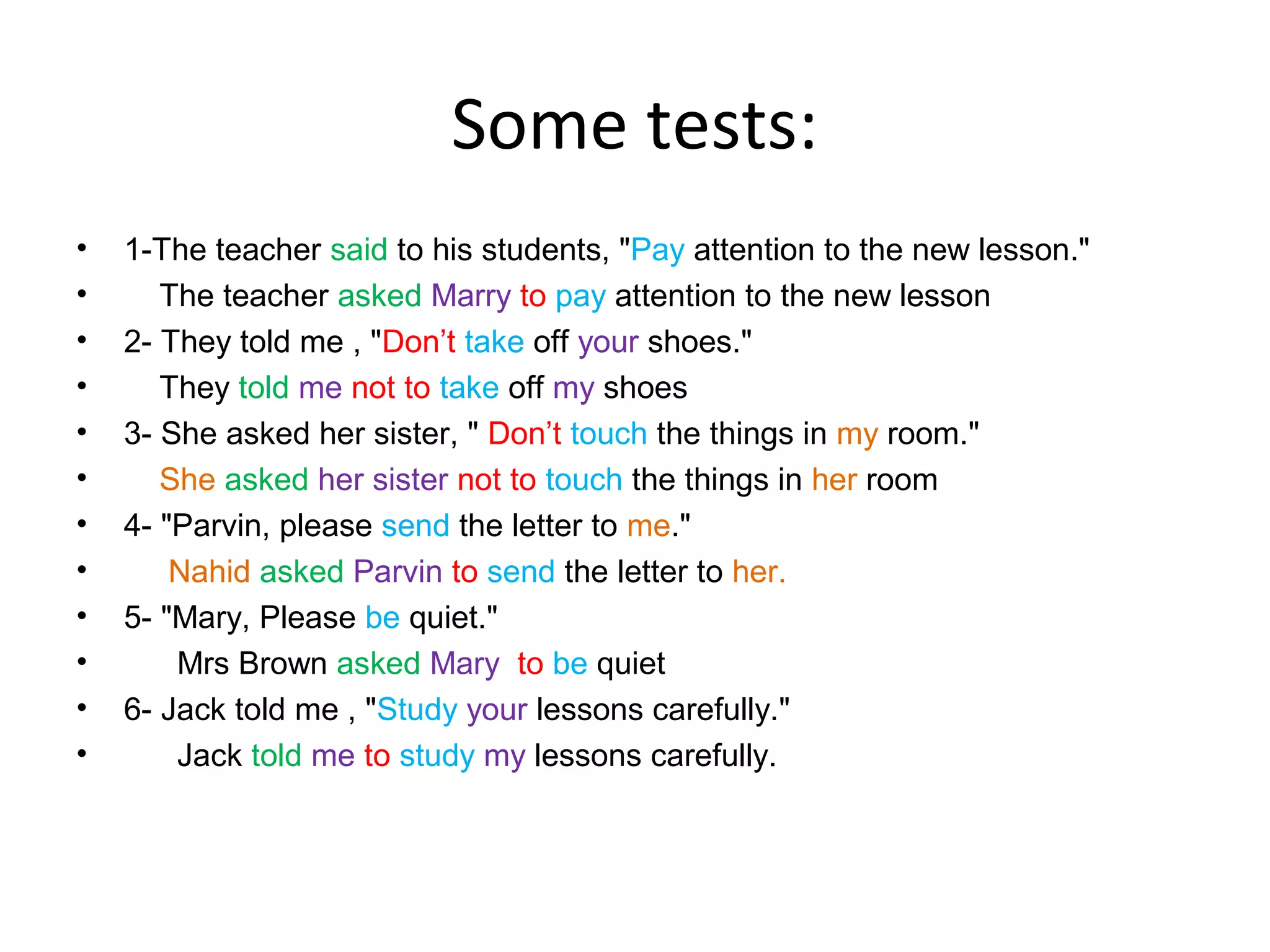
1-The teacher said to his students, "Pay attention to the new lesson."
The teacher asked Marry to pay attention to the new lesson
2- They told me , "Don’t take off your shoes."
They told me not to take off my shoes
3- She asked her sister, " Don’t touch the things in my room."
She asked her sister not to touch the things in her room
4- "Parvin, please send the letter to me."
Nahid asked Parvin to send the letter to her.
5- "Mary, Please be quiet."
Mrs Brown asked Mary to be quiet
6- Jack told me , "Study your lessons carefully."
Jack told me to study my lessons carefully.
Indirect speech

  • 1.
  • 2.
  • 3.
  • 4.
    ‫‪Verb + to+ verb‬‬ ‫• بعد ازبعضی افعال مصدر به همراه ‪ to‬به کار می رود در‬ ‫این حالت مصدر به همراه اجزایش نقش مفعول فعل اصلی‬ ‫را ایفا می کنند.‬ ‫• بعضی از این افعال عبارتند از :‬ ‫– )خواستن (‪• want‬‬
  • 5.
    ‫‪Verb + to+ verb‬‬ ‫• بعد ازبعضی افعال مصدر به همراه ‪ to‬به کار می رود در‬ ‫این حالت مصدر به همراه اجزایش نقش مفعول فعل اصلی‬ ‫را ایفا می کنند.‬ ‫• بعضی از این افعال عبارتند از :‬ ‫– )آرزو کردن (‪) – wish‬خواستن (‪• want‬‬
  • 6.
    ‫‪Verb + to+ verb‬‬ ‫• بعد ازبعضی افعال مصدر به همراه ‪ to‬به کار می رود در‬ ‫این حالت مصدر به همراه اجزایش نقش مفعول فعل اصلی‬ ‫را ایفا می کنند.‬ ‫• بعضی از این افعال عبارتند از :‬ ‫ترجیح ( ‪) – prefer‬آرزو کردن (‪) – wish‬خواستن (‪• want‬‬ ‫– )دادن‬
  • 7.
    ‫‪Verb + to+ verb‬‬ ‫• بعد ازبعضی افعال مصدر به همراه ‪ to‬به کار می رود در‬ ‫این حالت مصدر به همراه اجزایش نقش مفعول فعل اصلی‬ ‫را ایفا می کنند.‬ ‫• بعضی از این افعال عبارتند از :‬ ‫ترجیح ( ‪) – prefer‬آرزو کردن (‪) – wish‬خواستن (‪• want‬‬ ‫– )قول دادن (‪) – promise‬دادن‬
  • 8.
    ‫‪Verb + to+ verb‬‬ ‫• بعد ازبعضی افعال مصدر به همراه ‪ to‬به کار می رود در‬ ‫این حالت مصدر به همراه اجزایش نقش مفعول فعل اصلی‬ ‫را ایفا می کنند.‬ ‫• بعضی از این افعال عبارتند از :‬ ‫ترجیح ( ‪) – prefer‬آرزو کردن (‪) – wish‬خواستن (‪• want‬‬ ‫– )تل ش کردن (‪) – try‬قول دادن (‪) – promise‬دادن‬
  • 9.
    ‫‪Verb + to+ verb‬‬ ‫• بعد ازبعضی افعال مصدر به همراه ‪ to‬به کار می رود در‬ ‫این حالت مصدر به همراه اجزایش نقش مفعول فعل اصلی‬ ‫را ایفا می کنند.‬ ‫• بعضی از این افعال عبارتند از :‬ ‫ترجیح ( ‪) – prefer‬آرزو کردن (‪) – wish‬خواستن (‪• want‬‬ ‫– )تل ش کردن (‪) – try‬قول دادن (‪) – promise‬دادن‬ ‫)برنامه ریزی کردن (‪plan‬‬
  • 10.
    ‫‪Verb + to+ verb‬‬ ‫• بعد ازبعضی افعال مصدر به همراه ‪ to‬به کار می رود در‬ ‫این حالت مصدر به همراه اجزایش نقش مفعول فعل اصلی‬ ‫را ایفا می کنند.‬ ‫• بعضی از این افعال عبارتند از :‬ ‫ترجیح ( ‪) – prefer‬آرزو کردن (‪) – wish‬خواستن (‪• want‬‬ ‫– )تل ش کردن (‪) – try‬قول دادن (‪) – promise‬دادن‬ ‫– )تصمیم گرفتن (‪) – decide‬برنامه ریزی کردن (‪plan‬‬
  • 11.
    ‫‪Verb + to+ verb‬‬ ‫• بعد ازبعضی افعال مصدر به همراه ‪ to‬به کار می رود در‬ ‫این حالت مصدر به همراه اجزایش نقش مفعول فعل اصلی‬ ‫را ایفا می کنند.‬ ‫• بعضی از این افعال عبارتند از :‬ ‫ترجیح ( ‪) – prefer‬آرزو کردن (‪) – wish‬خواستن (‪• want‬‬ ‫– )تل ش کردن (‪) – try‬قول دادن (‪) – promise‬دادن‬ ‫– )تصمیم گرفتن (‪) – decide‬برنامه ریزی کردن (‪plan‬‬ ‫– )شروع کردن (‪begin‬‬
  • 12.
    ‫‪Verb + to+ verb‬‬ ‫• بعد ازبعضی افعال مصدر به همراه ‪ to‬به کار می رود در‬ ‫این حالت مصدر به همراه اجزایش نقش مفعول فعل اصلی‬ ‫را ایفا می کنند.‬ ‫• بعضی از این افعال عبارتند از :‬ ‫ترجیح ( ‪) – prefer‬آرزو کردن (‪) – wish‬خواستن (‪• want‬‬ ‫– )تل ش کردن (‪) – try‬قول دادن (‪) – promise‬دادن‬ ‫– )تصمیم گرفتن (‪) – decide‬برنامه ریزی کردن (‪plan‬‬ ‫– )دوست داشتن ( ‪) – like‬شروع کردن (‪begin‬‬
  • 13.
    ‫‪Verb + to+ verb‬‬ ‫• بعد ازبعضی افعال مصدر به همراه ‪ to‬به کار می رود در‬ ‫این حالت مصدر به همراه اجزایش نقش مفعول فعل اصلی‬ ‫را ایفا می کنند.‬ ‫• بعضی از این افعال عبارتند از :‬ ‫ترجیح ( ‪) – prefer‬آرزو کردن (‪) – wish‬خواستن (‪• want‬‬ ‫– )تل ش کردن (‪) – try‬قول دادن (‪) – promise‬دادن‬ ‫– )تصمیم گرفتن (‪) – decide‬برنامه ریزی کردن (‪plan‬‬ ‫‪) – hope‬دوست داشتن ( ‪) – like‬شروع کردن (‪begin‬‬ ‫– ) امید وار بودن(‬
  • 14.
    ‫‪Verb + to+ verb‬‬ ‫• بعد ازبعضی افعال مصدر به همراه ‪ to‬به کار می رود در‬ ‫این حالت مصدر به همراه اجزایش نقش مفعول فعل اصلی‬ ‫را ایفا می کنند.‬ ‫• بعضی از این افعال عبارتند از :‬ ‫ترجیح ( ‪) – prefer‬آرزو کردن (‪) – wish‬خواستن (‪• want‬‬ ‫– )تل ش کردن (‪) – try‬قول دادن (‪) – promise‬دادن‬ ‫– )تصمیم گرفتن (‪) – decide‬برنامه ریزی کردن (‪plan‬‬ ‫‪) – hope‬دوست داشتن ( ‪) – like‬شروع کردن (‪begin‬‬ ‫-)موافق بودن ( ‪ ) – agree‬امید وار بودن(‬
  • 15.
    ‫‪Verb + to+ verb‬‬ ‫• بعد ازبعضی افعال مصدر به همراه ‪ to‬به کار می رود در این‬ ‫حالت مصدر به همراه اجزایش نقش مفعول فعل اصلی را ایفا‬ ‫می کنند.‬ ‫• بعضی از این افعال عبارتند از :‬ ‫ترجیح ( ‪) – prefer‬آرزو کردن (‪) – wish‬خواستن (‪• want‬‬ ‫– )تل ش کردن (‪) – try‬قول دادن (‪) – promise‬دادن‬ ‫– )تصمیم گرفتن (‪) – decide‬برنامه ریزی کردن (‪plan‬‬ ‫امید( ‪) – hope‬دوست داشتن ( ‪) – like‬شروع کردن (‪begin‬‬ ‫)رد کردن(‪)- refuse‬موافق بودن ( ‪ ) – agree‬وار بودن‬
  • 16.
    ‫‪Verb + to+ verb‬‬ ‫• بعد ازبعضی افعال مصدر به همراه ‪ to‬به کار می رود در این‬ ‫حالت مصدر به همراه اجزایش نقش مفعول فعل اصلی را ایفا‬ ‫می کنند.‬ ‫• بعضی از این افعال عبارتند از :‬ ‫ترجیح ( ‪) – prefer‬آرزو کردن (‪) – wish‬خواستن (‪• want‬‬ ‫– )تل ش کردن (‪) – try‬قول دادن (‪) – promise‬دادن‬ ‫– )تصمیم گرفتن (‪) – decide‬برنامه ریزی کردن (‪plan‬‬ ‫امید( ‪) – hope‬دوست داشتن ( ‪) – like‬شروع کردن (‪begin‬‬ ‫)ردکردن(‪)- refuse‬موافق بودن ( ‪ ) – agree‬وار بودن‬
  • 17.
    ‫‪Verb + to+ verb‬‬ ‫• دراین حالت ساختار جمله به این شکل در می آید:‬
  • 18.
    ‫‪Verb + to+ verb‬‬ ‫• دراین حالت ساختار جمله به این شکل در می آید:‬ ‫•‬ ‫قید زمان +قید مکان +قید حالت + مفعول+ مصدر + ‪+ to‬فعل اصلی+ فعل کمکی +فاعل‬
  • 19.
    ‫‪Verb + to+ verb‬‬ ‫• دراین حالت ساختار جمله به این شکل در می آید:‬ ‫•‬ ‫قید زمان +قید مکان +قید حالت + مفعول+ مصدر + ‪+ to‬فعل اصلی+ فعل کمکی +فاعل‬ ‫•‬ ‫در این ساختار فاعل فعل اصلی فاعل مصدر هم خواهد بود یعنی فاعل برای خود انجام کاری‬ ‫را در ذهن دارد.‬
  • 20.
    Verb + to+ verb • • • • • • • • I want to go home now. They like to watch the cartoons on Fridays . She decided to buy a blue dress. I’m trying to learn French ,too. He has promised to answer the letter soon. I hope to see them next month. I wish to become a writer. we try to complete the house in a few weeks.
  • 21.
    ‫‪Verb +object +to + verb‬‬ ‫• گاهی اوقات ما از فرد دیگری می خواهیم کاری را انجام‬ ‫دهد یعنی به طور غیر مستقیم فردی را با انجام کاری وادار‬ ‫می کنیم یعنی از امری غیر مستقیم استفاده می کنیم.‬
  • 22.
    ‫‪Verb +object +to + verb‬‬ ‫• گاهی اوقات ما از فرد دیگری می خواهیم کاری را انجام‬ ‫دهد یعنی به طور غیر مستقیم فردی را با انجام کاری وادار‬ ‫می کنیم یعنی از امری غیر مستقیم استفاده می کنیم.‬ ‫• دراین حالت ساختار جمله به این شکل در می آید:‬
  • 23.
    ‫‪Verb +object +to + verb‬‬ ‫•‬ ‫گاهی اوقات ما از فرد دیگری می خواهیم کاری را انجام دهد یعنی به طور غیر مستقیم فردی‬ ‫را با انجام کاری وادار می کنیم یعنی از امری غیر مستقیم استفاده می کنیم.‬ ‫دراین حالت ساختار جمله به این شکل در می آید:‬ ‫•‬ ‫قید زمان +قید مکان +قید حالت + مفعول+ مصدر + ‪+ to‬مفعول+فعل اصلی+ فعل کمکی +فاعل‬ ‫•‬
  • 24.
    ‫‪Verb +object +to + verb‬‬ ‫•‬ ‫گاهی اوقات ما از فرد دیگری می خواهیم کاری را انجام دهد یعنی به طور غیر مستقیم فردی‬ ‫را با انجام کاری وادار می کنیم یعنی از امری غیر مستقیم استفاده می کنیم.‬ ‫دراین حالت ساختار جمله به این شکل در می آید:‬ ‫•‬ ‫•‬ ‫قید زمان +قید مکان +قید حالت + مفعول+ مصدر + ‪+ to‬مفعول+فعل اصلی+ فعل کمکی +فاعل‬ ‫در این ساختار فاعل فعل اصلی از مفعول فعل اصلی می خواهد کاری را انجام دهد و مفعول جمله قرار‬ ‫است فاعل مصدر بشود.‬ ‫•‬
  • 25.
    ‫‪Verb +object +to + verb‬‬ ‫•‬ ‫گاهی اوقات ما از فرد دیگری می خواهیم کاری را انجام دهد یعنی به طور غیر مستقیم فردی‬ ‫را با انجام کاری وادار می کنیم یعنی از امری غیر مستقیم استفاده می کنیم.‬ ‫دراین حالت ساختار جمله به این شکل در می آید:‬ ‫•‬ ‫•‬ ‫قید زمان +قید مکان +قید حالت + مفعول+ مصدر + ‪+ to‬مفعول+فعل اصلی+ فعل کمکی +فاعل‬ ‫در این ساختار فاعل فعل اصلی از مفعول فعل اصلی می خواهد کاری را انجام دهد و مفعول جمله قرار‬ ‫است فاعل مصدر بشود.‬ ‫در این ساختارمفعول اسم یا یک ضمیر است.‬ ‫•‬ ‫•‬
  • 26.
    ‫‪Verb +object +to + verb‬‬ ‫•‬ ‫تعدادی از این افعال عبارتند از:‬ ‫– )خواستن( ‪want‬‬ ‫•‬
  • 27.
    ‫‪Verb +object +to + verb‬‬ ‫•‬ ‫تعدادی از این افعال عبارتند از:‬ ‫– )خواستن( ‪want‬‬ ‫–)گفت ( ‪told‬گفتن (و( ‪tell‬‬ ‫•‬ ‫•‬
  • 28.
    ‫‪Verb +object +to + verb‬‬ ‫•‬ ‫تعدادی از این افعال عبارتند از:‬ ‫– )خواستن( ‪want‬‬ ‫–)گفت ( ‪told‬گفتن (و( ‪tell‬‬ ‫– )خواستن ( ‪ask‬‬ ‫•‬ ‫•‬ ‫•‬
  • 29.
    ‫‪Verb +object +to + verb‬‬ ‫•‬ ‫تعدادی از این افعال عبارتند از:‬ ‫– )خواستن( ‪want‬‬ ‫–)گفت ( ‪told‬گفتن (و( ‪tell‬‬ ‫– )خواستن ( ‪ask‬‬ ‫– )دستور دادن ( ‪order‬‬ ‫•‬ ‫•‬ ‫•‬ ‫•‬
  • 30.
    ‫‪Verb +object +to + verb‬‬ ‫•‬ ‫تعدادی از این افعال عبارتند از:‬ ‫– )خواستن( ‪want‬‬ ‫–)گفت ( ‪told‬گفتن (و( ‪tell‬‬ ‫– )خواستن ( ‪ask‬‬ ‫– )دستور دادن ( ‪order‬‬ ‫– )نصیحت کردن ( ‪advise‬‬ ‫•‬ ‫•‬ ‫•‬ ‫•‬ ‫•‬
  • 31.
    ‫‪Verb +object +to + verb‬‬ ‫•‬ ‫تعدادی از این افعال عبارتند از:‬ ‫– )خواستن( ‪want‬‬ ‫–)گفت ( ‪told‬گفتن (و( ‪tell‬‬ ‫– )خواستن ( ‪ask‬‬ ‫– )دستور دادن ( ‪order‬‬ ‫– )نصیحت کردن ( ‪advise‬‬ ‫)اجازه دادن ( ‪permit=allow‬‬ ‫•‬ ‫•‬ ‫•‬ ‫•‬ ‫•‬ ‫•‬
  • 32.
    ‫‪Verb +object +to + verb‬‬ ‫•‬ ‫تعدادی از این افعال عبارتند از:‬ ‫– )خواستن( ‪want‬‬ ‫–)گفت ( ‪told‬گفتن (و( ‪tell‬‬ ‫– )خواستن ( ‪ask‬‬ ‫– )دستور دادن ( ‪order‬‬ ‫– )نصیحت کردن ( ‪advise‬‬ ‫– )اجازه دادن ( ‪permit=allow‬‬ ‫– )مجبور کردن ( ‪force‬‬ ‫•‬ ‫•‬ ‫•‬ ‫•‬ ‫•‬ ‫•‬ ‫•‬
  • 33.
    ‫‪Verb +object +to + verb‬‬ ‫•‬ ‫تعدادی از این افعال عبارتند از:‬ ‫– )خواستن( ‪want‬‬ ‫–)گفت ( ‪told‬گفتن (و( ‪tell‬‬ ‫– )خواستن ( ‪ask‬‬ ‫– )دستور دادن ( ‪order‬‬ ‫– )نصیحت کردن ( ‪advise‬‬ ‫– )اجازه دادن ( ‪permit=allow‬‬ ‫– )مجبور کردن ( ‪force‬‬ ‫– )انتظار داشتن ( ‪expect‬‬ ‫•‬ ‫•‬ ‫•‬ ‫•‬ ‫•‬ ‫•‬ ‫•‬ ‫•‬
  • 34.
    ‫‪Verb +object +to + verb‬‬ ‫•‬ ‫تعدادی از این افعال عبارتند از:‬ ‫– )خواستن( ‪want‬‬ ‫–)گفت ( ‪told‬گفتن (و( ‪tell‬‬ ‫– )خواستن ( ‪ask‬‬ ‫– )دستور دادن ( ‪order‬‬ ‫– )نصیحت کردن ( ‪advise‬‬ ‫– )اجازه دادن ( ‪permit=allow‬‬ ‫– )مجبور کردن ( ‪force‬‬ ‫– )انتظار داشتن ( ‪expect‬‬ ‫– )دعوت کردن ( ‪invite‬‬ ‫•‬ ‫•‬ ‫•‬ ‫•‬ ‫•‬ ‫•‬ ‫•‬ ‫•‬ ‫•‬
  • 35.
    ‫‪Verb +object +to + verb‬‬ ‫•‬ ‫تعدادی از این افعال عبارتند از:‬ ‫– )خواستن( ‪want‬‬ ‫–)گفت ( ‪told‬گفتن (و( ‪tell‬‬ ‫– )خواستن ( ‪ask‬‬ ‫– )دستور دادن ( ‪order‬‬ ‫– )نصیحت کردن ( ‪advise‬‬ ‫– )اجازه دادن ( ‪permit=allow‬‬ ‫– )مجبور کردن ( ‪force‬‬ ‫– )انتظار داشتن ( ‪expect‬‬ ‫– )دعوت کردن ( ‪invite‬‬ ‫– )مایل بودن ( ‪would like‬‬ ‫•‬ ‫•‬ ‫•‬ ‫•‬ ‫•‬ ‫•‬ ‫•‬ ‫•‬ ‫•‬ ‫•‬
  • 36.
    ‫‪Verb +object +to + verb‬‬ ‫•‬ ‫تعدادی از این افعال عبارتند از:‬ ‫– )خواستن( ‪want‬‬ ‫–)گفت ( ‪told‬گفتن (و( ‪tell‬‬ ‫– )خواستن ( ‪ask‬‬ ‫– )دستور دادن ( ‪order‬‬ ‫– )نصیحت کردن ( ‪advise‬‬ ‫– )اجازه دادن ( ‪permit=allow‬‬ ‫– )مجبور کردن ( ‪force‬‬ ‫– )انتظار داشتن ( ‪expect‬‬ ‫– )دعوت کردن ( ‪invite‬‬ ‫– )مایل بودن ( ‪would like‬‬ ‫– )تشویق کردن ( ‪encourage‬‬ ‫•‬ ‫•‬ ‫•‬ ‫•‬ ‫•‬ ‫•‬ ‫•‬ ‫•‬ ‫•‬ ‫•‬ ‫•‬
  • 37.
    ‫‪Verb +object +to + verb‬‬ ‫•‬ ‫تعدادی از این افعال عبارتند از:‬ ‫– )خواستن( ‪want‬‬ ‫–)گفت ( ‪told‬گفتن (و( ‪tell‬‬ ‫– )خواستن ( ‪ask‬‬ ‫– )دستور دادن ( ‪order‬‬ ‫– )نصیحت کردن ( ‪advise‬‬ ‫– )اجازه دادن ( ‪permit=allow‬‬ ‫– )مجبور کردن ( ‪force‬‬ ‫– )انتظار داشتن ( ‪expect‬‬ ‫– )دعوت کردن ( ‪invite‬‬ ‫– )مایل بودن ( ‪would like‬‬ ‫– )تشویق کردن ( ‪encourage‬‬ ‫– )قول دادن ( ‪promise‬‬ ‫•‬ ‫•‬ ‫•‬ ‫•‬ ‫•‬ ‫•‬ ‫•‬ ‫•‬ ‫•‬ ‫•‬ ‫•‬ ‫•‬
  • 38.
    ‫‪Verb +object +to + verb‬‬ ‫•‬ ‫تعدادی از این افعال عبارتند از:‬ ‫– )خواستن( ‪want‬‬ ‫–)گفت ( ‪told‬گفتن (و( ‪tell‬‬ ‫– )خواستن ( ‪ask‬‬ ‫– )دستور دادن ( ‪order‬‬ ‫– )نصیحت کردن ( ‪advise‬‬ ‫– )اجازه دادن ( ‪permit=allow‬‬ ‫– )مجبور کردن ( ‪force‬‬ ‫– )انتظار داشتن ( ‪expect‬‬ ‫– )دعوت کردن ( ‪invite‬‬ ‫– )مایل بودن ( ‪would like‬‬ ‫– )تشویق کردن ( ‪encourage‬‬ ‫– )قول دادن ( ‪promise‬‬ ‫)دوست داشتن ( ‪like‬‬ ‫•‬ ‫•‬ ‫•‬ ‫•‬ ‫•‬ ‫•‬ ‫•‬ ‫•‬ ‫•‬ ‫•‬ ‫•‬ ‫•‬ ‫•‬
  • 39.
    Verb +object +to + verb • • Some examples: I wanted her to make some cake.
  • 40.
    Verb +object +to + verb • • • Some examples: I wanted her to make some cake. She has told me to open the window.
  • 41.
    Verb +object +to + verb • • • • Some examples: I wanted her to make some cake. She has told me to open the window. They asked us to help them .
  • 42.
    Verb +object +to + verb • • • • • Some examples: I wanted her to make some cake. She has told me to open the window. They asked us to help them . We would like you to stay here.
  • 43.
    Verb +object +to + verb • • • • • • Some examples: I wanted her to make some cake. She has told me to open the window. They asked us to help them . We would like you to stay here. He had ordered them to sit down silently.
  • 44.
    Verb +object +to + verb • • • • • • • Some examples: I wanted her to make some cake. She has told me to open the window. They asked us to help them . We would like you to stay here. He had ordered them to sit down silently. I will allow John to turn on the TV .
  • 45.
    Verb +object +to + verb • • • • • • • • Some examples: I wanted her to make some cake. She has told me to open the window. They asked us to help them . We would like you to stay here. He had ordered them to sit down silently. I will allow John to turn on the TV . We expect you to be on time.
  • 46.
    Verb +object +to + verb • • • • • • • • • Some examples: I wanted her to make some cake. She has told me to open the window. They asked us to help them . We would like you to stay here. He had ordered them to sit down silently. I will allow John to turn on the TV . We expect you to be on time. My mother advised me to wear my overcoat.
  • 47.
    Verb +object +to + verb • • • • • • • • • • Some examples: I wanted her to make some cake. She has told me to open the window. They asked us to help them . We would like you to stay here. He had ordered them to sit down silently. I will allow John to turn on the TV . We expect you to be on time. My mother advised me to wear my overcoat. My father doesn’t permit me to use the car.
  • 48.
    Verb +object +to + verb • • • • • • • • • • • Some examples: I wanted her to make some cake. She has told me to open the window. They asked us to help them . We would like you to stay here. He had ordered them to sit down silently. I will allow John to turn on the TV . We expect you to be on time. My mother advised me to wear my overcoat. My father doesn’t permit me to use the car. They forced us to leave the room.
  • 49.
    Verb +object +to + verb • • • • • • • • • • • • Some examples: I wanted her to make some cake. She has told me to open the window. They asked us to help them . We would like you to stay here. He had ordered them to sit down silently. I will allow John to turn on the TV . We expect you to be on time. My mother advised me to wear my overcoat. My father doesn’t permit me to use the car. They forced us to leave the room. I invited some of my friends to have lunch with me.
  • 50.
    Verb +object +to + verb • • • • • • • • • • • • • Some examples: I wanted her to make some cake. She has told me to open the window. They asked us to help them . We would like you to stay here. He had ordered them to sit down silently. I will allow John to turn on the TV . We expect you to be on time. My mother advised me to wear my overcoat. My father doesn’t permit me to use the car. They forced us to leave the room. I invited some of my friends to have lunch with me. They tried to encourage him to find a better job.
  • 51.
    Verb +object +to + verb • • • • • • • • • • • • • Some examples: I wanted her to make some cake. She has told me to open the window. They asked us to help them . We would like you to stay here. He had ordered them to sit down silently. I will allow John to turn on the TV . We expect you to be on time. My mother advised me to wear my overcoat. My father doesn’t permit me to use the car. They forced us to leave the room. I invited some of my friends to have lunch with me. I tried to encourage him to find a better job.
  • 52.
    ‫نقل قول‬ ‫• نقلقول بر2 نوع است:‬
  • 53.
    ‫نقل قول‬ ‫• نقلقول بر2 نوع است:‬ ‫• 1- نقل قول مستقیم‬
  • 54.
    ‫نقل قول‬ ‫• نقلقول بر2 نوع است:‬ ‫• 1- نقل قول مستقیم‬ ‫• 2- نقل قول غیر مستقیم‬
  • 55.
    ‫نقل قول‬ ‫• نقلقول بر2 نوع است:‬ ‫• 1- نقل قول مستقیم‬ ‫• اگر سخن کسی را بدون هیچ تغییری نقل کنیم نقل قول‬ ‫مستقیم انجام داده ایم در این حالت سخن فرد را در گیومه یا‬ ‫علمت نقل قول)” ”( قرار می دهیم‬
  • 56.
    ‫نقل قول‬ ‫• نقلقول بر2 نوع است:‬ ‫• 2- نقل قول غیر مستقیم‬ ‫• اما اگر در سخن فرد تغییری ایجاد کنیم نقل غیرمستقیم‬ ‫انجام داده ایم.‬
  • 57.
    ‫نقل قول‬ ‫• نقلقول می تواند برای یک جمله خبری ، پرسشی یا امری‬ ‫انجام شود‬
  • 58.
    ‫نقل قول‬ ‫• نقلقول می تواند برای یک جمله خبری ، پرسشی یا امری‬ ‫انجام شود‬ ‫• در این درس نقل قول در جمله امری بررسی می شود.‬
  • 59.
    ‫تبدیل نقل قولمستقیم جمله امری به نقل قول غیر مستقیم‬
  • 60.
    ‫تبدیل نقل قولمستقیم جمله امری به نقل قول غیر مستقیم‬ ‫• یادآوری: می دانید که جمله امری با فعل اصلی یا در‬ ‫حالت منفی قبل از فعل اصلی کلمه ‪ Don’t‬قرار می گیرد‬ ‫کلمه ‪ please‬هم می تواند در ابتدا یا انتهای جمله واقع شود‬
  • 61.
    ‫تبدیل نقل قولمستقیم جمله امری به نقل قول غیر مستقیم‬ ‫• یادآوری: می دانید که جمله امری با فعل اصلی یا در‬ ‫حالت منفی قبل از فعل اصلی کلمه ‪ Don’t‬قرار می گیرد‬ ‫کلمه ‪ please‬هم می تواند در ابتدا یا انتهای جمله واقع شود‬ ‫• برای تبدیل نقل قول مستقیم جمله امری به نقل قول غیر‬ ‫مستقیم مراحل زیر را انجام می دهیم:‬
  • 62.
    ‫:توضیح‬ ‫• جمله نقلقول از 4 قسمت تشکیل شده است:‬
  • 63.
    ‫:توضیح‬ ‫• جمله نقلقول از 4 قسمت تشکیل شده است:‬ ‫• 1- فاعل فعل نقل قول )نقل قول کننده(‬
  • 64.
    ‫:توضیح‬ ‫• جمله نقلقول از 4 قسمت تشکیل شده است:‬ ‫• 1- فاعل فعل نقل قول )نقل قول کننده(‬ ‫• 2- فعل نقل قول )افعال قابل کاربرد در ساختار شماره 2(‬
  • 65.
    ‫:توضیح‬ ‫•‬ ‫•‬ ‫•‬ ‫•‬ ‫جمله نقل قولاز 4 قسمت تشکیل شده است:‬ ‫1- فاعل فعل نقل قول )نقل قول کننده(‬ ‫2- فعل نقل قول )افعال قابل کاربرد در ساختار شماره 2(‬ ‫3- مفعول فعل نقل قول )مخاطب (‬
  • 66.
    ‫:توضیح‬ ‫•‬ ‫•‬ ‫•‬ ‫•‬ ‫•‬ ‫جمله نقل قولاز 4 قسمت تشکیل شده است:‬ ‫1- فاعل فعل نقل قول )نقل قول کننده(‬ ‫2- فعل نقل قول )افعال قابل کاربرد در ساختار شماره 2(‬ ‫3- مفعول فعل نقل قول )مخاطب (‬ ‫4- جمله نقل شونده‬
  • 67.
    ‫تبدیل نقل قولمستقیم جمله امری به نقل قول غیر مستقیم‬ ‫•‬ ‫برای تبدیل نقل قول مستقیم جمله امری به نقل قول غیر مستقیم مراحل زیر را انجام می دهیم:‬
  • 68.
    ‫تبدیل نقل قولمستقیم جمله امری به نقل قول غیر مستقیم‬ ‫•‬ ‫•‬ ‫برای تبدیل نقل قول مستقیم جمله امری به نقل قول غیر مستقیم مراحل زیر را انجام می دهیم:‬ ‫«( و کلمه ‪ please‬را حذف می کنیم .‬ ‫1- علمت نقل قول یا ) »‬
  • 69.
    ‫تبدیل نقل قولمستقیم جمله امری به نقل قول غیر مستقیم‬ ‫•‬ ‫•‬ ‫•‬ ‫برای تبدیل نقل قول مستقیم جمله امری به نقل قول غیر مستقیم مراحل زیر را انجام می دهیم:‬ ‫«( و کلمه ‪ please‬را حذف می کنیم .‬ ‫1- علمت نقل قول یا ) »‬ ‫2- قبل از فعل امر نشانه مصدر ‪ to‬قرار می دهیم.‬
  • 70.
    ‫تبدیل نقل قولمستقیم جمله امری به نقل قول غیر مستقیم‬ ‫•‬ ‫•‬ ‫•‬ ‫•‬ ‫برای تبدیل نقل قول مستقیم جمله امری به نقل قول غیر مستقیم مراحل زیر را انجام می دهیم:‬ ‫«( و کلمه ‪ please‬را حذف می کنیم .‬ ‫1- علمت نقل قول یا ) »‬ ‫2- قبل از فعل امر نشانه مصدر ‪ to‬قرار می دهیم.‬ ‫3- در صورت منفی بودن جمله امری کلمه ‪ Don’t‬را حذف به جای آن ‪ not to‬می‬ ‫نویسیم.‬
  • 71.
    ‫تبدیل نقل قولمستقیم جمله امری به نقل قول غیر مستقیم‬ ‫•‬ ‫•‬ ‫•‬ ‫•‬ ‫•‬ ‫برای تبدیل نقل قول مستقیم جمله امری به نقل قول غیر مستقیم مراحل زیر را انجام می دهیم:‬ ‫«( و کلمه ‪ please‬را حذف می کنیم .‬ ‫1- علمت نقل قول یا ) »‬ ‫2- قبل از فعل امر نشانه مصدر ‪ to‬قرار می دهیم.‬ ‫3- در صورت منفی بودن جمله امری کلمه ‪ Don’t‬را حذف به جای آن ‪ not to‬می‬ ‫نویسیم.‬ ‫4 - صفات ملکی یا ضمایر موجود در جمله نقل قول بر اساس شرایط خاصی تغییر می کنند‬
  • 72.
    ‫تغییرات خاص‬ ‫•‬ ‫1- درصورت وجود صفت ملکی یا ضمیر مفعولی ـ ملکی یا ضمیر انعکاسی دوم شخص در‬ ‫جمله نقل قول آن را بر اساس مفعول فعل نقل قول )مخاطب ( تغییر میدهیم‬
  • 73.
    ‫تغییرات خاص‬ ‫•‬ ‫1- درصورت وجود صفت ملکی یا ضمیر مفعولی ـ ملکی یا ضمیر انعکاسی دوم شخص در‬ ‫جمله نقل قول آن را بر اساس مفعول فعل نقل قول )مخاطب ( تغییر میدهیم‬ ‫•‬ ‫مخاطب‬ ‫مفعول‬
  • 74.
    ‫تغییرات خاص‬ ‫•‬ ‫1- درصورت وجود صفت ملکی یا ضمیر مفعولی ـ ملکی یا ضمیر انعکاسی دوم شخص در‬ ‫جمله نقل قول آن را بر اساس مفعول فعل نقل قول )مخاطب ( تغییر میدهیم‬ ‫•‬ ‫‪yourself → myself‬‬ ‫•‬ ‫مخاطب‬ ‫, ‪your → my‬‬ ‫مفعول‬ ‫‪me‬‬ ‫, ‪you →me‬‬
  • 75.
    ‫تغییرات خاص‬ ‫•‬ ‫1- درصورت وجود صفت ملکی یا ضمیر مفعولی ـ ملکی یا ضمیر انعکاسی دوم شخص در‬ ‫جمله نقل قول آن را بر اساس مفعول فعل نقل قول )مخاطب ( تغییر میدهیم‬ ‫•‬ ‫‪yourself → myself‬‬ ‫•‬ ‫مفعول‬ ‫مخاطب‬ ‫‪me‬‬ ‫, ‪you →me , your → my‬‬ ‫‪you‬‬ ‫بدون تغییر‬
  • 76.
    ‫تغییرات خاص‬ ‫•‬ ‫1- درصورت وجود صفت ملکی یا ضمیر مفعولی ـ ملکی یا ضمیر انعکاسی دوم شخص در‬ ‫جمله نقل قول آن را بر اساس مفعول فعل نقل قول )مخاطب ( تغییر میدهیم‬ ‫•‬ ‫‪yourself → myself‬‬ ‫‪yourself →himself‬‬ ‫•‬ ‫مفعول‬ ‫مخاطب‬ ‫‪me‬‬ ‫, ‪you →me , your → my‬‬ ‫‪you‬‬ ‫بدون تغییر‬ ‫‪him‬‬ ‫, ‪you →him , your →his‬‬
  • 77.
    ‫تغییرات خاص‬ ‫•‬ ‫1- درصورت وجود صفت ملکی یا ضمیر مفعولی ـ ملکی یا ضمیر انعکاسی دوم شخص در‬ ‫جمله نقل قول آن را بر اساس مفعول فعل نقل قول )مخاطب ( تغییر میدهیم‬ ‫•‬ ‫‪yourself → myself‬‬ ‫‪yourself →himself‬‬ ‫‪yourself → herself‬‬ ‫•‬ ‫مفعول‬ ‫مخاطب‬ ‫‪me‬‬ ‫, ‪you →me , your → my‬‬ ‫‪you‬‬ ‫بدون تغییر‬ ‫‪him‬‬ ‫, ‪you →him , your →his‬‬ ‫‪her‬‬ ‫, ‪you →her , your →her‬‬
  • 78.
    ‫تغییرات خاص‬ ‫•‬ ‫1- درصورت وجود صفت ملکی یا ضمیر مفعولی ـ ملکی یا ضمیر انعکاسی دوم شخص در‬ ‫جمله نقل قول آن را بر اساس مفعول فعل نقل قول )مخاطب ( تغییر میدهیم‬ ‫•‬ ‫•‬ ‫‪yourself → myself‬‬ ‫‪yourself →himself‬‬ ‫‪yourself → herself‬‬ ‫‪yourselves →ourselves‬‬ ‫,‬ ‫,‬ ‫,‬ ‫,‬ ‫مفعول‬ ‫مخاطب‬ ‫‪me‬‬ ‫‪you →me , your → my‬‬ ‫‪you‬‬ ‫بدون تغییر‬ ‫‪him‬‬ ‫‪you →him , your →his‬‬ ‫‪her‬‬ ‫‪you →her , your →her‬‬ ‫‪us‬‬ ‫‪you →us‬‬ ‫‪, your → our‬‬
  • 79.
    ‫تغییرات خاص‬ ‫1- درصورت وجود صفت ملکی یا ضمیر مفعولی ـ ملکی یا ضمیر انعکاسی دوم شخص در‬ ‫جمله نقل قول آن را بر اساس مفعول فعل نقل قول )مخاطب ( تغییر میدهیم‬ • ‫مفعول‬ ‫مخاطب‬ me you →me , your → my , you ‫بدون تغییر‬ him you →him , your →his , her you →her , your →her , us you →us , your → our , them you →them , your →their , yourself → myself • yourself →himself yourself → herself yourselves →ourselves yourselves →themselves •
  • 80.
    ‫تغییرات خاص‬ ‫1- درصورت وجود صفت ملکی یا ضمیر مفعولی ـ ملکی یا ضمیر انعکاسی دوم شخص در‬ ‫جمله نقل قول آن را بر اساس مفعول فعل نقل قول )مخاطب ( تغییر میدهیم‬ • ‫مفعول‬ ‫مخاطب‬ me you →me , your → my , you ‫بدون تغییر‬ him you →him , your →his , her you →her , your →her , us you →us , your → our , them you →them , your →their , yourself → myself • yourself →himself yourself → herself yourselves →ourselves yourselves →themselves •
  • 81.
  • 82.
    ‫تغییرات خاص‬ ‫•‬ ‫2 -در صورت وجود صفت ملکی یا ضمیر مفعولی -ملکی یا ضمیر انعکاسی اول شخص در‬ ‫جمله نقل قول آن را بر اساس فاعل فعل نقل قول تغییر میدهیم‬
  • 83.
    ‫تغییرات خاص‬ ‫•‬ ‫ درصورت وجود صفت ملکی یا ضمیر مفعولی -ملکی یا ضمیر انعکاسی اول شخص در‬‫جمله نقل قول آن را بر اساس فاعل فعل نقل قول تغییر میدهیم‬ ‫•‬ ‫اول شخص‬ ‫فاعل‬
  • 84.
    ‫تغییرات خاص‬ ‫•‬ ‫ درصورت وجود صفت ملکی یا ضمیر مفعولی -ملکی یا ضمیر انعکاسی اول شخص در‬‫جمله نقل قول آن را بر اساس فاعل فعل نقل قول تغییر میدهیم‬ ‫•‬ ‫‪myself →myself‬‬ ‫•‬ ‫اول شخص‬ ‫‪me →me‬‬ ‫‪my →my‬‬ ‫فاعل‬ ‫‪I‬‬
  • 85.
    ‫تغییرات خاص‬ ‫•‬ ‫•‬ ‫ درصورت وجود صفت ملکی یا ضمیر مفعولی -ملکی یا ضمیر انعکاسی اول شخص در‬‫جمله نقل قول آن را بر اساس فاعل فعل نقل قول تغییر میدهیم‬ ‫‪myself →myself‬‬ ‫‪ourselves →ourselves‬‬ ‫•‬ ‫اول شخص‬ ‫‪me →me‬‬ ‫‪my →my‬‬ ‫‪us →us‬‬ ‫‪our →our‬‬ ‫فاعل‬ ‫‪I‬‬ ‫‪we‬‬
  • 86.
    ‫تغییرات خاص‬ ‫•‬ ‫•‬ ‫ درصورت وجود صفت ملکی یا ضمیر مفعولی -ملکی یا ضمیر انعکاسی اول شخص در‬‫جمله نقل قول آن را بر اساس فاعل فعل نقل قول تغییر میدهیم‬ ‫‪myself →myself‬‬ ‫‪ourselves →ourselves‬‬ ‫• ‪myself →yourself‬‬ ‫•‬ ‫اول شخص‬ ‫‪me →me‬‬ ‫‪my →my‬‬ ‫‪us →us‬‬ ‫‪our →our‬‬ ‫‪me →you‬‬ ‫‪my →your‬‬ ‫فاعل‬ ‫‪I‬‬ ‫‪we‬‬ ‫‪you‬‬
  • 87.
    ‫تغییرات خاص‬ ‫•‬ ‫•‬ ‫ درصورت وجود صفت ملکی یا ضمیر مفعولی -ملکی یا ضمیر انعکاسی اول شخص در‬‫جمله نقل قول آن را بر اساس فاعل فعل نقل قول تغییر میدهیم‬ ‫‪myself →myself‬‬ ‫‪ourselves →ourselves‬‬ ‫• ‪myself →yourself‬‬ ‫‪ourselves →yourselves‬‬ ‫•‬ ‫اول شخص‬ ‫‪me →me‬‬ ‫‪my →my‬‬ ‫‪us →us‬‬ ‫‪our →our‬‬ ‫‪me →you‬‬ ‫‪my →your‬‬ ‫‪us →you‬‬ ‫‪our →your‬‬ ‫فاعل‬ ‫‪I‬‬ ‫‪we‬‬ ‫‪you‬‬ ‫‪you‬‬
  • 88.
    ‫تغییرات خاص‬ ‫ درصورت وجود صفت ملکی یا ضمیر مفعولی -ملکی یا ضمیر انعکاسی اول شخص در‬‫جمله نقل قول آن را بر اساس فاعل فعل نقل قول تغییر میدهیم‬ ‫فاعل‬ I we you you he • ‫اول شخص‬ me →me my →my us →us our →our me →you my →your us →you our →your me →him my →his myself →myself ourselves →ourselves myself →yourself • ourselves →yourselves myself →himself • •
  • 89.
    ‫تغییرات خاص‬ ‫ درصورت وجود صفت ملکی یا ضمیر مفعولی -ملکی یا ضمیر انعکاسی اول شخص در‬‫جمله نقل قول آن را بر اساس فاعل فعل نقل قول تغییر میدهیم‬ ‫فاعل‬ I we you you he she • ‫اول شخص‬ me →me my →my us →us our →our me →you my →your us →you our →your me →him my →his me →her my →her myself →myself ourselves →ourselves myself →yourself • ourselves →yourselves myself →himself myself →herself • •
  • 90.
    ‫تغییرات خاص‬ ‫ درصورت وجود صفت ملکی یا ضمیر مفعولی -ملکی یا ضمیر انعکاسی اول شخص در‬‫جمله نقل قول آن را بر اساس فاعل فعل نقل قول تغییر میدهیم‬ ‫فاعل‬ I we you you he she they • ‫اول شخص‬ me →me my →my us →us our →our me →you my →your us →you our →your me →him my →his me →her my →her us →them our →their myself →myself ourselves →ourselves myself →yourself • ourselves →yourselves myself →himself myself →herself ourselves →themselves • •
  • 91.
    ‫تغییرات خاص‬ ‫•‬ ‫ درصورت وجود صفت ملکی یا ضمیر مفعولی -ملکی یا ضمیر انعکاسی سوم شخص در‬‫جمله نقل قول بدون تغییر باقی می ماند.‬
  • 92.
    ‫:مثال‬ • The teacher told us, ”Writethe answers on your answer sheet.”
  • 93.
    ‫:مثال‬ • The teacher told us, • Theteacher told us ”Write the answers on your answer sheet.” to write the answer on our answer sheet.
  • 94.
    ‫:مثال‬ • I ordered them , “Don’t open your books .”
  • 95.
    ‫:مثال‬ • I ordered them , • I them ordered “Don’t open your books .” not to open their books .
  • 96.
    ‫:مثال‬ • She asked John , “Don’ttake my bags to the second floor.”
  • 97.
    ‫:مثال‬ • She asked John , “Don’ttake my bags to the second floor.” • She asked John not to take her bags to the second floor.
  • 98.
    ‫:مثال‬ • He asked me,” Give me some money.”
  • 99.
    ‫:مثال‬ • He asked me,” Give me some money.” • He asked me to give him some money.
  • 100.
    ‫:مثال‬ • They ordered me,”Don’t let anybody come into our room.”
  • 101.
    ‫:مثال‬ • They ordered me,”Don’t let anybody come into our room.” • They ordered me not to let anybody come into their room.
  • 102.
    ‫:مثال‬ • Mrs Karimi toldthem,”Brush your teeth before going to bed.”
  • 103.
    ‫:مثال‬ • Mrs Karimi toldthem,”Brush your teeth before going to bed.” • Mrs Karimi told them to brush their teeth before going to bed.
  • 104.
    ‫:مثال‬ • My father advisedus , “Do your homework yourselves .”
  • 105.
    ‫:مثال‬ • My father advisedus , “Do your homework yourselves .” • My father advised us to do our homework ourselves .
  • 106.
    ‫:مثال‬ • The man wantedme ,”please ,don’t park your car in front of my house.”
  • 107.
    ‫:مثال‬ • The man wantedme ,”please ,don’t park your car in front of my house.” • The man wanted me not to park my car in front of his house.
  • 108.
    ‫:مثال‬ • He asked me,” Give me some money.” • He asked me to give him some money. • They ordered me ,”Don’t let anybody come into our room.” • They ordered me not to let anybody come into their room. • Mrs Karimi told them,”Brush your teeth before going to bed.” • Mrs Karimi told them to brush their teeth before going to bed. • My father advised us , “Do your homework yourselves .” • My father advised us to do our homework ourselves . • The man wanted me ,”please ,don’t park your car in front of my house.” • The man wanted me not to park my car in front of his house.
  • 109.
    Some tests: 1-Last weekthe doctor advised me …………. late in the morning. • a) don’t get up b) not getting up c) not to get up d) didn’t get up
  • 110.
    Some tests: 1-Last weekthe doctor advised me …………. late in the morning. • a) don’t get up b) not getting up c) not to get up 2- " We invited Mr. Green ………… lunch with us. • a) eating b) to eat c) eats d) didn’t get up d) eaten
  • 111.
    Some tests: 1-Last weekthe doctor advised me …………. late in the morning. • a) don’t get up b) not getting up c) not to get up 2- " We invited Mr. Green ………… lunch with us. • a) eating b) to eat c) eats 3- The teacher told his students …………… the time uselessly. • a) don’t spend b) not to spend c) not spending d) didn’t get up d) eaten d) not spend
  • 112.
    Some tests: • • • • • • • • Last weekthe doctor advised me …………. late in the morning. a) don’t get up b) not getting up c) not to get up d) didn’t get up 2- " We invited Mr. Green ………… lunch with us. a) eating b) to eat c) eats d) eaten 3- The teacher told his students …………… the time uselessly. a) don’t spend b) not to spend c) not spending d) not spend 4- Did they permit him to take part in the competition? " Permit " means …………. a) encourage b) force c) attract d) allow
  • 113.
    Some tests: • • • • • • • • • • Last weekthe doctor advised me …………. late in the morning. a) don’t get up b) not getting up c) not to get up d) didn’t get up 2- " We invited Mr. Green ………… lunch with us. a) eating b) to eat c) eats d) eaten 3- The teacher told his students …………… the time uselessly. a) don’t spend b) not to spend c) not spending d) not spend 4- Did they permit him to take part in the competition? " Permit " means …………. a) encourage b) force c) attract d) allow 5- Did you hear what he said or did you want him …………….. it? a) repeated b) to repeat c) repeat d) repeating
  • 114.
    Some tests: • • • • • • • • • • • • Last weekthe doctor advised me …………. late in the morning. a) don’t get up b) not getting up c) not to get up d) didn’t get up 2- " We invited Mr. Green ………… lunch with us. a) eating b) to eat c) eats d) eaten 3- The teacher told his students …………… the time uselessly. a) don’t spend b) not to spend c) not spending d) not spend 4- Did they permit him to take part in the competition? " Permit " means …………. a) encourage b) force c) attract d) allow 5- Did you hear what he said or did you want him …………….. it? a) repeated b) to repeat c) repeat d) repeating 6- Would you like your son ………… an airline pilot? a) becoming b) become c) to become d) becomes
  • 115.
    Some tests: • • • • • • • • • • • • • • Last weekthe doctor advised me …………. late in the morning. a) don’t get up b) not getting up c) not to get up d) didn’t get up 2- " We invited Mr. Green ………… lunch with us. a) eating b) to eat c) eats d) eaten 3- The teacher told his students …………… the time uselessly. a) don’t spend b) not to spend c) not spending d) not spend 4- Did they permit him to take part in the competition? " Permit " means …………. a) encourage b) force c) attract d) allow 5- Did you hear what he said or did you want him …………….. it? a) repeated b) to repeat c) repeat d) repeating 6- Would you like your son ………… an airline pilot? a) becoming b) become c) to become d) becomes 7- Did the teacher ask the students …………. the words after him? a) repeated b) to repeat c) repeat d) repeating
  • 116.
    Some tests: • • • • • • • • • • • • • • • • Last weekthe doctor advised me …………. late in the morning. a) don’t get up b) not getting up c) not to get up d) didn’t get up 2- " We invited Mr. Green ………… lunch with us. a) eating b) to eat c) eats d) eaten 3- The teacher told his students …………… the time uselessly. a) don’t spend b) not to spend c) not spending d) not spend 4- Did they permit him to take part in the competition? " Permit " means …………. a) encourage b) force c) attract d) allow 5- Did you hear what he said or did you want him …………….. it? a) repeated b) to repeat c) repeat d) repeating 6- Would you like your son ………… an airline pilot? a) becoming b) become c) to become d) becomes 7- Did the teacher ask the students …………. the words after him? a) repeated b) to repeat c) repeat d) repeating 8- His father advised him ……………. his homework before going out with his friends. a) do b) did c) to do d) does
  • 117.
    Some tests: • 1-The teachersaid to his students, "Pay attention to the new lesson."
  • 118.
    Some tests: • • 1-The teachersaid to his students, "Pay attention to the new lesson." The teacher asked his students to pay attention to the new lesson
  • 119.
    Some tests: • 2- Theytold me , "Don’t take off your shoes."
  • 120.
    Some tests: • • 2- Theytold me , "Don’t take off your shoes." They told me not to take off my shoes
  • 121.
    Some tests: • 3- Sheasked her sister, " Don’t touch the things in my room.“
  • 122.
    Some tests: • • 3- Sheasked her sister, " Don’t touch the things in my room." She asked her sister not to touch the things in her room
  • 123.
    Some tests: • 4- "Parvin,please send the letter to me.”
  • 124.
    Some tests: • • 4- "Parvin,please send the letter to me." Nahid asked Parvin to send the letter to her.
  • 125.
    Some tests: • 5- "Mary,Please be quiet.”
  • 126.
    Some tests: • • 5- "Mary,Please be quiet." Mrs Brown asked Mary to be quiet
  • 127.
    Some tests: • 6- Jacktold me , "Study your lessons carefully."
  • 128.
    Some tests: • • 6- Jacktold me , "Study your lessons carefully." Jack told me to study my lessons carefully.
  • 129.
    Some tests: • • • • • • • • • • • • 1-The teachersaid to his students, "Pay attention to the new lesson." The teacher asked Marry to pay attention to the new lesson 2- They told me , "Don’t take off your shoes." They told me not to take off my shoes 3- She asked her sister, " Don’t touch the things in my room." She asked her sister not to touch the things in her room 4- "Parvin, please send the letter to me." Nahid asked Parvin to send the letter to her. 5- "Mary, Please be quiet." Mrs Brown asked Mary to be quiet 6- Jack told me , "Study your lessons carefully." Jack told me to study my lessons carefully.