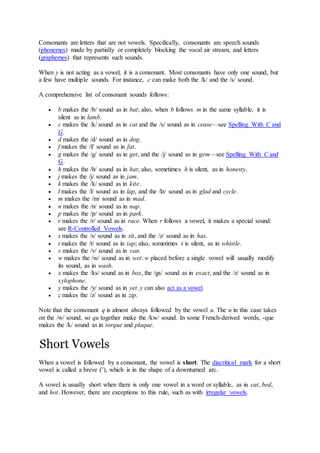
Consonants are letters that are not vowels. Specifically, consonants are speech sounds
(phonemes) made by partially or completely blocking the vocal air stream, and letters
(graphemes) that represents such sounds.
When y is not acting as a vowel, it is a consonant. Most consonants have only one sound, but
a few have multiple sounds. For instance, c can make both the /k/ and the /s/ sound.
A comprehensive list of consonant sounds follows:
 b makes the /b/ sound as in bat; also, when b follows m in the same syllable, it is
silent as in lamb.
 c makes the /k/ sound as in cat and the /s/ sound as in cease—see Spelling With C and
G.
 d makes the /d/ sound as in dog.
 f makes the /f/ sound as in fat.
 g makes the /g/ sound as in get, and the /j/ sound as in gem—see Spelling With C and
G.
 h makes the /h/ sound as in hat; also, sometimes h is silent, as in honesty.
 j makes the /j/ sound as in jam.
 k makes the /k/ sound as in kite.
 l makes the /l/ sound as in lap, and the /lə/ sound as in glad and cycle.
 m makes the /m/ sound as in mad.
 n makes the /n/ sound as in nap.
 p makes the /p/ sound as in park.
 r makes the /r/ sound as in race. When r follows a vowel, it makes a special sound:
see R-Controlled Vowels.
 s makes the /s/ sound as in sit, and the /z/ sound as in has.
 t makes the /t/ sound as in tap; also, sometimes t is silent, as in whistle.
 v makes the /v/ sound as in van.
 w makes the /w/ sound as in wet. w placed before a single vowel will usually modify
its sound, as in wash.
 x makes the /ks/ sound as in box, the /gs/ sound as in exact, and the /z/ sound as in
xylophone.
 y makes the /y/ sound as in yet. y can also act as a vowel.
 z makes the /z/ sound as in zip.
Note that the consonant q is almost always followed by the vowel u. The u in this case takes
on the /w/ sound, so qu together make the /kw/ sound. In some French-derived words, -que
makes the /k/ sound as in torque and plaque.
When a vowel is followed by a consonant, the vowel is short. The diacritical mark for a short
vowel is called a breve (˘), which is in the shape of a downturned arc.
A vowel is usually short when there is only one vowel in a word or syllable, as in cat, bed,
and hot. However, there are exceptions to this rule, such as with irregular vowels.
There is both a long and short sound to “oo”. The short sound appears as in the words book,
booth, and took.
The following is a list of short vowel sounds, shown along with their diacritical marks:
 Short a (ă) sound as in at, taxi, anniversary, laboratory, and tackle
 Short e (ĕ) sound as in elm, elevator, jellyfish, pentagon, and dentist
 Short i (ĭ) sound as in it, gift, inflate, spinach, and cereal
 Short o (ŏ) sound as in hop, camouflage, garage, chop, father, paw, and binoculars
 Short u (ŭ) sound as in up, cut and subtract
A long vowel sound is the same as its name. The diacritical mark for a long vowel is called a
macron (¯), which is in the shape of a line above the vowel.
When a single vowel letter is in the end of a word (or syllable), it usually says its long sound
(or its name), as in go and be. When two vowels go hand in hand in the same word (or
syllable), the first vowel is usually long, and the second vowel is usually silent. e.g., bake
makes the /ay/ sound (long a) and the e is silent; goal makes the /oh/ sound (long o) and the a
is silent. However, there are many exceptions to this rule, such as with irregular vowels.
When there are two adjacent vowels in a word, the first one is long and the second one is
silent. The first vowel is marked with a long line and second one is crossed out. Examples of
this rule are in coat, ride, and read.
There is both a long and short sound to “oo”. The long sound appears as in the words boo,
food, smooth, and moose.
The following is a list of long vowel sounds, shown along with their diacritical marks:
 Long a (ā) sound as in ape, snail, ache, explain, and reindeer
 Long e (ē) sound as in eat, agony, needle, pianist, and electricity
 Long i (ī) sound as in eye, cry, tightrope, tile, and violin
 Long o (ō) sound as in oh, domino, ghost, pillow, and stethoscope
 Long u (ū) sound as in you, salute, toothbrush, goose, boot, and costume
A vowel combination is a combination of two or three vowels, or of a vowel and at least one
consonant, that is associated with one or more specific single sounds. For example, ea has the
sounds /long e/ and /long a/; ay has the sound /long a/, and igh has the sound /long i/. These
vowel combinations are sometimes called digraphs, diphthongs, trigraphs, and triphthongs.
Vowel combinations occur in three different forms in written English:
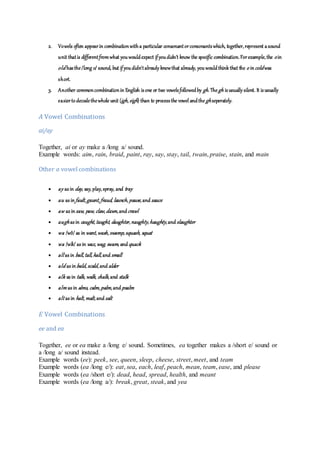
1. Vowels often appearin clusterswithin asingle syllable.Thisis themost common form.
2. Vowels often appearin combinationwitha particular consonantorconsonantswhich, together,represent asound
unit thatis differentfromwhat youwouldexpect ifyoudidn't know the specific combination.Forexample,the oin
old hasthe/long o/ sound, but ifyoudidn'talready knowthat already, youwouldthink that the o incoldwas
short.
3. Another commoncombinationin English isone or two vowelsfollowedby gh.Thegh isusually silent. It isusually
easiertodecodethewhole unit (igh,eigh) than to processthe vowel andthe ghseperately.
A Vowel Combinations
ai/ay
Together, ai or ay make a /long a/ sound.
Example words: aim, rain, braid, paint, ray, say, stay, tail, twain, praise, stain, and main
Other a vowel combinations
 ay asin day, say,play,spray, and tray
 au asinfault,gaunt, fraud, launch,pause,andsauce
 aw asinsaw, paw, claw,dawn,andcrawl
 aughasin caught,taught, daughter,naughty,haughty,andslaughter
 wa /wô/ as inwant,wash,swamp,squash, squat
 wa /wă/ asin wax,wag, swam, andquack
 all asin ball,tall,hall,andsmall
 ald asinbald,scald,andalder
 alk asin talk, walk, chalk,and stalk
 alm asin alms, calm, palm,andpsalm
 alt asin halt,malt,andsalt
E Vowel Combinations
ee and ea
Together, ee or ea make a /long e/ sound. Sometimes, ea together makes a /short e/ sound or
a /long a/ sound instead.
Example words (ee): peek, see, queen, sleep, cheese, street, meet, and team
Example words (ea /long e/): eat, sea, each, leaf, peach, mean, team, ease, and please
Example words (ea /short e/): dead, head, spread, health, and meant
Example words (ea /long a/): break, great, steak, and yea
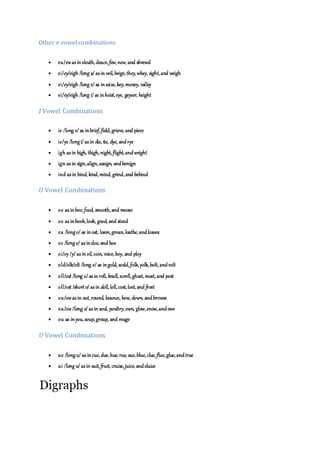
Other e vowel combinations
 eu/ewasinsleuth,deuce,few,new,and shrewd
 ei/ey/eigh /long a/ asin veil,beige,they,whey, eight,and weigh
 ei/ey/eigh /long e/ as inseize,key,money, valley
 ei/ey/eigh /long i/ as inheist,eye, geyser, height
I Vowel Combinations
 ie /long e/ as inbrief,field,grieve,and piece
 ie/ye /longi/ asin die, tie, dye, andrye
 igh asin high, thigh,night,flight,andwright
 ign asin sign,align,assign, andbenign
 ind asin bind, kind,mind, grind,and behind
O Vowel Combinations
 oo asinboo,food, smooth,and moose
 oo asinbook,look, good, and stood
 oa /longo/ as inoat, loam,groan, loathe,andloaves
 oe /longo/ asindoe,and hoe
 oi/oy /y/ asinoil,coin, voice,boy, and ploy
 old/olk/olt /long o/ as ingold, scold,folk,yolk,bolt,andvolt
 oll/ost /long o/ asin roll, knoll,scroll,ghost,most,and post
 oll/ost /short o/ asin doll,loll,cost,lost, and frost
 ou/owasin out,round, bounce, how, down, andbrowse
 ou/ow/long o/ asin soul, poultry,own, glow,snow,andowe
 ou as inyou,soup,group, and rouge
U Vowel Combinations
 ue /longu/ asincue,due,hue,rue, sue,blue,clue,flue,glue,andtrue
 ui /long u/ asin suit, fruit, cruise,juice, andsluice
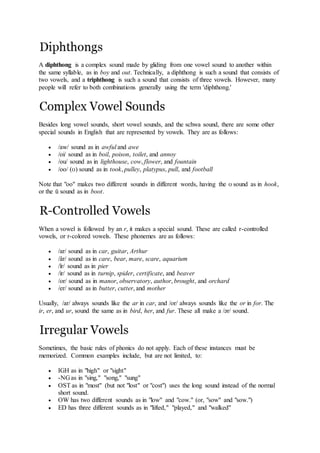
A digraph is a single sound, or phoneme, which is represented by two letters. A trigraph is a
phoneme which consists of three letters. However, many people will simply use the term
'digraph' generally to describe both combinations. In digraphs, consonants join together to
form a kind of consonant team, which makes a special sound. For instance, p and h combine
to form ph, which makes the /f/ sound as in phonemic.
When two or more consonants appear together and you hear each sound that each consonant
would normally make, the consonant team is called a consonant blend. For instance, the word
blend has two consonant blends: bl, for which you hear the sounds for both b and l, and nd,
for which you hear the sounds for both n and d.
Digraphs
 ch, whichmakesthe/ch/ sound as in watch,chick, chimpanzee, andchampion
 ck, which makesthe /k/ soundasin chick
 ff, whichmakesthe/f/ soundasin cliff
 gh, whichmakes the/g/ soundasin ghost and ghastly
 gn, whichmakesthe /n/ sound asin gnomeandgnarled
 kn, whichmakesthe /n/ sound as in knifeandknight
 ll, which makesthe/l/ soundasin wall
 mb, which makesthe /m/ soundasin lamb andthumb
 ng, whichmakesthe /ng/ soundasin fang, boomerang,andfingerprint
 nk, whichmakesthe /nk/ sound as in ink,sink andrink
 ph,which makesthe /f/ sound as in digraph,phone,and phonics
 qu, whichmakesthe /kw/ sound as in quick
 sh,which makesthe/sh/ soundasin shore, shipwreck,shark, and shield
 ss,which makesthe/s/ sound as in floss
 th, whichmakesthe/th/ sound as inathlete,toothbrush,bathtub,thin, andthunderstorm
 th, whichmakesthe/th/ sound as in this,there,andthat
 wh, whichmakesthe/hw/ sound as in whereandwhich
 wr, whichmakes the/wr/ sound as in write
 zz, whichmakes the /z/ soundasinfuzz andbuzz
Trigraphs
 chr,which makesthe /chr/ soundasin chromeandchromosome
 dge, whichmakes the/g/ soundasin dodgeandpartridge
 tch,which makesthe/tch/ soundasin catch, match
When two or more letters appear together and you hear each sound that each consonant
would normally make, the combination is called a blend. For instance, the word blend has
two consonant blends: bl, for which you hear the sounds for both b and l, and nd, for which
you hear the sounds for both n and d.
Two-Letter Blends
 bl, whichblends the /b/ andthe /l/ sounds togethertomakethe/bl/ sound as in blendandblight
 br, which blendsthe/b/ and the/r/ sounds togetherto make the/br/ sound asin break and brown
 cl, whichblendsthe/c/ andthe /l/ sounds togethertomakethe/cl/ soundasin cluster andclass
 cr, whichblendsthe /c/ and the /r/ soundstogetherto make the /cr/ soundasin crashandcross
 dr, whichblends the /d/ andthe/r/ sounds togethertomakethe/dr/ sound as in drive and drab
 fl, whichblendsthe /f/ and the /l/ soundstogethertomake the /fl/ sound as in fluandflake
 fr, whichblends the /f/ andthe/r/ sounds togethertomakethe/fr/ sound asin freedom andfrost
 gl, which blendsthe/g/ andthe/l/ soundstogether to make the /gl/ sound as ingladand glory
 gr, whichblendsthe /g/ and the /r/ soundstogether to make the /gr/ soundasin greenandgravy
 nd, whichblendsthe /n/ and the/d/ sounds togetherto make the/nd/ soundasin blend andsend
 pl, whichblendsthe /p/ andthe /l/ soundstogether to make the /pl/ soundasin play and plow
 pr,which blends the/p/ andthe /r/ soundstogether tomake the /pr/ soundasin prime and prowl
 sl, whichblendsthe /s/ and the/l/ soundstogether tomake the /sl/ sound asin sloganand sloppy
 sm, whichblends the /s/ andthe/m/ sounds togethertomakethe/sm/ sound asin small andsmart
 sn, whichblends the /s/ andthe/n/ sounds togethertomakethe/sn/ sound as in snail andsnore
 sp,which blendsthe/s/ andthe /p/ soundstogether tomake the /sp/ soundasin specialandspackel
 st, whichblends the /s/ andthe/t/ sounds togethertomakethe/st/ sound as in stopandstart
Three-Letter Blends
 shr,whichblendsthe /sh/ digraphand the /r/ soundtogethertomake the /shr/ sound as in shroud
 spl,which blends the/sp/ blendand the /l/ sound together to make the /spl/ sound as in splash andspendid
 spr,whichblendsthe /sp/ blend andthe/r/ soundtogether to make the /spr/ sound as in spring and spray
 squ, whichblends the /s/ soundandthe /sq/ digraphtogethertomakethe/squ/ soundasin squidandsquelch
 str,which blendsthe/st/ blendandthe /r/ sound togethertomakethe/str/ soundasin struggle and strap
 thr,which blends the/th/ digraphandthe/r/ sound together to make the /thr/ sound as in throw
A diphthong is a complex sound made by gliding from one vowel sound to another within
the same syllable, as in boy and out. Technically, a diphthong is such a sound that consists of
two vowels, and a triphthong is such a sound that consists of three vowels. However, many
people will refer to both combinations generally using the term 'diphthong.'
Besides long vowel sounds, short vowel sounds, and the schwa sound, there are some other
special sounds in English that are represented by vowels. They are as follows:
 /aw/ sound as in awful and awe
 /oi/ sound as in boil, poison, toilet, and annoy
 /ou/ sound as in lighthouse, cow, flower, and fountain
 /oo/ (ʊ) sound as in took, pulley, platypus, pull, and football
Note that "oo" makes two different sounds in different words, having the ʊ sound as in hook,
or the ū sound as in boot.
When a vowel is followed by an r, it makes a special sound. These are called r-controlled
vowels, or r-colored vowels. These phonemes are as follows:
 /ar/ sound as in car, guitar, Arthur
 /âr/ sound as in care, bear, mare, scare, aquarium
 /îr/ sound as in pier
 /ir/ sound as in turnip, spider, certificate, and beaver
 /or/ sound as in manor, observatory, author, brought, and orchard
 /er/ sound as in butter, cutter, and mother
Usually, /ar/ always sounds like the ar in car, and /or/ always sounds like the or in for. The
ir, er, and ur, sound the same as in bird, her, and fur. These all make a /ər/ sound.
Sometimes, the basic rules of phonics do not apply. Each of these instances must be
memorized. Common examples include, but are not limited, to:
 IGH as in "high" or "sight"
 -NG as in "sing," "song," "sung"
 OST as in "most" (but not "lost" or "cost") uses the long sound instead of the normal
short sound.
 OW has two different sounds as in "low" and "cow." (or, "sow" and "sow.")
 ED has three different sounds as in "lifted," "played," and "walked"
 OI does not follow the two vowels rule, e.g., "moist" or "boil."
 Double O has two different sounds, as in "book" and "loose."
 OUS as in "nervous."
 AU as in "fault" or "haul."
 -SION, -TION, and -CION are all pronounced "shun."
 OUGH has at least seven different sounds, as in "bough," "cough," "hough," "tough,"
"thorough," "thought," and "through."

Phonics

  • 1.
    Consonants are lettersthat are not vowels. Specifically, consonants are speech sounds (phonemes) made by partially or completely blocking the vocal air stream, and letters (graphemes) that represents such sounds. When y is not acting as a vowel, it is a consonant. Most consonants have only one sound, but a few have multiple sounds. For instance, c can make both the /k/ and the /s/ sound. A comprehensive list of consonant sounds follows:  b makes the /b/ sound as in bat; also, when b follows m in the same syllable, it is silent as in lamb.  c makes the /k/ sound as in cat and the /s/ sound as in cease—see Spelling With C and G.  d makes the /d/ sound as in dog.  f makes the /f/ sound as in fat.  g makes the /g/ sound as in get, and the /j/ sound as in gem—see Spelling With C and G.  h makes the /h/ sound as in hat; also, sometimes h is silent, as in honesty.  j makes the /j/ sound as in jam.  k makes the /k/ sound as in kite.  l makes the /l/ sound as in lap, and the /lə/ sound as in glad and cycle.  m makes the /m/ sound as in mad.  n makes the /n/ sound as in nap.  p makes the /p/ sound as in park.  r makes the /r/ sound as in race. When r follows a vowel, it makes a special sound: see R-Controlled Vowels.  s makes the /s/ sound as in sit, and the /z/ sound as in has.  t makes the /t/ sound as in tap; also, sometimes t is silent, as in whistle.  v makes the /v/ sound as in van.  w makes the /w/ sound as in wet. w placed before a single vowel will usually modify its sound, as in wash.  x makes the /ks/ sound as in box, the /gs/ sound as in exact, and the /z/ sound as in xylophone.  y makes the /y/ sound as in yet. y can also act as a vowel.  z makes the /z/ sound as in zip. Note that the consonant q is almost always followed by the vowel u. The u in this case takes on the /w/ sound, so qu together make the /kw/ sound. In some French-derived words, -que makes the /k/ sound as in torque and plaque. When a vowel is followed by a consonant, the vowel is short. The diacritical mark for a short vowel is called a breve (˘), which is in the shape of a downturned arc. A vowel is usually short when there is only one vowel in a word or syllable, as in cat, bed, and hot. However, there are exceptions to this rule, such as with irregular vowels.
  • 2.
    There is botha long and short sound to “oo”. The short sound appears as in the words book, booth, and took. The following is a list of short vowel sounds, shown along with their diacritical marks:  Short a (ă) sound as in at, taxi, anniversary, laboratory, and tackle  Short e (ĕ) sound as in elm, elevator, jellyfish, pentagon, and dentist  Short i (ĭ) sound as in it, gift, inflate, spinach, and cereal  Short o (ŏ) sound as in hop, camouflage, garage, chop, father, paw, and binoculars  Short u (ŭ) sound as in up, cut and subtract A long vowel sound is the same as its name. The diacritical mark for a long vowel is called a macron (¯), which is in the shape of a line above the vowel. When a single vowel letter is in the end of a word (or syllable), it usually says its long sound (or its name), as in go and be. When two vowels go hand in hand in the same word (or syllable), the first vowel is usually long, and the second vowel is usually silent. e.g., bake makes the /ay/ sound (long a) and the e is silent; goal makes the /oh/ sound (long o) and the a is silent. However, there are many exceptions to this rule, such as with irregular vowels. When there are two adjacent vowels in a word, the first one is long and the second one is silent. The first vowel is marked with a long line and second one is crossed out. Examples of this rule are in coat, ride, and read. There is both a long and short sound to “oo”. The long sound appears as in the words boo, food, smooth, and moose. The following is a list of long vowel sounds, shown along with their diacritical marks:  Long a (ā) sound as in ape, snail, ache, explain, and reindeer  Long e (ē) sound as in eat, agony, needle, pianist, and electricity  Long i (ī) sound as in eye, cry, tightrope, tile, and violin  Long o (ō) sound as in oh, domino, ghost, pillow, and stethoscope  Long u (ū) sound as in you, salute, toothbrush, goose, boot, and costume A vowel combination is a combination of two or three vowels, or of a vowel and at least one consonant, that is associated with one or more specific single sounds. For example, ea has the sounds /long e/ and /long a/; ay has the sound /long a/, and igh has the sound /long i/. These vowel combinations are sometimes called digraphs, diphthongs, trigraphs, and triphthongs. Vowel combinations occur in three different forms in written English: 1. Vowels often appearin clusterswithin asingle syllable.Thisis themost common form.
  • 3.
    2. Vowels oftenappearin combinationwitha particular consonantorconsonantswhich, together,represent asound unit thatis differentfromwhat youwouldexpect ifyoudidn't know the specific combination.Forexample,the oin old hasthe/long o/ sound, but ifyoudidn'talready knowthat already, youwouldthink that the o incoldwas short. 3. Another commoncombinationin English isone or two vowelsfollowedby gh.Thegh isusually silent. It isusually easiertodecodethewhole unit (igh,eigh) than to processthe vowel andthe ghseperately. A Vowel Combinations ai/ay Together, ai or ay make a /long a/ sound. Example words: aim, rain, braid, paint, ray, say, stay, tail, twain, praise, stain, and main Other a vowel combinations  ay asin day, say,play,spray, and tray  au asinfault,gaunt, fraud, launch,pause,andsauce  aw asinsaw, paw, claw,dawn,andcrawl  aughasin caught,taught, daughter,naughty,haughty,andslaughter  wa /wô/ as inwant,wash,swamp,squash, squat  wa /wă/ asin wax,wag, swam, andquack  all asin ball,tall,hall,andsmall  ald asinbald,scald,andalder  alk asin talk, walk, chalk,and stalk  alm asin alms, calm, palm,andpsalm  alt asin halt,malt,andsalt E Vowel Combinations ee and ea Together, ee or ea make a /long e/ sound. Sometimes, ea together makes a /short e/ sound or a /long a/ sound instead. Example words (ee): peek, see, queen, sleep, cheese, street, meet, and team Example words (ea /long e/): eat, sea, each, leaf, peach, mean, team, ease, and please Example words (ea /short e/): dead, head, spread, health, and meant Example words (ea /long a/): break, great, steak, and yea
  • 4.
    Other e vowelcombinations  eu/ewasinsleuth,deuce,few,new,and shrewd  ei/ey/eigh /long a/ asin veil,beige,they,whey, eight,and weigh  ei/ey/eigh /long e/ as inseize,key,money, valley  ei/ey/eigh /long i/ as inheist,eye, geyser, height I Vowel Combinations  ie /long e/ as inbrief,field,grieve,and piece  ie/ye /longi/ asin die, tie, dye, andrye  igh asin high, thigh,night,flight,andwright  ign asin sign,align,assign, andbenign  ind asin bind, kind,mind, grind,and behind O Vowel Combinations  oo asinboo,food, smooth,and moose  oo asinbook,look, good, and stood  oa /longo/ as inoat, loam,groan, loathe,andloaves  oe /longo/ asindoe,and hoe  oi/oy /y/ asinoil,coin, voice,boy, and ploy  old/olk/olt /long o/ as ingold, scold,folk,yolk,bolt,andvolt  oll/ost /long o/ asin roll, knoll,scroll,ghost,most,and post  oll/ost /short o/ asin doll,loll,cost,lost, and frost  ou/owasin out,round, bounce, how, down, andbrowse  ou/ow/long o/ asin soul, poultry,own, glow,snow,andowe  ou as inyou,soup,group, and rouge U Vowel Combinations  ue /longu/ asincue,due,hue,rue, sue,blue,clue,flue,glue,andtrue  ui /long u/ asin suit, fruit, cruise,juice, andsluice
  • 5.
    A digraph isa single sound, or phoneme, which is represented by two letters. A trigraph is a phoneme which consists of three letters. However, many people will simply use the term 'digraph' generally to describe both combinations. In digraphs, consonants join together to form a kind of consonant team, which makes a special sound. For instance, p and h combine to form ph, which makes the /f/ sound as in phonemic. When two or more consonants appear together and you hear each sound that each consonant would normally make, the consonant team is called a consonant blend. For instance, the word blend has two consonant blends: bl, for which you hear the sounds for both b and l, and nd, for which you hear the sounds for both n and d. Digraphs  ch, whichmakesthe/ch/ sound as in watch,chick, chimpanzee, andchampion  ck, which makesthe /k/ soundasin chick  ff, whichmakesthe/f/ soundasin cliff  gh, whichmakes the/g/ soundasin ghost and ghastly  gn, whichmakesthe /n/ sound asin gnomeandgnarled  kn, whichmakesthe /n/ sound as in knifeandknight  ll, which makesthe/l/ soundasin wall  mb, which makesthe /m/ soundasin lamb andthumb  ng, whichmakesthe /ng/ soundasin fang, boomerang,andfingerprint  nk, whichmakesthe /nk/ sound as in ink,sink andrink  ph,which makesthe /f/ sound as in digraph,phone,and phonics  qu, whichmakesthe /kw/ sound as in quick  sh,which makesthe/sh/ soundasin shore, shipwreck,shark, and shield  ss,which makesthe/s/ sound as in floss  th, whichmakesthe/th/ sound as inathlete,toothbrush,bathtub,thin, andthunderstorm  th, whichmakesthe/th/ sound as in this,there,andthat  wh, whichmakesthe/hw/ sound as in whereandwhich  wr, whichmakes the/wr/ sound as in write  zz, whichmakes the /z/ soundasinfuzz andbuzz Trigraphs  chr,which makesthe /chr/ soundasin chromeandchromosome  dge, whichmakes the/g/ soundasin dodgeandpartridge  tch,which makesthe/tch/ soundasin catch, match
  • 6.
    When two ormore letters appear together and you hear each sound that each consonant would normally make, the combination is called a blend. For instance, the word blend has two consonant blends: bl, for which you hear the sounds for both b and l, and nd, for which you hear the sounds for both n and d. Two-Letter Blends  bl, whichblends the /b/ andthe /l/ sounds togethertomakethe/bl/ sound as in blendandblight  br, which blendsthe/b/ and the/r/ sounds togetherto make the/br/ sound asin break and brown  cl, whichblendsthe/c/ andthe /l/ sounds togethertomakethe/cl/ soundasin cluster andclass  cr, whichblendsthe /c/ and the /r/ soundstogetherto make the /cr/ soundasin crashandcross  dr, whichblends the /d/ andthe/r/ sounds togethertomakethe/dr/ sound as in drive and drab  fl, whichblendsthe /f/ and the /l/ soundstogethertomake the /fl/ sound as in fluandflake  fr, whichblends the /f/ andthe/r/ sounds togethertomakethe/fr/ sound asin freedom andfrost  gl, which blendsthe/g/ andthe/l/ soundstogether to make the /gl/ sound as ingladand glory  gr, whichblendsthe /g/ and the /r/ soundstogether to make the /gr/ soundasin greenandgravy  nd, whichblendsthe /n/ and the/d/ sounds togetherto make the/nd/ soundasin blend andsend  pl, whichblendsthe /p/ andthe /l/ soundstogether to make the /pl/ soundasin play and plow  pr,which blends the/p/ andthe /r/ soundstogether tomake the /pr/ soundasin prime and prowl  sl, whichblendsthe /s/ and the/l/ soundstogether tomake the /sl/ sound asin sloganand sloppy  sm, whichblends the /s/ andthe/m/ sounds togethertomakethe/sm/ sound asin small andsmart  sn, whichblends the /s/ andthe/n/ sounds togethertomakethe/sn/ sound as in snail andsnore  sp,which blendsthe/s/ andthe /p/ soundstogether tomake the /sp/ soundasin specialandspackel  st, whichblends the /s/ andthe/t/ sounds togethertomakethe/st/ sound as in stopandstart Three-Letter Blends  shr,whichblendsthe /sh/ digraphand the /r/ soundtogethertomake the /shr/ sound as in shroud  spl,which blends the/sp/ blendand the /l/ sound together to make the /spl/ sound as in splash andspendid  spr,whichblendsthe /sp/ blend andthe/r/ soundtogether to make the /spr/ sound as in spring and spray  squ, whichblends the /s/ soundandthe /sq/ digraphtogethertomakethe/squ/ soundasin squidandsquelch  str,which blendsthe/st/ blendandthe /r/ sound togethertomakethe/str/ soundasin struggle and strap  thr,which blends the/th/ digraphandthe/r/ sound together to make the /thr/ sound as in throw
  • 7.
    A diphthong isa complex sound made by gliding from one vowel sound to another within the same syllable, as in boy and out. Technically, a diphthong is such a sound that consists of two vowels, and a triphthong is such a sound that consists of three vowels. However, many people will refer to both combinations generally using the term 'diphthong.' Besides long vowel sounds, short vowel sounds, and the schwa sound, there are some other special sounds in English that are represented by vowels. They are as follows:  /aw/ sound as in awful and awe  /oi/ sound as in boil, poison, toilet, and annoy  /ou/ sound as in lighthouse, cow, flower, and fountain  /oo/ (ʊ) sound as in took, pulley, platypus, pull, and football Note that "oo" makes two different sounds in different words, having the ʊ sound as in hook, or the ū sound as in boot. When a vowel is followed by an r, it makes a special sound. These are called r-controlled vowels, or r-colored vowels. These phonemes are as follows:  /ar/ sound as in car, guitar, Arthur  /âr/ sound as in care, bear, mare, scare, aquarium  /îr/ sound as in pier  /ir/ sound as in turnip, spider, certificate, and beaver  /or/ sound as in manor, observatory, author, brought, and orchard  /er/ sound as in butter, cutter, and mother Usually, /ar/ always sounds like the ar in car, and /or/ always sounds like the or in for. The ir, er, and ur, sound the same as in bird, her, and fur. These all make a /ər/ sound. Sometimes, the basic rules of phonics do not apply. Each of these instances must be memorized. Common examples include, but are not limited, to:  IGH as in "high" or "sight"  -NG as in "sing," "song," "sung"  OST as in "most" (but not "lost" or "cost") uses the long sound instead of the normal short sound.  OW has two different sounds as in "low" and "cow." (or, "sow" and "sow.")  ED has three different sounds as in "lifted," "played," and "walked"
  • 8.
     OI doesnot follow the two vowels rule, e.g., "moist" or "boil."  Double O has two different sounds, as in "book" and "loose."  OUS as in "nervous."  AU as in "fault" or "haul."  -SION, -TION, and -CION are all pronounced "shun."  OUGH has at least seven different sounds, as in "bough," "cough," "hough," "tough," "thorough," "thought," and "through."