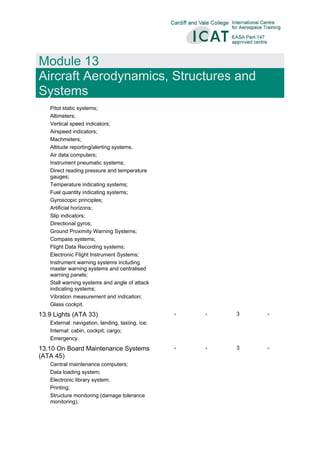
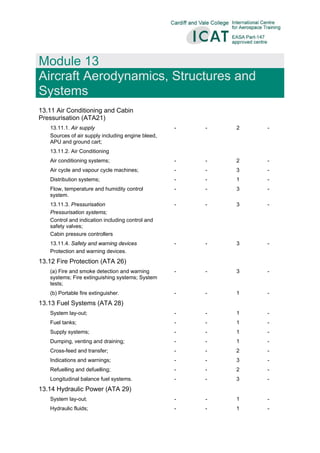
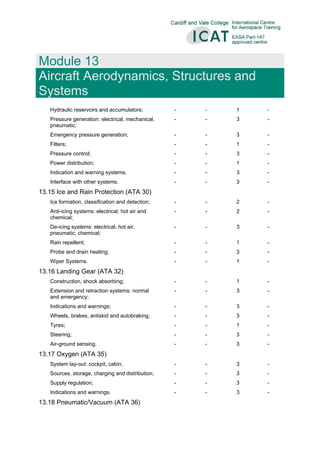
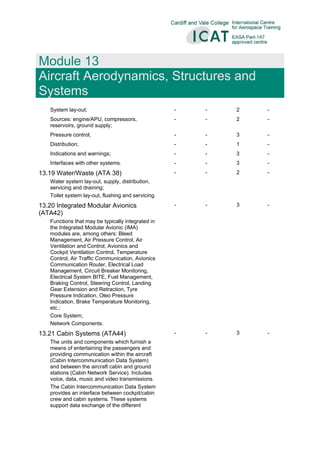
Module 13
Aircraft Aerodynamics, Structures and
Systems 
 
  Level
  A B1 B2 B3
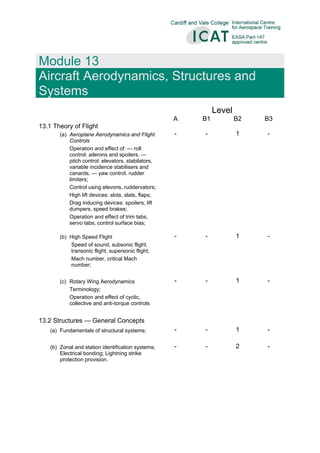
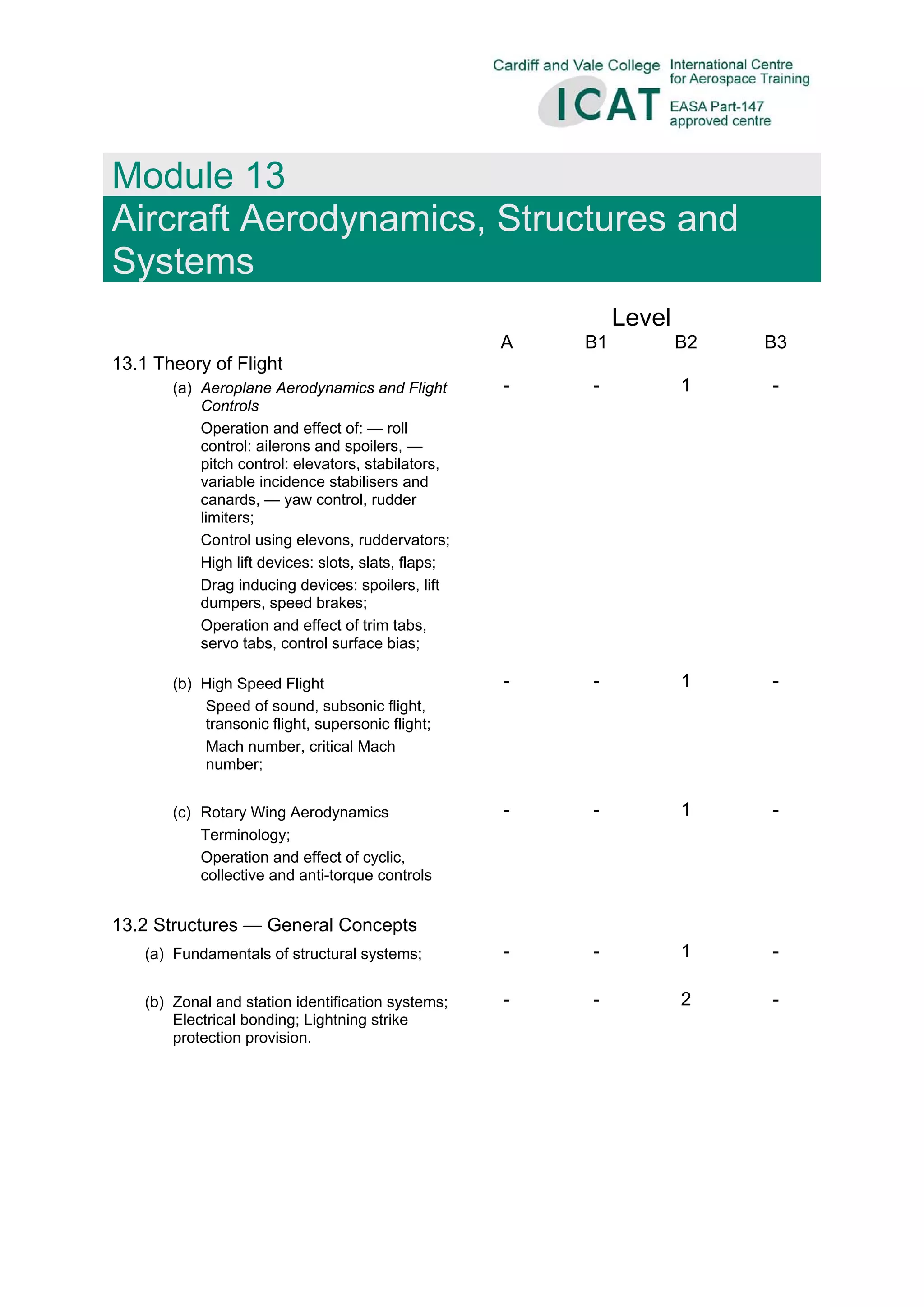
13.1 Theory of Flight
(a) Aeroplane Aerodynamics and Flight
Controls
Operation and effect of: — roll
control: ailerons and spoilers, —
pitch control: elevators, stabilators,
variable incidence stabilisers and
canards, — yaw control, rudder
limiters;
Control using elevons, ruddervators;
High lift devices: slots, slats, flaps;
Drag inducing devices: spoilers, lift
dumpers, speed brakes;
Operation and effect of trim tabs,
servo tabs, control surface bias;
- - 1 -
(b) High Speed Flight
Speed of sound, subsonic flight,
transonic flight, supersonic flight;
Mach number, critical Mach
number;
 
- - 1 -
(c) Rotary Wing Aerodynamics
Terminology;
Operation and effect of cyclic,
collective and anti-torque controls
 
- - 1 -
13.2 Structures — General Concepts
(a) Fundamentals of structural systems;
 
- - 1 -
(b) Zonal and station identification systems;
Electrical bonding; Lightning strike
protection provision.


- - 2 -
 
 
Module 13
Aircraft Aerodynamics, Structures and
Systems 
 
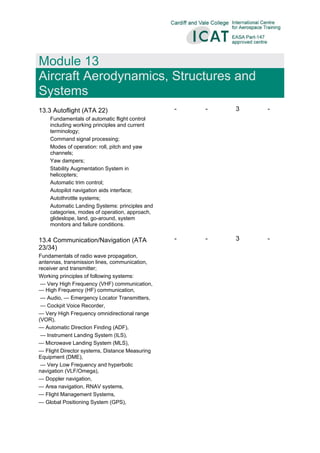
13.3 Autoflight (ATA 22)
Fundamentals of automatic flight control
including working principles and current
terminology;
Command signal processing;
Modes of operation: roll, pitch and yaw
channels;
Yaw dampers;
Stability Augmentation System in
helicopters;
Automatic trim control;
Autopilot navigation aids interface;
Autothrottle systems;
Automatic Landing Systems: principles and
categories, modes of operation, approach,
glideslope, land, go-around, system
monitors and failure conditions.
 
- - 3 -
13.4 Communication/Navigation (ATA
23/34)
Fundamentals of radio wave propagation,
antennas, transmission lines, communication,
receiver and transmitter;
Working principles of following systems:
— Very High Frequency (VHF) communication,
— High Frequency (HF) communication,
— Audio, — Emergency Locator Transmitters,
— Cockpit Voice Recorder,
— Very High Frequency omnidirectional range
(VOR),
— Automatic Direction Finding (ADF),
— Instrument Landing System (ILS),
— Microwave Landing System (MLS),
— Flight Director systems, Distance Measuring
Equipment (DME),
— Very Low Frequency and hyperbolic
navigation (VLF/Omega),
— Doppler navigation,
— Area navigation, RNAV systems,
— Flight Management Systems,
— Global Positioning System (GPS),
- - 3 -
 
 
Module 13
Aircraft Aerodynamics, Structures and
Systems 
 
Global Navigation Satellite Systems (GNSS),
— Inertial Navigation System,
— Air Traffic Control transponder, secondary
surveillance radar,
— Traffic Alert and Collision Avoidance System
(TCAS),
— Weather avoidance radar,
— Radio altimeter,
— ARINC communication and reporting.
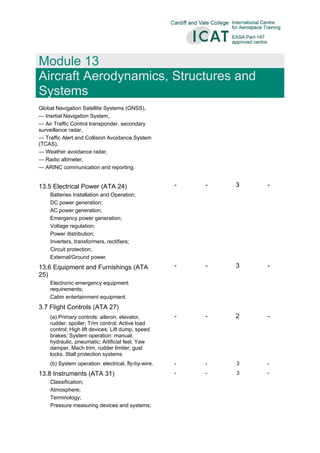
13.5 Electrical Power (ATA 24)
Batteries Installation and Operation;
DC power generation;
AC power generation;
Emergency power generation;
Voltage regulation;
Power distribution;
Inverters, transformers, rectifiers;
Circuit protection;
External/Ground power.
- - 3 -
13.6 Equipment and Furnishings (ATA
25)
Electronic emergency equipment
requirements;
Cabin entertainment equipment.
- - 3 -
3.7 Flight Controls (ATA 27)
(a) Primary controls: aileron, elevator,
rudder, spoiler; Trim control; Active load
control; High lift devices; Lift dump, speed
brakes; System operation: manual,
hydraulic, pneumatic; Artificial feel, Yaw
damper, Mach trim, rudder limiter, gust
locks. Stall protection systems
- - 2 -
(b) System operation: electrical, fly-by-wire. - - 3 -
13.8 Instruments (ATA 31)
Classification;
Atmosphere;
Terminology;
Pressure measuring devices and systems;
- - 3 -
 
 
Module 13
Aircraft Aerodynamics, Structures and
Systems 
 
Pitot static systems;
Altimeters;
Vertical speed indicators;
Airspeed indicators;
Machmeters;
Altitude reporting/alerting systems;
Air data computers;
Instrument pneumatic systems;
Direct reading pressure and temperature
gauges;
Temperature indicating systems;
Fuel quantity indicating systems;
Gyroscopic principles;
Artificial horizons;
Slip indicators;
Directional gyros;
Ground Proximity Warning Systems;
Compass systems;
Flight Data Recording systems;
Electronic Flight Instrument Systems;
Instrument warning systems including
master warning systems and centralised
warning panels;
Stall warning systems and angle of attack
indicating systems;
Vibration measurement and indication;
Glass cockpit.
13.9 Lights (ATA 33)
External: navigation, landing, taxiing, ice;
Internal: cabin, cockpit, cargo;
Emergency.
- - 3 -
13.10 On Board Maintenance Systems
(ATA 45)
Central maintenance computers;
Data loading system;
Electronic library system;
Printing;
Structure monitoring (damage tolerance
monitoring).
- - 3 -
 
 
Module 13
Aircraft Aerodynamics, Structures and
Systems 
 
13.11 Air Conditioning and Cabin
Pressurisation (ATA21)
13.11.1. Air supply
Sources of air supply including engine bleed,
APU and ground cart;
- - 2 -
13.11.2. Air Conditioning
Air conditioning systems; - - 2 -
Air cycle and vapour cycle machines; - - 3 -
Distribution systems; - - 1 -
Flow, temperature and humidity control
system.
- - 3 -
13.11.3. Pressurisation
Pressurisation systems;
Control and indication including control and
safety valves;
Cabin pressure controllers
- - 3 -
13.11.4. Safety and warning devices
Protection and warning devices.
- - 3 -
13.12 Fire Protection (ATA 26)
(a) Fire and smoke detection and warning
systems; Fire extinguishing systems; System
tests;
- - 3 -
(b) Portable fire extinguisher. - - 1 -
13.13 Fuel Systems (ATA 28)
System lay-out; - - 1 -
Fuel tanks; - - 1 -
Supply systems; - - 1 -
Dumping, venting and draining; - - 1 -
Cross-feed and transfer; - - 2 -
Indications and warnings; - - 3 -
Refuelling and defuelling; - - 2 -
Longitudinal balance fuel systems. - - 3 -
13.14 Hydraulic Power (ATA 29)
System lay-out; - - 1 -
Hydraulic fluids; - - 1 -
 
 
Module 13
Aircraft Aerodynamics, Structures and
Systems 
 
Hydraulic reservoirs and accumulators; - - 1 -
Pressure generation: electrical, mechanical,
pneumatic;
- - 3 -
Emergency pressure generation; - - 3 -
Filters; - - 1 -
Pressure control; - - 3 -
Power distribution; - - 1 -
Indication and warning systems; - - 3 -
Interface with other systems. - - 3 -
13.15 Ice and Rain Protection (ATA 30)
Ice formation, classification and detection; - - 2 -
Anti-icing systems: electrical, hot air and
chemical;
- - 2 -
De-icing systems: electrical, hot air,
pneumatic, chemical;
- - 3 -
Rain repellent; - - 1 -
Probe and drain heating; - - 3 -
Wiper Systems. - - 1 -
13.16 Landing Gear (ATA 32)
Construction, shock absorbing; - - 1 -
Extension and retraction systems: normal
and emergency;
- - 3 -
Indications and warnings; - - 3 -
Wheels, brakes, antiskid and autobraking; - - 3 -
Tyres; - - 1 -
Steering; - - 3 -
Air-ground sensing. - - 3 -
13.17 Oxygen (ATA 35)
System lay-out: cockpit, cabin; - - 3 -
Sources, storage, charging and distribution; - - 3 -
Supply regulation; - - 3 -
Indications and warnings. - - 3 -
13.18 Pneumatic/Vacuum (ATA 36)
 
 
Module 13
Aircraft Aerodynamics, Structures and
Systems 
 
System lay-out; - - 2 -
Sources: engine/APU, compressors,
reservoirs, ground supply;
- - 2 -
Pressure control; - - 3 -
Distribution; - - 1 -
Indications and warnings; - - 3 -
Interfaces with other systems. - - 3 -
13.19 Water/Waste (ATA 38)
Water system lay-out, supply, distribution,
servicing and draining;
Toilet system lay-out, flushing and servicing.
- - 2 -
13.20 Integrated Modular Avionics
(ATA42)
Functions that may be typically integrated in
the Integrated Modular Avionic (IMA)
modules are, among others: Bleed
Management, Air Pressure Control, Air
Ventilation and Control, Avionics and
Cockpit Ventilation Control, Temperature
Control, Air Traffic Communication, Avionics
Communication Router, Electrical Load
Management, Circuit Breaker Monitoring,
Electrical System BITE, Fuel Management,
Braking Control, Steering Control, Landing
Gear Extension and Retraction, Tyre
Pressure Indication, Oleo Pressure
Indication, Brake Temperature Monitoring,
etc.;
Core System;
Network Components.
- - 3 -
13.21 Cabin Systems (ATA44)
The units and components which furnish a
means of entertaining the passengers and
providing communication within the aircraft
(Cabin Intercommunication Data System)
and between the aircraft cabin and ground
stations (Cabin Network Service). Includes
voice, data, music and video transmissions.
The Cabin Intercommunication Data System
provides an interface between cockpit/cabin
crew and cabin systems. These systems
support data exchange of the different
- - 3 -
 
 
Module 13
Aircraft Aerodynamics, Structures and
Systems 
 
related LRU’s and they are typically
operated via Flight Attendant Panels.
The Cabin Network Service typically
consists on a server, typically interfacing
with, among others, the following systems:
— Data/Radio Communication, In-Flight
Entertainment System.
The Cabin Network Service may host
functions such as: — Access to pre-
departure/departure reports, — E-
mail/intranet/Internet access, — Passenger
database;
Cabin Core System;
In-flight Entertainment System;
External Communication System;
Cabin Mass Memory System;
Cabin Monitoring System;
Miscellaneous Cabin System.
13.22 Information Systems (ATA46)
The units and components which furnish a
means of storing, updating and retrieving
digital information traditionally provided on
paper, microfilm or microfiche. Includes units
that are dedicated to the information storage
and retrieval function such as the electronic
library mass storage and controller. Does
not include units or components installed for
other uses and shared with other systems,
such as flight deck printer or general use
display.
Typical examples include Air Traffic and
Information Management Systems and
Network Server Systems.
Aircraft General Information System;
Flight Deck Information System;
Maintenance Information System;
Passenger Cabin Information System;
Miscellaneous Information System
- - 3 -

Easa Part 66 -Module 13 Aircraft aerodynamics-structures-and-systems-syllabus

  • 1.
        Module 13 Aircraft Aerodynamics,Structures and Systems      Level   A B1 B2 B3 13.1 Theory of Flight (a) Aeroplane Aerodynamics and Flight Controls Operation and effect of: — roll control: ailerons and spoilers, — pitch control: elevators, stabilators, variable incidence stabilisers and canards, — yaw control, rudder limiters; Control using elevons, ruddervators; High lift devices: slots, slats, flaps; Drag inducing devices: spoilers, lift dumpers, speed brakes; Operation and effect of trim tabs, servo tabs, control surface bias; - - 1 - (b) High Speed Flight Speed of sound, subsonic flight, transonic flight, supersonic flight; Mach number, critical Mach number;   - - 1 - (c) Rotary Wing Aerodynamics Terminology; Operation and effect of cyclic, collective and anti-torque controls   - - 1 - 13.2 Structures — General Concepts (a) Fundamentals of structural systems;   - - 1 - (b) Zonal and station identification systems; Electrical bonding; Lightning strike protection provision.             - - 2 -
  • 2.
        Module 13 Aircraft Aerodynamics,Structures and Systems    13.3 Autoflight (ATA 22) Fundamentals of automatic flight control including working principles and current terminology; Command signal processing; Modes of operation: roll, pitch and yaw channels; Yaw dampers; Stability Augmentation System in helicopters; Automatic trim control; Autopilot navigation aids interface; Autothrottle systems; Automatic Landing Systems: principles and categories, modes of operation, approach, glideslope, land, go-around, system monitors and failure conditions.   - - 3 - 13.4 Communication/Navigation (ATA 23/34) Fundamentals of radio wave propagation, antennas, transmission lines, communication, receiver and transmitter; Working principles of following systems: — Very High Frequency (VHF) communication, — High Frequency (HF) communication, — Audio, — Emergency Locator Transmitters, — Cockpit Voice Recorder, — Very High Frequency omnidirectional range (VOR), — Automatic Direction Finding (ADF), — Instrument Landing System (ILS), — Microwave Landing System (MLS), — Flight Director systems, Distance Measuring Equipment (DME), — Very Low Frequency and hyperbolic navigation (VLF/Omega), — Doppler navigation, — Area navigation, RNAV systems, — Flight Management Systems, — Global Positioning System (GPS), - - 3 -
  • 3.
        Module 13 Aircraft Aerodynamics,Structures and Systems    Global Navigation Satellite Systems (GNSS), — Inertial Navigation System, — Air Traffic Control transponder, secondary surveillance radar, — Traffic Alert and Collision Avoidance System (TCAS), — Weather avoidance radar, — Radio altimeter, — ARINC communication and reporting. 13.5 Electrical Power (ATA 24) Batteries Installation and Operation; DC power generation; AC power generation; Emergency power generation; Voltage regulation; Power distribution; Inverters, transformers, rectifiers; Circuit protection; External/Ground power. - - 3 - 13.6 Equipment and Furnishings (ATA 25) Electronic emergency equipment requirements; Cabin entertainment equipment. - - 3 - 3.7 Flight Controls (ATA 27) (a) Primary controls: aileron, elevator, rudder, spoiler; Trim control; Active load control; High lift devices; Lift dump, speed brakes; System operation: manual, hydraulic, pneumatic; Artificial feel, Yaw damper, Mach trim, rudder limiter, gust locks. Stall protection systems - - 2 - (b) System operation: electrical, fly-by-wire. - - 3 - 13.8 Instruments (ATA 31) Classification; Atmosphere; Terminology; Pressure measuring devices and systems; - - 3 -
  • 4.
        Module 13 Aircraft Aerodynamics,Structures and Systems    Pitot static systems; Altimeters; Vertical speed indicators; Airspeed indicators; Machmeters; Altitude reporting/alerting systems; Air data computers; Instrument pneumatic systems; Direct reading pressure and temperature gauges; Temperature indicating systems; Fuel quantity indicating systems; Gyroscopic principles; Artificial horizons; Slip indicators; Directional gyros; Ground Proximity Warning Systems; Compass systems; Flight Data Recording systems; Electronic Flight Instrument Systems; Instrument warning systems including master warning systems and centralised warning panels; Stall warning systems and angle of attack indicating systems; Vibration measurement and indication; Glass cockpit. 13.9 Lights (ATA 33) External: navigation, landing, taxiing, ice; Internal: cabin, cockpit, cargo; Emergency. - - 3 - 13.10 On Board Maintenance Systems (ATA 45) Central maintenance computers; Data loading system; Electronic library system; Printing; Structure monitoring (damage tolerance monitoring). - - 3 -
  • 5.
        Module 13 Aircraft Aerodynamics,Structures and Systems    13.11 Air Conditioning and Cabin Pressurisation (ATA21) 13.11.1. Air supply Sources of air supply including engine bleed, APU and ground cart; - - 2 - 13.11.2. Air Conditioning Air conditioning systems; - - 2 - Air cycle and vapour cycle machines; - - 3 - Distribution systems; - - 1 - Flow, temperature and humidity control system. - - 3 - 13.11.3. Pressurisation Pressurisation systems; Control and indication including control and safety valves; Cabin pressure controllers - - 3 - 13.11.4. Safety and warning devices Protection and warning devices. - - 3 - 13.12 Fire Protection (ATA 26) (a) Fire and smoke detection and warning systems; Fire extinguishing systems; System tests; - - 3 - (b) Portable fire extinguisher. - - 1 - 13.13 Fuel Systems (ATA 28) System lay-out; - - 1 - Fuel tanks; - - 1 - Supply systems; - - 1 - Dumping, venting and draining; - - 1 - Cross-feed and transfer; - - 2 - Indications and warnings; - - 3 - Refuelling and defuelling; - - 2 - Longitudinal balance fuel systems. - - 3 - 13.14 Hydraulic Power (ATA 29) System lay-out; - - 1 - Hydraulic fluids; - - 1 -
  • 6.
        Module 13 Aircraft Aerodynamics,Structures and Systems    Hydraulic reservoirs and accumulators; - - 1 - Pressure generation: electrical, mechanical, pneumatic; - - 3 - Emergency pressure generation; - - 3 - Filters; - - 1 - Pressure control; - - 3 - Power distribution; - - 1 - Indication and warning systems; - - 3 - Interface with other systems. - - 3 - 13.15 Ice and Rain Protection (ATA 30) Ice formation, classification and detection; - - 2 - Anti-icing systems: electrical, hot air and chemical; - - 2 - De-icing systems: electrical, hot air, pneumatic, chemical; - - 3 - Rain repellent; - - 1 - Probe and drain heating; - - 3 - Wiper Systems. - - 1 - 13.16 Landing Gear (ATA 32) Construction, shock absorbing; - - 1 - Extension and retraction systems: normal and emergency; - - 3 - Indications and warnings; - - 3 - Wheels, brakes, antiskid and autobraking; - - 3 - Tyres; - - 1 - Steering; - - 3 - Air-ground sensing. - - 3 - 13.17 Oxygen (ATA 35) System lay-out: cockpit, cabin; - - 3 - Sources, storage, charging and distribution; - - 3 - Supply regulation; - - 3 - Indications and warnings. - - 3 - 13.18 Pneumatic/Vacuum (ATA 36)
  • 7.
        Module 13 Aircraft Aerodynamics,Structures and Systems    System lay-out; - - 2 - Sources: engine/APU, compressors, reservoirs, ground supply; - - 2 - Pressure control; - - 3 - Distribution; - - 1 - Indications and warnings; - - 3 - Interfaces with other systems. - - 3 - 13.19 Water/Waste (ATA 38) Water system lay-out, supply, distribution, servicing and draining; Toilet system lay-out, flushing and servicing. - - 2 - 13.20 Integrated Modular Avionics (ATA42) Functions that may be typically integrated in the Integrated Modular Avionic (IMA) modules are, among others: Bleed Management, Air Pressure Control, Air Ventilation and Control, Avionics and Cockpit Ventilation Control, Temperature Control, Air Traffic Communication, Avionics Communication Router, Electrical Load Management, Circuit Breaker Monitoring, Electrical System BITE, Fuel Management, Braking Control, Steering Control, Landing Gear Extension and Retraction, Tyre Pressure Indication, Oleo Pressure Indication, Brake Temperature Monitoring, etc.; Core System; Network Components. - - 3 - 13.21 Cabin Systems (ATA44) The units and components which furnish a means of entertaining the passengers and providing communication within the aircraft (Cabin Intercommunication Data System) and between the aircraft cabin and ground stations (Cabin Network Service). Includes voice, data, music and video transmissions. The Cabin Intercommunication Data System provides an interface between cockpit/cabin crew and cabin systems. These systems support data exchange of the different - - 3 -
  • 8.
        Module 13 Aircraft Aerodynamics,Structures and Systems    related LRU’s and they are typically operated via Flight Attendant Panels. The Cabin Network Service typically consists on a server, typically interfacing with, among others, the following systems: — Data/Radio Communication, In-Flight Entertainment System. The Cabin Network Service may host functions such as: — Access to pre- departure/departure reports, — E- mail/intranet/Internet access, — Passenger database; Cabin Core System; In-flight Entertainment System; External Communication System; Cabin Mass Memory System; Cabin Monitoring System; Miscellaneous Cabin System. 13.22 Information Systems (ATA46) The units and components which furnish a means of storing, updating and retrieving digital information traditionally provided on paper, microfilm or microfiche. Includes units that are dedicated to the information storage and retrieval function such as the electronic library mass storage and controller. Does not include units or components installed for other uses and shared with other systems, such as flight deck printer or general use display. Typical examples include Air Traffic and Information Management Systems and Network Server Systems. Aircraft General Information System; Flight Deck Information System; Maintenance Information System; Passenger Cabin Information System; Miscellaneous Information System - - 3 -