ii
Introduction AVIATION LAW
© Oxford Aviation Academy (UK) Limited 2008
All Rights Reserved
This text book is to be used only for the purpose of private study by individuals and may not be reproduced
in any form or medium, copied, stored in a retrieval system, lent, hired, rented, transmitted or adapted in
whole or in part without the prior written consent of Oxford Aviation Academy.
Copyright in all documents and materials bound within these covers or attached hereto, excluding that material
which is reproduced by the kind permission of third parties and acknowledged as such, belongs exclusively to
Oxford Aviation Academy.
Certain copyright material is reproduced with the permission of the International Civil Aviation Organisation,
the United Kingdom Civil Aviation Authority and the European Aviation Safety Agency (EASA).
This text book has been written and published as a reference work to assist students enrolled on an approved
EASA Air Transport Pilot Licence (ATPL) course to prepare themselves for the EASA ATPL theoretical
knowledge examinations. Nothing in the content of this book is to be interpreted as constituting instruction
or advice relating to practical flying.
Whilst every effort has been made to ensure the accuracy of the information contained within this book, neither
Oxford Aviation Academy nor the distributor gives any warranty as to its accuracy or otherwise. Students
preparing for the EASA ATPL theoretical knowledge examinations should not regard this book as a substitute
for the EASA ATPL theoretical knowledge training syllabus published in the current edition of ‘EASA-FCL 1
Flight Crew Licensing (Aeroplanes)’ (the Syllabus). The Syllabus constitutes the sole authoritative definition
of the subject matter to be studied in an EASA ATPL theoretical knowledge training programme. No student
should prepare for, or is currently entitled to enter himself/herself for the EASA ATPL theoretical knowledge
examinations without first being enrolled in a training school which has been granted approval by an EASA
authorised national aviation authority to deliver EASA ATPL training.
Oxford Aviation Academy excludes all liability for any loss or damage incurred or suffered as a result of any
reliance on all or part of this book except for any liability for death or personal injury resulting from Oxford
Aviation Academy’s negligence or any other liability which may not legally be excluded.
Cover Photograph: Approach in to Cork (EICK) Eire
Photographed by L ten Hoopen
		
This edition distributed by Transair (UK) Ltd, Shoreham, England: 2008
Printed in Singapore by KHL Printing Co. Pte Ltd
iii
IntroductionAVIATION LAW
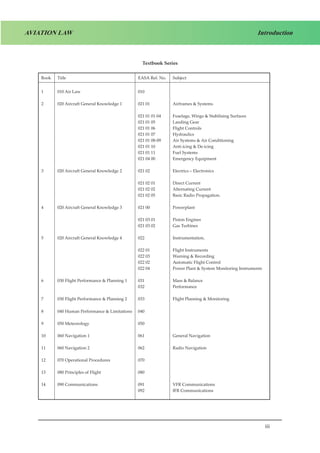
Textbook Series
Book Title EASA Ref. No. Subject
1 010 Air Law 010
2 020 Aircraft General Knowledge 1 021 01 Airframes & Systems
021 01 01-04 Fuselage, Wings & Stabilising Surfaces
021 01 05 Landing Gear
021 01 06 Flight Controls
021 01 07 Hydraulics
021 01 08-09 Air Systems & Air Conditioning
021 01 10 Anti-icing & De-icing
021 01 11 Fuel Systems
021 04 00 Emergency Equipment
3 020 Aircraft General Knowledge 2 021 02 Electrics – Electronics
021 02 01 Direct Current
021 02 02 Alternating Current
021 02 05 Basic Radio Propagation.
4 020 Aircraft General Knowledge 3 021 00 Powerplant
021 03 01 Piston Engines
021 03 02 Gas Turbines
5 020 Aircraft General Knowledge 4 022 Instrumentation
022 01 Flight Instruments
022 03 Warning & Recording
022 02 Automatic Flight Control
022 04 Power Plant & System Monitoring Instruments
6 030 Flight Performance & Planning 1 031 Mass & Balance
032 Performance
7 030 Flight Performance & Planning 2 033 Flight Planning & Monitoring
8 040 Human Performance & Limitations 040
9 050 Meteorology 050
10 060 Navigation 1 061 General Navigation
11 060 Navigation 2 062 Radio Navigation
12 070 Operational Procedures 070
13 080 Principles of Flight 080
14 090 Communications 091 VFR Communications
092 IFR Communications
iv
Introduction AVIATION LAW
v
IntroductionAVIATION LAW
Book Contents
DEFINITIONS .  .  .  .  .  .  .  .  .  .  .  .  .  .  .  .  .  .  .  .  .  .  .  .  .  .  .  .  .  .  .  .  .  .  .  .  .  .  .  .  .  .  1
INTERNATIONAL AGREEMENTS AND ORGANISATIONS .  .  .  .  .  .  .  .  .  .  .  .  .  .  . 19
AIRWORTHINESS OF AIRCRAFT .  .  .  .  .  .  .  .  .  .  .  .  .  .  .  .  .  .  .  .  .  .  .  .  .  .  .  .  .  . 47
AIRCRAFT NATIONALITY AND REGISTRATION MARKS .  .  .  .  .  .  .  .  .  .  .  .  .  .  . 53
FLIGHT CREW LICENSING .  .  .  .  .  .  .  .  .  .  .  .  .  .  .  .  .  .  .  .  .  .  .  .  .  .  .  .  .  .  .  .  .  . 61
RULES OF THE AIR .  .  .  .  .  .  .  .  .  .  .  .  .  .  .  .  .  .  .  .  .  .  .  .  .  .  .  .  .  .  .  .  .  .  .  .  .  .  . 85
INSTRUMENT PROCEDURES - DEPARTURES .  .  .  .  .  .  .  .  .  .  .  .  .  .  .  .  .  .  .  .  .  . 131
APPROACH PROCEDURES .  .  .  .  .  .  .  .  .  .  .  .  .  .  .  .  .  .  .  .  .  .  .  .  .  .  .  .  .  .  .  .  . 145
CIRCLING APPROACH  .  .  .  .  .  .  .  .  .  .  .  .  .  .  .  .  .  .  .  .  .  .  .  .  .  .  .  .  .  .  .  .  .  .  . 177
HOLDING PROCEDURES .  .  .  .  .  .  .  .  .  .  .  .  .  .  .  .  .  .  .  .  .  .  .  .  .  .  .  .  .  .  .  .  .  . 185
ALTIMETER SETTING PROCEDURES .  .  .  .  .  .  .  .  .  .  .  .  .  .  .  .  .  .  .  .  .  .  .  .  .  .  . 195
PARALLEL OR NEAR-PARALLEL RUNWAY OPERATION .  .  .  .  .  .  .  .  .  .  .  .  .  . 207
SSR AND ACAS .  .  .  .  .  .  .  .  .  .  .  .  .  .  .  .  .  .  .  .  .  .  .  .  .  .  .  .  .  .  .  .  .  .  .  .  .  .  .  . 221
AIRSPACE  .  .  .  .  .  .  .  .  .  .  .  .  .  .  .  .  .  .  .  .  .  .  .  .  .  .  .  .  .  .  .  .  .  .  .  .  .  .  .  .  .  .  . 229
AIR TRAFFIC SERVICES .  .  .  .  .  .  .  .  .  .  .  .  .  .  .  .  .  .  .  .  .  .  .  .  .  .  .  .  .  .  .  .  .  .  . 245
SEPARATION .  .  .  .  .  .  .  .  .  .  .  .  .  .  .  .  .  .  .  .  .  .  .  .  .  .  .  .  .  .  .  .  .  .  .  .  .  .  .  .  . 263
CONTROL OF AIRCRAFT .  .  .  .  .  .  .  .  .  .  .  .  .  .  .  .  .  .  .  .  .  .  .  .  .  .  .  .  .  .  .  .  .  . 297
AERONAUTICAL INFORMATION SERVICE (AIS) .  .  .  .  .  .  .  .  .  .  .  .  .  .  .  .  .  .  . 323
AERODROMES PHYSICAL CHARACTERISTICS .  .  .  .  .  .  .  .  .  .  .  .  .  .  .  .  .  .  .  . 341
AERODROMES VISUAL AIDS MARKINGS AND SIGNS .  .  .  .  .  .  .  .  .  .  .  .  .  .  .  . 363
AERODROME LIGHTING .  .  .  .  .  .  .  .  .  .  .  .  .  .  .  .  .  .  .  .  .  .  .  .  .  .  .  .  .  .  .  .  .  . 389
AERODROME SERVICES AND OBSTACLE MARKING .  .  .  .  .  .  .  .  .  .  .  .  .  .  .  .  . 409
FACILITATION .  .  .  .  .  .  .  .  .  .  .  .  .  .  .  .  .  .  .  .  .  .  .  .  .  .  .  .  .  .  .  .  .  .  .  .  .  .  .  . 423
SEARCH AND RESCUE .  .  .  .  .  .  .  .  .  .  .  .  .  .  .  .  .  .  .  .  .  .  .  .  .  .  .  .  .  .  .  .  .  .  . 431
SECURITY .  .  .  .  .  .  .  .  .  .  .  .  .  .  .  .  .  .  .  .  .  .  .  .  .  .  .  .  .  .  .  .  .  .  .  .  .  .  .  .  .  .  . 441
AIRCRAFT ACCIDENT AND INCIDENT INVESTIGATION .  .  .  .  .  .  .  .  .  .  .  .  .  . 455
REVISION QUESTIONS .  .  .  .  .  .  .  .  .  .  .  .  .  .  .  .  .  .  .  .  .  .  .  .  .  .  .  .  .  .  .  .  .  .  . 465
vi
Introduction AVIATION LAW
1
Chapter 1Definitions
INTRODUCTION. . . . . . . . . . . . . . . . . . . . . . . . . . . . . . . . . . . . . . . . . . . . . . . . . . . . . . . . . . . .  3
AIR LAW. . . . . . . . . . . . . . . . . . . . . . . . . . . . . . . . . . . . . . . . . . . . . . . . . . . . . . . . . . . . . . . . . . . .  3
ABBREVIATIONS. . . . . . . . . . . . . . . . . . . . . . . . . . . . . . . . . . . . . . . . . . . . . . . . . . . . . . . . . . . .  3
DEFINITIONS. . . . . . . . . . . . . . . . . . . . . . . . . . . . . . . . . . . . . . . . . . . . . . . . . . . . . . . . . . . . . . .  6
CHAPTER ONE
DEFINITIONS
Contents
2
Chapter 1 Definitions
3
Chapter 1Definitions
INTRODUCTION
The content of the Oxford Aviation College Aviation Law course meets the requirements of the
JAA-FCL syllabus (Subject 010- Air Law) and the associated Learning Objectives (LOs). The
main reference documents are the Annexes to the Convention on International Aviation (The
Chicago Convention) and the associated PANS documents. Additional references are taken
from JAR FCL and JAR OPS.
AIR LAW
The subject of Air Law is a misnomer. The content of the subject is effectively airmanship with
the addition of information concerning some of the international conventions that have been
adopted to regularise the administration of aviation and the aviation industry. The subject
matter is diverse ranging from international agreements through the rules of the air, flight crew
licensing, instrument procedures,ATC and the physical characteristics of aerodromes.A student
does not need to be a lawyer to pass this subject. Most of the requirements are common sense,
the majority of which will be familiar to a PPL holder. The ab initio student should approach the
subject from the ‘need to know’ principle and be guided by the examination feedback as well as
the syllabus. The end of chapter questions are based on examination questions and should give
the student a feel for the level of knowledge required on completion of the course.
ABBREVIATIONS
Air Law, perhaps more than any other subject, is inundated with abbreviations, some of which
are examinable. Where this is the case, the abbreviations are specified in the appropriate
chapter and ‘decoded.’ The following is a list (not exhaustive) of abbreviations commonly used
in aviation.
AAIB	 Air Accident Investigation Board
AAL	 Above Aerodrome Level
ABN	 Aerodrome Beacon
A/c	 Aircraft
ACC	 Area Control Centre
ADA	 Advisory Airspace
ADF	 Automatic Direction Finding
ADR	 Advisory Route
ADT	 Approved Departure Time
AFI	 Assistant Flying Instructor
AFIS	 Aerodrome Flight Information Service
AFS	 Aeronautical Fixed Service
AFTN	 Aeronautical Fixed Telecommunications Network
AGL	 Above Ground Level
AIC	 Aeronautical Information Circular
AIP	 Aeronautical Information Publication
AIREP	 Air Report
AIS	 Aeronautical Information Service
AME	 Authorised Medical Examiner
AMSL	 Above Mean Sea Level
ANO	 Air Navigation Order
AOC	 Air Operator’s Certificate
ARP	 Aerodrome Reference Point
ARN	 ATS Route Network
4
Chapter 1 Definitions
ASDA	 Accelerate-Stop Distance Available
ASR	 Altimeter Setting Region
ATAS	 Air Traffic Advisory Service
ATC	 Air Traffic Control
ATCC	 Air Traffic Control Centre
ATCU	 Air Traffic Control Unit
ATCRU	 Air Traffic Control Radar Unit
ATFM	 Air Traffic Flow Management
ATIS	 Automatic Terminal Information Service
ATS	 Air Traffic Service
ATSU	 Air Traffic Service Unit
ATZ	 Air Traffic Zone
AUW	 All up weight
AWD	 Airworthiness Division
AWY	 Airway
CAA	 Civil Aviation Authority
CANP	 Civil Aviation Notification Procedure
CAS	 Controlled Airspace
C of A	 Certificate of Airworthiness
CTR	 Control Zone
DA	 Decision Altitude
DF	 Direction Finding
DH	 Decision Height
DME	 Distance Measuring Equipment
DR	 Dead Reckoning
EAT	 Expected Approach Time
ECAC	 European Civil Aviation Authority
ED	 Emergency Distance
EET	 Estimated Elapse Time
ELT	 Emergency Location Transmitter
EPIRB	 Emergency Position Indicating Radio Beacon
ETA	 Estimated Time of Arrival
ETOPS	 Extended Twin Jet Operations
FAL	 Facilitation of Air Transport
FCL	 Flight Crew Licensing
FI	 Flying Instructor
FIR	 Flight Information Region
FIS	 Flight Information Service
FL	 Flight Level
FLPFM	 Foot Launched Powered Flying Machine
FTL	 Flight Time Limitations
GASIL	 General Aviation Safety Information Leaflet
GCA	 Ground Controlled Approach
H24	 Day and Night Operating Hours
HF	 High Frequency
Hz	 Hertz Radio Frequency
IAS	 Indicated Air Speed
Ibn	 Identification Beacon
ICAO	 International Civil Aviation Organisation
IFR	 Instrument Flight Rules
ILS	 Instrument Landing System
IMC	 Instrument Meteorological Conditions
IR	 Instrument Rating
IRE	 Instrument Rating Examiner
IRVR	 Instrument Runway Visual Range
5
Chapter 1Definitions
ISA	 International Standard Atmosphere
JAA	 Joint Aviation Authority
JAR	 JAA Regulations
KHz	 Kilo Hertz
Kt	 Knots
LARS	 Lower Airspace Radar Service
LATCC	 London Air Traffic Control Centre
LDA	 Landing Distance Available
LF	 Low Frequency
MATZ	 Military Air Traffic Zone
MDH	 Minimum Descent Height
MEHT	 Minimum Eye Height (PAPIs)
MEL	 Minimum Equipment List
METAR	 Aviation Routine Weather Report
MF	 Medium Frequency
MHz	 Megahertz
MNPS	 Minimum Navigation Performance Specification
MoD	 Ministry of Defence
MOTNE	 Meteorological Operational Telecommunications Network
MRSA	 Mandatory Radar Service Area
MTOM	 Maximum Take-off Mass
MTWA	 Maximum Take-off Weight Authorised
NAPs	 Noise Abatement Procedures
NATS	 National Air Traffic Services
NDB	 Non-Directional Beacon
NOH	 Notified Operating Hours
NOSIG	 No Significant Change
NOTAM	 Notice to Airmen
OCA	 Oceanic Control Area
OCA	 Obstacle Clearance Altitude
OCH	 Obstacle Clearance Height
OCL	 Obstacle Clearance Limit
OIS	 Obstacle Identification Surface
PANS	 Procedures for Air Navigation
PAR	 Precision Approach Radar
PAPI	 Precision Approach Path Indicator
Pax	 Passengers
PIC	 Pilot in Charge
PT	 Public Transport
RCC	 Rescue Co-ordination Centre
RIS	 Radar Information Service
RLCE	 Request level change en-route
RNOTAM	 Royal NOTAM
RTF	 Radio Telephony
RTOW	 Regulated Take-off Weight
RTG	 Radio Telegraphy
RVR	 Runway Visual Range
RVSM	 Reduced Vertical Separation Minima
Rwy	 Runway
SAR	 Search and Rescue
SARP	 Standard and Recommended Practice (ICAO)
SARSAT	 Search and Rescue Satellite Tracking System
SELCAL	 Selective Calling
Sfc	 Surface
SID	 Standard Instrument Departure
6
Chapter 1 Definitions
SIGMET	 Significant Meteorological Warning
SNOCLO	 Closed by Snow
SPECI	 Special Met Report
SPL	 Supplementary Flight Plan
SSR	 Secondary Surveillance Radar
STAR	 Standard Instrument Arrival
SVFR	 Special Visual Flight Rules
TAF	 Aerodrome Meteorological Forecast
TAS	 True Airspeed
TCA	 Terminal Control Area
TMA	 Terminal Maneuvering Area
TODA	 Take-off Distance Available
TOM	 Take-off Minima
TORA	 Take-off Run Available
TR	 Type Rating
TRE	 Type Rating Examiner
TL	 Transition Level
TVOR	 Terminal VHF Omni Ranging
Twr	 Tower (Aerodrome Control)
UHF	 Ultra High Frequency
UIR	 Upper Information Region
U/s	 Unserviceable
UTC	 Co-ordinated Universal Time
VASI	 Visual Approach Slope Indicator
VFR	 Visual Flight Rules
VHF	 Very High Frequency
VMC	 Visual Meteorological Conditions
VOR	 VHF Omni-ranging
VSTOL	 Very Short Take-off and Landing
WEF	 With effect from
WIP	 Work in Progress
Wpt	 Waypoint
DEFINITIONS
Some of the examination questions relate to the wording of definitions and the LOs require
the student to be able to identify the correct definition from a list of offered alternatives. The
following are the definitions used in the Annexes to the Convention on International Civil
Aviation.
Advisory Airspace. Airspace of defined dimensions, or designated route, within which air
traffic advisory service is available.
Advisory Route. A designated route along which air traffic advisory service is available.
Aerial WorkAircraft means an aircraft (other than a public transport aircraft) flying, or intended
by the operator to fly, for the purpose of aerial work.
Aerial Work. Undertaking means an undertaking whose business includes the performance of
aerial work.
Aerobatic Manoeuvres includes loops, spins, rolls, bunts, stall turns, inverted flying and any
other similar manoeuvre.
7
Chapter 1Definitions
Aerodrome means any area of land or water designed, equipped, set apart or commonly used
for affording facilities for the landing and departure of aircraft and includes any area or space,
whether on the ground, on the roof of a building or elsewhere, which is designed, equipped or
set apart for affording facilities for the landing and departure of aircraft capable of descending
or climbing vertically, but shall not include any area the use of which for affording facilities for
the landing and departure of aircraft has been abandoned and has not been resumed.
Aerodrome Control Service means an air traffic control service for any aircraft on the
manoeuvring area or apron of the aerodrome in respect of which the service is being provided
or which is flying in, or in the vicinity of, the aerodrome traffic zone of that aerodrome by visual
reference to the surface.
Aerodrome Flight Information Unit means a person appointed by the Authority or by any
other person maintaining an aerodrome to give information by means of radio signals to aircraft
flying or intending to fly within the aerodrome traffic zone of that aerodrome and aerodrome
flight information service shall be construed accordingly.
Aerodrome. A defined area on land or water (including any buildings, installations and
equipment) intended to be used either wholly or in part for the arrival, departure and surface
movement of aircraft.
Aerodrome Control Tower. A unit established to provide air traffic control service to aerodrome
traffic.
Aerodrome Operating Minima in relation to the operation of an aircraft at an aerodrome means
the cloud ceiling and runway visual range for take-off, and the decision height or minimum
descent height, runway visual range and visual reference for landing, which are the minimum
for the operation of that aircraft at that aerodrome.
Aerodrome Traffic. All traffic on the manoeuvring area of an aerodrome and all aircraft flying
in the vicinity of an aerodrome.
Aerodrome Traffic Zone. Airspace of defined dimensions established around an aerodrome for
the protection of aerodrome traffic.
Aeronautical Ground Light means any light specifically provided as an aid to air navigation,
other than a light displayed on an aircraft.
Aeronautical Part. That part of an aerodrome including buildings to which access is limited by
security measures (airside).
Aeronautical Radio Station means a radio station on the surface, which transmits or receives
signals for the purpose of assisting aircraft.
Aeronautical Station. A land station in the aeronautical mobile service. In certain instances, an
aeronautical station may be located, for example, on board ship or on a platform at sea.
Aeroplane. A power driven heavier than air aircraft, deriving its lift in flight chiefly from
aerodynamic reactions on surfaces which remain fixed under given conditions of flight.
Aircraft. Any machine that can derive support in the atmosphere from the reactions of the air
other than the reactions of the air against the earth’s surface.
Aircraft Category. Classification of aircraft according to specified basic characteristics e.g.
aeroplane, helicopter, glider, free balloon.
8
Chapter 1 Definitions
Aircraft certified for single pilot operation. A type of aircraft which the State of Registry has
determined, during the certification process, can be operated safely with a minimum crew of
one pilot.
Aircraft - Type of. All aircraft of the same basic design including all modifications thereto except
those modifications which result in change in handling or flight characteristics
Air Traffic. All aircraft in flight or operating on the manoeuvring area of an aerodrome.
Air Traffic Advisory Service. A service provided within advisory airspace to ensure separation,
in so far as practical, between aircraft which are operating on IFR flight plans.
Air Traffic Control Clearance Authorisation for an aircraft to proceed under conditions
specified by an air traffic control unit.
Note. For convenience, the term “air traffic control clearance” is frequently abbreviated to “clearance”
when used in appropriate contexts.
Note 2. - The abbreviated team “clearance” may be prefixed by the words “taxi”, “take-off”, “departure”,
“en-route”, “approach” or “landing” to indicate the particular portion of flight to which the air traffic
control clearance relates.
Air Traffic Control Service. A service provided for the purpose of:
	 Preventing collisions:
•	 Between aircraft
•	 On the manoeuvring area between aircraft and obstructions
	 Expediting and maintaining an orderly flow of air traffic.
Air Traffic Control Unit. A generic term meaning variously, area control centre, approach
control office or aerodrome control tower.
Air Traffic Services Airspaces. Airspaces of defined dimensions alphabetically designated,
within which specific types of flights may operate and for which air traffic services and rules of
operation are specified.
Air Traffic Services Reporting Office. A unit established for the purpose of receiving reports
concerning air traffic services and flight plans submitted before departure.
Note. An air traffic reporting office may be established as separate unit or combined with an existing unit,
such as another air traffic services unit, or a unit of the aeronautical information
Air Traffic Services Unit. A generic term meaning variously, air traffic control unit, flight
information centre or air traffic services reporting office.
Air Transport Undertaking means an undertaking whose business includes the undertaking of
flights for the purposes of public transport of passengers or cargo.
Airborne Collision Avoidance System (ACAS). An aircraft system based on secondary
surveillance radar (SSR) transponder signals which operates independently of ground-based
equipment to provide advice to the pilot on potential conflicting aircraft that are equipped with
SSR transponders.
9
Chapter 1Definitions
Airway. A control area or portion thereof established in the form of a corridor equipped with
radio navigation aids.
Alerting Service. A service provided to notify appropriate organisations regarding aircraft in
need of search and rescue aid, and to assist such organisations as required.
Alternate Aerodrome. An aerodrome to which an aircraft may proceed when it becomes either
impossible or inadvisable to continue to or to land at, the aerodrome of intended landing.
Alternate aerodromes include the following:
	 Take-off alternate. An aerodrome to which an aircraft can land should this become
necessary shortly after take-off where it is not possible to use the aerodrome of departure.
	 En-route alternate. An aerodrome at which an aircraft would be able to land after
experiencing an abnormal or emergency condition while en route.
	 Destination alternate. An aerodrome to which an aircraft may proceed should it become
either impossible or inadvisable to land at the aerodrome of intended landing.
Note. The aerodrome from which a flight departs may also be en-route or a destination alternate aerodrome
for that flight.
Altitude. The vertical distance of a level, a point or an object considered as a point, measured
from mean to sea level.
Annual Costs in relation to the operation of an aircraft means the best estimate reasonably
practicable at the time of a particular flight in respect of the year commencing on the first day of
January preceding the date of the flight, of the cost of keeping and maintaining and the indirect
costs of operating the aircraft, such costs in either case excluding direct costs and being those
actually and necessarily incurred without a view to profit.
Annual Flying Hours. The best estimate reasonably practicable at the time of a particular flight
by an aircraft of the hours flown or to be flown by the aircraft in respect of the year commencing
on the first day of January preceding the date of the flight.
Approach Control Office. A unit established to provide air traffic control service to controlled
flights arriving at, or departing from, one or more aerodromes.
Approach Control Service. Air traffic control service for arriving or departing controlled
flights.
Approach to Landing means that portion of the flight of the aircraft, when approaching to land,
in which it is descending below a height of 1000 ft above the relevant specified decision height
or minimum descent height.
Appropriate ATS Authority. The relevant authority designated by the State responsible for
providing air traffic services in the airspace concerned.
Appropriate Authority.
	 Regarding flight over the high seas; the relevant authority of the State of Registry
	 Regarding flight other than over the high seas: the relevant authority of the State having
sovereignty over the territory being overflown
10
Chapter 1 Definitions
Apron. A defined area, on a land aerodrome, intended to accommodate aircraft for the purposes
of loading or unloading passengers, mail or cargo, fuelling, parking or maintenance.
Area Control Centre. An air traffic control unit established to provide an area control service to
aircraft flying within a notified flight information region which are not receiving an aerodrome
control service or an approach control service.
Area Control Service. Air traffic control service for controlled flights in control areas.
Area Navigation Equipment (RNAV). Equipment carried on board an aircraft which enables
the aircraft to navigate on any desired flight path within the coverage of appropriate ground
based navigation aids or within the limits of that on-board equipment or a combination of the
two.
ATS Route. A specified route designed for channeling the flow of traffic as necessary for the
provision of air traffic services.
Note. The term “ATS route” is used to mean variously, airway, advisory route, controlled or uncontrolled
route, arrival or departure route, etc.
Authorised Person means:
	 Any constable
	 Any person authorised by the Secretary of State (whether by name, or by class or
description) either generally or in relation to a particular case of class of cases
	 Any person authorised by the Authority (whether by name or class or description)
either generally or in relation to a particular case or class of cases
Cabin Attendant in relation to an aircraft means a person on a flight for the purpose of public
transport carried for the purpose of performing in the interests of the safety of passengers
duties to be assigned by the operator or the commander of the aircraft but who shall not act as
a member of the flight crew.
Captive Flight means flight by an uncontrollable balloon during which it is attached to the
surface by a restraining device.
Cargo includes mail and animals.
Certified for single pilot operation means an aircraft which is not required to carry more than
one pilot by virtue of one or more of the following.
Change-over Point. The point at which an aircraft navigating on an ATS route segment defined
by reference to very high frequency omni directional radio ranges (VOR) is expected to transfer
its primary navigational reference from the facility behind the aircraft to the next facility ahead
of the aircraft.
Note. Change-over points are established to provide the optimum balance in respect of signal strength and
quality between facilities at all levers to be used and to ensure a common source of azimuth guidance for
all aircraft operating along the same portion of a route segment.
Clearance Limit. The point to which an aircraft is granted an air traffic control clearance.
11
Chapter 1Definitions
Cloud Ceiling in relation to an aerodrome means the vertical distance from the elevation of
the aerodrome to the lowest part of any cloud visible from the aerodrome which is sufficient to
obscure more than one-half of the sky so visible.
Commander in relation to an aircraft means the member of the flight crew designated as
commander of that aircraft by the operator thereof, or, failing such a person, the person who is
for the time being the pilot in command of the aircraft.
Commercial Pilot Licence (CPL). A licence held by a professional pilot which permits the
holder to:
	 Exercise all the privileges of a PPL
	 Act as PIC in any aeroplane engaged in operations other than commercial air
transport
	 Act as PIC in commercial air transport in any aeroplane certificated for single pilot
operation
	 To act as co-pilot in commercial air transport in aeroplanes required to be operated with
a co-pilot
Competent Authority. The authority responsible under the law of the State for promoting the
safety of civil aviation.
Contracting State means any state which is party to the Convention on International Civil
Aviation signed at Chicago on the 7 December 1944.
Control Area. A controlled airspace extending upwards from a specified limit above the earth.
Controlled Aerodrome. An aerodrome at which air traffic control service is provided to
aerodrome traffic.
Note. The term “controlled aerodrome” indicates that air traffic control service is provided to aerodrome
traffic but does not necessarily imply that a control zone exists.
Controlled Airspace. An airspace of defined dimensions within which air traffic control service
is provided to IFR flights and to VFR flights in accordance with the airspace classification.
Note. Controlled airspace is a generic term which covers ATS airspace Classes A, B, C, D and E.
Controlled Flight. Any flight which is subject to an air traffic control clearance.
Control Zone. A controlled airspace extending upwards from the surface of the earth to a
specified upper limit.
Configuration (as applied to the aeroplane). A particular combination of the positions of the
moveable elements, such as wing flaps, landing gear, etc., which affect the aerodynamics of the
aeroplane.
Co-pilot. A licenced pilot serving in any piloting capacity other than as pilot-in-command
but excluding a pilot who is on board the aircraft for the sole purpose of receiving flight
instruction.
12
Chapter 1 Definitions
CPL (Current Flight Plan). The Flight Plan, including changes if any, brought about by
subsequent clearances.
Crew means a member of the flight crew, a person carried on the flight deck who is appointed
by the operator of the aircraft to give or to supervise the training, experience, practice and
periodical tests as required and in respect of the flight crew or as a cabin attendant.
Critical Power-Units(s). The power-unit(s), failure of which gives the most adverse effect on the
aircraft characteristics relative to the case under consideration.
Cruise Climb. An aeroplane cruising technique resulting in a net increase in altitude as the
aeroplane mass decreases.
Cruising Level. A level maintained during a significant portion of a flight.
Danger Area. An airspace of defined dimensions within which activities dangerous to the flight
of aircraft may exist at specified times.
Day means the time from half an hour before sunrise until half and hour after sunset (both
times exclusive), sunset and sunrise being determined at surface level.
Decision Height in relation to the operation of an aircraft at an aerodrome means the height
in a precision approach at which a missed approach must be initiated if the required visual
reference to continue that approach has not been established.
Declared Distances has the meaning which has been notified.
Design Landing Mass. The maximum mass of the aircraft at which, for structural design
purposes, it is assumed to be planned to land.
Design Take-off Mass. The maximum mass at which the aircraft, for structural design purposes,
is assumed to be planned to be at the start of the take-off run.
Design Taxiing Mass. The maximum mass of the aircraft, at which the structural provision is
made for load liable to occur during the use of the aircraft, on the ground prior to the start of
take- off.
Destination Alternate. An alternate aerodrome to which an aircraft may proceed should it
become either impossible or inadvisable to land at the aerodrome of intended landing.
Dual Instruction Time. Flight time during which a person is receiving flight instruction from a
properly authorised pilot on board the aircraft.
En-route Clearance. Where an ATC clearance is issued for the initial part of a flight solely as a
means of expediting departing traffic, the subsequent clearance to the aerodrome of intended
landing is an en-route clearance.
Estimated Off Blocks Time. The estimated time at which the aircraft will commence movement
associated with departure.
Estimated Time of Arrival. For IFR flights, the time at which it is estimated that the aircraft
will arrive over that designated point, defined by reference to navigation aids, from which it is
intended that an instrument approach procedure will be commenced, or, if no navigation aid
is associated with the aerodrome, the time at which the aircraft will arrive over the aerodrome.
13
Chapter 1Definitions
Expected Approach Time. The time at which ATC expects that an arriving aircraft, following a
delay, will leave the holding point to complete its approach to landing. Note.-The actual time of
leaving a holding point will depend on the approach clearance.
Final approach and take-off area/FATO (except helicopters). A defined area over which the
final phase of the approach manoeuvre to hover or landing is completed and from which the
take- off manoeuvre is commenced and, where the FATO is to be used by performance class 1
helicopters, includes the rejected take-off area available.
Filed Flight Plan. The flight plan as filed with an ATS unit by the pilot or a designated
representative, without any subsequent changes.
Note. When the word “message” is used as a suffix to this term, it denotes the content and format of the
filed flight plan data as transmitted.
Flight Crew Member. A licensed crew member charged with duties essential to the operation
of an aircraft during flight time.
Flight Information Service. A service provided for the purpose of giving advice and information
useful for the safe and efficient conduct of flights.
Flight Level. A surface of constant atmospheric pressure which is related to a specific pressure
datum, 1013.2 hPa, and is separated from other such surfaces by specific pressure intervals.
Note 1. A pressure type altimeter calibrated in accordance with the Standard Atmosphere:
	 When set to QNH, altimeter will indicate altitude
	 When set to QFE, altimeter will indicate height above the QFE reference datum
	 When set at a pressure of 1013.2 hPa, may be used to indicate flight levels
	
Note 2. The terms “height” and “altitude, used in Note 1 above, indicate altimetric rather than geometric
heights or altitudes.
Flight Plan. Specified information provided to air traffic services units, relative to an intended
flight or portion of a flight of an aircraft.
Flight Procedures Trainer. See Synthetic flight trainer.
Flight Simulator. See Synthetic flight trainer.
Flight Recording System means a system comprising either a flight data recorder or a cockpit
voice recorder or both.
Flight Time. The total time from the moment an aircraft first moves under its own power for the
purpose of taking off until the moment it first comes to rest at the end of the flight.
Note 1. Flight time as here defined is synonymous with the term “block to block” time or “chock to chock”
time in general usage which is measured from the time an aircraft moves from the loading point until it
stops at the unloading point.
Note 2. Whenever helicopter rotors are engaged, the time will be included in the flight time.
Flight Time as Student Pilot in Command. Flight time during which the flight instructor
will only observe the student acting as PIC and shall not influence or control the flight of the
aircraft.
14
Chapter 1 Definitions
Flight Visibility. The visibility forward from the cockpit of an aircraft in flight.
Free Balloon means a balloon which when in flight is not attached by any form of restraining
device to the surface.
Free Controlled Flight means flight during which a balloon is not attached to the surface by
any form of restraining device (other than a tether not exceeding 5 metres in length which
may be used as part of the take-off procedure) and during which the height of the balloon is
controllable by means of a device attached to the balloon and operated by the commander of
the balloon or by remote control.
Ground Visibility. The visibility at an aerodrome, as reported by an accredited observer.
Government Aerodrome means any aerodrome in the United Kingdom which is in the
occupation of any Government Department or visiting force.
Heading. The direction in which the longitudinal axis of an aircraft is pointed, usually expressed
in degrees from North (true, magnetic, compass or grid).
Height. The vertical distance if a level, a point or an object considered as a point, measured from
a specified datum.
IFR. The symbol used to designate the instrument flight rules.
IFR Flight. A flight conducted in accordance with the instrument flight rules.
IMC. The symbol used to designate instrument meteorological conditions.
Instrument Approach Procedure. A series of predetermined manoeuvres by reference to flight
instruments with specified protection from obstacles from the initial approach fix, or where
applicable, from the beginning of a defined arrival route to a point from which a landing can
be completed and thereafter, if a landing is not completed, to a position at which holding or
en-route clearance criteria apply.
Instrument Meteorological Conditions. Meteorological conditions expressed in terms of
visibility,distancefromcloud,andceiling,lessthantheminimaspecifiesforvisualmeteorological
conditions.
	
Note. In a control zone, a VFR flight may proceed under instrument meteorological conditions of and as
authorised by air traffic control.
Instrument Flight Time. Time during which a pilot is piloting an aircraft solely by reference to
instruments and without external reference points.
Instrument Ground Time. Time during which a pilot is practising, on the ground, simulated
instrument flight in a synthetic flight trainer approved by the Licensing Authority.
Instrument time. Instrument flight time or instrument ground time.
JAA means the Joint Aviation Authorities, an associated body of the European Civil Aviation
Conference.
JAR means a joint aviation requirement of the JAA bearing that number as it has effect under
the Technical Harmonisation Regulation and reference to a numbered JAR is a reference to such
a requirement.
15
Chapter 1Definitions
Landing Area. That part of a movement area intended for the landing or take-off of aircraft.
Landing Surface. That part of the surface of an aerodrome which the aerodrome authority
has declared available for the normal ground or water run of aircraft landing in a particular
direction.
Level. A generic term relating to the vertical position of an aircraft in flight and meaning
variously, height, altitude or flight level.
Lifejacket includes any device designed to support a person individually in or on the water.
Log Book in the case of an aircraft log book, engine log book or variable pitch propeller log
book, or personal flying log book includes a record kept either in a book, or by any other means
approved by the Authority in the particular case.
Manoeuvring Area. That part of an aerodrome to be used for the take-off, landing and taxiing
of aircraft, excluding aprons.
Maintenance. Tasks required to ensure the continued airworthiness of an aircraft including
any one or combination of overhaul, repair, inspection, replacement, modification or defect
rectification.
Medical Assessment. The evidence issued by a Contracting State that the licence holder meets
specific requirements of medical fitness. It is issued following an evaluation by the Licensing
Authority of the report submitted by the designated medical examiner who conducted the
examination of the applicant for the licence.
Minimum Descent Height in relation to the operation of an aircraft at an aerodrome means the
height in a non-precision approach below which descent may not be made without the required
visual reference.
Multiple Pilot Aeroplanes. Aeroplanes certificated for operation with a minimum crew of at
least two pilots.
Multi-crew Co-operation. The function of the flight crew as a team of co-operating members
led by the pilot-in-command.
Movement Area. That part of an aerodrome to be used for the take-off, landing and taxiing of
aircraft, consisting of the manoeuvring area and the apron(s).
Nautical mile means the International Nautical Mile, that is to say, a distance of 1852 metres.
Night. The hours between the end of evening civil twilight and the beginning of morning
civil twilight or such other period between sunset and sunrise, as may be prescribed by the
appropriate authority.
Note. Civil twilight ends in the evening when the centre of the sun’s disc is 6 degrees below the horizon
and begins in the morning when the centre of the sun’s disc is 6 degrees below the horizon.
Non-precision Approach means an instrument approach using non-visual aids for guidance in
azimuth or elevation but which is not a precision approach.
Private Pilot’s Licence (PPL). The licence held by a pilot which prohibits the piloting of an
aircraft for which remuneration is given.
16
Chapter 1 Definitions
(To) Pilot. To manipulate the flight controls of an aircraft during flight time.
Pilot-In-Command. The pilot responsible for the operation and safety of the aircraft during
flight time.
Power-unit. A system of one or more engines and ancillary parts which are together necessary
to provide thrust, independently of the continued operation of any other power unit(s), but not
including short period thrust-producing devices.
Precision approach means an instrument approach using Instrument Landing System,
Microwave Landing System or Precision Approach Radar for guidance in both azimuth and
elevation.
Pressure altitude. An atmospheric pressure expressed in terms of altitude which corresponds
to the pressure in the Standard Atmosphere.
Proficiency Check. Demonstration of skill to revalidate or renew ratings, and including such
oral examinations as the examiner may require.
Prohibited Area. An airspace of defined dimensions above the land areas or territorial waters
of a State within which flight of aircraft is prohibited.
Rating. An authorisation entered on or associated with a licence and forming part thereof,
stating special conditions, privileges or limitations pertaining to such licence.
Renewal. The administrative action taken after a rating has expired.
Rendering a Licence Valid. The action taken by a Contracting State, as an alternative to issuing
its own licence, in accepting a licence issued by any other state as an equivalent of its own
licence.
Repetitive Flight Plan (RPL). A flight plan related to a series of frequently recurring, regularly
operated individual flights with identical basic features, submitted by an operator for retention
and repetitive use by ATS units.
Reporting Point. A specified geographical location in relation to which the position of an aircraft
can be reported.
Restricted Area. An airspace of defined dimensions above the land areas or territorial waters
of a State within which flight of aircraft is restricted in accordance with certain specified
conditions.
Re-validation. The administrative action taken within the period of validity of a rating or
approval that allows the holder to continue to exercise the privileges of a rating or approval for
a further specified period consequent upon the fulfillment of specified requirements.
Runway. A defined rectangular area on a land aerodrome prepared for the landing and take-off
of aircraft.
Runway Visual Range in relation to a runway means the distance in the direction of take-off
or landing over which the runway lights or surface markings may be seen from the touchdown
zone as calculated by either human observation or instruments in the vicinity of the touchdown
zone or where this is not reasonably practicable in the vicinity of the mid-point of the runway;
and the distance, if any, communicated to the commander of an aircraft by or on behalf of the
person in charge of the aerodrome as being the runway visual range for the time being.
17
Chapter 1Definitions
Scheduled Journey means one of a series of journeys which are undertaken between the same
two places and which together amount to a systematic service.
Signal Area. An area of an aerodrome used for the display of ground signals.
Skill Test. Demonstration of skill for licence or rating issue including such oral examinations as
the examiner may require.
Solo Flight Time. Flight time during which a student pilot is the sole occupant of an aircraft.
Special VFR Flight. A VFR flight cleared by air traffic control to operate within a control zone
in meteorological conditions below VMC.
State of Design. The state having jurisdiction over the organisation responsible for the type
design.
State of Registry. The State on whose register the aircraft is entered.
Synthetic Flight Trainer. Any one of the following three types if apparatus in which flight
conditions are simulated on the ground:
	 A Flight Simulator. Which provides an accurate representation of the flight deck of a
particular aircraft type to the extent that the mechanical, electrical, electronic etc aircraft
control functions; the normal environment of flight crew members, and the performance
and flight characteristics of that type of aircraft are realistically simulated
	 A Flight Procedures Trainer. Which provides a realistic flight deck environment, and
which simulates instrument responses, simple control functions of mechanical, electric,
electronic etc aircraft systems, and the performance and flight characteristics of aircraft
of a particular class
	 A Basic Instrument Flight Trainer. Which is equipped with appropriate instruments,
and which simulates the flight deck environment of an aircraft in flight in instrument
flight conditions
Take-off Surface. That part of the surface of an aerodrome which the aerodrome authority
has declared available for the normal ground or water run of aircraft taking off in a particular
direction.
Taxiing. Movement of an aircraft on the surface of an aerodrome under its own power, excluding
take-off and landing.
Taxiway. A defined path on a land aerodrome established for the taxiing of an aircraft and
intended to provide a link between one part of the aerodrome and another, including:
	 Aircraft stand taxi-lane. A portion of an apron designated as a taxiway and Intended to
provide access to aircraft stands only
	 Apron taxiway. A portion of a taxiway system located on an apron and intended to
provide a through taxi route across the apron
	 Rapid exit taxiway. A taxiway connected to a runway at an acute angle and designed
to allow landing aeroplanes to turn off at higher speeds than are achieved on other exit
taxiways thereby minimising runway occupancy times
18
Chapter 1 Definitions
Terminal Control Area (TCA). A control area normally established at the Confluence of ATS
routes in the vicinity of one or more major aerodromes.
Total Estimated Elapsed Time. For IFR flights, the estimated time required from take-off to
arrive over that designated point, defined by reference to navigation aids, from which it is
intended than an instrument approach procedure will be commenced, or, if no navigation aid is
associated with the destination aerodrome, to arrive over the destination aerodrome. For VFR
flights, the estimated time required from take-off, to arrive over the destination aerodrome.
Track. The projection on the Earth’s surface of the path of an aircraft, the direction of which path
at any point is usually expressed in degrees from North (true, magnetic or grid).
Traffic Avoidance Service. Advice provided by an air traffic service unit specifying manoeuvres
to assist a pilot to avoid a collision.
Traffic Information. Information issued by an air traffic service unit to alert a pilot to other
known or observed air traffic which may be in proximity to the position or intended route of
flight and to help the pilot avoid a collision.
Transition Altitude. The altitude at or below which the vertical position of an aircraft is
controlled by reference to altitudes.
VFR. The symbol used to designate the visual flight rules.
VFR Flight. A flight conducted in accordance with the visual flight rules.
Visibility. The ability, as determined by atmospheric conditions and expressed in units of
distance, to see and identify prominent unlighted objects by day and prominent lighted objects
by night.
Visual Meteorological Conditions. Meteorological conditions expressed in terms of visibility;
distance from cloud, and ceiling equal to or better than specified minima.
VMC. The symbol used to designate visual meteorological conditions.
19
Chapter 2International Agreements and Organisations
CHAPTER TWO
INTERNATIONAL AGREEMENTS AND ORGANISATIONS
	
Contents
THE CHICAGO CONVENTION  . . .  . . .  . . .  . . .  . . .  . . .  . . .  . . .  . . .  . . .  . . .  . . .  . . .  . . .  . . .  . . .  . . .21
INTERNATIONAL LAW . . .  . . .  . . .  . . .  . . .  . . .  . . .  . . .  . . .  . . .  . . .  . . .  . . .  . . .  . . .  . . .  . . .  . . .  . . .22
CUSTOMS AND EXCISE, AND IMMIGRATION  . . .  . . .  . . .  . . .  . . .  . . .  . . .  . . .  . . .  . . .  . . .  . . .  . . .24
INTERNATIONAL OBLIGATIONS OF CONTRACTED STATES . . .  . . .  . . .  . . .  . . .  . . .  . . .  . . .  . . . 24
DUTIES OF ICAO MEMBER STATES . . .  . . .  . . .  . . .  . . .  . . .  . . .  . . .  . . .  . . .  . . .  . . .  . . .  . . .  . . .  . . .25
STATUS OF ANNEX COMPONENTS . . .  . . .  . . .  . . .  . . .  . . .  . . .  . . .  . . .  . . .  . . .  . . .  . . .  . . .  . . .  . . 26
THE INTERNATIONAL CIVIL AVIATION ORGANISATION (ICAO)  . . .  . . .  . . .  . . .  . . .  . . .  . . .  . .26
THE ORGANISATION OF ICAO . . .  . . .  . . .  . . .  . . .  . . .  . . .  . . .  . . .  . . .  . . .  . . .  . . .  . . .  . . .  . . .  . . .27
REGIONAL STRUCTURE OF ICAO . . .  . . .  . . .  . . .  . . .  . . .  . . .  . . .  . . .  . . .  . . .  . . .  . . .  . . .  . . .  . . . 28
REGIONAL STRUCTURE AND OFFICES  . . .  . . .  . . .  . . .  . . .  . . .  . . .  . . .  . . .  . . .  . . .  . . .  . . .  . . .  . .29
ICAO PUBLICATIONS . . .  . . .  . . .  . . .  . . .  . . .  . . .  . . .  . . .  . . .  . . .  . . .  . . .  . . .  . . .  . . .  . . .  . . .  . . .  . 29
OTHER INTERNATIONAL AGREEMENTS . . .  . . .  . . .  . . .  . . .  . . .  . . .  . . .  . . .  . . .  . . .  . . .  . . .  . . . 30
THE CONVENTIONS OF TOKYO, THE HAGUE AND MONTREAL . . .  . . .  . . .  . . .  . . .  . . .  . . .  . . 31
THE WARSAW CONVENTION . . .  . . .  . . .  . . .  . . .  . . .  . . .  . . .  . . .  . . .  . . .  . . .  . . .  . . .  . . .  . . .  . . . 33
THE ROME CONVENTION  . . .  . . .  . . .  . . .  . . .  . . .  . . .  . . .  . . .  . . .  . . .  . . .  . . .  . . .  . . .  . . .  . . .  . . .33
IATA . . .  . . .  . . .  . . .  . . .  . . .  . . .  . . .  . . .  . . .  . . .  . . .  . . .  . . .  . . .  . . .  . . .  . . .  . . .  . . .  . . .  . . .  . . .  . . .33
ECAC  . . .  . . .  . . .  . . .  . . .  . . .  . . .  . . .  . . .  . . .  . . .  . . .  . . .  . . .  . . .  . . .  . . .  . . .  . . .  . . .  . . .  . . .  . . .  . .34
EASA . . .  . . .  . . .  . . .  . . .  . . .  . . .  . . .  . . .  . . .  . . .  . . .  . . .  . . .  . . .  . . .  . . .  . . .  . . .  . . .  . . .  . . .  . . .  . . 34
JAA . . .  . . .  . . .  . . .  . . .  . . .  . . .  . . .  . . .  . . .  . . .  . . .  . . .  . . .  . . .  . . .  . . .  . . .  . . .  . . .  . . .  . . .  . . .  . . . 35
EUROCONTRO . . .  . . .  . . .  . . .  . . .  . . .  . . .  . . .  . . .  . . .  . . .  . . .  . . .  . . .  . . .  . . .  . . .  . . .  . . .  . . .  . . . L36
GENEVA CONVENTION  . . .  . . .  . . .  . . .  . . .  . . .  . . .  . . .  . . .  . . .  . . .  . . .  . . .  . . .  . . .  . . .  . . .  . . .  . 36
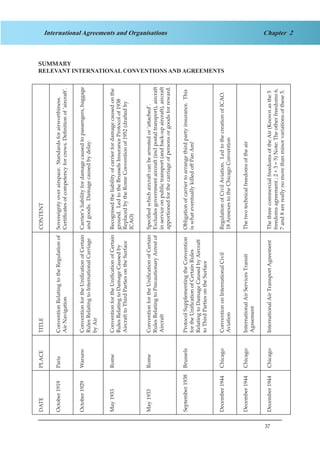
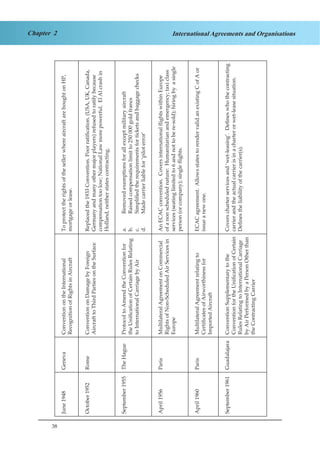
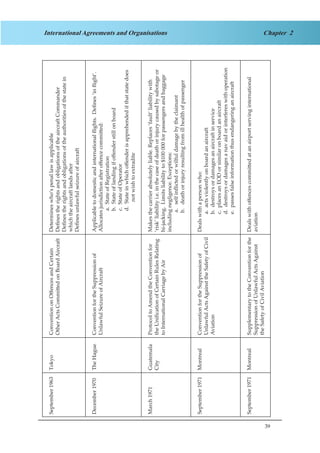
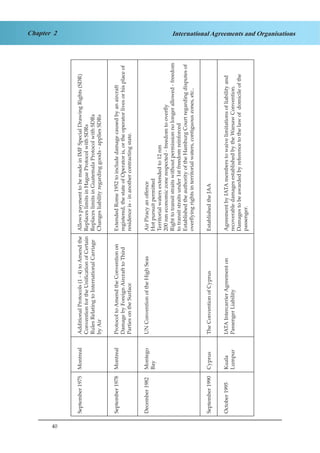
SUMMARY  . . .  . . .  . . .  . . .  . . .  . . .  . . .  . . .  . . .  . . .  . . .  . . .  . . .  . . .  . . .  . . .  . . .  . . .  . . .  . . .  . . .  . . . 37
QUESTIONS  . . .  . . .  . . .  . . .  . . .  . . .  . . .  . . .  . . .  . . .  . . .  . . .  . . .  . . .  . . .  . . .  . . .  . . .  . . .  . . .  . . .  . . .41
ANSWERS . . .  . . .  . . .  . . .  . . .  . . .  . . .  . . .  . . .  . . .  . . .  . . .  . . .  . . .  . . .  . . .  . . .  . . .  . . .  . . .  . . .  . . .  . 46
20
Chapter 2 International Agreements and Organisations
21
Chapter 2International Agreements and Organisations
THE CHICAGO CONVENTION
2.1	 Historical Background. As far as modes of transport is concerned, civil aviation has
been the fastest growing and the most technically innovative of any. From the first attempts
at powered manned flight to regular space flight we have only just exceeded 100 years of
aviation and we have had scheduled commercial air services since 1919. In this day and age of
information technology, computerised ticketing systems and computerised flight plans, how
did they cope in those early days? It is probably no co-incidence that the first International
Conference on Civil Aviation also took place in 1919 at Paris. Since then, the field of our chosen
profession has been subjected to far more international legislation and regulation, than any
other. The overriding need, which is recognised by all, regardless of political inclination, is for
higher and higher safety standards. The degree of international co-operation in this respect is
outstanding and shows that where there is a genuine desire to achieve international agreement,
it is forthcoming.
2.2	 The Second World War. The Second World War had a major effect upon technical
development of the aeroplane telescoping a quarter of a century of normal peacetime
development into just six years. The strategic use of aeroplanes for the movement of men and
materiel to and from theatres of war laid the foundation for the air transport industry we have
today. It was foreseen that a vast network of passenger and freight services would be set up but
also many problems were foreseen to which solutions had to be found to benefit and support a
world subsequently at peace. There was the question of commercial rights - what arrangements
would be made for the airlines of one country to fly into and through the territories of another?
There were other concerns with regard to the legal and economic conflicts that might come
with peace-time flying across national borders such as how to maintain existing air navigation
facilities, many of which were located in sparsely populated areas. However, international
commercial aviation was considered to be of such importance and a priority issue, that the
government of the United States conducted exploratory discussions with other allied (friendly)
nations during the early months of 1944. Subsequently, invitations were sent to 55 states to meet
in Chicago in November 1944.
2.3	 The Meeting at Chicago. For five weeks the delegates of the 52 nations who attended,
considered the problems of international civil aviation. The outcome was the Convention on
International Civil Aviation, the purpose of which was “…. to foster the future development of
International CivilAviation, to help to create and preserve friendship and understanding among
peoples of the world, so as to prevent its abuse becoming a threat to the general security thus
promoting co-operation between peoples”. The 52 states agreed on policy and arrangements
so that civil aviation may be developed in a safe and orderly manner and that international air
transport services might be established on the basis of equality of opportunity and economically
sound operation. A permanent body was subsequently charged with the administration of the
principles, the International Civil Aviation Organisation (known throughout the world by the
acronym ICAO pronounced eye-kay-oh).
2.4	 The “Chicago” Convention. The Chicago Convention, consisting of ninety-six articles
(legislative items of agreement), accepts the principle that every state has complete and exclusive
sovereignty over the airspace above its territory and provides that no scheduled international air
service may operate over or into the territory of a contracting state without that state’s previous
consent. It established the privileges and restrictions of all contracting states, to provide for the
adoption of International Standards and Recommended Practices for:
	 Regulating air navigation
	 The installation of navigation facilities by contracting states
	 The facilitation of air transport by the reduction of customs and immigration
formalities
22
Chapter 2 International Agreements and Organisations
INTERNATIONAL LAW
2.5	 Applicable law. There is no world parliament or global legislative body so there is
legally no such thing as international law. However, at conventions of states (meetings for the
purpose of reaching consensus between states), arrangements are made to regulate activities
affecting more than one state through common agreement. The agreements themselves are not
legally enforceable as there is no global police force, and all states are entitled to their sovereignty
(see definition). What happens is that the national delegation to the convention places before the
national parliament (or legislative body) a proposal to make the text of the agreement (and any
codicils, appendices, protocols etc...) the law of that state. This process is known as adoption
and subsequently, ratification. In this manner what has been agreed inter-nationally, becomes
locally enforceable law in the states concerned. An offence committed against such law would
be try-able and punishable under national penal legislation in any contracting state anywhere
in the world.
2.6	 Territorial airspace. The application of national law is only applicable to the territory
over which that state has jurisdiction. In aviation, the extent of jurisdiction is limited by the
lateral limits of territorial airspace, but unlimited vertically. (An interesting situation regarding
satellites and space craft!). Lateral territorial limits have been agreed internationally where such
a limit is not coincident with a land boundary. The airspace of Switzerland is easily defined
because the country is land-locked. For the UK however, the limit is defined by the limit of
territorial waters, which was agreed at the Geneva Convention on the Territorial Sea and
Contiguous Zones (1958).
2.7	 High Seas. The early international maritime agreements concerned the right to use the
“high seas” unhindered. The right of free aviation operation over the high seas was embodied
in the Geneva Convention on the High Seas (also of 1958), in which the high seas are defined
as ‘...all the seas outside of territorial seas’. In these (and other) conventions, the established
privileges and freedoms of mariners, including those of the flag state (the State in which a vessel
is registered and the flag of which the vessel is allowed to fly), were applied to aeroplanes.
The rights of non-coastal states to ply the seas under the flag of those countries, requires the
co-operation of coastal states to allow free access to the sea. In aviation, similar freedoms are
embodied in the Chicago Convention to allow contracting states to fly over the territory of other
contracting states for the purpose of international civil aviation operations. At the subsequent
UN Convention on the Law of the Sea (1982) the original agreements were updated and
reinforced.
2.8	 Territory. As defined in international legislation, in aviation terms applies to the
airspace existing over the defined limits of a country’s territory at ground level.
2.9	 Sovereignty. This is the right of a country (or contracting ICAO state) to impose national
law to users of the State’s territorial airspace.
2.10	 Suzerainty (from the French “Suzerain” - Feudal overlord) is the acceptance by a State
of all the rules and regulations agreed by common consent at international conventions, even if
there is no practical requirement for a state to adopt all of the rules.
23
Chapter 2International Agreements and Organisations
COMMERCIAL CONSIDERATIONS
2.11	 International Civil Aviation. A matter to which the Chicago Conference attached great
importance was the question of exchange of commercial rights in international civil aviation.
The states addressed the subject, resulting in contracting states agreeing, bilaterally, to grant
each other certain rights regarding the commercial exploitation of civil aviation. These rights
are now known as the Freedoms of the Air, and are detailed at {2.10.2 - 2.10.4.} The freedoms
give rights to transit the airspace of contracting states to scheduled flights.
2.12	 Bilateral Agreements. Due to political and national rivalries, it was not found possible
to reach a single agreement satisfactory to all 52 States, therefore two supplementary bilateral
agreements were set up which gave each state the opportunity to enter into agreements with
other states on a ‘one-to-one’ basis if considered desirable between those states:
2.13	 The International Air Services Transit Agreement permits aircraft of a signatory State
to fly over, or land for technical reasons in, the territory of another signatory state;
2.14	 The International Air Transport Agreement allows the carriage of traffic between
the State of Registration and another signatory state. (Traffic: the carriage of mail, cargo or
passengers).
2.15	 Definitions. The following definitions are required knowledge.
2.16	 Scheduled Flight is a flight, for which agreement has been reached between
states (at government level), concerning the schedule. For instance, how many
flights would be allowed in any period, what aerodromes could be used, what
time of day the flights would be allowed, and what reciprocal arrangements
would be required. A state is not obliged to grant permission for an operator to
operate a schedule.
2.17	 Non-scheduled flights are those to which a schedule is not attached. i.e.
one-off flights or charter flights that are not flown on a regular basis. It is an
embodiment of the freedoms that a state cannot refuse, on political or economic
grounds, to accept a non-scheduled flight.
2.18	 Cabotage. Cabotage is defined as the transport of goods or passengers
between two points in the same country. In aviation, the term cabotage is used
in association with internal (domestic) scheduled commercial air transport.
It allows a State the right to restrict internal domestic scheduled (or non-
scheduled) air services to aircraft and operators registered in that state. In
international aviation, cabotage is permitted and the US is the prime example.
No foreign carrier is permitted to operate internally in the US. In the EC, the
treaty of Rome demands free access to territory of all EC states and cabotage in
aviation within individual EC states is forbidden. This is why Ryanair (an Irish
airline) is permitted to operate scheduled services within the UK and other EC
states. However, the EC applies cabotage and doesn’t permit non-EC states to
operate internally within the EC!
24
Chapter 2 International Agreements and Organisations
CUSTOMS AND EXCISE, AND IMMIGRATION
2.19	 Facilitation. Under international law the imposition of customs tariffs and the
prohibition of the importation of proscribed items, is allowed. In order to allow contracting
states to maintain national Customs and Excise regulations, international flights are required to
make the first point of landing in a contracting state at a recognised international airport which
provides customs, health and immigration facilities. (In the UK these are known as customs
airports). Within the EU the removal of restrictions to free trade now allows flights from one
EU state to another to make the first point of landing at a non-customs aerodrome providing
certain rules are observed. These rules are explored in the section of this manual concerning
Facilitation. Other rules apply to immigration.
INTERNATIONAL OBLIGATIONS OF CONTRACTED STATES
2.20	 National and ‘International’ Law. In becoming an ICAO Contracting State, states agree
to observe the International Standards specified by ICAO. From the standards, the international
rules and regulations governing civil aviation are drawn. By accepting contracted status, each
state accepts the responsibility for enforcement of the rules and regulations within its sovereign
territory and airspace (through national law). Article 38 of the Chicago Convention requires
each Sovereign State to notify ICAO of any differences between their national regulations and
the International Standards adopted. Thus a situation is recognised where national legislation
and regulations have precedent over international rules within the territorial airspace of that
State. Where flights are conducted over the high seas, the international rules apply without
exception. The International (ICAO) Rules of the Air are promulgated (Annex 2) to standardise
the procedures for civil aviation specifically for the safety of aircrew and passengers. Other
regulations are established to facilitate the smooth and expeditious flow of air traffic by the
adoption of Standards and Recommended Practices (SARPS).
2.21	 Right to Prosecute Offenders. Where an offence is committed in an aeroplane contrary
to the ‘international’ law, the state, in whose airspace the offence occurs, has the right to try
and punish offenders. If the offence occurs over ‘the high seas’ the state of registration of the
aircraft has the right to prosecute the offender(s). Note: The international agreements oblige
states to prosecute. If a state doesn’t want to (for political reasons) another state may do so. For
instance: A bomb is placed on an American aeroplane (contrary to the Montreal Convention and
Protocols) by 2 Libyans, in Frankfurt or Rome. The aeroplane explodes over Scotland. Who has
the power to prosecute? The order is as follows:
	 The UK (under Scottish law) – the offence happened over Scotland
	 The United States – the aeroplane was registered in the USA
	 The Italians – because the bomb was placed on board in Rome
	 The Germans – because the aeroplane made an intermediate stop in Frankfurt
	 Any other state, the citizens of which were killed or injured.
	 Libya – because the suspects are Libyan
	 Note: 	 If the UK had not prosecuted, the US most certainly would have.
2.22	 Search and Rescue. In accepting contracted State status, each state specifically
undertakes to provide procedures and facilities for Search and Rescue (SAR) within the territory
of that state. The provision of SAR services in areas of high seas, and areas of undetermined
sovereignty, will be established on the basis of Regional Air Navigation (RAN) agreements.
The standards governing the provision of SAR services oblige the state to provide at least the
minimum service compatible with the type and frequency of the air traffic using the airspace
for which the state is responsible, and that service is to be available 24 hours per day. The
requirement also imposes upon the state the need to maintain a degree of co-operation with
adjacent states and the readiness to assist with SAR operations if requested.
25
Chapter 2International Agreements and Organisations
DUTIES OF ICAO MEMBER STATES
2.23	 Standards and Recommended Practices (SARPs). The stated aim of the Convention on
International Civil Aviation and subsequently the aims of ICAO are to ensure safety, regularity
and efficiency of international civil aviation operations. In order to achieve this, the contracting
states are required to comply with the Standards and Recommended Practices (SARPs). There
are 18 annexes to the Convention, 17 of which are applicable to air navigation. The SARPs
are established after consultation with the contracting states and interested international
organisations, finalised by the ICAO Air Navigation Commission and submitted to the Council
where a two-thirds majority is required for adoption. The SARPs are considered binding on
contracting states but if a state finds it impossible to implement the SARPs; it must inform
ICAO under the terms of Article 38, of any differences that will exist on the applicability date
of the amendment. Such differences will be detailed in the national aeronautical information
publication (AIP) and summarised in a supplement to each Annex of the Chicago Convention.
2.24	 Customs Duty and Excise. ICAO has addressed taxation in the field of international
aviation and member states are required to follow the resolutions and recommendation of
the Council in this respect. States are asked to exempt fuel, lubricants, and other technical
consumables taken on an aircraft in a state other than the State of registry, providing such
supplies are for consumption in flight. Also to reduce or eliminate taxes on international air
transport (fares) and to grant, reciprocally to air transport enterprises of other States, exemption
from taxation on income and profits. Within the area of customs duty and excise charges, Annex
9 (Facilitation) requires States to apply procedures, which allow expeditious handling of goods
and cargo intended for import or which are passing through. The establishment of ‘free zones’
is encouraged.
2.25	 Aircraft Certificates, Registration and Licenses. Annex 7 (Aircraft Nationality and
Registration Markings) requires contracting states to apply standard procedures for registration.
It includes the format of registration marks and nationality symbols, including the size and
where these are to be displayed on aircraft. The annex also calls for the registration of all aircraft
and provides a sample of a certificate of registration for use by States. Annex 8 (Airworthiness
of Aircraft) requires States to provide a Certificate of Airworthiness, for each registered aircraft,
declaring that the aircraft is fit to fly. Under the terms of Annex 1 (Personnel Licensing), SARPs
are established requiring each state to apply standardisation in the licensing of personnel
involved in international aviation including flight crew members (pilots, flight engineers), air
traffic controllers and maintenance technicians. The overriding purpose of such standardisation
is to ensure that all involved in air transport operations are licensed to common standards and
able to operate throughout the world, thus generating greater trust in aviation on the part of the
traveller.A licence issued by the authority in one state is not automatically valid in another State.
In this instance, the Annex requires states to establish procedures for the validation of licences
issued in other states and defines the method by which such validation shall be annotated.
2.26	 Carriage of Dangerous Cargo.	 More than half the cargo carried by all modes
of transport in the world is classified as dangerous. Because of the speed advantages of air
transport, a great deal of this cargo is carried by aircraft. In Annex 18 (The Safe Transport of
Dangerous Goods by Air), States are required to accept the SARPs associated with the carriage
of dangerous goods and to implement the Technical Instructions for the Safe Transport of
Dangerous Goods by Air.
26
Chapter 2 International Agreements and Organisations
2.27	 Documentation and Certificates. Other duties of member states include the provisions
for the carriage of photographic equipment in aircraft and specification of what documentation
is required to be carried. Documentation includes:
	 Certificates of Airworthiness
	 Flight Crew licences
	 Load sheets
	 Maintenance documentation
STATUS OF ANNEX COMPONENTS
2.28	 Definition. An annex is made up of the following component parts, not all of which are
necessarily found in every Annex. They have the status indicated:
2.29	 Standards and Recommended Practices (SARPs) are adopted by the Council and
are considered binding upon all contracting states unless a state has notified a ‘difference’ as
defined under article 38 of the convention. SARPs defined thus.
2.30	 A Standard is any specification for physical characteristics, configuration,
materiel, performance, personnel or procedure, the uniform application of
which is recognised as necessary for the safety or regularity of international air
navigation and to which Contracting States will conform in accordance with
the Convention. In the event of impossibility of compliance, notification to the
Council is compulsory under article 38 of the Convention.
2.31	 A Recommended Practice is any specification for physical characteristics,
configuration, materiel, performance, personnel or procedure, the uniform
applicationofwhichisrecognisedasdesirableintheinterestofsafety,regularity
or efficiency of international air navigation and to which Contracting States
will endeavour to conform in accordance with the Convention.
THE INTERNATIONAL CIVIL AVIATION ORGANISATION (ICAO)
2.32	 Status.ICAO,createdbytheChicagoConvention,isaninter-governmentalorganisation,
whichhasbecomeaspecialisedagencyinrelationshipwiththeUnitedNations.Theheadquarters
of ICAO is in Montreal and it provides the machinery to achieve standardisation and agreement
between Contracting States of all technical, economic and legal aspects of international civil
aviation.
27
Chapter 2International Agreements and Organisations
2.33	 ICAO Aims and Objectives. The aims and objectives of ICAO are to develop the
principles and techniques of international civil air navigation and to foster the planning and
development of international air transport so as to:
	 Ensure the safe and orderly growth of international civil aviation throughout
the world.
	 Encourage arts of aircraft design and operation.
	 Encourage the development of airways, airports and air navigation facilities.
	 Meet the need for safe, regular, efficient and economical air transport.
	 Prevent waste caused by unreasonable competition.
	 Ensure the rights of Contracting States are fully respected.
	 Avoid discrimination between Contracting States.
	 Promote the safety of flight in international aviation.
	 Generally promote all aspect of international civil aeronautics.
THE ORGANISATION OF ICAO
The Assembly
(all contracting States)
(The Sovereign body)
The Council
(33 members elected by the Assembly)
(The Governing body)
The SecretariatCommittees and
Commissions
2.34	 The Assembly. The sovereign body of ICAO is the Assembly, which meets at least once
every three years and is convened by the Council. Each Contracting State is entitled to one vote
and decisions of the Assembly are by majority vote of the Contracting States.
2.35	 The Council. The Council of ICAO is a permanent body responsible to the Assembly
and is composed of 33 Contracting States elected by the Assembly for a three-year term. The
Council is the governing body of ICAO.
28
Chapter 2 International Agreements and Organisations
2.36	 The Commissions and Committees of ICAO are composed of members, appointed by
the Council, from nominations of contracting states or elected from amongst Council members.
They are:
	 The Air Navigation Commission
	 The Air Transport Committee
	 The Legal Committee
	 The Committee on Joint Support of Air Navigation Services
	 The Personnel Committee
	 The Finance Committee
	 The Committee on Unlawful Interference
2.37	 Air Navigation Commission. This is the body that proposes, formulates and finalises
the SARPs and presents them for adoption by the Council.
2.38	 The ICAO Secretariat is divided into sections, each corresponding to a Committee, and
supplies technical and administrative aid to the Council. It is headed by a Secretary- General,
appointed by the Council, and is divided into five main divisions:
	 Air Navigation Bureau
	 Air Transport Bureau
	 Technical Assistance Bureau
	 Legal Bureau
	 Bureau of Administration and Services
REGIONAL STRUCTURE OF ICAO
2.39	 Regions and Offices. ICAO maintains seven regional offices: Bangkok, Cairo, Dakar,
Lima, Mexico City, Nairobi and Paris. Each regional office is accredited to a group of Contracting
States (making up nine recognised geographic regions) and the main function of regional offices
is maintaining, encouraging, assisting, expediting and following-up the implementation of air
navigation plans. The nine geographic regions are:
AFI - Africa - Indian Ocean; NAM - North America; ASIA - Asia; CAR - Caribbean;
NAT - North Atlantic; EUR - Europe; PAC - Pacific; MID - Middle East; SAM - South America
2.40	 The Need for a Regional Structure. In dealing with international civil aviation, there
are many subjects that ICAO considers on a regional basis as well as on a worldwide scale. In
order to facilitate:
	 The planning of facilities and services
	 The formulation of supplementary procedures to support increases in traffic
density
	 New air routes
	 The introduction of new types of aircraft
29
Chapter 2International Agreements and Organisations
REGIONAL STRUCTURE AND OFFICES
2.41	 Regional Air Navigation (RAN) meetings are held periodically to consider the
requirements of air operations within specified geographic areas. The plan, which emerges
from a regional meeting, is so designed that, when the states concerned implement it, it will
lead to an integrated, efficient system for the entire region and contribute to the global system.
In addition to the duties detailed above, the regional offices are responsible for keeping the
regional plans up to date.
2.42	 Financial Assistance. Through the regional offices, financial assistance is provide to
assist states in specific circumstances. The provision of air traffic control, navigation aids and
meteorological services in Greenland and Iceland are examples of this specific aid, where due
to the intense air traffic using the airspace of those states such expenditure is disproportionate
to the gross national product of those states.
ICAO PUBLICATIONS
2.43	 The Annexes. One of the major duties of the ICAO Council is to adopt International
Standards and Recommended Practices (SARPS) and incorporate these as annexes to the
Convention on International Civil Aviation. There are now 18 annexes to the 1944 convention
which are constantly under review to ensure that the content realistically meets the requirements
of civil aviation now. You are required to be able to identify the annex and content. The 18
annexes are:
Annex 1.	 Personnel Licensing
Annex 2.	 Rules of the Air
Annex 3.	 Meteorological Services for International Air Navigation
Annex 4.	 Aeronautical Charts
Annex 5.	 Units of Measurement to be used in Air and Ground Operations
Annex 6.	 Operation of Aircraft
Annex 7.	 Aircraft Nationality and Registration Marks
Annex 8.	 Airworthiness of Aircraft
Annex 9.	 Facilitation
Annex 10.	 Aeronautical Telecommunications
Annex 11.	 Air Traffic Services
Annex 12.	 Search and Rescue
Annex 13.	 Aircraft Accident Investigations
Annex 14.	 Aerodromes
Annex 15.	 Aeronautical Information Services
Annex 16.	 Environmental Protection
Annex 17.	 Security - Safeguarding International Civil Aviation against Acts of
		 Unlawful Interference
Annex 18.	 The Safe Transport of Dangerous Goods by Air
2.44	 PANS. Where the content of the SARPS is somewhat technical and requires further
explanation or discussion, Procedures for Air Navigation Services (PANS) are published by
ICAO. PANS are approved by the Council, unlike SARPS which are adopted by the Council.
2.45	 PANS OPS (Doc 8168) Procedures for Air Navigation Services - Aircraft
Operations. This publication (in two parts) describes the Operational Procedures
recommended for the guidance of flight operations personnel (Vol. 1) and procedures
for specialists in the essential areas of obstacle clearance requirements for the production
of instrument flight charts (Vol. 2).
30
Chapter 2 International Agreements and Organisations
2.46	 PANSATM(Doc4444)ProceduresforAirNavigation–AirTrafficManagement.
This document specifies the requirements for the establishment of an Air Traffic Control
Service.
2.47	 Regional Supplementary Procedures (Doc 7030/4). Where navigational procedures,
which differ from the worldwide procedures, are deemed necessary for a specific geographic
region by the appropriate Regional Air Navigation Meeting, such procedures are recorded in
the relevant region section of Doc 7030/4, and are known as Regional Supplementary Procedures
(SUPPS). As in the case of PANS, SUPPS are approved by the Council, but only for regional
use.
OTHER INTERNATIONAL AGREEMENTS
2.48	 The InternationalAir Services TransitAgreement and the InternationalAir Transport
Agreement. The Chicago Convention attached great importance to the question of the exchange
of commercial rights in international civil aviation. It was not found possible to reach an
agreement satisfactory to all the original 52 states, but the conference set up two supplementary
agreements - the International Air Services Transit Agreement, and the International Air
Transport Agreement. The first agreement made provision for aircraft of any participating state
to fly over, or to land for technical reasons in, the territory of any other participating state. The
second provided, among other things, for the carriage of traffic (passengers, mail and cargo.
between the State of Registration of the aircraft and any other signatory state.
2.49	 The Freedoms of the Air. The International Air Services Transit Agreement established
two technical freedoms of the air (known as the first and second freedoms. In this context the
word ‘freedom’ refers to the privilege conferred by virtue of signatory status to a bilateral
agreement. Because the two agreements require bilateral understandings between the parties,
ICAO has produced the ‘Chicago Standard Form for Bilateral Agreement for Regular Air
Transport’ based on the definitions for the Freedoms of the Air, as defined in the International
Air Services Transit and the International Air Transport Agreements. For general aviation and
non-scheduled commercial operations, the filing of an international flight plan is the method by
which a flight gives notification to exercise the privileges of the appropriate freedoms.
2.50	 The Technical Freedoms: These comprise the first two freedoms and were established
through the International Air Services Transit Agreement:
2.51	 First Freedom: The privilege to fly across the territory of another participating
state without landing.
2.52	 Second Freedom: The privilege to land in another participating state for
non-traffic purposes (i.e. refuelling or repair. but not for uplift or discharge of traffic
passengers, cargo or mail).
2.53	 The Commercial Freedoms. The International Air Transport Agreement established
three further freedoms. These are defined as commercial and whilst still bilateral, are subject to
inter-government negotiation.
2.54	 Third Freedom: The privilege to put down in another state (e.g. the USA) traffic
taken on in the state of registration (e.g. the UK).
2.55	 Fourth Freedom: The privilege to take on in another state (e.g. the USA), traffic
destined for the state of airline registration (e.g. the UK).
31
Chapter 2International Agreements and Organisations
2.56	 Fifth Freedom: The privilege for an airline registered in one state (e.g. the UK)
and en-route to or from that state, to take on traffic in a second state (e.g. Greece) and
put them down in a third state (e.g. Italy).
2.57	 Modern Freedoms. Due to the process of growth in air transport and the evolution of
airlines operating on a global basis, further commercial freedoms have evolved. However, these
are not covered by the LOs for Air Law.
2.58	 Bermuda Agreement. The first bilateral Air Transport Agreement (ATA) was signed at
Bermuda in 1946 between the UK government and the US government and set an example for
other states to follow. Currently there are some 3000 ATAs in force globally.
THE CONVENTIONS OF TOKYO, THE HAGUE AND MONTREAL
2.59	 The Tokyo Convention of 1963. This convention provides that the State of Registration
of an aircraft is competent to exercise jurisdiction over offences and acts committed on board. Its
object is to ensure that offences, wherever committed should not go unpunished. As certain acts
committed on board an aircraft may jeopardise the safety of the aircraft or persons and property
on board or may prejudice good order and discipline on board, the aircraft commander and
others are empowered to prevent such acts being committed and to deliver the person concerned
to the appropriate authority. In the case of an anticipated or actual unlawful or forcible seizure
of an aircraft in flight by a person on board, the States party to the Convention are obliged
to take all appropriate measures to restore and preserve control of the aircraft to its lawful
commander.
2.60	 The Hague Convention of 1970.After a spate of politically motivated terrorist hijackings
of aircraft in the 1960’s, the international community, under the auspices of ICAO, resolved to
work together to prevent or deter (suppress) such acts. Otherwise known as the Convention for
the Suppression of Unlawful Seizure of Aircraft, signed at The Hague in December 1970, the
convention defines the act of unlawful seizure of aircraft (hijacking), and lists which contracting
states have undertaken to make such offences punishable by severe penalties. The convention
contains detailed provisions on the establishment of jurisdiction by states over the offence; on
the taking of the offender into custody; and on the prosecution or extradition of the offender.
This convention came into effect on 14 October 1971.
2.61	 The Montreal Convention of 1971. This Convention is correctly titled the Convention
for the Suppression of Unlawful Acts against the Safety of Civil Aviation. It makes it an offence
to attempt any of the unlawful acts specified or to be an accomplice to such acts. The contracting
states have undertaken to make these offences punishable by severe penalties. The convention
contains similar detailed provisions regarding jurisdiction, custody, prosecution and extradition
of the alleged offender as the Hague Convention of 1970. This convention came into force on
26 January 1973. It is mainly concerned with acts other than those pertaining to the unlawful
seizure i.e.:
	 Acts of violence on board which endanger people and property and the safety
of the aeroplane
	 The destruction of an aircraft in service or causing damage which renders it
incapable of flight or which is likely to endanger its safety in flight
	 Placing in an aircraft any device likely to destroy, damage or render unfit for
flight any aircraft
32
Chapter 2 International Agreements and Organisations
	 Destroying or damaging any air navigation facility or interference with its
correct operation
	 The communication of information known to be false which endangers the
safety of an aeroplane in flight
2.62	 The Protocol Supplementary to the Montreal Convention of 1971. This protocol was
adopted by a conference, which met at Montreal in 1988. It extends the definition of offence given
in the 1971 Convention to include specified acts of violence at airports serving international
civil aviation. Such acts include:
	 The intentional and unlawful use of any device, substance or weapon in
performing anactofviolenceagainstapersonatanairportservinginternational
civil aviation, which causes or is likely to cause serious injury or death
	 The intentional and unlawful use of any device, substance or weapon to:
•	 Destroy or seriously damage the facilities of an airport
•	 Destroy or seriously damage aircraft not in service at the airport
•	 Disrupt the services at an airport
2.63	 Enforcement. Contracting States have undertaken to make these offences punishable
by severe penalties. The protocol also contains provisions on jurisdiction.
2.64	 Annex 17. The measures taken by ICAO have resulted in the adoption of the SARPS
detailed in Annex 17 - Security. The provisions of the SARPS are applicable to all Contracting
States. The Annex requires all contracting States to:
	 Establish national civil aviation security programmes
	 To designate an authority responsible for security
	 To keep the level of threat under constant review
	 To co-ordinate activities with other relevant national agencies and liaise with
the corresponding authority in other States
2.65	 Programmes and plans. In order to make such activities workable and efficient, States
are also required to set up training programmes, establish airport security committees and to
have contingency plans drawn up.
2.66	 International co-operation. As an on-going commitment to security, each State is
required to co-operate with other States in research and development of security systems and
equipment which will better satisfy civil aviation security objectives.
2.67	 The Authority of the Commander. The aircraft commander may order or authorise the
assistance of other crew members and may request and authorise, but not order, the assistance
of passengers to restrain any person he is required to restrain. The aircraft commander may,
when he has reasonable ground to believe that a person has committed, or is about to commit,
an act which may or does jeopardize the safety of the aircraft or persons or property on board
or which jeopardize good order and discipline on board, impose reasonable measures, which
may include restraint, necessary:
	 To protect the safety of the aircraft, or of persons or property on board
	 To maintain good order and discipline on board
	 To enable him to deliver such a person to competent authorities or to disembark
him in accordance with provision of the Convention
33
Chapter 2International Agreements and Organisations
THE WARSAW CONVENTION
2.68	 Liability of the Carrier. The Warsaw Convention of 1929 concerned itself with
responsibilities and liabilities of the Carrier and the Agents of aircraft together with matters of
compensation for loss of life or injury to passengers; delays and loss of baggage. This limited
the liability, except in cases of gross negligence, to roughly the equivalent of US$10,000 in
International Bank Special Drawing Rights (SDRs). In 1955 an amendment to the Convention
was adopted by a diplomatic conference at The Hague (known as The Hague Protocol)
which doubled the existing limits of liability and the present limit is a maximum amount of
US$100,000 per person. By agreeing to the terms of the Warsaw agreement, an airline agrees to
pay compensation without further process of law however, the amounts payable are nowadays
relatively small in litigation circumstances. Some airlines, state that they will not be bound by
the Warsaw agreement and will pay higher amounts of compensation if awarded by a Court.
2.69	 Issue of a Ticket. The issuing of a passenger ticket, luggage ticket or cargo consignment
note, forms a contract between the carrier and the person receiving the ticket/note. The contract is
defined by the Warsaw Convention including the previously mentioned exclusion or limitation
of liabilities. If a carrier accepts a passenger, luggage or cargo on board an aeroplane without a
ticket/note, then the carrier is liable for any loss which is occasioned without the protection of
the limits set by the Warsaw Convention. The loss, irregularity or absence of a ticket/note does
not affect the existence or the validity of the contract. If applicable, the Operator is required to
draw the passenger’s attention to the Warsaw Convention limits of liability where ‘electronic’
tickets are issued.
THE ROME CONVENTION
2.70	 The Rome Convention of 1952 dealt with damage caused by foreign aircraft to third
parties on the ground. It permits a claimant to pursue a claim against a foreign operator through
the Court in the state of residence. Any resulting judgement would then be enforceable in the
state of the Operator.
IATA
2.71	 The International Air
Transport Association (IATA) is the air
transport industry global trade
organisation. Over 60 years, IATA has
developed the commercial standards that
have built a global industry. Today,
IATA’s mission is to represent, lead and
serve the airline industry. Its members
comprise some 260 airlines - the world’s
leading passenger and cargo airlines
among them - representing 94 percent of
international scheduled air traffic. IATA
seeks to improve understanding of the
industry among decision makers and
increase awareness of the benefits that
aviation brings to national and global
economies. It fights for the interests of airlines across the globe, challenging unreasonable rules and
charges, holding regulators and governments to account, and striving for sensible regulation.
34
Chapter 2 International Agreements and Organisations
ECAC
2.72	 European Civil Aviation Conference (ECAC) is the driving force for a common civil
aviation policy in Europe. It was set up under the auspices of the Council for Europe and ICAO.
Membership now extends from Iceland to Turkey (all the European Commission countries are
members of ECAC). ECAC is an inter-governmental organisation founded in 1955 from the
Conference on the Co-ordination of Air Transport in Europe (CATE), with the aim of promoting
the continued development of a safe, efficient and sustainable European air transport system.
ECAC seeks to:
	 Harmonise civil aviation policies and practices amongst its member states
	 Promote understanding on policy matters between member states and other
parts of the world
2.73	 Aims. Within Europe, because of its established position, ECAC is the only forum
for consideration of major civil aviation topics relevant to all European states. The strength of
ECAC is derived from:
	 Membership across Europe
	 Active co-operation with institutions of the EU (including the EC and the
European Parliament
	 Close liaison with ICAO
	 Established relationships with organisations representing all parts of the air
transport industry including consumer and airline interests
EASA
2.74	 European Aviation Safety Agency (EASA). The European Aviation Safety
Agency is the centrepiece of the European Union’s strategy for aviation safety. Its
mission is to promote the highest common standards of safety and environmental
protection in civil aviation. While national authorities continue to carry out the majority
of operational tasks - such as certification of individual aircraft or licensing of pilots
- the Agency ensures common safety and environmental standards at the European
level. The agency’s current responsibilities include:
	 Rulemaking: drafting safety legislation and providing technical advice to the
European institutions and the member states
	 Inspections, training and standardisation programmes to ensure uniform
implementation of European aviation safety legislation in all member states
	 Safety and environmental type-certification of aircraft, engines and parts
	 Approval and oversight of aircraft design organisations world-wide and of
production and maintenance organisations outside the EU
	 Data collection, analysis and research to improve aviation safety
35
Chapter 2International Agreements and Organisations
JAA
2.75	 TheJointAviationAuthorities.TheJointAviationAuthorities(JAA)are
anassociatedbodyofECACrepresentingthecivilaviationregulatoryauthorities
of a number of European States who have agreed to co-operate in developing
and implementing common safety regulatory standards and procedures. This
co-operation is intended to provide high and consistent standards of safety and
a ‘level playing field’ for competition in Europe. The JAA Membership is based
on signing the “JAA Arrangements” document originally signed by the then
current member states in Cyprus in 1990.
2.76	 Objectives. The JAA objectives and functions may be summarised as follows:
	 To ensure, through co-operation, common high levels of aviation safety within
Member States
	 Through the application of uniform safety standards, to contribute to fair and
equal competition within Member States
	 To aim for cost-effective safety and minimum regulatory burden so as to
contribute to European industry’s international competitiveness
2.77	 JAA Organisation. The JAA is controlled by a Committee, which works under the
authority of the Plenary Conference of ECAC and reports to the JAA Board of Directors General.
The Board is responsible for review of general policy and long term objectives of the JAA.
The JAA Committee is composed of one member from each Authority and is responsible for
the administrative and technical implementation of the Arrangement. The Committee and the
Board are supported by a Secretariat.
2.78	 JAA Documentation. The Authorities agreed to co-operate to produce common
comprehensive and detailed requirements and where necessary acceptable means of compliance
with and interpretations of them (the Joint Aviation Requirements - JARs). JARs encompass
both technical and administrative functions. In developing JARs, the JAA takes into account
the duties and obligations under the Chicago Convention; consults the parties to whom the
requirements apply and takes into account other aviation codes so as to facilitate exchange of
products, services or persons or reliance on organisations, between the JAA countries and other
countries in the world.
36
Chapter 2 International Agreements and Organisations
EUROCONTROL
2.79	 History and Role. Eurocontrol was founded
in 1960 with the objective of providing common ATC
services in the upper airspace of Member States and
strengthening co-operation between Member States in
matters of air navigation. Eurocontrol was established
under the International Convention Relating to Co-
operation for the Safety of Air Navigation signed at
Brussels on 13 December 1960. Initially, six countries
signed the agreement: Germany (FDR); Belgium; France;
United Kingdom; Luxembourg and the Netherlands. In
1999 there were 26 member states and the organisation
was greatly reformed through the revised Eurocontrol
Convention of June 1997. The Eurocontrol ATCC is at
Maastricht, Holland. The role of Eurocontrol is now much
wider than originally envisaged. The limit of operations,
to just the upper airspace, was abandoned in 1986 and
Eurocontrol now has a much wider remit, placed on the
Organisation by ECAC, most notably in the area of Air Traffic Flow Management (ATFM) which led to
the establishment of the Eurocontrol Central Flow Management Unit (CFMU) in 1988. Eurocontrol has
a training centre in Luxembourg and an experimental research centre at Brétigny, France, with a new
ATCC in Vienna (CEATS).
GENEVA CONVENTION
2.80	 The Convention on International Recognition of Rights in Aircraft (Geneva 1947)
established the right of the seller of an aircraft to secure any lending (mortgage) granted to the
buyer, by a mortgage against the aircraft. Specifically the convention:
	 Outlawed double registration
	 Made it a requirement that the registering authority address appeared on the
certificate of registration
	 Contained requirements regarding salvage of aircraft
	 Stipulated that an aircraft could not be transferred from one register to another
unless all interested parties had been informed
	 Stipulated that the articles of the Convention would not prevent a State
imposing its laws relating to immigration, customs or air navigation
EUROCONTROL
37
Chapter 2International Agreements and Organisations
DATEPLACETITLECONTENT
October1919ParisConventionRelatingtotheRegulationof
AirNavigation
Sovereigntyoverairspace.Standardsforairworthiness.
Certificatesofcompetencyforcrews.Definitionof‘aircraft’.
October1929WarsawConventionfortheUnificationofCertain
RulesRelatingtoInternationalCarriage
byAir
Carrier’sliabilityfordamagecausedtopassengers,baggage
andgoods.Damagecausedbydelay.
May1933RomeConventionfortheUnificationofCertain
RulesRelatingtoDamageCausedby
AircrafttoThirdPartiesontheSurface
Recognisedtheliabilityofcarrierfordamagecausedonthe
ground.LedtotheBrusselsInsuranceProtocolof1938
ReplacedbytheRomeConventionof1952(draftedby
ICAO)
May1933RomeConventionfortheUnificationofCertain
RulesRelatingtoPrecautionaryArrestof
Aircraft
Specifiedwhichaircraftcanbearrestedor‘attached’.
Excludesgovernmentaircraft(inclpostaltransport),aircraft
inserviceonpublictransport(andback-upaircraft),aircraft
apportionedforthecarriageofpersonsorgoodsforreward.
September1938BrusselsProtocolSupplementingtheConvention
fortheUnificationofCertainRules
RelatingtoDamageCausedbyAircraft
toThirdPartiesontheSurface
Obligationofcarriertoarrangethirdpartyinsurance.This
iswhateventuallykilledoffPanAm!
December1944ChicagoConventiononInternationalCivil
Aviation
RegulationofCivilAviation.LedtothecreationofICAO.
18AnnexestotheChicagoConvention
December1944ChicagoInternationalAirServicesTransit
Agreement
Thetwotechnicalfreedomsoftheair
December1944ChicagoInternationalAirTransportAgreementThethreecommercialfreedomsoftheAir(Knownasthe5
freedomsagreement;2+3=5)Note:Theotherfreedoms6,
7and8arereallynomorethanminorvariationsofthese5.
SUMMARY
RELEVANT INTERNATIONAL CONVENTIONS AND AGREEMENTS
38
Chapter 2 International Agreements and Organisations
June1948GenevaConventionontheInternational
RecognitionofRightsinAircraft
ToprotecttherightsofthesellerwhereaircraftareboughtonHP,
mortgageorlease.
October1952RomeConventiononDamagebyForeign
AircrafttoThirdPartiesontheSurface
Replacedthe1933Convention.Poorratification.(USA,UK,Canada,
Germanyandmanyothermajorplayers)refusedtoratifybecause
compensationtoolow;NationalLawmorepowerful.ElAlcrashin
Holland,neitherstatescontracting.
September1955TheHagueProtocoltoAmendtheConventionfor
theUnificationofCertainRulesRelating
toInternationalCarriagebyAir
a.	Removedexemptionsforallexceptmilitaryaircraft
b.	Raisedcompensationlimitto250000goldfrancs
c.	Simplifiedtherequirementsforticketsandbaggagechecks
d.	Madecarrierliablefor‘piloterror’
April1956ParisMultilateralAgreementonCommercial
RightsofNon-ScheduledAirServicesin
Europe
AnECACconvention.CoversinternationalflightswithinEurope
ofanonschedulednature:Humanitarianandemergency;taxiclass
services(seatinglimitedto6andnottobere-sold);hiringbyasingle
person(orcompany);singleflights.
April1960ParisMultilateralAgreementrelatingto
CertificatesofAirworthinessfor
ImportedAircraft
ECACagreement.AllowsstatestorendervalidanexistingCofAor
issueanewone.
September1961GuadalajaraConventionSupplementarytothe
ConventionfortheUnificationofCertain
RulesRelatingtoInternationalCarriage
byAirPerformedbyaPersonOtherthan
theContractingCarrier
Coverscharterservicesand‘wet-leasing’.Defineswhothecontracting
carrierandtheactualcarrierisinacharterorwet-leasesituation.
Definestheliabilityofthecarrier(s).
39
Chapter 2International Agreements and Organisations
September1963TokyoConventiononOffencesandCertain
OtherActsCommittedonBoardAircraft
Determineswho’spenallawisapplicable
DefinestherightsandobligationsoftheaircraftCommander
Definestherightsandobligationsoftheauthoritiesofthestatein
whichtheaircraftlandsafter
Definesunlawfulseizureofaircraft
December1970TheHagueConventionfortheSuppressionof
UnlawfulSeizureofAircraft
Applicabletodomesticandinternationalflights.Defines‘inflight’.
Allocatesjurisdictionafteroffencecommitted:
a.StateofRegistration
b.Stateoflandingifoffenderstillonboard
c.StateofOperator
d.Stateinwhichoffenderisapprehendedifthatstatedoes
notwishtoextradite
March1971Guatemala
City
ProtocoltoAmendtheConventionfor
theUnificationofCertainRulesRelating
toInternationalCarriagebyAir
Makesthecarrierabsolutelyliable.Replaces‘fault’liabilitywith
‘risk’liabilityi.e.inthecaseofdeathorinjurycausedbysabotageor
hi-jacking.Limitsliabilityto$100000forpassengersandbaggage
includingnegligence.Exceptions:
a.selfinflictedorwilfuldamagebytheclaimant
b.deathorinjuryresultingfromillhealthofpassenger
September1971MontrealConventionfortheSuppressionof
UnlawfulActsAgainsttheSafetyofCivil
Aviation
Dealswithapersonwho:
a.actsviolentlyonboardanaircraft
b.destroysordamagesanaircraftinservice
c.placesanEODorsimilaronboardanaircraft
d.destroysordamagesanavaidorinterfereswithoperation
e.passesfalseinformationthusendangeringanaircraft
September1971MontrealSupplementarytotheConventionforthe
SuppressionofUnlawfulActsAgainst
theSafetyofCivilAviation
Dealswithoffencescommittedatanairportservinginternational
aviation
40
Chapter 2 International Agreements and Organisations
September1975MontrealAdditionalProtocols(1-4)toAmendthe
ConventionfortheUnificationofCertain
RulesRelatingtoInternationalCarriage
byAir
AllowspaymenttobemadeinIMFSpecialDrawingRights(SDR)
ReplaceslimitsinHagueProtocolwithSDRs
ReplaceslimitsinGuatemalaProtocolwithSDRs
Changesliabilityregardinggoods-appliesSDRs
September1978MontrealProtocoltoAmendtheConventionon
DamagebyForeignAircrafttoThird
PartiesontheSurface
ExtendedRome1952toincludedamagecausedbyanaircraft
registered,thestateofOperatoris,ortheoperatorlivesorhisplaceof
residenceis-inanothercontractingstate.
December1982Montego
Bay
UNConventionoftheHighSeasAirPiracyanoffence
Hotpursuitpermitted
Territorialwatersextendedto12nm
200nmeconomiczonerespected-freedomtooverfly
Righttotransitstraitswithoutpermissionnolongerallowed-freedom
totransitstraitsunder1stfreedomreinforced
EstablishedtheauthorityoftheHamburgCourtregardingdisputesof
overflyingrightsinterritorialwaters,contiguouszones,etc..
September1990CyprusTheConventionofCyprusEstablishedtheJAA
October1995Kuala
Lumpur
IATAIntercarrierAgreementon
PassengerLiability
AgreementbyIATAmemberstowaivelimitationsofliabilityand
recoverabledamagesestablishedbytheWarsawConvention.
Damagestobeawardedbyreferencetothelawofdomicileofthe
passenger.
41
Chapter 2International Agreements and Organisations
QUESTIONS
1.	 What does Cabotage refer to?
a.	 Domestic air services within a state.
b.	 An international air carrier.
c.	 A flight above territorial waters.
d.	 Crop spraying.
2.	 The Convention signed by the states relating to damage caused by foreign aircraft to persons
and property on the ground is:
a.	 the Tokyo convention.
b.	 the Rome convention.
c.	 the Warsaw convention.
d.	 the Paris convention.
3.	 The Convention on offences and other acts committed on board an aeroplane is:
a.	 the Tokyo convention.
b.	 the Paris convention.
c.	 the Rome convention.
d.	 the Chicago convention.
4.	 Which of the following is an obligation of being an ICAO contracting state?
a.	 ICAO must be informed about all new flight crew licences and any suspended validity
of such 	licences.
b.	 ICAO must be informed about differences from the standards detailed in any of the
annexes to the Chicago Convention.
c.	 ICAO must approve the pricing of tickets on international airline connections.
d.	 ICAO must be informed about changes to national regulations.
5.	 Which of the following annexes to the Chicago Convention contains the minimum specifications
for the construction of aerodromes?
a.	 Annex 6.
b.	 Annex 11.
c.	 Annex 10.
d.	 Annex 14.
6.	 The ICAO annex containing the standards and recommended practices for Personnel Licensing
is:
a.	 Annex 1.
b.	 Annex 2.
c.	 Annex 11.
d.	 Annex 12.
42
Chapter 2 International Agreements and Organisations
7.	 The aircraft commander may, when he/she has reasonable grounds to believe that a person has
committed or is about to commit an offence against penal law on board the aircraft:
a.	 ask the person to disembark.
b.	 ask the crew to assist in restraining the person.
c.	 order the passengers to assist the crew in restraining the person.
d.	 deliver the person to the competent authority.
8.	 The international convention concerning the responsibilities of international air carriers
(operators), for the carriage of passengers, baggage and freight is the:
a.	 Tokyo convention.
b.	 Hague convention.
c.	 Montreal convention.
d.	 Warsaw convention.
9.	 The Rome convention and its later amendments deals with:
a.	 offences and other acts committed on board an aeroplane.
b.	 damage caused by foreign aircraft to third parties on the ground.
c.	 regulation of the transportation of dangerous goods.
d.	 damage caused by any aircraft to third parties on the ground.
10.	 The Warsaw convention and its later amendments deals with:
a.	 regulation of the transportation of dangerous goods.
b.	 operators licence for international scheduled operations.
c.	 security systems at airports.
d.	 limitation of the Operator’s liability concerning passengers and goods transported.
11.	 The objectives of ICAO were defined by:
a.	 the Geneva Convention of 1936.
b.	 the Chicago Convention of 1944.
c.	 the Warsaw Convention of 1929.
d.	 the Geneva Convention of 1948.
12.	 The annex to the Chicago convention which deals with the entry and departure of cargo and
other articles on international flights is:
a.	 Annex 15.
b.	 Annex 16.
c.	 Annex 9.
d.	 Annex 8.
13.	 Which freedom of the air is applicable to a flight which wishes to land in a foreign state for
technical reasons?
a.	 1st freedom.
b.	 3rd freedom.
c.	 4th freedom.
d.	 2nd freedom.
43
Chapter 2International Agreements and Organisations
14.	 ICAO establishes:
a.	 aeronautical standards adopted by all states.
b.	 proposals for aeronautical regulations in the form of 18 annexes.
c.	 standards and recommended practices applied without exception by all states which
are signatory to the Chicago Convention of 1944.
d.	 standards and recommended practices for contracting states.
15.	 The first freedom of the air is:
a.	 The right to board passengers from the state where the aircraft is registered and fly to
any other state.
b.	 The right to over fly without landing.
c.	 The right to land for a technical stop.
d.	 The right to operate a commercial flight with passengers on board between two states.
16.	 The Convention which deals with offences against penal law is:
a.	 the convention of Rome.
b.	 the convention of Madrid.
c.	 the convention of Tokyo.
d.	 the convention of Warsaw.
17.	 One of the main objectives of ICAO is to:
a.	 develop principles and techniques for international aviation.
b.	 approve the ticket prices set by international airlines.
c.	 approve new airlines operating turbine engine powered aircraft.
d.	 approve new international airlines.
18.	 Which international convention established ICAO?
a.	 Chicago.
b.	 The Hague.
c.	 Warsaw.
d.	 Montreal.
19.	 The standards contained in the annexes to the Chicago convention are to be considered:
a.	 binding upon all airlines operating international routes.
b.	 binding for contracting states that have not notified ICAO about national differences.
c.	 advice and guidance for the aviation legislation within contracting states.
d.	 binding for all contracting states.
20.	 Which body of ICAO finalises the SARPS to be submitted for adoption?
a.	 The Council.
b.	 The Regional Air Navigation Committee.
c.	 The Air Navigation Commission.
d.	 The Assembly.
44
Chapter 2 International Agreements and Organisations
21.	 The second freedom of the air is the:
a.	 right to cabotage traffic.
b.	 right to operate a commercial passenger flight with passengers on board between two
states.
c.	 right to land in a foreign for a technical stop.
d.	 right to over fly a foreign state without landing.
22.	 Which annex contains information concerning Air Traffic Services?
a.	 Annex 11.
b.	 Annex 10.
c.	 Annex 14.
d.	 Annex 15.
45
Chapter 2International Agreements and Organisations
46
Chapter 2 International Agreements and Organisations
ANSWERS
Question Answer Reference
1. A 2.18
2. B 2.70
3. A 2.59
4. B 2.23
5. D 2.43
6. A 2.43
7. D 2.59
8. D 2.68
9. B 2.70
10. D 2.68
11. B 2.32 / 2.33
12. C 2.43
13. D 2.50
14. D 2.40
15. B 2.50
16. C 2.59
17. A 2.33
18. A 2.32
19. B 2.29
20. C 2.37
21. C 2.52
22. A 2.43
47
Chapter 3Airworthiness of Aircraft
CHAPTER THREE
AIRWORTHINESS OF AIRCRAFT
Contents
INTRODUCTION .  .  .  .  .  .  .  .  .  .  .  .  .  .  .  .  .  .  .  .  .  .  .  .  .  .  .  .  .  .  .  .  .  .  .  .  .  .  .  . 49
AIRWORTHINESS  .  .  .  .  .  .  .  .  .  .  .  .  .  .  .  .  .  .  .  .  .  .  .  .  .  .  .  .  .  .  .  .  .  .  .  .  .  .  . 49
QUESTIONS .  .  .  .  .  .  .  .  .  .  .  .  .  .  .  .  .  .  .  .  .  .  .  .  .  .  .  .  .  .  .  .  .  .  .  .  .  .  .  .  .  .  . 51
ANSWERS  .  .  .  .  .  .  .  .  .  .  .  .  .  .  .  .  .  .  .  .  .  .  .  .  .  .  .  .  .  .  .  .  .  .  .  .  .  .  .  .  .  .  .  . 52
48
Chapter 3 Airworthiness of Aircraft
49
Chapter 3Airworthiness of Aircraft
INTRODUCTION
3.1	 Background.	 The Chicago Convention placed great emphasis on safety, and one
particular ‘area of interest’ was in the airworthiness of aeroplanes. In order to ensure that an
aeroplane was safe to use it was agreed that all aeroplanes would have a certificate that stated
that the aircraft was airworthy when manufactured, and that through the continued validation
of that certificate, the continuing airworthiness of the aircraft would be ensured. During the
design and building stage of the life of a type of aeroplane, rigorous rules and regulations
are applied to the manufacturing processes and the flight testing process, to ensure that the
aircraft does what it is intended to do. Once the testing procedures have been successfully
completed, the State of Manufacture (the USA in the case of Boeing aircraft and France in the
case of Airbus) issues a Certificate of Airworthiness to the type and this is then applicable to all
subsequent production models (issued to the individual aircraft by the State of Registry after
a short ‘compliance’ air test). The initial certificate would also be applicable to all subsequent
marks or upgrades of the type, within reason. The FAA and UK CAA decided that the 747-400
was not the same aeroplane as the original 747, and required re-certification. An expensive
process for Boeing! For the initial flight testing, the prototype is permitted to fly under a Permit
to Fly issued by the State of Manufacture.
3.2	 Standards. The Airworthiness standards of Annex 8 of the Chicago Convention are
related to the standards of Annex 6, part 1, which deals with aeroplane performance operating
limitations. An element of the safety of an operation is the intrinsic safety of the aircraft. That
is, its airworthiness. The airworthiness of an aircraft is not fully defined by the application of
the airworthiness Standards of Annex 8, but also requires the application of the Standards of
Annex 6 that are complimentary. In other words, Annex 8 deals with airworthiness from the
engineering point of view, whereas Annex 6 deals with the safety standards necessary for any
operation. The standards apply to both performance and flying qualities.
3.3	 Applicability. The Standards ofAirworthiness, detailed inAnnex 8 Part 3 are applicable
to aeroplanes with certificated maximum take-off mass greater than 5 700kg, intended for
the carriage of passengers, cargo or mail in international air navigation. Unless specifically
exempted, the standards apply to the complete aeroplane including power-units, systems and
equipment. For the standards to be applicable; the aircraft must have at least two engines.
AIRWORTHINESS
3.4	 Certificate of Airworthiness. A Certificate of Airworthiness (CofA) is issued by the
State of Registration when satisfactory evidence is provided that the aeroplane complies with
the appropriate airworthiness requirements. ICAO has specified a standard form of C of A
which is to include the nationality and registration marks, manufacturer and designation of the
aircraft (i.e. Boeing 747-400), aircraft serial number (i.e. the airframe number like a car chassis
number).
3.5	 Continuing Airworthiness. The State of Registry is responsible for determining if an
aircraft continues to be airworthy. The state is required to maintain a system for recording faults,
malfunctions, defects or other occurrences which might affect the airworthiness of aircraft with
maximum take off mass greater than 5700 Kg.
3.6	 Structural Integrity/Corrosion Control. The State of Design is required to ensure that
a structural integrity programme exists to ensure the airworthiness of aircraft with a maximum
take off mass greater than 5700Kg. The programme is to include information concerning
corrosion control.
50
Chapter 3 Airworthiness of Aircraft
3.7	 Validity of C of A. The C of A will be renewed or will remain valid provided that
the continued airworthiness of the aircraft has been determined by a periodic inspection. The
period between the inspections is to be established by the state. Where an aircraft is damaged, it
is the responsibility of the State of Registry to judge whether the damage is of such a nature that
the aircraft is no longer airworthy. Where a damaged aircraft is repaired, the State of Registry is
to specify the necessary repairs and to determine that such repairs have been properly carried
out before re-issuing a C of A.
3.8	 Aircraft Limitations and Information. Each aircraft is required to have a flight manual
(or other means) in which the approved limitations are defined and additional information is
contained necessary for the safe operation of the aeroplane. Where the determined limiting
speeds are specified as a Mach number, the aircraft is to be fitted with a Mach meter.
51
Chapter 3Airworthiness of Aircraft
QUESTIONS
1.	 The State of Design is to ensure that a continuing structural integrity programme, including
information concerning corrosion control, is maintained in respect of aeroplanes:
	 a.	 with maximum certificated take-off mass less than 5700kg.
	 b.	 with maximum certificated take-off mass greater than 5700kg.
	 c.	 with maximum certificated take-off mass equal to 5700kg.
	 d.	 with maximum certificated take-off mass not more than 5700kg.
2.	 The continuing validity of a Certificate of Airworthness of an aircraft is subject to the laws of:
	 a.	 the State of Registration.
	 b.	 the State of Registration or the State of the Operator.
	 c.	 the State of Operator.
	 d.	 the State of Registration and the State of Design.
52
Airworthiness of AircraftChapter 3
ANSWERS
Question Answer Reference
1. B 3.6
2. A 3.5
53
Chapter 4Aircraft Nationality and Registration Marks
CHAPTER FOUR
AIRCRAFT NATIONALITY AND REGISTRATION MARKS
Contents
INTRODUCTION .  .  .  .  .  .  .  .  .  .  .  .  .  .  .  .  .  .  .  .  .  .  .  .  .  .  .  .  .  .  .  .  .  .  .  .  .  .  .  . 55
CERTIFICATION OF REGISTRATION .  .  .  .  .  .  .  .  .  .  .  .  .  .  .  .  .  .  .  .  .  .  .  .  .  .  .  . 56
AIRCRAFT MARKINGS  .  .  .  .  .  .  .  .  .  .  .  .  .  .  .  .  .  .  .  .  .  .  .  .  .  .  .  .  .  .  .  .  .  .  .  . 56
CLASSIFICATION OF AIRCRAFT .  .  .  .  .  .  .  .  .  .  .  .  .  .  .  .  .  .  .  .  .  .  .  .  .  .  .  .  .  . 57
QUESTIONS .  .  .  .  .  .  .  .  .  .  .  .  .  .  .  .  .  .  .  .  .  .  .  .  .  .  .  .  .  .  .  .  .  .  .  .  .  .  .  .  .  .  . 58
ANSWERS  .  .  .  .  .  .  .  .  .  .  .  .  .  .  .  .  .  .  .  .  .  .  .  .  .  .  .  .  .  .  .  .  .  .  .  .  .  .  .  .  .  .  .  . 60
54
Chapter 4 Aircraft Nationality and Registration Marks
55
Chapter 4Aircraft Nationality and Registration Marks
INTRODUCTION
4.1	 Annex 7. The Paris Convention of 1919 requires all aircraft to be registered and to
carry a nationality mark and a registration mark. Annex 7 of the Chicago Convention covers
Aircraft Nationality and Registration Marks. The Annex contains only Standards without any
recommendations. An Authority may temporarily exempt an aircraft from registration (test
flying of a prototype) or the carriage of markings (an historic aircraft or ex-military aeroplane).
NATIONALITY AND REGISTRATION MARKS
4.2	 Markings. The nationality and registration mark is to consist of a group of characters.
					 G-ABCD
In this case G is the nationality mark and is always to precede the registration mark, in this case
ABCD. When the first character of the registration mark is the same type of character as the
last character of the nationality mark, it is be preceded by a hyphen (-). The nationality mark
is selected from the series of nationality symbols included in the radio call signs allocated to
the State of Registry by the International Telecommunications Union (an agency of the United
Nations). The nationality mark is to be notified by the State of Registry, to ICAO and may
consist of single letters; multiple letters or a combination of letters and numbers. It may also
include a symbol of the State (e.g. the Red Cross in the case of Switzerland). The registration
mark may consist of letters, numbers or a combination of both and is assigned by the State of
Registry, or the common mark registering authority, from a list of available (not previously
issued) marks applicable to the State of Registry.
4.3	 Common Mark. A common mark replaces a nationality mark where the aircraft is
owned (operated) by an operator registered in more than one country. In this case, a ‘common
mark’ is allocated by the ITU, and ICAO specifies a state to exercise the responsibilities of
the State of Registry (known as the common mark registering authority). The common mark
registering authority also performs the function of the State of Registry with regard to the
continuing airworthiness of the aircraft. Presently, the common mark 4YB is issued by ICAO to
Arab Air Cargo Incorporated (based in Jordan and Iraq) for registering aircraft operated by that
organisation. ICAO has specified that Jordan performs the other functions of the common mark
registering authority.
Figure 4.1:
56
Chapter 4 Aircraft Nationality and Registration Marks
4.4	 Exclusions. Certain combinations of letters are not permitted to be used as registration
letters or parts of a registration mark. These are those combinations of letters used for
specific distress traffic indicators or internationally accepted communication abbreviations.
Specifically:
	 SOS (Distress - morse)
	 PAN (Urgency)
	 XXX (Urgency - morse)
	 TTT (Safety /Securité - morse)
	 ‘Q’ codes (i.e. QNH; QRT; QUG etc….
	 5 letter combinations of the international Code of Signals
CERTIFICATION OF REGISTRATION
4.5	 Status and Content. The certificate of registration is an official document certifying
that the State of Registry has registered an aircraft. The certificate is to be carried in the aircraft
at all times. The certificate contains:
	 	 Nationality or Common mark,
	 Registration mark,
	 Manufacturer’s designation of the aircraft,
	 Serial number of the aircraft,
	 Name and address of the owner,
	 A certificate that it has been entered on the register of the State,
	 Dated signature of the registering officer.
AIRCRAFT MARKINGS
4.6	 Location of Nationality and Registration Marks. The nationality or common mark
and registration mark are to be painted on the aircraft or shall be affixed by any other means
ensuring a similar degree of permanence. The marks shall be kept clean and visible at all
times.
4.7	 Heavier than Air Aircraft. The required markings are to appear on the lower surface
(underside) of the wing, the fuselage between the wings and the tail, or on the upper half of the
vertical tail surface.
4.8	 Size of Markings. The markings on the wings are to be at least 50cm high, and on the
fuselage and vertical surfaces, 30cm high.
57
Chapter 4Aircraft Nationality and Registration Marks
50cmHorizontal
Surface
30cm Vertical
Surface
Character Size
CLASSIFICATION OF AIRCRAFT
Classification Of Aircraft
Non Powered Balloon
Lighter
than air
Powered Airship
Aircraft
Non Powered Glider
Heavier
than air Aeroplane Powered Lift
Powered Rotorcraft
Ornithopter
Figure 4.2:
Figure 4.3:
58
Aircraft Nationality and Registration MarksChapter 4
QUESTIONS
1.	 What cannot be included in a registration mark?
	
a.	 LLL
b.	 RCC
c.	 TTT
d.	 FFF
2.	 What letters are prohibited for registration marks?
a.	 4 letter international codes.
b.	 5 letter international codes.
c.	 4 letter codes preceded by Q.
d.	 Any number referring to an ICAO document.
3.	 Which of the following is not allowed in a registration mark?
a.	 NNN
b.	 XXX
c.	 RCC
d.	 DDD
4.	 What registration is disallowed because of possible confusion with distress/urgency signals?
a.	 RCC
b.	 NNN
c.	 XXX
d.	 ZZZ
5.	 Which of the following is not permitted in the registration mark of an aircraft?
a.	 Four letter Q codes.
b.	 Five letter international code signals.
c.	 Three letter international code signals.
d.	 Any number identifying an ICAO document.
6.	 Concerning aircraft registration, no combination of letters can be used which can be confused
with distress codes, for example:
a.	 RCC
b.	 DDD
c.	 LLL
d.	 PAN
7.	 Which of the following registration marks would not be permitted?
a.	 G-PRAT
b.	 SY-PAN
c.	 3T-SSS
d.	 YT-LLL
59
Chapter 4Aircraft Nationality and Registration Marks
8.	 Concerning aircraft registration markings, no combinations can be used if they can be mistaken
for:
a.	 codes which are used for identification of ICAO documents.
b.	 letter combinations including the letter Q.
c.	 3 letter combinations which are used by international code of signals.
d.	 5 letter combinations which are used by international code of signals.
9.	 According to Annex 7, the registration mark shall be letters, numbers or a combination of letters
and numbers and shall be that assigned by:
a.	 the State of Registry or Common Mark Registering Authority.
b.	 the State of Registry only.
c.	 the International Civil Aviation Organisation.
d.	 the International Telecommunication Union.
10.	 The common mark shall be selected from the series of symbols included in the radio call signs
allocated:
	 a.	 to ICAO by the ITU.
	 b.	 to the State of Registry by ICAO.
	 c.	 to the State of Registry by the ITU.
	 d.	 to the State of the Operator.
11.	 The height of the markings under the wings of a heavier than air aircraft shall be:
	 a.	 at least 30 cm.
	 b.	 at least 40 cm.
	 c.	 at least 50 cm.
	 d.	 more than 40 cm but not more than 50 cm.
12.	 The height of the markings on the fuselage (or equivalent surface) and on the vertical tail surface
of a heavier than air aircraft shall be:
	 a.	 at least 20 cm.
	 b.	 more than 20 cm but not more than 30 cm.
	 c.	 at least 30 cm.
	 d.	 at least 40 cm.
60
Aircraft Nationality and Registration MarksChapter 4
ANSWERS
Question Answer Reference
1. C 4.4
2. B 4.4
3. B 4.4
4. C 4.4
5. B 4.4
6. D 4.4
7. B 4.4
8. D 4.4
9. A 4.2
10. A 4.3
11. C 4.8
12. C 4.8
61
Chapter 5Flight Crew Licensing
CHAPTER FIVE
FLIGHT CREW LICENSING
Contents
INTRODUCTION .  .  .  .  .  .  .  .  .  .  .  .  .  .  .  .  .  .  .  .  .  .  .  .  .  .  .  .  .  .  .  .  .  .  .  .  .  .  .  63
DEFINITIONS .  .  .  .  .  .  .  .  .  .  .  .  .  .  .  .  .  .  .  .  .  .  .  .  .  .  .  .  .  .  .  .  .  .  .  .  .  .  .  .  .  63
GENERAL RULES CONCERNING LICENSING  .  .  .  .  .  .  .  .  .  .  .  .  .  .  .  .  .  .  .  .  .  64
LICENCES AND RATINGS FOR PILOTS  .  .  .  .  .  .  .  .  .  .  .  .  .  .  .  .  .  .  .  .  .  .  .  .  .  . 66
PRIVATE PILOT LICENCE (AEROPLANE) – PPL(A)  .  .  .  .  .  .  .  .  .  .  .  .  .  .  .  .  .  .  . 68
COMMERCIAL PILOT LICENCE (AEROPLANE) – CPL(A)  .  .  .  .  .  .  .  .  .  .  .  .  .  .  . 68
AIRLINE TRANSPORT PILOT LICENCE (AEROPLANE) – ATPL(A)  .  .  .  .  .  .  .  .  .  69
MULTI-CREW PILOT LICENCE (MPL)  .  .  .  .  .  .  .  .  .  .  .  .  .  .  .  .  .  .  .  .  .  .  .  .  .  .  . 70
INSTRUMENT RATING (AEROPLANE) (IR(A)) .  .  .  .  .  .  .  .  .  .  .  .  .  .  .  .  .  .  .  .  .  . 70
INSTRUCTOR AND EXAMINER RATING  .  .  .  .  .  .  .  .  .  .  .  .  .  .  .  .  .  .  .  .  .  .  .  .  . 70
JAR-FCL 3 MEDICAL REQUIREMENTS .  .  .  .  .  .  .  .  .  .  .  .  .  .  .  .  .  .  .  .  .  .  .  .  .  .  72
PILOT PROFICIENCY .  .  .  .  .  .  .  .  .  .  .  .  .  .  .  .  .  .  .  .  .  .  .  .  .  .  .  .  .  .  .  .  .  .  .  .  . 74
JAA THEORETICAL KNOWLEDGE EXAMINATIONS  .  .  .  .  .  .  .  .  .  .  .  .  .  .  .  .  .  74
QUESTIONS .  .  .  .  .  .  .  .  .  .  .  .  .  .  .  .  .  .  .  .  .  .  .  .  .  .  .  .  .  .  .  .  .  .  .  .  .  .  .  .  .  .  75
ANSWERS  .  .  .  .  .  .  .  .  .  .  .  .  .  .  .  .  .  .  .  .  .  .  .  .  .  .  .  .  .  .  .  .  .  .  .  .  .  .  .  .  .  .  .  84
62
Chapter 5 Flight Crew Licensing
63
Chapter 5Flight Crew Licensing
INTRODUCTION
5.1	 Requirement.	 The Learning Objectives and the Syllabus for 010 Air Law require the
student to have knowledge of the SARPS detailed in Annex 1 (Personnel Licensing). However,
the EASA requirement for Flight Crew Licensing is contained in JAR-FCL and there are questions
in the CQB relating to JAR-FCL. Where there are JAR differences from Annex 1, these will be
highlighted.
5.2	 International Standard. Each Annex to the Chicago Convention includes a supplement,
which is a summary of the changes notified by each state (in alphabetical order) under article
38 of the convention. The supplement for Annex 1 is the biggest of all the annex supplements
and signifies the disparity in flight crew licensing around the world. It must be stated that the
FAA, the JAA and certainly the UK CAA have not, and never have, adopted the requirements of
Annex 1 (crew licensing and medical requirements) as a standard. Each authority has specific
rules, to which, JAR-FCL is the JAA standard applied in Europe. It must be emphasised that
the inclusion of information from Annex 1 in this manual is for information only (to enable
you to pass the exam) and must not be relied upon for any matters relating to the issue of, or
maintenance of your flight crew licence.
5.3	 European Standard. The licensing of pilots (also Flight Engineers) to JAR requirements
is in accordance with the requirements of JAR-FCL parts 1, 2 3 and 4.
	 JAR-FCL 1 covers the licensing of pilots of aeroplanes
	 JAR-FCL 2 covers the licensing of helicopter pilots
	 JAR-FCL 3 covers the medical requirements for licensing of aircrew
	 JAR-FCL 4 covers the licensing of Flight Engineers (Systems Panel Operators)
DEFINITIONS
5.4	 Definitions. When the following terms are used in the standards and recommended
practices of Annex 1, they have the following meanings:
5.5	 Pilot-in-Command (PIC). The PIC is the pilot who is responsible for the safety of the
aircraft and compliance with the rules of the air, during flight time.
5.6	 Commander. A pilot designated by the operator who is qualified as PIC, who may
delegate the responsibility for the conduct of the flight to another qualified pilot.
5.7	 Co-pilot. A licensed pilot serving in any capacity other than PIC but excluding a pilot
who is on board for the sole purpose of receiving instruction.
5.8	 Flight Time. The total time from the moment an aircraft first moves under its own
power for the purpose of taking off until it comes to rest at the end of the flight (synonymous
with ‘block to block’ or ‘chock to chock’).
5.9	 Instrument Ground Time. Time during which a pilot is practising, on the ground,
simulated instrument flight in a synthetic flight trainer (see def) approved by the authority.
5.10	 Rating. An authorisation entered on or associated with a licence and forming part
thereof, stating special conditions, privileges or limitations pertaining to such a licence.
64
Chapter 5 Flight Crew Licensing
5.11	 Synthetic Flight Trainer. Any one of the following three types of apparatus in which
flight conditions are simulated on the ground:
	 Flight Simulator, which provides an accurate representation of the flight
deck of a particular aircraft type to the extent that the mechanical, electrical,
electronic, etc. aircraft systems control functions, the normal environment of
flight crew members, and the performance and flight characteristics of that
type of aircraft are realistically simulated;
	 Flight Procedures Trainer, which provides realistic flight deck environment
and which simulates instrument responses, simple control functions of
mechanical, electrical, electronic, etc. aircraft systems and the performance and
flight characteristics of aircraft of a particular class;
	 Basic Instrument Flight Trainer, which is equipped with appropriate
instruments, and which simulates the flight deck environment of an aircraft in
flight in instrument flight conditions.
GENERAL RULES CONCERNING LICENSING
5.12	 Authority to Act as Flight Crew. A person shall not act as a flight crewmember of an
aircraft unless a valid licence is held showing compliance with the specifications of Annex 1 and
appropriate to the duties to be performed by that person. The licence shall have been issued by
the State of Registry of that aircraft or by any other Contracting State and rendered valid by the
state of Registry of that aircraft.
5.13	 Re-issue of a JAA Licence. The period of validity of a JAA licence is 5 years. Within
this period, the licence will be re-issued by the appropriate JAA authority under the following
conditions:
	 After initial issue or renewal of a rating
	 When paragraph xii. of the licence document is full
	 For any administrative reason
	 At the discretion of the JAA member State Authority when a rating is re-
validated
5.14	 Rendering a Licence Valid. A Contracting State may validate a licence issued by another
authority, with the proviso that the period of validity is not to extend beyond the original period
of validity of the licence. A JAA licence (and associated ratings etc…) issued in accordance with
JAR-FCL is to be accepted without further formality in any other JAA member state.
5.15	 Validation of a non JAA licence for use in a JAA state. A non JAA licence that includes
an instrument rating (IR) may be validated for use in a JAA state for a period not exceeding one
year providing the basic licence remains valid in the state of licence issue.
5.16	 Credit of Experience. The holder of a non-JAA licence may be credited with theoretical
knowledge and/or flying experience at the discretion of the JAA member state authority towards
the issue of a comparable JAA licence by that member state.
5.17	 Privileges of a Licence. A pilot licence issued by a State grants the holder the privilege
to act as a pilot in aircraft registered in that state. A licence (or rating) holder is not permitted to
exercise privileges other than those granted by the licence or rating.
65
Chapter 5Flight Crew Licensing
5.18	 Medical Fitness. The holder of a licence is to hold a medical assessment certificate
issued in accordance with the requirements of Annex 1 Chapter 6 (Medical Provisions for
Licensing) or in the case of a JAA licence, JAR-FCL part 3. Holders of licences are not to exercise
the privileges of their licences if they are aware of any decrease in medical fitness standard
(either physical or mental). Licence holders are not to act in any capacity under their licence
whilst under the influence of any psychoactive substance. Licence holders are not to engage
in any problematic use (or abuse) of substances. Licence holders should seek the advice of
an approved aeromedical examiner (AME) before taking any medication over a prolonged
period.
5.19	 Validity of Licences. A licence (or rating) is only valid if the necessary ratings or
certificates (including a medical certificate) are also valid. A licence or rating holder is to
maintain competence and meet the requirements for recent experience required by the licence
or rating, including the maintenance of a current medical assessment.
5.20	 Validity of Ratings. A licence that includes a rating is only valid as long as the rating
remains valid. The periods of and methods of maintaining a rating are as follows:
5.21	 Instrument Rating (IR). An IR is valid for a period of 12 months. It may be renewed
during the last three months of the period of validity of the rating. If an instrument rating test
for renewal of a rating is failed, the current IR is cancelled.
	
5.22	 Class and Type Ratings. Multi engines class ratings and Type ratings are valid for 12
months. Single pilot single engine class ratings (including touring motor glider rating) are valid
for 2 years. Ratings are valid from the date of issue, or the date of expiry if re-validated within
the validity period. The method of renewal of ratings is by passing a pilot proficiency (skill)
test.
5.23	 Medical Report Periods. Reports of medical fitness are to be submitted at intervals not
greater than:
	 CPL(A)/ATPL(A) - Class 1:
ICAO and JAA: 12 months to age 60 (age 40 if engaged in single pilot
operations), then 6 months thereafter.
	 	 MPL - Class 1:
	 ICAO:	 12 months to age 60, then 6 months thereafter.
	 	 PPL(A)- Class 2:
	 ICAO:	 60 months to age 40, then 24 months thereafter 	
(recommended 12 months after age 50)
	 JAA:	 60 months to age 40, then 24 months to age 50, then 12 months
thereafter.
5.24	 Medical Examination Deferment. Annex 1 permits a licence holder is operating in
a remote area where medical examination facilities do not exist, at the discretion of the
authority. It must be stressed that this is not a JAA acceptable procedure and a pilot exercising
the privileges of a JAA licence must have a valid medical certificate in accordance with JAR-
FCL-3. The ICAO requirement for a medical examination may be deferred as follow:
	 For a period of 6 months for aircrew not engaged in commercial aviation.
	 Two consecutive periods of three months for aircrew engaged in commercial
air transport providing a favourable report is obtained after examination or
where no approved medical examiner is available a favourable report from a
medical practising physician. Such a report is to be sent to the authority of the
State of Licence Issue.
	 A single period of 24 months for a PPL holder.
66
Chapter 5 Flight Crew Licensing
5.25	 Age. The holder of a pilot licence will not be permitted to act as the pilot of a commercial
air transport aircraft once the age of 60 has been reached except when he/she is a member of a
multipilot crew, and he/she is the only pilot of that crew who has reached the age of 60.
5.26	 Age 65. Once the age of 65 is reached, a pilot shall not act as a pilot of an aircraft
engaged in commercial air transport. Some JAA states limit this age to 60.
LICENCES AND RATINGS FOR PILOTS
5.27	 General Requirements. A person is not permitted to act as PIC or co-pilot in the
following categories of aircraft unless he/she holds the appropriate licence. Licence categories
are:
	 Aeroplane
	 Helicopter
	 Glider
	 Free balloon
5.28	 Licence types. Three levels of licence are issued:
	 Private Pilot Licence (PPL)
	 Commercial Pilot Licence (CPL)
	 Air Transport Pilot Licence (ATPL)
	 Multi Crew Pilot Licence (MPL)
Note:	 Licences are referred to by type and category i.e. a commercial pilot licence for an aeroplane is a
CPL(A).
5.29	 Aeroplane Class Ratings. Class ratings are to be established for aeroplanes certificated
for single pilot operation and are to comprise:
	 Single-engine, land
	 Single-engine, sea
	 Multi-engine, land
	 Multi-engine, sea
5.30	 JAR-FCL Class Rating. Additional ratings are as follows:
	 All touring motor gliders
	 Each manufacturer of single engine turbo prop land plane
	 Each manufacturer of single engine turbo prop sea plane
5.31	 Type Ratings. Where required, a type rating will be issued after satisfactory completion
of a type rating course for the appropriate type of aeroplane and demonstration of the necessary
pilot skill in that type. When a type rating is issued limiting the holder to act as co-pilot only, the
rating is to be so endorsed. There is no limit to the number of type (or class) ratings that may
be held at any one time, however, the authority suggests that no more than can be maintained
safely, should be held simultaneously.
5.32	 Criteria. The JAR-FCL criteria upon which type ratings are established is as follows:
	 Airworthiness type certificate
	 Handling characteristics
	 Certified minimum flight crew compliment
	 Level of technology
67
Chapter 5Flight Crew Licensing
5.33	 Divisions. Type ratings are required for:
	 Each type of multi-pilot aeroplane;
or
	 Each type of single pilot multi-engine aeroplane fitted with turbojet or turbo-
prop engines;
or
	 Each type of single pilot single-engine aeroplane fitted with a turbojet
engines;
or
	 Any other type of aeroplane if considered necessary by the authority.
5.34	 ICAO variations. Annex 1 specifies type ratings for:
	 Each type of multi-pilot aircraft; and
	 Each type of single pilot operation helicopter; and
	 Helicopters certified for single pilot operation (if not covered by a class
rating).
5.35	 Variants. Within a type rating, difference training may be required for variants of the
basic type. If the specific variant has not been flown during a period of 2 years, further difference
training is required.
5.36	 Multi-pilot conditions. According to JAR-FCL, an applicant for a multi-pilot type
rating must have:
	 Not less than 100 hours as PIC of aeroplanes
	 A valid multi-engine IR(A)
	 A certificate of MCC
	 Completed the theoretical knowledge course and passed the examinations for
ATPL(A)
Note: This requirement is regardless of the type of licence held
5.37	 Use of Synthetic Trainers. The licensing authority may approve the use of a synthetic
flight trainer for performing any manoeuvre required for the demonstration of skill for the issue
of a licence or rating, after it has ensured that the trainer is appropriate for the task.
5.38	 When an Instrument Rating (IR) is required. The State of Licence Issue is not to
permit a licence holder to act as pilot or co-pilot under Instrument Flight Rules (IFR) unless
the holder also holds an Instrument Rating (IR) appropriate to the aircraft category. JAR-FCL
permits member states to specify national rules for flight under IFR without an IR(A) i.e the UK
IMC rating, however, such authority is limited to the airspace of that state only.
5.39	 Instructor Rating. A Contracting State, having issued a pilot licence, is not to permit
the holder to carry out flight instruction for the issue of any licence or rating, unless the holder
has received the proper authorisation.
5.40	 Credit of Flight Time. A student pilot (or the holder of a licence) is entitled to be
credited in full with all solo, dual instruction and PIC flight time towards the total flight time
required for the initial issue of a pilot licence or a higher-grade pilot licence. When acting as
co- pilot of an aeroplane in which a co-pilot is required the pilot is entitled to count not more
than 100% of the co-pilot time towards the total flight time required for a higher-grade licence.
A pilot acting as co-pilot performing as PIC under supervision, can count the full hours towards
the total flight time required for a higher-grade licence.
68
Chapter 5 Flight Crew Licensing
5.41	 Student Pilot. Licence Issuing States are to ensure that student pilots do not pose a
hazard to navigation. Student pilots are only permitted to fly solo under the supervision of, or
with the authorisation of, an authorised flight instructor. Student pilots are not permitted to fly
solo on international flights unless in accordance with an agreement between the contracting
states concerned. A student pilot is not permitted to fly solo unless he/she holds at least a class
2 medical assessment.
PRIVATE PILOT LICENCE (AEROPLANE) – PPL(A)
5.42	 Age. An applicant for a PPL is to be not less than 17 years of age. Training can be started
at any age, but a solo flight is not permitted until the student is 16.
5.43	 Knowledge. An applicant for a PPL is required to demonstrate by examination a
required level of theoretical knowledge.
5.44	 Experience. An applicant for a PPL is to complete not less than 45 hours flight time.
Where time in a synthetic trainer is permitted, it is limited to a maximum of 5 hours as part of
the required 40 hours. Flight time as pilot in other categories of aircraft may (with authority
authorisation) by credited. The applicant is required to have completed not less than 10 hours
solo which is to include 5 hours of solo cross country flight time with at least one flight of not
less than 270 km (150 nm) which must include full stop landing at two different aerodromes.
5.45	 Medical Fitness. A PPL (A) holder must hold a current class 2 medical assessment.
5.46	 Privileges. The holder of a PPL (A) may as PIC or co-pilot of any aeroplane engaged
in non-revenue (non commercial) flights. If the privilege is to be exercised at night, the holder
is to have received dual instruction in aeroplanes flying at night, including take-offs, landings
and navigation.
COMMERCIAL PILOT LICENCE (AEROPLANE) – CPL(A)
5.47	 Age. An applicant for a CPL(A) is to be not less than 18 years of age.
5.48	 Theoretical Knowledge. An applicant for a CPL(A) must have a required level of
knowledge, demonstrated by successful passing of examinations, of the following subjects:
	 Air Law
	 Aircraft general knowledge
	 Flight performance and planning
	 Human performance and limitations
	 Meteorology
	 Navigation
	 Operational Procedures
	 Principles of flight
	 Radiotelephony
5.49	 Experience. An applicant for a CPL(A) is to complete not less than 200 hours flight
time. Where time in a synthetic trainer is permitted, it is limited to a maximum of 10 hours
as part of the required hours. For a student completing an integrated CPL(A) course, at least
150 hours including all progress test is to be completed within which up to 5 hours may be
instrument ground time. Flight time as pilot in other categories of aircraft may (with authority
authorisation) by credited. The applicant is required to have completed not less than:
69
Chapter 5Flight Crew Licensing
	 100 hours as PIC (70 in the case of approved course)
	 20 hours cross country flight time with at least one flight of not less than 540 km
(300 nm) which must include full stop landing at two different aerodromes.
	 10 hours of instrument instruction time of which not more than 5 hours may be
instrument ground time.
	 If the privilege is to be exercised at night, 5 hours night flight time including 5
take-offs and landings as PIC.
5.50	 Medical Fitness. A CPL(A) holder must hold a current class 1 medical assessment.
5.51	 Privileges. The holder of a CPL(A) is permitted to exercise all the privileges of a PPL(A);
to act as PIC of any aeroplane engaged in operations other than commercial air transport; to
act as PIC in commercial air transport in aeroplanes certificated for single pilot operation; to act
as co- pilot in commercial air transport in aeroplanes that require a co-pilot (JAR-FCL requires
a CPL(A) holder to have passed the theoretical knowledge for ATPL(A) prior to starting type
rating training for multi-pilot aeroplanes engaged in commercial air transportation). If the
privilege is to be exercised at night, the holder is to have received dual instruction in aeroplanes
flying at night, including take-offs, landings and navigation.
AIRLINE TRANSPORT PILOT LICENCE (AEROPLANE) – ATPL(A)
5.52	 Age. An applicant for a ATPL(A) is to be not less than 21 years of age.
5.53	 Theoretical Knowledge. An applicant for a ATPL(A) must have knowledge of the
same subjects detailed in paragraph 5.6.2 but to a more demanding level determined by
examination.
5.54	 Experience. An applicant for a ATPL(A) is to complete not less than 1500 hours flight
time and to demonstrate the ability to pilot multi-crew aeroplanes under IFR. Where synthetic
trainer time is permitted, it is limited to a maximum of 100 hours as part of the required hours
provided that not more than 25 hours have been acquired in a flight procedure trainer or a
basic instrument trainer. Flight time as pilot in other categories of aircraft may (with authority
authorisation) by credited. The applicant is required to have completed not less than:
	 250 hours as PIC which can be made up of not less than 100 hours PIC and the
additional hours as co-pilot acting as PIC under supervision provided that the
method is approved by he authority.
	 200 hours cross country flight time with not less than 100 hours PIC or co-pilot
acting as PIC under supervision provided that the method is approved by he
authority.
	 75 hours instrument time of which not more than 30 hours may be instrument
ground time.
	 100 hours night flight time as PIC or co-pilot.
	 JAR-FCL additionally requires 500 hours multi-pilot operations in transport,
commuter category aeroplanes (or equivalent code).
5.55	 Medical Fitness. A ATPL(A) holder must hold a current class 1 medical assessment.
5.56	 Privileges. The holder of a ATPL(A) is permitted to exercise all the privileges granted
to the holder of a PPL(A) and CPL(A) and of an IR(A); and to act as PIC and co-pilot of any
aeroplane engaged in commercial air transport.
70
Chapter 5 Flight Crew Licensing
MULTI-CREW PILOT LICENCE (MPL)
5.57	 Concept. ICAO PANS Training defines the MPL as a licence that permits the holder
to exercise the privileges of a co-pilot in commercial air transport on multi-crew aeroplanes
(aeroplanes which require a flight crew of at least two pilots). It permits pilots to be trained
directly as co-pilots rather than under the CPL or ATPL system that trains PICs.
5.58	 Limitations.	 As the licence is designed for co-pilots of multi-crew aeroplanes, the
holder of an MPL will not be able to exercise the privilege of the licence on single pilot operation
aeroplanes.
5.59	 Licence Specification. It is expected that the specification for the MPL will broadly
follow the example of the JAA ‘frozen’ ATPL(A)
INSTRUMENT RATING (AEROPLANE) (IR(A))
5.60	 Requirements for Issue. The knowledge requirements for an IR(A) are related to
the privilege of the rating, specifically, to operations under IFR. The skill requirement also
specifically requires the applicant to demonstrate the ability to operate multi-engine aeroplanes
solely with reference to instruments with one engine inoperative, if a pilot is to fly IFR in such
aeroplanes. The regulations permit the use of synthetic trainers to demonstrate skills.
5.62	 Experience. The applicant is to hold a PPL(A) with a night qualification, or a CPL(A),
and have completed 50 hours of cross country flight time as PIC in aeroplanes or helicopters, of
which not less than 10 hours shall be in aeroplanes.
5.63	 Medical. Holders of PPL(A) are required to comply with the hearing requirements for
class 1 certification and contracting states should consider requiring the PPL holder to pass the
physical, mental and visual requirements of class 1.
5.64	 Privileges of an IR(A). Providing the holder of an IR(A) is also the holder of the
appropriate licence and is medically fit (certificated), the holder is permitted to fly aeroplanes
under IFR. If a pilot holds both an aeroplane and a helicopter licence, the privilege to fly both
types under IFR may be conferred by a single instrument rating.
5.65	 Conditions. In states where flight in VMC at night is not permitted, holders of a PPL(A)
or a CPL(A) without an IR(A) may (under national rules) be granted a night rating permitting
flight at night in VMC under IFR. Additionally, states may (under national rules) grant an IMC
rating permitting flight outside controlled airspace (which may include exemptions for flight in
some CTRs) in meteorological conditions less than VMC during daytime, to pilots without an
IR(A).
INSTRUCTOR AND EXAMINER RATING
5.66	 Instructor Categories. There are six categories of aeroplane instructor ratings:
	 Flight Instructor – Aeroplane (FI(A))
	 Type Rating Instructor – Aeroplane (TRI(A))
	 Class Rating Instructor – Aeroplane (CRI(A))
	 Instrument Rating Instructor – Aeroplane (IRI(A))
	 Synthetic Flight Instructor – Aeroplane (SFI(A))
	 Multi-crew Co-operation Course Instructor - Aeroplane MCCI(A)
71
Chapter 5Flight Crew Licensing
5.67	 Prerequisites.	 All instructors are required to hold at least the licence, rating or
qualification for which instruction is given and shall be entitled to act as PIC of the aeroplane
during such instruction.
5.68	 Period of Validity. Instructor ratings are valid for 3 years.
5.69	 Flight Instructor Rating - Aeroplane (FI(A)). The following are the conditions which
apply to the granting of an FI(A) rating:
	 Minimum age 18
	 Must be supervised until:
•	 Completed 100 hours of instruction
•	 Supervised 25 student solo flights
5.70	 Pre-requisites. Before beginning the course of training for a FI(A) rating the applicant
is to have:
	 A CPL(A) or 200 hours flight time of which 150 as PIC if holding a PPL(A)
	 The theoretical knowledge of a CPL(A) holder
	 Completed 30 hours in single engine piston powered aeroplanes with at least 5
hours in the last six months
	 Received at least 10 hours of instruction (of which not more than 5 is instrument
ground 	time)
	 Completed at least 20 hours of cross country as PIC (distance and landings as
per CPL(A))
	 Passed a pre-entry flight test
		
5.71	 Unrestricted Privileges. The following are the unrestricted privileges of a FI(A) (with
specific experience conditions as per JAR-FCL 1.330). To conduct flight instruction for:
	 The issue of a PPL(A)
	 The issue of class and type ratings for single engine aeroplanes
	 The issue of a CPL(A) 500 hours flight time, 200 hours instructional
	 Instruction at night providing a night qualification is held
	 The issue of an IR(A) for single engine aeroplanes
	 The issue of an IR(A) for multi-engine aeroplanes
	 The issue of single-pilot multi-engine type or class ratings
	 The issue of a FI(A) rating
5.72	 Examiners. Five roles of an examiner are recognised:
	 Flight examiner (FE(A)).
	 Type rating examiner (TRE(A)/Synthetic flight examiner (SFE(A)).
	 Class rating examiner (CRE(A)).
	 Instrument rating examiner (IRE(A)).
	 Flight instructor examiner (FIE(A)).
	
5.73	 Requirement. Examiners shall hold a licence and rating at least equal to the licence
or rating for which they are authorised to conduct skill tests or proficiency checks and, unless
specified otherwise, the privilege to instruct for this licence or rating.
5.74	 Period of Validity. An examiners authorisation is valid for not more than three years.
Examiners are re-authorised at the discretion of the Authority.
72
Chapter 5 Flight Crew Licensing
JAR-FCL 3 MEDICAL REQUIREMENTS
5.75	 Requirement. In order to apply for, or to exercise the privileges, of a licence, the
applicant or the holder shall hold a medical certificate issued in accordance with the provisions
of JAR-FCL 3 (Medical) and appropriate to the privileges of the licence. The holder of a medical
certificate shall be mentally and physically fit to safely exercise the privileges of the applicable
licence.
	
5.76	 JAR-FCL Medical certificates. JAR-FCL defines two classes of medical assessment
certificates for pilots:
	
	 Class 1 for commercial pilots (CPL and ATPL)
	 Class 2 for private pilots (PPL)
5.77	 ICAO Medical Certificates. ICAO defines three medical assessment classes:
	
	 Class 1 for commercial pilot licence and flight engineer and navigator licences
	 Class 2 for private pilot licences (including glider and free balloon)
	 Class 3 for Air Traffic Controllers
5.78	 Aeromedical Disposition. After completion of the examination the applicant shall
be advised whether fit, unfit or referred to the Authority. The authorised medical examiner
(AME) shall inform the applicant of any condition(s) (medical, operational or otherwise) that
may restrict flying training and/or the privileges of any licence issued. In the event that a
restricted medical certificate is issued which limits the holder to exercise pilot-in- command
privileges only when a safety pilot is carried, the authority will give advisory information for
use by the safety pilot in determining the function and responsibilities.
5.79	 Periodic Medical Examination. The annual medical examination is effectively a
health check and takes into account the aging process since the issue of the original certificate.
Providing the pilot has medical examinations at the required intervals, the aging process will be
taken into account. Under the JAA regulations, extensions (deferment of medical examination)
of medical certificate validity are not permitted. For further requirements see 5.23
5.80	 Decrease in Medical Fitness. Licence holders are not to exercise the privileges of their
licences if they are aware that they are unwell. In such circumstances they are to seek the advice
of the Authority or AME. Such circumstances are:
	 Hospital or clinic admission for more than 12 hours
	 Surgical operation or invasive procedure
	 The regular use of medication
	 The need for regular use of correcting lenses
5.81	 Operational Multi-crew Limitation (OML). In the circumstance where a commercial
pilot does not fully meet the requirements for the issue of a class 1 certificate, the certificate may
be annotated with the limitation ‘valid only as or with qualified co-pilot’. In such a case, the
other pilot must be qualified on type, not be over 60 and not be subject to an OML.
73
Chapter 5Flight Crew Licensing
5.82	 Medical Conditions. Every licence holder who is aware of:
	 Any significant personal injury involving incapacity to function as flight crew
	 Any illness involving incapacity to act as flight crew throughout a period of 21
days or more
	 Being pregnant
Shall inform the authority in writing of such injury or pregnancy, and as soon as the period of 21
days has elapsed in the case of illness. The medical certificate shall be deemed to be suspended
upon the occurrence of a - c above. In the case of injury or illness, the suspension shall be
lifted on being pronounced fit after a medical examination. The authority may exempt the
holder from such an examination. In the case of pregnancy, the suspension may be lifted for
such period by the Authority and subject to such conditions as it thinks fit and shall cease upon
the holder being medically examined after the pregnancy has ended and being pronounced fit.
If this procedure is complied with, the medical certificate shall be suspended (cannot expire)
during the period of illness or injury and will be reinstated once the crew member becomes fit.
5.83	 Suspension of Medical Certificate. Provided the authority is notified immediately in
the event of injury or when pregnancy is diagnosed, or on the 21st day of prolonged illness, the
medical certificate of the holder will be suspended until the holder is passed as fit to resume
aircrew duty. At this point the certificate will be reinstated with a remaining validity period
equal to that extant at the time that it was suspended. After a female pilot has been diagnosed
as pregnant, she may be permitted to continue flying duty until such a date as the medical
authority deems that it is no longer prudent for the health of the embryonic baby or the mother
to continue to be engaged in flying duty. After delivery and after a medical examination, she
will then be declared fit to resume duty at which point the certificate will be reinstated.
5.84	 Validity of Medical Certificates. A medical certificate is valid from the date of the
initial general medical examination. It may be renewed during the period of validity or as
below. If a licence holder allows the certificate to expire by more than 5 years renewal will
require initial or extended aeromedical examination (at AMEs discretion). Such an examination
shall be carried out at an AMC which has obtained the certificate holder’s medical records. If
the certificate has expired by more than 2 years but less than 5 years, a standard or extended
examination will be required at an AMC or by an AME (if approved by the AMS) subject to
the records of medical examinations being made available. If the certificate expires by more
than 90 days but less than 2 years, a standard or extended examination performed at an AMC
or by an AME (if approved by the AMS) will be required. If a certificate has expired by less than
90 days, renewal shall be possible by standard or extended examination as prescribed.
5.85	 45-Day rule. If the medical revalidation is taken up to 45 days prior to the expiry
date, the validity of the new certificate extends from the previous certificate expiry date. In
other words, if your certificate expires on 31st December and you have your annual medical
no earlier than 15th November, the new certificate will be valid from 1st January until the next
31st December. However, if you have a medical on 1 November, the certificate will be valid
from 1st November until the following 31st October.
74
Chapter 5 Flight Crew Licensing
PILOT PROFICIENCY
5.86	 Pilot Proficiency Checks. Pilots are required to demonstrate piloting technique and
the ability to execute emergency procedures and that such skill is checked. Where flight under
IFR is required, the checks required are to be carried out twice a year with any two similar
checks not conducted within four months.
5.87	 Base and Line Checks. According to both ICAO and JARs, operators are required to
carry out checks of pilot proficiency at regular intervals. The are known as base or line checks
and are usually coincident with other proficiency checks carried out for validation of type
ratings and instrument ratings. These checks meet the requirements of paragraph 5.86 above.
JAA THEORETICAL KNOWLEDGE EXAMINATIONS
5.88	 Requirement. Applicants for a JAA professional pilot licence or an instrument rating
are required to demonstrate a level of knowledge appropriate to the privileges of the licence or
rating by means of success in passing examinations. The examination is to be set in a language
considered appropriate by the authority. The format of the examination is to be by multiple
choice answer format set by computer from a central question bank (CQB).
5.89	 Pass standards. The pass mark is 75%. All the examinations must be passed within a
period of 18 months from the end of the calendar month in which the first examination was
attempted. All previous examination passes will be rendered invalid if a candidate fails one
particular subject at the fourth attempt. All previous examination passes will be rendered
invalid if a candidate fails to record a pass in all subjects within either 6 sittings or the above
mentioned 18 month period.
5.90	 Acceptance period. A pass in the theoretical knowledge examinations will be accepted
for the grant of a CPL(A) or IR(A) during the 36 months from the date of gaining a pass in all the
required subjects. Providing that an IR(A) is obtained within the 36 months stated above, a pass
in the ATPL(A) theoretical knowledge examinations will remain valid for a period of 7 years
from the last validity date of the IR(A) entered in the CPL(A) for the issue of an ATPL(A).
75
Chapter 5Flight Crew Licensing
QUESTIONS
1.	 According to JAR-FCL class ratings shall be established for single pilot aeroplanes not requiring
a type rating including:
a.	 all touring motor gliders.
b.	 all types of single pilot, single engine aeroplanes fitted with a turbojet engine.
c.	 microlights having fixed wings and moveable aerodynamic control surfaces acting in
all three dimensions.
d.	 any other type of aeroplane if considered necessary.
2.	 Which of the following is the privilege of the holder of a CPL (A)?
a.	 To act as PIC of any aeroplane engaged in operations other than 	c o m m e r c i a l a i r 	
transportation.
b.	 To act as PIC of any aeroplane engaged in commercial air transportation.
c.	 To act as PIC of any aircraft certificated for single pilot operation other than commercial
air transportation.
d.	 To act as co-pilot of any aircraft engaged in commercial air transport operations.
3.	 What age do you need to be to exercise the privileges of a CPL licence?
	 a.	 18
	 b.	 21
	 c.	 16
	 d	 23
4.	 When you are over 60 and the holder of an ATPL (A), how often are you 	required to have a
medical examination?
	 a.	 The 12 month period reduces to 6 months.
	 b.	 The 24 month period reduces to 12 months.
	 c.	 The 6 month period reduces to 3 months.
	 d.	 The 9 month period reduces to 3 months.
5.	 You can use simulator hours towards the 1500 hours required for an ATPL. How are simulator
hours limited?
	 a.	 Maximum of 100, not more than 15 in a procedural flight trainer.
	 b.	 Maximum of 100, not more than 30 in a procedural flight trainer.
	 c.	 Maximum of 100, not more than 25 in a procedural flight trainer.
	 d.	 Maximum of 100, not more than 50 in a procedural flight trainer.
6.	 What is the night flying hours requirement for an ATPL(A) licence?
	 a.	 75 hours PIC.
	 b.	 100 hours PIC or co-pilot.
	 c.	 100 hours PIC.
	 d.	 75 hours PIC or co-pilot.
76
Chapter 5 Flight Crew Licensing
7.	 One of the privileges of the holder of a CPL(A) is to:
a.	 act as Co-pilot of aircraft in commercial air transport operations.
b.	 act as PIC of single engine aeroplanes in commercial air transport operations.
c.	 act as a flying instructor.
d.	 act as PIC of aeroplanes involved in operations other than commercial air
transportation.
8.	 Included in the requirements for 1500 hours, an ATPL(A) holder must have:
a.	 500 hours multipilot operations in transport; commuter or equivalent category
aircraft.
b.	 500 hours multipilot operations and 250 hours as PIC.
c.	 500 hours multipilot operations including up to 150 hours flight engineering time.
d.	 500 hours multipilot operations including 200 hours night time.
9.	 When are you required to tell the authorities of an illness?
	 a.	 After the period of 21 days of illness has elapsed.
	 b.	 On the 21st day of the illness.
	 c.	 After a month.
	 d.	 After medical has expired.
10.	 To obtain a CPL(A), how many hours of cross country flying are required?
	 a.	 15 hrs.
	 b.	 20 hrs.
	 c.	 25 hrs.
	 d.	 35 hrs.
11.	 What medical is required for the issue of a CPL(A)?
	 a.	 Class 2.
	 b.	 As required by particular state.
	 c.	 Class 1.
	 d.	 JAR Class A (as from 1 Jan 2001).
12.	 The holder of a pilot licence when acting as co-pilot under supervision of the PIC and performing
the functions and duties of the PIC shall be entitled to be credited:
a.	 with 50% of the flight time towards the total time required for a higher grade of
licence.
b.	 in full, but not more than 300hrs towards the total time required for a higher grade of
licence.
c.	 the flight time in full towards the total time required for a higher grade of licence.
d.	 the flight time in full towards the total time required for a higher grade of pilot licence
according to the requirements of the licensing authority.
13.	 For an ATPL(A), how many night hours are required?
	 a.	 30
	 b.	 75
	 c.	 100
	 d.	 150
77
Chapter 5Flight Crew Licensing
14.	 For an ATPL, how many cross-country hours are required, and how many of these must be as
pilot in command?
	 a.	 200/100
	 b.	 200/75
	 c.	 150/75
	 d.	 250/75
15.	 How long would you have to spend in a clinic or hospital before you would have to inform the
authorities?
	 a.	 24 hrs or more.
	 b.	 Not less than 20 days.
	 c.	 More than 12 hours.
	 d.	 12 days or more.
16.	 When you are a newly qualified flying instructor you have to be supervised by a qualified flying
instructor. When will the period of supervision cease?
	 a.	 Once you have passed a competency check.
	 b.	 When you have completed 100 hours instruction and sent 25 students solo.
	 c.	 When you have completed 25 hours instruction and sent 100 students solo.
	 d.	 When you have completed 100 hours solo.
17.	 Between what ages can you exercise the privileges of an ATPL(A) on an unrestricted basis?
	
	 a.	 21 - 60
	 b.	 21 - 59
	 c.	 18 - 59
	 d.	 18 - 60
18.	 How long would a non JAA licence be valid for if validated for use in a JAA state?
	 a.	 Not less than 6 months.
	 b.	 12 months from the date of validation.
	 c.	 12 months providing the licence is still valid in the State of Issue.
	 d.	 Not more than 3 months.
19.	 Which of the following correctly identifies the cross country hours requirement for a CPL(A)?
a.	 100 hours PIC or SPIC.
b.	 20 hours cross country as PIC including a cross country flight not less than 540 km (300
nm) in the course of which full stop landings are made at two different aerodromes.
c.	 25 hours including at least one flight of 2 hours duration covering at least 300 nm and
to include 2 full stop landings.
d.	 10 hours solo with at least one flight over 300 nm with at least two full stop landings.
20.	 What is the minimum age for a holder of a PPL?
	 a.	 16
	 b.	 17
	 c.	 18
	 d.	 21
78
Chapter 5 Flight Crew Licensing
21.	 What is the period of validity of a JAR-FCL class 2 medical?
	 a.	 24 months until age 30, then 24 months until 50, then 12 months 	thereafter.
	 b.	 24 months until age 30, then 12 months until 50, then 6 months thereafter.
	 c.	 60 months until age 40, then 24 months until 50, then 12 months 	thereafter.
	 d.	 60 months until age 30, then 24 months until 50, then 12 months thereafter.
22.	 A PPL(A) or Commercial licence holder, before taking his/her Instrument Rating, must have
completed ................. hours of cross country of which .............hours must be in an aeroplane ?
	 a.	 50	 15
	 b.	 50	 10
	 c.	 40	 15
	 d.	 40	 10
23.	 A PPL(A) holder shall demonstrate competence for an IR(A) in a………… aircraft type with
………………. .?
	 a.	 Amphibian	 	 all engines running only
	 b.	 Seaplane	 	 one engine inoperative
	 c.	 Multi-engined	 	 one engine inoperative
	 d.	 Multi-engined		 all engines running
	
24.	 Of the 1500 hours required experience for an ATPL(A). ……… hours may be in a simulator but
not more than ……. hours may be in a basic instrument trainer or basic procedure trainer.
	 a.	 100	 15
	 b.	 100	 20
	 c.	 100	 25
	 d.	 75	 25
25.	 Which of the following types of aircraft requires a type rating?
a.	 Each type of multi engine aircraft.
b.	 Each type of single pilot multi-engined turbine.
c.	 Each type of micro-light with fixed wings and able to move its surfaces in three
dimensions.
d.	 Each type of touring motor glider.
26.	 To have an unrestricted FI(A) rating and to instruct for the issue of a CPL(A) or a PPL(A.), you
must have a CPL(A) or:
	 a.	 at least 250 hours as a pilot.
	 b.	 not less than 15 hours in the last 12 months on the relevant type.
	 c.	 at least 200 hours of flight instruction.
	 d.	 200 hours flight time of which not less than 150 hours is PIC.
27.	 According to JAR-FCL, what classes of medical exist?
a.	 Class 1 only.
b.	 Classes 1 and 2.
c.	 Classes 1, 2 and 3.
d.	 Classes 1, 2, 3 and 4.
79
Chapter 5Flight Crew Licensing
28.	 According to JAR-FCL, a single engine class rating is valid for:
a.	 2 years.
b.	 2 years up to the age of 40 then 1 year thereafter.
c.	 5 years after licence issue.
d.	 1 year.
29.	 The validity of a multi-engine class rating or a type rating shall be 1 year 	from:
a.	 date of issue or the date of expiry if re-validated within the validity period.
b.	 date of application received by the authority.
c.	 date of skill test.
d.	 date of medical examination.
30.	 In order to carry out PPL(A) instruction you must:
a.	 hold a PPL(A) with instrument rating.
b.	 have passed the CPL theoretical knowledge exams and hold a FI(A) rating.
c.	 hold a CPL(A)/IR(A).
d.	 hold an ATPL(A).
31.	 For a pilot to hold an ATPL(A), the hours required are:
a.	 500 PIC, or 300 PIC and 200 as co-pilot acting as PIC under supervision.
b. 	 200 PIC, or 100 PIC and 100 as co-pilot acting as PIC under supervision.
c.	 250 PIC, or 150 PIC and 100 as co-pilot acting as PIC under supervision.
d.	 250 PIC, or 100 PIC and the remainder of the hours as co-pilot acting as PIC under
supervision.
32.	 A pilot holding a CPL(A) can act as:
a.	 PIC of any aircraft in non-commercial aviation.
b.	 PIC in any single engine aeroplane engaged in commercial aviation.
c.	 PIC of any single pilot aeroplane engaged in commercial aviation.
d.	 PIC in any aircraft for which he/she is class/type rated engaged in non-commercial
aviation.
33.	 From what date is a medical certificate valid from?
a.	 The date of the initial general medical examination.
b.	 The date the certificate delivered to the pilot.
c.	 The date of licence issue.
d.	 The date of the revalidation of the licence.
	
34.	 Which of the following Annexes of the Chicago Convention contains the minimum specification
for a crew member’s licence to be recognised by Contracting States?
	 a.	 Annex 2.
	 b.	 Annex 3.
	 c.	 Annex 1.
	 d.	 Annex 4.
80
Chapter 5 Flight Crew Licensing
35.	 For the holder of a commercial pilot’s licence for single pilot fixed-wing and helicopters who
has attained the age of 40, the period between medical reports decreases from:
	 a.	 12 months to 6 months.
	 b.	 60 months to 24 months.
	 c.	 24 months to 6 months.
	 d.	 24 months to 12 months.
36.	 An applicant for an ATPL(A) for aircraft shall have at least:
a.	 100 hours night flying purely as PIC.
b.	 75 hours night flying as PIC or as co pilot.
c.	 100 hours night flying as PIC or as co pilot.
d.	 75 hours night flying as PIC.
37.	 A CPL(A) applicant undergoing an integrated course of flight training shall have completed:
	 a.	 150 hours flight time of which 5 hours may be instrument ground time.
	 b.	 150 hours flight time.
	 c.	 200 hours flight time including 10 hours instrument ground time.
	 d.	 200 hours flight time.
38.	 If an applicant for a CPL(A) wishes to exercise the privileges of the licence at night, flight
experience will include:
	 a.	 5 hours of night flight including 3 take-offs and 5 landings as PIC.
	 b.	 5 hours of night flight including 5 take-offs and 5 landings as PIC.
	 c.	 5 hours of night flight including 5 take-offs and 5 landings as PIC or co-pilot.
	 d.	 5 hours of night flight including 3 take-offs and 3 landings as PIC or co-pilot.
39.	 According to JAR-FCL, an instrument rating is valid for:
	 a.	 one year.
	 b.	 two years.
	 c.	 the period of validity of the licence.
	 d.	 indefinitely.
40.	 When acting as co-pilot of an aeroplane that requires a co-pilot, the pilot shall be entitled to
credit not more than:
a.	 40% of the co-pilot time towards the total flight time required for a higher grade of
licence.
b.	 60% of the co-pilot time towards the total flight time required for a higher grade of
licence.
c.	 100 hours of the co-pilot time towards the total flight time required for a higher grade
of licence.
d.	 100% of the co-pilot time towards the total flight time required for a higher grade of
licence.
81
Chapter 5Flight Crew Licensing
41.	 An applicant for a CPL(A) shall have completed in aeroplanes, not less than:
a.	 200 hours of flight time including 70 hours as PIC.
b.	 150 hours of flight time including 100 hours as PIC.
c.	 200 hours of flight time or 150 hours if completed during an integrated course of
approved training as a pilot of aeroplanes.
d.	 200 hours of flight time including 80 hours as PIC.
42.	 The holders of pilot licences are required to inform the authority if, through illness, they are
unable to undertake those functions to which the licence relates throughout a certain number of
days. The number of days is:
	 a.	 14
	 b.	 21
	 c.	 28
	 d.	 30
43.	 The cross-country requirement for the issue of a CPL(A) is to include:
a.	 20 hours cross country with one flight including 2 full stop landings over a total distance
of 270km(150nm).
b.	 20 hours cross country with one flight including 2 full stop landings over a total distance
of 540km(300nm).
c.	 10 hours cross country with one flight including 2 full stop landings over a total distance
of 270km(150nm).
d.	 15 hours cross country with one flight including 2 full stop landings over a total distance
of 540km(300nm).
44.	 An applicant for a CPL(A) shall hold:
a.	 a current class 3 medical assessment.
b	 a current class 2 medical assessment.
c.	 a current class 1 medical assessment.
d.	 a current medical assessment to a level prescribed by the authority of the state of licence
issue.
45.	 How many synthetic flight trainer hours may be included by an applicant for an ATPL(A) as
part of the 1 500 hours necessary experience?
	
a.	 100 hours of which not more than 15 hours have been completed in a flight procedures
trainer or basic instrument trainer.
b.	 75 hours of which not more than 20 hours have been completed in a flight procedures
trainer or basic instrument trainer.
c.	 100 hours of which not more than 25 hours have been completed in a flight procedures
trainer or basic instrument trainer.
d.	 100 hours of which not more than 20 hours have been completed in a flight procedures
trainer or basic instrument trainer.
82
Chapter 5 Flight Crew Licensing
46.	 According to JAR-FCL, an applicant for an IR(A) shall hold a PPL(A) with a night qualification,
or a CPL(A), and have completed at least 50 hours:
a.	 instructional time as student PIC of aeroplanes or helicopters of which at least 10 hours
is to be in aeroplanes.
b.	 cross country time as PIC of aeroplanes or helicopters of which at least 10 hours is to be
in aeroplanes.
c.	 cross country time as a pilot of aeroplanes or helicopters of which at least 10 hours is to
be in aeroplanes.
d.	 instructional time as student PIC of aeroplanes.
47.	 For which of the following are type ratings established?
	 a.	 Each type of multi-pilot aeroplane.
	 b.	 Each type of single pilot multi-engine aeroplane fitted with turbine engines.
	 c.	 Any type of aircraft whenever considered necessary by the authority.
	 d.	 All the above answers are correct.
48.	 According to JAR-FCL, establishment of separate type rating for aeroplanes will be assessed on
the basis of three criteria. One of these criteria is that the aeroplane has:
	 a.	 handling characteristics that require the use of more than one crew member.
	 b.	 a certificate of airworthiness issued by a non-JAA state.
	 c.	 a certificate of airworthiness issued by the manufacturer.
	 d.	 handling characteristics that require additional flying or simulator training.
49.	 Which Annex to the Chicago Convention contains minimum specifications for a crew licence to
have international validity?
	 a.	 Annex 3.
	 b.	 Annex 4.
	 c.	 Annex 1.
	 d.	 Annex 2.
		
50.	 A type rating is applicable to:
a.	 an aeroplane requiring a certificate of airworthiness.
b.	 an aeroplane with a certificate of airworthiness issued by the state of licence issue.
c.	 an aeroplane that requires multi-pilot operation.
d.	 an aeroplane that requires additional skills training.
51.	 According to JAR-FCL, recognised instructor categories are:
	 a.	 FI(A); TRI(A); CRI(A); IRI(A) only.
	 b.	 FI(A); CRI(A) only.
	 c.	 FI(A); TRI(A) only.
	 d.	 FI(A); TRI(A); CRI(A); IRI(A); MCCI(A) and SFI(A) only.
52.	 When a state renders valid a licence issued by another Contracting State, as an alternative to
issuance of its own licence, the period of validity shall:
	 a.	 not extend beyond 15 days after the validity of the licence.
	 b.	 not extend beyond the period of validity of the licence.
	 c.	 shall be at the discretion of the validating state.
	 d.	 be at the discretion of ICAO.
83
Chapter 5Flight Crew Licensing
53.	 An applicant for a JAR-FCL ATPL(A) has to demonstrate the ability to pilot:
	 a.	 training aircraft.
	 b.	 multi-crew aircraft requiring a Flight Engineer.
	 c.	 multi-crew aeroplanes under IFR.
	 d.	 night flights with passengers on board.
84
Chapter 5 Flight Crew Licensing
ANSWERS
	
Question Answer Reference Question Answer Reference
1. A 5.30 29. A 5.22
2. A 5.51 30. B 5.70
3. A 5.47 31. D 5.54
4. A 5.23 32. C 5.51
5. C 5.54 33. A 5.84
6. B 5.54 34. C 5.1
7. D 5.51 35. A 5.23
8. A 5.54 36. C 5.54
9. A 5.82 37. A 5.49
10. B 5.49 38. B 5.51
11. C 5.50 39. A 5.21
12. C 5.40 40. D 5.40
13. C 5.54 41. C 5.49
14. A 5.54 42. B 5.82
15. C 5.80 43. B 5.49
16. B 5.69 44. C 5.50
17. B 5.52 / 5.25 45. C 5.54
18. C 5.15 46. B 5.62
19. B 5.49 47. D 5.33
20. B 5.42 48. A 5.32 / 5.33
21. C 5.23 49. C 5.1
22. B 5.62 50. C 5.33
23. C 5.60 51. D 5.66
24. C 5.54 52. B 5.15
25. B 5.33 53. C 5.54
26. D 5.70
27. B 5.76
28. A 5.22
85
Chapter 6Rules of the Air
Contents
HISTORY .  .  .  .  .  .  .  .  .  .  .  .  .  .  .  .  .  .  .  .  .  .  .  .  .  .  .  .  .  .  .  .  .  .  .  .  .  .  .  .  .  .  .  .  . 87
APPLICABILITY OF THE RULES OF THE AIR .  .  .  .  .  .  .  .  .  .  .  .  .  .  .  .  .  .  .  .  .  .  . 87
GENERAL RULES .  .  .  .  .  .  .  .  .  .  .  .  .  .  .  .  .  .  .  .  .  .  .  .  .  .  .  .  .  .  .  .  .  .  .  .  .  .  .  . 89
VISUAL FLIGHT RULES .  .  .  .  .  .  .  .  .  .  .  .  .  .  .  .  .  .  .  .  .  .  .  .  .  .  .  .  .  .  .  .  .  .  . 105
INSTRUMENT FLIGHT RULES .  .  .  .  .  .  .  .  .  .  .  .  .  .  .  .  .  .  .  .  .  .  .  .  .  .  .  .  .  .  . 106
SEMI-CIRCULAR FLIGHT LEVEL RULES AND RVSM  .  .  .  .  .  .  .  .  .  .  .  .  .  .  .  .  . 108
SPECIAL VFR .  .  .  .  .  .  .  .  .  .  .  .  .  .  .  .  .  .  .  .  .  .  .  .  .  .  .  .  .  .  .  .  .  .  .  .  .  .  .  .  . 109
DISTRESS AND URGENCY SIGNALS .  .  .  .  .  .  .  .  .  .  .  .  .  .  .  .  .  .  .  .  .  .  .  .  .  .  . 109
RESTRICTED, PROHIBITED OR DANGER AREAS .  .  .  .  .  .  .  .  .  .  .  .  .  .  .  .  .  .  . 111
SIGNALS FOR AERODROME TRAFFIC .  .  .  .  .  .  .  .  .  .  .  .  .  .  .  .  .  .  .  .  .  .  .  .  .  . 112
QUESTIONS .  .  .  .  .  .  .  .  .  .  .  .  .  .  .  .  .  .  .  .  .  .  .  .  .  .  .  .  .  .  .  .  .  .  .  .  .  .  .  .  .  . 122
ANSWERS  .  .  .  .  .  .  .  .  .  .  .  .  .  .  .  .  .  .  .  .  .  .  .  .  .  .  .  .  .  .  .  .  .  .  .  .  .  .  .  .  .  .  . 130
CHAPTER SIX
RULES OF THE AIR
86
Chapter 6 Rules of the Air
87
Chapter 6Rules of the Air
HISTORY
6.1	 Education. The rules of the air, like the rules of the road, have evolved as aviation
has advanced. Initially, aircraft flew without radios (radio hadn’t been invented or when it
had, there wasn’t an aeroplane big enough to carry the equipment!). Simple rules evolved to
attempt to reduce the risk of collisions. Remember, in 1920 an aeroplane flying at 80 or 90 kts
was travelling at a previously unimagined speed. Visual signals were required at aerodromes
to convey information to pilots and procedures evolved to allow orderly flight in the vicinity of
aerodromes and to permit visual navigation en-route. Between the 1920’s and WWII, individual
states passed legislation to enforce the rules that had become established in those states. With
the expansion of commercial aviation during and after the war, the need for standardisation in
the rules was evident and this was one topic that was seriously addressed at Chicago in 1944.
APPLICABILITY OF THE RULES OF THE AIR
6.2	 Annex 2. Annex 2 of the Chicago Convention details the ICAO Rules of the Air. As
mentioned above, the rules were primarily written in the early days for non-radio traffic and
some of the requirements may now seem out of date. However, there is still a considerable
amount of non-radio traffic in general aviation and those airmen are equally entitled to the
protection afforded to commercial air transport, and of course, there is always the possibility
of communication failure. The ICAO Rules of the Air apply to aircraft bearing the nationality
and registration marks of an ICAO Contracting State, wherever they may be, providing they do
not conflict with the rules published by the State having jurisdiction of the territory overflown.
The ICAO Council resolved in adopting Annex 2 in April 1948 and Amendment 1 in November
1951, that the ICAO Rules apply without exception over the high seas. (High Seas are defined as
the areas of sea outside the territorial limits of any State.) When an aircraft is flying within the
airspace of the state of registration, the rules of the air of that state (in the UK as published in
CAP393 - The ANO) are applicable. Indeed, for a UK registered aeroplane, the UK rules apply
wherever the aeroplane is flown providing there is no confliction with local rules. Where a UK
registered aircraft is flying over a foreign state, the rules of the air of that state apply. Do not
confuse Rules with Law! The application of the rules can be summarised thus:
	 UK registered aircraft over the UK - UK rules apply
	 UK registered aircraft over France - French and UK rules apply (French have
priority)
	 UK registered aircraft over the high seas - ICAO rules apply without exception
6.3	 Applicable Rules. The operation of an aeroplane either in flight or on the movement
area of an aerodrome is to be in accordance with the general rules and, when in flight, either:
	 The visual flight rules (VFR), if the aircraft is flown in visual meteorological
conditions (VMC)
or
	 The instrument flight rules (IFR)
6.4	 IFR or VFR? A pilot may elect to fly in accordance with the Instrument Flight Rules in
VMC (he/she may be required to do so by the ATS Authority in certain circumstances). A
pilot must fly in accordance with the IFR in IMC. If a pilot elects to fly VFR he/she must do so
only where VMC exist.
88
Chapter 6 Rules of the Air
6.5	 Visual Meteorological Criteria. To fly under VFR, the visual meteorological criteria
(VMC) must exist. This is defined by altitude (or Flight Level); flight visibility (the forward
visibility from the flight deck of an aeroplane in flight), and distance (horizontally and vertically)
from cloud, for the relevant classes of airspace. Classes of airspace are discussed fully in
Chapter 14 - Airspace but basically, specify what rules are permitted and what type of control (if
any) is applied by the Air Traffic Service. It is imperative that you know the VMC.
FL100 or 10 000ft
At and above
Below
8km
Flight Visibility
Flight Visibility
5km
1000ft (300m)
1000ft (300m)
1500m
1500m
CLASSES A; B; C; D and E airspace
At and above
FL100 or 10 000ft
Below
Flight Visibility
8km
5km
Flight Visibility
3000ft
1000ft (300m)
1000ft
(300m)
1500m
5km*
Clear of cloud and in sight of the ground (CCISG)* Visibility may be reduced
commensurate with aircraft speed
CLASSES F and G airspace
Distances From Cloud – As Above
FL100 or 10 000ft
At and above
Below
8km
Flight Visibility
Flight Visibility
5km
1000ft (300m)
1000ft (300m)
1500m
1500m
CLASSES A; B; C; D and E airspace
At and above
FL100 or 10 000ft
Below
Flight Visibility
8km
5km
Flight Visibility
3000ft
1000ft (300m)
1000ft
(300m)
1500m
5km*
Clear of cloud and in sight of the ground (CCISG)* Visibility may be reduced
commensurate with aircraft speed
CLASSES F and G airspace
Distances From Cloud – As Above
Figure 6.1:
Figure 6.2:
89
Chapter 6Rules of the Air
6.6	 VMC Criteria Classes A, B, C, D and E Airspace. At and above 10,000 ft (FL100) the
flight visibility requirement is 8 km with 300m (1000 ft) vertically, and 1500m horizontally from
cloud. Below 10,000 ft (FL100) the flight visibility requirement is reduced to 5km.
6.7	 VMC Criteria Classes F and G Airspace. At and above 10,000 ft (FL100) the flight
visibility requirement is 8 km with 300m (1000 ft) vertically, and 1500m horizontally from
cloud. Below 10,000 ft (FL100) but above 3,000 ft, the flight visibility requirement is reduced to
5km. Below 3,000 ft AMSL and within 1,000 ft of the surface (where surface elevation is above
3,000 ft) the flight visibility remains 5km but VMC would exist if the aircraft was clear of cloud
and within sight of the surface.
6.8	 Pilot-In-Command Responsibilities. Definitions:
	 Commander: A designated pilot amongst the flight crew who is qualified
as Pilot-In-Command who may delegate the conduct of the flight to another
qualified pilot.
	 Pilot-In-Command (PIC): A pilot who is responsible for the operation and
safety of the aeroplane during flight time.
	 Pilot Flying (PF): The pilot, who for the time being, is in charge of the controls
of the aeroplane.
	 Pilot not Flying (PNF): The pilot who is assisting the pilot flying in accordance
with the multi-crew co-operation concept, when the required flight crew is more
than one.
6.9 Responsibilities. The commander is responsible for compliance with the Rules of the
Air. This applies whether or not he/she is at the controls. The commander has, however, the
overriding right to depart from the rules if it is absolutely necessary to do so in the interests
of safety. The commander is responsible also for planning the flight. In doing so he/she will
study all available weather reports and forecasts, and considering fuel available, will plan an
alternative course of action. The commander of an aeroplane has the final authority as to the
disposition of the aircraft whilst in command.
6.10	 Intoxicating Liquor, Narcotics or Drugs. No person is to pilot an aircraft, or act as
a flight crew member of an aircraft, whilst under the influence of intoxicating liquor, any
narcotic or drug, by reason of which that person’s capacity to act is impaired. ICAO does not
lay down any restrictions or maximum blood/alcohol levels for aircrew. However, JAR OPS-1
does. Aircrew are not permitted to exercise the privileges of their licences with a blood/alcohol
level exceeding 0.2 promille (20mg/100ml) about one quarter of the UK driving limit. ICAO
clearly states that no person may act as aircrew if he/she is under the effect of any psychotropic
substance. As professional pilots, you are expected to behave in an adult manner commensurate
with the responsibility placed on your shoulders concerning the safety of the passengers in
your care. This is an onerous duty which, if it is abused, will result in the full force of the law
being applied if you are found negligent in that duty.
GENERAL RULES
6.11	 Minimum Heights. Except when necessary for take off or landing, or except by
permission of the appropriate authority, aircraft shall not be flown over the congested areas of
cities, towns or settlements or over an open-air gathering of persons, unless at such a height as
will permit, in the event of an emergency arising, a landing to be made without undue hazard
to persons or property on the surface. No specific heights are mentioned and this rule should
not be confused with the minimum height rules for IFR or VFR.
Note: The term “aircraft level” is used generally to mean flight level; altitude, or height.
90
Chapter 6 Rules of the Air
An aircraft must be flown at a height from which, in the event of an emergency, a landing can be
made without undue hazard to persons or property on the surface
Minimum Height
6.12	 Cruising Levels. For flights at or above the lowest usable flight level or where
applicable, above the transition altitude, flights shall be conducted in terms of flight levels.
For flights below the lowest usable flight level or where applicable, at or below the transition
altitude, flights shall be conducted in terms of altitude.
6.13	 Proximity and Right of Way. An aircraft shall not be operated in such proximity to
Figure 6.3: An aircraft must be flown at a height from which, in the event of an
emergency, a landing can be made without undue hazard to persons or property on the
surface.
© K Boxall
Figure 6.4:
91
Chapter 6Rules of the Air
other aircraft as to create a collision hazard. The aircraft that has the right of way shall maintain
its heading and speed, but the PIC is still responsible for avoiding collisions (including ACAS
alerts). Aircraft which are obliged to give way are to do so and avoid passing over, under or in
front of the other unless it is well clear, and to take into account the effect of wake turbulence.
6. 14	 Approaching Head On. When two aircraft are approaching head on, and there is a
danger of collision, each shall alter course to the right. It is generally accepted that where
another aircraft is within a sector 20° either side of dead ahead and approaching, that the aircraft
are deemed to be approaching each other head on.
What do I
do?
What do
I do?
They are both AIRCRAFT,
so they must both turn to
the right!
What do I
do?
What do
I do?
They are both AIRCRAFT,
so they must both turn to
the right!
Figure 6.5:
Figure 6.6:
92
Chapter 6 Rules of the Air
6.15	 Converging.	 When two aircraft of the same type (see definition of aircraft) are
converging at approximately the same level, the aircraft that has the other on its right shall
give way. In order not to fly over, under or pass in front of the other aircraft, the aircraft that is
obliged to give way should pass behind the other aircraft. In order to achieve this, the aircraft
giving way should turn right. Where the two aircraft are not of the same type, the following
order of priority will apply, and again, the method of giving way is to turn to the right:
	 Power driven heavier than air aircraft (aeroplanes) shall give way to airships,
gliders and balloons
	 Power driven lighter than air aircraft (airships) shall give way to gliders and
balloons
	 Gliders shall give way to balloons
	 Power-driven aircraft shall give way to aircraft which are seen to be towing
other aircraft or objects.
	 (Note: A towing combination is considered to be a single flying machine (not ICAO
definition) under the control of the pilot in command of the towing aircraft).
Glider on the
right – he has
the right of way
I have the right of way
but I must be prepared
to act if the airship
doesn’t give way
Powered aircraft must give way to non-powered
Figure 6.7:
93
Chapter 6Rules of the Air
A towing combination is
considered to be a single
flying machine under the
command of the pilot of
the towing machine
Power driven aircraft shall give way to aircraft which
are seen to be towing other aircraft or objects
Aeroplane towing a
glider on the left –
but he has the right
of way
6.16	 Overtaking. An overtaking aircraft is an aircraft that approaches another from the rear
on a line forming an angle of less than 70° with the plane of symmetry of the latter (at night,
the approaching aircraft would see the white tail light of the aircraft in front). An aeroplane
that is being overtaken has the right of way and the overtaking aircraft whether climbing or
descending or in horizontal flight, shall keep out of the way of the other aircraft by altering its
heading to the right and to maintain this position with regard to the other aircraft until well
clear.
70°
COLLISION
AVOIDANCE AND
LIGHTS
SEE THE WHITE LIGHT –
OVERTAKE ON THE RIGHT
Figure 6.8:
Figure 6.9:
94
Chapter 6 Rules of the Air
6.17	 Landing. An aircraft in flight, or operating on the ground (or water), shall give way to
aircraft landing or in the final stages of an approach to land (see definition). When two or more
heavier than air aircraft are approaching an aerodrome to land, the aircraft at the higher level
shall give way to the aircraft at the lower level, but the lower aircraft mustn’t take advantage
of this rule to ‘cut in’ in front of another aircraft. In any event, power-driven heavier-than-air
aircraft shall give way to gliders.
6.18	 Emergency Landing. An aircraft that is aware that another aircraft is in an emergency
and is compelled to land, shall give way to that aircraft.
6.19	 Taking Off. An aircraft taxiing on the manoeuvring area shall give way to aircraft
taking off or about to take off.
6.20 	 Stop Bars. An aircraft taxiing on the manoeuvring area shall stop and hold at all lighted
stop bars (used in poor visibility) and may only proceed when the lights are switched off.
6.21	 Surface Movement of Aircraft. In the case of danger of collision between two aircraft
taxiing on the movement area (see definition) of an aerodrome, the following shall apply:
	 Approaching head on. Both stop or where practicable alter course to the right
to keep well clear.
	 Converging. The one that has the other on its right shall give way. (Stop or
turn to pass behind).
	 Overtaking. The aircraft being overtaken has the right of way. The overtaking
aircraft is to keep well clear of the other aircraft.
Note: ICAO (Annex 2 ) states that any vehicle operating regularly on the manoeuvring area of an
aerodrome must be in two-way radio contact withATC. The UKANO (Rules of theAir - Rule 37) requires
all vehicles and aircraft moving on the manoeuvring area to give way to vehicles towing aircraft.
6.22	 Aircraft Lights. The systems of displaying navigation lights, anti collision lights and
other lights designed to draw attention to the presence of an aircraft, are covered in Operational
Procedures. However, you may be asked questions in the Air Law exam on this subject. The law
in this matter is restricted to when you must have the lights fitted and when they must be on.
Aircraft Lights
Anti-collision lights
To attract the attention
to the aircraft
Navigation lights
To indicate the relative
path of the aircraft
Figure 6.10: