M3: Give a PowerPoint presentation on four main
flight forces & their origin. Presentation will be
delivered individually.
Prepared By
Rahiduzzaman
BTEC Level-5, HND-10
ID No- UCA-18072
Welcome
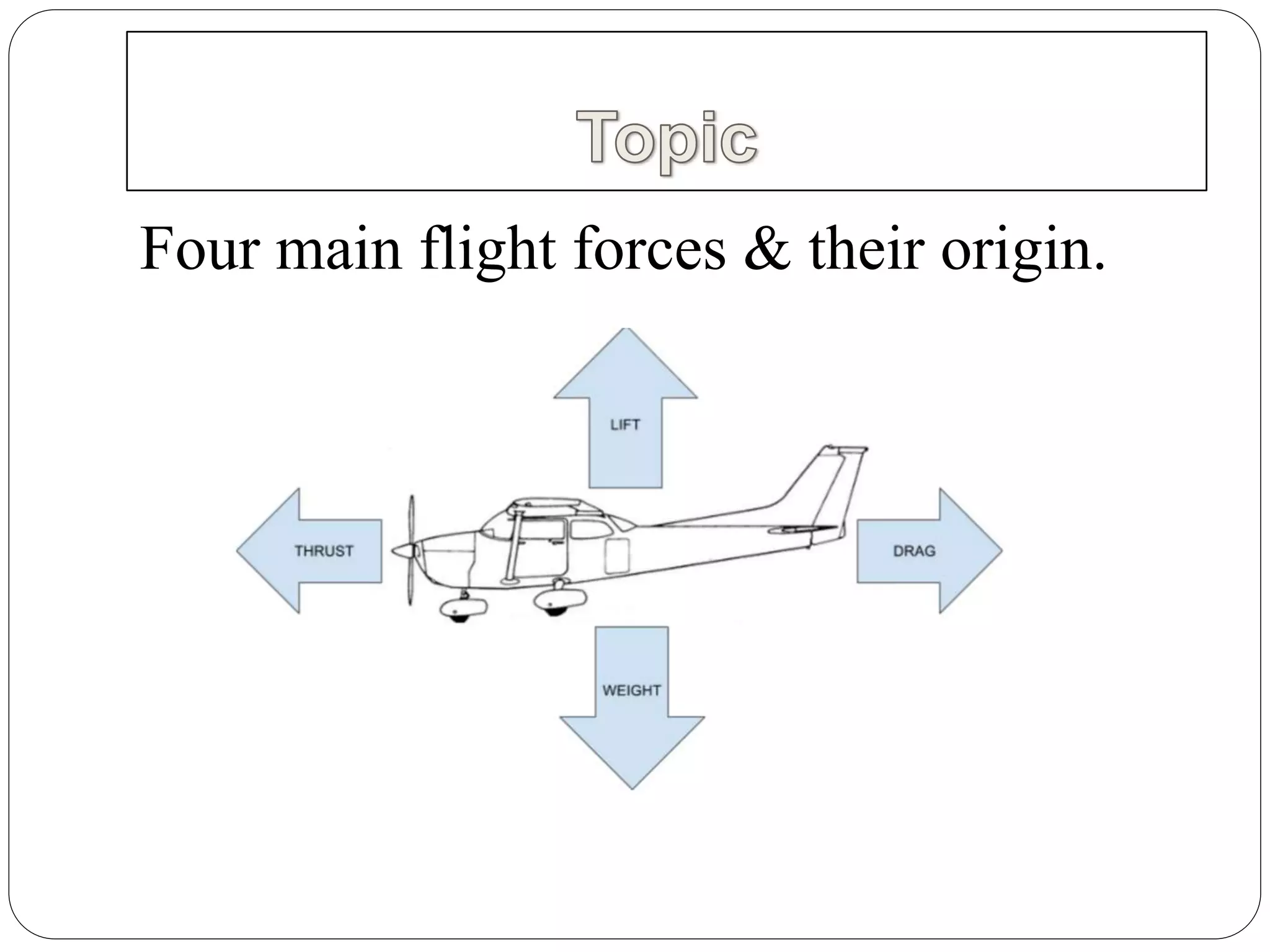
Four main flight forces & their origin.
Air flowing over an aero plane, must be diverted from its
original path, and such deflections lead to changes in the speed
of the air. Bernoulli’s equation shows that the pressure exerted
by the air on the aero plane is altered from that of the
undisturbed stream. Also the viscosity of the air leads to the
existence of frictional forces tending to resist its flow. As a result
of these processes, the aero plane experiences a resultant
aerodynamic force and moment. There are four main flight force
to maintain aero plane flying in original path. The four main
force are
1. Lift
2. Drag
3. Weight
4. Thrust
LIFT
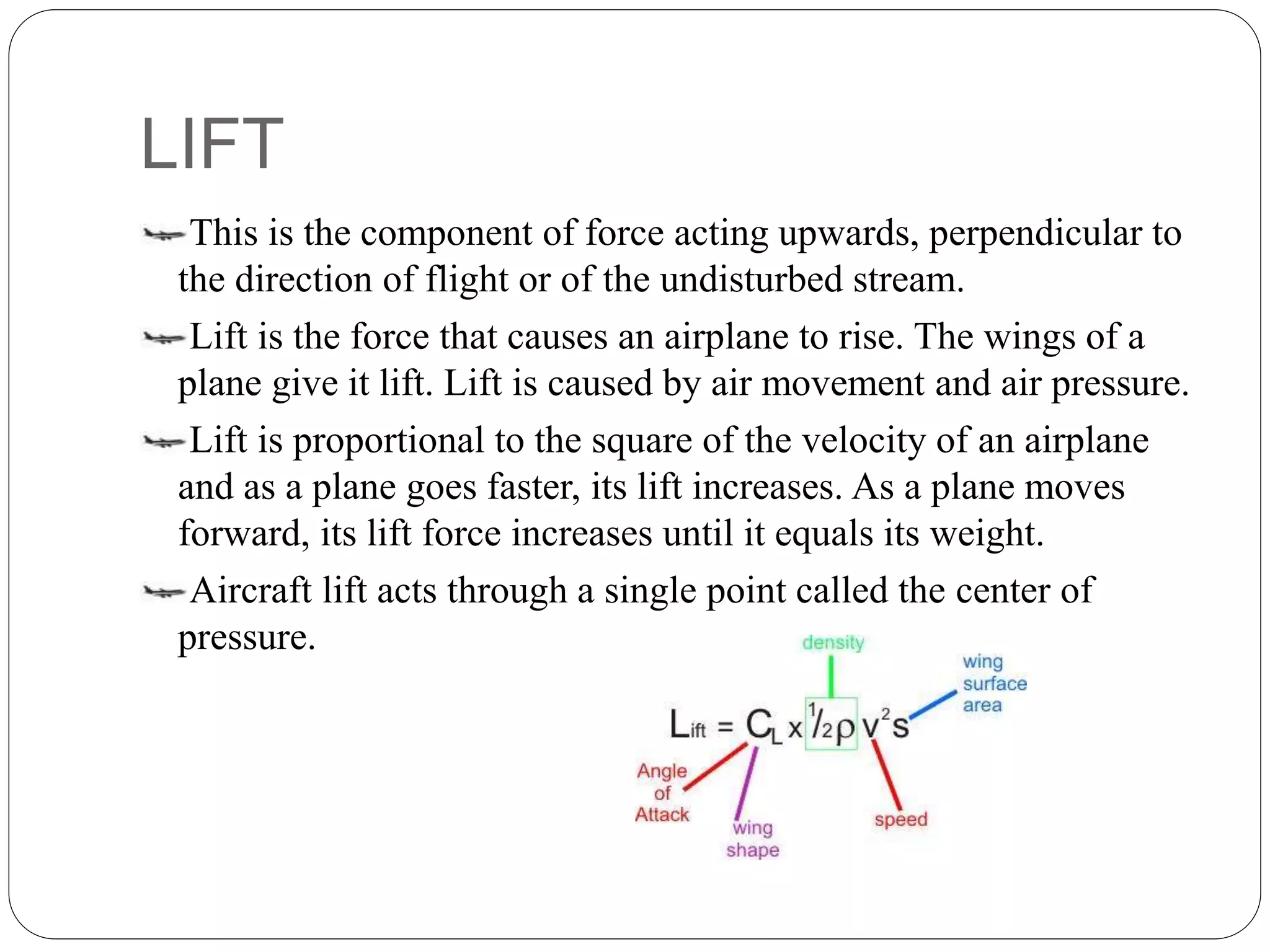
This is the component of force acting upwards, perpendicular to
the direction of flight or of the undisturbed stream.
Lift is the force that causes an airplane to rise. The wings of a
plane give it lift. Lift is caused by air movement and air pressure.
Lift is proportional to the square of the velocity of an airplane
and as a plane goes faster, its lift increases. As a plane moves
forward, its lift force increases until it equals its weight.
Aircraft lift acts through a single point called the center of
pressure.
CONTINUE
Center of Pressure: Center of Pressure is the point on the wing where
lift acts. Lift acts through the center of pressure (CP) of the object and
is directed perpendicular to the flow direction. The lift will act through
the centre of pressure, which will depend on the position of the wings;
so the designer must be careful to place the planes in the correct
position along the fuselage. The location of the center of pressure varies
with changes of lift coefficient and angle of attack.
Center of Gravity: Lift acts upward from wing, at a point called
the center of lift. By moving the CG (Center of Gravity) forward and
aft, can change the amount of tail down force and lift for stable flight.
The CG will be aft if the center of lift, within the aircraft's CG limits. [8]
Aerodynamic Center: The aerodynamic center is the point at which the
pitching moment coefficient for the airfoil does not vary with lift
coefficient (angle of attack).
WEIGHT
Weight is a force that is always directed toward the center of the
earth. The weight is distributed throughout the airplane. In flight,
the airplane rotates about the center of gravity
Weight and lift are equal when a plane flies level at constant
velocity. Because excess weight requires more lift, and therefore
more thrust. Planes with less weight require less thrust. Thus,
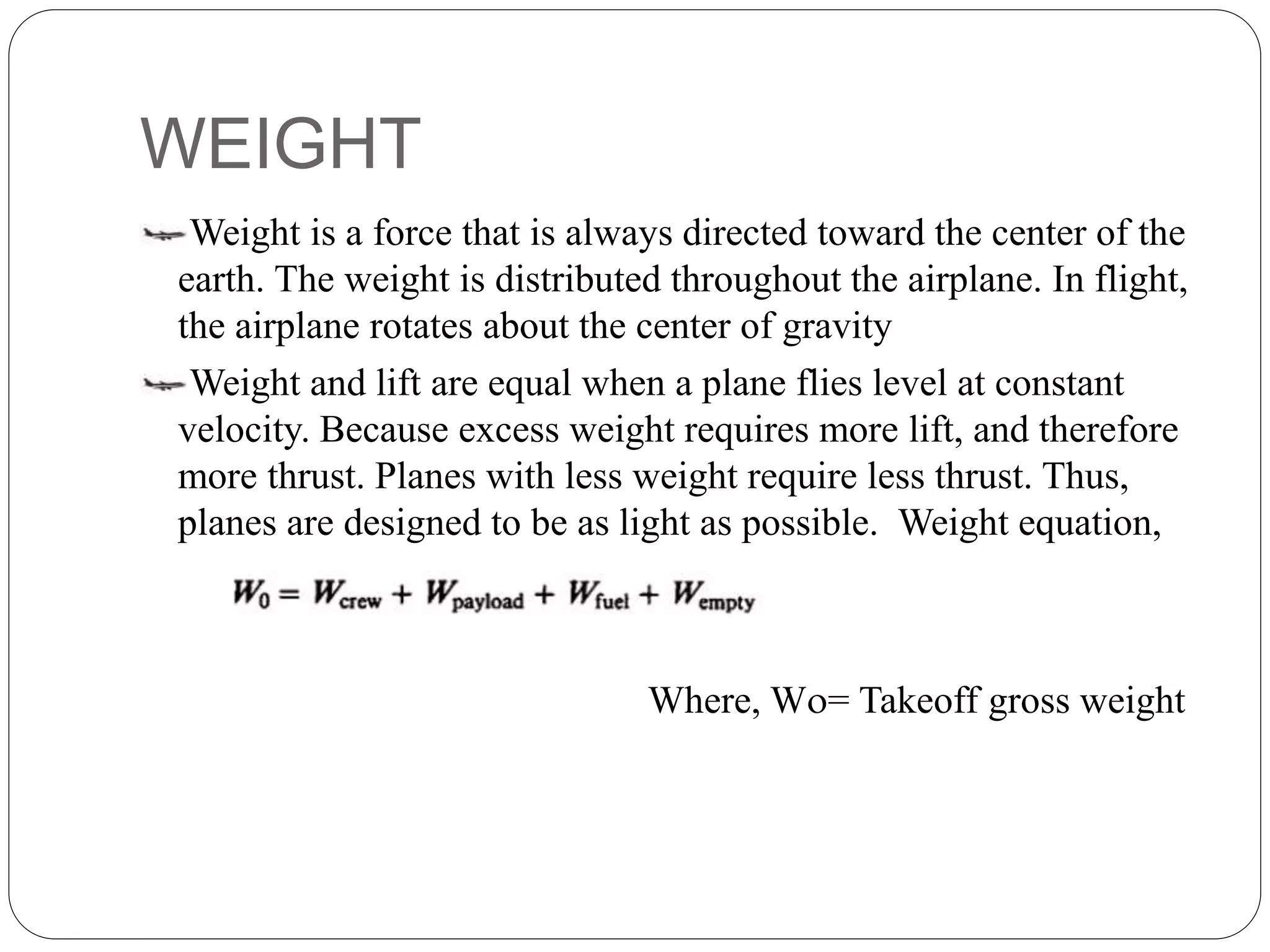
planes are designed to be as light as possible. Weight equation,
Where, W= Takeoff gross weight
CONTINUE
Center of gravity: This will act through the centre of gravity (CG)
which in turn will depend on the weight and position of every
individual part of the aero plane and the loads that it carries. But there
is a possibility of movement of the centre of gravity during flight
caused, for instance, by consumption of fuel, movement of passengers.
In flight, the airplane rotates about the center of gravity, but the
direction of the weight force always remains toward the center of the
earth.
Center of Pressure: There are no changes or effect of center of pressure
for aircraft weight force.
Aerodynamic center: Aerodynamic center is the point in the wing
where the pitching moments are constant.
DRAG
The air resists the motion of the aircraft and the resistance force is
called drag. Drag is directed along and opposed to the flight direction.
There are many factors that affect the magnitude of the drag force
including the shape of the aircraft, the "stickiness" of the air, and the
velocity of the aircraft. Collect all of the individual components' drags
and combine them into a single aircraft drag magnitude. Drag acts
through the aircraft center of pressure.
CONTINUE
Center of gravity: Putting the CG in the middle of the range
makes the aircraft stable. Putting it farther aft increases
performance by reducing drag. If CG is forward, there more tail
down force, and more lift. It generates extra lift by increasing
angle of attack, which in turn increases induced drag. An aircraft
will be stable when the Center-of-Gravity (CG) is forward of the
Center-of-Pressure (CP).
Center of Pressure: Drag is caused by friction and differences in
air pressure. Center of pressure is the point on the airfoil or wing
where the drag acts. Drag force act through the center of pressure
(CP) of the aircraft.
Aerodynamic Center: The aerodynamic center is the point at
which the pitching moment coefficient for the airfoil does not
vary with drag coefficient (angle of attack).
THRUST
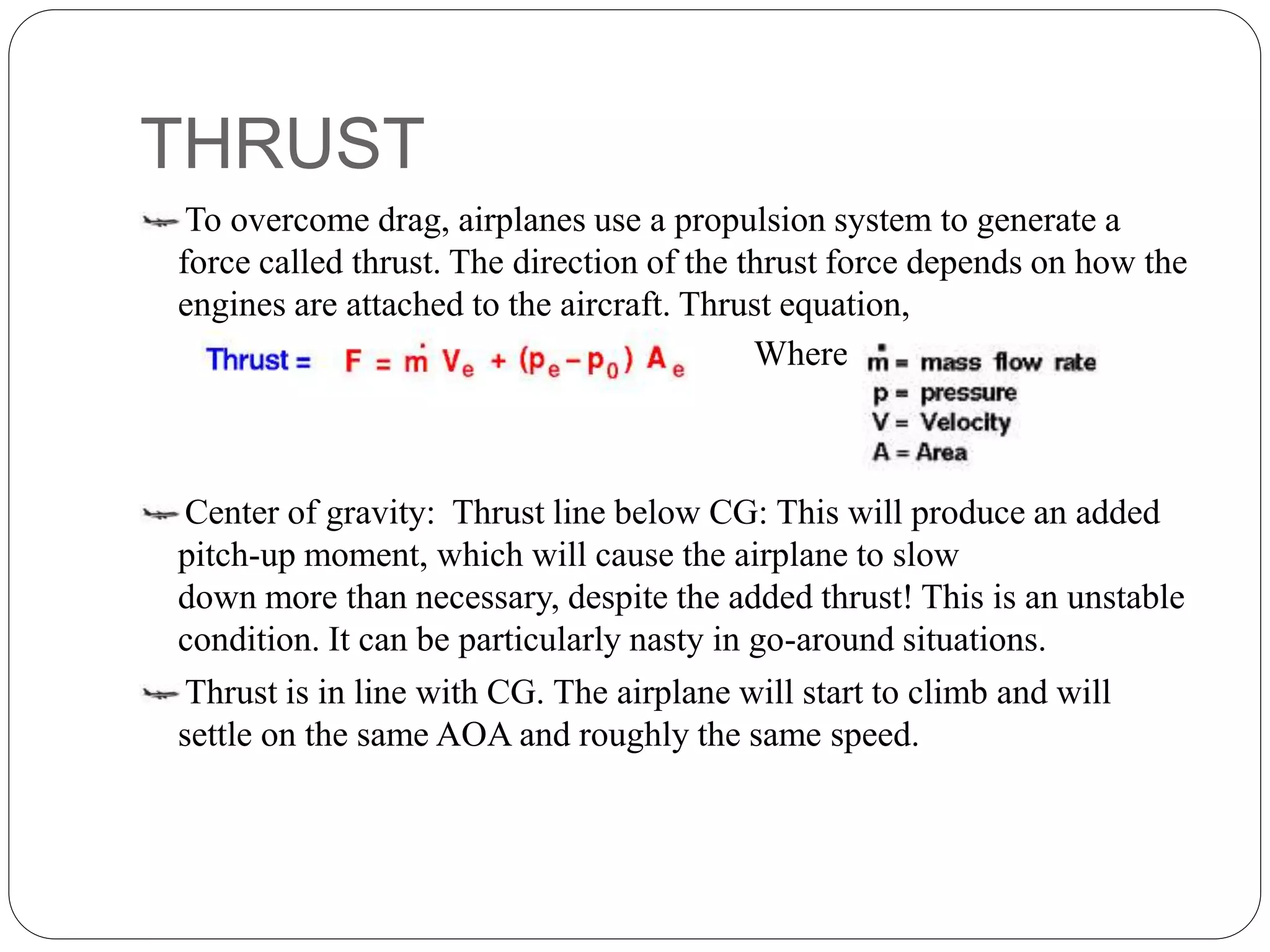
To overcome drag, airplanes use a propulsion system to generate a
force called thrust. The direction of the thrust force depends on how the
engines are attached to the aircraft. Thrust equation,
Where,
Center of gravity: Thrust line below CG: This will produce an added
pitch-up moment, which will cause the airplane to slow
down more than necessary, despite the added thrust! This is an unstable
condition. It can be particularly nasty in go-around situations.
Thrust is in line with CG. The airplane will start to climb and will
settle on the same AOA and roughly the same speed.
CONTINUE
Thrust line above CG: This is the opposite of the above and, in
moderate amounts, can have stabilizing effect and easier trim changes.
The airplane will settle at a higher speed. When the line is too high, the
airplane may even descend and accelerate more than necessary, until
the aerodynamic moment balances out the thrust moment, but overall
the condition is stable.
Center of pressure: if Cp and Cg coincides, that means net pitching
moment produced about the centre of gravity due to aerodynamic force
is zero.
Aerodynamic center: Aerodynamic center is the point in the wing
where the pitching moments are constant.
Aerodynamics flight force

Aerodynamics flight force

  • 1.
    M3: Give aPowerPoint presentation on four main flight forces & their origin. Presentation will be delivered individually.
  • 2.
    Prepared By Rahiduzzaman BTEC Level-5,HND-10 ID No- UCA-18072 Welcome
  • 3.
    Four main flightforces & their origin.
  • 4.
    Air flowing overan aero plane, must be diverted from its original path, and such deflections lead to changes in the speed of the air. Bernoulli’s equation shows that the pressure exerted by the air on the aero plane is altered from that of the undisturbed stream. Also the viscosity of the air leads to the existence of frictional forces tending to resist its flow. As a result of these processes, the aero plane experiences a resultant aerodynamic force and moment. There are four main flight force to maintain aero plane flying in original path. The four main force are 1. Lift 2. Drag 3. Weight 4. Thrust
  • 5.
    LIFT This is thecomponent of force acting upwards, perpendicular to the direction of flight or of the undisturbed stream. Lift is the force that causes an airplane to rise. The wings of a plane give it lift. Lift is caused by air movement and air pressure. Lift is proportional to the square of the velocity of an airplane and as a plane goes faster, its lift increases. As a plane moves forward, its lift force increases until it equals its weight. Aircraft lift acts through a single point called the center of pressure.
  • 6.
    CONTINUE Center of Pressure:Center of Pressure is the point on the wing where lift acts. Lift acts through the center of pressure (CP) of the object and is directed perpendicular to the flow direction. The lift will act through the centre of pressure, which will depend on the position of the wings; so the designer must be careful to place the planes in the correct position along the fuselage. The location of the center of pressure varies with changes of lift coefficient and angle of attack. Center of Gravity: Lift acts upward from wing, at a point called the center of lift. By moving the CG (Center of Gravity) forward and aft, can change the amount of tail down force and lift for stable flight. The CG will be aft if the center of lift, within the aircraft's CG limits. [8] Aerodynamic Center: The aerodynamic center is the point at which the pitching moment coefficient for the airfoil does not vary with lift coefficient (angle of attack).
  • 7.
    WEIGHT Weight is aforce that is always directed toward the center of the earth. The weight is distributed throughout the airplane. In flight, the airplane rotates about the center of gravity Weight and lift are equal when a plane flies level at constant velocity. Because excess weight requires more lift, and therefore more thrust. Planes with less weight require less thrust. Thus, planes are designed to be as light as possible. Weight equation, Where, W= Takeoff gross weight
  • 8.
    CONTINUE Center of gravity:This will act through the centre of gravity (CG) which in turn will depend on the weight and position of every individual part of the aero plane and the loads that it carries. But there is a possibility of movement of the centre of gravity during flight caused, for instance, by consumption of fuel, movement of passengers. In flight, the airplane rotates about the center of gravity, but the direction of the weight force always remains toward the center of the earth. Center of Pressure: There are no changes or effect of center of pressure for aircraft weight force. Aerodynamic center: Aerodynamic center is the point in the wing where the pitching moments are constant.
  • 9.
    DRAG The air resiststhe motion of the aircraft and the resistance force is called drag. Drag is directed along and opposed to the flight direction. There are many factors that affect the magnitude of the drag force including the shape of the aircraft, the "stickiness" of the air, and the velocity of the aircraft. Collect all of the individual components' drags and combine them into a single aircraft drag magnitude. Drag acts through the aircraft center of pressure.
  • 10.
    CONTINUE Center of gravity:Putting the CG in the middle of the range makes the aircraft stable. Putting it farther aft increases performance by reducing drag. If CG is forward, there more tail down force, and more lift. It generates extra lift by increasing angle of attack, which in turn increases induced drag. An aircraft will be stable when the Center-of-Gravity (CG) is forward of the Center-of-Pressure (CP). Center of Pressure: Drag is caused by friction and differences in air pressure. Center of pressure is the point on the airfoil or wing where the drag acts. Drag force act through the center of pressure (CP) of the aircraft. Aerodynamic Center: The aerodynamic center is the point at which the pitching moment coefficient for the airfoil does not vary with drag coefficient (angle of attack).
  • 11.
    THRUST To overcome drag,airplanes use a propulsion system to generate a force called thrust. The direction of the thrust force depends on how the engines are attached to the aircraft. Thrust equation, Where, Center of gravity: Thrust line below CG: This will produce an added pitch-up moment, which will cause the airplane to slow down more than necessary, despite the added thrust! This is an unstable condition. It can be particularly nasty in go-around situations. Thrust is in line with CG. The airplane will start to climb and will settle on the same AOA and roughly the same speed.
  • 12.
    CONTINUE Thrust line aboveCG: This is the opposite of the above and, in moderate amounts, can have stabilizing effect and easier trim changes. The airplane will settle at a higher speed. When the line is too high, the airplane may even descend and accelerate more than necessary, until the aerodynamic moment balances out the thrust moment, but overall the condition is stable. Center of pressure: if Cp and Cg coincides, that means net pitching moment produced about the centre of gravity due to aerodynamic force is zero. Aerodynamic center: Aerodynamic center is the point in the wing where the pitching moments are constant.