Space and Time 
The Blue Planet: Chapter 4
Outline 
• The Sun 
• The Solar System 
• Other Suns and Planetary Systems 
• Time and Change
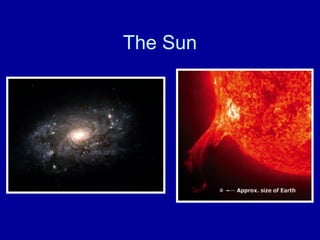
The Sun 
• Each visible point of light in the night 
sky, except nearby planets, is actually a 
sun or collection of suns 
• Or rather, our Sun is an ordinary star 
• The is dominated by hydrogen and 
helium at 98% of its mass 
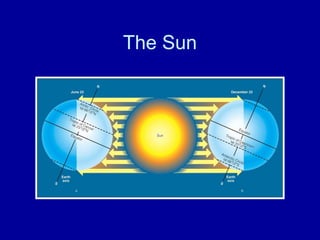
• Of course, the Sun provides the light 
and energy for life to exist on Earth
The Sun
The Sun
Outline 
• The Sun 
• The Solar System 
• Other Suns and Planetary Systems 
• Time and Change
The Solar System 
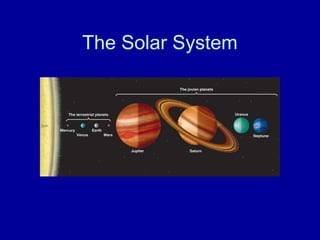
• Beyond the Sun, there are 8 planets in the solar 
system, at least 5 dwarf planets and vast 
numbers of asteroids, comets, meteoroids, and 
moons 
• The innermost planets are small, rocky, metallic, 
and dense: terrestrial planets 
– Mercury, Venus, Earth and Mars 
• The outer planets are much larger, less dense 
and gaseous: Jovian planets (gas giants) 
– Jupiter, Saturn, Uranus and Neptune
The Solar System 
• The early model of our solar system was 
geocentric, meaning that people thought all 
objects revolved around the Earth 
• Today we know it is heliocentric, meaning that all 
objects revolve around the Sun 
• Any hypothesis for the origin of the solar system 
must account for as many of its features as 
possible: 
– All solar system objects revolve in the same direction, 
around the sun, moons around their respective 
planets, and all on the same plane, consistently
The Solar System
The Solar System 
• The origin of the Sun was probably 
similar to the origins of billions of other 
stars in the universe, so the prevailing 
model for the origin of the solar system 
is the nebular hypothesis 
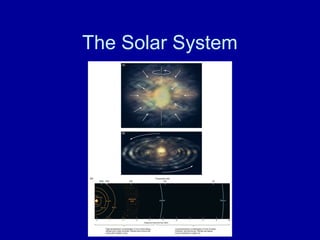
• This proposes that a huge swirling 
cloud of cosmic gas and dust (a nebula) 
formed the sun and planets
The Solar System
The Solar System 
• Gravity pulled the slowly swirling cloud 
of dust and gas inward, as this 
happened the gar became hotter and 
denser 
• Eventually temperature and pressure 
was high enough that nuclear fusion 
started and a star was born: the Sun 
• Surrounding the new Sun was a 
flattened, rotating disc of gas and dust
The Solar System 
• By the time the Sun started burning, the cooler 
outer portions of the solar nebula had become 
so compressed that solid particles and liquid 
droplets began to condense from the gas 
• These condensates, through accretion, 
became the building blocks of the planets, 
moons, and other objects in the solar system 
• Distance from the Sun and condensation 
temperatures explain the distinct materials of 
the terrestrial and Jovian planets
The Solar System 
• Space missions continue to provide 
evidence indicating that all objects in 
the solar system formed at the same 
time from a single solar nebula 
• Beyond the end of the nebular 
hypothesis story, five key factors played 
determining roles in the subsequent 
evolution of the terrestrial planets
The Solar System 
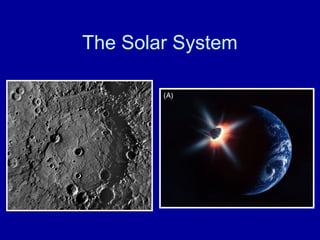
• Melting, impacts, and differentiation 
– Colliding bodies convert kinetic energy into 
heat energy 
– As planetary accretion climaxed about 4.56 
billion years ago, bigger collisions mean 
more kinetic energy and more heat 
– Terrestrial planets began to melt, at least 
partially, and dense metallic liquids sank 
while lighter materials floated 
– Planetary differentiation by chemical 
segregation
The Solar System
The Solar System 
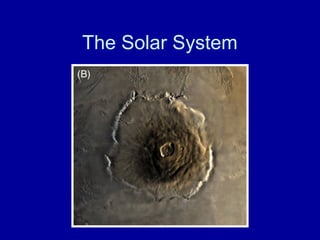
• Volcanism 
– After partial melting, the interior of the 
planets still remained hot because of 
radioactive elements 
– All planets are slowly cooling, larger 
planets slower than smaller planets 
– Volcanism is an indicator of high internal 
temperature
The Solar System
The Solar System 
• Planetary mass 
– Determines the orbit of a planet, and how 
many moons it captures 
– Determines whether the planet has 
sufficient gravitational pull to hold onto its 
atmosphere
The Solar System
The Solar System 
• Distance from the Sun 
– Determines if water can exist as a liquid 
• Biosphere 
– Presence or absence of a biosphere plays 
an essential role in the development of the 
biogeochemical cycles that control the 
composition of Earth’s atmosphere
The Solar System
The Solar System 
• We do not know if any other terrestrial 
planets have molten or partially molten 
cores, which has provided Earth with a 
strong magnetic field 
• All terrestrial planets have experienced 
volcanic activity, indicating an internal 
heat source, and have been through 
intense collisions 
• Apparently unique to Earth is tectonic 
activity
The Solar System 
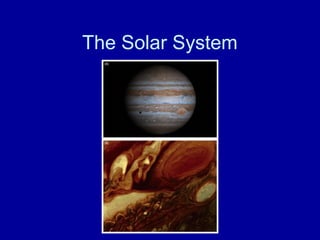
• The outer planets are shrouded by thick 
atmospheres that have not escaped the 
planets’ enormous gravitational pull 
• Their bulk compositions are therefore 
about the same as the nebula from which 
they formed: Jupiter’s composition is 
remarkably similar to that of the Sun 
• Huge storm systems are common in the 
gas giants’ atmospheres, and all probably 
have rocky cores
The Solar System
The Solar System 
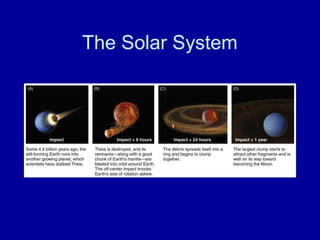
• Moons 
– The 19 largest moons are roughly spherical 
in shape, the smaller ones can be extremely 
irregular 
– Some formed by coalescence from the same 
mass as the solar nebula, others by 
gravitational capture, and others by collision 
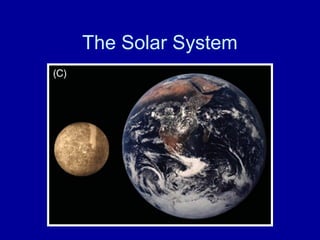
– Earth’s moon is 1/4 the size of Earth, making 
it the largest natural satellite in comparison 
with its parent planet, it likely formed from a 
catastrophic collision
The Solar System
The Solar System 
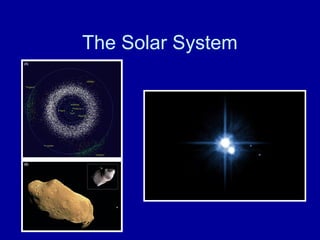
• Asteroids and Meteorites 
– Subplanetary objects orbiting the sun 
– Commonly rocky and/or metallic 
• Pluto and the Dwarf Planets 
– Minor planets or small bodies that are 
orbiting the sun, massive enough to be 
spherical, but not massive enough to have 
cleared its orbital path 
– In addition to Pluto, are Eris, Haumea, 
Makemake, and Ceres
The Solar System
The Solar System 
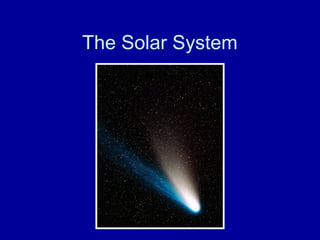
• Comets, the Kuiper Belt, and the Oort Cloud 
– The dwarf planets belong to a group that 
includes thousands of other objects outside of 
Neptune’s orbit called the Kuiper Belt 
– Similar to the Asteroid belt in appearance, but 
consists mainly of icey rather than rocky bodies, 
akin to comets 
– The Oort Cloud is further out still, and also 
appears to be a store of cometary material
The Solar System
Outline 
• The Sun 
• The Solar System 
• Other Suns and Planetary Systems 
• Time and Change
Other Suns and Planetary Systems 
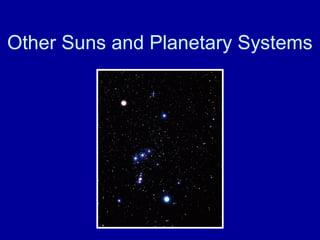
• Stars are classified by color and 
brightness 
– Color is an indication of temperature, blue 
light comes from short wavelengths and is 
hot, while red light comes from long 
wavelengths and is cool 
– Each color designates the star’s spectral 
class, from 9 (hottest) to 0 (coolest)
Other Suns and Planetary Systems
Other Suns and Planetary Systems 
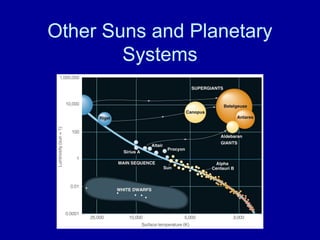
• A star’s brightness is a function of both the 
star’s luminosity (energy emitted) and its 
distance from the Earth 
– This requires a normalization of star 
distances, which is difficult to measure, but 
can be done to 300 light-years 
• Once temperature and luminosity are 
known, they can be compared with values 
on the Hertzsprung-Russell diagram 
– White dwarfs, main sequence and red giants
Other Suns and Planetary 
Systems
Other Suns and Planetary Systems 
• The H-R diagram can be used to 
explain the evolution of a star 
– The smaller the star, the longer it can live 
• For the lifetime of most stars, a balance 
is reached between gravitational and 
radiation forces, where it maintains the 
stable luminosity and temperature of a 
main sequence star
Other Suns and Planetary Systems 
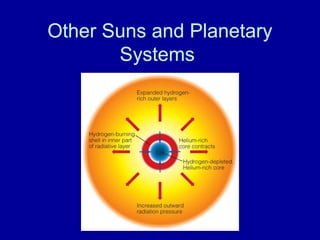
• A star the size of our Sun will fuel 
nuclear fusion for about 10 billion years 
• When the hydrogen fuel is used up, 
nuclear fusion ceases, gravity takes 
control, and the helium-rich core 
contracts 
• As the core collapses, it heats up, and a 
shell of hydrogen in the inner radiative 
layer begins shell fusion, the star 
expands, and becomes a red giant
Other Suns and Planetary 
Systems
Other Suns and Planetary Systems 
• The core continues to contract, 
eventually becoming hot enough for 
helium fusion to form carbon, the shell 
slowly diminishes in size becoming a 
white dwarf 
• Eventually it loses its luminosity and 
becomes a dead star known as a black 
dwarf
Other Suns and Planetary Systems 
• Astronomers believe that 5-10% of the 
200-400 billion stars in the Milky Way 
have characteristics similar to those of 
our Sun, and it is likely that they have 
planetary systems like our own 
• These planets are called exoplanets, 
and as of June 2009, 353 exoplanets 
had been found
Outline 
• The Sun 
• The Solar System 
• Other Suns and Planetary Systems 
• Time and Change
Time and Change 
• Scientists estimate the age of the 
universe by looking at the rate at which 
objects are moving apart from each 
other 
• The hypothesis is that everything 
originated at one location in an explosion 
called the Big Bang 
• The universe is 2 to 3 times as old as 
the Sun and the solar system
Time and Change 
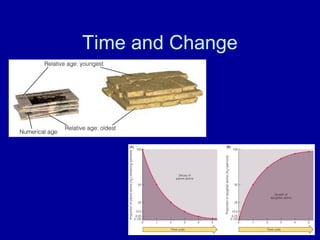
• To deal with the ages of materials within 
the Earth system and elsewhere in the 
universe, scientists use two concepts of 
time and age 
– Relative age: refers to the order in which a 
sequence of past events occurred 
– Numerical age: is the actual time, in years, 
when a specific event happened, 
calculated using radioactive decay
Time and Change
Time and Change 
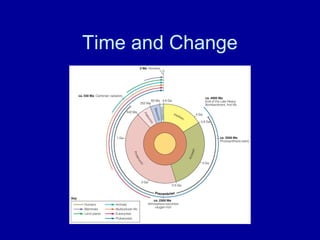
• Using these tools and worldwide 
comparison and correlation of rock 
units, geologists have assembled a 
geologic column that summarizes in 
chronological order the succession of 
known rock units 
– Major divisions include the Hadean, 
Archean, Proterozoic, Paleozoic, Mesozoic 
and Cenozoic Eons
Time and Change
Time and Change 
• In the 17th and 18th centuries, people 
hypothesized that all of Earth’s features 
were formed by a few great catastrophic 
events - this idea is catastrophism 
• In the late 18th century, this idea was 
tested with geological evidence 
• James Hutton, with the use of the 
scientific method, proposed a counter 
theory called the principle of 
uniformitarianism
Time and Change 
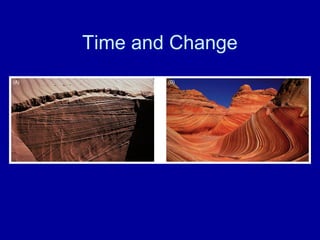
• Hutton observed the slow, steady effects of 
erosion 
• Determined that mountains must slowly 
weather away, that new rocks form from 
the debris of erosion, and be thrust back up 
into mountains 
• Couldn’t explain what caused this to 
happen, but reasoned that everything 
moves slowly in repetitive continuous 
cycles
Time and Change 
• The principle of uniformitarianism, which 
essentially states that ā€œthe present is the 
key to the past,ā€ indicates that the Earth 
is incredibly old 
• This concept is important to all branches 
of science, but we also know that some 
events are so large and damaging that 
they can cause catastrophic change
Time and Change

Space and time ch4

  • 1.
    Space and Time The Blue Planet: Chapter 4
  • 2.
    Outline • TheSun • The Solar System • Other Suns and Planetary Systems • Time and Change
  • 3.
    The Sun •Each visible point of light in the night sky, except nearby planets, is actually a sun or collection of suns • Or rather, our Sun is an ordinary star • The is dominated by hydrogen and helium at 98% of its mass • Of course, the Sun provides the light and energy for life to exist on Earth
  • 4.
  • 5.
  • 6.
    Outline • TheSun • The Solar System • Other Suns and Planetary Systems • Time and Change
  • 7.
    The Solar System • Beyond the Sun, there are 8 planets in the solar system, at least 5 dwarf planets and vast numbers of asteroids, comets, meteoroids, and moons • The innermost planets are small, rocky, metallic, and dense: terrestrial planets – Mercury, Venus, Earth and Mars • The outer planets are much larger, less dense and gaseous: Jovian planets (gas giants) – Jupiter, Saturn, Uranus and Neptune
  • 8.
    The Solar System • The early model of our solar system was geocentric, meaning that people thought all objects revolved around the Earth • Today we know it is heliocentric, meaning that all objects revolve around the Sun • Any hypothesis for the origin of the solar system must account for as many of its features as possible: – All solar system objects revolve in the same direction, around the sun, moons around their respective planets, and all on the same plane, consistently
  • 9.
  • 10.
    The Solar System • The origin of the Sun was probably similar to the origins of billions of other stars in the universe, so the prevailing model for the origin of the solar system is the nebular hypothesis • This proposes that a huge swirling cloud of cosmic gas and dust (a nebula) formed the sun and planets
  • 11.
  • 12.
    The Solar System • Gravity pulled the slowly swirling cloud of dust and gas inward, as this happened the gar became hotter and denser • Eventually temperature and pressure was high enough that nuclear fusion started and a star was born: the Sun • Surrounding the new Sun was a flattened, rotating disc of gas and dust
  • 13.
    The Solar System • By the time the Sun started burning, the cooler outer portions of the solar nebula had become so compressed that solid particles and liquid droplets began to condense from the gas • These condensates, through accretion, became the building blocks of the planets, moons, and other objects in the solar system • Distance from the Sun and condensation temperatures explain the distinct materials of the terrestrial and Jovian planets
  • 14.
    The Solar System • Space missions continue to provide evidence indicating that all objects in the solar system formed at the same time from a single solar nebula • Beyond the end of the nebular hypothesis story, five key factors played determining roles in the subsequent evolution of the terrestrial planets
  • 15.
    The Solar System • Melting, impacts, and differentiation – Colliding bodies convert kinetic energy into heat energy – As planetary accretion climaxed about 4.56 billion years ago, bigger collisions mean more kinetic energy and more heat – Terrestrial planets began to melt, at least partially, and dense metallic liquids sank while lighter materials floated – Planetary differentiation by chemical segregation
  • 16.
  • 17.
    The Solar System • Volcanism – After partial melting, the interior of the planets still remained hot because of radioactive elements – All planets are slowly cooling, larger planets slower than smaller planets – Volcanism is an indicator of high internal temperature
  • 18.
  • 19.
    The Solar System • Planetary mass – Determines the orbit of a planet, and how many moons it captures – Determines whether the planet has sufficient gravitational pull to hold onto its atmosphere
  • 20.
  • 21.
    The Solar System • Distance from the Sun – Determines if water can exist as a liquid • Biosphere – Presence or absence of a biosphere plays an essential role in the development of the biogeochemical cycles that control the composition of Earth’s atmosphere
  • 22.
  • 23.
    The Solar System • We do not know if any other terrestrial planets have molten or partially molten cores, which has provided Earth with a strong magnetic field • All terrestrial planets have experienced volcanic activity, indicating an internal heat source, and have been through intense collisions • Apparently unique to Earth is tectonic activity
  • 24.
    The Solar System • The outer planets are shrouded by thick atmospheres that have not escaped the planets’ enormous gravitational pull • Their bulk compositions are therefore about the same as the nebula from which they formed: Jupiter’s composition is remarkably similar to that of the Sun • Huge storm systems are common in the gas giants’ atmospheres, and all probably have rocky cores
  • 25.
  • 26.
    The Solar System • Moons – The 19 largest moons are roughly spherical in shape, the smaller ones can be extremely irregular – Some formed by coalescence from the same mass as the solar nebula, others by gravitational capture, and others by collision – Earth’s moon is 1/4 the size of Earth, making it the largest natural satellite in comparison with its parent planet, it likely formed from a catastrophic collision
  • 27.
  • 28.
    The Solar System • Asteroids and Meteorites – Subplanetary objects orbiting the sun – Commonly rocky and/or metallic • Pluto and the Dwarf Planets – Minor planets or small bodies that are orbiting the sun, massive enough to be spherical, but not massive enough to have cleared its orbital path – In addition to Pluto, are Eris, Haumea, Makemake, and Ceres
  • 29.
  • 30.
    The Solar System • Comets, the Kuiper Belt, and the Oort Cloud – The dwarf planets belong to a group that includes thousands of other objects outside of Neptune’s orbit called the Kuiper Belt – Similar to the Asteroid belt in appearance, but consists mainly of icey rather than rocky bodies, akin to comets – The Oort Cloud is further out still, and also appears to be a store of cometary material
  • 31.
  • 32.
    Outline • TheSun • The Solar System • Other Suns and Planetary Systems • Time and Change
  • 33.
    Other Suns andPlanetary Systems • Stars are classified by color and brightness – Color is an indication of temperature, blue light comes from short wavelengths and is hot, while red light comes from long wavelengths and is cool – Each color designates the star’s spectral class, from 9 (hottest) to 0 (coolest)
  • 34.
    Other Suns andPlanetary Systems
  • 35.
    Other Suns andPlanetary Systems • A star’s brightness is a function of both the star’s luminosity (energy emitted) and its distance from the Earth – This requires a normalization of star distances, which is difficult to measure, but can be done to 300 light-years • Once temperature and luminosity are known, they can be compared with values on the Hertzsprung-Russell diagram – White dwarfs, main sequence and red giants
  • 36.
    Other Suns andPlanetary Systems
  • 37.
    Other Suns andPlanetary Systems • The H-R diagram can be used to explain the evolution of a star – The smaller the star, the longer it can live • For the lifetime of most stars, a balance is reached between gravitational and radiation forces, where it maintains the stable luminosity and temperature of a main sequence star
  • 38.
    Other Suns andPlanetary Systems • A star the size of our Sun will fuel nuclear fusion for about 10 billion years • When the hydrogen fuel is used up, nuclear fusion ceases, gravity takes control, and the helium-rich core contracts • As the core collapses, it heats up, and a shell of hydrogen in the inner radiative layer begins shell fusion, the star expands, and becomes a red giant
  • 39.
    Other Suns andPlanetary Systems
  • 40.
    Other Suns andPlanetary Systems • The core continues to contract, eventually becoming hot enough for helium fusion to form carbon, the shell slowly diminishes in size becoming a white dwarf • Eventually it loses its luminosity and becomes a dead star known as a black dwarf
  • 41.
    Other Suns andPlanetary Systems • Astronomers believe that 5-10% of the 200-400 billion stars in the Milky Way have characteristics similar to those of our Sun, and it is likely that they have planetary systems like our own • These planets are called exoplanets, and as of June 2009, 353 exoplanets had been found
  • 42.
    Outline • TheSun • The Solar System • Other Suns and Planetary Systems • Time and Change
  • 43.
    Time and Change • Scientists estimate the age of the universe by looking at the rate at which objects are moving apart from each other • The hypothesis is that everything originated at one location in an explosion called the Big Bang • The universe is 2 to 3 times as old as the Sun and the solar system
  • 44.
    Time and Change • To deal with the ages of materials within the Earth system and elsewhere in the universe, scientists use two concepts of time and age – Relative age: refers to the order in which a sequence of past events occurred – Numerical age: is the actual time, in years, when a specific event happened, calculated using radioactive decay
  • 45.
  • 46.
    Time and Change • Using these tools and worldwide comparison and correlation of rock units, geologists have assembled a geologic column that summarizes in chronological order the succession of known rock units – Major divisions include the Hadean, Archean, Proterozoic, Paleozoic, Mesozoic and Cenozoic Eons
  • 47.
  • 48.
    Time and Change • In the 17th and 18th centuries, people hypothesized that all of Earth’s features were formed by a few great catastrophic events - this idea is catastrophism • In the late 18th century, this idea was tested with geological evidence • James Hutton, with the use of the scientific method, proposed a counter theory called the principle of uniformitarianism
  • 49.
    Time and Change • Hutton observed the slow, steady effects of erosion • Determined that mountains must slowly weather away, that new rocks form from the debris of erosion, and be thrust back up into mountains • Couldn’t explain what caused this to happen, but reasoned that everything moves slowly in repetitive continuous cycles
  • 50.
    Time and Change • The principle of uniformitarianism, which essentially states that ā€œthe present is the key to the past,ā€ indicates that the Earth is incredibly old • This concept is important to all branches of science, but we also know that some events are so large and damaging that they can cause catastrophic change
  • 51.