Subject:- Earthquake Engineering
             Name:- Patel Kartik J.
              Cl0935
EQ TIPS 2

HOW THE GROUND
SHAKES????
SEISMIC WAVES

•Large strain energy released during an
earthquake travels as seismic waves in all
directions through the Earth’s layers,
reflecting and refracting at each
interface.
•These waves are of two types - body waves
and surface waves; the latter are restricted
to near the Earth’s surface (Figure 1).
•Body waves consist of Primary Waves
(P-waves) and Secondary Waves
(Swaves), and surface waves consist of
Love waves and Rayleigh waves.
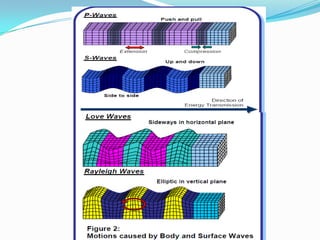
•Under P-waves, material particles
undergo extensional and compressional
strains along direction of energy
transmission, but under S-waves,
oscillate at right angles to it (Figure 2).
•Love waves cause surface motions similar to that by
S- waves, but with no vertical component.
Rayleigh wave makes a material particle oscillate in
an elliptic path in the vertical plane (with horizontal
motion along direction of energy transmission).
 •P-waves are fastest, followed in sequence by S-,Love
 and Rayleigh waves. For example, in granites, P and
 S-waves have speeds ~4.8 km/sec and
 ~3.0km/sec, respectively.
 •S-waves do not travel through liquids.
 •S-waves in association with effects of Love waves
 cause maximum damage to structures by their
 racking motion on the surface in both vertical and
 horizontal directions.
• When P- and S-waves reach the Earth's
surface,most of their energy is reflected back.
• Some of this energy is returned back to the surface
by reflections at different layers of soil and rock.
• Shaking is more severe (about twice as much) at
the Earth's surface than at substantial depths.
• This is often the basis for designing structures
buried
underground for smaller levels of acceleration than
those above the ground.
Measuring Instruments
•The instrument that measures earthquake shaking, a
seismograph, has three components – the sensor, the recorder and
the timer.
•The principle on which it works is simple and is explicitly reflected
in the early seismograph (Figure 3) – a pen attached at the tip of an
oscillating simple pendulum (a mass hung by a string from a
support) marks on a chart paper that is held on a drum rotating at
a constant speed.
• A magnet around the string provides required damping to
control the amplitude of oscillations.
• The pendulum mass, string, magnet and support together
constitute the sensor; the drum, pen and chart paper constitute
the recorder; and the motor that rotates the drum at constant
speed forms the timer.
•One such instrument is required in each of the two
  orthogonal horizontal directions.
 • Of course, for measuring vertical oscillations, the string
 pendulum (Figure 3) is replaced with a spring pendulum
 oscillating about a fulcrum.
 • Some instruments do not have a timer device (i.e., the
 drum holding the chart paper does not rotate).
 • Such instruments provide only the maximum extent (or
 scope) of motion during the earthquake; for this reason
 they are called seismoscopes.
• The analog instruments have evolved over time, but
today, digital instruments using modern computer
technology are more commonly used.
• The digital instrument records the ground motion on the
memory of the microprocessor that is in-built in the
instrument.
Strong Ground Motions
•Shaking of ground on the Earth’s surface is a net
consequence of motions caused by seismic waves
generated by energy release at each material point
within the three-dimensional volume that
ruptures at the fault.
•Large earthquakes at great distances can produce
weak motions that may not damage structures or
even be felt by humans.
•But, sensitive instruments can record these.
• This makes it possible to locate distant
earthquakes
Characteristics of Strong Ground
Motions
•The motion of the ground can be described in terms of
displacement, velocity or acceleration.
•Thevariation of ground acceleration with time recorded
at a point on ground during an earthquake is called an
accelerogram.
• The nature of accelerograms may vary(Figure 4)
depending on energy released at source, type of slip at
fault rupture, geology along the travel path from fault
rupture to the Earth’s surface, and local soil (Figure 1).
• They carry distinct information regarding ground
shaking; peak amplitude, duration of strong shaking,
frequency content (e.g., amplitude of shaking associated
with each frequency) and energy content (i.e., energy
carried by ground shaking at each frequency) are often
used to distinguish them.
•Generally, the maximum amplitudes of horizontal
motions in the two orthogonal directions are about the
same.
• However, the maximum amplitude in the vertical
direction is usually less than that in the horizontal
direction.
• In design codes, the vertical design acceleration is taken
as 1/2 to 2/3 of the horizontal design acceleration.

Earthquake tips 2

  • 1.
    Subject:- Earthquake Engineering Name:- Patel Kartik J. Cl0935
  • 2.
    EQ TIPS 2 HOWTHE GROUND SHAKES????
  • 3.
    SEISMIC WAVES •Large strainenergy released during an earthquake travels as seismic waves in all directions through the Earth’s layers, reflecting and refracting at each interface. •These waves are of two types - body waves and surface waves; the latter are restricted to near the Earth’s surface (Figure 1).
  • 5.
    •Body waves consistof Primary Waves (P-waves) and Secondary Waves (Swaves), and surface waves consist of Love waves and Rayleigh waves. •Under P-waves, material particles undergo extensional and compressional strains along direction of energy transmission, but under S-waves, oscillate at right angles to it (Figure 2).
  • 7.
    •Love waves causesurface motions similar to that by S- waves, but with no vertical component. Rayleigh wave makes a material particle oscillate in an elliptic path in the vertical plane (with horizontal motion along direction of energy transmission). •P-waves are fastest, followed in sequence by S-,Love and Rayleigh waves. For example, in granites, P and S-waves have speeds ~4.8 km/sec and ~3.0km/sec, respectively. •S-waves do not travel through liquids. •S-waves in association with effects of Love waves cause maximum damage to structures by their racking motion on the surface in both vertical and horizontal directions.
  • 8.
    • When P-and S-waves reach the Earth's surface,most of their energy is reflected back. • Some of this energy is returned back to the surface by reflections at different layers of soil and rock. • Shaking is more severe (about twice as much) at the Earth's surface than at substantial depths. • This is often the basis for designing structures buried underground for smaller levels of acceleration than those above the ground.
  • 9.
    Measuring Instruments •The instrumentthat measures earthquake shaking, a seismograph, has three components – the sensor, the recorder and the timer. •The principle on which it works is simple and is explicitly reflected in the early seismograph (Figure 3) – a pen attached at the tip of an oscillating simple pendulum (a mass hung by a string from a support) marks on a chart paper that is held on a drum rotating at a constant speed. • A magnet around the string provides required damping to control the amplitude of oscillations. • The pendulum mass, string, magnet and support together constitute the sensor; the drum, pen and chart paper constitute the recorder; and the motor that rotates the drum at constant speed forms the timer.
  • 11.
    •One such instrumentis required in each of the two orthogonal horizontal directions. • Of course, for measuring vertical oscillations, the string pendulum (Figure 3) is replaced with a spring pendulum oscillating about a fulcrum. • Some instruments do not have a timer device (i.e., the drum holding the chart paper does not rotate). • Such instruments provide only the maximum extent (or scope) of motion during the earthquake; for this reason they are called seismoscopes. • The analog instruments have evolved over time, but today, digital instruments using modern computer technology are more commonly used. • The digital instrument records the ground motion on the memory of the microprocessor that is in-built in the instrument.
  • 12.
    Strong Ground Motions •Shakingof ground on the Earth’s surface is a net consequence of motions caused by seismic waves generated by energy release at each material point within the three-dimensional volume that ruptures at the fault. •Large earthquakes at great distances can produce weak motions that may not damage structures or even be felt by humans. •But, sensitive instruments can record these. • This makes it possible to locate distant earthquakes
  • 13.
    Characteristics of StrongGround Motions •The motion of the ground can be described in terms of displacement, velocity or acceleration. •Thevariation of ground acceleration with time recorded at a point on ground during an earthquake is called an accelerogram. • The nature of accelerograms may vary(Figure 4) depending on energy released at source, type of slip at fault rupture, geology along the travel path from fault rupture to the Earth’s surface, and local soil (Figure 1). • They carry distinct information regarding ground shaking; peak amplitude, duration of strong shaking, frequency content (e.g., amplitude of shaking associated with each frequency) and energy content (i.e., energy carried by ground shaking at each frequency) are often used to distinguish them.
  • 14.
    •Generally, the maximumamplitudes of horizontal motions in the two orthogonal directions are about the same. • However, the maximum amplitude in the vertical direction is usually less than that in the horizontal direction. • In design codes, the vertical design acceleration is taken as 1/2 to 2/3 of the horizontal design acceleration.