Downloaded 32 times
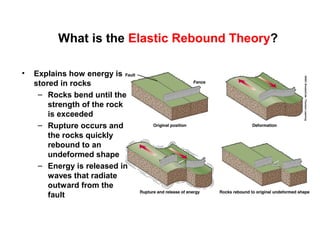
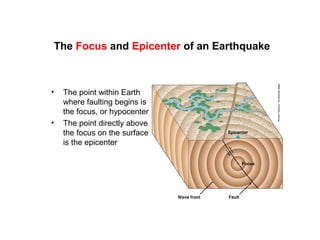
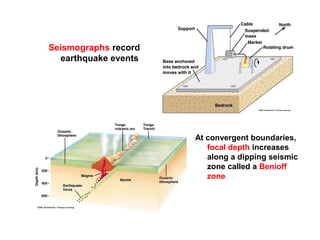
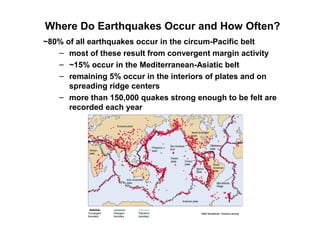
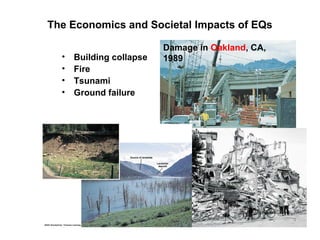
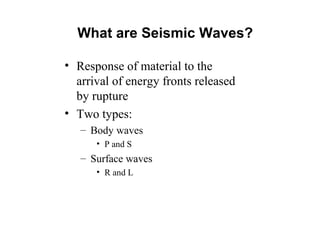
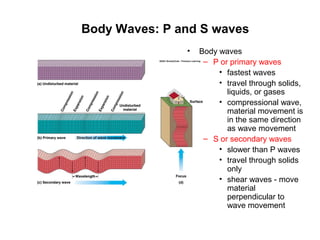
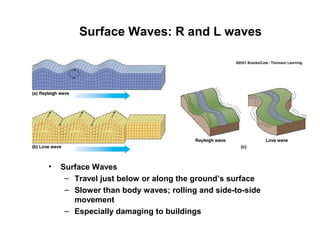

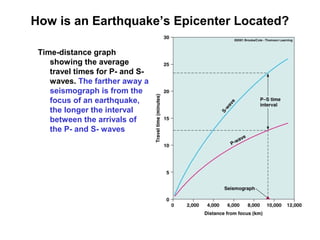


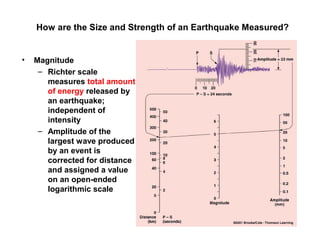


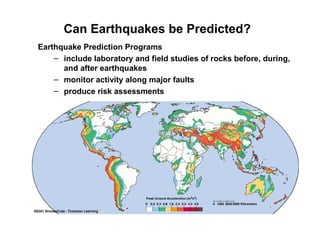

Earthquakes are caused by the sudden release of energy from faults or breaks in rocks. The elastic rebound theory explains how stress builds in rocks until the strength is exceeded, causing rupture and the release of seismic waves. The focus is where faulting begins underground, and the epicenter is the point directly above on the surface. Most earthquakes occur along plate boundaries and are recorded by seismographs. The size and strength are measured by both intensity scales and magnitude scales on the Richter scale. Earthquake effects include ground shaking and damage that increases in unconsolidated materials. Prediction efforts monitor faults and precursors, but earthquakes cannot be reliably predicted yet.


