RamiReddy subbaRami Reddy
engineeRing college
Kadanuthala
DEPARTMENT OF CIVIL ENGINEERING
PRESENTED BY
KALYAN KUMAR Y
133R1A0118
CONTENTS
 INTRODUCTION
 DEFINITION OF PRESTRESS
 PRINCIPLE OF PRE-STRESSING
 METHOD OF PRESTRESSING
 GIRDER DESIGN
 WORKING OF PRESTRESSED CONCRETE
 DIFFERENCE B/W ORDINARY AND PRESTRESSED CONCRETE
 TYPES OF PRESTRESSED CONCRETE
 TEST ON PRESTRESSED CONCRETE
 ADVANTAGES AND DISADVANTAGES OF PRESTRESSED CONCRETE
 APPLICATION
 CASE STUDY
 CONCLUSION
INTRODUCTION
 Prestressed concrete is a method for overcoming concrete's natural
weakness in tension.
 In 1904, Freyssinet attempted to introduce permanent acting forces .
To resist elastic forces under loads and was named “Pre Stressing”.
 It can be used to produce beams , floors , bridges with a longer span
than is practical with ordinary reinforced concrete.
DEFINITION OF PRESTRESS
• Prestress is defined as a method of applying pre-
compression to control the stresses resulting due to
external loads below the neutral axis of the beam
tension developed due to external load which is more
than the permissible limits of the plain concrete.
PRINCIPLE OF PRE-STRESSING
• Pre-stressing is a method in which compression force is
applied to the reinforced concrete section.
• Pre-stressing tendons (generally of high tensile steel cable or
rods) are used to provide a clamping load which produces a
compressive stress that balances the tensile stress that the
concrete compression member would otherwise experience
due to a bending load.
METHODs OF PRESTRESSING
This classification is based on the method by which the prestressing
force is generated.
 Hydraulic Prestressing
 Mechanical Prestressing
 Electrical Prestressing
 Chemical Prestressing
GIRDER DESIGN
• For transportation and handling purposes of the pier segments of both tx70 and
Texas u54 girder bridges.
• Diameter are provided in the bottom flange of the pier segments.
• Various corrosion protection systems are available for these 106 thread bars, none
of which bond with the structure.
• Once the pier segment is erected on site, it behaves as a cantilever.
• The preliminary designs for tx70 and Texas u54 girder bridges assumed shored
construction.
• From the preliminary designs, it was noted that the span lengths of 280 ft and 240 ft
for the continuous prestressed concrete bridges using the standard tx70 and texas
u54 girders, respectively are achieved using shoring towers (shored construction)
and by making the girder sections work up to their limits.
WORKING OF PRESTRESSED
CONCRETE Pre-stressed concrete refers to a procedure whereby
tensile rods are put in place first and tightened,
followed by concrete pouring.
 Compression can be applied after pouring concrete
using bonds. They are tightened once the concrete is
dry
 Main disadvantage is that a cable can burst out of the
slab, if the anchoring system fails.
DIFFERENCE B/W ORDINARY AND
PRESTRESSED CONCRETE
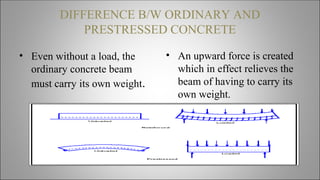
• Even without a load, the
ordinary concrete beam
must carry its own weight.
• An upward force is created
which in effect relieves the
beam of having to carry its
own weight.
TYPES OF PRESTRESSED
CONCRETE
• There are two types of prestressed concrete.
• They are
 Pre- tensioned concrete
 Post tensioned concrete
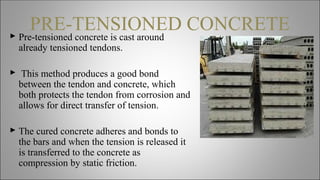
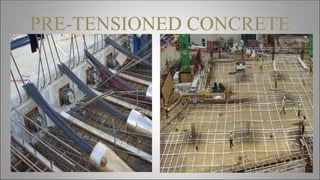
PRE-TENSIONED CONCRETE Pre-tensioned concrete is cast around
already tensioned tendons.
 This method produces a good bond
between the tendon and concrete, which
both protects the tendon from corrosion and
allows for direct transfer of tension.
 The cured concrete adheres and bonds to
the bars and when the tension is released it
is transferred to the concrete as
compression by static friction.
PRE-TENSIONED CONCRETE
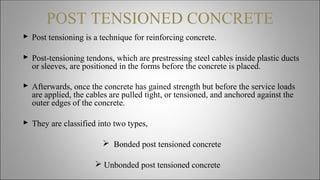
POST TENSIONED CONCRETE
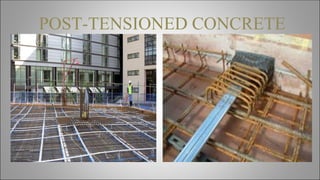
 Post tensioning is a technique for reinforcing concrete.
 Post-tensioning tendons, which are prestressing steel cables inside plastic ducts
or sleeves, are positioned in the forms before the concrete is placed.
 Afterwards, once the concrete has gained strength but before the service loads
are applied, the cables are pulled tight, or tensioned, and anchored against the
outer edges of the concrete.
 They are classified into two types,
 Bonded post tensioned concrete
 Unbonded post tensioned concrete
POST-TENSIONED CONCRETE
BONDED POST-TENSIONED
CONCRETE
• Bonded post-tensioned concrete is the descriptive term for a
method of applying compression after pouring concrete and
the curing process (in situ).
• The concrete is cast around a plastic, steel or aluminum
curved duct, to follow the area where otherwise tension would
occur in the concrete element.
UNBONDED POST-TENSIONED
CONCRETE
• Unbounded post-tensioned concrete differs from bonded post-
tensioning by providing each individual cable permanent
freedom of movement relative to the concrete.
• To achieve this, each individual tendon is coated with a grease
(generally lithium based) and covered by a plastic sheathing
formed in an extrusion process.
TEST ON PRESTRESSED
CONCRETE
POST- TENSIONED SPLICE
CAST-IN-PLACE SPLICE
FLEXURAL TEST
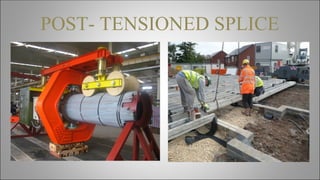
POST- TENSIONED SPLICE
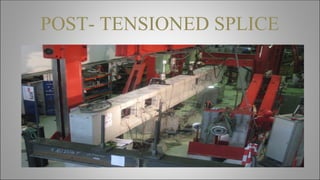
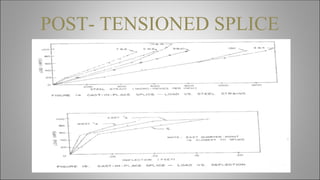
The specimen was loaded through a hydraulic jack at the
centerline of the span. The jack reacted against a steel
test frame bolted to the foundation. Elastomeric bearing
pads were used at the end bearings and between the jack
and the slab. The jack had a capacity of 400 kips, while
the test frame was rated at about 200 kips. The jack had
been pre-calibrated for correspondence between gage
pressure and applied load.
POST- TENSIONED SPLICE
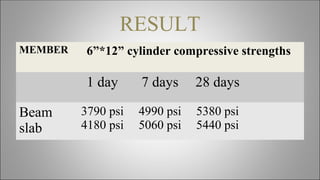
RESULT
MEMBER 6”*12” cylinder compressive strengths
1 day 7 days 28 days
Beam
slab
3790 psi
4180 psi
4990 psi
5060 psi
5380 psi
5440 psi
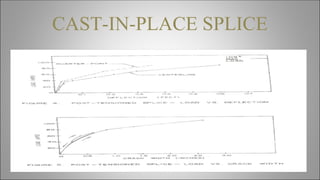
CAST-IN-PLACE SPLICE
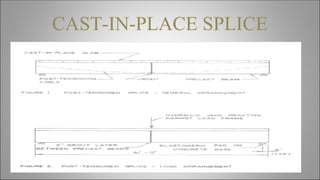
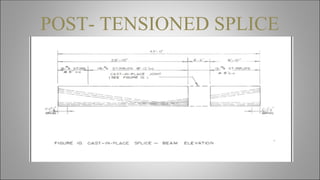
The splice contemplated in the present application
consists of cast-in place concrete section of perhaps 4
feet in length, reinforced with mild steel bars
projecting from each precast element. Supplemental
stirrups are also used in the splice. (Possible
variations would include post-tensioning the cast-in-
place portion, but this will not be considered herein)
CAST-IN-PLACE SPLICE
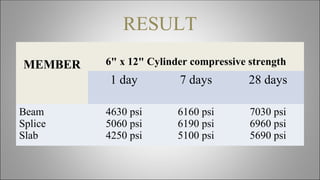
RESULT
MEMBER 6" x 12" Cylinder compressive strength
1 day 7 days 28 days
Beam
Splice
Slab
4630 psi
5060 psi
4250 psi
6160 psi
6190 psi
5100 psi
7030 psi
6960 psi
5690 psi
FLEXURAL TEST
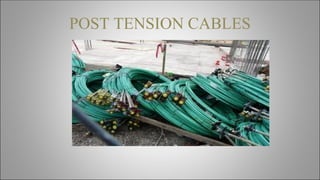
POST TENSION CABLES
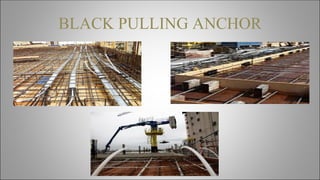
BLACK PULLING ANCHOR
ADVANTAGES
Take full advantages of high strength concrete and high
strength steel
Need less materials
Smaller and lighter structure
No cracks
Use the entire section to resist the load
Better corrosion resistance
Very effective for deflection control
Better shear resistance
DISADVANTAGES OF
PRESTRESSED CONCRETE
• The availability of experienced builders is scanty.
• Initial equipment cost is very high.
• Availability of experienced engineers is scanty.
• Prestressed sections are brittle
• Prestressed concrete sections are less fire
resistant.
APPLICATION
• Bridges
• Slabs in buildings
• Water tank
• Concrete pile
• Thin shell structures
• Offshore platform
• Nuclear power plant
• Repair and rehabilitations
CASE STUDY
HARRODS CREEK ARCH BRIDGE WIDENING
• Completion Date: August, 2010
• Cost: $34,00,000
• Designer: Stantec Consulting
• Client/Owner: Louisville Metro Public Works
• Contracter MAC Construction & Excavating, New Albany, Indiana.
• Located on River Road over Harrods Creek near Prospect, Kentucky, 10 miles
northeast of Louisville
• River Road is a Kentucky Scenic Byway and the bridge is located within the
Harrods Creek Historic District.
HARRODS CREEK ARCH BRIDGEHARRODS CREEK ARCH BRIDGE
WIDENINGWIDENING
CONCLUSION
• Thus, pre-stressed concrete increases the quality, strength,
span of the structure.
• Since it is cost effective, it is used widely on recent days.
PRE STRESSED CONCRETE

PRE STRESSED CONCRETE

  • 1.
    RamiReddy subbaRami Reddy engineeRingcollege Kadanuthala DEPARTMENT OF CIVIL ENGINEERING PRESENTED BY KALYAN KUMAR Y 133R1A0118
  • 2.
    CONTENTS  INTRODUCTION  DEFINITIONOF PRESTRESS  PRINCIPLE OF PRE-STRESSING  METHOD OF PRESTRESSING  GIRDER DESIGN  WORKING OF PRESTRESSED CONCRETE  DIFFERENCE B/W ORDINARY AND PRESTRESSED CONCRETE  TYPES OF PRESTRESSED CONCRETE  TEST ON PRESTRESSED CONCRETE  ADVANTAGES AND DISADVANTAGES OF PRESTRESSED CONCRETE  APPLICATION  CASE STUDY  CONCLUSION
  • 3.
    INTRODUCTION  Prestressed concreteis a method for overcoming concrete's natural weakness in tension.  In 1904, Freyssinet attempted to introduce permanent acting forces . To resist elastic forces under loads and was named “Pre Stressing”.  It can be used to produce beams , floors , bridges with a longer span than is practical with ordinary reinforced concrete.
  • 4.
    DEFINITION OF PRESTRESS •Prestress is defined as a method of applying pre- compression to control the stresses resulting due to external loads below the neutral axis of the beam tension developed due to external load which is more than the permissible limits of the plain concrete.
  • 5.
    PRINCIPLE OF PRE-STRESSING •Pre-stressing is a method in which compression force is applied to the reinforced concrete section. • Pre-stressing tendons (generally of high tensile steel cable or rods) are used to provide a clamping load which produces a compressive stress that balances the tensile stress that the concrete compression member would otherwise experience due to a bending load.
  • 6.
    METHODs OF PRESTRESSING Thisclassification is based on the method by which the prestressing force is generated.  Hydraulic Prestressing  Mechanical Prestressing  Electrical Prestressing  Chemical Prestressing
  • 7.
    GIRDER DESIGN • Fortransportation and handling purposes of the pier segments of both tx70 and Texas u54 girder bridges. • Diameter are provided in the bottom flange of the pier segments. • Various corrosion protection systems are available for these 106 thread bars, none of which bond with the structure. • Once the pier segment is erected on site, it behaves as a cantilever. • The preliminary designs for tx70 and Texas u54 girder bridges assumed shored construction. • From the preliminary designs, it was noted that the span lengths of 280 ft and 240 ft for the continuous prestressed concrete bridges using the standard tx70 and texas u54 girders, respectively are achieved using shoring towers (shored construction) and by making the girder sections work up to their limits.
  • 8.
    WORKING OF PRESTRESSED CONCRETEPre-stressed concrete refers to a procedure whereby tensile rods are put in place first and tightened, followed by concrete pouring.  Compression can be applied after pouring concrete using bonds. They are tightened once the concrete is dry  Main disadvantage is that a cable can burst out of the slab, if the anchoring system fails.
  • 9.
    DIFFERENCE B/W ORDINARYAND PRESTRESSED CONCRETE • Even without a load, the ordinary concrete beam must carry its own weight. • An upward force is created which in effect relieves the beam of having to carry its own weight.
  • 10.
    TYPES OF PRESTRESSED CONCRETE •There are two types of prestressed concrete. • They are  Pre- tensioned concrete  Post tensioned concrete
  • 11.
    PRE-TENSIONED CONCRETE Pre-tensionedconcrete is cast around already tensioned tendons.  This method produces a good bond between the tendon and concrete, which both protects the tendon from corrosion and allows for direct transfer of tension.  The cured concrete adheres and bonds to the bars and when the tension is released it is transferred to the concrete as compression by static friction.
  • 12.
  • 13.
    POST TENSIONED CONCRETE Post tensioning is a technique for reinforcing concrete.  Post-tensioning tendons, which are prestressing steel cables inside plastic ducts or sleeves, are positioned in the forms before the concrete is placed.  Afterwards, once the concrete has gained strength but before the service loads are applied, the cables are pulled tight, or tensioned, and anchored against the outer edges of the concrete.  They are classified into two types,  Bonded post tensioned concrete  Unbonded post tensioned concrete
  • 14.
  • 15.
    BONDED POST-TENSIONED CONCRETE • Bondedpost-tensioned concrete is the descriptive term for a method of applying compression after pouring concrete and the curing process (in situ). • The concrete is cast around a plastic, steel or aluminum curved duct, to follow the area where otherwise tension would occur in the concrete element.
  • 16.
    UNBONDED POST-TENSIONED CONCRETE • Unboundedpost-tensioned concrete differs from bonded post- tensioning by providing each individual cable permanent freedom of movement relative to the concrete. • To achieve this, each individual tendon is coated with a grease (generally lithium based) and covered by a plastic sheathing formed in an extrusion process.
  • 17.
    TEST ON PRESTRESSED CONCRETE POST-TENSIONED SPLICE CAST-IN-PLACE SPLICE FLEXURAL TEST
  • 18.
    POST- TENSIONED SPLICE Thespecimen was loaded through a hydraulic jack at the centerline of the span. The jack reacted against a steel test frame bolted to the foundation. Elastomeric bearing pads were used at the end bearings and between the jack and the slab. The jack had a capacity of 400 kips, while the test frame was rated at about 200 kips. The jack had been pre-calibrated for correspondence between gage pressure and applied load.
  • 19.
  • 20.
  • 21.
  • 22.
  • 23.
    RESULT MEMBER 6”*12” cylindercompressive strengths 1 day 7 days 28 days Beam slab 3790 psi 4180 psi 4990 psi 5060 psi 5380 psi 5440 psi
  • 24.
    CAST-IN-PLACE SPLICE The splicecontemplated in the present application consists of cast-in place concrete section of perhaps 4 feet in length, reinforced with mild steel bars projecting from each precast element. Supplemental stirrups are also used in the splice. (Possible variations would include post-tensioning the cast-in- place portion, but this will not be considered herein)
  • 25.
  • 26.
  • 27.
    RESULT MEMBER 6" x12" Cylinder compressive strength 1 day 7 days 28 days Beam Splice Slab 4630 psi 5060 psi 4250 psi 6160 psi 6190 psi 5100 psi 7030 psi 6960 psi 5690 psi
  • 28.
  • 29.
  • 30.
  • 31.
    ADVANTAGES Take full advantagesof high strength concrete and high strength steel Need less materials Smaller and lighter structure No cracks Use the entire section to resist the load Better corrosion resistance Very effective for deflection control Better shear resistance
  • 32.
    DISADVANTAGES OF PRESTRESSED CONCRETE •The availability of experienced builders is scanty. • Initial equipment cost is very high. • Availability of experienced engineers is scanty. • Prestressed sections are brittle • Prestressed concrete sections are less fire resistant.
  • 33.
    APPLICATION • Bridges • Slabsin buildings • Water tank • Concrete pile • Thin shell structures • Offshore platform • Nuclear power plant • Repair and rehabilitations
  • 34.
    CASE STUDY HARRODS CREEKARCH BRIDGE WIDENING • Completion Date: August, 2010 • Cost: $34,00,000 • Designer: Stantec Consulting • Client/Owner: Louisville Metro Public Works • Contracter MAC Construction & Excavating, New Albany, Indiana. • Located on River Road over Harrods Creek near Prospect, Kentucky, 10 miles northeast of Louisville • River Road is a Kentucky Scenic Byway and the bridge is located within the Harrods Creek Historic District.
  • 35.
    HARRODS CREEK ARCHBRIDGEHARRODS CREEK ARCH BRIDGE WIDENINGWIDENING
  • 36.
    CONCLUSION • Thus, pre-stressedconcrete increases the quality, strength, span of the structure. • Since it is cost effective, it is used widely on recent days.