EARTHQUAKE RESISTANT BUILDING
Presented by: Kadtare Gouri Satej
Contents
1. Introduction to Earthquake
2. Earthquake resistant design
3. Advanced techniques of earthquake resistant design &
construction
4. Base isolation
5. Earthquake generated forces
6. Deformation and damages
7. Response of base isolation
8. Basic requirements of isolation
9. Advantages of isolation
10. Energy dissipation devices
11. Friction dampers
12. Metallic dampers
13. Viscoelastic dampers
14. Conclusion
15. References
EARTHQUAKE
It is a wavelike motion generated under the surface of earth
traveling through earth’s crust.
One of the greatest hazards of life and property.
This is release of energy generated by sudden dislocation of
segments of crust.
EARTHQUAKE RESISTANT DESIGN
 Providing the building with strength, stiffness & inelastic
deformation capacity
 Reducing the earthquake generated forces acting upon
building
 Selection of appropriate structural configuration & careful
detailing of structural members
ADVANCED TECHNIQUES OF EARTHQUAKE RESISTANT
DESIGN & CONSTRUCTION
Base Isolation
Energy Dissipation Devices
BASE ISOLATION
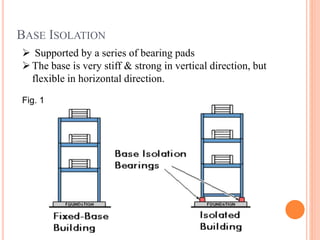
 Supported by a series of bearing pads
The base is very stiff & strong in vertical direction, but
flexible in horizontal direction.
Fig. 1
 Earthquake Generated Forces
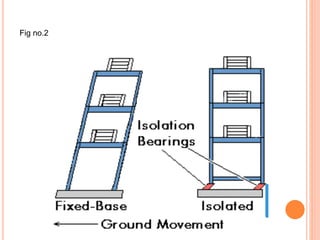
• The ground beneath each building begins to move.
• In fig. 2 the earthquake generated forces are towards left due
to which each building responds with a moment towards
right.
• This motion is actually due to Inertia.
Fig no.2
 Deformation & Damages
• The un-isolated building is also shown to be changing it’s shape.
• The primary cause of earthquake damage to buildings is the
deformation which the building undergoes as a result of the
inertial forces acting upon it.
 Response of base isolated building
• Even though it is too displacing the building remain it’s
original.
• The lead-rubber bearing that supporting the building are
deformed.
• The inertial forces acting on the base isolated building have
been reduced.
• Isolated building in earthquake have been shown to reduce
the building acceleration to as little as ¼ of comparable of
fixed base buildings.
• Acceleration is reduced due to base isolation system lengthens
the building’s period of vibration.
• Longer the period of vibration reduction in vibration
• The rubber isolated bearings does not suffers any damage.
 Basic Requirements of isolation system
 Flexibility
 Damping
 Resistance to vertical and other loads
Advantages of base isolation
 Less displacement during earthquake
 Improve safety of structure
 Maintaining performance of structure
 Enhances performance of building
ENERGY DISSIPATION DEVICES
• A certain amount of vibration energy is transferred to the
building by earthquake ground motion.
• Buildings do posses an inherent ability to dissipate this energy.
• The capacity of building to dissipate energy is quite limited.
• The building will dissipate energy either by undergoing large
scale movements in elements such as columns beams etc.
• So by equipping building with additional devices which have
high damping capacity we can decrease seismic energy.
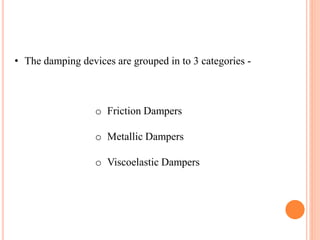
• The damping devices are grouped in to 3 categories -
o Friction Dampers
o Metallic Dampers
o Viscoelastic Dampers
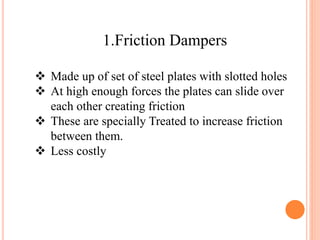
1.Friction Dampers
 Made up of set of steel plates with slotted holes
 At high enough forces the plates can slide over
each other creating friction
 These are specially Treated to increase friction
between them.
 Less costly
FRICTION DAMPERS
Types-
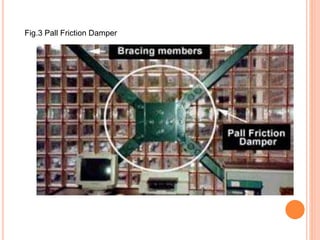
• Pall Friction damper
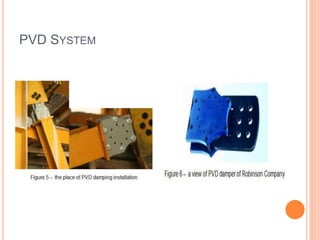
• PVD Friction Damper
Fig.3 Pall Friction Damper
PVD SYSTEM
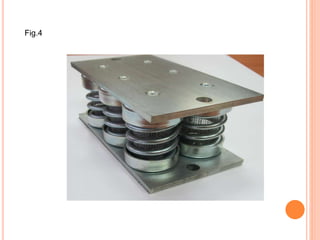
2.Metallic Dampers
 Usually made up of steel
 Designed to deform so much when building
vibrates
 It uses some of earthquake energy which goes in
to building
Fig.4
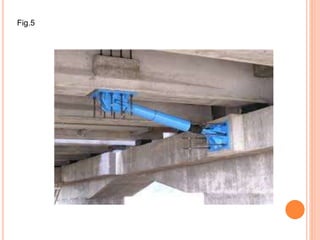
3.Viscoelastic Dampers
 Viscoelastic dampers dissipates earthquake energy
by converting the buildings mechanical energy in to
heat.
 Basically Silicon paste is used as viscous material
Fig.5
CONCLUSION
 The hazardous effects of earthquake on buildings
can be reduced using proper techniques.
 Base isolation and Friction dampers are the mostly
used techniques of earthquake resistant
construction.
 Viscoelastic Dampers are used for commertial
buildings.
REFERENCES
Earthquake resistant structure Wikipedia
Paper published by B. Samali in November
1995, vol. 17(9):639-654, doi:10.1016
Paper published by Tallers Egana S.L. ,March
2006, vol. 13

Earthquake

  • 1.
  • 2.
    Contents 1. Introduction toEarthquake 2. Earthquake resistant design 3. Advanced techniques of earthquake resistant design & construction 4. Base isolation 5. Earthquake generated forces 6. Deformation and damages 7. Response of base isolation 8. Basic requirements of isolation 9. Advantages of isolation 10. Energy dissipation devices 11. Friction dampers 12. Metallic dampers 13. Viscoelastic dampers 14. Conclusion 15. References
  • 3.
    EARTHQUAKE It is awavelike motion generated under the surface of earth traveling through earth’s crust. One of the greatest hazards of life and property. This is release of energy generated by sudden dislocation of segments of crust.
  • 4.
    EARTHQUAKE RESISTANT DESIGN Providing the building with strength, stiffness & inelastic deformation capacity  Reducing the earthquake generated forces acting upon building  Selection of appropriate structural configuration & careful detailing of structural members
  • 5.
    ADVANCED TECHNIQUES OFEARTHQUAKE RESISTANT DESIGN & CONSTRUCTION Base Isolation Energy Dissipation Devices
  • 6.
    BASE ISOLATION  Supportedby a series of bearing pads The base is very stiff & strong in vertical direction, but flexible in horizontal direction. Fig. 1
  • 7.
     Earthquake GeneratedForces • The ground beneath each building begins to move. • In fig. 2 the earthquake generated forces are towards left due to which each building responds with a moment towards right. • This motion is actually due to Inertia.
  • 8.
  • 9.
     Deformation &Damages • The un-isolated building is also shown to be changing it’s shape. • The primary cause of earthquake damage to buildings is the deformation which the building undergoes as a result of the inertial forces acting upon it.
  • 10.
     Response ofbase isolated building • Even though it is too displacing the building remain it’s original. • The lead-rubber bearing that supporting the building are deformed. • The inertial forces acting on the base isolated building have been reduced. • Isolated building in earthquake have been shown to reduce the building acceleration to as little as ¼ of comparable of fixed base buildings.
  • 11.
    • Acceleration isreduced due to base isolation system lengthens the building’s period of vibration. • Longer the period of vibration reduction in vibration • The rubber isolated bearings does not suffers any damage.
  • 12.
     Basic Requirementsof isolation system  Flexibility  Damping  Resistance to vertical and other loads
  • 13.
    Advantages of baseisolation  Less displacement during earthquake  Improve safety of structure  Maintaining performance of structure  Enhances performance of building
  • 14.
    ENERGY DISSIPATION DEVICES •A certain amount of vibration energy is transferred to the building by earthquake ground motion. • Buildings do posses an inherent ability to dissipate this energy. • The capacity of building to dissipate energy is quite limited. • The building will dissipate energy either by undergoing large scale movements in elements such as columns beams etc. • So by equipping building with additional devices which have high damping capacity we can decrease seismic energy.
  • 15.
    • The dampingdevices are grouped in to 3 categories - o Friction Dampers o Metallic Dampers o Viscoelastic Dampers
  • 16.
    1.Friction Dampers  Madeup of set of steel plates with slotted holes  At high enough forces the plates can slide over each other creating friction  These are specially Treated to increase friction between them.  Less costly
  • 17.
    FRICTION DAMPERS Types- • PallFriction damper • PVD Friction Damper
  • 18.
  • 19.
  • 20.
    2.Metallic Dampers  Usuallymade up of steel  Designed to deform so much when building vibrates  It uses some of earthquake energy which goes in to building
  • 21.
  • 22.
    3.Viscoelastic Dampers  Viscoelasticdampers dissipates earthquake energy by converting the buildings mechanical energy in to heat.  Basically Silicon paste is used as viscous material
  • 23.
  • 24.
    CONCLUSION  The hazardouseffects of earthquake on buildings can be reduced using proper techniques.  Base isolation and Friction dampers are the mostly used techniques of earthquake resistant construction.  Viscoelastic Dampers are used for commertial buildings.
  • 25.
    REFERENCES Earthquake resistant structureWikipedia Paper published by B. Samali in November 1995, vol. 17(9):639-654, doi:10.1016 Paper published by Tallers Egana S.L. ,March 2006, vol. 13