David Alexander
University College London
Cascading Disasters:
Lessons from the Past, Recent
Developments, Future Prospects
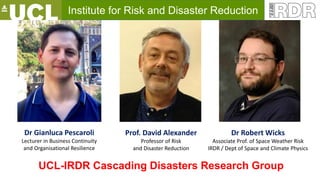
Institute for Risk and Disaster Reduction
Prof. David Alexander
Professor of Risk
and Disaster Reduction
Dr Gianluca Pescaroli
Lecturer in Business Continuity
and Organisational Resilience
Dr Robert Wicks
Associate Prof. of Space Weather Risk
IRDR / Dept of Space and Climate Physics
UCL-IRDR Cascading Disasters Research Group
www.ucl.ac.uk/risk-disaster-reduction/research/
cascading-disasters-research-group
A broad
theoretical
basis
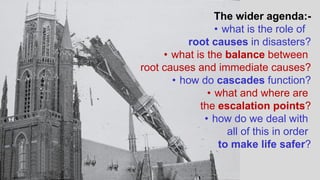
The wider agenda:-
• what is the role of
root causes in disasters?
• what is the balance between
root causes and immediate causes?
• how do cascades function?
• what and where are
the escalation points?
• how do we deal with
all of this in order
to make life safer?
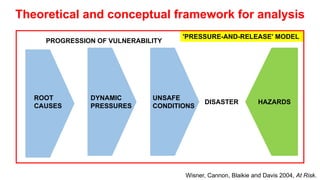
'PRESSURE-AND-RELEASE' MODEL
PROGRESSION OF VULNERABILITY
ROOT
CAUSES
DYNAMIC
PRESSURES
UNSAFE
CONDITIONS
HAZARDSDISASTER
Theoretical and conceptual framework for analysis
Wisner, Cannon, Blaikie and Davis 2004, At Risk.
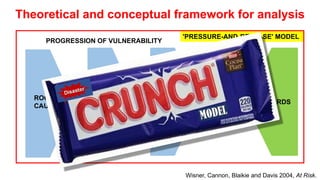
'PRESSURE-AND-RELEASE' MODEL
PROGRESSION OF VULNERABILITY
ROOT
CAUSES
DYNAMIC
PRESSURES
UNSAFE
CONDITIONS
HAZARDSDISASTER
Theoretical and conceptual framework for analysis
Wisner, Cannon, Blaikie and Davis 2004, At Risk.
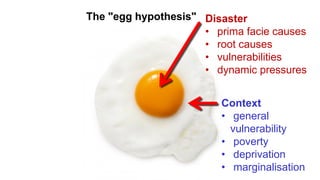
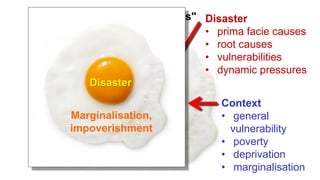
The "egg hypothesis" Disaster
• prima facie causes
• root causes
• vulnerabilities
• dynamic pressures
Context
• general
vulnerability
• poverty
• deprivation
• marginalisation
The "egg hypothesis" Disaster
• prima facie causes
• root causes
• vulnerabilities
• dynamic pressures
Context
• general
vulnerability
• poverty
• deprivation
• marginalisation
Disaster
Marginalisation,
impoverishment
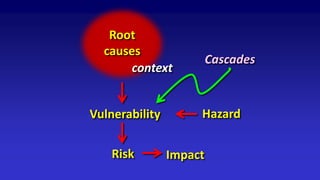
Root
causes
Vulnerability Hazard
Risk Impact
context
Cascades
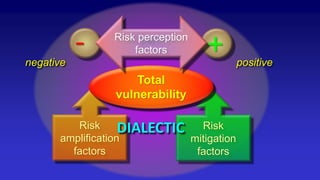
Risk
amplification
factors
Risk
mitigation
factors
Total
vulnerability
Risk perception
factors- + positivenegative
DIALECTIC
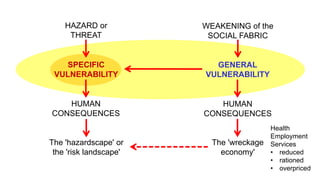
HAZARD or
THREAT
SPECIFIC
VULNERABILITY
HUMAN
CONSEQUENCES
The 'hazardscape' or
the 'risk landscape'
WEAKENING of the
SOCIAL FABRIC
GENERAL
VULNERABILITY
HUMAN
CONSEQUENCES
The 'wreckage
economy'
Health
Employment
Services
• reduced
• rationed
• overpriced
`
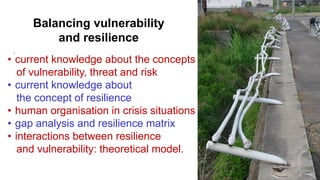
• current knowledge about the concepts
of vulnerability, threat and risk
• current knowledge about
the concept of resilience
• human organisation in crisis situations
• gap analysis and resilience matrix
• interactions between resilience
and vulnerability: theoretical model.
Balancing vulnerability
and resilience
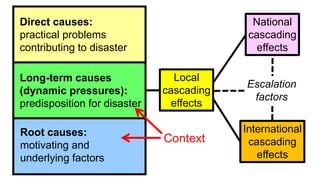
Direct causes:
practical problems
contributing to disaster
Long-term causes
(dynamic pressures):
predisposition for disaster
Root causes:
motivating and
underlying factors
Local
cascading
effects
National
cascading
effects
International
cascading
effects
Escalation
factors
Context
What are
cascading
disasters?
Cascading disasters
[crises, emergencies]
are negative events that involve:-
• a primary impact (the trigger)
• chains & networks of consequences
• secondary impacts
• complex interacting vulnerabilities
• escalation points
• (usually) complex impacts
upon critical infrastructure.
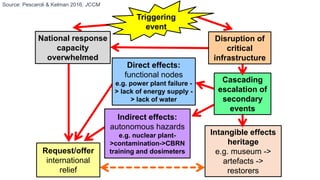
Intangible effects
heritage
e.g. museum ->
artefacts ->
restorers
Cascading
escalation of
secondary
events
Triggering
event
National response
capacity
overwhelmed
Disruption of
critical
infrastructure
Direct effects:
functional nodes
e.g. power plant failure -
> lack of energy supply -
> lack of water
Indirect effects:
autonomous hazards
e.g. nuclear plant-
>contamination->CBRN
training and dosimetersRequest/offer
international
relief
Source: Pescaroli & Kelman 2016, JCCM
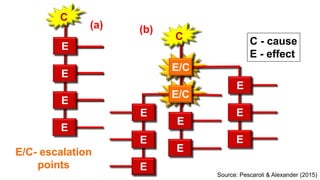
C
E
E
E
E
C
E/C
E
E
E
E
E
E
E
E
E/C
(a) (b)
C - cause
E - effect
E/C- escalation
points
Source: Pescaroli & Alexander (2015)
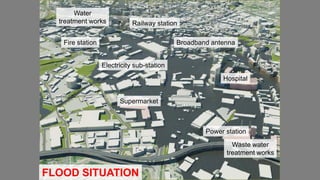
Water
treatment works Railway station
Fire station
Electricity sub-station
Broadband antenna
Hospital
Supermarket
Power station
Waste water
treatment works
FLOOD SITUATION
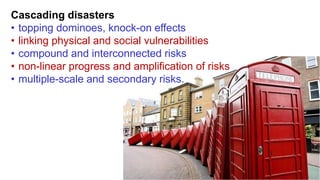
Cascading disasters
• topping dominoes, knock-on effects
• linking physical and social vulnerabilities
• compound and interconnected risks
• non-linear progress and amplification of risks
• multiple-scale and secondary risks.
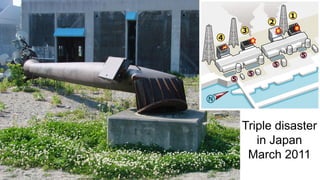
Triple disaster
in Japan
March 2011
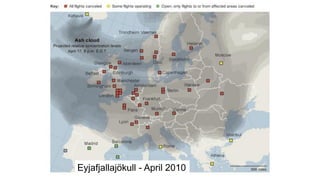
Eyjafjallajökull - April 2010
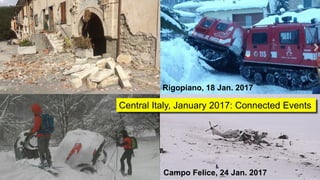
Rigopiano, 18 Jan. 2017
Central Italy, January 2017: Connected Events
Campo Felice, 24 Jan. 2017
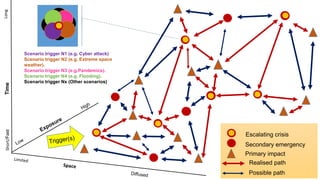
TimeLongShort/Fast
Scenario trigger N1 (e.g. Cyber attack)
Scenario trigger N2 (e.g. Extreme space
weather).
Scenario trigger N3 (e.g.Pandemics).
Scenario trigger N4 (e.g. Flooding).
Scenario trigger Nx (Other scenarios)
Possible path
Realised path
Secondary emergency
Escalating crisis
Primary impact
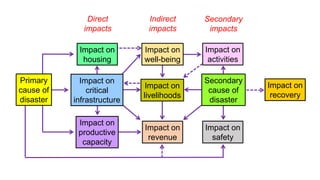
Primary
cause of
disaster
Impact on
critical
infrastructure
Impact on
housing
Impact on
productive
capacity
Direct
impacts
Indirect
impacts
Impact on
activities
Secondary
impacts
Impact on
livelihoods
Impact on
revenue
Secondary
cause of
disaster
Impact on
well-being
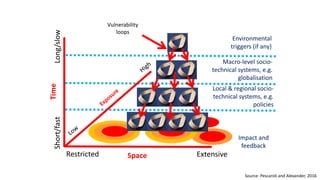
Impact on
safety
Impact on
recovery
Source: Pescaroli and Alexander, 2016
Time
Short/fastLong/slow
SpaceRestricted Extensive
CAS & critical
infrastructure
Macro-level socio-
technical systems, e.g.
globalisation
Local & regional socio-
technical systems, e.g.
policies
Environmental
triggers (if any)
Impact and
feedback
Vulnerability
loops
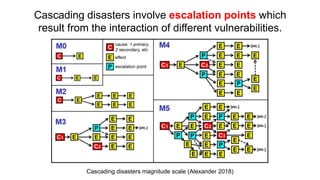
Cascading disasters magnitude scale (Alexander 2018)
Cascading disasters involve escalation points which
result from the interaction of different vulnerabilities.
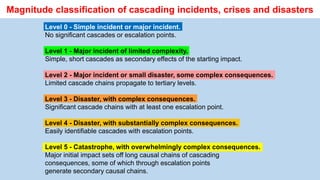
Level 0 - Simple incident or major incident.
No significant cascades or escalation points.
Level 1 - Major incident of limited complexity.
Simple, short cascades as secondary effects of the starting impact.
Level 2 - Major incident or small disaster, some complex consequences.
Limited cascade chains propagate to tertiary levels.
Level 3 - Disaster, with complex consequences.
Significant cascade chains with at least one escalation point.
Level 4 - Disaster, with substantially complex consequences.
Easily identifiable cascades with escalation points.
Level 5 - Catastrophe, with overwhelmingly complex consequences.
Major initial impact sets off long causal chains of cascading
consequences, some of which through escalation points
generate secondary causal chains.
Magnitude classification of cascading incidents, crises and disasters
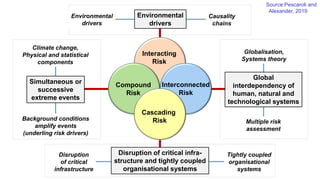
Interacting
Risk
Interconnected
Risk
Compound
Risk
Cascading
Risk
Environmental
drivers
Simultaneous or
successive
extreme events
Global
interdependency of
human, natural and
technological systems
Disruption of critical infra-
structure and tightly coupled
organisational systems
Multiple risk
assessment
Globalisation,
Systems theory
Causality
chains
Background conditions
amplify events
(underling risk drivers)
Climate change,
Physical and statistical
components
Environmental
drivers
Tightly coupled
organisational
systems
Disruption
of critical
infrastructure
Source:Pescaroli and
Alexander, 2019
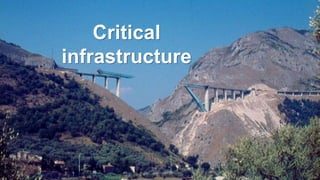
Critical
infrastructure
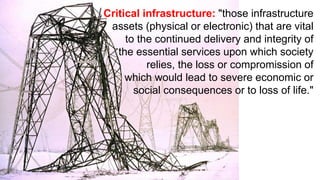
Critical infrastructure: "those infrastructure
assets (physical or electronic) that are vital
to the continued delivery and integrity of
the essential services upon which society
relies, the loss or compromission of
which would lead to severe economic or
social consequences or to loss of life."
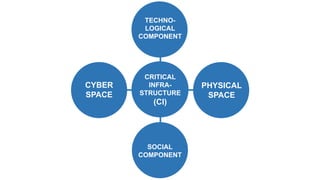
CRITICAL
INFRA-
STRUCTURE
(CI)
CYBER
SPACE
PHYSICAL
SPACE
SOCIAL
COMPONENT
TECHNO-
LOGICAL
COMPONENT
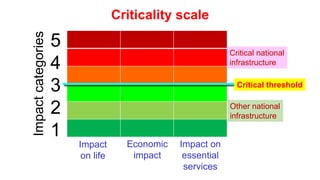
Criticality scale
Impact
on life
Economic
impact
Impact on
essential
services
Impactcategories 5
4
3
2
1
Critical threshold
Critical national
infrastructure
Other national
infrastructure
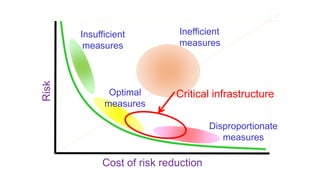
Cost of risk reduction
Risk
Inefficient
measures
Disproportionate
measures
Insufficient
measures
Optimal
measures
Critical infrastructure
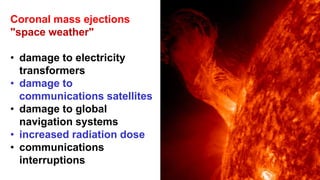
Coronal mass ejections
"space weather"
• damage to electricity
transformers
• damage to
communications satellites
• damage to global
navigation systems
• increased radiation dose
• communications
interruptions
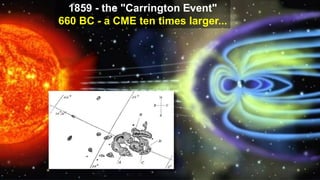
1859 - the "Carrington Event"
660 BC - a CME ten times larger...
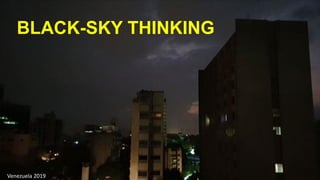
BLACK-SKY THINKING
Venezuela 2019
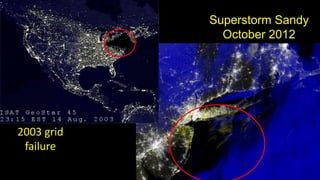
2003 grid
failure
Superstorm Sandy
October 2012
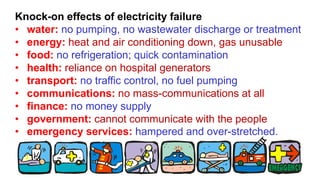
Knock-on effects of electricity failure
• water: no pumping, no wastewater discharge or treatment
• energy: heat and air conditioning down, gas unusable
• food: no refrigeration; quick contamination
• health: reliance on hospital generators
• transport: no traffic control, no fuel pumping
• communications: no mass-communications at all
• finance: no money supply
• government: cannot communicate with the people
• emergency services: hampered and over-stretched.
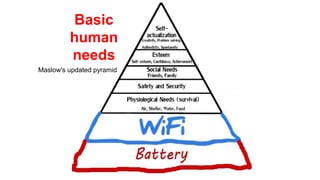
Basic
human
needs
Maslow's updated pyramid
Basic problem: how to communicate
when there is no electricity?
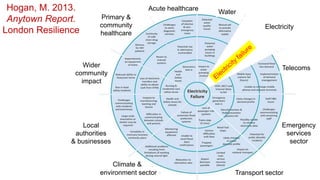
Hogan, M. 2013.
Anytown Report.
London Resilience
Telecoms
Electricity
Water
Acute healthcare
Primary &
community
healthcare
Wider
community
impact
Local
authorities
& businesses
environment sector
Climate &
Transport sector
Emergency
services
sector
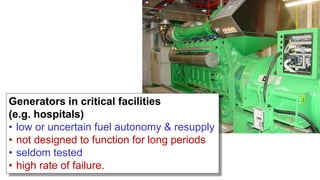
Generators in critical facilities
(e.g. hospitals)
• low or uncertain fuel autonomy & resupply
• not designed to function for long periods
• seldom tested
• high rate of failure.
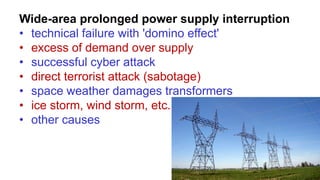
Wide-area prolonged power supply interruption
• technical failure with 'domino effect'
• excess of demand over supply
• successful cyber attack
• direct terrorist attack (sabotage)
• space weather damages transformers
• ice storm, wind storm, etc.
• other causes
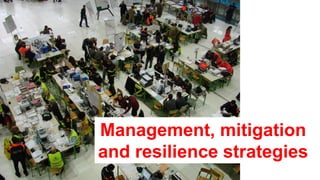
Management, mitigation
and resilience strategies
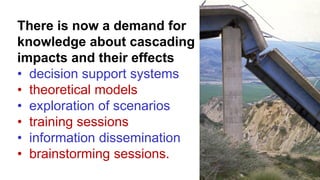
There is now a demand for
knowledge about cascading
impacts and their effects
• decision support systems
• theoretical models
• exploration of scenarios
• training sessions
• information dissemination
• brainstorming sessions.
How to deal with cascading disasters and crises
• do not focus only on the trigger event
• consider the strategic and tactical levels
• use a broader impact analysis with 'impact trees'
• create reasonable worst-case scenarios
• identify escalation points and subject them to 'stress tests'.
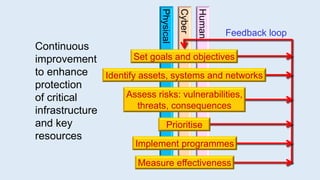
Cyber
Human
Physical
Set goals and objectives
Identify assets, systems and networks
Assess risks: vulnerabilities,
threats, consequences
Prioritise
Implement programmes
Measure effectiveness
Continuous
improvement
to enhance
protection
of critical
infrastructure
and key
resources
Feedback loop
Safeguarding critical infrastructure
• redundant systems
• adequate levels of operating supplies
• fault-tolerant design
• "fail-safe" design
• adequate and reserve manpower
• scenarios for failures and disasters
• contingency and emergency plans kept current
• involvement of top management.
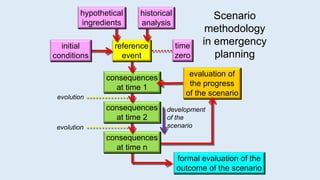
evolution
development
of the
scenarioevolution
time
zero
formal evaluation of the
outcome of the scenario
consequences
at time n
Scenario
methodology
in emergency
planning
consequences
at time 2
consequences
at time 1
reference
event
initial
conditions
evaluation of
the progress
of the scenario
historical
analysis
hypothetical
ingredients
Conclusions
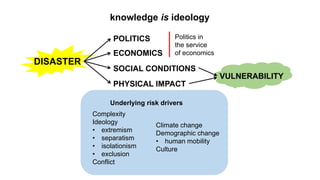
DISASTER
POLITICS
ECONOMICS
SOCIAL CONDITIONS
PHYSICAL IMPACT
Politics in
the service
of economics
VULNERABILITY
knowledge is ideology
Complexity
Ideology
• extremism
• separatism
• isolationism
• exclusion
Conflict
Climate change
Demographic change
• human mobility
Culture
Underlying risk drivers
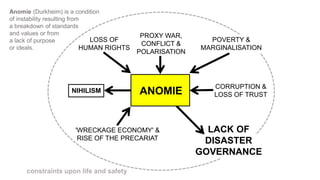
LOSS OF
HUMAN RIGHTS
PROXY WAR,
CONFLICT &
POLARISATION
POVERTY &
MARGINALISATION
'WRECKAGE ECONOMY' &
RISE OF THE PRECARIAT
LACK OF
DISASTER
GOVERNANCE
NIHILISM
CORRUPTION &
LOSS OF TRUSTANOMIE
constraints upon life and safety
Anomie (Durkheim) is a condition
of instability resulting from
a breakdown of standards
and values or from
a lack of purpose
or ideals.
Anomie means loss of basic morality.
There is a disaster because fairness
gives way to self-promotion and
blatant exploitation.
“Qu’ils mangent de la brioche!”
Disaster is about the use and abuse of power:
we have to factor that into the equation.
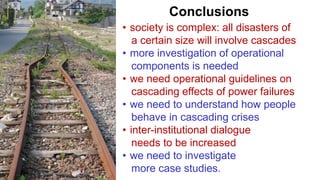
Conclusions
• society is complex: all disasters of
a certain size will involve cascades
• more investigation of operational
components is needed
• we need operational guidelines on
cascading effects of power failures
• we need to understand how people
behave in cascading crises
• inter-institutional dialogue
needs to be increased
• we need to investigate
more case studies.
International Journal of
Disaster Risk Reduction
Special Issue (2018):
Understanding and
mitigating cascading
crises in the global
interconnected system
Thank you for listening!
emergency-planning.blogspot.com
www.slideshare.net/dealexander
www.ucl.ac.uk/rdr/cascading
David.Alexander@ucl.ac.uk

Cascading Disasters

  • 1.
    David Alexander University CollegeLondon Cascading Disasters: Lessons from the Past, Recent Developments, Future Prospects
  • 2.
    Institute for Riskand Disaster Reduction Prof. David Alexander Professor of Risk and Disaster Reduction Dr Gianluca Pescaroli Lecturer in Business Continuity and Organisational Resilience Dr Robert Wicks Associate Prof. of Space Weather Risk IRDR / Dept of Space and Climate Physics UCL-IRDR Cascading Disasters Research Group
  • 3.
  • 4.
  • 5.
    The wider agenda:- •what is the role of root causes in disasters? • what is the balance between root causes and immediate causes? • how do cascades function? • what and where are the escalation points? • how do we deal with all of this in order to make life safer?
  • 6.
    'PRESSURE-AND-RELEASE' MODEL PROGRESSION OFVULNERABILITY ROOT CAUSES DYNAMIC PRESSURES UNSAFE CONDITIONS HAZARDSDISASTER Theoretical and conceptual framework for analysis Wisner, Cannon, Blaikie and Davis 2004, At Risk.
  • 7.
    'PRESSURE-AND-RELEASE' MODEL PROGRESSION OFVULNERABILITY ROOT CAUSES DYNAMIC PRESSURES UNSAFE CONDITIONS HAZARDSDISASTER Theoretical and conceptual framework for analysis Wisner, Cannon, Blaikie and Davis 2004, At Risk.
  • 8.
    The "egg hypothesis"Disaster • prima facie causes • root causes • vulnerabilities • dynamic pressures Context • general vulnerability • poverty • deprivation • marginalisation
  • 9.
    The "egg hypothesis"Disaster • prima facie causes • root causes • vulnerabilities • dynamic pressures Context • general vulnerability • poverty • deprivation • marginalisation Disaster Marginalisation, impoverishment
  • 10.
  • 11.
  • 12.
    HAZARD or THREAT SPECIFIC VULNERABILITY HUMAN CONSEQUENCES The 'hazardscape'or the 'risk landscape' WEAKENING of the SOCIAL FABRIC GENERAL VULNERABILITY HUMAN CONSEQUENCES The 'wreckage economy' Health Employment Services • reduced • rationed • overpriced
  • 13.
    ` • current knowledgeabout the concepts of vulnerability, threat and risk • current knowledge about the concept of resilience • human organisation in crisis situations • gap analysis and resilience matrix • interactions between resilience and vulnerability: theoretical model. Balancing vulnerability and resilience
  • 14.
    Direct causes: practical problems contributingto disaster Long-term causes (dynamic pressures): predisposition for disaster Root causes: motivating and underlying factors Local cascading effects National cascading effects International cascading effects Escalation factors Context
  • 15.
  • 16.
    Cascading disasters [crises, emergencies] arenegative events that involve:- • a primary impact (the trigger) • chains & networks of consequences • secondary impacts • complex interacting vulnerabilities • escalation points • (usually) complex impacts upon critical infrastructure.
  • 17.
    Intangible effects heritage e.g. museum-> artefacts -> restorers Cascading escalation of secondary events Triggering event National response capacity overwhelmed Disruption of critical infrastructure Direct effects: functional nodes e.g. power plant failure - > lack of energy supply - > lack of water Indirect effects: autonomous hazards e.g. nuclear plant- >contamination->CBRN training and dosimetersRequest/offer international relief Source: Pescaroli & Kelman 2016, JCCM
  • 18.
    C E E E E C E/C E E E E E E E E E/C (a) (b) C -cause E - effect E/C- escalation points Source: Pescaroli & Alexander (2015)
  • 19.
    Water treatment works Railwaystation Fire station Electricity sub-station Broadband antenna Hospital Supermarket Power station Waste water treatment works FLOOD SITUATION
  • 20.
    Cascading disasters • toppingdominoes, knock-on effects • linking physical and social vulnerabilities • compound and interconnected risks • non-linear progress and amplification of risks • multiple-scale and secondary risks.
  • 21.
  • 22.
  • 23.
    Rigopiano, 18 Jan.2017 Central Italy, January 2017: Connected Events Campo Felice, 24 Jan. 2017
  • 24.
    TimeLongShort/Fast Scenario trigger N1(e.g. Cyber attack) Scenario trigger N2 (e.g. Extreme space weather). Scenario trigger N3 (e.g.Pandemics). Scenario trigger N4 (e.g. Flooding). Scenario trigger Nx (Other scenarios) Possible path Realised path Secondary emergency Escalating crisis Primary impact
  • 25.
    Primary cause of disaster Impact on critical infrastructure Impacton housing Impact on productive capacity Direct impacts Indirect impacts Impact on activities Secondary impacts Impact on livelihoods Impact on revenue Secondary cause of disaster Impact on well-being Impact on safety Impact on recovery
  • 26.
    Source: Pescaroli andAlexander, 2016 Time Short/fastLong/slow SpaceRestricted Extensive CAS & critical infrastructure Macro-level socio- technical systems, e.g. globalisation Local & regional socio- technical systems, e.g. policies Environmental triggers (if any) Impact and feedback Vulnerability loops
  • 27.
    Cascading disasters magnitudescale (Alexander 2018) Cascading disasters involve escalation points which result from the interaction of different vulnerabilities.
  • 28.
    Level 0 -Simple incident or major incident. No significant cascades or escalation points. Level 1 - Major incident of limited complexity. Simple, short cascades as secondary effects of the starting impact. Level 2 - Major incident or small disaster, some complex consequences. Limited cascade chains propagate to tertiary levels. Level 3 - Disaster, with complex consequences. Significant cascade chains with at least one escalation point. Level 4 - Disaster, with substantially complex consequences. Easily identifiable cascades with escalation points. Level 5 - Catastrophe, with overwhelmingly complex consequences. Major initial impact sets off long causal chains of cascading consequences, some of which through escalation points generate secondary causal chains. Magnitude classification of cascading incidents, crises and disasters
  • 29.
    Interacting Risk Interconnected Risk Compound Risk Cascading Risk Environmental drivers Simultaneous or successive extreme events Global interdependencyof human, natural and technological systems Disruption of critical infra- structure and tightly coupled organisational systems Multiple risk assessment Globalisation, Systems theory Causality chains Background conditions amplify events (underling risk drivers) Climate change, Physical and statistical components Environmental drivers Tightly coupled organisational systems Disruption of critical infrastructure Source:Pescaroli and Alexander, 2019
  • 30.
  • 31.
    Critical infrastructure: "thoseinfrastructure assets (physical or electronic) that are vital to the continued delivery and integrity of the essential services upon which society relies, the loss or compromission of which would lead to severe economic or social consequences or to loss of life."
  • 32.
  • 33.
    Criticality scale Impact on life Economic impact Impacton essential services Impactcategories 5 4 3 2 1 Critical threshold Critical national infrastructure Other national infrastructure
  • 34.
    Cost of riskreduction Risk Inefficient measures Disproportionate measures Insufficient measures Optimal measures Critical infrastructure
  • 35.
    Coronal mass ejections "spaceweather" • damage to electricity transformers • damage to communications satellites • damage to global navigation systems • increased radiation dose • communications interruptions
  • 36.
    1859 - the"Carrington Event" 660 BC - a CME ten times larger...
  • 37.
  • 38.
  • 39.
    Knock-on effects ofelectricity failure • water: no pumping, no wastewater discharge or treatment • energy: heat and air conditioning down, gas unusable • food: no refrigeration; quick contamination • health: reliance on hospital generators • transport: no traffic control, no fuel pumping • communications: no mass-communications at all • finance: no money supply • government: cannot communicate with the people • emergency services: hampered and over-stretched.
  • 40.
  • 41.
    Basic problem: howto communicate when there is no electricity?
  • 42.
    Hogan, M. 2013. AnytownReport. London Resilience Telecoms Electricity Water Acute healthcare Primary & community healthcare Wider community impact Local authorities & businesses environment sector Climate & Transport sector Emergency services sector
  • 43.
    Generators in criticalfacilities (e.g. hospitals) • low or uncertain fuel autonomy & resupply • not designed to function for long periods • seldom tested • high rate of failure.
  • 44.
    Wide-area prolonged powersupply interruption • technical failure with 'domino effect' • excess of demand over supply • successful cyber attack • direct terrorist attack (sabotage) • space weather damages transformers • ice storm, wind storm, etc. • other causes
  • 45.
  • 46.
    There is nowa demand for knowledge about cascading impacts and their effects • decision support systems • theoretical models • exploration of scenarios • training sessions • information dissemination • brainstorming sessions.
  • 47.
    How to dealwith cascading disasters and crises • do not focus only on the trigger event • consider the strategic and tactical levels • use a broader impact analysis with 'impact trees' • create reasonable worst-case scenarios • identify escalation points and subject them to 'stress tests'.
  • 48.
    Cyber Human Physical Set goals andobjectives Identify assets, systems and networks Assess risks: vulnerabilities, threats, consequences Prioritise Implement programmes Measure effectiveness Continuous improvement to enhance protection of critical infrastructure and key resources Feedback loop
  • 49.
    Safeguarding critical infrastructure •redundant systems • adequate levels of operating supplies • fault-tolerant design • "fail-safe" design • adequate and reserve manpower • scenarios for failures and disasters • contingency and emergency plans kept current • involvement of top management.
  • 50.
    evolution development of the scenarioevolution time zero formal evaluationof the outcome of the scenario consequences at time n Scenario methodology in emergency planning consequences at time 2 consequences at time 1 reference event initial conditions evaluation of the progress of the scenario historical analysis hypothetical ingredients
  • 51.
  • 52.
    DISASTER POLITICS ECONOMICS SOCIAL CONDITIONS PHYSICAL IMPACT Politicsin the service of economics VULNERABILITY knowledge is ideology Complexity Ideology • extremism • separatism • isolationism • exclusion Conflict Climate change Demographic change • human mobility Culture Underlying risk drivers
  • 53.
    LOSS OF HUMAN RIGHTS PROXYWAR, CONFLICT & POLARISATION POVERTY & MARGINALISATION 'WRECKAGE ECONOMY' & RISE OF THE PRECARIAT LACK OF DISASTER GOVERNANCE NIHILISM CORRUPTION & LOSS OF TRUSTANOMIE constraints upon life and safety Anomie (Durkheim) is a condition of instability resulting from a breakdown of standards and values or from a lack of purpose or ideals.
  • 54.
    Anomie means lossof basic morality. There is a disaster because fairness gives way to self-promotion and blatant exploitation. “Qu’ils mangent de la brioche!” Disaster is about the use and abuse of power: we have to factor that into the equation.
  • 55.
    Conclusions • society iscomplex: all disasters of a certain size will involve cascades • more investigation of operational components is needed • we need operational guidelines on cascading effects of power failures • we need to understand how people behave in cascading crises • inter-institutional dialogue needs to be increased • we need to investigate more case studies.
  • 56.
    International Journal of DisasterRisk Reduction Special Issue (2018): Understanding and mitigating cascading crises in the global interconnected system
  • 58.
    Thank you forlistening! emergency-planning.blogspot.com www.slideshare.net/dealexander www.ucl.ac.uk/rdr/cascading David.Alexander@ucl.ac.uk