Earthquake
What is an
EARTHQUAKE?
oEarthquake is the shaking, rolling or
sudden shock of the earth’s surface.
oIt is the Earth’s natural means of
releasing stress.
oIt can be felt over large areas although
they usually last less than one minute.
oIt cannot be predicted, although
scientists are working on it.
What causes an
EARTHQUAKE?
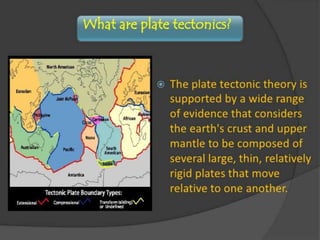
oThere are about 20 plates along the
surface of the earth that move
continuously and slowly past each
other. When the plates squeeze or
stretch, huge rocks form at their edges
and the rocks shift with great force,
causing an earthquake.
What causes an
EARTHQUAKE?
oAs the plates move they put forces on
themselves and each other. When the
force is large enough, the crust is
forced to break. When the break
occurs, the stress is released as
energy, which moves through the
earth in the form of waves, which we
feel and call an EARTHQUAKE.
Earthquake Profile of Leyte
BEFORE
The key to effective disaster prevention is planning.
• Determine whether the site is along an active fault and/or
prone to liquefaction or landslide which may cause damage
to your house or building.
• Be sure that proper
structural design and
engineering practice is
followed when
constructing a house or
building.
• Evaluate the structural
soundness of buildings
and important
infrastructures;
strengthen or retrofit if
found necessary.
BEFORE
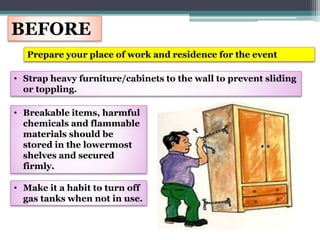
Prepare your place of work and residence for the event
• Strap heavy furniture/cabinets to the wall to prevent sliding
or toppling.
• Breakable items, harmful
chemicals and flammable
materials should be
stored in the lowermost
shelves and secured
firmly.
• Make it a habit to turn off
gas tanks when not in use.
BEFORE
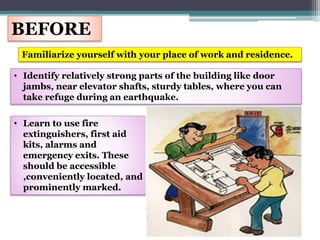
Familiarize yourself with your place of work and residence.
• Identify relatively strong parts of the building like door
jambs, near elevator shafts, sturdy tables, where you can
take refuge during an earthquake.
• Learn to use fire
extinguishers, first aid
kits, alarms and
emergency exits. These
should be accessible
,conveniently located, and
prominently marked.
BEFORE
Most causes of injuries during earthquakes are from
falling objects.
• Heavy materials should be kept in lower shelves.
• Check the stability of
hanging objects which
may break loose and fall
during earthquakes.
• Prepare and maintain an
earthquake survival kit
consisting of a battery
powered radio, flashlight,
first aid kit, potable
water, candles, ready-to-
eat food, whistle and dust
mask.
DURING
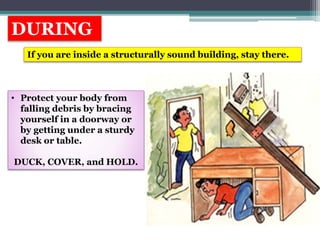
If you are inside a structurally sound building, stay there.
• Protect your body from
falling debris by bracing
yourself in a doorway or
by getting under a sturdy
desk or table.
DUCK, COVER, and HOLD.
DURING
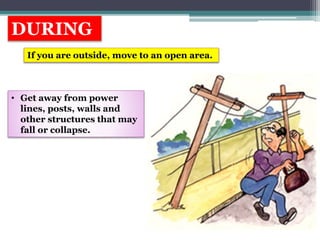
If you are outside, move to an open area.
• Get away from power
lines, posts, walls and
other structures that may
fall or collapse.
DURING
If you are outside, move to an open area.
• Stay away from buildings
with glass panes.
DURING
When driving a vehicle, pull to the side of the road and stop.
• Do not attempt to cross
bridges or overpasses
which may have been
damaged.
DURING
When driving a vehicle, pull to the side of the road and stop.
• When you are on a
mountain or near a steep
hillside, move away from
steep escarpments that
may be affected by
landslides.
DURING
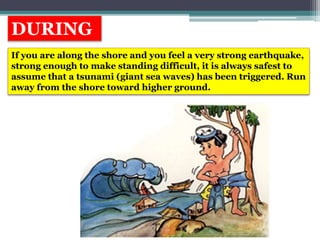
If you are along the shore and you feel a very strong earthquake,
strong enough to make standing difficult, it is always safest to
assume that a tsunami (giant sea waves) has been triggered. Run
away from the shore toward higher ground.
AFTER
If you are inside an old structure, take the fastest and safest
way out!
• Do not rush to the exit; get out calmly in an orderly manner.
• Do not use elevators, use
the stairs.
• Check yourself and
others for injuries.
AFTER
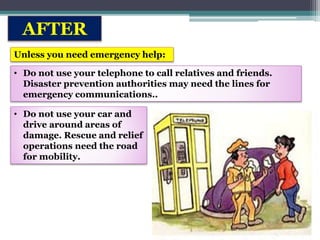
Unless you need emergency help:
• Do not use your telephone to call relatives and friends.
Disaster prevention authorities may need the lines for
emergency communications..
• Do not use your car and
drive around areas of
damage. Rescue and relief
operations need the road
for mobility.
AFTER
Help reduce the number of casualties from the earthquake:
• Don’t enter partially damaged buildings. Strong aftershocks
may cause these to collapse.
• Gather information and
disaster prevention
instructions from battery-
operated radios.
• Obey public safety
precautions.
AFTER
Check your surroundings.
• Clean-up chemical spills, toxic and flammable materials to
avoid any chain of unwanted events.
• Check for fire and if any,
have it controlled.
• Check your water and
electrical lines for defects.
If any damage is
suspected, turn the
system off in the main
valve or switch.
AFTER
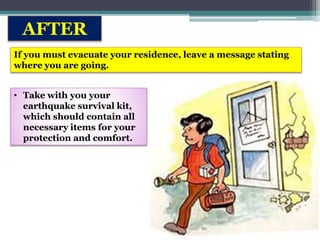
If you must evacuate your residence, leave a message stating
where you are going.
• Take with you your
earthquake survival kit,
which should contain all
necessary items for your
protection and comfort.
• A pre-arranged signal such as
siren/bell should be known to all.
• During the drill, the siren/bell
indicates earthquake/shaking. All will
be alerted by this signal.
PHASES OF AN EARTHQUAKE DRILL
Phase 1. Alarm
While the siren/bell is ongoing,
everyone should move away from
windows, glass or light fixtures. In this
phase, everyone should perform
“DUCK, COVER and HOLD” under
desks, tables or chairs. Remain in this
position until the “shaking” stops.
Phase 2. Response
Once the “SHAKING” stops,
students should evacuate the
building and proceed using pre-
determined routes to go to
identified evacuation areas.
Phase 3. Evacuation
At the designated evacuation area,
students must be grouped together
according to grades where they
belong.
Phase 4. Assembly
The Teachers should check and
make sure all students/pupils are
accounted for.
Phase 5. Head count
An evaluation of the drill must be
conducted to identify problems
encountered during the drill and
how this can be corrected in future
earthquake drills.
Phase 6. Evaluation
Salamat…

EARTHQUAKE AP10.pptx

  • 2.
  • 3.
    What is an EARTHQUAKE? oEarthquakeis the shaking, rolling or sudden shock of the earth’s surface. oIt is the Earth’s natural means of releasing stress. oIt can be felt over large areas although they usually last less than one minute. oIt cannot be predicted, although scientists are working on it.
  • 4.
    What causes an EARTHQUAKE? oThereare about 20 plates along the surface of the earth that move continuously and slowly past each other. When the plates squeeze or stretch, huge rocks form at their edges and the rocks shift with great force, causing an earthquake.
  • 6.
    What causes an EARTHQUAKE? oAsthe plates move they put forces on themselves and each other. When the force is large enough, the crust is forced to break. When the break occurs, the stress is released as energy, which moves through the earth in the form of waves, which we feel and call an EARTHQUAKE.
  • 14.
  • 16.
    BEFORE The key toeffective disaster prevention is planning. • Determine whether the site is along an active fault and/or prone to liquefaction or landslide which may cause damage to your house or building. • Be sure that proper structural design and engineering practice is followed when constructing a house or building. • Evaluate the structural soundness of buildings and important infrastructures; strengthen or retrofit if found necessary.
  • 17.
    BEFORE Prepare your placeof work and residence for the event • Strap heavy furniture/cabinets to the wall to prevent sliding or toppling. • Breakable items, harmful chemicals and flammable materials should be stored in the lowermost shelves and secured firmly. • Make it a habit to turn off gas tanks when not in use.
  • 18.
    BEFORE Familiarize yourself withyour place of work and residence. • Identify relatively strong parts of the building like door jambs, near elevator shafts, sturdy tables, where you can take refuge during an earthquake. • Learn to use fire extinguishers, first aid kits, alarms and emergency exits. These should be accessible ,conveniently located, and prominently marked.
  • 19.
    BEFORE Most causes ofinjuries during earthquakes are from falling objects. • Heavy materials should be kept in lower shelves. • Check the stability of hanging objects which may break loose and fall during earthquakes. • Prepare and maintain an earthquake survival kit consisting of a battery powered radio, flashlight, first aid kit, potable water, candles, ready-to- eat food, whistle and dust mask.
  • 20.
    DURING If you areinside a structurally sound building, stay there. • Protect your body from falling debris by bracing yourself in a doorway or by getting under a sturdy desk or table. DUCK, COVER, and HOLD.
  • 21.
    DURING If you areoutside, move to an open area. • Get away from power lines, posts, walls and other structures that may fall or collapse.
  • 22.
    DURING If you areoutside, move to an open area. • Stay away from buildings with glass panes.
  • 23.
    DURING When driving avehicle, pull to the side of the road and stop. • Do not attempt to cross bridges or overpasses which may have been damaged.
  • 24.
    DURING When driving avehicle, pull to the side of the road and stop. • When you are on a mountain or near a steep hillside, move away from steep escarpments that may be affected by landslides.
  • 25.
    DURING If you arealong the shore and you feel a very strong earthquake, strong enough to make standing difficult, it is always safest to assume that a tsunami (giant sea waves) has been triggered. Run away from the shore toward higher ground.
  • 26.
    AFTER If you areinside an old structure, take the fastest and safest way out! • Do not rush to the exit; get out calmly in an orderly manner. • Do not use elevators, use the stairs. • Check yourself and others for injuries.
  • 27.
    AFTER Unless you needemergency help: • Do not use your telephone to call relatives and friends. Disaster prevention authorities may need the lines for emergency communications.. • Do not use your car and drive around areas of damage. Rescue and relief operations need the road for mobility.
  • 28.
    AFTER Help reduce thenumber of casualties from the earthquake: • Don’t enter partially damaged buildings. Strong aftershocks may cause these to collapse. • Gather information and disaster prevention instructions from battery- operated radios. • Obey public safety precautions.
  • 29.
    AFTER Check your surroundings. •Clean-up chemical spills, toxic and flammable materials to avoid any chain of unwanted events. • Check for fire and if any, have it controlled. • Check your water and electrical lines for defects. If any damage is suspected, turn the system off in the main valve or switch.
  • 30.
    AFTER If you mustevacuate your residence, leave a message stating where you are going. • Take with you your earthquake survival kit, which should contain all necessary items for your protection and comfort.
  • 31.
    • A pre-arrangedsignal such as siren/bell should be known to all. • During the drill, the siren/bell indicates earthquake/shaking. All will be alerted by this signal. PHASES OF AN EARTHQUAKE DRILL Phase 1. Alarm
  • 32.
    While the siren/bellis ongoing, everyone should move away from windows, glass or light fixtures. In this phase, everyone should perform “DUCK, COVER and HOLD” under desks, tables or chairs. Remain in this position until the “shaking” stops. Phase 2. Response
  • 33.
    Once the “SHAKING”stops, students should evacuate the building and proceed using pre- determined routes to go to identified evacuation areas. Phase 3. Evacuation
  • 34.
    At the designatedevacuation area, students must be grouped together according to grades where they belong. Phase 4. Assembly
  • 35.
    The Teachers shouldcheck and make sure all students/pupils are accounted for. Phase 5. Head count
  • 36.
    An evaluation ofthe drill must be conducted to identify problems encountered during the drill and how this can be corrected in future earthquake drills. Phase 6. Evaluation
  • 37.