Disaster Management’s
Project
MadeBy:Udit Mittal
Earthquakes – What To Do ? Page 2
X - E
Earthquakes – What To Do ? Page 3
Before an earthquake
Go through your home, imagining what could happen to each
part of it, if shaken by a violent earthquake. Check off the items that you have completed in this
list.
• Teach everybody in the family (if they are old enough) how
to turn off the water and electricity.
• Clearly label the on-off positions for the water, electricity
and gas.
• Repair loose roof shingles.
• Secure water heaters to wall studs or masonry using a bracing
kit to reduce the possibility of the heater falling and rupturing gas and water connections.
• Secure major appliances to walls, such as refrigerators.
• Secure costly and heavy electronics.
• Secure the tops of top-heavy furniture to a wall by anchoring
to studs and using flexible fasteners. Keep heavy items on lower shelves.
• Secure expensive or fragile items that if damaged would be
a significant loss.
• Affix mirrors, paintings and other hanging objects securely,
so they won't fall off hooks.
• Locate beds and chairs away from chimneys and windows.
Don't hang heavy pictures and other items over beds. Closed curtains and blinds will help stop
broken window glass from falling on beds.
• Put anti-skid pads under TVs, computers and other small
appliances, or secure them with Velcro or other such product.
• Use child-proof or safety latches on cupboards to stop contents
from spilling out.
• Keep flammable items and household chemicals away from
heat and where they are less likely to spill.
• Secure items in the garage to reduce hazardous material
spills and damage to vehicles.
• Consult a professional for additional ways to protect your
home, such as bolting the house to its foundation and other structural mitigation techniques.
• If you live in an apartment block or a multi-storey building,
work with your building manager or condominium board to decide how best to "quake-safe"
your unit. Seek advice from professionals (building engineers, emergency preparedness
authorities) if you are unsure about what to do.
• If you live in a mobile home, you can leave the wheels on
the mobile home to limit its fall. Or, you can install a structural
bracing system to reduce the chance of your unit falling off
Earthquakes – What To Do ? Page 4
its supports. Ensure the awning on your home is securely
supported and fastened to the unit. For information on the best way to brace your unit, contact your local mobile home
dealer or a mobile home owner's association.
• Review your Emergency Plan with your family (see Step 2 for
more information).
• Have an emergency kit that will sustain you and your family
for at least 72 hours (see Step 3 for more information).
• Discuss earthquake insurance with your insurance broker.
Check your coverage — it could affect your financial ability to recover losses after an earthquake.
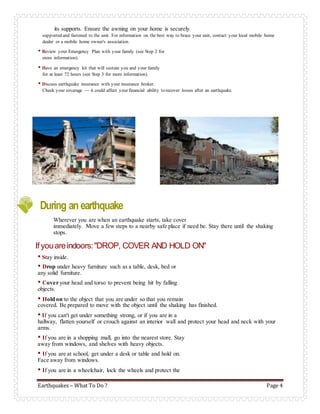
During an earthquake
Wherever you are when an earthquake starts, take cover
immediately. Move a few steps to a nearby safe place if need be. Stay there until the shaking
stops.
If youareindoors:"DROP, COVER AND HOLD ON"
• Stay inside.
• Drop under heavy furniture such as a table, desk, bed or
any solid furniture.
• Cover your head and torso to prevent being hit by falling
objects.
• Hold on to the object that you are under so that you remain
covered. Be prepared to move with the object until the shaking has finished.
• If you can't get under something strong, or if you are in a
hallway, flatten yourself or crouch against an interior wall and protect your head and neck with your
arms.
• If you are in a shopping mall, go into the nearest store. Stay
away from windows, and shelves with heavy objects.
• If you are at school, get under a desk or table and hold on.
Face away from windows.
• If you are in a wheelchair, lock the wheels and protect the
Earthquakes – What To Do ? Page 5
back of your head and neck.
If you are outdoors
• Stay outside.
• Go to an open area away from buildings. The most dangerous
place is near exterior walls.
• If you are in a crowded public place, take cover where you
won't be trampled.
If you are in a vehicle
• Pull over to a safe place where you are not blocking the road.
Keep roads clear for rescue and emergency vehicles.
• Avoid bridges, overpasses, underpasses, buildings or anything
that could collapse.
• Stop the car and stay inside.
• Listen to your car radio for instructions from emergency
officials.
• Do not attempt to get out of your car if downed power lines
are across it. Wait to be rescued.
• Place a HELP sign in your window if you need assistance.
• If you are on a bus, stay in your seat until the bus stops. Take
cover in a protected place. If you can't take cover, sit in a crouched position and protect your head
from falling debris.
AVOID the following in an earthquake
• Doorways. Doors may slam shut and cause injuries.
• Windows, bookcases, tall furniture and light fixtures. You could
be hurt by shattered glass or heavy objects.
• Elevators. If you are in an elevator during an earthquake, hit
the button for every floor and get out as soon as you can.
• Downed power lines — stay at least 10 metres away to
avoid injury.
• Coastline. Earthquakes can trigger large ocean waves called
tsunamis. If you are near a coastline in a high risk area during
a strong earthquake, immediately move inland or to higher
ground and remain there until officials declare the area safe.
Earthquakes – What To Do ? Page 6
Afteranearthquake
• Stay calm. Help others if you are able.
• Be prepared for aftershocks.
• Listen to the radio or television for information from
authorities. Follow their instructions.
• Place corded telephone receivers back in their cradles; only
make calls if requiring emergency services.
• Put on sturdy shoes and protective clothing to help prevent
injury from debris, especially broken glass.
• Check your home for structural damage and other hazards.
If you suspect your home is unsafe, do not re-enter.
• Unplug appliances and broken lights to prevent fire when the
power is restored.
• Stay away from brick walls and chimneys as they may be
damaged or weakened and could collapse during aftershocks.
Do not use your fireplace if your chimney has been damaged as a fire may start or gases
could be released.
• If you have to leave your home, take your emergency kit and
other essential items with you. Post a message in clear view,
indicating where you can be found. Do not waste food or water as supplies may be
interrupted.
• Do not light matches or turn on light switches until you are
sure there are no gas leaks or flammable liquids spilled. Use a flashlight to check utilities
and do not shut them off unless damaged. Leaking gas will smell like rotten eggs.
• If your home is equipped with natural gas: Call your gas
provider immediately to report any concerns or if you smell
gas (rotten egg smell). Shut off the gas valve if you know how. Once the gas is turned
off, don't turn it back on.
Only a licensed gas technician can turn the gas on safely.
• If tap water is still available immediately after the earthquake,
fill a bathtub and other containers in case the supply gets cut
off. If there is no running water, there may be water in the hot water tank (make sure
water is not hot before touching it) and toilet reservoir (not the bowl).
• Do not flush toilets if you suspect sewer lines are broken.
• Use extreme caution with hazardous materials or spills.
When in doubt, leave your home.
• Check on your neighbours after looking after members of
your own household. Organize rescue measures if people are trapped or call for
Earthquakes – What To Do ? Page 7
emergency assistance if you cannot safely help them.
• If you have pets, try to find and comfort them. If you have to
evacuate, take them to a pre-identified pet-friendly shelter.
• Place a HELP sign in your window if you need assistance.
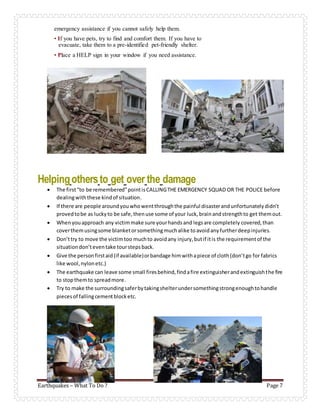
Helpingothersto get over the damage
 The first“to be remembered”pointisCALLINGTHE EMERGENCY SQUAD OR THE POLICE before
dealingwiththese kindof situation.
 If there are people aroundyouwhowentthroughthe painful disasterandunfortunatelydidn’t
provedtobe as luckyto be safe,thenuse some of your luck,brainandstrengthto get themout.
 Whenyouapproach any victimmake sure yourhandsand legsare completely covered,than
coverthemusingsome blanketorsomethingmuchalike toavoidanyfurtherdeepinjuries.
 Don’ttry to move the victimtoo muchto avoidany injury,butif itis the requirementof the
situationdon’teventake tourstepsback.
 Give the personfirstaid(if available)orbandage himwithapiece of cloth(don’tgo for fabrics
like wool,nylonetc.)
 The earthquake can leave some small firesbehind,findafire extinguisherandextinguishthe fire
to stopthemto spreadmore.
 Try to make the surroundingsaferbytakingshelterundersomethingstrongenoughtohandle
piecesof fallingcementblocketc.

Earthquakes! What To Do?

  • 1.
  • 2.
    Earthquakes – WhatTo Do ? Page 2 X - E
  • 3.
    Earthquakes – WhatTo Do ? Page 3 Before an earthquake Go through your home, imagining what could happen to each part of it, if shaken by a violent earthquake. Check off the items that you have completed in this list. • Teach everybody in the family (if they are old enough) how to turn off the water and electricity. • Clearly label the on-off positions for the water, electricity and gas. • Repair loose roof shingles. • Secure water heaters to wall studs or masonry using a bracing kit to reduce the possibility of the heater falling and rupturing gas and water connections. • Secure major appliances to walls, such as refrigerators. • Secure costly and heavy electronics. • Secure the tops of top-heavy furniture to a wall by anchoring to studs and using flexible fasteners. Keep heavy items on lower shelves. • Secure expensive or fragile items that if damaged would be a significant loss. • Affix mirrors, paintings and other hanging objects securely, so they won't fall off hooks. • Locate beds and chairs away from chimneys and windows. Don't hang heavy pictures and other items over beds. Closed curtains and blinds will help stop broken window glass from falling on beds. • Put anti-skid pads under TVs, computers and other small appliances, or secure them with Velcro or other such product. • Use child-proof or safety latches on cupboards to stop contents from spilling out. • Keep flammable items and household chemicals away from heat and where they are less likely to spill. • Secure items in the garage to reduce hazardous material spills and damage to vehicles. • Consult a professional for additional ways to protect your home, such as bolting the house to its foundation and other structural mitigation techniques. • If you live in an apartment block or a multi-storey building, work with your building manager or condominium board to decide how best to "quake-safe" your unit. Seek advice from professionals (building engineers, emergency preparedness authorities) if you are unsure about what to do. • If you live in a mobile home, you can leave the wheels on the mobile home to limit its fall. Or, you can install a structural bracing system to reduce the chance of your unit falling off
  • 4.
    Earthquakes – WhatTo Do ? Page 4 its supports. Ensure the awning on your home is securely supported and fastened to the unit. For information on the best way to brace your unit, contact your local mobile home dealer or a mobile home owner's association. • Review your Emergency Plan with your family (see Step 2 for more information). • Have an emergency kit that will sustain you and your family for at least 72 hours (see Step 3 for more information). • Discuss earthquake insurance with your insurance broker. Check your coverage — it could affect your financial ability to recover losses after an earthquake. During an earthquake Wherever you are when an earthquake starts, take cover immediately. Move a few steps to a nearby safe place if need be. Stay there until the shaking stops. If youareindoors:"DROP, COVER AND HOLD ON" • Stay inside. • Drop under heavy furniture such as a table, desk, bed or any solid furniture. • Cover your head and torso to prevent being hit by falling objects. • Hold on to the object that you are under so that you remain covered. Be prepared to move with the object until the shaking has finished. • If you can't get under something strong, or if you are in a hallway, flatten yourself or crouch against an interior wall and protect your head and neck with your arms. • If you are in a shopping mall, go into the nearest store. Stay away from windows, and shelves with heavy objects. • If you are at school, get under a desk or table and hold on. Face away from windows. • If you are in a wheelchair, lock the wheels and protect the
  • 5.
    Earthquakes – WhatTo Do ? Page 5 back of your head and neck. If you are outdoors • Stay outside. • Go to an open area away from buildings. The most dangerous place is near exterior walls. • If you are in a crowded public place, take cover where you won't be trampled. If you are in a vehicle • Pull over to a safe place where you are not blocking the road. Keep roads clear for rescue and emergency vehicles. • Avoid bridges, overpasses, underpasses, buildings or anything that could collapse. • Stop the car and stay inside. • Listen to your car radio for instructions from emergency officials. • Do not attempt to get out of your car if downed power lines are across it. Wait to be rescued. • Place a HELP sign in your window if you need assistance. • If you are on a bus, stay in your seat until the bus stops. Take cover in a protected place. If you can't take cover, sit in a crouched position and protect your head from falling debris. AVOID the following in an earthquake • Doorways. Doors may slam shut and cause injuries. • Windows, bookcases, tall furniture and light fixtures. You could be hurt by shattered glass or heavy objects. • Elevators. If you are in an elevator during an earthquake, hit the button for every floor and get out as soon as you can. • Downed power lines — stay at least 10 metres away to avoid injury. • Coastline. Earthquakes can trigger large ocean waves called tsunamis. If you are near a coastline in a high risk area during a strong earthquake, immediately move inland or to higher ground and remain there until officials declare the area safe.
  • 6.
    Earthquakes – WhatTo Do ? Page 6 Afteranearthquake • Stay calm. Help others if you are able. • Be prepared for aftershocks. • Listen to the radio or television for information from authorities. Follow their instructions. • Place corded telephone receivers back in their cradles; only make calls if requiring emergency services. • Put on sturdy shoes and protective clothing to help prevent injury from debris, especially broken glass. • Check your home for structural damage and other hazards. If you suspect your home is unsafe, do not re-enter. • Unplug appliances and broken lights to prevent fire when the power is restored. • Stay away from brick walls and chimneys as they may be damaged or weakened and could collapse during aftershocks. Do not use your fireplace if your chimney has been damaged as a fire may start or gases could be released. • If you have to leave your home, take your emergency kit and other essential items with you. Post a message in clear view, indicating where you can be found. Do not waste food or water as supplies may be interrupted. • Do not light matches or turn on light switches until you are sure there are no gas leaks or flammable liquids spilled. Use a flashlight to check utilities and do not shut them off unless damaged. Leaking gas will smell like rotten eggs. • If your home is equipped with natural gas: Call your gas provider immediately to report any concerns or if you smell gas (rotten egg smell). Shut off the gas valve if you know how. Once the gas is turned off, don't turn it back on. Only a licensed gas technician can turn the gas on safely. • If tap water is still available immediately after the earthquake, fill a bathtub and other containers in case the supply gets cut off. If there is no running water, there may be water in the hot water tank (make sure water is not hot before touching it) and toilet reservoir (not the bowl). • Do not flush toilets if you suspect sewer lines are broken. • Use extreme caution with hazardous materials or spills. When in doubt, leave your home. • Check on your neighbours after looking after members of your own household. Organize rescue measures if people are trapped or call for
  • 7.
    Earthquakes – WhatTo Do ? Page 7 emergency assistance if you cannot safely help them. • If you have pets, try to find and comfort them. If you have to evacuate, take them to a pre-identified pet-friendly shelter. • Place a HELP sign in your window if you need assistance. Helpingothersto get over the damage  The first“to be remembered”pointisCALLINGTHE EMERGENCY SQUAD OR THE POLICE before dealingwiththese kindof situation.  If there are people aroundyouwhowentthroughthe painful disasterandunfortunatelydidn’t provedtobe as luckyto be safe,thenuse some of your luck,brainandstrengthto get themout.  Whenyouapproach any victimmake sure yourhandsand legsare completely covered,than coverthemusingsome blanketorsomethingmuchalike toavoidanyfurtherdeepinjuries.  Don’ttry to move the victimtoo muchto avoidany injury,butif itis the requirementof the situationdon’teventake tourstepsback.  Give the personfirstaid(if available)orbandage himwithapiece of cloth(don’tgo for fabrics like wool,nylonetc.)  The earthquake can leave some small firesbehind,findafire extinguisherandextinguishthe fire to stopthemto spreadmore.  Try to make the surroundingsaferbytakingshelterundersomethingstrongenoughtohandle piecesof fallingcementblocketc.