EARTHQUAKE
The sudden and violent shaking experienced during an
earthquake is caused by the shifting and breaking of
subterranean rocks. Earthquakes can happen almost anywhere
and anytime without warning, so you and your family should be
prepared.

How to Prepare for an Earthquake
•   Minimize home hazards by bolting shelves, bookcases,
    china cabinets and other tall furniture and strapping the water heater to structural elements in the
    walls.
•   Identify a safe place in every room of your home where nothing can fall on you, such as under a
    table, against a wall or in a doorway.
•   Practice earthquake drills as a family so everyone knows what to do, especially “Drop, Cover,
    and Hold On!”
•   Get an emergency supply kit, and store it where it can be accessed by all family members.
•   Develop an evacuation procedure as a family.
•   Develop an emergency communication procedure in case family members are separated during
    an earthquake.

What to Do If There Is an Earthquake
•   If you are indoors:
    ○ Do not run outside. There may be falling debris.
    ○ If possible, DROP to the floor, take COVER under a table or sturdy piece of furniture and
         HOLD ON until the shaking stops.
    ○ If you are not near any sturdy furniture, crouch in a corner or in a stable doorway where there
         is less chance of things falling on you.
    ○ Stay away from windows, light fixtures, unstable furniture or anything that could fall.
    ○ Stay inside until the shaking stops and you are absolutely sure it is safe to go outside.
    ○ The electricity may go out, so don’t use elevators.
•   If you are outdoors:
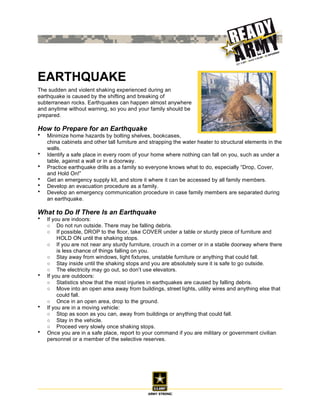
    ○ Statistics show that the most injuries in earthquakes are caused by falling debris.
    ○ Move into an open area away from buildings, street lights, utility wires and anything else that
         could fall.
    ○ Once in an open area, drop to the ground.
•   If you are in a moving vehicle:
    ○ Stop as soon as you can, away from buildings or anything that could fall.
    ○ Stay in the vehicle.
    ○ Proceed very slowly once shaking stops.
•   Once you are in a safe place, report to your command if you are military or government civilian
    personnel or a member of the selective reserves.
What to Do When the Shaking Stops
•   Check yourself and others for injuries.
•   Turn off any building gas supply if you suspect a leak.
•   Stay tuned to the radio for further information and instructions.
•   Expect aftershocks, which can come minutes, hours or days after an earthquake.
•   If an aftershock happens, “Drop, Cover and Hold On.”
•   Be very careful of falling debris in homes or outdoors. This is how most injuries occur.
•   If you are trapped beneath debris:
    ○ Do not light a match for light. There may be gas leaks in the area.
    ○ Do not move around or kick up dust.
    ○ Cover your mouth with a handkerchief or piece of clothing to reduce dust inhalation.
    ○ Tap on a pipe (preferably with something that won’t cause a spark) or use a whistle to help
         rescuers find you. Shout only as a last resort as it will increase dust inhalation.
•   If you live near the ocean, be aware of possible tsunamis, which are caused by earthquakes off
    the coast.

Where to Find Additional Information
•   Ready Army—www.ready.army.mil
•   American Red Cross—www.redcross.org
•   Centers for Disease Control and Prevention (CDC)—www.bt.cdc.gov/disasters/earthquakes/
•   Department of Homeland Security (Ready.gov)—
    www.ready.gov./america/beinformed/earthquakes.html
•   Federal Emergency Management Agency (FEMA)—
    http://www.fema.gov/hazard/earthquake/index.shtm


It’s up to you. Prepare strong. Get an emergency supply kit with enough supplies for at least three
     days, make an emergency plan with your family and be informed about what might happen.

Earthquake fact sheet[1]

  • 1.
    EARTHQUAKE The sudden andviolent shaking experienced during an earthquake is caused by the shifting and breaking of subterranean rocks. Earthquakes can happen almost anywhere and anytime without warning, so you and your family should be prepared. How to Prepare for an Earthquake • Minimize home hazards by bolting shelves, bookcases, china cabinets and other tall furniture and strapping the water heater to structural elements in the walls. • Identify a safe place in every room of your home where nothing can fall on you, such as under a table, against a wall or in a doorway. • Practice earthquake drills as a family so everyone knows what to do, especially “Drop, Cover, and Hold On!” • Get an emergency supply kit, and store it where it can be accessed by all family members. • Develop an evacuation procedure as a family. • Develop an emergency communication procedure in case family members are separated during an earthquake. What to Do If There Is an Earthquake • If you are indoors: ○ Do not run outside. There may be falling debris. ○ If possible, DROP to the floor, take COVER under a table or sturdy piece of furniture and HOLD ON until the shaking stops. ○ If you are not near any sturdy furniture, crouch in a corner or in a stable doorway where there is less chance of things falling on you. ○ Stay away from windows, light fixtures, unstable furniture or anything that could fall. ○ Stay inside until the shaking stops and you are absolutely sure it is safe to go outside. ○ The electricity may go out, so don’t use elevators. • If you are outdoors: ○ Statistics show that the most injuries in earthquakes are caused by falling debris. ○ Move into an open area away from buildings, street lights, utility wires and anything else that could fall. ○ Once in an open area, drop to the ground. • If you are in a moving vehicle: ○ Stop as soon as you can, away from buildings or anything that could fall. ○ Stay in the vehicle. ○ Proceed very slowly once shaking stops. • Once you are in a safe place, report to your command if you are military or government civilian personnel or a member of the selective reserves.
  • 2.
    What to DoWhen the Shaking Stops • Check yourself and others for injuries. • Turn off any building gas supply if you suspect a leak. • Stay tuned to the radio for further information and instructions. • Expect aftershocks, which can come minutes, hours or days after an earthquake. • If an aftershock happens, “Drop, Cover and Hold On.” • Be very careful of falling debris in homes or outdoors. This is how most injuries occur. • If you are trapped beneath debris: ○ Do not light a match for light. There may be gas leaks in the area. ○ Do not move around or kick up dust. ○ Cover your mouth with a handkerchief or piece of clothing to reduce dust inhalation. ○ Tap on a pipe (preferably with something that won’t cause a spark) or use a whistle to help rescuers find you. Shout only as a last resort as it will increase dust inhalation. • If you live near the ocean, be aware of possible tsunamis, which are caused by earthquakes off the coast. Where to Find Additional Information • Ready Army—www.ready.army.mil • American Red Cross—www.redcross.org • Centers for Disease Control and Prevention (CDC)—www.bt.cdc.gov/disasters/earthquakes/ • Department of Homeland Security (Ready.gov)— www.ready.gov./america/beinformed/earthquakes.html • Federal Emergency Management Agency (FEMA)— http://www.fema.gov/hazard/earthquake/index.shtm It’s up to you. Prepare strong. Get an emergency supply kit with enough supplies for at least three days, make an emergency plan with your family and be informed about what might happen.