Preparedness for Disaster
“Earthquake”
DYNAMIC
INSTITUTION OF SKILL DEVELOPMENT
What is Disasters?
Nobody expects an emergency or disaster – especially
one that affects, the simple truth is that emergencies and
disasters can strike anyone, anytime, and anywhere.
The best way to protect our self/family, our students/
staffs/ workers, and our business is to expect the unexpected.
And develop a well designed emergency action plan/drills
and training to guide us when immediate action is necessary.
The best way is to prepare yourself to respond to an
emergency before it happens, so it is important to do so in
advance, when you have time to be thorough.
Are You Prepared?
 What if an
earthquake struck
our community?
What is an Earthquake?
An earthquake is a sudden, rapid shaking of the
ground caused by the breaking and shifting of
rock beneath the earth's surface.
Earthquakes may occur at any time with little or
no advanced warning.
An earthquake’s magnitude or “energy release”
is measured on the Moment magnitude (Mw)
scale.
How to Recognize Earthquake
Magnitude?
 Felt by instruments only
 Felt by sensitive people and sensitive animals
 Felt by many people
 Felt by everyone; pictures fall off of walls
 Damage
 Destruction of nearby communities
Some Hazards of an Earthquake
 Structures to collapse (buildings, bridges,
dams, etc.)
 Damage to utilities (gas, electric, phone, etc.)
 Landslides
 Flash floods
 Fires
 Sea waves
(Tidal waves and Tsunamis)
 Liquefaction (Building tilt/sink )
Earthquake Response
While the signal is ongoing, move away from
windows, glass and unfastened objects.
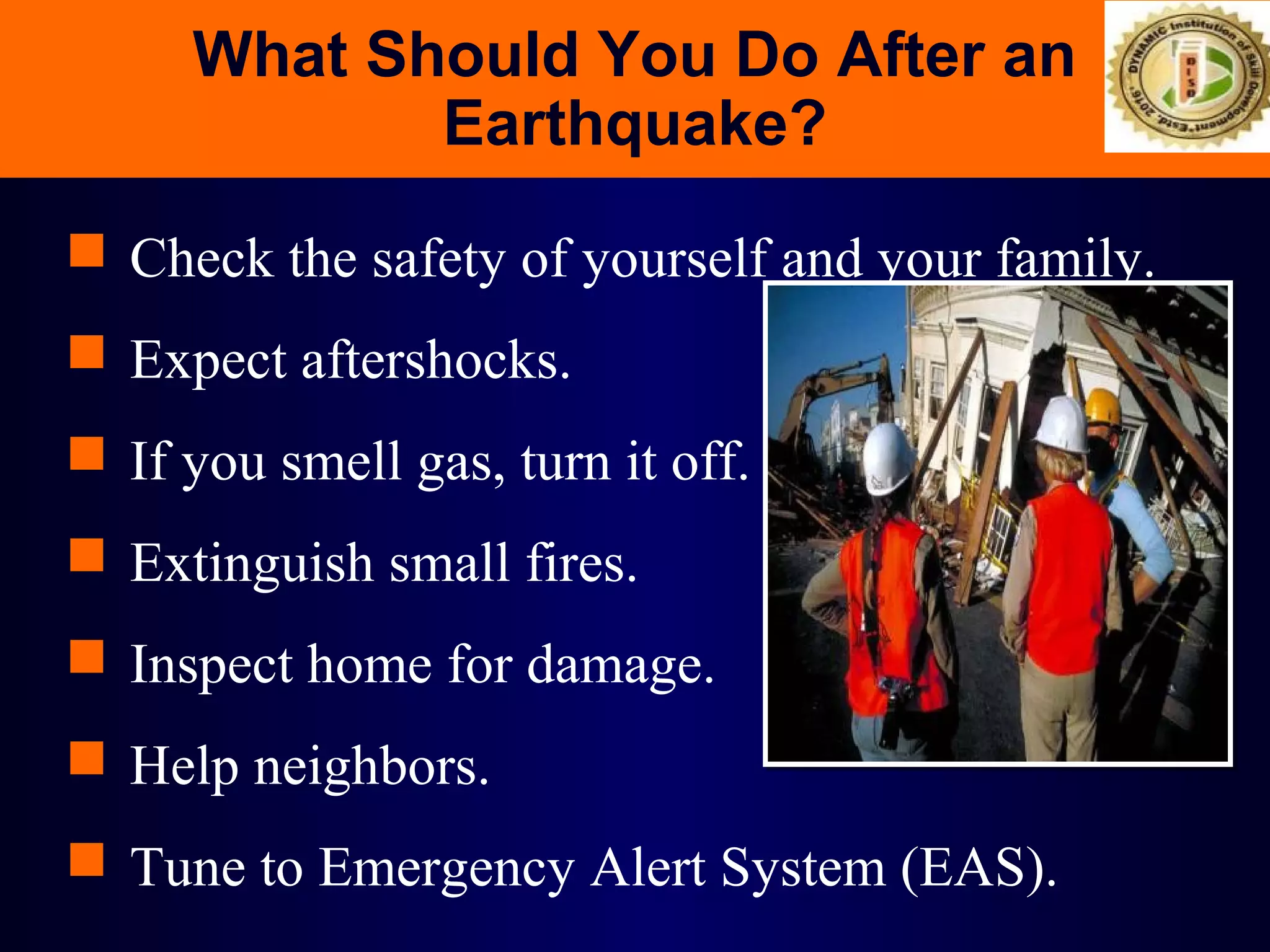
Everyone should perform “drop, cover and hold”
under tables, desks or chairs until the “shaking” signal
stops.
School bags can be used to protect head where
sufficient number of desks are not available or where
there are no desks at all.
If outdoors, find a spot away from buildings, trees,
streetlights, power lines, and overpasses.
If in a vehicle, drive to a clear spot and stop.
Remember
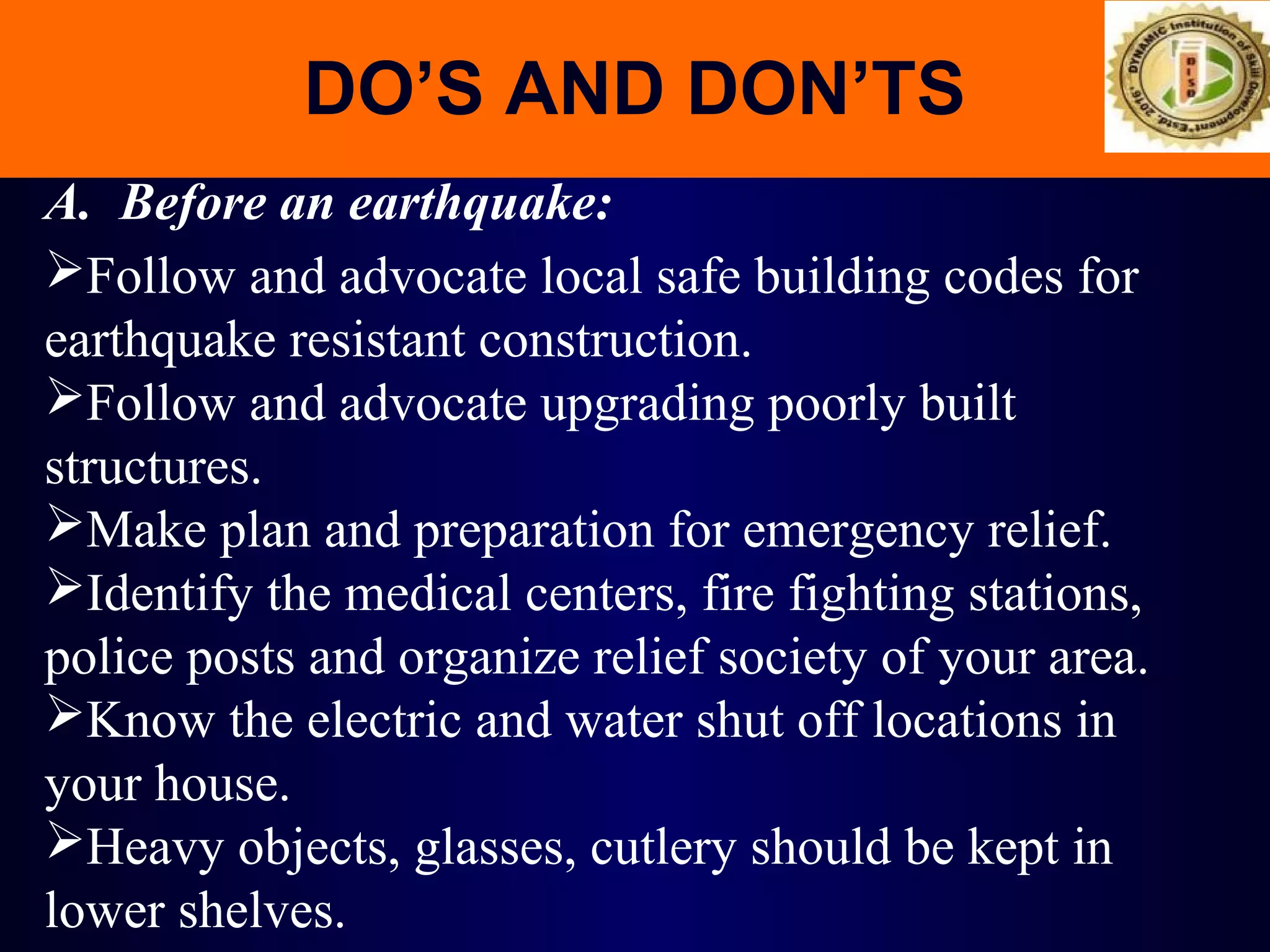
What Should You Do After an
Earthquake?
 Check the safety of yourself and your family.
 Expect aftershocks.
 If you smell gas, turn it off.
 Extinguish small fires.
 Inspect home for damage.
 Help neighbors.
 Tune to Emergency Alert System (EAS).
DO’S AND DON’TS
A.  Before an earthquake:
Follow and advocate local safe building codes for
earthquake resistant construction.
Follow and advocate upgrading poorly built
structures.
Make plan and preparation for emergency relief.
Identify the medical centers, fire fighting stations,
police posts and organize relief society of your area.
Know the electric and water shut off locations in
your house.
Heavy objects, glasses, cutlery should be kept in
lower shelves.
DO’S AND DON’TS
B.  During an earthquake: 
Keep calm and reassure others.
During the event, the safest place is an open space,
away from buildings.
If you are indoors, take cover under a desk, table,
bed or doorways and against inside alls and
staircase. Stay away from glass doors, glass panes,
windows or outside doors. Do not rush to go out of
the building, to avoid stampede.
If you are outside, move away from buildings and
utility wires.
DO’S AND DON’TS
B.  During an earthquake: (continued)
Once in the open, stay there till the vibrations
stops.
If you are in a moving vehicle, stop as quickly as
possible and stay in the vehicle.
Free all pets and domestic animals so that they can
run outside.
Do not use candles, matches or other open flames.
Put out all fires.
DO’S AND DON’TS
C.   After an earthquake: 
Keep stock of drinking water, foodstuff and first-
aid equipment in accessible place.
Do not spread and believe rumours.
Turn on your transistor or television to get the
latest information/bulletins and aftershock warnings.
Provide help to others and develop confidence.
Attend the injured persons and give them aid,
whatever is possible and also inform hospital.
Be prepared for aftershocks as these may strike.
DO’S AND DON’TS
C.   After an earthquake: (continued)
Close the valve of kitchen gas stove, if it is on. If it
is closed, do not open. Do not use open flames.
Do not operate electric switches or appliances, if
gas leaks are suspected.
Check water pipes, electric lines and fittings. If
damaged, shut off the main valves. Do not touch live
wires of electricity.
If needed, open doors and cup boards carefully as
objects may fall.
Quiz
 The class A extinguisher is used for
putting out metal fires. True or False
 Name two potential fire hazards in your
School__________________ and
__________________.
 If someone is on fire, it is best to
use an extinguisher on the person. True or False
 Describe the first two things you should do if you spot
a fire: ______________ and ______________.
Quiz (cont.)
 What is the most dangerous
habit to have when working
with flammable chemicals?
 Prior to evacuating out the
nearest exit, you should
________________________
_
 Which type of natural disaster
is most likely to strike your
community?
Summary
Proper training is a key component of a safe
response.
Understand how to prevent emergencies
Understand emergency response
Only use fire-fighting equipment if trained
Know your role in an Emergency
Apply this information (also applies at home)
About Training Provider
Why This Training Tool Was Created
This training tool was created by the “DYNAMIC
Institution of Skill Development” in public and
society safety interest, so that people can aware and
mitigate the loss of disaster
THANK YOU!
Prepared by Mohammad Naushad
Contact- www.dynamicskilldev.com
Email- go.dynamicskill@gmail.com

Preparedness for earthquake

  • 1.
  • 2.
    What is Disasters? Nobodyexpects an emergency or disaster – especially one that affects, the simple truth is that emergencies and disasters can strike anyone, anytime, and anywhere. The best way to protect our self/family, our students/ staffs/ workers, and our business is to expect the unexpected. And develop a well designed emergency action plan/drills and training to guide us when immediate action is necessary. The best way is to prepare yourself to respond to an emergency before it happens, so it is important to do so in advance, when you have time to be thorough.
  • 3.
    Are You Prepared? What if an earthquake struck our community?
  • 4.
    What is anEarthquake? An earthquake is a sudden, rapid shaking of the ground caused by the breaking and shifting of rock beneath the earth's surface. Earthquakes may occur at any time with little or no advanced warning. An earthquake’s magnitude or “energy release” is measured on the Moment magnitude (Mw) scale.
  • 5.
    How to RecognizeEarthquake Magnitude?  Felt by instruments only  Felt by sensitive people and sensitive animals  Felt by many people  Felt by everyone; pictures fall off of walls  Damage  Destruction of nearby communities
  • 6.
    Some Hazards ofan Earthquake  Structures to collapse (buildings, bridges, dams, etc.)  Damage to utilities (gas, electric, phone, etc.)  Landslides  Flash floods  Fires  Sea waves (Tidal waves and Tsunamis)  Liquefaction (Building tilt/sink )
  • 7.
    Earthquake Response While thesignal is ongoing, move away from windows, glass and unfastened objects. Everyone should perform “drop, cover and hold” under tables, desks or chairs until the “shaking” signal stops. School bags can be used to protect head where sufficient number of desks are not available or where there are no desks at all. If outdoors, find a spot away from buildings, trees, streetlights, power lines, and overpasses. If in a vehicle, drive to a clear spot and stop.
  • 8.
  • 9.
    What Should YouDo After an Earthquake?  Check the safety of yourself and your family.  Expect aftershocks.  If you smell gas, turn it off.  Extinguish small fires.  Inspect home for damage.  Help neighbors.  Tune to Emergency Alert System (EAS).
  • 10.
    DO’S AND DON’TS A.  Before an earthquake: Followand advocate local safe building codes for earthquake resistant construction. Follow and advocate upgrading poorly built structures. Make plan and preparation for emergency relief. Identify the medical centers, fire fighting stations, police posts and organize relief society of your area. Know the electric and water shut off locations in your house. Heavy objects, glasses, cutlery should be kept in lower shelves.
  • 11.
    DO’S AND DON’TS B.  During an earthquake:  Keepcalm and reassure others. During the event, the safest place is an open space, away from buildings. If you are indoors, take cover under a desk, table, bed or doorways and against inside alls and staircase. Stay away from glass doors, glass panes, windows or outside doors. Do not rush to go out of the building, to avoid stampede. If you are outside, move away from buildings and utility wires.
  • 12.
    DO’S AND DON’TS B.  During an earthquake: (continued) Oncein the open, stay there till the vibrations stops. If you are in a moving vehicle, stop as quickly as possible and stay in the vehicle. Free all pets and domestic animals so that they can run outside. Do not use candles, matches or other open flames. Put out all fires.
  • 13.
    DO’S AND DON’TS C.   After an earthquake:  Keepstock of drinking water, foodstuff and first- aid equipment in accessible place. Do not spread and believe rumours. Turn on your transistor or television to get the latest information/bulletins and aftershock warnings. Provide help to others and develop confidence. Attend the injured persons and give them aid, whatever is possible and also inform hospital. Be prepared for aftershocks as these may strike.
  • 14.
    DO’S AND DON’TS C.   After an earthquake: (continued) Closethe valve of kitchen gas stove, if it is on. If it is closed, do not open. Do not use open flames. Do not operate electric switches or appliances, if gas leaks are suspected. Check water pipes, electric lines and fittings. If damaged, shut off the main valves. Do not touch live wires of electricity. If needed, open doors and cup boards carefully as objects may fall.
  • 15.
    Quiz  The classA extinguisher is used for putting out metal fires. True or False  Name two potential fire hazards in your School__________________ and __________________.  If someone is on fire, it is best to use an extinguisher on the person. True or False  Describe the first two things you should do if you spot a fire: ______________ and ______________.
  • 16.
    Quiz (cont.)  Whatis the most dangerous habit to have when working with flammable chemicals?  Prior to evacuating out the nearest exit, you should ________________________ _  Which type of natural disaster is most likely to strike your community?
  • 17.
    Summary Proper training isa key component of a safe response. Understand how to prevent emergencies Understand emergency response Only use fire-fighting equipment if trained Know your role in an Emergency Apply this information (also applies at home)
  • 18.
    About Training Provider WhyThis Training Tool Was Created This training tool was created by the “DYNAMIC Institution of Skill Development” in public and society safety interest, so that people can aware and mitigate the loss of disaster THANK YOU! Prepared by Mohammad Naushad Contact- www.dynamicskilldev.com Email- go.dynamicskill@gmail.com

Editor's Notes

  • #2 I. Speaker’s Notes: The Occupational Safety and Health Administration (OSHA) requires employers to have written emergency action and fire prevention plans. These plans must contain information such as: Evacuation procedures Alarm systems Fire hazards and prevention Fire response procedures Fire protection equipment Training information Today’s class will cover all of these topics and more. Your role in an emergency is vital whether it is preventing a fire, reporting an incident, responding to the incident, or evacuating the area.
  • #3 I. Speaker’s Notes: No one expects an emergency situation to happen; fortunately, they are not common occurrences. But even if there’s just a minute possibility of an emergency where you work, you need to be prepared. Knowing what to do in the event of an emergency could save your life—as well as those of your co-workers. By the end of the class, you will know your role in an emergency and how to respond to an alarm.
  • #4 I. Speaker’s Notes: No one expects an emergency situation to happen; fortunately, they are not common occurrences. But even if there’s just a minute possibility of an emergency where you work, you need to be prepared. Knowing what to do in the event of an emergency could save your life—as well as those of your co-workers. By the end of the class, you will know your role in an emergency and how to respond to an alarm.
  • #16 I. Background for the Trainer: Remind employees that the quiz is to encourage further discussion and to help you, the trainer, ensure that everyone understands what was discussed.