Sources: DO No. 48, s. 2012, National Christian Life College, DOST/PHIVOLCS
charlyngarcia5@gmail.com
MOBO CENTRAL SCHOOL
Mobo North District
Mobo, Masbate
EARTHQUAKE AND FIRE SAFETY
PRECAUTIONS
STAGE 1
Form a School Disaster Management Committee
(SDMC)
 Over-all Coordinator
 First Aid Team
 Fire Safety Team
 Communication Team
 Building Safety Inspection Team
 Evacuation Team
 Site Security Team
Prepare Earthquake Survival Kit
Basic items inside an earthquake survival kit
1. First Aid Kit
(Alcohol, bondage,absorbent cotton,gauze,
masks, adhesive plasters,medicines & tweezers)
2. Food
3. Bottled water
4. Flashlights & extra batteries
5. Radio (battery operated)
6. Lighters & matches
7. Whistle
8. Knife
9. Blankets & spare clothes
10. Rope – at least 7 meters long
11. Toiletries
12. Pen & paper
13. Emergency contact numbers
14. Cash
SMDC should:
 Have the yearly update on information of school
population
 Prepare the most recent school map
 Prepare the building floor plan of each building
SMDC should conduct School Watching Exercise
 Observe safe and unsafe zones
 Suggest corrections for improvements
 Assess the structural integrity of the building/s
 Assess if the school is tsunami prone
Good practices and safe zones
 Swing out door
 Wide corridors
 Wide open space for evacuation
 Fire exits
 Public alarm system
Some of the unsafe zones
 Windows and glass panes
 Book shelves, machinery, cabinets and furniture
that may topple of slide
 Narrow alleys
avoid passing
near water
tank
narrow exit
STAGE 2
Developing the Earthquake Evaluation Plan
 Use all available OPEN SPACES nearest to the
building
 Determine if there is sufficient space for all, set a
buffer zone from the building.
Length x width = area
(how many pupils? / 1 square meter)
(Consider the number of pupils in each
building per session)
 Make sure that evacuation route will not expose
the pupils/students to additionalhazards
 School Earthquake Evacuation Plan
STAGE 3
Orientation Prior to the Conduct of an Earthquake
Drill
A. Preparations
1. Conduct of lectures about earthquake
2. Conduct classroom hazard observation
activity
3. Introduce evacuation plan
4. Introduce assigned evacuation area
5. Post the school evacuation map in every
classroomand bulletin board
6. Assigned pupil/student in-charge of making
sure the door is open during shaking
7. Assign observers and evaluators who will
give comments and suggestions
8. Inform the neighbourhood about the drill
9. Check available alarm system
10. Assign class marshall
11. Take note of persons with disabilities (PWD),
pregnant and elderly and identify their
locations for evacuation
12. Assign marshalls to assist the PWD, pregnant
and elderly during evacuation
B. Protect yourself
What to do DURING an earthquake
 DROP, COVER and HOLD ON
 Watch out for falling objects
 Keep calm and don’t panic
 Keep away from glass window and heavy shelves
STAGE 4
Actual Conduct of an Earthquake Drill
PHASES OF AN EARTHQUAKE DRILL
Phase 1: Alarm
 During the drill, the 1-minute alarm indicates
earthquake or shaking
Sources: DO No. 48, s. 2012, National Christian Life College, DOST/PHIVOLCS
charlyngarcia5@gmail.com
Phase 2: Response
 While the alarm is on-going, everyone should
perform “duck, cover and hold”. Remain in this
position until the “shaking stops”
 Use the book to cover your head
 Hide under an arm chair
Phase 3: Evacuation
 As soon as the shaking stops, immediately
evacuate the school building and proceed to
identified evacuation areas using the pre-
determined routes guided by the class marshall or
teacher.
Phase 4: Assembly
 At the designated evacuation area, pupils must be
grouped togetheraccording to the class where they
belong.
Phase 5: Head Count
 Teacher should check and make sure all pupils are
accounted for.
Phase 6: Evaluation
 The over-all coordinator will announce the
termination of drill or “All clear”
 An evaluation of the drill must be conducted to
identify problems encountered during the drill and
how these can be improved in future earthquake
drills.
 Observers will give their comments and
suggestions when all are gathered in the
evacuation areas
WHEN IS THE TIME TO EVACUATE?
After a very strong earthquake wherein you lose balance or
could not stand, and heavy objects and furniture start to be
removed or shifted.
As need arises or as declared by authorities
SCHOOL DISASTER MANAGEMENT COUNCIL
SCHOOL WATCHING TEAM
Mobo Central School
Mobo North District
Chairman - Vicente L. Mayor, Ph.D.
Vice Chairman - Josephine Sabacco
Fire Safety Team - Roldan Amante
Members - Ma. Consolacion Viterbo
Pacita Rañola
Gloria Duran
Elizabeth Esquillo
Building Safety - Orlando Almario Jr.
Inspection Team Simona Castillo
Members - Nikki Rosero
Ma. Cristina Ponciano
Marivic Arizala
Site Security Team- Nagel Alicante
Members - Belenda Alicante
Evelyn Francisco
Gemma Ramos
Marichu Aguilar
Evacuation Team - Jesus Tumbaga
Members - Shirley Aban
Catherine Connie T. Duran
Emeline T. Abella
Josiemar Mangaliman
First Aide/Relief - Jocelyn Bueno
Members - Susan Duran
Charlyn G. Capinig
Catherine Tidon
Luz S. Triambulo
Administrative Aide- Jaime Castillo
Jovel Castillo
Heracleo Clores Jr.
Orlando Goyon
Student-Led Watching Team - Allona Cryzza Tidon
Members -
Prepared by:
CHARLYN G. CAPINIG
Teacher, Mobo Central School

EARTHQUAKE AND FIRE SAFETY PRECAUTIONS

  • 1.
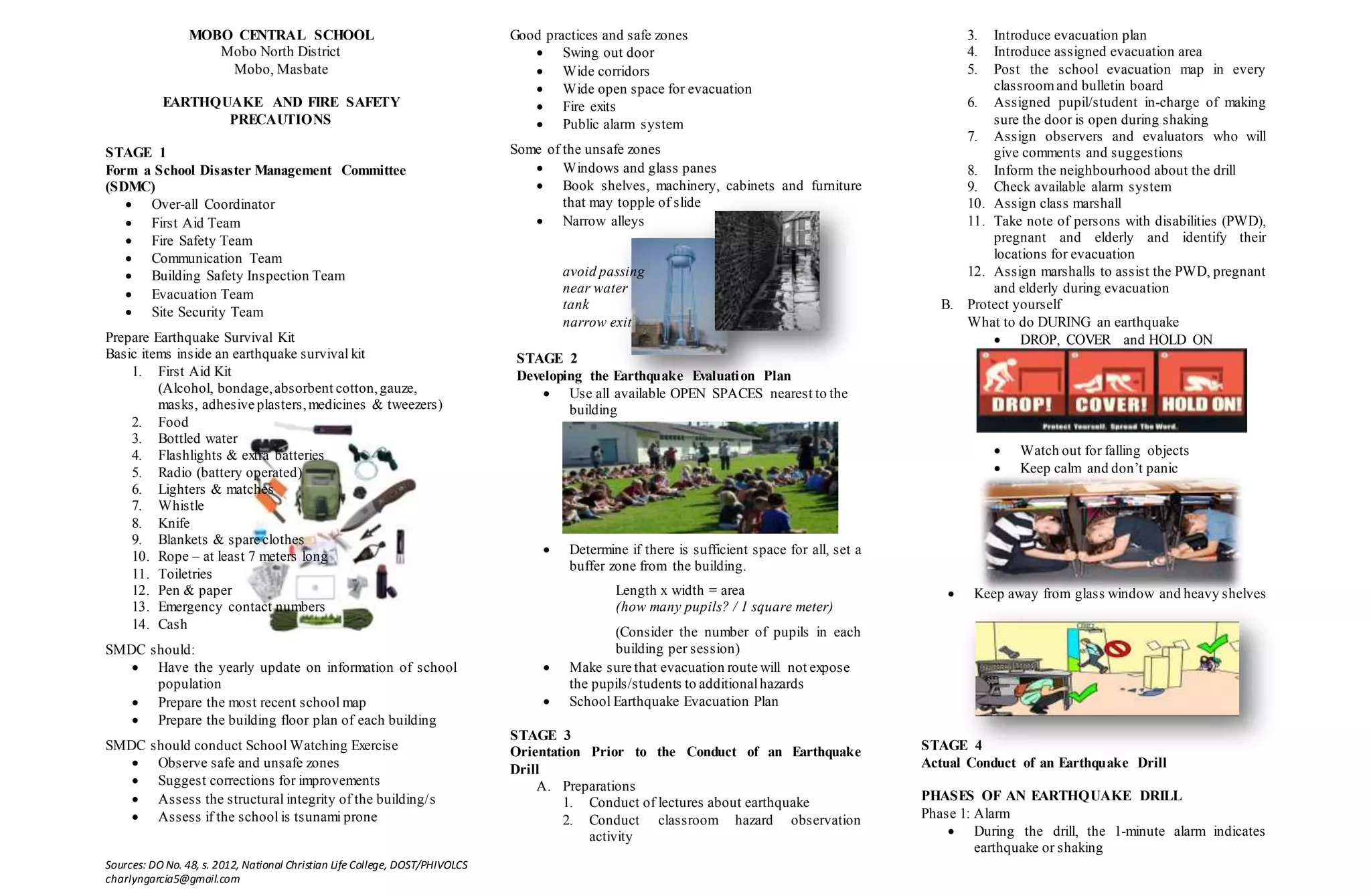
    Sources: DO No.48, s. 2012, National Christian Life College, DOST/PHIVOLCS charlyngarcia5@gmail.com MOBO CENTRAL SCHOOL Mobo North District Mobo, Masbate EARTHQUAKE AND FIRE SAFETY PRECAUTIONS STAGE 1 Form a School Disaster Management Committee (SDMC)  Over-all Coordinator  First Aid Team  Fire Safety Team  Communication Team  Building Safety Inspection Team  Evacuation Team  Site Security Team Prepare Earthquake Survival Kit Basic items inside an earthquake survival kit 1. First Aid Kit (Alcohol, bondage,absorbent cotton,gauze, masks, adhesive plasters,medicines & tweezers) 2. Food 3. Bottled water 4. Flashlights & extra batteries 5. Radio (battery operated) 6. Lighters & matches 7. Whistle 8. Knife 9. Blankets & spare clothes 10. Rope – at least 7 meters long 11. Toiletries 12. Pen & paper 13. Emergency contact numbers 14. Cash SMDC should:  Have the yearly update on information of school population  Prepare the most recent school map  Prepare the building floor plan of each building SMDC should conduct School Watching Exercise  Observe safe and unsafe zones  Suggest corrections for improvements  Assess the structural integrity of the building/s  Assess if the school is tsunami prone Good practices and safe zones  Swing out door  Wide corridors  Wide open space for evacuation  Fire exits  Public alarm system Some of the unsafe zones  Windows and glass panes  Book shelves, machinery, cabinets and furniture that may topple of slide  Narrow alleys avoid passing near water tank narrow exit STAGE 2 Developing the Earthquake Evaluation Plan  Use all available OPEN SPACES nearest to the building  Determine if there is sufficient space for all, set a buffer zone from the building. Length x width = area (how many pupils? / 1 square meter) (Consider the number of pupils in each building per session)  Make sure that evacuation route will not expose the pupils/students to additionalhazards  School Earthquake Evacuation Plan STAGE 3 Orientation Prior to the Conduct of an Earthquake Drill A. Preparations 1. Conduct of lectures about earthquake 2. Conduct classroom hazard observation activity 3. Introduce evacuation plan 4. Introduce assigned evacuation area 5. Post the school evacuation map in every classroomand bulletin board 6. Assigned pupil/student in-charge of making sure the door is open during shaking 7. Assign observers and evaluators who will give comments and suggestions 8. Inform the neighbourhood about the drill 9. Check available alarm system 10. Assign class marshall 11. Take note of persons with disabilities (PWD), pregnant and elderly and identify their locations for evacuation 12. Assign marshalls to assist the PWD, pregnant and elderly during evacuation B. Protect yourself What to do DURING an earthquake  DROP, COVER and HOLD ON  Watch out for falling objects  Keep calm and don’t panic  Keep away from glass window and heavy shelves STAGE 4 Actual Conduct of an Earthquake Drill PHASES OF AN EARTHQUAKE DRILL Phase 1: Alarm  During the drill, the 1-minute alarm indicates earthquake or shaking
  • 2.
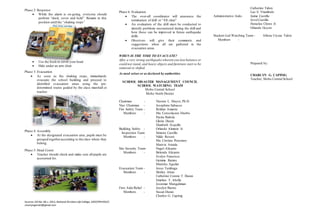
    Sources: DO No.48, s. 2012, National Christian Life College, DOST/PHIVOLCS charlyngarcia5@gmail.com Phase 2: Response  While the alarm is on-going, everyone should perform “duck, cover and hold”. Remain in this position until the “shaking stops”  Use the book to cover your head  Hide under an arm chair Phase 3: Evacuation  As soon as the shaking stops, immediately evacuate the school building and proceed to identified evacuation areas using the pre- determined routes guided by the class marshall or teacher. Phase 4: Assembly  At the designated evacuation area, pupils must be grouped togetheraccording to the class where they belong. Phase 5: Head Count  Teacher should check and make sure all pupils are accounted for. Phase 6: Evaluation  The over-all coordinator will announce the termination of drill or “All clear”  An evaluation of the drill must be conducted to identify problems encountered during the drill and how these can be improved in future earthquake drills.  Observers will give their comments and suggestions when all are gathered in the evacuation areas WHEN IS THE TIME TO EVACUATE? After a very strong earthquake wherein you lose balance or could not stand, and heavy objects and furniture start to be removed or shifted. As need arises or as declared by authorities SCHOOL DISASTER MANAGEMENT COUNCIL SCHOOL WATCHING TEAM Mobo Central School Mobo North District Chairman - Vicente L. Mayor, Ph.D. Vice Chairman - Josephine Sabacco Fire Safety Team - Roldan Amante Members - Ma. Consolacion Viterbo Pacita Rañola Gloria Duran Elizabeth Esquillo Building Safety - Orlando Almario Jr. Inspection Team Simona Castillo Members - Nikki Rosero Ma. Cristina Ponciano Marivic Arizala Site Security Team- Nagel Alicante Members - Belenda Alicante Evelyn Francisco Gemma Ramos Marichu Aguilar Evacuation Team - Jesus Tumbaga Members - Shirley Aban Catherine Connie T. Duran Emeline T. Abella Josiemar Mangaliman First Aide/Relief - Jocelyn Bueno Members - Susan Duran Charlyn G. Capinig Catherine Tidon Luz S. Triambulo Administrative Aide- Jaime Castillo Jovel Castillo Heracleo Clores Jr. Orlando Goyon Student-Led Watching Team - Allona Cryzza Tidon Members - Prepared by: CHARLYN G. CAPINIG Teacher, Mobo Central School