How to Survive an Earthquake
Earthquakes are among the most destructive natural disasters. They occur
mainly near the edges of tectonic plates, but they can happen just about
anywhere. Earthquakes cannot be predicted, but your chances of survival are
much better if you prepare in advance and you know what to do when an
earthquake strikes.
If you are in a
vehicle
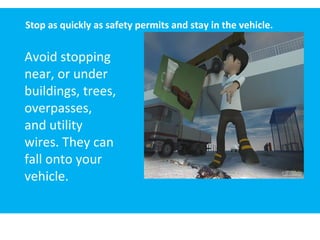
Stop as quickly as safety permits and stay in the vehicle.
Avoid stopping
near, or under
buildings, trees,
overpasses,
and utility
wires. They can
fall onto your
vehicle.
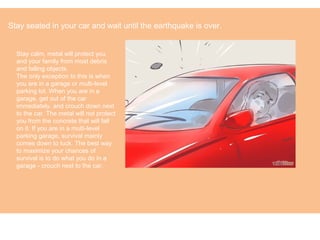
Stay calm, metal will protect you
and your family from most debris
and falling objects.
The only exception to this is when
you are in a garage or multi-level
parking lot. When you are in a
garage, get out of the car
immediately, and crouch down next
to the car. The metal will not protect
you from the concrete that will fall
on it. If you are in a multi-level
parking garage, survival mainly
comes down to luck. The best way
to maximize your chances of
survival is to do what you do in a
garage - crouch next to the car.
Stay seated in your car and wait until the earthquake is over.
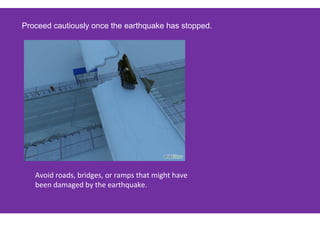
Proceed cautiously once the earthquake has stopped.
Avoid roads, bridges, or ramps that might have
been damaged by the earthquake.
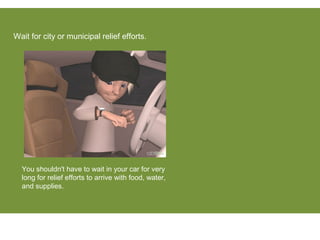
Wait for city or municipal relief efforts.
You shouldn't have to wait in your car for very
long for relief efforts to arrive with food, water,
and supplies.
If you are in a building
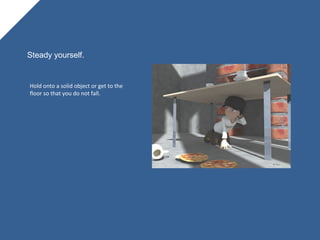
Steady yourself.
Hold onto a solid object or get to the
floor so that you do not fall.
Drop, cover, and hold.
This is the national standard for earthquake
safety in the United States. [2] The alternate
advice is to get next to a sturdy piece of
furniture so that if a wall falls, it will create a
crawl space in which you can survive. This
"triangle of life" method, however, is
inconsistent with earthquake research and not
recommended by the American Red Cross,
Structural Engineers Association of Northern
California, and Earthquake Country Alliance.
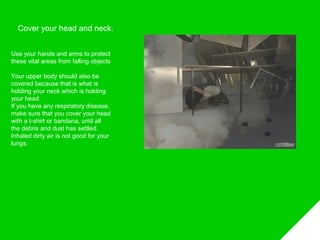
Cover your head and neck.
Use your hands and arms to protect
these vital areas from falling objects
Your upper body should also be
covered because that is what is
holding your neck which is holding
your head.
If you have any respiratory disease,
make sure that you cover your head
with a t-shirt or bandana, until all
the debris and dust has settled.
Inhaled dirty air is not good for your
lungs.
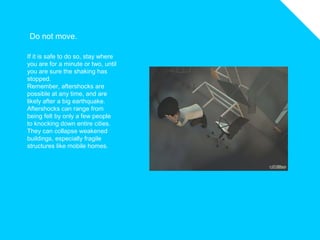
Do not move.
If it is safe to do so, stay where
you are for a minute or two, until
you are sure the shaking has
stopped.
Remember, aftershocks are
possible at any time, and are
likely after a big earthquake.
Aftershocks can range from
being felt by only a few people
to knocking down entire cities.
They can collapse weakened
buildings, especially fragile
structures like mobile homes.
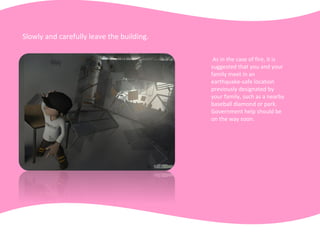
Slowly and carefully leave the building.
As in the case of fire, it is
suggested that you and your
family meet in an
earthquake-safe location
previously designated by
your family, such as a nearby
baseball diamond or park.
Government help should be
on the way soon.
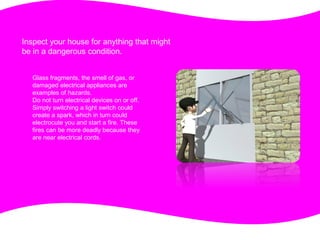
Inspect your house for anything that might
be in a dangerous condition.
Glass fragments, the smell of gas, or
damaged electrical appliances are
examples of hazards.
Do not turn electrical devices on or off.
Simply switching a light switch could
create a spark, which in turn could
electrocute you and start a fire. These
fires can be more deadly because they
are near electrical cords.
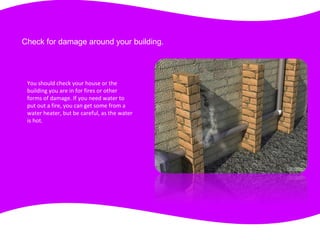
Check for damage around your building.
You should check your house or the
building you are in for fires or other
forms of damage. If you need water to
put out a fire, you can get some from a
water heater, but be careful, as the water
is hot.
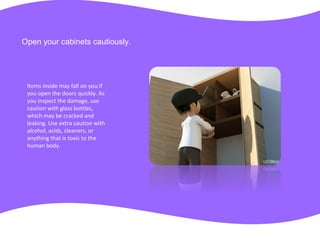
Open your cabinets cautiously.
Items inside may fall on you if
you open the doors quickly. As
you inspect the damage, use
caution with glass bottles,
which may be cracked and
leaking. Use extra caution with
alcohol, acids, cleaners, or
anything that is toxic to the
human body.
If you are Outdoors
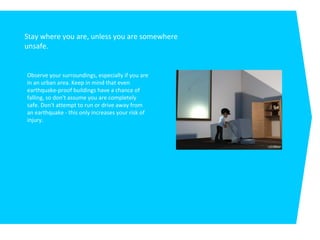
Stay where you are, unless you are somewhere
unsafe.
Observe your surroundings, especially if you are
in an urban area. Keep in mind that even
earthquake-proof buildings have a chance of
falling, so don't assume you are completely
safe. Don't attempt to run or drive away from
an earthquake - this only increases your risk of
injury.
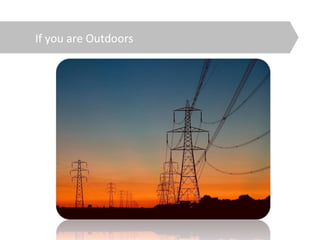
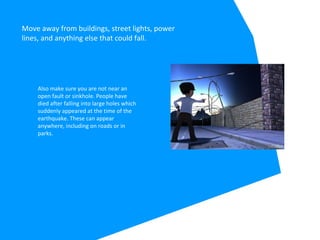
Move away from buildings, street lights, power
lines, and anything else that could fall.
Also make sure you are not near an
open fault or sinkhole. People have
died after falling into large holes which
suddenly appeared at the time of the
earthquake. These can appear
anywhere, including on roads or in
parks.
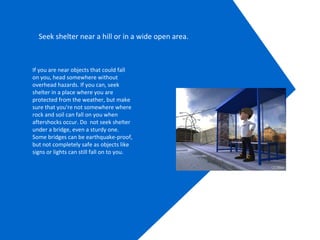
Seek shelter near a hill or in a wide open area.
If you are near objects that could fall
on you, head somewhere without
overhead hazards. If you can, seek
shelter in a place where you are
protected from the weather, but make
sure that you're not somewhere where
rock and soil can fall on you when
aftershocks occur. Do not seek shelter
under a bridge, even a sturdy one.
Some bridges can be earthquake-proof,
but not completely safe as objects like
signs or lights can still fall on to you.
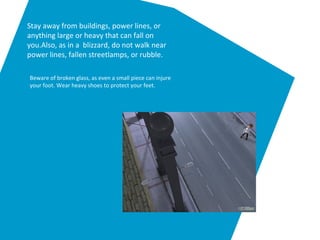
Stay away from buildings, power lines, or
anything large or heavy that can fall on
you.Also, as in a blizzard, do not walk near
power lines, fallen streetlamps, or rubble.
Beware of broken glass, as even a small piece can injure
your foot. Wear heavy shoes to protect your feet.
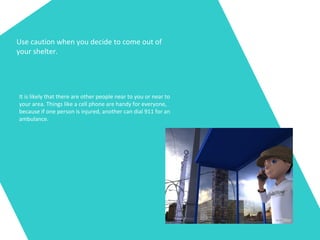
Use caution when you decide to come out of
your shelter.
It is likely that there are other people near to you or near to
your area. Things like a cell phone are handy for everyone,
because if one person is injured, another can dial 911 for an
ambulance.
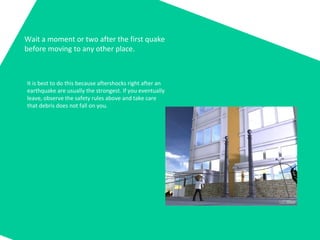
Wait a moment or two after the first quake
before moving to any other place.
It is best to do this because aftershocks right after an
earthquake are usually the strongest. If you eventually
leave, observe the safety rules above and take care
that debris does not fall on you.
Preparing for an Earthquake
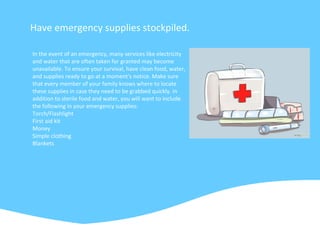
Have emergency supplies stockpiled.
In the event of an emergency, many services like electricity
and water that are often taken for granted may become
unavailable. To ensure your survival, have clean food, water,
and supplies ready to go at a moment's notice. Make sure
that every member of your family knows where to locate
these supplies in case they need to be grabbed quickly. In
addition to sterile food and water, you will want to include
the following in your emergency supplies:
Torch/Flashlight
First aid kit
Money
Simple clothing
Blankets
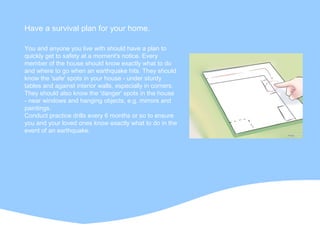
You and anyone you live with should have a plan to
quickly get to safety at a moment's notice. Every
member of the house should know exactly what to do
and where to go when an earthquake hits. They should
know the 'safe' spots in your house - under sturdy
tables and against interior walls, especially in corners.
They should also know the 'danger' spots in the house
- near windows and hanging objects, e.g. mirrors and
paintings.
Conduct practice drills every 6 months or so to ensure
you and your loved ones know exactly what to do in the
event of an earthquake.
Have a survival plan for your home.
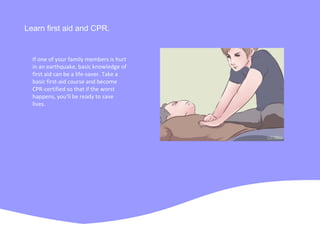
Learn first aid and CPR.
If one of your family members is hurt
in an earthquake, basic knowledge of
first aid can be a life-saver. Take a
basic first-aid course and become
CPR-certified so that if the worst
happens, you'll be ready to save
lives.
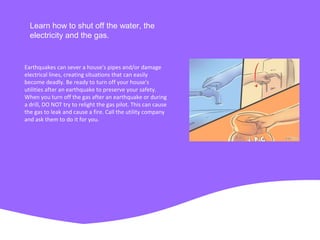
Learn how to shut off the water, the
electricity and the gas.
Earthquakes can sever a house's pipes and/or damage
electrical lines, creating situations that can easily
become deadly. Be ready to turn off your house's
utilities after an earthquake to preserve your safety.
When you turn off the gas after an earthquake or during
a drill, DO NOT try to relight the gas pilot. This can cause
the gas to leak and cause a fire. Call the utility company
and ask them to do it for you.
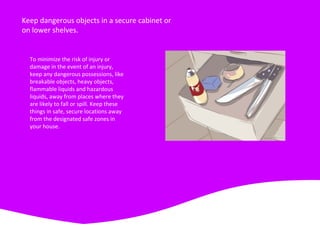
Keep dangerous objects in a secure cabinet or
on lower shelves.
To minimize the risk of injury or
damage in the event of an injury,
keep any dangerous possessions, like
breakable objects, heavy objects,
flammable liquids and hazardous
liquids, away from places where they
are likely to fall or spill. Keep these
things in safe, secure locations away
from the designated safe zones in
your house.

how to do during before and after an earthquake

  • 1.
    How to Survivean Earthquake Earthquakes are among the most destructive natural disasters. They occur mainly near the edges of tectonic plates, but they can happen just about anywhere. Earthquakes cannot be predicted, but your chances of survival are much better if you prepare in advance and you know what to do when an earthquake strikes.
  • 2.
    If you arein a vehicle
  • 3.
    Stop as quicklyas safety permits and stay in the vehicle. Avoid stopping near, or under buildings, trees, overpasses, and utility wires. They can fall onto your vehicle.
  • 4.
    Stay calm, metalwill protect you and your family from most debris and falling objects. The only exception to this is when you are in a garage or multi-level parking lot. When you are in a garage, get out of the car immediately, and crouch down next to the car. The metal will not protect you from the concrete that will fall on it. If you are in a multi-level parking garage, survival mainly comes down to luck. The best way to maximize your chances of survival is to do what you do in a garage - crouch next to the car. Stay seated in your car and wait until the earthquake is over.
  • 5.
    Proceed cautiously oncethe earthquake has stopped. Avoid roads, bridges, or ramps that might have been damaged by the earthquake.
  • 6.
    Wait for cityor municipal relief efforts. You shouldn't have to wait in your car for very long for relief efforts to arrive with food, water, and supplies.
  • 7.
    If you arein a building
  • 8.
    Steady yourself. Hold ontoa solid object or get to the floor so that you do not fall.
  • 9.
    Drop, cover, andhold. This is the national standard for earthquake safety in the United States. [2] The alternate advice is to get next to a sturdy piece of furniture so that if a wall falls, it will create a crawl space in which you can survive. This "triangle of life" method, however, is inconsistent with earthquake research and not recommended by the American Red Cross, Structural Engineers Association of Northern California, and Earthquake Country Alliance.
  • 10.
    Cover your headand neck. Use your hands and arms to protect these vital areas from falling objects Your upper body should also be covered because that is what is holding your neck which is holding your head. If you have any respiratory disease, make sure that you cover your head with a t-shirt or bandana, until all the debris and dust has settled. Inhaled dirty air is not good for your lungs.
  • 11.
    Do not move. Ifit is safe to do so, stay where you are for a minute or two, until you are sure the shaking has stopped. Remember, aftershocks are possible at any time, and are likely after a big earthquake. Aftershocks can range from being felt by only a few people to knocking down entire cities. They can collapse weakened buildings, especially fragile structures like mobile homes.
  • 12.
    Slowly and carefullyleave the building. As in the case of fire, it is suggested that you and your family meet in an earthquake-safe location previously designated by your family, such as a nearby baseball diamond or park. Government help should be on the way soon.
  • 13.
    Inspect your housefor anything that might be in a dangerous condition. Glass fragments, the smell of gas, or damaged electrical appliances are examples of hazards. Do not turn electrical devices on or off. Simply switching a light switch could create a spark, which in turn could electrocute you and start a fire. These fires can be more deadly because they are near electrical cords.
  • 14.
    Check for damagearound your building. You should check your house or the building you are in for fires or other forms of damage. If you need water to put out a fire, you can get some from a water heater, but be careful, as the water is hot.
  • 15.
    Open your cabinetscautiously. Items inside may fall on you if you open the doors quickly. As you inspect the damage, use caution with glass bottles, which may be cracked and leaking. Use extra caution with alcohol, acids, cleaners, or anything that is toxic to the human body.
  • 16.
    If you areOutdoors
  • 17.
    Stay where youare, unless you are somewhere unsafe. Observe your surroundings, especially if you are in an urban area. Keep in mind that even earthquake-proof buildings have a chance of falling, so don't assume you are completely safe. Don't attempt to run or drive away from an earthquake - this only increases your risk of injury.
  • 18.
    Move away frombuildings, street lights, power lines, and anything else that could fall. Also make sure you are not near an open fault or sinkhole. People have died after falling into large holes which suddenly appeared at the time of the earthquake. These can appear anywhere, including on roads or in parks.
  • 19.
    Seek shelter neara hill or in a wide open area. If you are near objects that could fall on you, head somewhere without overhead hazards. If you can, seek shelter in a place where you are protected from the weather, but make sure that you're not somewhere where rock and soil can fall on you when aftershocks occur. Do not seek shelter under a bridge, even a sturdy one. Some bridges can be earthquake-proof, but not completely safe as objects like signs or lights can still fall on to you.
  • 20.
    Stay away frombuildings, power lines, or anything large or heavy that can fall on you.Also, as in a blizzard, do not walk near power lines, fallen streetlamps, or rubble. Beware of broken glass, as even a small piece can injure your foot. Wear heavy shoes to protect your feet.
  • 21.
    Use caution whenyou decide to come out of your shelter. It is likely that there are other people near to you or near to your area. Things like a cell phone are handy for everyone, because if one person is injured, another can dial 911 for an ambulance.
  • 22.
    Wait a momentor two after the first quake before moving to any other place. It is best to do this because aftershocks right after an earthquake are usually the strongest. If you eventually leave, observe the safety rules above and take care that debris does not fall on you.
  • 23.
    Preparing for anEarthquake
  • 24.
    Have emergency suppliesstockpiled. In the event of an emergency, many services like electricity and water that are often taken for granted may become unavailable. To ensure your survival, have clean food, water, and supplies ready to go at a moment's notice. Make sure that every member of your family knows where to locate these supplies in case they need to be grabbed quickly. In addition to sterile food and water, you will want to include the following in your emergency supplies: Torch/Flashlight First aid kit Money Simple clothing Blankets
  • 25.
    You and anyoneyou live with should have a plan to quickly get to safety at a moment's notice. Every member of the house should know exactly what to do and where to go when an earthquake hits. They should know the 'safe' spots in your house - under sturdy tables and against interior walls, especially in corners. They should also know the 'danger' spots in the house - near windows and hanging objects, e.g. mirrors and paintings. Conduct practice drills every 6 months or so to ensure you and your loved ones know exactly what to do in the event of an earthquake. Have a survival plan for your home.
  • 26.
    Learn first aidand CPR. If one of your family members is hurt in an earthquake, basic knowledge of first aid can be a life-saver. Take a basic first-aid course and become CPR-certified so that if the worst happens, you'll be ready to save lives.
  • 27.
    Learn how toshut off the water, the electricity and the gas. Earthquakes can sever a house's pipes and/or damage electrical lines, creating situations that can easily become deadly. Be ready to turn off your house's utilities after an earthquake to preserve your safety. When you turn off the gas after an earthquake or during a drill, DO NOT try to relight the gas pilot. This can cause the gas to leak and cause a fire. Call the utility company and ask them to do it for you.
  • 28.
    Keep dangerous objectsin a secure cabinet or on lower shelves. To minimize the risk of injury or damage in the event of an injury, keep any dangerous possessions, like breakable objects, heavy objects, flammable liquids and hazardous liquids, away from places where they are likely to fall or spill. Keep these things in safe, secure locations away from the designated safe zones in your house.