Earthquake
By
Prof. S.S.Naik
Earthquake
• Vibrations induced in the earth’s crust due to
internal or external causes that virtually shake
up a part of crust and all structure and living
and non-living things existing on it
Prepared by Prof S.S.Naik GHRIEMJ
Seismology
• The science dealing with the study of earthquake
in all their aspects
• Anything related to an earthquake such as waves,
intensity etc
Prepared by Prof S.S.Naik GHRIEMJ
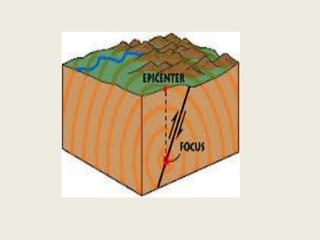
Focus Or Hypocenter
• Due to some disturbance of displacement in
rocks at some depth below surface of earth
• Place or point of origin of an earthquake
below the surface of earth
• Focus signifies a zone rather than point of
origin
Prepared by Prof S.S.Naik GHRIEMJ
Epicenter
• The point or place on surface vertically above
focus of particular earthquake
• Vibrations from particular earthquake reach
first of all
Prepared by Prof S.S.Naik GHRIEMJ
Seismic Waves
• During Earthquake elastic waves are generated
at focus
• Travel in all directions with their characteristics
velocity
• There are three main types of Seismic Waves
Prepared by Prof S.S.Naik GHRIEMJ
P-Waves
• Also called primary waves, push and pull
waves, longitudinal waves
• These are the fastest seismic wave and
longitudinal character
Prepared by Prof S.S.Naik GHRIEMJ
S-Waves
• Also called secondary waves, shear waves,
transverse waves or distortional waves
• Theses waves are transverse character like
light waves and slow as compared to P-waves
Prepared by Prof S.S.Naik GHRIEMJ
L-Waves
• Also called long waves, surface waves
• Their journey is confined mainly to near
surface of the earth
• Comparatively slow only after arrival of P & S
waves
Prepared by Prof S.S.Naik GHRIEMJ
Magnitude
• Rating of an earthquake on the basis of
amplitude of seismic waves recorded as
seismograms
1. Nature of shock
2. Nature of rocks
Prepared by Prof S.S.Naik GHRIEMJ
Classification of Earthquakes
• Depth of focus as basis –
a. Shallow earthquakes of depth of focus lies up to
60 km below surface
b. Intermediate earthquake between 60 to 300 km
below surface
c. Deep seated earthquakes between 300 to
700km
Prepared by Prof S.S.Naik GHRIEMJ
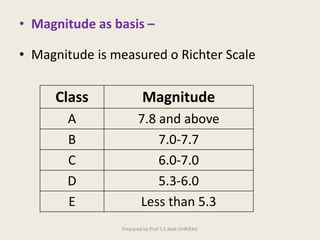
• Magnitude as basis –
• Magnitude is measured o Richter Scale
Class Magnitude
A 7.8 and above
B 7.0-7.7
C 6.0-7.0
D 5.3-6.0
E Less than 5.3
Prepared by Prof S.S.Naik GHRIEMJ
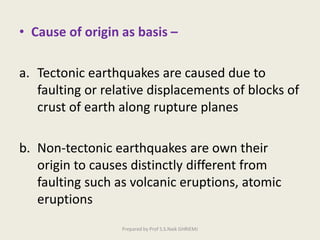
• Cause of origin as basis –
a. Tectonic earthquakes are caused due to
faulting or relative displacements of blocks of
crust of earth along rupture planes
b. Non-tectonic earthquakes are own their
origin to causes distinctly different from
faulting such as volcanic eruptions, atomic
eruptions
Prepared by Prof S.S.Naik GHRIEMJ
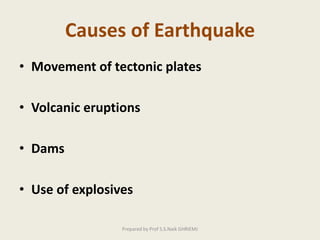
Causes of Earthquake
• Movement of tectonic plates
• Volcanic eruptions
• Dams
• Use of explosives
Prepared by Prof S.S.Naik GHRIEMJ
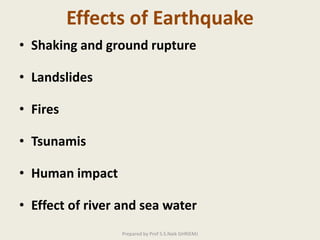
Effects of Earthquake
• Shaking and ground rupture
• Landslides
• Fires
• Tsunamis
• Human impact
• Effect of river and sea water
Prepared by Prof S.S.Naik GHRIEMJ
Earthquake Resistant Structures
• Earthquake damages structures like dam,
buildings, kills people.
• Conventional building instantly collapse
without any warning
• For safe earthquake resistance design,
provision made in various codes
Prepared by Prof S.S.Naik GHRIEMJ
i. Foundation should be provided over hard rock
with no sign of faults
ii. Building should be symmetrical and rectangular
plan
iii. Minimum 16 mm dia reinforcing bar should be
used in all structural member of RCC building
iv. Ductile material should be provided to construct
structures
Prepared by Prof S.S.Naik GHRIEMJ
THANK
YOU

Earthquake

  • 1.
  • 2.
    Earthquake • Vibrations inducedin the earth’s crust due to internal or external causes that virtually shake up a part of crust and all structure and living and non-living things existing on it Prepared by Prof S.S.Naik GHRIEMJ
  • 3.
    Seismology • The sciencedealing with the study of earthquake in all their aspects • Anything related to an earthquake such as waves, intensity etc Prepared by Prof S.S.Naik GHRIEMJ
  • 4.
    Focus Or Hypocenter •Due to some disturbance of displacement in rocks at some depth below surface of earth • Place or point of origin of an earthquake below the surface of earth • Focus signifies a zone rather than point of origin Prepared by Prof S.S.Naik GHRIEMJ
  • 6.
    Epicenter • The pointor place on surface vertically above focus of particular earthquake • Vibrations from particular earthquake reach first of all Prepared by Prof S.S.Naik GHRIEMJ
  • 7.
    Seismic Waves • DuringEarthquake elastic waves are generated at focus • Travel in all directions with their characteristics velocity • There are three main types of Seismic Waves Prepared by Prof S.S.Naik GHRIEMJ
  • 8.
    P-Waves • Also calledprimary waves, push and pull waves, longitudinal waves • These are the fastest seismic wave and longitudinal character Prepared by Prof S.S.Naik GHRIEMJ
  • 9.
    S-Waves • Also calledsecondary waves, shear waves, transverse waves or distortional waves • Theses waves are transverse character like light waves and slow as compared to P-waves Prepared by Prof S.S.Naik GHRIEMJ
  • 10.
    L-Waves • Also calledlong waves, surface waves • Their journey is confined mainly to near surface of the earth • Comparatively slow only after arrival of P & S waves Prepared by Prof S.S.Naik GHRIEMJ
  • 11.
    Magnitude • Rating ofan earthquake on the basis of amplitude of seismic waves recorded as seismograms 1. Nature of shock 2. Nature of rocks Prepared by Prof S.S.Naik GHRIEMJ
  • 12.
    Classification of Earthquakes •Depth of focus as basis – a. Shallow earthquakes of depth of focus lies up to 60 km below surface b. Intermediate earthquake between 60 to 300 km below surface c. Deep seated earthquakes between 300 to 700km Prepared by Prof S.S.Naik GHRIEMJ
  • 13.
    • Magnitude asbasis – • Magnitude is measured o Richter Scale Class Magnitude A 7.8 and above B 7.0-7.7 C 6.0-7.0 D 5.3-6.0 E Less than 5.3 Prepared by Prof S.S.Naik GHRIEMJ
  • 14.
    • Cause oforigin as basis – a. Tectonic earthquakes are caused due to faulting or relative displacements of blocks of crust of earth along rupture planes b. Non-tectonic earthquakes are own their origin to causes distinctly different from faulting such as volcanic eruptions, atomic eruptions Prepared by Prof S.S.Naik GHRIEMJ
  • 15.
    Causes of Earthquake •Movement of tectonic plates • Volcanic eruptions • Dams • Use of explosives Prepared by Prof S.S.Naik GHRIEMJ
  • 16.
    Effects of Earthquake •Shaking and ground rupture • Landslides • Fires • Tsunamis • Human impact • Effect of river and sea water Prepared by Prof S.S.Naik GHRIEMJ
  • 17.
    Earthquake Resistant Structures •Earthquake damages structures like dam, buildings, kills people. • Conventional building instantly collapse without any warning • For safe earthquake resistance design, provision made in various codes Prepared by Prof S.S.Naik GHRIEMJ
  • 18.
    i. Foundation shouldbe provided over hard rock with no sign of faults ii. Building should be symmetrical and rectangular plan iii. Minimum 16 mm dia reinforcing bar should be used in all structural member of RCC building iv. Ductile material should be provided to construct structures Prepared by Prof S.S.Naik GHRIEMJ
  • 19.
    Prepared by ProfS.S.Naik GHRIEMJ THANK YOU