
Earthquake Terminology
Causes earthquakes
Tsunami
Earthquake-proofing
Er. Ramprasad Kumawat
(M.Tech.)
DEPARTMENT OF
CIVIL ENGINEERING
Earthquake Terminology
• Epicenter:
• It is the point on the (free) surface of the earth
vertically above the place of origin (hypocenter)
of an earthquake. This point is expressed by its
geographical latitude and longitude.
• Hypocenter or Focus:
• It is the point within the earth from where seismic
waves originate. Focal depth is the vertical
distance between the hypocenter and epicenter.
• Magnitude:
• It is the quantity to measure the size of an
earthquake in terms of its energy and is
independent of the place of the observation.
• Richter Scale:
• Magnitude is measured on the basis of ground
motion recorded by an instrument and
applying standard correction for the epicentral
distance from recording station. It is linearly
related to the logarithm of amount of energy
released by an earthquake and expressed in
Richter Scale.
• Intensity:
• It is the rating of the effects of an earthquake at
a particular place based on the observations of
the affected areas, using a descriptive scale
like Modified Mercalli Scale.
Classification of earthquakes
Slight Magnitude upto 4.9 on the Richter Scale.
Moderate
Magnitude 5.0 to 6.9
Great
Magnitude 7.0 to 7.9
very Great
Magnitude 8.0 and more
What causes earthquakes?
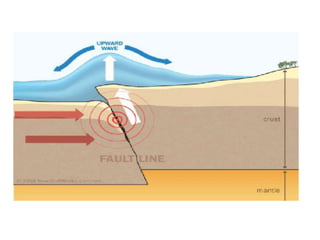
• Earthquakes are caused by faulting, a sudden
lateral or vertical movement of rock along a
rupture (break) surface.
• Earthquakes are caused by tectonic movements
in the Earth's crust. The main cause is that
when tectonic plates, one rides over the other,
causing progeny collide (mountain building),
earthquakes.
• The surface of the Earth is in continuous slow
motion.
• This is plate tectonics--the motion of immense
rigid plates at the surface of the Earth in
response to flow of rock within the Earth.
• The plates cover the entire surface of the
globe. Since they are all moving they rub
against each other in some places, sink beneath
each other in others or spread apart from each
other .
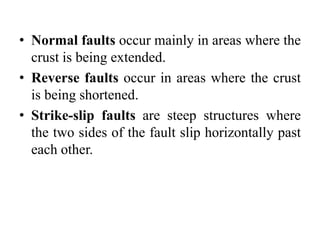
• At such places the motion isn't smooth--the
plates are stuck together at the edges but the
rest of each plate is continuing to move, so the
rocks along the edges are distorted (what we
call "strain").
• As the motion continues, the strain builds up to
the point where the rock cannot withstand any
more bending.
• With a lurch, the rock breaks and the two sides
move. An earthquake is the shaking that
radiates out from the breaking rock.
Earthquake fault types
• There are three main types of geological
fault that may cause an earthquake:
• Normal,
• Reverse (thrust) and
• Strike-slip
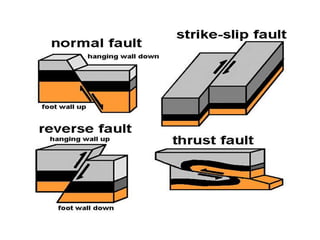
• Normal faults occur mainly in areas where the
crust is being extended.
• Reverse faults occur in areas where the crust
is being shortened.
• Strike-slip faults are steep structures where
the two sides of the fault slip horizontally past
each other.
Tsunami
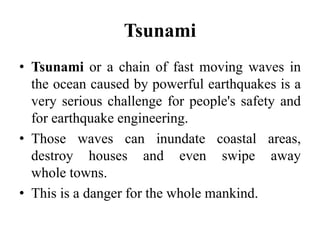
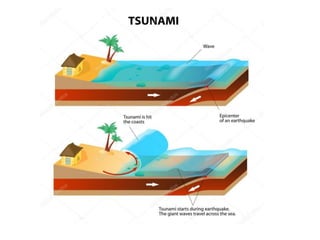
• Tsunami or a chain of fast moving waves in
the ocean caused by powerful earthquakes is a
very serious challenge for people's safety and
for earthquake engineering.
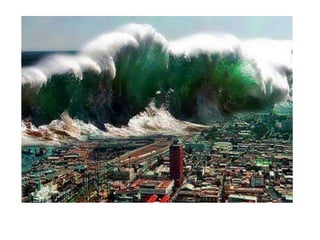
• Those waves can inundate coastal areas,
destroy houses and even swipe away
whole towns.
• This is a danger for the whole mankind.
Earthquake-proofing
• Some places, such as Japan or California, have
many earthquakes and many inhabitants.
There, it is good practice to
construct houses and other buildings which
will resist collapse in an earthquake. This is
called seismic design or "earthquake-
proofing".
• Earthquake-proof buildings are constructed to
withstand the destructive force of an
earthquake.
• This depends upon its type of construction,
shape, mass distribution, and rigidity. Different
combinations are used.
• Square, rectangular, and shell-shaped buildings
can withstand earthquakes better
than skyscrapers.
• To reduce stress, a building's ground floor can
be supported by extremely rigid, hollow
columns, while the rest of the building is
supported by flexible columns inside the
hollow columns.
• Another method is to use rollers or rubber pads
to separate the base columns from the ground,
allowing the columns to shake parallel to each
other during an earthquake.
• To help prevent a roof from collapsing,
builders make the roof out of light-weight
materials.
• Outdoor walls are made with stronger and
more reinforced materials such as steel
or reinforced concrete.
• During an earthquake flexible windows may
help hold the windows together so they don’t
break.
• Email : ramkumawat001@gmail.com
THANKS!

Earthquake Terminology & causes

  • 1.
    Earthquake Terminology Causes earthquakes Tsunami Earthquake-proofing Er.Ramprasad Kumawat (M.Tech.) DEPARTMENT OF CIVIL ENGINEERING
  • 2.
    Earthquake Terminology • Epicenter: •It is the point on the (free) surface of the earth vertically above the place of origin (hypocenter) of an earthquake. This point is expressed by its geographical latitude and longitude. • Hypocenter or Focus: • It is the point within the earth from where seismic waves originate. Focal depth is the vertical distance between the hypocenter and epicenter.
  • 3.
    • Magnitude: • Itis the quantity to measure the size of an earthquake in terms of its energy and is independent of the place of the observation.
  • 4.
    • Richter Scale: •Magnitude is measured on the basis of ground motion recorded by an instrument and applying standard correction for the epicentral distance from recording station. It is linearly related to the logarithm of amount of energy released by an earthquake and expressed in Richter Scale.
  • 5.
    • Intensity: • Itis the rating of the effects of an earthquake at a particular place based on the observations of the affected areas, using a descriptive scale like Modified Mercalli Scale.
  • 6.
    Classification of earthquakes SlightMagnitude upto 4.9 on the Richter Scale. Moderate Magnitude 5.0 to 6.9 Great Magnitude 7.0 to 7.9 very Great Magnitude 8.0 and more
  • 7.
    What causes earthquakes? •Earthquakes are caused by faulting, a sudden lateral or vertical movement of rock along a rupture (break) surface. • Earthquakes are caused by tectonic movements in the Earth's crust. The main cause is that when tectonic plates, one rides over the other, causing progeny collide (mountain building), earthquakes.
  • 8.
    • The surfaceof the Earth is in continuous slow motion. • This is plate tectonics--the motion of immense rigid plates at the surface of the Earth in response to flow of rock within the Earth. • The plates cover the entire surface of the globe. Since they are all moving they rub against each other in some places, sink beneath each other in others or spread apart from each other .
  • 9.
    • At suchplaces the motion isn't smooth--the plates are stuck together at the edges but the rest of each plate is continuing to move, so the rocks along the edges are distorted (what we call "strain"). • As the motion continues, the strain builds up to the point where the rock cannot withstand any more bending. • With a lurch, the rock breaks and the two sides move. An earthquake is the shaking that radiates out from the breaking rock.
  • 10.
    Earthquake fault types •There are three main types of geological fault that may cause an earthquake: • Normal, • Reverse (thrust) and • Strike-slip
  • 11.
    • Normal faultsoccur mainly in areas where the crust is being extended. • Reverse faults occur in areas where the crust is being shortened. • Strike-slip faults are steep structures where the two sides of the fault slip horizontally past each other.
  • 14.
    Tsunami • Tsunami ora chain of fast moving waves in the ocean caused by powerful earthquakes is a very serious challenge for people's safety and for earthquake engineering. • Those waves can inundate coastal areas, destroy houses and even swipe away whole towns. • This is a danger for the whole mankind.
  • 18.
    Earthquake-proofing • Some places,such as Japan or California, have many earthquakes and many inhabitants. There, it is good practice to construct houses and other buildings which will resist collapse in an earthquake. This is called seismic design or "earthquake- proofing".
  • 19.
    • Earthquake-proof buildingsare constructed to withstand the destructive force of an earthquake. • This depends upon its type of construction, shape, mass distribution, and rigidity. Different combinations are used. • Square, rectangular, and shell-shaped buildings can withstand earthquakes better than skyscrapers.
  • 20.
    • To reducestress, a building's ground floor can be supported by extremely rigid, hollow columns, while the rest of the building is supported by flexible columns inside the hollow columns. • Another method is to use rollers or rubber pads to separate the base columns from the ground, allowing the columns to shake parallel to each other during an earthquake.
  • 21.
    • To helpprevent a roof from collapsing, builders make the roof out of light-weight materials. • Outdoor walls are made with stronger and more reinforced materials such as steel or reinforced concrete. • During an earthquake flexible windows may help hold the windows together so they don’t break.
  • 22.
    • Email :ramkumawat001@gmail.com THANKS!